On one of the blogs I regularly follow, I saw this test so had to take it.
http://www.easydamus.com/character.html
warning, it is long.
As far as character...
I Am A: True Neutral Dwarf Bard/Wizard (2nd/1st Level)
Ability Scores:
Strength-11
Dexterity-9
Constitution-12
Intelligence-13
Wisdom-15
Charisma-12
Alignment:
True Neutral A true neutral character does what seems to be a good idea. He doesn't feel strongly one way or the other when it comes to good vs. evil or law vs. chaos. Most true neutral characters exhibit a lack of conviction or bias rather than a commitment to neutrality. Such a character thinks of good as better than evil after all, he would rather have good neighbors and rulers than evil ones. Still, he's not personally committed to upholding good in any abstract or universal way. Some true neutral characters, on the other hand, commit themselves philosophically to neutrality. They see good, evil, law, and chaos as prejudices and dangerous extremes. They advocate the middle way of neutrality as the best, most balanced road in the long run. True neutral is the best alignment you can be because it means you act naturally, without prejudice or compulsion. However, true neutral can be a dangerous alignment when it represents apathy, indifference, and a lack of conviction.
Race:
Dwarves are known for their skill in warfare, their ability to withstand physical and magical punishment, their hard work, and their capacity for drinking ale. Dwarves are slow to jest and suspicious of strangers, but they are generous to those who earn their trust. They stand just 4 to 4.5 feet tall, but are broad and compactly built, almost as wide as they are tall. Dwarven men value their beards highly.
Primary Class:
Bards often serve as negotiators, messengers, scouts, and spies. They love to accompany heroes (and villains) to witness heroic (or villainous) deeds firsthand, since a bard who can tell a story from personal experience earns renown among his fellows. A bard casts arcane spells without any advance preparation, much like a sorcerer. Bards also share some specialized skills with rogues, and their knowledge of item lore is nearly unmatched. A high Charisma score allows a bard to cast high-level spells.
Secondary Class:
Wizards are arcane spellcasters who depend on intensive study to create their magic. To wizards, magic is not a talent but a difficult, rewarding art. When they are prepared for battle, wizards can use their spells to devastating effect. When caught by surprise, they are vulnerable. The wizard's strength is her spells, everything else is secondary. She learns new spells as she experiments and grows in experience, and she can also learn them from other wizards. In addition, over time a wizard learns to manipulate her spells so they go farther, work better, or are improved in some other way. A wizard can call a familiar- a small, magical, animal companion that serves her. With a high Intelligence, wizards are capable of casting very high levels of spells.
Find out What Kind of Dungeons and Dragons Character Would You Be?, courtesy of Easydamus (e-mail)
Wednesday, November 16, 2011


Tuesday, November 15, 2011
At the Queen's Command for Free At Amazon
While I will be purchasing books in physical format for some time to come, due to great deals at various markets or through Half-Priced books, or simply when the format is not available in another format, I'm always pleased when e-books provide readers with reasons to check them out. In this casse, At the Queen's Command: The First Book of the Crown Colonies, by Michael A. Stackpole is available in Kindle format for the princely sum of zero.
http://www.amazon.com/At-Queens-Command-Colonies-ebook/dp/B0046LVDKA/ref=ntt_at_ep_edition_2_1?ie=UTF8&m=AG56TWVU5XWC2
I find these types of bargains, where the first book in a series is reduced or even free, or the first book by a new author, to be an excellent way to provide new readers to that authors work with an introduction to the work without fear of investment. Well, outside of time.
I hope to see more authors doing this and seeing older works continue to go down and more variety in sales as Amazon and it's new Fire tablet continue to work the market.
http://www.amazon.com/At-Queens-Command-Colonies-ebook/dp/B0046LVDKA/ref=ntt_at_ep_edition_2_1?ie=UTF8&m=AG56TWVU5XWC2
I find these types of bargains, where the first book in a series is reduced or even free, or the first book by a new author, to be an excellent way to provide new readers to that authors work with an introduction to the work without fear of investment. Well, outside of time.
I hope to see more authors doing this and seeing older works continue to go down and more variety in sales as Amazon and it's new Fire tablet continue to work the market.
Monday, November 14, 2011
Joe Abercrombie's The Heroes For $1.99!
I have a few posts where I discuss some of Joe Abercrombie's work and well, if you are interested in getting his latest in e-format, Amazon has The Heroes for $1.99. It's not my favorite of his works but there was enough in there for me to post a few things about it and well, it's the price of a cup of coffee at Star Bucks.
Sunday, November 13, 2011
When Art Attacks


I'm certainly not saying that the two have any relation to each other, the one being a Frank piece and the other a more recent artist, but the pose certainly seems iconic in and of itself.
Lawrence Watt-Evans The Sword of Bheleu

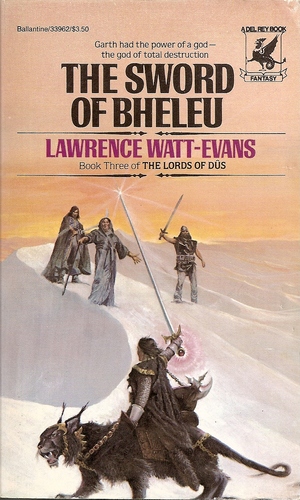
I have finished The Sword of Bheleu, a relic from the dark era known as the 80's or that specific time known as the early 80's. The books are still available in both print and in electronic format so those interested in some old fashioned sword and sorcery books might want to check them out. This volume at least, was well worth the read.
Below I'll be discussing some of the bits in the book that I enjoyed and how I might try and bring some of those elements to my game, as well as somethings that I would try to be aware of before bringing them to my game.
First, when looking at material like the Sword of Bheleu, it's important to keep in mind the different purposes between fiction and gaming material. Much like Elric and his famous sword, Stormbringer, or King Arthur and his blade, Excalibur, these characters and events are not written with anything resembling 'balance' or 'realism' in mind. There are ways and methods to overcome these individuals and they are not invincible, but the needs of fiction pit them against a few select enemies while a standard dungeon crawl might pit players against dozens who would be powerless against such might.
And if that's what your game is going for, a throw the game balance out the window thing, that's fine. Because in such situations, it often works both ways.
For example, Elric's sword, as awesome as it is, has a whole host of enemies that its ineffective against that Elric rarely meets. A player on the other hand with a soul sucking blade might find himself fighting a lot more constructs and elements and traps. Garth the Overman, finds he's got two choices in this book. The first is to accept that he is indeed the avatar of the god of destruction and will rain death on the world for thirty years, or give in to the King in Yellow. Neither one appeals to him, but he hopes he'll be able to work out something to his satisfaction with the King in Yellow. In a standard role playing game, if Garth decided to just keep on his marry way, he'd probably become an NPC.
Interestingly enough, I recently picked up a PDF copy of something called Fourthcore Alphabet. The whole idea of Fourthcore seems a bit supported in this in that there are high risks and high rewards that go beyond the standard balanced encounters and in many ways, remind me of the older editions of the game where one, at a fairly low to mid level, might encounter a weapon like Black Razor in an adventure as opposed to 3rd and 4th editions where most items are good in what they do, but rarely bring the awe to the game that earlier editions did. Game balance in this instance is great in terms of easily designing scenarios and encounters but terrible an encompassing some of the non-tangible elements of game play.
Another interesting thing Lawrence Watt-Evans does here, is provide the viewpoint of Garth's enemies, a council of mages. It's interesting because in previous adventures that have been recaptured here quickly, the council is catching up to events from an outsider's viewpoint. While some might be upset at what could be perceived as a waste of pages telling us things from a different perspective, I found it interesting and as a Game Master, a reminder that the world is not one big vast network where everyone knows everything that goes on.
In some instances, this should be a boon for players when they are at the center of events. If players see a king, baron, or other noble taken down and have first hand information on how things actually went down, they may be able to husband this information into deals behind the scenes latter. If they are actually the cause of some news, they may have a limited time to work things out before their adventurers become well known. While many campaign settings do have some magical means of communication, in default sword and sorcery settings, or settings like 4th edition's Points of Light, communication is dangerous and takes time. This should give the players time to engage in other acts.
Am I saying that players should be able to do anything they want with never fear of repercussion? No. But without things like telephones, the internet, or some other method of world wide communication and perhaps more importantly, visual recording, players would probably have a lot more leeway than the Game Master might initially think about. Even in a large fantasy city broken down by wards, the people in a rich ward might know nothing of the murder of the Beggar King in a lower ward by a group of vagrant adventurers.
Another break against common fantasy elements, is that Garth, as an overman, is of a created race, and while that creation happened thousands of years ago, the creator is known and it's essentially an established fact. Most games hem and haw about race creation, pointing out to the very roots of time and the gods involved with such things. Not so here. Its a change of pace from the standard methods of showcasing how ancient and vast a race is.
The Sword of Bheleu, while the third in the series, and doesn't end in a spot I'm happy with as a reader, is fairly self contained and easy to get into. Those looking for magic items with outrageous powers and an author not afraid to chop up his setting should check it out.
Sunday, November 6, 2011
The Sword of Bheleu by Lawrence Watt-Evans
Written by Lawrence Watt-Evans, the Sword of Bheleu is apparently the third in a series. This is another one of those novels that I picked up for $1.00 at Half Priced books. Hell, maybe I had a coupon and picked it up for eighty cents or something.
The interesting thing is that at the time of its printing, it was $2.50. Yeah, inflation in a specific field gone wild again eh? More interesting to me, is that at Amazon, you can buy it in ebook format for $5.59 which to me is a little overpriced considering the original cover price but not horrible.
Knowing nothing of the series, the author, or what happens after, as I'm still reading it, but I'm going to hit some spoilers below.
First off, the book is sword and sorcerer. Magic is fairly rare but those who have it tend to be powerful. Magic items are also fairly rare, and in this case, while we have a few of the standards, like the crystal ball, the Sword of Bheleu itself turns out to be a major artifact, effectively making the user a avatar of the god of destruction. This isn't a one way ticket though. Indeed, the sword often compels its user to destroy, to attack, to kill. this is often indicated by the massive ruby on the hilt of this two-handed bad boy glowing with an inner fire. A great visual cue but if you're playing the prototypical dumb fighter, all the visual cues in the world aren't going to help.
The sword is also a bit of old school in that it seems it can do many things. For example, when the wielder, Garth, is spied upon with a crystal ball, his connection to the got of destruction travels back on that feed and destroys the crystal ball. Garth can also use the weapon to set fire to buildings, to burn through stone itself. This doesn't count that others don't seem to be able to use the weapon without suffering massive burns and wind up dropping it.
By not pinning everything the sword does, the author provides himself some space in which to use the sword for different elements. One of the terrible things that third edition started, and fourth edition fully embraced and has been struggling to get back ever since, is removed the magic from magic items. I haven't played a lot of 4e lately and I know that some others, like the Fourthcore group, have also tried to bring some of the magic back to the magic so to speak. Damn shame that it ever got that far to begin with.
Anyway...
Another interesting aspect of the book is that Garth isn't human, he's what's called an overman, humanoid but physically better than a human. The problem is that the overmen lost the Racial Wars that happened some odd three hundred years ago. Turns out that like orcs and some other humanoids, while they may be great independent fighters, they are terrible fighters when it comes to war as they are not great social creatures, each too headstrong and independent to do any group warfare that doesn't involve a numerous commanders involved with many levels of the soldiers. Their home life structure isn't that great either, they essentially borrow the idea of marriage to provide some stability to their lives.
I like this factor because it provides the overmen some character and showcases why they are where they are when I read this book. It's not some nine hundred page beast that I feel compelled to read because it's trying to teach me history. Rather, it's a quick sword and sorcery romp that showcases bad things happen and sometimes, more bad things happen. Heck, I think Rolemaster old versions may even have something similar to this guy. I know that they had High Men, which were essentially homages to Strider's people, but I think they had something even bigger and stronger and with even fewer background points in one of their series of companions.
In addition, it gives me some ideas as to why elves and dwarves and other long lived races don't rule the world. They're just not able to compete with humanity. It's not that elves aren't the best archers, rangers, or masters of magic. It's just that they're so tied up in their own thing they never think, "Man, these humans are going to take it all over." For the dwarves, they might have so much going on in their various book of grudges, that they don't necessarily care that humans are taking over until those humans get into the book of grudges themselves, and because humanity at least if often allied to dwarves, the dwarves are only worried about specific humans to hunt down. The decline of their race isn't something directly attributed to humans often, but rather to their many numerous other enemies ranging, at least in say, Warhammer, to goblins, trolls, orcs and Skaven, to even chaos dwarves. Humans may provide worthy foes, a few may even go into the book, but for the most part, allies and trade partners.
Speaking of those bad things, in that war three hundred years ago, when the overmen lost, they got some bad terms. But interestingly enough, the garrison, the town, the fortress that provided them? Well, as Garth notes, humans have short memories and yesterday's heroes are today's useless dregs of society. The town that has its borders with the overmen is poor and feeble and easily overcome. Mind you this isn't necessarily a good thing because as I read its indicated that yeah, this was a wasting outpost but its just a part of a larger entity. Still, showcasing how decay can ease up onto these elements of society, especially those that might have been considered the most important at one part of a setting's history, are important.
The overmen have another advantage here in that they have warbeasts. These are essentially large, black massive hunting cats that, like like worgs, wargs, or dire wolves, are actually more dangerous than the overmen themselves. This makes fighting overmen even worse when they come prepared. Worse still, the beasts aren't too concerned with what they eat as at one point Garth is worried about the warbeast eating patrolling soldiers if they're not feed soon. Scary but entertaining stuff.
A third interesting factor, is the use of the King in Yellow. Now I'm not saying it's the exact character from the Mythos, but when you read a little on the author's page about the series, yeah, it's pretty much him. He comes off as a tragic character with a terrible destiny but also a little like the dude of Many Eyes and the Faceless mentors of the Twain from Fritz Lieber's various Swords Against series. Good stuff.
So, still reading, and may/may not get the ebook versions, but they're out there, the paperbacks are still out there, and there's even an omnibus edition. It's old school with a bit of a twist and well worth reading for those looking for a non-human hero with a kick ass magic weapon.
 and come on, how can you not lover a cover where the guy in the middle of these enemies isn't looking like he's going, "What, you wanna piece of this?"
The interesting thing is that at the time of its printing, it was $2.50. Yeah, inflation in a specific field gone wild again eh? More interesting to me, is that at Amazon, you can buy it in ebook format for $5.59 which to me is a little overpriced considering the original cover price but not horrible.
Knowing nothing of the series, the author, or what happens after, as I'm still reading it, but I'm going to hit some spoilers below.
First off, the book is sword and sorcerer. Magic is fairly rare but those who have it tend to be powerful. Magic items are also fairly rare, and in this case, while we have a few of the standards, like the crystal ball, the Sword of Bheleu itself turns out to be a major artifact, effectively making the user a avatar of the god of destruction. This isn't a one way ticket though. Indeed, the sword often compels its user to destroy, to attack, to kill. this is often indicated by the massive ruby on the hilt of this two-handed bad boy glowing with an inner fire. A great visual cue but if you're playing the prototypical dumb fighter, all the visual cues in the world aren't going to help.
The sword is also a bit of old school in that it seems it can do many things. For example, when the wielder, Garth, is spied upon with a crystal ball, his connection to the got of destruction travels back on that feed and destroys the crystal ball. Garth can also use the weapon to set fire to buildings, to burn through stone itself. This doesn't count that others don't seem to be able to use the weapon without suffering massive burns and wind up dropping it.
By not pinning everything the sword does, the author provides himself some space in which to use the sword for different elements. One of the terrible things that third edition started, and fourth edition fully embraced and has been struggling to get back ever since, is removed the magic from magic items. I haven't played a lot of 4e lately and I know that some others, like the Fourthcore group, have also tried to bring some of the magic back to the magic so to speak. Damn shame that it ever got that far to begin with.
Anyway...
Another interesting aspect of the book is that Garth isn't human, he's what's called an overman, humanoid but physically better than a human. The problem is that the overmen lost the Racial Wars that happened some odd three hundred years ago. Turns out that like orcs and some other humanoids, while they may be great independent fighters, they are terrible fighters when it comes to war as they are not great social creatures, each too headstrong and independent to do any group warfare that doesn't involve a numerous commanders involved with many levels of the soldiers. Their home life structure isn't that great either, they essentially borrow the idea of marriage to provide some stability to their lives.
I like this factor because it provides the overmen some character and showcases why they are where they are when I read this book. It's not some nine hundred page beast that I feel compelled to read because it's trying to teach me history. Rather, it's a quick sword and sorcery romp that showcases bad things happen and sometimes, more bad things happen. Heck, I think Rolemaster old versions may even have something similar to this guy. I know that they had High Men, which were essentially homages to Strider's people, but I think they had something even bigger and stronger and with even fewer background points in one of their series of companions.
In addition, it gives me some ideas as to why elves and dwarves and other long lived races don't rule the world. They're just not able to compete with humanity. It's not that elves aren't the best archers, rangers, or masters of magic. It's just that they're so tied up in their own thing they never think, "Man, these humans are going to take it all over." For the dwarves, they might have so much going on in their various book of grudges, that they don't necessarily care that humans are taking over until those humans get into the book of grudges themselves, and because humanity at least if often allied to dwarves, the dwarves are only worried about specific humans to hunt down. The decline of their race isn't something directly attributed to humans often, but rather to their many numerous other enemies ranging, at least in say, Warhammer, to goblins, trolls, orcs and Skaven, to even chaos dwarves. Humans may provide worthy foes, a few may even go into the book, but for the most part, allies and trade partners.
Speaking of those bad things, in that war three hundred years ago, when the overmen lost, they got some bad terms. But interestingly enough, the garrison, the town, the fortress that provided them? Well, as Garth notes, humans have short memories and yesterday's heroes are today's useless dregs of society. The town that has its borders with the overmen is poor and feeble and easily overcome. Mind you this isn't necessarily a good thing because as I read its indicated that yeah, this was a wasting outpost but its just a part of a larger entity. Still, showcasing how decay can ease up onto these elements of society, especially those that might have been considered the most important at one part of a setting's history, are important.
The overmen have another advantage here in that they have warbeasts. These are essentially large, black massive hunting cats that, like like worgs, wargs, or dire wolves, are actually more dangerous than the overmen themselves. This makes fighting overmen even worse when they come prepared. Worse still, the beasts aren't too concerned with what they eat as at one point Garth is worried about the warbeast eating patrolling soldiers if they're not feed soon. Scary but entertaining stuff.
A third interesting factor, is the use of the King in Yellow. Now I'm not saying it's the exact character from the Mythos, but when you read a little on the author's page about the series, yeah, it's pretty much him. He comes off as a tragic character with a terrible destiny but also a little like the dude of Many Eyes and the Faceless mentors of the Twain from Fritz Lieber's various Swords Against series. Good stuff.
So, still reading, and may/may not get the ebook versions, but they're out there, the paperbacks are still out there, and there's even an omnibus edition. It's old school with a bit of a twist and well worth reading for those looking for a non-human hero with a kick ass magic weapon.
Thursday, November 3, 2011
Brunner: Equipment Evolution
One of the interesting things about Brunner, the bounty hunter from the Warhammer series of books, is that unlike a lot of fantasy characters, he tends to accumulate some toys along the way.
Don't misunderstand me, there's a lot of cash he's collected. Somehow we never see him spend it. I suspect that like the manga Lone Wolf and Cub, we'll see he's been saving these coins for a very special rainy day.
But that's not what I'm talking about. I'm not even talking about how he names his large serrated cutting knife because that's what he uses to lop the heads off his bounties or his horse or his pony that he carries various items. I'm not even talking about the 'standard' weapons he starts with, which include some expensive ones like a highly polished gun that works almost every time he needs it to.
Rather, I'm talking about loot!
In one of the stories, he 'liberates' a sword from a false noble. The blade is of a special magical variety against those of chaos.
In another, he earns a repeating crossbow from an encounter with Skaven.
These items in and of their own, become a bit of a signature thing with Brunner.
This is something that happens in movies and books and comics all the time. A nifty weapon makes an appearance and then everyone wants one! Admit it, how long after the Phantom Menace came out and we saw Double Light Sabers did you see one at the game?
Signature weapons can be useful and fun if used correctly. In level based games like Rolemaster or Dungeons and Dragons, they can be a little more difficult to efficiently fit in the actual game as unless you allow the player to upgrade the item, no matter how signature the Blade of the Family Blood is, it's it's +1 +2 versus Undead and the character gets an opportunity to get a +3 weapon... well, we can all see that old blade hanging on the shelf right?
Another thing about signature weapons and items is that they may have history and significance that showcases some aspect of the character's own background. For example, some weapons may only work for individuals of a specific race or a specific family line. Others may take rites and rituals to activate. Others may just look so unique that they are known wherever they go. One of the fun things to do is allow these items to provide hooks into the game, but not dominate it.
Use and reward players with special items that fit into their own goals and background and don't forget to use them against them when the players are trying to sneak around. "The Dagger of St. McMac! No lowly acolyte would have that item! Arrest them!'
Good times.
Don't misunderstand me, there's a lot of cash he's collected. Somehow we never see him spend it. I suspect that like the manga Lone Wolf and Cub, we'll see he's been saving these coins for a very special rainy day.
But that's not what I'm talking about. I'm not even talking about how he names his large serrated cutting knife because that's what he uses to lop the heads off his bounties or his horse or his pony that he carries various items. I'm not even talking about the 'standard' weapons he starts with, which include some expensive ones like a highly polished gun that works almost every time he needs it to.
Rather, I'm talking about loot!
In one of the stories, he 'liberates' a sword from a false noble. The blade is of a special magical variety against those of chaos.
In another, he earns a repeating crossbow from an encounter with Skaven.
These items in and of their own, become a bit of a signature thing with Brunner.
This is something that happens in movies and books and comics all the time. A nifty weapon makes an appearance and then everyone wants one! Admit it, how long after the Phantom Menace came out and we saw Double Light Sabers did you see one at the game?
Signature weapons can be useful and fun if used correctly. In level based games like Rolemaster or Dungeons and Dragons, they can be a little more difficult to efficiently fit in the actual game as unless you allow the player to upgrade the item, no matter how signature the Blade of the Family Blood is, it's it's +1 +2 versus Undead and the character gets an opportunity to get a +3 weapon... well, we can all see that old blade hanging on the shelf right?
Another thing about signature weapons and items is that they may have history and significance that showcases some aspect of the character's own background. For example, some weapons may only work for individuals of a specific race or a specific family line. Others may take rites and rituals to activate. Others may just look so unique that they are known wherever they go. One of the fun things to do is allow these items to provide hooks into the game, but not dominate it.
Use and reward players with special items that fit into their own goals and background and don't forget to use them against them when the players are trying to sneak around. "The Dagger of St. McMac! No lowly acolyte would have that item! Arrest them!'
Good times.
Subscribe to:
Posts (Atom)


