Showing posts with label Almuric. Show all posts

Wednesday, October 14, 2009

A last look at Robert E. Howard's Almuric


Almuric is a rather short book by today's standards of mega multi-volume epics but it gets it done in one while leaving the setting open enough that further adventurers could have been written in the vein. Like a good campaign ending at that.
But now for some specifics and what I thought of in regards to role playing as I read this tome. Page references are from the Paizo edition.
"On the remnants of flesh were the marks of fangs, and some of the bones had been broken, apparently to get the marrow." (p.83)
The characters are not the only inhabitants of the world. They should see signs of other live on the setting all around them. On the road there should be shrines and way markers with richer countries having way stations and havens for travellers. In dungeons there should be evidence that the things that live there, unless undead or animated objects, are eating and doing their business. Make the players realize that they are moving through a world and not a passive setting.
"By Thak, it is he! Do you not remember me, Tharn Swordswinger, whose life you saved in the Hills?" (p.133)
4th edition, perhaps more so than any other edition, does not have a huge implicit love for the good factors of the game. Unaligned, not neutral or chaotic neutral or some other hinged alignment, is fairly sellf expalanatory. However, this should't necessarily be license for the players to run wild.
When they do deeds for no reward, when they help those who can't at the time help themselves, insure that these strangers mark the players as potential allies and possibly even potential friends. Have the players hear of those they've helped. Have the players develop a reputation. In a typical fantasy setting, it'll take time for players to have a reputation that goes far and wide, but make sure it's one they've earned. If played with a little heart, they'll have allies and friends in many corners of the setting as well as the enemies they've earned by helping those who could not help themselves.
"Runners were sent to the cities, to give word of what went forward. Southward we marched, four thousand men of Koth, five thousand of Khor. We moved in separate columns, for I deemed it wise to keep the tribes apart until the sigh of their oppressors should again drown tribal feelings." (p.139)
The old saying is the enemy of my enemy is my friend. I've seen this used in various pieces from the animated series Robotech with threat of alien attack to the same plot in the Watchmen graphic novel. If you have an enemy but at least know that enemy, it's better to ally with that enemy against the unknown enemy who overpowers all of you individually. In some ways it's even a good motivation to keep a party together. The members are not friendly towards one another but because of the recent changes in the campaign, they've been thrown together and have to make the best of it least they all fall.
Almuric is a quick moving book and Game Masters who want to learn from Robert E. Howard need to keep their own campaigns moving foward.

Monday, October 12, 2009

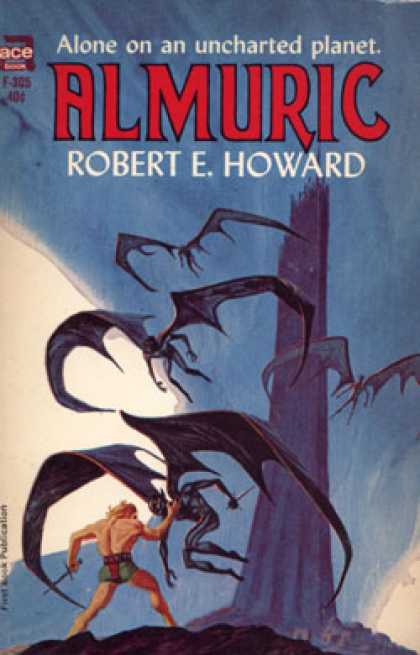
Robert E. Howard's Almuric


One of the things I love about Paizo's Planet Stories line is that it brings back a lot of material that is often hard to find in today's modern shelves of the latest fads. One of those books is Almuric, Robert E. Howard's take on the whole Planetary Romance inspired by a certain hero who went to Mars...


Below will be some quotes with some ideas of how they'd fit into one of my games and how I try to keep some things in mind when I'm gaming. Page numbers come from the 1st printing Paizo edition. Spoilers may follow so beware!


"It was chance led him there, the blind instinct of the hunted thing to find a den wherein to turn at bay." (p.15)


Often, when one door closes, another opens. If the party finds themselves overmatched, the Game Master must have a plan outside of the party runs for their lives. In some instances, whole campaigns can be built in this fashion. For example, back in the day, Orcus or Necromancer Games mentioned how he'd like to start an "Iron Tower" adventure path with the characters battling gnolls in treacherous terrain that plunges both character and monster into new venues.


Having an out that is a lead in for future adventurers provides the Game Master an opportunity that he may not need, but always has ready.


"Boss Blaine could not understand that he was dealing with a man to whom his power and wealth meant nothing." (p. 17)


This one's a little close in page numbers to the previous one and also hits on a theme I've mentioned before.


Players tend to run their characters unlike how people of those times would act. They're not real living breathing characters save to the most dedicated role player and the players are often willing to take chances with a character that any normal person would find insane. The Game Master needs to be careful that when dealing plot lines and making NPCs that none of them so motivate the players to action, that the action the players take is straight out murder that thrusts the entire party into a situation that requires either a whole new group of characters of a quick change of setting.


"The tangible and material can never be as grisly as the unknown, however perilous." (p. 22)


One of the great things about H. P. Lovecraft's work is the whole theme of the unknown. That there are things man isn't meant to know. That man is at his best, ignorant of the lowly position he has in the universe.


One of the great things about older Ravenloft material is how it would remind the Game Master to use description and details but not labels. Speak of an ogre's massive height and powerful frame, the low gleam of intelligence in it's eyes, the size of it's mammoth fists and the cruel edges to it's teeth, but do not actually call it an ogre. Players love to label things because they gain an accuracy of the enemy's strength.


By providing description without naming something though, while the Game Master is giving the players something solid and tangible to face, they still have the potential fear of the unknown. 3rd edition and 4th edition Dungeons and Dragons take this a long way too. Not only could an ogre be an ogre, it could be an ogre with some type of template or an ogre that is no mere soldier, but an elite brute.


"I made out only a dim gigantic shape, which somehow seemed infinitely longer than it was broad- out of natural proportions, somehow. It passed away up the vallye, and with its going, it was as if the night audibly expelled a gusty sight of relief." (pg. 32-33)


In addition to describing things that are tangible threats, the Game Master should be sure to include those that are simply beyond the ability of the characters at the moment. In the Stephen King novel and movie the Mist, there is a scene where the group witnessess a massive creature whose size makes the term behemoth seem too little. Showcase the awe of the setting, showcase the scope of the campaign. Allow players to note the hights and the lows even when they are not directly interferring with them.


Robert E. Howard wrote with an energy that was almost tangible to the reader. Make the players your readers and entrance them with description, but make sure that description not only leads to action, but leads to opportunity.