So after watching the Borgias and the Borgia series on Netflix, I was still in the mood for more information on the various issues in Italy. Well, the area around which the series took place as Italy as a unified state didn't exist at that time and the whole area was rife with warfare from French and Spanish, as well as numerous Italian, French, and German mercenaries.
Pavia 1525, The Climax of the Italian Wars, is written by Angus Konstam, and outside of the numerous illustrations from historical sources, utilizes the modern day talents of Graham Turner to bring to life the battles in the Italian Wars the cumulated at Pavia in 1525. Note that the cover I used here is not the latest one, but rather, the cover of the edition I personally own that at its time of publishing, ran for $19.99, but not runs for $21.95.
There are a number of interesting factors at work when looking at history.
Never Ending War: When looking at the Italian Wars, such as over on the Wiki, http://en.wikipedia.org/wiki/Italian_campaign_of_1524%E2%80%9325, you'll see that there are various 'wars'. LIke the Italian War of 1521-1526. The sack of Rome happens in 1527. War is a part of the landscape.
Names: I sometimes laugh at some of the names I see in fantasy novels, my own characters, friend's characters or other media. Historically though, such names like 'the Bastard of Savoy' or Saint-Severin (Master of the King's Horse) among others, such as Bande nere, the Black Band mercenary group.
Weather: One of the things that happen with canons and hand canons, is that they are vulnerable for a wide range of weaknesses. For example, once the canons are in place, they don't move. Mobility is not a key factor. Another thing is fog. If you can't see the enemy, you can't shoot the enemy. Another problem is rain. Wet guns and wet gunpowder do not make for good weapons.
Reversals: The French lose the battle at Pavia. The Imperials though, don't have time to take advantage of it due to the quick thinking of the mother of the French King.
Mercenaires: The Italians were known for their mercenaries. The Germans, such as the Landsknechts, and the Swiss, are all employed here. The payment, or lack of payment for these forces, provide fooder in and of itself for how things could work.
Large Campaigns, Small Campaigns: Despite the book being titles Pavia, it covers many of the other events that happened, such as 'The Storming of Mirabello", where the Imperialist troops attacked the French at the hunting lodge. This hunting lodge is described as a small castle with its own drawbridge. This would be a perfect fortification to hold back a larger group. For example, a group of players fighting against larger numbers to slow them down. Another example is when a group of French soldiers fight a group of Spanish infantry outside the small town of Binasco.
Pavia is an interesting look at a small slice of a terrible time in history and has enough odd bits between its pages to provide readers with many bits for their own games.
Showing posts with label Graham Turner. Show all posts
Saturday, March 22, 2014
Tuesday, November 2, 2010
Condottiere: More Thoughts on Mercenaries
While reading over Condottiere, one of the things I found interesting, is that part of the influx of mercenaries comes from soldiers that fought during the Hundred Years War. In your own campaigns, if there have been large battles recently, what happens to the soldiers after the wars are over? Even in today's 'modern' society, there are difficulties making sure that those who served in war time are treated right when they come home. How much harder in a society that has not the modern lifestyel or the modern thinking?
But all things turn. Even as the mercenaries rose from outside sources in Italy, they fall to outside sources that have adopted to war quicker and with more efficiency than those in Italy. The rise of national armies against divided city states proves one method superior to the other.
In terms of mercenary use, when the land is rich with them, different methodologies may crop up. Much like discussions of Democrats and Republicans in American society, these teachings tend to break into different factions and are almost politics in and of themselves. When crafting some of the background of the setting, think about some simple philosophies that different mercenary companies would follow and how they interact with each other.
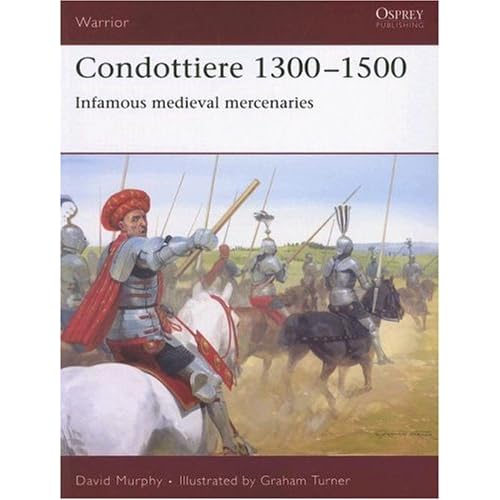
In terms of Graham Turner's art, he's good. His work lends a solid feeling that isn't fantastical but is stylized. If you like the cover, which is from the battle of San Romano, 1432, then chances are you'll enjoy the interior art by him as well.
Lastly, I'd like to mention the cover. The commander isn't wielding a sword. Instead, he's wielding a batton, an instrument to denote his rank and his leadership. In a game with magical items, something that augmented command or charisma or allowed a user to influence a large group of soldiers, wither issuing them commands, fortifying them from magical fear, or showcasing the user's own ability, would be desirable and perhaps even common to those with the funds to purchase them.
When I look at different books for ideas and inspiration, I'm also looking for different ways and methods I might use that inspiration in the first place. Of course in a historical material, there would be no magical rods of command, but it's an old school magical item and fits the theme well.
When looking at material, try to think about not only what its teaching or its original use is, but how it may beenfit in different ways than originally intended.
For example, what if the humanoid hordes are finished with their wars and instead of turning on the humans, seek out employeement with them by the thousands? Instant mercenary armies. And if what the book mentions here is true, there would be many parallels. For example, the mercenary armies were often devastating to the surrounding landscape, engaging in acts of pure carnage and rapine of both land and people. At the same time, the employers of the mercenaries were often worse, assassinating the leaders and refusing to honor the contracts that they themselves had drafted.
Now with hobgoblins, orcs, and other races doing these vile acts, the poor treatment of the employees almost seems justified eh? A few tweaks here and there and things like half-orcs and half-hobgoblins become that much easier to explain. A history of hogoblin nobles arising from their mercenary roots becomes more tangible. An integration of these races to the setting, only to have them crushed later by other national armies, becomes part of the background.
But all things turn. Even as the mercenaries rose from outside sources in Italy, they fall to outside sources that have adopted to war quicker and with more efficiency than those in Italy. The rise of national armies against divided city states proves one method superior to the other.
In terms of mercenary use, when the land is rich with them, different methodologies may crop up. Much like discussions of Democrats and Republicans in American society, these teachings tend to break into different factions and are almost politics in and of themselves. When crafting some of the background of the setting, think about some simple philosophies that different mercenary companies would follow and how they interact with each other.
In terms of Graham Turner's art, he's good. His work lends a solid feeling that isn't fantastical but is stylized. If you like the cover, which is from the battle of San Romano, 1432, then chances are you'll enjoy the interior art by him as well.
Lastly, I'd like to mention the cover. The commander isn't wielding a sword. Instead, he's wielding a batton, an instrument to denote his rank and his leadership. In a game with magical items, something that augmented command or charisma or allowed a user to influence a large group of soldiers, wither issuing them commands, fortifying them from magical fear, or showcasing the user's own ability, would be desirable and perhaps even common to those with the funds to purchase them.
When I look at different books for ideas and inspiration, I'm also looking for different ways and methods I might use that inspiration in the first place. Of course in a historical material, there would be no magical rods of command, but it's an old school magical item and fits the theme well.
When looking at material, try to think about not only what its teaching or its original use is, but how it may beenfit in different ways than originally intended.
For example, what if the humanoid hordes are finished with their wars and instead of turning on the humans, seek out employeement with them by the thousands? Instant mercenary armies. And if what the book mentions here is true, there would be many parallels. For example, the mercenary armies were often devastating to the surrounding landscape, engaging in acts of pure carnage and rapine of both land and people. At the same time, the employers of the mercenaries were often worse, assassinating the leaders and refusing to honor the contracts that they themselves had drafted.
Now with hobgoblins, orcs, and other races doing these vile acts, the poor treatment of the employees almost seems justified eh? A few tweaks here and there and things like half-orcs and half-hobgoblins become that much easier to explain. A history of hogoblin nobles arising from their mercenary roots becomes more tangible. An integration of these races to the setting, only to have them crushed later by other national armies, becomes part of the background.
Labels:
Campaigns,
Condottiere,
Game Master,
Graham Turner,
Ospery
Monday, November 1, 2010
Condottiere 1300-1500: Infamous medieval mercenaries
I wish I could say that I'm an armchair scholar. But I'm not. Way too lazy for that sort of research a lot of friends I know who can spout off bits and facts like rapid fire machine guns.
But in the modern era, when I want some information on something, I generally know where to look. For example, if I want a thin book with some, usually, great art in it, about a caste of a certain warrior type, I'm pretty sure Osprey Publishing will have it.
I've long had an interest in mercenaries on the battle field. Part of this is from the old book The White Company, part of it when I discovered Glen Cook's The Black Company, and part of it when I discovered Berserk and Griffin's Band of the Hawk. Each one organized around mercenaries.Other books, like the ones written by Elizabeth Moon, have used mercenaries,
Gaming books, ranging from AEG's own Mercenaries book to various other third party resources, like Born of Blood, have also been around. Although my memory does kick in and say, "Hey dude, the Flaming Fist." Yeah, I remember running many a Forgotten Realms campaign where the Flaming Fist were foes of the party, maily because the party memebers were always after new magic items and the quick way to get such items was to attack any NPC that might have 'em. Ah, the glory days of youth.
I haven't finished the Condotteire yet, but it made me curious enough to see what Wiki had to say on the subject. One thing I found fascinating, is that these mercenary armies, essentially in this book and resource if I'm reading it correctly, crop up to a very unique set of cirumstances. This gets into world building. When plotting out the dominos, make sure you know where things are likely to fall.
In terms of ideas, one of the things I like is the idea of a charter, so that these mercenaries can be identified and are not 'mere' mercenaries, but are condottiere.
Another idea I like is the use of famous mercenaries as statues or cast on gold coins. It doesn't always have to be a local member of the nobility, the religious caste, or some weird monster. Powerful individuals that can take a city get recognized here.
Lastly, I like the idea of collaterali. These individuals werestate official who oversaw the use of payment to the mercenaries. He was the one who oversaw the contracts. He was the one who overwent the 'daily admnistration of the mercenary armies.' Need to know how many men are in the army? Need to know what type of weapons they have? Need to know what level of training they have? Can't trust the mercenaries to be truthful so you have to have you own man on the inside job there.
And this is true today. In many instances, the stock market is a huge gamble that the goods and services these companies are offering are real. I've read many a 'bust' that happened because the promised goods weren't there. If that is happening know, where we have all of this digital technology about us, imagine how much easier it would be in a place where a famous soldier would be unknown in another country?
To prevent abuse it woudl require mercenaries that fully honored their contracts or collaterali who were so trustworthy that they'd likely be killed. I can easily see a game where a group of players, acting as collaterali, discover that the mercenaries in their lords employee are a sham but have enough strength to take down the players if they're not careful about how they go about reporting it. On the other hand, I've dealt with enough players where I can see them taking the mercenaies side and for a side cut of the gold, selling out the defense of the kingdom by falsifying units, weapons, and training that doesn't exist.
Imagine some lord's horror when the ogres attack and those mercenaries that do show up do so in ratty leather armor with spears instead of on horseback with shinny plate armor and bright lances? The players might have a little explaining to do at that point.
But in the modern era, when I want some information on something, I generally know where to look. For example, if I want a thin book with some, usually, great art in it, about a caste of a certain warrior type, I'm pretty sure Osprey Publishing will have it.
I've long had an interest in mercenaries on the battle field. Part of this is from the old book The White Company, part of it when I discovered Glen Cook's The Black Company, and part of it when I discovered Berserk and Griffin's Band of the Hawk. Each one organized around mercenaries.Other books, like the ones written by Elizabeth Moon, have used mercenaries,
Gaming books, ranging from AEG's own Mercenaries book to various other third party resources, like Born of Blood, have also been around. Although my memory does kick in and say, "Hey dude, the Flaming Fist." Yeah, I remember running many a Forgotten Realms campaign where the Flaming Fist were foes of the party, maily because the party memebers were always after new magic items and the quick way to get such items was to attack any NPC that might have 'em. Ah, the glory days of youth.
I haven't finished the Condotteire yet, but it made me curious enough to see what Wiki had to say on the subject. One thing I found fascinating, is that these mercenary armies, essentially in this book and resource if I'm reading it correctly, crop up to a very unique set of cirumstances. This gets into world building. When plotting out the dominos, make sure you know where things are likely to fall.
In terms of ideas, one of the things I like is the idea of a charter, so that these mercenaries can be identified and are not 'mere' mercenaries, but are condottiere.
Another idea I like is the use of famous mercenaries as statues or cast on gold coins. It doesn't always have to be a local member of the nobility, the religious caste, or some weird monster. Powerful individuals that can take a city get recognized here.
Lastly, I like the idea of collaterali. These individuals werestate official who oversaw the use of payment to the mercenaries. He was the one who oversaw the contracts. He was the one who overwent the 'daily admnistration of the mercenary armies.' Need to know how many men are in the army? Need to know what type of weapons they have? Need to know what level of training they have? Can't trust the mercenaries to be truthful so you have to have you own man on the inside job there.
And this is true today. In many instances, the stock market is a huge gamble that the goods and services these companies are offering are real. I've read many a 'bust' that happened because the promised goods weren't there. If that is happening know, where we have all of this digital technology about us, imagine how much easier it would be in a place where a famous soldier would be unknown in another country?
To prevent abuse it woudl require mercenaries that fully honored their contracts or collaterali who were so trustworthy that they'd likely be killed. I can easily see a game where a group of players, acting as collaterali, discover that the mercenaries in their lords employee are a sham but have enough strength to take down the players if they're not careful about how they go about reporting it. On the other hand, I've dealt with enough players where I can see them taking the mercenaies side and for a side cut of the gold, selling out the defense of the kingdom by falsifying units, weapons, and training that doesn't exist.
Imagine some lord's horror when the ogres attack and those mercenaries that do show up do so in ratty leather armor with spears instead of on horseback with shinny plate armor and bright lances? The players might have a little explaining to do at that point.
Labels:
Campaigns,
David Murphy,
Game Master,
Graham Turner,
Mercenaries,
Ospery
Subscribe to:
Posts (Atom)