Showing posts with label NPC. Show all posts

Sunday, January 4, 2015

Kundo: Age of the Rampant

I knew about Kundo from previews,  I had seen on Hulu back when it was first show in theaters in America. It looked like a solid action film but I did not get the chance to see it in the movies. While looking at various martial arts action films, I stumbled upon this on Netflix. 


Kundo is a South Korean martial arts film. The costumes and weapons are great but it feels a little long in the tooth. There are several characters but really only one main one, Dolchi, a former butcher who uses two massive clever style weapons.

Part of the problem is that the movie is too long clocking in over two hours time. In some movies that can be nothing and it can flash by in a minute. In this one, you keep waiting for the inevitable duel between Dolchi and Jo Yoon, his nemesis. 

I give Kundo, as an action film, three stars and its worth watching if you want to see all the different costumes and unique weapons.


For those who often wonder how to run a Oriental Adventurers game or Legend of the Five Rings, this would be a good 'introduction' film in that many of the issues the 'heroes', a group of bandits have with the legitimate rulers, are issues that could be common to almost any setting and almost any time period.

Here's a summary by Wiki: "it is about a power struggle between the unjust wealthy noblemen who run society and a group of righteous outlaws who steal from corrupt officials to give to the downtrodden and starving"  Is it about Robin Hood? Is it about some Solos and Net Runners in the future? It's an easy, almost too generic plot piece but it is a prime example of how people can sometimes get too involved in the 'culture' of a foreign land and forget about the basics.

In terms of gaming, it has several things going for it that make it more interesting than if you were only watching it for the action sequences.

1. Environment: One of my old favorite fight scenes is from Ninja Scroll. Our main hero, Jubei, is outfought by a blind swordsman but in a bamboo forest, the hero is able to use the forest to his advantage and claim victory.

In this movie, Jo Yoon is such a bad ass that he beats Dolchi easily several times. Even in the 'heroic' end game rematch, Jo Yoon holds the upper hand until Dolchi leads him into a bamboo forest that hinders his movements. The bamboo though, isn't brick or steel and it makes for a great sequence as they both slash through the trees and have to dodge the falling debris. 


Note that it appears that fighting in a bamboo forest is a bit of 'old school' itself for such action movies.  

2. Non-Player Character Motivation: I'm going to sound a little rambling here. Jo Yoon is the illegitimate son of a noble. He is taken out of his mother's house, a house of prostitution, and raised at home because the noble has no male heirs. Then the wife sees this and uses a variety of methods to become pregnant and gives birth to a male heir. Bad news for Jo Yoon in many ways.

First, his parents treat him as a second class citizen which causes him to act out, which causes the parents to discipline him even worse.

Then he decides, "Well, I know how to take care of this problem" and goes to suffocate his baby half brother. But when he starts to, he looks at his baby brother and realizes that he cannot do it. This could have been a turning point for him.

But he's caught by his mother-in-law and well, the punishment is sever including his birth mother killed and his personal valet crippled. These acts help explain why he's such a vile bastard and even still loyal to his own father.

His main motivation is to be the heir to the family, and it appears that when his half-brother is killed by the 'heroic bandits', that his time may have come. But the wife was pregnant. This leads to all sorts of things ranging from hiring a butcher to kill the wife, to destroying the village of the heroes, including slaughter of women and children.

At this point, Jo Yoon for some reason, brings home the rightful heir instead of just killing him. Bad idea as now his father sees the true heir and doesn't appoint Jo Yoon the position. Anyone remember the Russel Crowe movie Gladiator? Anyone remember the discussion on the Four Virtues and the claims that "I have other virtues." 

The son so wanting, so needing to be loved by his father, finally does the unthinkable and committed patricide. 

But when he turns to the child, again, Jo Yoon cannot find it in him to kill a baby. He's older now. More wicked now. More capable of even the foulest deeds. But for whatever reason, even when it puts his own life in danger, he protects the child. 

These elements make for great bits. They make Jo Yoon more 'complete' as a character if you will than the hero Dolchi who is essentially Batman looking for vengeance.

My own problem comes in in that we, the audience, known this. But no one else does. In a role playing game, the depth of the non-player characters isn't' known by the characters, or isn't accessible to the characters, say from friends of Jo Yoon, or from journals, or from some other sort of records like punishment records, then it doesn't exist anywhere but in the Game Master's Mind.

The greatest stories in the world that aren't known arent' great stories, they're not great motivations, and their not all the useful to the players.

They can cement the character for the Game Master though, and in that aspect at least, still have value.

Themes are often times universal. I've mentioned several Western films, and other forms of medium, like anime, that use the themes and scenarios painted in Kundo. When you're watching a wide variety of material, see what's cycling over and over again. See what works when it's used over and over again and pluck it out for your own use when you can.

Now I have to find another movie to kill some time! Anyone have any recommendations?

Friday, December 27, 2013

The Wire: Season One

So HBO was kind enough to bring us the Wire and after many years, I've finally watched the first season. I kept waiting for it to come out in blu-ray so I didn't have to replace it when it did come out in that format but I've had season one forever and a day.

Not seeing any blu-ray releases on the horizon, I decided screw it and watched season one. As my dear mother would say, "It's a little slow." This isn't a bash against the show mind you. It relies on multiple episodes to provide some coverage to a wide cast of characters on both the sides of the angels and the devils. And it does a good job of that.

The Wire, like many 'cop' shows, is an interesting model to view from a gamer's perspective. Well, I should say a Game Master's perspective. Players can use anything as fodder and because a lot of movies and shows are focused on the solo character, like the Wolverine or others, it can be a little more difficult for the GM to get anything out of those. The Wire though, provides a whole crew to observe and enjoy.

In that vein, I'd like to point out a few things that might be useful for a role playing game.

Omar Little: Say you have a player who can only show up when the full moon is out. Say you have a game where he likes some of the concepts, but doesn't necessarily want to run directly with the crowd because you know, he feels that since he's only there once every blue moon to being with, he wants a little room to navigate. A character like Omar Little may be perfect for him.

Omar is a criminal who finds himself in alliance with the police in season one. This works perfectly with the old adage, "The enemy of my enemy is my friend." Omar robs the criminals that the police are actively pursuing and in turn finds himself under fire for it by that aspect of the underworld including losing allies and loved ones. The police provide a legitimate method of putting the heat back on his enemies by sharing information that they might not normally have access to.

In a different vein though, Omar is a competent character who is more than capable of inflicting his own 'street justice' on those he wages war against. In his initial appearance, he is observing what the money is flowing from those he is preparing to rob. His skill with a shot gun and his ability to whistle show tunes though, giving him a bit of a catch phrase, make him more than just a resource, they make him a very possible character.

Looking at the various deeds and bits attributed to him in later seasons, I can say that for those players who don't show up that often, but want to be in the midst of things when they do, providing them with a character who is competent, who has distinctive features, like Omar's facial scar, and whistling tunes, as well as his folk town hero status, is the way to go.

Bubbles: In contrast to the competency Omar shows in dealing physical violence as well as being able to plan and plot his own methods, Bubbles is a drug addict and informant for the police who has a heart of gold. His initial turn to the police, at least in season one, is when those he is actively trying to scam catch his prodigy at it and hospitalize him.

Bubbles has his own troubles, his own arc, his own efforts at redemption, but in a gaming context, I paint them all as description feed to the players, and different descriptions at that. In terms of utility, he would be the face and the name of a skill check or a face to face with someone on the street as opposed to a character level utility.

His knowledge of life on the streets is high mind you. He provides a bird's eye view of what it's like for those with addiction and no prospects. He provides advice on making an undercover cop look more believable. He provides officers with names and faces.

But such a character might not be appropriate to play. His interaction with the main cast is almost always as an outsider. His ability to hold his own, non-existent. This aren't bad characteristics in and of themselves, but could easily be frustrating for a player, as opposed to a NPC.

The Wire provides a whole host of characters and situations in season one, and looking at the HBO site, it looks like it covers a lot of ground between season one and five. Character development with characters that aren't saints? The lives of inner city inhabitants that isn't glorified? Showcasing friends turning into executioners? It's all there and I look forward to watching the rest of the Wire real soon.

Saturday, October 26, 2013

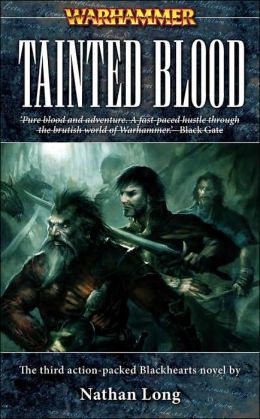
Tainted Blood by Nathan Long: The Blackhearts Omnibus book 3

Nathan Long brings the conclusion to the Blackhearts trilogy with all the flavor you'd come to expect from a good popcorn read. We have dark elves, skaven, and other vile creatures doing their best to take out the anti-heroes known as the Blackhearts whose interest isn't necessarily in saving the Empire so much as in saving their own skin.

It has a good flow for the most part and is an easy read and brings the series to a nice conclusion while at the same time leaving it open for future volumes. This novel even has the appearance of a certain high elf mage from the pages of the Warhammer tabletop version which is always a nice touch. If you're a fan of the Warhammer setting, this will be a nice novel to read over while prepping to wipe out your players.

Onward to spoilers!

One of the things I've mentioned before, is that if you're using a specific setting that has its own things that are famous and familiar to those who enjoy the setting either through video games, board games, or table top games, is that you should check the waters and see if the players enjoy it when you bring in those iconic elements.

Tainted Blood not only has the character meet the Skaven again, but learn of their lust for the dreaded Warpstone and that they are willing to try and 'fix' things when it is to their advantage. We have multiple groups of chaos worshippers trying to trust one another but due to their intrinsic nature, are easy to manipulate into fighting one another. We have Telcis, one of the most powerful magic users of the setting here.

The good news is that since this isn't a book about Telcis, but rather, one about the Blackhearts, the author does what any good author should and takes that character out of the action immediately. This allows the Blackhearts to have to strive even harder because hey, if this guy could take out that guy, what's he going to do to us?

The solution is great though in that it's one the author set up earlier in the novel with one of the thieves/assassins talking about a set up he performed where it looked like he murdered his target, but rather just had the appearance of murder and not actual death. This comes back in later and allows the characters to have a friendly ace in the hole later on and works quite well. It goes back to my thing of if the players have a great idea, let them run with it. Let their inventiveness provide success when possible. It'll make them know that you're rewarding them for it.

The other big thing? The Blackhearts are freed of their service. This does have the odd thing of "what now" though as at the end, the character don't necessarily know what their going to do with their lives and wonder if they can go back to their old profession but without the coercion this time. It's an important thing to have an end game in mind if the characters are starting out with some type of limitation.

I'm not saying the campaign has to end or anything like that mind you. But if the whole campaign revolves around killing X, if the players kill X, what then? It can be as easy as kill Y or as complex as moving onto a new campaign with new characters and new genres. Try to have an end game in mind when you start if you're putting those things in place at the start of the campaign.

Blackhearts is a nice omnibus and I haven't mentioned the two short stories included in the book which augments it's value and provides more insights into the characters and the dire situation they find themselves in as agents of the Empire. If you want to run a Dirty Dozen or Inglorious Bastards style campaign, Blackhearts by Nathan Long provides a lot of fodder for the fire.

Sunday, November 25, 2012

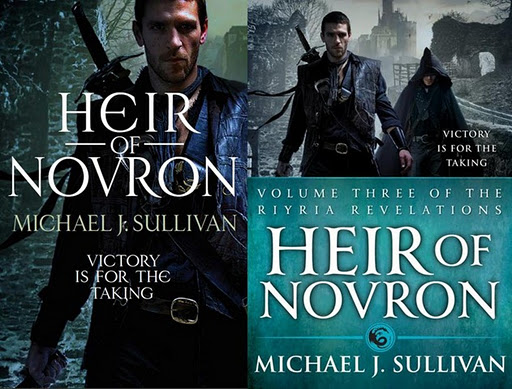
Heir of Novron by Michael J. Sullivan

The Riyria Revelations conclude in this final omnibus edition, Heir of Novron. This volume includes the two novels, Wintertide and Percepliquis.  Again, Micahel J. Sullivan's writing does not fail to impress as he weaves together numerous plot points from previous novels and ties them up.

I'll be discussing specifics from the book including spoilers so for those who want to avoid such things, read no further.

1. Elves. I mentioned previously that the elves of the setting were different. Well, the real trick is that the elves are such supreme entities that the only reason mankind wasn't wiped out was that one elf lord challenged another for control of the empire. It was a 'civilized' way of handling conflict so that many elves didn't have to fight and die. See, elf life is precious and there was no reason to do things the uncivilized way. On the other hand, the elves are so unstoppable that when it comes time to renew the challenge, they are able to take out civilization almost without trying. The music that accompanies their army for example, is so binding to humans that unless they stop their eats up, they cannot fight back. They control monsters that can only be killed with specific blades designed for that deed.

2. Deception. Sometimes those who befriend you don't really have you best interest at heart. Royce had a long time mentor who betrays him in the worst way possible because he doesn't believe Royce is worthy of a specific that was going his way. Suffice it to say that this betrayal leads to some 'bad behavior' on Royce's part as well but the whole point of someone being willing to do whatever it takes to thwart a player's designs, even if that might mean their own death, should be something that GM has in place for at least a Non-Player Character or two. Imagine a player who is about to rescue a princess when his old friend grabs her and provides a quick soliloquy that while he loves the player like a brother, this is one time he can't stand back and dives with the princess of the cliff into a volcano or something dramatic in that vein.

Sometimes the action may come as a complete surprise. Sometimes the player will have to find out from third party sources why this happened. It should always tie into the campaign. For better or worse it should be built out of the characters background stories, or better yet, out of events that happened in the campaign.

3. False History. While I appreciate how Michael J. Sullivan handles the twist here, that the savior of the empire that has enslaved elves is actually an elf himself and that the history of the whole land has been twisted to fit one madman's desires and wishes, it can be a tricky bit to handle in an established campaign setting. Pulling the veil back and telling the players, in essence, "Got You." with the background can be great fun, especially in a home brewed setting or one that the players are not intimately familiar with, but doing something like that on their own background on in an established setting with playing with setting purists can be a little more difficult. Know your audience if you're going to pull a big reveal where much of what the players know is false.

4. The Future! When the mage with no hands is killed, his cloak passes on. The wearer of the cloak starts to experience all sorts of visions and past life scenarios. Others have the ability to read the future through an individuals life line. Often times the answers aren't bold and in front but are a good method to add more information, especially if the players are stuck on something. In terms of life line reading, its also dangerous to do with elves as they tend to have very long lives and this is something that can actually lead to death if done on an elf with a very long life ahead of him.

5. The Gods! One of the father of the gods committed an unspeakable crime for which he strives to attain atonement through good deeds. Every time he does one and the act is deemed acceptable, he gains a white feather. This is something that's been mentioned several times in the series. At the end, we find out that Royce was given his special dagger and essentially his freedom from an inescapable prison because Royce would one day be very important and would have to redeem himself from his own actions. The whole theme of redemption and the very gentle hands of the god are good themes here as it doesn't put the deity as the forefront of the action and rather, act as a stepping stone to setting the characters on their own path. Good stuff.

Heir of Novron is a quick paced novel that will bring characters up and cast others down and provides a lot of inspiration for a fantasy campaign.

Saturday, October 20, 2012

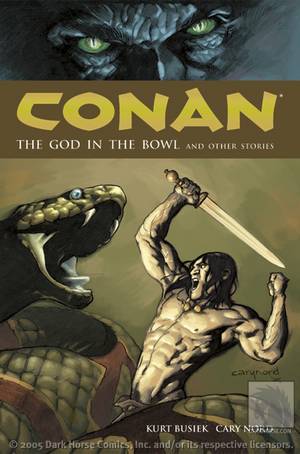
Conan: The God In The Bowl by Kurt Busiek and Cary Nord


Continuing to go through the old collection as I'm trying to organize things. Not easy as I tend to get distracted a bit too easily but nonetheless ongoing.

Conan continues his adventures in this collection of the single issues. Cary Nord does a fantastic job of illustrating the series and the colors are fantastic to view. This volume again presents stunning visuals if nothing else for any sword and sorcery campaign. Kurt provides some interesting interpretations of old stories and introduces new characters to the setting.

I'll be discussing specific spoilers below so if you'd rather not have any of that, read no further.

In terms of characters, the Bone Woman and her servant, Janissa are probably the 'big news' here. The Bone Woman was retroactively introduced in the zero volume and in many ways would be a GMNPC where the character is too powerful and can do no wrong. Thankfully her actual use is minimal here.

Janissa is... I don't want to say a poor substitution for Red Sonja, but... she's a red head warrior (and not in every illustration mind you, in some its brown hair) woman whose origin is tied into rape. More elements of the supernatural here? Yes. Similar enough to be a substitution? I'll let people more learned in the whole Conan mythos argue that one.

The thing I thought would fit with most campaigns though, is that the Bone Woman offers her services to those who seek her out. However she does make those who take her services work for her. This makes her a perfect patron for those campaigns that use an employer model. This can be anything from "Go kill this guy" to "retrieve this artifact." What do the players get out of it? Training, unique skill sets, magic items, spells, or other trinkets? Depends on the nature of the campaign.

Part of Conan's tales this volume involve a trip to Hanumar, "once a stronghold of learning and still a place of ancient power." It's necessary to go there because of the Eye of Tik-Pulonga, "Dark and tainted beyond measure." See, one of the few places that Eye can be destroyed is in Hanumar so off Conan and his new patron and allies go.

In standard campaigns, there is often little need to consider how to destroy magic items. Rather the opposite is often sough. But in looking to destroy magic items, it presents something of a different challenge not only in getting to the destination, but in keeping the item from those who would abuse its powers.

Are there items in the campaign that in the right hands would do vast harm and must be destroyed? Are there ancient powers out there that seek to use those powers for their own gain? A patron allows you to add those things in relatively simply.

For example, in older editions of AD&D, there were tables that broke spells down into their rarity. The more rare the spell, the harder to find, and the more to purchase, it cost. Having a patron allows you to sprinkle those things into the game with a ration for it.

In newer editions of the game, magic items became baked into the math that characters required to have. However, their accumulation then felt artificial since they HAD to have them. This mean you had to sprinkle them through the adventurers by 'chance' or allow magic shops on every corner. The patron is a somewhat mix of the two in that there is a source of magic but isn't one that the characters can necessarily just 'buy' things from.

There are other elements in The God In The Bowl worth reviewing but the main story itself is more about the build up of suspense. Its something that I've rarely been good at unless I'm 'on' so to speak. The building of good terror can be accomplished in a lot of ways, the peeling of the onion so to speak, but for most games these days, unless that is the genre you're playing in, such as Call of Cthulhu, which is excellent for this type of scenario, the pay off may take too long. There may be too much investigation. There may be too much questioning.

At the end of the day, Conan the God In The Bowl provides more fantastic visuals and some interesting monsters in the tales of Conan the barbarian.


Wednesday, July 4, 2012

Harry Brown (2009)

Harry Brown, staring Michael Caine, came out in 2009. Thanks to Nexflix, I've just gotten around to watching it. I'll be pinging some spoilers after this so if you're not interested in that sort of thing, read no further.

The movie takes a few popular themes, that of the semi-common person who is pushed too far, and the retired warrior who has to come out for one last mission, and mashes them together. While the vigilante theme is more popular in modern settings, especially super hero ones, it's possible to have 'masked' crusaders in older campaigns but those would generally have to take place in highly civilized areas where a break down of the local order is seen as a bad thing as opposed to just a thing happening.

The retired warrior bit is there to remind viewers that being a bad ass apparently isn't a matter of age. This movie doe it a letter better than the recent legend of Krell that I read. For example, when Harry is chasing down someone, he collapses into a near death-coma experience thanks to emphysema. No such thing tends to happen to the fantasy heroes who might complain about stiff joints and old wounds but cut through legions of their enemies like butter with a hot knife. Harry? Harry has to cheat a bit.

Michael Caine plays Harry Brown, an elderly individual who lives in what must be the slums of England. Everything is in a state of decay, graffiti is everywhere and there are gangsters and drug deals on every corner. Not good times for those who live there.

Harry Brown though does okay until his pushed moment when one of his elderly friends, who happens to mention what a bad ass Harry was in his youth, decides that he's had enough and seeks out revenge against those who've tormented him only to die at their hands.

The interesting bits that can be taken are the sense of urban decay. The sense of uselessness on the part of the law. When Harry's friend is out to take the law into his own hand, Harry urges him not to but to contact the police and his friend replies that he did.  To me, the writers here did something a little different. They didn't necessarily make the police corrupt, not did they make them grossly incompetent in most matters. They did make them a bureaucracy though and one that takes time to lift its mighty fist to smash against those who disturb the public.

In terms of acquiring the supplies he needs though, Harry does something any respectful adventurer would do. He becomes a 'murder hobo' or adventurer who finds a villain and kills him and takes his stuff. Along the way he also burns down a massive amount of drugs and saves a drugged woman's live and kills the henchman of the bad guy. But here's the thing. He has to have this equipment.

The movie doesn't play it off like the last Rocky movie where, "I've still got something inside" or whatever it was the old Rocky said. No, this is an old man who needs every advantage he can find. In a fantasy game, this might include poisons, various ranged weapons, weapons that can kill instantly like Vorpal blades and death spells pre 4th edition and other such toys.

In terms of characters I enjoyed about the movie, was the twist at the end. During the entire movie, Harry is going to a pub and while he sees the various drug deals and other illicit activities going on, he never suspects that it's anything other then, "Yeah, that sucks, but what's the owner going to do." Turns out the owner is a major power player in the events going on and is directly responsible for much of the crime in the area. By keeping that bit tucked in, it reminds the Game Master that NPCs shouldnt' be running around laughing manically ever few seconds and boasting of their evil plans. The best ones shouldn't even be known to be evil.

Lastly, at the end of the movie, while that twist is going on, it's brought on by a crack down of the authorities on the local scum. This is essentially a full scale invasion of the slums by the police that involves home made fire bombs, riot gear, tear gas, cars ramming into each other, and other property damaging events. The thing about this though, is it acts as a background to allow other events to happen. When planning out your own games, don't forget the things that the players don't directly control but can use as a distraction, or the things that the other characters in the setting, can use as a distraction against the players.

Harry Brown might be slow in a few spots for some viewers but I prefer to think of it as character development and set up. See if this old warhorse can stir some ideas for your game.

Saturday, June 2, 2012

Centurion (2010)

One of the nice things about Netflix, is that occasionally I get a couple of days off to watch it! I'm a fan of the 'bad-good' movies where I can shut my brain off and try to enjoy some violence and blood shed in the name of killing a few hours.

Up to the plate Centurion, a movie about the massacre of the 9th Roman Legion. the costumes and makeup are pretty good but the special effects? It's like they saw some exploding blood from some of those Japanese and Chinese martial art and samurai movies from the 90's and said, "We gotta get some of that!". It's funny in its own way.

Plot wise and story wise? Its pretty thin but there are things you can drag out of it for your own gaming. I'll be discussing some of the spoilers and other bits below so if that sort of thing blows your mind, look away now! Save yourself!

1. Its The Military Life For Me. One of the things that being in the military does, is provide a quick framework for adventurers and campaigns. In adventures that meet every few weeks due to the dreaded real life issues, the game master can provide a few quick things that the military needs done and send the players off to take care of it. In a longer term campaign, the players may find themselves rivals of other members of the military, may brush up against nobles who dislike their rising star, and even come to the attraction of the gods like Ares, the god of war! Their rise in the ranks and in the social sphere can be played up as much as the game master likes.

2. Behind Enemy Lines. So what happens if you're part of a huge group of soldiers and your army gets wiped out? Try to rescue any senior officers and failing that, run like hell eh? In this movie, Olga Kurylenko best known for her role as a 'Bond' girl among other roles, plays Etain, a mute hunter whose hatred of Romans is unquenchable. She is a master ranger and wielder of spear. She is the 'Nemesis' factor here. She also has a lot of help and a few other 'named' characters who would be worthy of past minion status.


3. Betrayal. Speaking of Etain, she's initially sent with the 9th to scout out the positions of the Picts. Turns out that as a child her village was destroyed, her mother raped and put to death and her raped and her tongue cut out. She survived, found allies, became super bad ass and then went to work for the Romans. What? How? Well, it's seemingly an old trick. In Dreadstar, a similar thing happens where Dreadstar suffers a tragedy and then joins the army that did it so he can get in nice and close and take care of things personally. Of course by that time other things pop up as they so often do but it's old hat. The interesting thing here, is it's not the the only betrayal. See, the Romans aren't necessarily painted as the bringers of salvation and civilization here. No, rather, they are... well, a growing empire that does thing such an empire does, especially the soldiers and the politicians. See, when the main character makes his happy way back to camp, his thanks is that they try to kill him so that the fate of the 9th can be a mystery. This leads us to...

4. Exile. During the escape from the Picts, the Romans come across a 'witch' woman who helps them. She does this despite being a Pict herself because her own people have put a cut on her face and marked her as exile. She trades with the Romans and the Picts tend to avoid her, especially as she goes out of her way to 'goth' up the place with skulls and skins. The Roman himself? Well, after you've killed a few guards and beaten a noble's mistress, what else is there for you but exile? In a role playing game, especially a campaign length one, well, there's potential for a return of the exile and perhaps even opportunity during the initial betrayal to take things to the finale right there. In terns of the Pict exile though, when you place your NPCs around and thing about their motivations, for some, loneliness can be a powerful factor. If they see in the PCs equals or potential allies, there may be the chance for long term relationships to blossom.

Centurion isn't the best movie I've ever seen but for a gamer, well, it's grimy. The characters have scars. Everyone is dirty. The 'good guys' get their asses handed to them several times. It makes for an interesting change of pace. If you're a gamer and can shut the old brain off for a few hours, it might be worth your while.

Monday, February 6, 2012

Breaking Bad Season 2 by AMC: NPC Archetypes

Breaking Bad Season 2 continues the exploration of Walter and his associate Jessie as they continue to run the drug game. Spoilers will follow as I discuss various characters from the show and how they might be incorporated into role playing games.

Saul: This season introduces Saul. When spoken of by Jessie, it's indicated that Saul isn't a real 'good' lawyer but he is a real good criminal lawyer. Not necessarily a lawyer specializing in criminal cases, but a lawyer's whose methodology makes him a little too suspect in anything that happens around him.

In many ways, Saul is the perfect NPC to assist players in almost any type of setting. His outlook is one motivated by the reality of the situation and a lack of morality. If it earns him funds, he can look into it. He is a man who knows others. He is a person who can connect people to the other right people. He can look death in the eye as an option for an associate if it's going to save a better associate from prison. He is able to create frame jobs for those who need a fall guy. He is able to break barriers between things that have happened and their root causes.

When creating an individual like Saul in a role playing game, it's all in the context. For example, when he first meets Walt, the good chemist is coughing. Later on, when Walt and Jessie kidnap Saul at gunpoint and threaten to kill him, when Walt coughs, Saul recognizes it and begins the negotiations in earnest. Observation is a key skill for Saul in this instance. His physical aspects may not be much and his actual charisma may not be much, but when it comes to getting people what they want and earning himself a nice profit, that aspect is not a problem.

Saul is also brutally honest. He remarks several times to the duo that their efforts thus far as made of fail. That they need to just handle working their own formula and allow others to handle the different aspects of things, like the marketing and selling because their own efforts at doing so far have landed them with very little cash.

Other characters may not play a huge role in the series in terms of longevity, but their utility in moving the characters is huge. Take for example Jane.

Jane is a former drug user who rents Jessie, a current drug user an apartment. You can already see where this one is going right? But how can you use someone like Jane in a RPG?

Such characters almost fall under the 'DNPC' or Dependant NPC (non-player character) where they're almost there to cause more problems then they are worth. But they have some hook or tie to the main character.

For example, if the group has an alchemist or magician or other type of individual that does some type of lab work, perhaps she used to be an alchemist herself but found the urge to mix certain types of chemicals too much? Perhaps she uses these same chemicals on others because she wants to share her joy and ecstasy in them?

But in and of herself, her ability to influence isn't that great until we come across her complications. In many instances, like Gwen Stacy from old Marvel Comics Spider Man fame, her ultimate role is to die in order to push the character she's attached to in a different direction. In this case, that would be her father, Donald. Turns out that this air-traffic controller has the property rights to where Jessie is living and even worse, has the dreaded cell phone and can call the police at any time if Jessie doesn't vacate and leave his daughter alone. This ability is because he has power over Jesssie.

In a role playing game, what type of power can a relative hold over the characters? This could range from trading rights if the players are land owners, to higher taxes, to calls to banish the characters because they are quite literally a threat to the city.  This type of character should be a contest that the players generally can't just walk up to and murder.

Another aspect of Donald's character though, is that when his daughter dies of an overdose, he is grief struck. Despite that, he still goes into work and manages to get a lot of people killed. Imagine that this alchemical assistantt dies and that her father, an archemage is one of a handful who can renew spells and rituals and locks on a dark and demonic presence and that in his current state of mind, he blows it and this winds up killing a lot of people.

While Jane and Saul are interesting character in their own way and right, it's when we get to individuals like Gus that make things potentially interesting. Gus, like Saul, is a businessman. Unlike Saul however, Gus is on a much higher level with a much deeper game. Running someone like Gus can be difficult because it requires the GM to almost cheat at what he does with the character. Someone like Gus needs to be something like a head of a guild or the head of a noble family. He needs to be someone who has a lot of influence and isn't afraid to use it.

In his real job, so to speak, he's the owner of a chain of restaurants. In his real illegal job, he's a distributor that has chains in many states. This could be problematic in a role playing game that isn't modern or futuristic in that transportation in the dark ages can be a bit problematic, relying on well worn road ways and sea ways. However, its not impossible. If the players go from town to town and keep finding the same Inn or the same Tavern run by people who actually have their own uniforms, code of conduct, and similar recipes, they should know that there is something different about the owner.

An individual like Gus would take full advantage of his setting. In a magic based setting, he might have magic items that protect him from divination magics. He might have potions or rings that are one shot items that allow him to make a hasty retreat or summon aid.

He's also someone that the players should have a very difficult time getting hold of and someone who has multiple groups of agents throughout the realm. If playing using the Pathfinder RPG and setting for example, he might run several lodges of Pathfinders, each group reporting to him, perhaps not even aware of the other groups.

Monday, March 14, 2011

The Wolf Age by James Enge


The third book featuring Morlock by James Enge, The Wolf Age is the best in the series so far. The cover is a powerful piece, featuring Morlock surrounded by werewolves with his magical sword and a flaming brand. I think the switch to darker colors for Morlock's clothing helps set the tone of the character better than the old red-blue on the previous covers.

I'll be discussing spoilers from the book below so if you wish to know no more, read no more.

"Sorry it's so heavy - can we change it for silver, somewhere?"

"Silver," said Hrutnefdhu faintly. "Are you still crazy?" pg. 144

"You should stay back. This hillside was a silver dump, I think. There may be some of the metal in these dust clouds." pg. 207

Morlock's capture by the werewolves has left him without funds and when he acquires some, in the form of copper, the fact that werewolves, indeed, a werewolf based society, would have absolutely no use for silver, comes to the forefront of things. When designing those alien societies and those monstrous societies, what standards would become the norm?

Would vampires outlaw the growing of garlic? Would they outlaw mirrors? Would they damn all streams and rivers to prevent running water?

On the other hand, such a scenario as the werewolves brings up a great opportunity for a heist style game. The werewolves don't want others to have the silver because its a weapon against them. Others, like the players, would want the silver because its worth money. The werewolves are allowing it to go to waste. In situations where silver may be slowly accumulating in a werewolf community, it probably all winds up in one spot. What happens if the players know of that spot? Ocean's fourteen?


Morlock's casual assumption that he would fight alongside Rokhlenu when the time came eased the werewolf's mind. pg. 172

Today your blood was shed for me and for these others. I will pay for that blood with the blood of your enemies. Blood for blood: that is the only law I know. Pg. 190

Rokhlenu, I will have blood for my friend's blood.
Is this what Hrutnefdhu would want?
I don't know. It doesn't matter, anyway. I am myself, not him. pg 330

This comes up several times. Morlock is the type of individual who when he befriends someone truly does so. His motives are that they are now his chosen family and blood is thicker than water. It makes him a great ally to have and a terrible enemy to betray.

In many ways, if the players can work out this type of alliance among themselves, it will help insure smoother game play while at the same time removing some of the potential fun game play of that nature involves itself with. The important thing though, is that everyone is on the same page. If you're bringing a new player into the game and he's unaware of the political alliances and ramifications the group has within its own dynamic and he assumes everyone is buddy buddy right from the get go, unless he is deliberately playing a naive character, the inevitable treachery such games encourage will not be seen as a good thing.

It's okay to have backstabbing and villains and morally gray ground in the campaign as long as everyone knows what the game is about. Rare are those who will week after week crawl into dark places to steal treasures of the ancients with people they can't trust at their back.


"Archers!' he thundered with what was nearly his last breath. "Sardhluun boat outside the fence! Kill all but the steersman. He's one of ours."

It was sheer bluff. pg. 180

In 3rd and 4th edition of D&D, skills came into their own a bit more than in previous editions where secondary skills and non-weapon proficiencies were the standard. Bluffing your enemies can be a skill check in the later editions and if the GM feels that the situation and role playing attempt deserves it, reward those actions in older editions. For those GMs of older systems, if you want to encourage this type of role playing effort, make sure that it works occasionally. Players will pick up their cues from what the NPCs do, how other NPCs react, what they do, and how the situation changes accordingly.

If they keep trying to use skills like bluff, intimidation and information gathering with little or no results, they'll stop doing it.


"I hate this place," she whispered, when they were fairly out of earshot. "I hate the stinking dirty water and the bugs in summer and the rickety lair towers and the mud and the wobbly boardwalks. But it is mine. It is mine. They gave it to me, after my last husband died; they made me First Wolf for life. I won't let anyone take it from me. You can go if you want." pg. 185

Possession and ownership of a thing provides responsibilities and loyalty to that thing, even if initially it wasn't something that was wanted. Give the players a run down keep that has to deal with raiders who used to use it in the winter, with orcs who used to stomp past it in the summer, and with politicians who seek to reclaim it once the players have put the hard work in or restoring it and see what the player reaction is.

"You don't want that swill," said Rokhlenu. "try this!" He cracked open the jar, poured a stream of purplish red wine into the bowl, and proudly handed it to Morlock. pg. 242

Character flaws are a great thing for a game master to use to further complicate the lives of players. Morlock, in addition to having a fiery blood, in addition to being a great swords master, in addition to having magic unlike most, in addition to have weapons of glass capable of cutting through armor, is a drunk. He didn't mention the drunk part to his friend, only that he had a preference for wine. So when its presented as a gift at a wedding, Morlock starts down the long downward spiral again.


Morlock opened his right hand and shrugged pg. 244

I know that seems like a weird thing to throw into the mix, but in terms of characters, both PC and NPC, having characters who not only have distinctive looks, like Morlock does, and distinctive catch phrases like Morlock does, goes even further when they have distinctive physical movements like Morlock does. This can be something done at that table.

In one game I ran, one of the players was a half-orc monk. Prior to every combat, the player would physically stand up and crack his knuckles loudly and smile. He didn't do that with his other characters and so it became something that character was known for.

He turned back and tried to find Iacomes' shop, but he lost his way in the twisting streets and finally had to give up.... "The streets shift. They say nothing is ever in the same place twice. All sorts of weird entities come and go." pg. 268

Towns and cities and forts should have their own distinctive ticks and tricks about them. The little things can make even the most boring village come to life.


"If he does, I'll buy him enough wine to stay drunk every day of his life, even if he lives to be a hundred." pg. 295

Morlock has not hidden his age, being hundreds of years old, but few believe him. In the old Kane novels by Karl Edgar Wagner, the same was often true. There may be rumors or hints of greater age and power behind the hero, in this cane Morlock and Kane, but the belief factor is low. This should make people underestimate them. Of course other ancient entities like outer planar creatures, ancient undead, and other near immortals won't make that mistake, but the standard folks in the setting? Why would they be expecting the middle aged man to actually be a powerful wizard?


There was a silence, and Wuinlendhono said with amusement, "Are you proposing that we eat fish?" pg. 216

When looking at different cultures, especially monstrous ones, what is the standard? For werewolves, apparently fist aren't even considered part of the menu despite the ease of access. This may be a cultural bias that has something to do with events in the far past. For example, several religions forbid the eating of Pork products. Ah, delicious pork products he said eating his ham steak and eggs..


Someone had crept into the den while Morlock was drunk, killed his friend, decapitated him, and escaped - not just unharmed but unchallenged. pg. 327

Morlock is far more dangerous than Hrutnefdhu so why would an assassin come in the middle of the night, kill Morlock's friend and make off with it?

What would happen to the book if indeed Morlock was killed? What would happen if the GM threw a skilled assassin that made all his rolls and killed all the party members through a combination of poison and stealth? The current game would end.

While that may be a fitting end, providing punishment to the heroes, in this case Morlock's friend's death, is more of a reminder of what can happen when vigilance isn't used. In a game, perhaps the players lose something of value? Perhaps one of their friends suffers retaliation for something the players did? Failure does not have to equal death unless the Game Master is set on having the players roll up new characters and to be frank, he could waste a lot less time by simply telling the players to roll up new characters.


Brum silently prayed to his gods in the dark, the Strange Gods. It was the Coranians who had first spread their worship through the north. Brum's people in the old time had persecuted and tortured and robbed and murdered the Coranian prophets. But the Coranians worked certain miracles that impressed the people deeply and led them to believe in the Strange Gods, even as they continued to rob and murder Coranians. pg. 344

So where do the religions in your world originate? In a setting like the Forgotten Realms, there are home grown deities, deities that arose from the ranks of modern man, deities from other setting, etc... Deities that are new to the setting should have a path that others can trace if they choose to. Such information might come in handy.

The manifestation of Death became disorganized and ceased to represent an individual identity.

Even in long ages, Death cannot die. Death continued to stand at the end of every road, the darkness framing the light of everything that lived until it lived no longer.

But Death who had been one of the strange Gods who had once been a woman, who had walked arm in arm with her sister Justice on the western edge of the world and talked of the way things were and the way things should be, that Death was gone.

In this limited sense, Death was dead. pg .447

In speaking of the gods a little more, what do the gods actually do in terms of the organization of the setting. In the 4e printed adventure path, Orcus seeks to take over for the Raven Queen. She is the god of death. Orcus the god of Undeath, well, demon prince of it at any rate. Does fighting the gods have unnatural effects on the setting?

Neil's the Sandman did a great job of illustrating some of the weird things that can happen when an aspect itself suffers as happened during the initial launch of the series where the Sandman, the master of dreams, is captured.

As the players continue to rise in level and the unthinkable becomes thinkable, in ever edition (yeah, Odin's tough but those 400 hit points in 1st ed ain't an infinite amount), think about what happens when the gods die.

The Wolf Age by James Enge is well worth a look to see how a standard adventurer may act in a supernatural setting where the werewolves aren't masters of horror, but just another civilization with its own ups and downs where the gods are interfering.