Showing posts with label Joe Abercrombie. Show all posts

Monday, April 7, 2014

Red Country by Joe Abercrombie

I was fortunate enough to pick up Red Country in hardcover at Half Price Books not that long ago for a cover price of $12.99, but it was during one of their many sales so I think my final price on it was well under $10. Not bad considering the hardcover at Amazon is just under $20 and the kindle version is just under $10.

I've enjoyed Joe Abercrombie's previous works. I like how he takes certain assumptions of the genre, like the 'good wise ancient wizard' and turns it on its head. I like how certain characters wind up threading through the different books in different capacities. Having read the others in the series, of which this book is the next chronologically, I was looking forward to seeing what he did here.

I've heard the book described as a fantasy western. To a point, that's a good description. We have frontier towns. In many fantasy settings, those in and of themselves are not that unusual. Anyone who has played the beloved Keep on the Borderlands knows that it's a staple of the genre.

There are a native people whose technology doesn't quite match that of the 'civilized' nations. Again, this is old hat if you will with fantasy games. One of the most famous characters in fantasy literature, Conan, for example, comes from such a people and others like Kull, make their way into kings.

Outlaws and grudges abound. Anyone who knows about westerns knows that grudges especially are a popular bit from that lore, some of them going back generation upon generation. Looking at other parts of the world though where tribalism is the main standard, it's not necessarily a western only element.

Then we have the setting itself; the great plains. Now this is an element I don't see get a lot of airplay in many other genres. The flooding, the difficulty of survival out in the open? The vast night skies? Those are Western for sure and haven't been co-oped by many other genres.

More important than that though, is the gold rush. The West, with a capital W, came about in many ways due to the unslakable thirst of people for 'easy' money. This leads to those dangerous frontier towns and to many a dangerous situation. The drama Deadwood is perhaps one of my favorite shows in terms of playing out characters and factions against one another.

While those elements are present though, they are minor as opposed to the main quest of Shy and her step father, Lamb. They are not seeking treasure. They are not bounty hunters. They are not lawmen. They are not settlers.

They are seeking Shy's younger brother and sister who have been kidnapped and so must follow those who've taken them into 'The Red Country'.

Joe does a solid job of making this an easy to read book. There are numerous characters that are dragged together by circumstance who might otherwise never have met and it's good to see some of the old friends, like Lamb, even if they are never called by their... 'proper' name. Which to me is a bit of a waste. Whenever someone recognizes 'Lamb', well, it doesn't tend to end well for them.

If you're looking for a rousing action packed fantasy, Red Country by Joe Abercrombie hits that nail on the head fairly easily. I'll be talking about some specific plot points and spoilers below, so for those who wish no spoilers, read no further.

We have the old hero coming out of retirement for one last big showdown. In many instances, I think people would like to compare 'Lamb' here to say, Clint Eastwood's character from Unforgiven. That to me is a very false comparison which I'll discuss when I get to spoilers. The old hero though? It's also a classic of the genre. We have, what I'd consider the 'modern' version of this archetype thanks to David Gemmell and his classic Legend, as well as others like Kell from the Clockwork Vampire Chronicles.

One of the nice things though, is that Joe Abercrombie doesn't blather about how old, weak, and ineffectual Lamb is while then going on to describe how dangerous he is. No, when the initial switch happens at the start of the novel, Lamb goes from one entity altogether to another with few complaints about the aches and weariness he faces. For this, I'm grateful. As I've mentioned before, there is no use bemoaning how crippled up the characters are if in every single action sequence they act like none of that matters.

For other archetypes, we have Sweet, who is in many ways, a ranger, a frontiersman who leads people back and forth between the old civilized world to the new world. Sweet's role is that of scout, of reader of weather, of outdoor survivalist. His skills in dealing with the natives and knowing what their moods are, are all things that rangers would traditionally handle.

I mentioned up thread that I wouldn't compare Lamb, aka the Bloody Nine, to William Munny because it takes WIlliam a long time to get into gear. William can't shoot at first. He's a 'real' family man. He is unsure about the mission. He's doing it for money for his family, but for money. He's not going out to save them from slavery. He also suffers a sever beating initially and it isn't till later on in the movie where his 'real' persona clicks.

Lamb? Not quite so much. As soon as Lamb see what's happened to the farm, his dead friend, and the missing children? It's on.

And that's great. But it's what makes Lamb the Bloody Nine and a killer right off the bat, not like William Munny who has to gradually assume that form.

In terms of role playing games? I like the Dragon People. Not because they are the 'Noble Savage', but because they bring children in from outside their bloodline because they are all sterile. In a role playing game, this would be a fantastic background element to showcase different races raised together. For example, need a reason why dwarves, elves, and half orcs are all part of one group? They are all part of the 'Village' so to speak.

The idea of the book itself could easily make a role playing session of three in and of itself. Players could either have their relatives or family members captured and taken for slavery purposes, or players, most of whom are damned lone wolves to begin with or would relish at the though of those damned NPCs being slain, could be hired by other NPCs to find and bring back their family members with the reward dependent on how many NPC's are returned alive and unharmed.

Sidetracks could happen such as that of the duel, where the players are pitted against another group of adventurers of similar powers and abilities. They could be hired to perform this task, could be 'tricked' into it by being called out say, by the other group that wants to make a quick name for itself out in the frontier town.

The environment can play against the characters as well. The threat of storms showing up from no where and creating flash flood situations, lack of shelter, the heat, and of course, the native hazards such as snakes and other inhabitants of the plains should be on the character's minds.

For those thinking about staying in the long term, outside of the whole prospect of building a town or joining an already existing one, there is always the prospect of mining but then the characters have to deal with the natives who are already there. Natives who may have their own gods and goals.

A way to make it more uncomfortable for the players? Give the natives some means or measure that the players need that the players initially don't know how to use. Some type of ritual or item that requires specialized training. Will the players throw away such a tool in exchange for some quick easy treasure? Red Country has one answer, players in a long term campaign may have another.

Red Country has a lot of potential adventure seeds and tons of quirky characters that a Dungeon Master could easily yank out and place into any frontier town like The Keep on the Borderlands.


Monday, November 14, 2011

Joe Abercrombie's The Heroes For $1.99!

I have a few posts where I discuss some of Joe Abercrombie's work and well, if you are interested in getting his latest in e-format, Amazon has The Heroes for $1.99. It's not my favorite of his works but there was enough in there for me to post a few things about it and well, it's the price of a cup of coffee at Star Bucks.

Friday, April 8, 2011

H is For History

When reading C. J. Snasom's Soverign, one of the things that comes into question is how history is formed and perceived by the people living today. There are older books that cover events and laws that become... shall we say, inconveinent and are purged from the archieves. But this isn't a universal purge as a few places that are out of the way still have this knowledge.

But not only that, but there are still some older people who recall the actual events.

Imagine a setting though, where there are elves, dwarves, and other long lived, if not immortal creatures. This rewriting of history doesn't necessarily become impossible, but it becomes more tangled. After all, it's not like people don't lie, even to themselves of older events or aren't above trying to make themselves look good, as a certain mage in The First Law series of books showed.

But outside of trying to recapture the truth of the past, either for the sake of knowing the truth or because there is vital information that is needed, history can have tremendous weight. After all, H is also for Holiday and it's not like someone just wakes up one day and announces something is now going to be celebrated. That's not impossible after all as Sienfield and Festivus proved but for the most part, holidays are build or corrupted from older events and then tied into more modern events to align themselves more popularly with todays ideas.

History can also be found in the very buildings that a city is build of. The materials and stylings of the old town may be different than the new town which may be different than the noble ward which may be different than the merchant ward and so on. History can also be found in the different styles of painting, music, dress and even outward attitudes.

When looking at your fantasy city, think about what events have given the city weight. Which events has the city hidden? Which events have become wide spread and celebrated? Which events does the city vow will never happen again? Which events has the city at one time vowed would never happen again but vigilance has long since cooled?

Monday, March 7, 2011

The Heroes: Bayaz, First of the Magi

If you're a fan of fantasy fiction, and of Dungeons and Dragons, chances are, you've stumbled upon Elminster. He is often used as a reason to actively dislike the Forgotten Realms setting. He is pointed at as being one of the root causes of the setting having issues.

Elminster, in terms of raw power, is probably more powerful than the person I'm about to talk about here, Bayaz, First of the Magi.

In Heroes, Bayaz is out field testing some canons on the bad guys. Pretty much whatever the canons hit, they destroy. He is in full love of technology and progress wishing it to continue its advancement so that he can use it to pound his mortal enemies back into the dirt.

In 4e, the canons would be too powerful to use against characters directly, but in The Heroes, there is a scene where one of the stones is struck and it sends shards of rock flying everywhere. You could use this as a hazard in 4e where if the characters occupy a space where a shard is lodged, they loss a healing surge. Sure, no obvious fatal damage, but the use of resources is still felt.

But back to Bayaz. Not only does he work the Union, the people fighting the Northmen, he's using the 'Celt' analog further north of the Northmen, he's using elements within the Northmen. In short, he's backing every player and his goals and plans will simply not be stopped. They may no proceed as he wishes them to. They may not be over as quick as he wishes them to. But he is going to get his way.

In a role playing game, if you're the player and you've go the Bayaz thing going on, awesome job. You've managed to showcase a lot of social skills, pure power, and the ability to manipulate. If you're the GM and you run a charaacter like Bayaz is run here, you're doing a terrible job if the players know that they are being manipulated by Bayaz.

As terrible as Elminster is as a all powerful NPC, he's not the complete and utter vile scum that Bayaz is. Letting the players know exactly up front that whatever they do and seek out that they are doomed to only stay within your pet NPC's maze? Not good.

This isn't to say such a character can't work. He just can't work as someone who lets others know that they're under his thumb and when his actions are discovered, the players, unlike the characters in a novel, better damn well be able to do something about it.

Sunday, March 6, 2011

The Heroes: Bremer Dan Gorst

I'll be talking about Joe Abercrombie's new book, The Heroes below so if you would wish to avoid spoilers, read no further.

On the insdie flap, we're introduced to several view point characters. Bremer Dan Gorst, disgraced master swordsman, has sworn to reclaim his stolen honor on the battlefield. Obsessed with redemption and addicted to violence, he's far past caring how much blood gets spilled in the attempt. Even if it's his own.

Wow. If several bits of that don't described most dungeon delving warriors eh?

The thing about Joe's writing though, is much like the writers of Futurama, he likes to occassionally stick the knife in and twist. In this instance, Gorst is out there in the field as only an observer. His hunger to reclaim his faded glory though, keeps him going into the front lines and getting into the deep ends of combat regardless of the ods.

As the book goes on though, towards the end, he receives a letter from the King. It's a letter telling him that he needs to return home immediately. It's dated before the conflict has started. It puts all of his mental doubts and death seeking look foolish in contrast to what was actually happening around him.

As a GM, you'll have information that the players will not have. Occassionally, you might be able to have an Abercrombie moment. A time when you can allow the players to go forward with some plans they have when you already know that there are better, easier, and more sure proof ways of taking care of the issues that plague them. When the players are headstrong and willing to charge forth into that mouth of death without exploring all of their options, enjoy your moment.

Saturday, March 5, 2011

The Heroes by Joe abercrombie


I've read the previous books written by Joe Abercrombie with much enjoyment. There is a lot of character building going on with a lot of emphasis on people as people as opposed to heroes or high morals. In some ways, much like the Black Company in its gritty take of standard high fantasy elements.

I'll be discussing some of the material below, so if you want to avoid spoilers, read no further.

Names: One of the characters in the book has a weapon called the Father of All Swords. Now this isn't the first time Joe's come up with some great naming conventions. His term for Death? The Great Leveller. I snagged that right away from my old character's fullblade as it fit him. Weapons don't have to be magical or unique one of a kind for it to have a name.

In addition, when you see the name of the book, The Heroes, it makes you think that its going to be about heroes right? Well, that's another nice trick. The name is the reference point for the actual circle/ring of stones that is called The Heroes because its supposed to have famous heroes buried under it. Another great use of the 'gotcha' by Joe.

History: The Father of All Swords had several names before it was the Father of all Swords. While the history isn't a significant part of the book nor does it take up much space in telling, the same is true for role playing games. Giving weapons a history gives them depth. Even if it's just another NPC telling the player that he heard of the Dreaded Black Wand of Agnash when it was called simply the Death Kiss of Korrus, before the dread lich Agnash had it.

Hoarding Resources: One of the things that gets a lot of talk on the internet is the '15 minute adventuring day' that is supposed to have been I guess, an everyday thing in older editions of Dungeons and Dragons. You know, go into the first few fights while expending all of your spells and abilities and some how finding your way back to territory safe enough that you can just rest and recover your abilities while the bad guys sit around wondering who just broke into their home and killed uncle Bob?

Since the Heroes is set during war time, there's no such thing really as 'break off' the engagement. You beat the first wave of soldiers? The next wave is up. You have a paladin in the party with super high AC? The archers are targeting dexterity. You have that great fire and poison resistance? Its force damage. The point being not that war is a great excuse to punish your players for their hoarding of resorces, but to get them to engage the system, to push them to the limits, to give them the Die-Hard experience.

It also helps break up the standard if that's what your players are actually like. Perhaps its just a reduction of wandering monsters in later editions. Perhaps its the GM not being forceful enough with the players to get more done in the alloted time. Perhaps its the diseased thinking that D&D is a online game where you can just retreat to the town at any time.

But its easy to break players out of the habbit by forcing them to actually fight beyond what they think they can handle. Minions and specialized forces in 4e with roles appropriate to test those defenses the party is lacking in can push the party. Forces that have a lot of hit points and ability to soak up damage to keep the party pinned up until the party finds that their enemies have reinforcements.

But this is only useful advice if you're not out to murder the characters. Don't get me wrong. My expectation as a GM is that if your character does something stupid, that's not a kid glove, it's a boxing glove with a horseshoe that I'm going to punch your character in the jaw with and as Drago said in Rock IV, "If he dies, he dies."

Part of this, for me, goes into building a world that's bigger than the character. If the party of first level adventurers thinks they can take out a family of hill giants and their cave bears because I mention the hills are thick with such monsters, then the party needs to adjust their thinking and try to focus on what their characters can and more importantly, cannot do with innate abilities. Some clever thinking, hiring of mass groups of henchemen, and control of the land could make it possible for a low level group to perhaps survive such an encounter, but the thinking that just because its there means its level appropriate? Out the window with that thinking.

The internet is full of great builds. Its full of useful advice for Max-Min play. It is sadly lacking in talking common sense as that seems to often fall under the umbrella "The GM's job is to take it." so to speak. To allow the players utter freedom to act without consequence. Perhaps I'm too old school in my GMing mentallity but if you charge a group of orcs thinking that they're all minions because if they were anything else they'd be too powerful, well, it's a good think that the DDI has a great online character generator cause chances are you'll need it.

Well, I seemed to have wandered off the deep end there away from the idea of using war as a method of mixing what players expect a standard encounter and resource measurement to be to a rant against some modern thinking in D&D I've seen.

Hang in for next post where I'll talk some more about the actual book!

Saturday, August 7, 2010

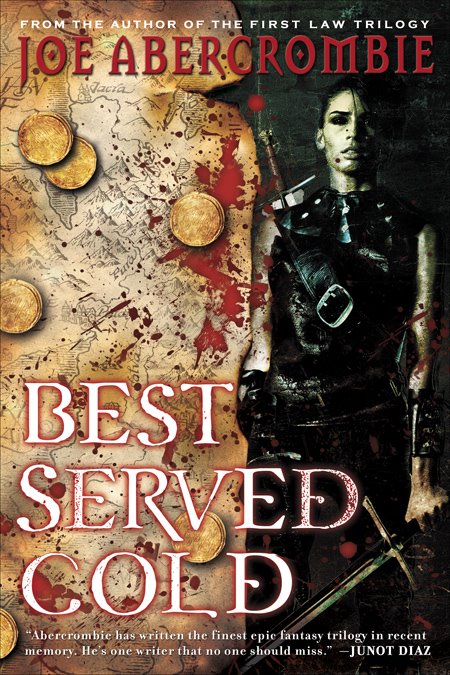
Best Served Cold by Joe Abercrombie

I'll be pulling some quotes and ideas out of Joe Abercrombie's latest book below so if you're not interested in spoilers, go no further.

It seems like just yesterday I was talking about revenge as a motivator. Here, a woman, Monza Murcatto, the Snake of Talins, who is apparently betrayed by her employer is left for dead but manages to survive the assassination attempt. But does not do so on her own.

Rather, she awakens looking a bit like ye old Frankenstein Monster with various surgeries performed on her near dead body. Nothing to augment, merely to pull the body back together. This is done by a benefactor who has his own reasons for doing so.

In that area, the GM can show some mercy to the players. If the players are facing certain death and it's not really through any fault of their own and only a few poor dice rolls or if the GM is feeling merceful, have outside sources save them at a high costs and for a price afterwards.
 but does not survive without being marked. This being Joe Abercrombie, the hero is scared and less than perfect.

But it does add an interesting point in the search for vengance. While Monza is saved, she then acts as a patron for a group of assassins who are to help her in acheiving her revenge.

In terms of player opportunities, one of the characters is named Friendly. He rarely talks and is obsessed with numbers, often expressed through his rolling of the bones. These are little hooks that can be used to hang a quick identifier on. It allows you to quickly get into the mind of the character.

For those seeking to change their player, look for the opportunities in the way the story evolves. In Best Served Cold, one of the characters, Shivers, is a norseman who left the north, forsaking a blood fued against the Bloody Nine. Here, he tries to be optimistic and positive and keep a positive spin on things. His employeer, Monza, has her own theories about the way the world works based on her own experiences, some of which are quite negative, but it isn't necessarily that which wins him over. Rather, it's being taken prisoner and having his eye put out by a hot brand that turns him from an optimistic sort to a pesimisstic sort whose anger at his own employeer at the end, casues him to betray her.

Speaking of Shivers, he also provides a nice constrast to the rest of the cast in that he is a non-native to Styria. This is many ways, is similiar to the standard adventurer who goes where the adventure is. It allows the GM to explain bits and pieces of his world to the other players who may actually be from that part of the setting, but may not be familiar with it as their characters could be. The GM can give those natives bits of background information in e-mail or typed form to provide to the non-native at their own lesiure.

In terms of battle environments, there is one scene where in seeking her vengance, Monza is battling in the court yard around a massive statue known as the Warrior. It becomes damaged in the fight and it is the statue, not Monza herself that winds up killing her foe. Think about adding things that at first may not seem like they can be used to be part of the scenery, but with a few skill checks or brute damage, can wind up being the method of victory.

In my own playing days, back in 2nd edition, I was playing a wizard and the party was fighting a dragon. The thing had such a massive Magic Resistance, that I was essentially useless until I asked the GM about the roof of the cavern that we were fighting in. He allowed me to use my damaging spells on the roof to knock forth the various long hanging stones which struck the dragon like daggers. That was well before all of this 'stunting' advice and environmental awareness was being talked about. He was just a good GM that would let you roll with the situation you were in. It may not be orthodox, but try not to box the players in with their options.

In terms of plot and letting the players in, Best Served Cold opens up the scale of the setting to Monza. She is approached by a man from the Union, a banker at that, who explains to her that there are forces at work and those forces on the standard field tend to be reresented through different factions and that if she does not ally with one of them, she will not survive. And yet here a third faction presents itself, allowing Monza to actually stay out of the 'game'. This allows the GM to provide the players with an idea on how large the scope of the campaign is without actually plunging them into if they do not wish to go. It pulls back the curtain a little.

Lastly, think about the names in the setting. Monza was the leader of the Thousand Swords. A pretty spiffy name. Thanks to the constrant stream of warfare in her land, the times were known as the Years of Blood, but then because of all the looting and burning, move on to the Years of Fire.  The Forgotten Realms does this with the naming of the years, each year having a different name. It can provide more context to the campaign setting.

Best Served Cold is a done in one that features several of the characters and themes and setting from Joe Abercrombie's first series, The First Law, and is well worth a read if you like your heroes dark and their enemies darker.

Wednesday, July 28, 2010

Last Argument of Kings by Joe Abercrombie

So I finished off The First Law series. An interesting trilogy with hardly a hero to be found. Interesting characters aplenty mind you with lots of shads of gray and lots of things to thing about but heroes? If that's what your looking for, wrong series.

So what did I bring out of the old brain after reading it?

"I'm here to make a challenge!" he bellowed, and the sound of it echoed back from the damp, dark walls and died a slow death in the misty air. pg. 324

"No, what we need for this task is a small man, but with great big fruits on him. No doubt we do, and the moon knows it. A man with a talent for creeping about, sharp-eyed and sure-footed. We need someone with a quick hand and a quick mind." pg. 328

Finding things that the characters excel at and giving them opportunities to use those abilities is a big part of what being the game master is all about. Killing players is a relatively easy deal. Its easy to overwhelm them if you desire ot to cast them down from the mountain. However, to give them an opportunity to shine, one in which they may or may not make it out alive depending on how well the dice roll? That's another opportunity in and of itself.

What do the players do that only they can do? Are they specilaists? Are they generalist? Are there things that only they know? Only they can do?

"The name was like a knife in the ear. No name could've been less expected, or less welcome.

"No chance it's some different Glustrod than the one came close to destroying half the world?" pg. 330

When building up enemies for the players to fight, think of them as 'named' men. Build them up before hand. Provide clues to their abilities. Leave witnessess, both living and dead, to testify to their power. Many gamers know the power of Orcus and Demongorgon among others and its hard to recreate this type of fear for someone that the Game Master has invented whole cloth, but when done properly and the players learn to respect those entities that the GM has added to his campaign? It's a wonderful thing.

"You look surprised. Not as surprised as I was, when instead of taking me in your arms you threw me down from the roof, eh my love? And why? So that you could keep your secrets? So that you could seem noble?" pg. 421

History is written by the winners. This is a something easy to verify in many fields. Pick up a paper and review the contents therin. Compare it to what you personally know about the subject. Often times, the reality of a situation and the published word, the history of a thing, may not necessarily be the same. You see, in this series, Bayaz, the First among the Magi, continuously points out that it was Tolomei's father, The Maker, who hurled her from the tower in his thirst for vengance as opposed to what actually happened.

These revelations can be great devices to move a campaign forward, but at the same time, should be taken with care. Too many reversals and flips of history will leave a party essentially uninterested in anything they learn as everything is subject to being turned into something else. Why research a thing and seek to uncover its secrets if its only going to turn out to be the opposite of what you, the GM, the characters eyes and ears, are in essence, lying to them?


To All Things an ending...

No, unfortunatley for the readers, the blog is not ending. Rather, I speak of the ending of the First Law series. Here's the thing. No everyone is going to like every ending. I devoured the books rather quickly. I made several notes of the characters, names, and some of the more interesting ideas I found.

But I thought the ending was piss poor. I thought it left the whole thing way up in the air and if there isn't another series contuining directly from where this one goes, as opposed to the other book in the same setting, it's a damn shame.

But you know what? That's the way it rolls sometimes. If you have six players in the campaign and five of them had a great time, are you going to change your whole campaign and Game Mastering style to please the one player who may have other issues that prevented him from enjoying the game?

I'm not saying ignore that player. I'm not saying tell her to leave the game. But after you speak with her and see if there's anything you might be able to add to the campaign, the pacing, the encounters and the treasures, if there's nothing there and they don't like it but aren't causing any problems with the rest of the crew? Why make an issue out if it? We can't control everyone's reactions to our game style.

The First Law contains all sorts of interesting characters and events and interweaves them well enough that a Game Master could pick up quite a few hints about running multiple sets of characters in different parts of the world while providing them reasons to all intertwine at different points.

Monday, July 26, 2010

Old Ruins = Old Enemies

"How did they get here?" Logen was shouting at Bayaz.

"I can only guess," grunted the Magus, wincing and breathing hard. "After the Maker's death we hunted them. We drove them into the dark corners of the world."

"There are few corners darker than this one." pg. 374-pg 375

"Not quite so empty as we thought eh?" pg. 410

It's a classic cliche that the old ruins of the world are inhabited by the things that are not allowed to dwell where man does. After all, why would those monsters be anywhere else? Is the balor going to take up residence in the elf town? If the great wurm going to act as a city guardsman?

More importantly though, these are places out of the way. These are places where evil can grow unchecked until it spills unto the rest of the world.

These are places where the foolish and adventuresome go and if they disappear, well, who knows better anyway?

Remember the old places of the world and the old powers and old treasures and even older horrors that might wait for the ambitious but remember to have it tie into current campaign events in some way.

In 4e for example, these lost ruins could be the former cities of the older primal beings whose followers were hunted out of the civilized lands. In the dark parts of the universe, those magi and angels and forces of light may have banished those dark and cruel entities to further realms. In the old 3.5 timeline, there was an invasion that took care of the current entities of the Abyss, the demons before the tanari. This was some good fiction taht the author put to use in his Green Ronin book of a similiar nature.

Things older than demons, things of an older nature than the Abyss. Things with darker ways and darker paths.

The world is vast and ancient and the adventurers that do not respect it will fall to it.

Before They Are Hanged by Joe Abercrombie

The First Law Book Two, Before They Are Hanged, continues the character driven wide campaign arc started in the first book. What I forgot to mention with the first book, is each book opens with a quote and that quote is only a partial quote for the cover title.

In this instance, "We should forgive our enemies, but not before they are hanged." by Heinrich Heine.

Quotes are a useful tool for setting the mood and the GM could do worse than to start each session with a quote based on what she expects the game to be like. In some instances, the game may be heavily focused on exploration or dungeon crawling and in others, it may be highly based on the characters themselves where the GM weaves the tale from the characters' backgrounds and events in the campaign.

Such a campaign as the latter is almost impossible to determine the events that will play out because the players are in an open campaign and can do anything, but if the GM has been keeping notes on what the players are doing and what has gone on in the past, she shouldn't have too hard a time.

The quote on the other hand, may introduce an NPC, a magic item, a place, a piece of forgotten history or something along those lines. In these instances, the actions of the players aren't as necessary in the framing of the quote.

In terms of game mechanics, one part struck out to me. In 4e, there are those, including myself, who sometimes look at the martial power source and ponder it's use of daily and encounter powers. Unlike magic or psionics or primal, martial would seem to be... well, free of such limitations. But what if there is an 'origin' story to such things? The players, in many editions and default assumptions, are not 'normal'. They are heroes.

So when reading page 105 of the sci-fi edition, "The devil-blood grew thin, and died out. It is rare indeed now, when our world and the world below have drifted so far apart, to see those gifts made flesh. We truly are privileged to witness it."

..."No more than a faction. But in her, there is a trace of the Other Side."

This is almost an origin story. In the super hero genre, it's a common thing for many heroes to have a common point of origin and to owe their powers or abilities to one particular event. In a role playing game, due to the power levels involved in some game systems, especially as the levels increase, why not borrow what works and provide some origin points? Martial powers are an expression of that common origin and don't rely on outside incluences, but still owe their origin to that common event.  King of how like the Golem and Doctor Strange are both mystic in nature but approach the whole genre vastly different than each other.

Just a passing idea mind you and one that could be eaisly swipped to explain how players are able to do things that most of the others in the setting can only gasp at.

Sunday, July 25, 2010

Those Silly Nobles...

Below is a quote taken from The Blade Itself from the Science Fiction Club edition.

"I don't need men with good blood. I need men who can plan, and organise, give orders and follow them. There will be no room in my army for those who cannot do as they are told, I don't care how noble they are."

"This war was a bad thing, a terrible thing, no doubt. He felt himself grinning. A terrible thing. But it just might be the making of him." (p. 255-256)

Many of the most famous fantasy settings for gaming, like Greyhawk and Forgotten Realms, are psuedo Middle Ages with various factions that have somewhere on them, a structure where the laws and money are held by the nobles and those of noble blood and where the merchant class is either just starting to appear or is kind of just ignored on the side.

In the Berserk series, Griffith's ambition is to have his own kingdom despite coming from nothing. It causes trouble with those of the kingdom and leads to some interesting scenarios.

I mention the plight of West from the Blade Itself and Griffith from Berserk because this is a reptition of theme. That change against an established government is not an easy thing and that despite the outside threats and enemies, that those who are seen as being responsible or part of the change, become enemies of the established heirarchy no matter how much that current government may need them.

Game Masters can use corruption, incompetence, intolerance and other themes to showcase how different the members of an up and coming group of adventurers are different even among their own people. Sure, there may be those who want their alliance and those who have missions for them, but what do those people actually think of the characters. Have the characters almost enter a chamber room where their patron is having a meeting with another noble house and is talking about how useful it is to have such wonderful lap dogs. Have the players have to battle a group of inquisitors who are after their cleric for supposed heresy. The potential for inner conflict with one's king, country, and religion, are not just limited to fighting the obvious evil ones.

The Blade Itself by Joe Abercrombie

Joe is another one of those 'modern' authors who I've wanted to get around to reading for a while. Since I first heard of him, he's published the remaining books in the first series and started a second series. Time flies I tell you. You never know when you'll be able to get around to things.

The Blade Itself has a series of characters who don't have feet made of clay. Rather, the clay stops at oh, say the neck. This can be solid reading for those who don't like their heroes to be perfect or for them to be prestine but in a role playing game, it has to work with the party.

For example, one of the characters, Glokta, is an inquisitor who used to be a great warrior until his capture and years of torture that broke his body down. The character suffers limitations on movement, eating, and other areas. In a game like Hero or GURPS where those limitations might come in as a reward somewhere else, it might be useful. In a level based game where such issues are not rewarded? Not so much. It's one of the primary reasons why D&D doesn't have a critical hit system that targets limbs.

Now if the GM and the player want to have the character role play out some issues, like talking about a limp or walking slow without it actually effecting the game mechanics, that works in many situations. Most often the other players will roll with it and perhaps even throw in their own jibs when the character has to put the run on. "No problem running from the dragon eh?" In other instances, it may not work and in those instances, you need to know why the player wants to run such a character in the first place. If it's just a role playing challenge, then there is no need to 'reward' them for it. If they want something in exchange, then it's not for the right reason.

But that wasn't why I wanted to post about the book. Rather,..

"This is better," said Logen. It was a simple, solid-looking sword, in a scabbard of weathered brown leathers. "Oh yes indeed. Much, much better. That blade is the work of Kanedias, the Master Maker himself."..."Consider it a gift. My thanks for your good manners. (pg. 151-152)

The idea of a character getting a powerful weapon as a gift is often frowned upon in many games. After all, if they didn't earn it, what good is it? But if you look at some famous examples, like King Arthur, pulling the sword from the stone didn't exactly require the squire to go and do battle.

Peter Morwood wrote a series, The Book of Years, that started off with the Horselord. The main character there is given a gift of a fine sword whose blade has to be continuously refitted to new hilts as the old ones wear away, the Widowmaker.

If you don't like the idea of powerful weapons and items just happening to be in a monsters lair, go the opposite route. Have these items become gifts to those that the ones already in power wish to befriend. Have them become gifts that are 'fated' to be used by the character. After all, owning a nifty magical weapon and mastering it are not quite one and the same as the Sword Bearer by Glen Cook finds out.