Showing posts with label Mistborn. Show all posts

Saturday, February 6, 2010

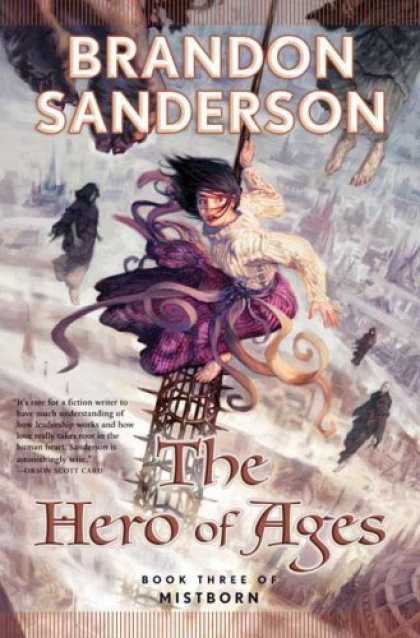
THe Hero of Ages by Brandon Sanderson


Brandon Sander's Mistborn comes to it's conclusion in the Hero of Ages.


Some of the things I'll be discussing below I've mentioned before, but as they continue to come up in books, they tend to reinforce their utility for both writing fiction and crafting entertaining games.
1. Vague prophecies. The Hero of Ages is an old prophecy that started off the series. It's been mentioned time and time again. It's been vague enough that many could fit the title, and when we, the readers finally discover who the hero of ages is, I wouldn't be shocked if many readers, much like I, were indeed fooled by the way the books had gone up to this point.
It wasn't a bluff nor a lie as people thought one character or another was the hero, but because it was vague, it was applicable to many fields. In a role playing game that may have several players in it, this is a good thing, allowing different players to fill in different parts of a propehcy.
2. The environment. The main foe here, Ruin, isn't a physical being. It's one of power. On a whole seperate plane of existance. It's destroying the world through continuous ash fall from volcanic mountains and earthquakes. No matter how might a physical foe, such as a dragon or giant is, often, there are ways to beat them that fit into the content of a role playing game. When it's trying to see through ash fall that storms down, the prospects of using a daily power or a utility power against it aren't quite so good.
Environmental disasters also offer something that Game Masters can use and that's a time limit. If the players are unable to keep moving, then the world ends and they lose. This is useful if you're players are the types that like to expand all of their neat toys in each and every fight and suffer the "fifteen minute a day" adventuring syndrome. By putting a time line on events, they don't have the time to wait a full day and recover their abilities, they have to keep going.
3. The prize. In this case, if the heroes lose, the world is doomed. And even if they win, the world is forever changed. At the end level of almost every edition of D&D (Advanced, 2nd, 3rd, and 4th), once the players can start using 9th level spells, and have magic items of the appropriate level, they should be the ones helping to determine the final fate of the setting. Go big or go home as the old saying goes.
4. Campaign styles: Here, the author has done a very solid job of making the campaign setting be very coherent. The world building ties together very nicely and many elements of it come together in this final volume. One of the benefits of doing a home brew as opposed to an off the shelf setting, is a home brewed can allow the Game Master to hit specific elements and themes and have them be consistant. Purchased settings, like Forgotten Realms and others, tend to be very emcompassing, allowing a wide range of player arche types to mix and mingle with one another without regards to the consistency of the actual campaign setting. It works if you don't examine things too closely but can fall apart if you try to figure out why faction Y hasn't simply abosrbed country B, etc...
In addition, some feel that they shouldnt' change an established campaign setting. Be making up your own, you completely negate that whole fear and worry. You can hold different games in different eras, allowing players to see the effects of their previous characters on the campaign setting, which can be very satisfying.
The Hero of Ages brings a satisfying conclussion to the Mistborn series and does so in a fasion that leaves the setting changed and the reader, perhaps a little shocked at the events, but satisfied nontheless.

Thursday, February 4, 2010

More thoughtso f Ascension


One of the things that I try to keep in mind when I'm reading a book, is that even if there are some great ideas and it reads solid, it may not be appreciated if incorporated into the game.
For example, Vin, is certain of a particular course of action she must take. Her scholar friends are also convinced of it. She must not take the power of the Well of Ascension for herself.
Turns out that was a lie and that she winds up releasing something that leads us into the next book.
Works well for a book. The hero must go to some levels of redemption.
In a role playing game? It might not work quite as well because as far as I can tell, the characters all put in time with their specialties and were essentially flat out lied to by the Game Master.
Don't get me wrong. I have no problem giving players enough rope to hang themselves with, but if you're going to let players have specilties and have them go through various trials and tribulations and lie to them anyway to have them set up the next episode of the campaign, it's a railraod and it's probably close to the Game Master wanting to write fiction as opposed to Game Mastering.
In addition, Vin, who I've described before as being very much a player character, initially has such a massive distrust of her kandra servant due to past issues, that she doesn't follow her questioning nature at first which smacks of not using every tool at her disposal. She eventually does start following those lines and it works out that her ally, the kandara, a race of near dopplengangers, will simply not answer some questions about their culture thanks to their own lore encoded in 'the Contract'.
It's okay if the players want to know about each and everything in the world, but that doesn't mean that every Non-Player Character is there to just spill out the history of their people. First off, many people, especially in a dark ages style setting, are ignorant of the real past of their people. Most don't leave the small towns they grew up on. It's one of the reasons they often welcome outsiders to gather news of the outside world, even as they may be insular themselves.
When looking for inspiration, remember that it's a group game and don't try to force the players down one path if they're not interested in it. On the other hand, don't be afraid of leaving some red herrings out there. There's nothing like providing just enough rope...

Wednesday, February 3, 2010

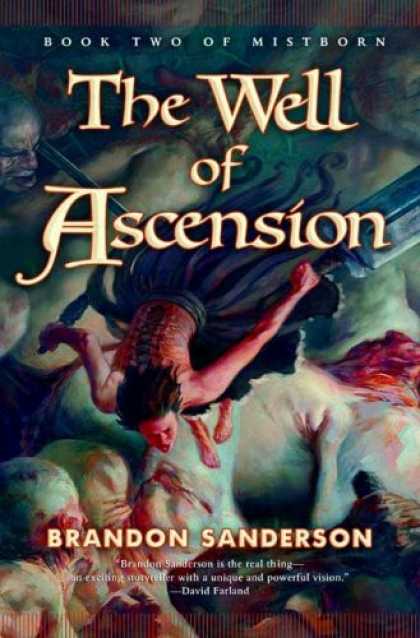
The Well of Ascension by Brandon Sanderson part 1


Brandon Sanderson's sophmore novel of the Mistborn picks up one year after the end of the original book, The Final Empire.


This break provides an interesting contrast to many adventure paths, especially those in the former print Dungeon magazine. Several of those adventurers almost ran right into one another.

By providing the readers with a pause, you give some space to allow things to have happened and pick up the pace again.

The main character, Vin, continues to master her Mistborn powers. Like Rand from Wheel of Time, or Pug from Magician, the reader gets to see that those with power, especially in a setting that lacks weapons like guns, are essentially super heroes.

There are several scenes where Vin cuts lose with such power and martial authority, that those she faces are little more than sheep.

When running the game, think about how you want the players to fit into the campaign setting. Vin's power level gives her a reputation. Her training at the hands of Kel, gives her a reputation. Her continued exploration of the world about her and the powers of Mistborn in general, continue to push her reputation.

In some games, the Game Master wants the players to be in fear for their life. Every combat is a grim and gritty affair where a lucky kobold or lowly goblin may finish them off.
It's not absolutely necessary to run low powered campaigns for such threats however. For example, in this book, one of Vin's arch enemy is Zane, who is also a Mistborn. The Mistborn 'burn' metals and there is one metal that provides its user the ability to see the future actions of his enemy. Vin has run out of this metal and Zane hasn't. This gives their fight a sense of grim and gritty without making it a brawl in the sewers fighting over a crust of bread.

In terms of world building, when looking at a book and looking at a fantasy campaign, beware the differences and enjoy them at the same time. Here, one of the threats to Vin's home is a race of humanoids, the koloss are brought to the forefront. The koloss continue to grow but their blue skin does not. It rips and tears. They are savage and brutal, probably similiar to Fomorians in good old Dungeons and Dragons.

Because larger koloss are stronger koloss, they can represent a variety of threats. This is a solid way to present an enemy. However, it's still just one type of enemy. Most campaigns, indeed, most adventures, will use many more types of adversaries than that. Don't ignore the potential of culture building and trying to make the races unique and interesting in and of themselves, but if the players are biting to fight some undead or demons, don't foster your own favorites on them time after time.
The Well of Ascension continues the path started by the Final Empire and I'll ahve more to say of it in a future posting of Appendix N!

Sunday, January 31, 2010

Mistborn Part 2

Continuing a look at the Mistborn and how some of the things in it may be useful to many types of campaign.

1. Keep the NPC's motivated. In this book, Vin, one of the main characters, is sought out by the Inquisitors several times. It's related to her background, but not as a hero of destiny, but rather, as a device by which the NPC can shame another character and take their power. Have the players allies that would rather not be dragged out to the light? Do they have aliases or friendships with individuals who would look bad simply for knowing the players let alone helping them? By capturing Vin her and forcing her to confess who her father is, Vin dooms that man to a harsh death and catapults the Inquisitors to a new level of greatness. See if there's anything in the players own backgrounds or actions in campaign to use in a similiar fashion and see if they can figure out what the NPC's are trying to do.

2. There's always another secret. This mantra comes up several times. In Mistborn, the Final Empire, Brandon Sanderson does a great job of wrapping up everything and yet leaving the scenario open for more books to follow without ending things in mid stride as many authors tend to do. While the Lord Ruler is dead at Vin's hands, his dying words indicate that he was doing something special, something that only he could do and that his death would bring in new problems. While the city has fallen from nobel hands, a new society does not emerge overnight and must be carefully cultivated leaving many adventure seeds for future campaigns. While the villains are defeated, what happened to their wealth that wasn't where everyone assumed it'd be?

In fantasy games, this could be as simple as providing multiple cave entrances in a dungeon that lead in different paths. It could be the players knowing that the foe they currently face isn't the most dangerous, only the most immediate. It could be that the foes they face aren't necessarily the real enemy at all and rather, they are on the retreat from something oh so much more powerful that they'd rather fight the players than stay where they were and die. Keep the players moving forward while giving them good 'pause' points to think of what the next move forward is.

Mistborn is a solid book and provides a lot of example characters and magic systems that in and of themselves could inspire their own RPG. Use the plotting and pacing as guides of how to bring the action and when to take a pause.

Saturday, January 30, 2010

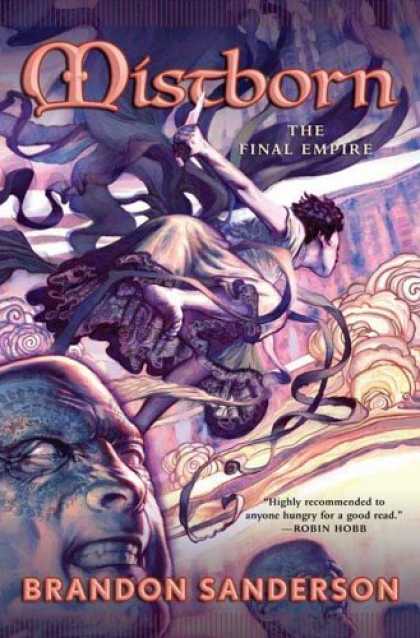
Mistborn the Final Empire by Brandon Sanderson Part 1


Below I'll be discussing Misborn the Final Empire by Brandon Sanderson. This is a series I decided to pick up when I heard he would be taking over the Wheel of Time. I haven't read the Wheel of Time for several books now, but I figure if it's ever actually completed, I'd like to see what the author whose taken over it can do. And I am pleasantly surprised.
Any page references are to the science fiction book club edition. Note that there will be spoilers below so those who are not looking for spoilers, go no further.
Brandon Sanderson uses many of the formulatic methods of writing fantasy that are familiar to those with a wide background of fantasy material.
1. The Prodigy: One of the heroes, Vin, is a Mistborn by blood. Her powers come from her father and his bloodline, mixed with that of her race, the skaa. She is a natural at the things it takes others months if not years to learn. She's also capable of quickly coming up with new strategies and methods with her powers that others for a thousand years haven't thought to do. In many ways, her ability to be a game changer, makes her a good sample player character.
How so? In the standard campaigns, if the NPC's acted like the PC's do, using their powers in many practical and purposeful methods, the whole setting would be vastly different. By having Vin not do things by the standard, it allows her, the prodigy, to be the game changer.
2. The Mentor. Vin is initially a lowly thief who doesn't even know of her power but she falls under the guidance of Kelsier, a man with a shady past. He teaches Vin her power and gives her something to believe in. In a role playing game, mentors are hard to pull off. Make them too powerful and they can steal the spotlight. Make them too weak and the players will soon pass them by. Kill them and make their deaths heroic and serve and as example to the players? Works here.
3. Thieves with a heat of gold. Intially hired to perform their mission, Kelsier and his 'crew' all follow through with the plan even when the one hiring them is killed and the money isn't there. In many role playing games, the default assumption is the players have a heart of gold. If the players are only motivated to adventure for the money, they could be cavaran guards or something of that nature where the adventure isn't really an adventure. It could work for some groups, but by having motivations that move past the financial, even if those motivations are still item based, they have reason to go hunting things that they just can't earn down the corner.
4. Urban Campaigns are character driven. In this book, part of Vin's duties is to act as a spy in noble society. She encounters numerous nobles and their servants and learns that despite the higher wealth and easier life they live, that the nobles have their own problems, most often, the other nobles. When having adventurers stay in a city, try to keep at least a list of twenty places that they either know about or can visit and at least three people involved with each of those twenty places. Urban campaigns can provide a change of pace from adventuring in the dungeon, but require a bit more work as the players, unless they'll be leaving the city very quickly, aren't going to just hack and slash their way through problems. Although there is always the city...
5. The powerful evil minon. Initially the evil Inquisitors are so powerful that Vin and her mentor can't overcome one. Then the mentor does. Then the secret for their destruction is passed out. This can be done in a game like 4e relatively easily. First, as the characters advance, the unbeatable becomes, well, defeatable. Next, the GM has the ability to make monsters minions. One of the great things about games like Mutants and Masterminds is the Mook rules in which if the players can damage the enemy, they've beaten the enemy. It's the old Ninja or Sentinel (Marvel comics old X-Men foes) problem. One of them is vastly difficult to beat requiring a pulling out of all the stops but dozens of them? They fall by the wayside.
6. The invicible enemy. Many fantasy epics have their own takes on such enemies. For example, Robert Jordan's Wheel of Time is leading up to a showdown between Rand and his nemesis. Other fantasy tales use dark gods, demon lords or other such villains. Here it's the Lord Ruler, the "Sliver of Eternity". If you can introduce the big bad early on, and provide a scene to showcase the big bad's vast and unopposable strength, when the players finally manage to get the device to beat the bad guy or finally have enough raw power in levels to do so, allow them to earn that victory.
7. Character Growth: Part of the young prodigy being in the novel means growth. Initially a scared thief who trusts no one and wastes no food, Vin grows into someone who not only comes to trust her crew, but to love her mentor, and finds the ability to trust a strength she didn't know it could ever possess. Too often novels will keep characters in some odd timeless state and they'll grow stale. If the players are able to effect real change on the world and on non-player characters, have the way others treat the players change. Allow the world to grow around the actions the players commit.
These are some standard staples of the genre but Sanderson does them with an agile hand by allowing the characters to grow, using a lot of foreshadowing that you may not even be aware is foreshadowing till another event happens, and drawing the reading into the world of the Mistborn through quick pacing and characters that relate to each other like people.
By giving the players something to care for, the players motivation will be more than money and will provide the Game Master with clues as to what types of campaign they enjoy.