Written by Nicholas Michael with color plates by G A Embleton, the Armies of Medieval Burgundy 1364-1477 is a short 40 page look at a country in a time period that isn't necessarily associated with the guns and cannons that the book discusses in depth.
On one hand, the book says "look, it's a small kingdom that had a rapid rise and a rapid disintegration." Few things speak to me and say, "ah, player characters and their silly antics" as much as the rise and fall of nations. For the time period, we have Philip the Bold, John the Fearless, Philip the Good, and Charles the Bold, known as the Valois Dukes. The use of descriptive titles on personal names is something that most players would be familiar with although few would be so tame.
In the case of Burgundy, that is very apparent from the start as the author notes they are surrounded by enemies and split in four. I can see a group following a similar methodology as each player may have different ideas.
Another bit that may make this one an odd duck, is that this book has been in print on and off since 1983. The Osprey series has changed quite a bit in that time and often has more historical information to it.
On the other hand, the book discusses the use of cannons and guns a bit. In doing so, it continues to reinforce my feelings that guns are very underrepresented in most fantasy games that have a medieval basis as their core. If your setting has full plate, it probably needs cannons.
One of the key pieces of text amuses me a bit not because it's out of place, but because it showcases that things happen alongside each other until one is proven clearly the superior. In this instance, we have Philip the Bold commissioning the brothers Jacques and Roland of Majorca to cast large-caliber cannon from 1368-1390. During that time frame, other books in the series will point out say, English Lowbowmen and their utility even as in further days, those like Benjamin Franlkin bemoan the lack of such skilled troops in their own ranks.
The color plates by G A Embleton include the one on the cover. If you enjoy that picture of a knight, the other interior ones are well worth study. These illustrations include various men-at-arms of the time including a few members of Philip the Bold's army from 1363 on color plate A, or a mason, gunner, and archer under Jean de Vergy, the Marshal of Burgundy at the siege of Vellexon on plate B. This is an interesting picture because it shows the mason and gunner in close cooperation working to cast cannon balls while the archer looks on as defense.
On plate C, Philip the Good, the Duke of Burgundy looking much like a knight of Warhammer's Bretonnia. The gentleman of the court surrounding him, as well as the trumpeter though ,are all dressed in white, providing a nice contrast to the multiple colors that make up Philip's own coat of arms and armor.
Another picture that could almost come from a modern Warhammer book, but for the Empire, is on plate E, the Artillery of the 1470's, where a Bombard with a master gunner is preparing to fire as a gunner with serpentine works on various matters of paperwork with gun powder and boxes and cannons beneath him.
In contrast, plate G showcases the Men of the ordinances and includes... well, let's not call them mundane, but a crossbowman, a pikeman, a coustillier, and another crossbowman while on plate H we have more men of the ordinances, including a handgunner, mounted archer, and another longbowmen.
These illustrations serve to showcase the mundane and military use of men of arms of various weapons in military formation and use as opposed to the relatively rogue nature of player's characters who are often masters of various weapons. It's a good instance to showcase that while guns are in use, that those who are skilled with their ware, such as longbow men and mounted archers, are still in demand and still useful.
Such times can showcase that skilled characters, like those of the players, can still make huge changes. That they can challenge the status quota. Long term mind you, those changes may be irrelevant but could belong to a group of specialist. This would make the characters similar to those who, in super hero settings, like Green Arrow or Hawkeye, continue to use long bows despite the rampant use of guns and other technology that makes the average bowman look silly in contrast.
In the end, I thought Armies of Medieval Burgundy benefited from the various pieces of art drawn from historical sources as well as G A Embleton's skilled hand but the writing seemed... I don't want to say off, but focused a bit too much on the weapons and artillery of the time as opposed to learning anything much of medieval Burgundy itself.
Showing posts with label Ospery. Show all posts
Monday, December 23, 2013
Wednesday, January 26, 2011
The Armies of Agincourt by Christopher Rothero
So after reading the fiction book Agincourt by Cornwell, I wanted some morei nformation. While I won't say I shouldn't have bothered, this is really more of a reflection of Cornwell's strength as a writer in relaying information than any failure of Christopher Rothero.
There are things that Christopher brings to the table that Cornwell did not. For example, a longer history of the rise of the longbow and its place in England's army. A comparission between some of the rulers and nobles between England and France, with France not coming out well.
And of course, illustrations. Christopher Rothero acts not only as scribe, but also as artist and does a fantastic job. If you're playing a Bretonian army in Warhammer, you could do with a worse reference. This guy is good. I thought for a moment it might have been a certain McBride, but nope, it's Rothero. He does a solid job of capturing the various soldiers and the different types of armor and weapons used at the time.
Some of the things I found ironic though, were the heavy handed way in which things worked then, which allowed the English to win, which if told in story form in a role playing game, might sound forced.
First off, the two kings. Henry V is at the top of his game here in terms of leadership of men. He's with them in the field, he's an able commander, he's vigourous and well respected. The enemy's leader? Well, he's not there. Indeed, he is Charles 'The Mad'. Those nobels that are there? They're so hungry for profit in capturing rich soldiers, that they put themselves at the head of the army.
They're so foolish, that they allow the much smaller and desperate force of English to set the battle. In a muddle field. A field of deep mud. While they are riding heavy horses.
Their advantage in numbers? Their strength of crossbowmen? Ah, push them to the side. There's glory to be gotten here.
What about the history of the longbow? A weapon that the English have used to devistating effect in the past and have won other major battles with it? Ah, that's history, don't worry about that.
But how do these fools get into these ranks? Same way they do today. It's not what you know, it's who you know. So you're a bit of an incompetent right? That's okay because you know people. Hey, those guys who work their way through the ranks and think they know what they're talking about? I tell you what, we're just going to ignore them, override their orders and overall diminish their contributions because hey, they don't know anyone.
Reading the battle of Agincourt with the extra details, with the various names of nobility attached to it, with the many mistakes that happened, looks like any huge 'bubble' that burst and everyone points to it afterwards and goes, "Hey, here is exactly what happened." It's just in this case the burster of the bubble was King Henry.
While to the modern eye, the second hand accounts present an easy to see series of events that could have been avoided in any number of areas, look around at things people are talking about, but not really doing anything about now. Think about gas at the station costing $5-$7 a gallon. Think about a housing bubble burst in China. Think about food inflation that easily outsrips commodity inflation. Think about the housing bubble that already burst, think about the various entitlement programs that can't be paid for with current revenues. There are 'dragons' all over the place that people don't want to face and they will come back and bite you in the face.
Now in a role playing game, it's important to note that the players are going to be 'meta' gaming in many cases. Sure, some of them may be going into the whole knightly orders or the various role playign aspects that go with it, but they would never be caught in the situation the French were. On times, you should allow them to face others though, who do fall into those patterns and to suffer under those same issues.
After all, why would the other nobles in the army listen to a bunch of adventuring peasants? Filthy tomb robbers!
Tuesday, December 7, 2010
Japanese Warrior Monks AD 949-1603
"There are three things that are beyond my control: the rapids of the Kamo river, the dice at gambling, and the monks of the mountain." ex-emperor Go Shirakawa-In.
I'm a fan of Legend of the Five Rings. I'm a fan of the old Oriental Adventurers 1st edition and the attempts to bring it up to date in various methods. In terms of history though, I don't know a lot about the various cultures that make up the far east in terms of Japan and China even though some of the timelines and events are somewhat known to me.
And the book is illustrated by Wayne Reynolds. You see, while I'm afraid some of his fantasy art is a little overplayed for me, between his numerous works for Wizards of the Coast and Paizo, and his shortening of the forearms in some of his illustrations, I do find his work in this book solid.
Anyway, the first thing I'd note is that the forces in Japan here, despite being monks, their initial battles and fights are not religion based. Rather, they are based on the world of politics. Various appointments are made that the monks don't agree with and they march!
To me, this is yet another powerful indicator that despite the 'secular' nature of religion, and most religions at their root tend to be of the do onto others bits, we find time and time again that in order to advance the cause if you will, that the religion must engage itself with the corporal. That the etheral ideas must be planted firmly in reality.
These politics go a long way in many of the early examples here, and they are not only all about the monks, but rather how those around the monks use politics to get there way, or how those who fall out of favor of the current politics have to watch their step or also fall out themselves.
When looking at the religious forces in the setting, how do they interact with the other parts of the setting? In campaigns like Greyhawk and the Forgotten Realms, those questions are semi-answered. Some of the more militant gods have churches. Some of the arcane gods have spellcasters as worshippers. Some of the shadier gods have rogues and assassins.
But the types of worshippers don't necessarily bring out what those forces actually do. The Japanese Warrior Monks, in many ways, are a standing army and served as such in several battles. While priest of Tempus are of the war god, do they have a standing army that is at the beck and call of whatever city they are in or is it an independent unit that is beholden only to the church? Do worshippers of Kord has a massive monestary they go to in order to train and learn their craft while preparing to showcase their strength and prowess?
The warrior monks also have a very distinctive weapon; the naginata. The naginata, as shown here, is a pole arm weapon with a massive blade that had a lot of variety. Wayne illustrates three of them in the book including a wide bladed one, a shobuzuri where the blade and shaft are almost of equal length, and a short bladed style with a heavy iron butt end.
The utility though, in a role playing game, would be the recognition that a whole unit or a whole style of enemy using a specific weapon brings. Some foes are known for their chaotic choice of weapons, others for their orderly methodology. By giving an army a specific weapon and a specific style, you give it definition and provide the players easy latch points.
I'm a fan of Legend of the Five Rings. I'm a fan of the old Oriental Adventurers 1st edition and the attempts to bring it up to date in various methods. In terms of history though, I don't know a lot about the various cultures that make up the far east in terms of Japan and China even though some of the timelines and events are somewhat known to me.
And the book is illustrated by Wayne Reynolds. You see, while I'm afraid some of his fantasy art is a little overplayed for me, between his numerous works for Wizards of the Coast and Paizo, and his shortening of the forearms in some of his illustrations, I do find his work in this book solid.
Anyway, the first thing I'd note is that the forces in Japan here, despite being monks, their initial battles and fights are not religion based. Rather, they are based on the world of politics. Various appointments are made that the monks don't agree with and they march!
To me, this is yet another powerful indicator that despite the 'secular' nature of religion, and most religions at their root tend to be of the do onto others bits, we find time and time again that in order to advance the cause if you will, that the religion must engage itself with the corporal. That the etheral ideas must be planted firmly in reality.
These politics go a long way in many of the early examples here, and they are not only all about the monks, but rather how those around the monks use politics to get there way, or how those who fall out of favor of the current politics have to watch their step or also fall out themselves.
When looking at the religious forces in the setting, how do they interact with the other parts of the setting? In campaigns like Greyhawk and the Forgotten Realms, those questions are semi-answered. Some of the more militant gods have churches. Some of the arcane gods have spellcasters as worshippers. Some of the shadier gods have rogues and assassins.
But the types of worshippers don't necessarily bring out what those forces actually do. The Japanese Warrior Monks, in many ways, are a standing army and served as such in several battles. While priest of Tempus are of the war god, do they have a standing army that is at the beck and call of whatever city they are in or is it an independent unit that is beholden only to the church? Do worshippers of Kord has a massive monestary they go to in order to train and learn their craft while preparing to showcase their strength and prowess?
The warrior monks also have a very distinctive weapon; the naginata. The naginata, as shown here, is a pole arm weapon with a massive blade that had a lot of variety. Wayne illustrates three of them in the book including a wide bladed one, a shobuzuri where the blade and shaft are almost of equal length, and a short bladed style with a heavy iron butt end.
The utility though, in a role playing game, would be the recognition that a whole unit or a whole style of enemy using a specific weapon brings. Some foes are known for their chaotic choice of weapons, others for their orderly methodology. By giving an army a specific weapon and a specific style, you give it definition and provide the players easy latch points.
Labels:
Historicals,
Ospery,
Warrior Monks,
Wayne Reynolds
Sunday, December 5, 2010
Angus McBride's Art of Byzantine Armies
Angus Mcbride has a huge swath of material to work for here. Not only does this book cover a large period of time, but as I've posted previously, the Byzantine armies are often made up not of natives, but of mercenaries that range far and wide.
The cover, the first color plate on the interior, is of a cavalryma, a man-at-arms, and an infantryman. The cover however, loses the awesome background which has stone spires reaching up behind the figures, giving them a very real sense of presence and exploration.
The next one, shows three mercenaries, almughavar, Cuman, and Alan, in some thin woods having brought down a bird with some solid bowmanship.
The next one showsBuzamtome sp;doers beomg waoted pm bu a servamt in front of a castle.
The fifrth one shows a Cuman mercenary on horse, in a stream, next to an Albanian mercenary who rests a spear on a shoulder with one foot in the stream and the other on a rock outcropping and an Italian mercenary creeping along the rocks out of the river. This picture could almost be a group of adventurers exploring as the Albanian mercenary, with one hand raised and his spear which almost resembles a staff, could easily pass for a wizard with his rounded cap.
There are other illustrations, but I consider those 'pose' shots, solid artwork that is the characters essentially standing around so that McBride can showcase what these various individuals might have looked like. The ones I picked out have more going on wither its exploring, hunting, or day to day activities.
Angus McBride's art is solid and could easly make for some quick visual referens in any role playing game.
The cover, the first color plate on the interior, is of a cavalryma, a man-at-arms, and an infantryman. The cover however, loses the awesome background which has stone spires reaching up behind the figures, giving them a very real sense of presence and exploration.
The next one, shows three mercenaries, almughavar, Cuman, and Alan, in some thin woods having brought down a bird with some solid bowmanship.
The next one showsBuzamtome sp;doers beomg waoted pm bu a servamt in front of a castle.
The fifrth one shows a Cuman mercenary on horse, in a stream, next to an Albanian mercenary who rests a spear on a shoulder with one foot in the stream and the other on a rock outcropping and an Italian mercenary creeping along the rocks out of the river. This picture could almost be a group of adventurers exploring as the Albanian mercenary, with one hand raised and his spear which almost resembles a staff, could easily pass for a wizard with his rounded cap.
There are other illustrations, but I consider those 'pose' shots, solid artwork that is the characters essentially standing around so that McBride can showcase what these various individuals might have looked like. The ones I picked out have more going on wither its exploring, hunting, or day to day activities.
Angus McBride's art is solid and could easly make for some quick visual referens in any role playing game.
Labels:
Angus Mcbride,
Byzantine Armies,
Historicals,
Ospery
Saturday, December 4, 2010
Byzantine Armies AD 1118-1461
When talking about this book previously, I mentioned the high cost of mercenaries. The book, when speaking about the armies, further list out the nationalities of the soldiers that were often in these mercenary armies.
In using these forces, the empire found it easier to control them in small waves. It also made it easier to pay them. The soldiers were often paid once every three months, but that payment was also late in coming. For some forces, the promise of land and ownership was enough. For others, even though there was no pay, they were allowed to keep what they plundered. For some, there was no actual use by the Byzantine empire, but rather, much pillage in that time under those colors.
For example, in 1354, we have some 10-20 thousand soldiers sieze Gallipoli for their own plunder. Pretty good numbers and a sizable take for themselves.
I'm going to list out some of those that fought for the Byzantine here. It's surprising from where they come from. This is more interesting to me as a fan of the historical information simply because even in today's society of easy to get around places, people don't tend to move around a lot with notable exceptions. Anyway, onto the list;
Alans or Massagetoi: Christian Turks from the Caucasus, Albanians, Armenians, Bulgarians, Burgundians,
Catalans, Cretans, Cumans, Englishmen, Georgians, Hungarians, Latains: Italians, Germans, Spaniards and the majoirty being Frenchmen., Mongols, Patzinaks or Turkic Pechenegs, Russians, Scandinavians, Serbs,
Turks, Uzes, Vlachs
Seriously, is there anyone there no covered? Of course the times nad terms of service for these different nationalities differed and some of these nationalities fought among themselves, further weakning the empire itself, but overall, this list represents an amazing reach and an amazing potential.
For role playing games that is. It is often wondered, how do adventurers meet? Well, if you're working for the Byzantine armies, apparently, it doesn't matter if you from England or from Russia, chances are you'll wind up working together or at least having the potential to work together. Having a large empire like this, even one in decline, like Byzantine is, allows the GM to have a very open and 'real' reason for characters of different races and professions to join together if only as a starting point.
In using these forces, the empire found it easier to control them in small waves. It also made it easier to pay them. The soldiers were often paid once every three months, but that payment was also late in coming. For some forces, the promise of land and ownership was enough. For others, even though there was no pay, they were allowed to keep what they plundered. For some, there was no actual use by the Byzantine empire, but rather, much pillage in that time under those colors.
For example, in 1354, we have some 10-20 thousand soldiers sieze Gallipoli for their own plunder. Pretty good numbers and a sizable take for themselves.
I'm going to list out some of those that fought for the Byzantine here. It's surprising from where they come from. This is more interesting to me as a fan of the historical information simply because even in today's society of easy to get around places, people don't tend to move around a lot with notable exceptions. Anyway, onto the list;
Alans or Massagetoi: Christian Turks from the Caucasus, Albanians, Armenians, Bulgarians, Burgundians,
Catalans, Cretans, Cumans, Englishmen, Georgians, Hungarians, Latains: Italians, Germans, Spaniards and the majoirty being Frenchmen., Mongols, Patzinaks or Turkic Pechenegs, Russians, Scandinavians, Serbs,
Turks, Uzes, Vlachs
Seriously, is there anyone there no covered? Of course the times nad terms of service for these different nationalities differed and some of these nationalities fought among themselves, further weakning the empire itself, but overall, this list represents an amazing reach and an amazing potential.
For role playing games that is. It is often wondered, how do adventurers meet? Well, if you're working for the Byzantine armies, apparently, it doesn't matter if you from England or from Russia, chances are you'll wind up working together or at least having the potential to work together. Having a large empire like this, even one in decline, like Byzantine is, allows the GM to have a very open and 'real' reason for characters of different races and professions to join together if only as a starting point.
Labels:
Angus Mcbride,
Byzantine Armies,
Historicals,
Ospery
Monday, November 29, 2010
Byzantine Armies AD 1118-1461
Written by Ian Heath and illustrated by Angus Mcbride, Byzantine Armies represents the downfall of an empire. While I haven't finished the whole book yet, considering my appreciation for mercenaries, I found the introduction to be somewhat ironic.
Believing that the army's weakness resulted from its heavy dependence on foreign mercenaries, he concentrated the best of the remaining native troops in Constantinople and reduced the pay and privileges of its foreign mercenaires, declaring his intention c 1255 'to build an army not of Turks, Italians or Serbs, but of Greeks.'
Of course right after Theodore II, Michael VIII, the former commander of the army's Latin mercenaries, goes right back to the employemenet of large numbers of foreign troops. This eventually leads to the economic collapse of Byzantine wealth and other associated bad things like the fall of Contantinople in 1453 by the Ottomans.
Here, the mercenaries are a damned if you do, damned if you don't. Pay them and well, the finances just weren't there. The need to spend on military has apparently crushed more than one super power. Don't pay them and well, they'll just find another employer who might use them again you.
Mercenaries... gotta love 'em.
Believing that the army's weakness resulted from its heavy dependence on foreign mercenaries, he concentrated the best of the remaining native troops in Constantinople and reduced the pay and privileges of its foreign mercenaires, declaring his intention c 1255 'to build an army not of Turks, Italians or Serbs, but of Greeks.'
Of course right after Theodore II, Michael VIII, the former commander of the army's Latin mercenaries, goes right back to the employemenet of large numbers of foreign troops. This eventually leads to the economic collapse of Byzantine wealth and other associated bad things like the fall of Contantinople in 1453 by the Ottomans.
Here, the mercenaries are a damned if you do, damned if you don't. Pay them and well, the finances just weren't there. The need to spend on military has apparently crushed more than one super power. Don't pay them and well, they'll just find another employer who might use them again you.
Mercenaries... gotta love 'em.
Labels:
Angus Mcbride,
Historicals,
Ian Heath,
Ospery
Saturday, November 27, 2010
Italian Medieval Armies 1300-1500
While reading over this book, there were a few things, not necessarily direclty related to the title, that struck me.
On page 47, there is a picture of a 15th century fresco. The illustration notes, "in the usual medieval manner it depicts war-gear of the artist's own day."
Think about that. Art, something that may be used down the line, not actually showing what was, but showing what is with the scenario of what was. In such a case, the viewer would have to know several things about the art. They'd have to know when it was actually done, and what era its covering.
This makes inventing history or using history perhaps even more tangled than it already is. The records of the past speaking with the minds of the more recent past?
The next thing was the aftermath of theBattle of Fornovo. Here, the French and Italians both claim victory and both did acheive some of their goals but neither really managed to wipe out the other or get everything they were looking for out of the conflict. Each country probably has history books recording these great victories against insurmountable odds. But where does the actual truth lie?
Again, the reality of history doesnt' lend itself easily to be shuttered up into one quick convienent piece. When designing your own backgrounds, don't forget the multiple view angle and how an event seen by many witnessess may appear different to each witness.
In terms of art, G A Embleton isn't bad. The artwork is similiar to the cover. It feels, to me at least, low grade 'gamish'. It doesn't have the polish of Angus McBride, but isn't bad. His illustrations are of the different army members and would make great illustrations for a group of warriors.
Italian Medeival Armies provides details on the overall militia life and several looks at different campaigns. Well worth a purusal if your interested in how the various city states of the time managed to thrive as long as they did.
On page 47, there is a picture of a 15th century fresco. The illustration notes, "in the usual medieval manner it depicts war-gear of the artist's own day."
Think about that. Art, something that may be used down the line, not actually showing what was, but showing what is with the scenario of what was. In such a case, the viewer would have to know several things about the art. They'd have to know when it was actually done, and what era its covering.
This makes inventing history or using history perhaps even more tangled than it already is. The records of the past speaking with the minds of the more recent past?
The next thing was the aftermath of theBattle of Fornovo. Here, the French and Italians both claim victory and both did acheive some of their goals but neither really managed to wipe out the other or get everything they were looking for out of the conflict. Each country probably has history books recording these great victories against insurmountable odds. But where does the actual truth lie?
Again, the reality of history doesnt' lend itself easily to be shuttered up into one quick convienent piece. When designing your own backgrounds, don't forget the multiple view angle and how an event seen by many witnessess may appear different to each witness.
In terms of art, G A Embleton isn't bad. The artwork is similiar to the cover. It feels, to me at least, low grade 'gamish'. It doesn't have the polish of Angus McBride, but isn't bad. His illustrations are of the different army members and would make great illustrations for a group of warriors.
Italian Medeival Armies provides details on the overall militia life and several looks at different campaigns. Well worth a purusal if your interested in how the various city states of the time managed to thrive as long as they did.
Labels:
David Nicolle,
G A Embleton,
Historicals,
Ospery
Friday, November 26, 2010
The Companies
The Great Company
The White Company
Free Company
Company of Siena
The Company of Cerruglio
Cavalieri della Colomba
Company of St. George
Some interesting names pulled from the Men-at-Arms Italian Medieval Armies 1300-1500. I was a little inspired by the old Condottiere...
The White Company
Free Company
Company of Siena
The Company of Cerruglio
Cavalieri della Colomba
Company of St. George
Some interesting names pulled from the Men-at-Arms Italian Medieval Armies 1300-1500. I was a little inspired by the old Condottiere...
Monday, November 15, 2010
The Hussite Wars: Final Thoughts
I've mentioned the importance of individuals both in starting wars and in fighting wars.
I've mentioned naming conventions and how things are named after people. The Orebites, after Zizka's death, labelled themselves 'The Orpahns', because of the loss they had suffered. People have historically had names that might sound odd even at a gaming table. For example, the successors to Jan Zikka, Prokop the Great and Prokop the lesser. The Great and the Lesser? I know which one I'm going after first.
Don't know if I'm mentioned the use of heraldry or how important it could be. The Hussites used a few symbols. These went on their shields, surcoats, and horse barding usually. Symbols include the chalice and a goose. Some illustrations combine the two. I can't imagine a player today using a goose as his herald symbol but there it is in history.
Women: Don't know if I mentioned it before, but women fought in the Hussite armies. Yeah, Women At Work In Medieval Europe points out women doctors on the field of battle and the Hussite armies bring the peasant women with them into the actual field of combat.
Historical importance: The events of the time may leave their mark on the landscape for centuries to come. Jan has several statues dedicated to him. Some of the ideas and issues of the initial Hussite Heresy come to the foreground in the Reformation. In a fantasy game, it would probably go a lot further.
For example, magic items. The Mace of Zizka could be a high powered Rod of Lordly Might. When he died he supposedly ordered his men make a drum out of his skin and beat it at the front of the Hussite Army. Drum of Zizka? Oh yeah. Anything a hero uses could be said to be of his power and by taking those names and events into the campaign, the GM can turn even a +1 item into something a bit more.
Now mind you this won't work in a magic item heavy campagin because the players will still turn in that Mace of Zizka if it's just a +1 mace and it's easier to get a +2 mace, but if the mace is used to improve moral, build troops, and other non-combat activities, even if it's not as powerful, it has greater appeal.
Artwork: The material by Angus is up to his usual standards. Several powerful illustrations of the movers and shakers of the time as well as an excellent illustration of a war wagon.
The Hussite Wars showcase how one event can lead to others and to decades of warfare and in doing so, sparks the imagination with wonder and awe at the strength of the principle characters brought to the foreground in its wake.
I've mentioned naming conventions and how things are named after people. The Orebites, after Zizka's death, labelled themselves 'The Orpahns', because of the loss they had suffered. People have historically had names that might sound odd even at a gaming table. For example, the successors to Jan Zikka, Prokop the Great and Prokop the lesser. The Great and the Lesser? I know which one I'm going after first.
Don't know if I'm mentioned the use of heraldry or how important it could be. The Hussites used a few symbols. These went on their shields, surcoats, and horse barding usually. Symbols include the chalice and a goose. Some illustrations combine the two. I can't imagine a player today using a goose as his herald symbol but there it is in history.
Women: Don't know if I mentioned it before, but women fought in the Hussite armies. Yeah, Women At Work In Medieval Europe points out women doctors on the field of battle and the Hussite armies bring the peasant women with them into the actual field of combat.
Historical importance: The events of the time may leave their mark on the landscape for centuries to come. Jan has several statues dedicated to him. Some of the ideas and issues of the initial Hussite Heresy come to the foreground in the Reformation. In a fantasy game, it would probably go a lot further.
For example, magic items. The Mace of Zizka could be a high powered Rod of Lordly Might. When he died he supposedly ordered his men make a drum out of his skin and beat it at the front of the Hussite Army. Drum of Zizka? Oh yeah. Anything a hero uses could be said to be of his power and by taking those names and events into the campaign, the GM can turn even a +1 item into something a bit more.
Now mind you this won't work in a magic item heavy campagin because the players will still turn in that Mace of Zizka if it's just a +1 mace and it's easier to get a +2 mace, but if the mace is used to improve moral, build troops, and other non-combat activities, even if it's not as powerful, it has greater appeal.
Artwork: The material by Angus is up to his usual standards. Several powerful illustrations of the movers and shakers of the time as well as an excellent illustration of a war wagon.
The Hussite Wars showcase how one event can lead to others and to decades of warfare and in doing so, sparks the imagination with wonder and awe at the strength of the principle characters brought to the foreground in its wake.
Sunday, November 14, 2010
The Hussite Wars: The War Wagons
One of the things I love about history is being surprised by it. One of the tools in the Hussite Army is the war wagon. When the majority of your forces hail from the peasants, who are farmers, they tend to have a lot of wagons used to carry their goods. Their leader managed to turn these wagons into proto-tanks.
They were first used when Jan Zizka used the landscape to control the flow of the enemy against him by using lakes as natural barriers and then arranging existing wagons as another barrier. After that, they become a central part of the Hussite army. One of the interesting things is that historically, it is assumed that these were defensive vehicles, using both crossbow men and gunmen using essentially murder holes to fire at the enemy and pike men to protect the outside. But that defensive nature seems overstated when in the book, two accounts talk about how the war wagons could encircle a part of the enemy army and cut it to ribbons.
Another interesting bit I like about the war wagons, is that despite having gun men, and a limited number at that due to the cost associated with the guns, is that they have stones for when the conflict gets too close. On one hand, using the gunpowder, on the other, man's earliest weapon.
The thing that comes across in the war wagon though, is that it's use was relatively limited to these areas because they required a lot of open area to use. Those in more mountainous or uneven terrain would find them useless. The other important part, according to that linked website, was the nature of the Hussite army. Peasants; infantry. When many armies consider the knight to be the pinnacle of military superiority, you make do with what you have.
When looking at the history of your own setting, remember the vital role that geography will play in the development of weapons; not just small weapons, but huge weapons of war.
Now if only Games Workshop would get around to releasing some War Wagons...
They were first used when Jan Zizka used the landscape to control the flow of the enemy against him by using lakes as natural barriers and then arranging existing wagons as another barrier. After that, they become a central part of the Hussite army. One of the interesting things is that historically, it is assumed that these were defensive vehicles, using both crossbow men and gunmen using essentially murder holes to fire at the enemy and pike men to protect the outside. But that defensive nature seems overstated when in the book, two accounts talk about how the war wagons could encircle a part of the enemy army and cut it to ribbons.
Another interesting bit I like about the war wagons, is that despite having gun men, and a limited number at that due to the cost associated with the guns, is that they have stones for when the conflict gets too close. On one hand, using the gunpowder, on the other, man's earliest weapon.
The thing that comes across in the war wagon though, is that it's use was relatively limited to these areas because they required a lot of open area to use. Those in more mountainous or uneven terrain would find them useless. The other important part, according to that linked website, was the nature of the Hussite army. Peasants; infantry. When many armies consider the knight to be the pinnacle of military superiority, you make do with what you have.
When looking at the history of your own setting, remember the vital role that geography will play in the development of weapons; not just small weapons, but huge weapons of war.
Now if only Games Workshop would get around to releasing some War Wagons...
Saturday, November 13, 2010
The Hussite Wars 1419-36 Part One
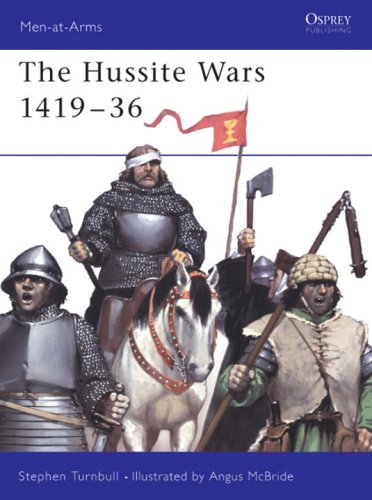
I've mentioned before that the art work of Angus McBride has a powerful pull on my imagination. This cover is no exception. In the Warhammer Fantasy Battle Game and the RPG version, clerics of the Empire are mace and hammer wielding fanatics. Seeing the center character here with one eye bandaged and a mace in hand, I was drawn to the book.
And it is another interesting read, well worthy of a look. I had no knowledge, or at least, direction knowledge, of The Hussite Wars before hand, but I am curious to learn more about them now.
One of the things that stands out to me as a reader and a Dungeon Master, is the enormous effect that individuals of character and charisma and skill have had on the world. The Hussite Wars themselves, take their name from Jan Huss. This is something that happens time and time again in the real world history and it's something I often forget about when looking at designing historical battles for any backgrounds I'm working on.
Not all wars can be the War of the Roses with such symbolism crashing through, but named individuals whose actions and fates, can inspire decades of warfare.
In addition to Jan Huss, the man in the centerpiece here, Jan Žižka, is a military genius of his time, revolutionizing the way battles were fought in his home and winning battle after battle despite only having one eye. Even more determination and grit is shown when he losses the other eye years latter and leads his army for another five years. This is something that in a fantasy book, people might laugh at and go, "Yeah right." But here it has apparently happened with no magic involved. Or course history revisionism is another topic...
But another point of interest about Jan Žižka is his death. He doesn't die on the battlefield. Rather, like several great warrior leaders before him, his death doesn't necessarily involve his profession; he dies of the plague in 1424.
The Hussite Wars bring some interesting bits together and showcase historical weight that will continue to roll down in history. When designing your own settings, if things happen at point X, do those actions have further repercussions down the road? Do people look at the leaders of a bygone era and say, "Yes, they were right and we will continue those works."
Lastly, once again, the strength and importance of religion is hammered home. These Hussite Wars are also Crusades with the Hussites being on the receiving end. Mind you they win these battles but the strength of faith is what starts off wars. Thousands of people killed for the methods of worship. This in turn reminds me of the great job Kate Elliot did with her series, Crown of Stars, and how strong the power of belief, without necessarily clerical magic or any magic for that point, can be.
In many fantasy campaigns, these wars of faith can be somewhat difficult. Some settings like the Forgotten Realms and even Greyhawk, are so brimming with deities that the idea of holy war or heresy on a large scale seems completely against the context of those settings. The best one might be able to do with them, is set up rival deities that can have various smaller rivalries and battles.
In these more intimate battles, the actions of single individuals, like the player characters, come more into focus. Do you want to be one man in an army of thousands, or one hero in a handful that knows of the plots of Shar against Sune?
On the other hand, as King of the North proved, althought briefly, the only thing more impressive than a war of faith is a war of gods. One of the fun things about Palladium Books and their Rift setting is that essentially everything is possible. There are gods, there are fake gods, there are ancient elder entities that had the same roles as some of the other gods and all manners of interesting bits and pieces that some how or another make a near whole. But, if you're looking for religious war fare on a grand and cosmic scale, then a war of Pantheons, where entire countries are moved by gods that are real and do take part of the battles, can be the route to go.
And it is another interesting read, well worthy of a look. I had no knowledge, or at least, direction knowledge, of The Hussite Wars before hand, but I am curious to learn more about them now.
One of the things that stands out to me as a reader and a Dungeon Master, is the enormous effect that individuals of character and charisma and skill have had on the world. The Hussite Wars themselves, take their name from Jan Huss. This is something that happens time and time again in the real world history and it's something I often forget about when looking at designing historical battles for any backgrounds I'm working on.
Not all wars can be the War of the Roses with such symbolism crashing through, but named individuals whose actions and fates, can inspire decades of warfare.
In addition to Jan Huss, the man in the centerpiece here, Jan Žižka, is a military genius of his time, revolutionizing the way battles were fought in his home and winning battle after battle despite only having one eye. Even more determination and grit is shown when he losses the other eye years latter and leads his army for another five years. This is something that in a fantasy book, people might laugh at and go, "Yeah right." But here it has apparently happened with no magic involved. Or course history revisionism is another topic...
But another point of interest about Jan Žižka is his death. He doesn't die on the battlefield. Rather, like several great warrior leaders before him, his death doesn't necessarily involve his profession; he dies of the plague in 1424.
The Hussite Wars bring some interesting bits together and showcase historical weight that will continue to roll down in history. When designing your own settings, if things happen at point X, do those actions have further repercussions down the road? Do people look at the leaders of a bygone era and say, "Yes, they were right and we will continue those works."
Lastly, once again, the strength and importance of religion is hammered home. These Hussite Wars are also Crusades with the Hussites being on the receiving end. Mind you they win these battles but the strength of faith is what starts off wars. Thousands of people killed for the methods of worship. This in turn reminds me of the great job Kate Elliot did with her series, Crown of Stars, and how strong the power of belief, without necessarily clerical magic or any magic for that point, can be.
In many fantasy campaigns, these wars of faith can be somewhat difficult. Some settings like the Forgotten Realms and even Greyhawk, are so brimming with deities that the idea of holy war or heresy on a large scale seems completely against the context of those settings. The best one might be able to do with them, is set up rival deities that can have various smaller rivalries and battles.
In these more intimate battles, the actions of single individuals, like the player characters, come more into focus. Do you want to be one man in an army of thousands, or one hero in a handful that knows of the plots of Shar against Sune?
On the other hand, as King of the North proved, althought briefly, the only thing more impressive than a war of faith is a war of gods. One of the fun things about Palladium Books and their Rift setting is that essentially everything is possible. There are gods, there are fake gods, there are ancient elder entities that had the same roles as some of the other gods and all manners of interesting bits and pieces that some how or another make a near whole. But, if you're looking for religious war fare on a grand and cosmic scale, then a war of Pantheons, where entire countries are moved by gods that are real and do take part of the battles, can be the route to go.
Labels:
Angus Mcbride,
Hussite Wars,
Ospery,
Stephen Turnbull
Thursday, November 4, 2010
The Limits of Specifics
As I continue to read through the Baltic Crusades, too much of it focuses on the weapons. On the knowledge side, it's interesting no doubt. I like seeing how one handed axes and pole arms come together to form big old halbreds. I like seeing that cheap and effective, such as the spear and the 'kettle' helmet continue to work their way through the ages.
But as a role playing piece of information? Unless I'm setting out to historically model a part of the campaign after it, useless. Most fantasy games have this weird pseudo era they take place in where you have all of the latest innovations in armor up to plate mail, but on the weapons side? Well, crossbows are about it. Even though in this book, it notes that guns and cannons started coming in much earlier than most people would normally think of when they think of guns and the middle ages. "It was during the 14th century that gunpowder reached Scandinavia and the Baltic, the Teutonic Knights and Danish armies being relatively earlier than Sweden and Norway in the use of this new technology."
I'm one of those weirdo's who likes guns in his fantasy. Star Wars is space opera. Light sabres and guns and all sorts of great stuff. Thundar the Barbarian isn't some post apocalyptic fantasy, it's fantasy. Sure, you can run into some weird bits when you try to model the accuracy, firing speed, and damage potential of all of the technology, but it doesn't stop fantasy game designers from throwing dozens of variants of swords, maces, and axes in there alongside of armor from cloth and leather to plate armor.
If the guns aren't made too extensive and too overwhelming in their use, their impact on the campaign should be minimal.
This is something everyone needs to determine for themselves of course but it's always been a no-brainer for me. Knights and dueling pistols are a long part of games like Warhammer Fantasy, and even Dungeons and Dragons 2nd edition toyed with them.
I guess part of it for me, is that it's just part of technological evolution. I have a hard time seeing an elf using some compsoite bow after being alive for ten thousand years. Sure, there is magic and it has a huge place, but unless the setting has suffered one massive dark ages apocalypse after another, something that the elves shouldn't have lived through in the first place, their inability to move past the woods is simply annoying.
It's one of the reasons why when I see Privateer Press and the old Rackham elves using what amounts to high technology and magic methodology, that I clap. Those ancient races should be the baddest of the bad. Even if, like Warhammer 40K they're not making newer technologies, their mastery of the old world material should render them like unto gods.
In 2nd edition, outside of the Forgotten Realms and it's brief flitartion with guns, we had Spelljammer. During the various wars between elf and orc, the pace of weapon mastery should have been staggering. While a few prizes of that nature do show up, it's often indicated in the "yeah, that was once long ago." and never seen again.
Eberron takes an interesting approach in that things seem to almost be at an industrial age level but it has come about through magic instead of technology.
Anyway, I'm rambling. While I like some of the ideas in the earlier part of the book, when it starts talking about the sepcifics, they become less useful to me. That may not be true for everyone, but unless you've got a weapons hunger that needs specifics, there's a big chunk of this book you can pass over.
In terms of art, Angus knocks it out of the ballpark. His use of color doesn't overwhelm the eyes. There is one picture in particular, where a group of soldiers is leading their horses through the swamp and the look upon their faces is great. The illustration on the next page looks like it was ripped out of one of his Middle Earth books illustrating a Rider of Rohan speaking to fellows at a castle. Suffice it to say if you enjoy the cover, the interior is more of the same.
Inspiration can come from anywhere but be aware that in some instances, the specifics of a thing will render those parts useless for the specifics of what you want inspiration for.
But as a role playing piece of information? Unless I'm setting out to historically model a part of the campaign after it, useless. Most fantasy games have this weird pseudo era they take place in where you have all of the latest innovations in armor up to plate mail, but on the weapons side? Well, crossbows are about it. Even though in this book, it notes that guns and cannons started coming in much earlier than most people would normally think of when they think of guns and the middle ages. "It was during the 14th century that gunpowder reached Scandinavia and the Baltic, the Teutonic Knights and Danish armies being relatively earlier than Sweden and Norway in the use of this new technology."
I'm one of those weirdo's who likes guns in his fantasy. Star Wars is space opera. Light sabres and guns and all sorts of great stuff. Thundar the Barbarian isn't some post apocalyptic fantasy, it's fantasy. Sure, you can run into some weird bits when you try to model the accuracy, firing speed, and damage potential of all of the technology, but it doesn't stop fantasy game designers from throwing dozens of variants of swords, maces, and axes in there alongside of armor from cloth and leather to plate armor.
If the guns aren't made too extensive and too overwhelming in their use, their impact on the campaign should be minimal.
This is something everyone needs to determine for themselves of course but it's always been a no-brainer for me. Knights and dueling pistols are a long part of games like Warhammer Fantasy, and even Dungeons and Dragons 2nd edition toyed with them.
I guess part of it for me, is that it's just part of technological evolution. I have a hard time seeing an elf using some compsoite bow after being alive for ten thousand years. Sure, there is magic and it has a huge place, but unless the setting has suffered one massive dark ages apocalypse after another, something that the elves shouldn't have lived through in the first place, their inability to move past the woods is simply annoying.
It's one of the reasons why when I see Privateer Press and the old Rackham elves using what amounts to high technology and magic methodology, that I clap. Those ancient races should be the baddest of the bad. Even if, like Warhammer 40K they're not making newer technologies, their mastery of the old world material should render them like unto gods.
In 2nd edition, outside of the Forgotten Realms and it's brief flitartion with guns, we had Spelljammer. During the various wars between elf and orc, the pace of weapon mastery should have been staggering. While a few prizes of that nature do show up, it's often indicated in the "yeah, that was once long ago." and never seen again.
Eberron takes an interesting approach in that things seem to almost be at an industrial age level but it has come about through magic instead of technology.
Anyway, I'm rambling. While I like some of the ideas in the earlier part of the book, when it starts talking about the sepcifics, they become less useful to me. That may not be true for everyone, but unless you've got a weapons hunger that needs specifics, there's a big chunk of this book you can pass over.
In terms of art, Angus knocks it out of the ballpark. His use of color doesn't overwhelm the eyes. There is one picture in particular, where a group of soldiers is leading their horses through the swamp and the look upon their faces is great. The illustration on the next page looks like it was ripped out of one of his Middle Earth books illustrating a Rider of Rohan speaking to fellows at a castle. Suffice it to say if you enjoy the cover, the interior is more of the same.
Inspiration can come from anywhere but be aware that in some instances, the specifics of a thing will render those parts useless for the specifics of what you want inspiration for.
Wednesday, November 3, 2010
The Scandinavian Baltic Crusades 1100-1500
There is so much history out there and the world is so large, that sometimes when you see a word, like Crusade, associate with a different location than you're used to, it perks your interest. Hell, sometimes seeing a favorite artist involved with a project, like Angus McBride, perks your interest.
While I haven't delved very far into the book, a few things struck me as important world building bits from this Northern Crusades material.
One, religion is a huge motivating tool in a society. The author argues that many went on Crusade because it was the 'right' thing to do, not because the royalty and religious powers wanted all of the 'rough' men out of the country during times of peace. There were rewards to be sure, such as having all previous sins, and all those committed on the trail, forgiven, but it was done because it was a 'good' thing.
Two, the use of waterways is so vital that it can help establish not only cultural similarities due to bleed, but is essential in the spread of news. This allows those individuals who are notable and noteworthy to have much greater and more reliable methods of finding out what is going on in the world. In a campaign setting like the Forgotten Realms, news in the Moonsea region, despite the hostility many of those independent city states hold towards one another, probably travels much quicker than it would merely up and down the Sword Coast, which is a huge stretch of coastline.
Three, religious pilgrimage. It's a common enough event for these times but one frought with danger. For example, King eric I 'Ever Good' of Denmark maded an armed pilgrimage to Palestine but did not make it back home.
Four, crusade is often used, at least in the times I've heard it referenced, almost in exclusive contact with the Holy Land. Here, the text makes the distrinction that it's against any religious hersey, even when its against members of the same faith who practice it a different way. Looking at the Forgotten Realms again, the Twilight War by Paul Kemp put this to good use with the sun god unergoing his change at the time and the new face of the faith taking place. The victor of the battles will determine what is the actual heresy. In some fantasy settings, perhaps the followers turn away from their god if the god does physically make new decrees and laws that those of his faith simply do not wish to follow.
Fifth, the environment plays a vital part in any military matters. While it was mentioned in the old mercenary book how one of the commanders used superior tactics involving the surrounding country side through use of scouting and planning, that idea is hammered home again here where the rugged landscape here isn't necessarily one that is suitible for the standard mounted men with the infantry taking a larger and more important role.
When looking at your gaming maps, try to keep in mind what type of armies can realistically funtion there. Now the rough terrain may not be an issue for those who ride griffons or giant eagles. It may not be an issue for those who use flying ships and fortressess. But for those who are using a more earthly campaign or more rooted in standards of reality, when the mountainous terrain and the badlands become too common, the use of horsemen is out.
The Baltic Crusades brings a lot to mind without even getting into the specifics of it. When reading material, try to keep the mind open. Try to think what can be applied to your own campaign. Try to think how you might be able to use the material. Keeping such things in mind as you read may open the campaign in ways you never initially thought about.
While I haven't delved very far into the book, a few things struck me as important world building bits from this Northern Crusades material.
One, religion is a huge motivating tool in a society. The author argues that many went on Crusade because it was the 'right' thing to do, not because the royalty and religious powers wanted all of the 'rough' men out of the country during times of peace. There were rewards to be sure, such as having all previous sins, and all those committed on the trail, forgiven, but it was done because it was a 'good' thing.
Two, the use of waterways is so vital that it can help establish not only cultural similarities due to bleed, but is essential in the spread of news. This allows those individuals who are notable and noteworthy to have much greater and more reliable methods of finding out what is going on in the world. In a campaign setting like the Forgotten Realms, news in the Moonsea region, despite the hostility many of those independent city states hold towards one another, probably travels much quicker than it would merely up and down the Sword Coast, which is a huge stretch of coastline.
Three, religious pilgrimage. It's a common enough event for these times but one frought with danger. For example, King eric I 'Ever Good' of Denmark maded an armed pilgrimage to Palestine but did not make it back home.
Four, crusade is often used, at least in the times I've heard it referenced, almost in exclusive contact with the Holy Land. Here, the text makes the distrinction that it's against any religious hersey, even when its against members of the same faith who practice it a different way. Looking at the Forgotten Realms again, the Twilight War by Paul Kemp put this to good use with the sun god unergoing his change at the time and the new face of the faith taking place. The victor of the battles will determine what is the actual heresy. In some fantasy settings, perhaps the followers turn away from their god if the god does physically make new decrees and laws that those of his faith simply do not wish to follow.
Fifth, the environment plays a vital part in any military matters. While it was mentioned in the old mercenary book how one of the commanders used superior tactics involving the surrounding country side through use of scouting and planning, that idea is hammered home again here where the rugged landscape here isn't necessarily one that is suitible for the standard mounted men with the infantry taking a larger and more important role.
When looking at your gaming maps, try to keep in mind what type of armies can realistically funtion there. Now the rough terrain may not be an issue for those who ride griffons or giant eagles. It may not be an issue for those who use flying ships and fortressess. But for those who are using a more earthly campaign or more rooted in standards of reality, when the mountainous terrain and the badlands become too common, the use of horsemen is out.
The Baltic Crusades brings a lot to mind without even getting into the specifics of it. When reading material, try to keep the mind open. Try to think what can be applied to your own campaign. Try to think how you might be able to use the material. Keeping such things in mind as you read may open the campaign in ways you never initially thought about.
Tuesday, November 2, 2010
Condottiere: More Thoughts on Mercenaries
While reading over Condottiere, one of the things I found interesting, is that part of the influx of mercenaries comes from soldiers that fought during the Hundred Years War. In your own campaigns, if there have been large battles recently, what happens to the soldiers after the wars are over? Even in today's 'modern' society, there are difficulties making sure that those who served in war time are treated right when they come home. How much harder in a society that has not the modern lifestyel or the modern thinking?
But all things turn. Even as the mercenaries rose from outside sources in Italy, they fall to outside sources that have adopted to war quicker and with more efficiency than those in Italy. The rise of national armies against divided city states proves one method superior to the other.
In terms of mercenary use, when the land is rich with them, different methodologies may crop up. Much like discussions of Democrats and Republicans in American society, these teachings tend to break into different factions and are almost politics in and of themselves. When crafting some of the background of the setting, think about some simple philosophies that different mercenary companies would follow and how they interact with each other.
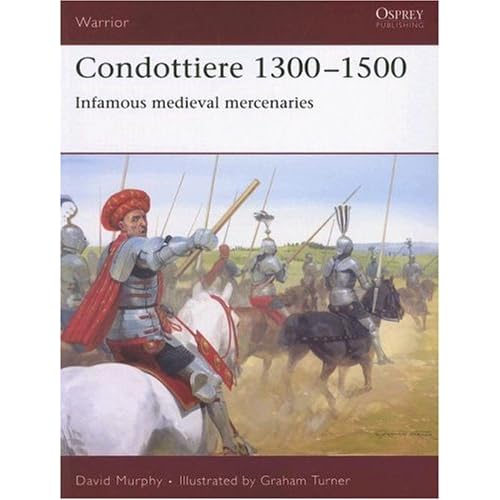
In terms of Graham Turner's art, he's good. His work lends a solid feeling that isn't fantastical but is stylized. If you like the cover, which is from the battle of San Romano, 1432, then chances are you'll enjoy the interior art by him as well.
Lastly, I'd like to mention the cover. The commander isn't wielding a sword. Instead, he's wielding a batton, an instrument to denote his rank and his leadership. In a game with magical items, something that augmented command or charisma or allowed a user to influence a large group of soldiers, wither issuing them commands, fortifying them from magical fear, or showcasing the user's own ability, would be desirable and perhaps even common to those with the funds to purchase them.
When I look at different books for ideas and inspiration, I'm also looking for different ways and methods I might use that inspiration in the first place. Of course in a historical material, there would be no magical rods of command, but it's an old school magical item and fits the theme well.
When looking at material, try to think about not only what its teaching or its original use is, but how it may beenfit in different ways than originally intended.
For example, what if the humanoid hordes are finished with their wars and instead of turning on the humans, seek out employeement with them by the thousands? Instant mercenary armies. And if what the book mentions here is true, there would be many parallels. For example, the mercenary armies were often devastating to the surrounding landscape, engaging in acts of pure carnage and rapine of both land and people. At the same time, the employers of the mercenaries were often worse, assassinating the leaders and refusing to honor the contracts that they themselves had drafted.
Now with hobgoblins, orcs, and other races doing these vile acts, the poor treatment of the employees almost seems justified eh? A few tweaks here and there and things like half-orcs and half-hobgoblins become that much easier to explain. A history of hogoblin nobles arising from their mercenary roots becomes more tangible. An integration of these races to the setting, only to have them crushed later by other national armies, becomes part of the background.
But all things turn. Even as the mercenaries rose from outside sources in Italy, they fall to outside sources that have adopted to war quicker and with more efficiency than those in Italy. The rise of national armies against divided city states proves one method superior to the other.
In terms of mercenary use, when the land is rich with them, different methodologies may crop up. Much like discussions of Democrats and Republicans in American society, these teachings tend to break into different factions and are almost politics in and of themselves. When crafting some of the background of the setting, think about some simple philosophies that different mercenary companies would follow and how they interact with each other.
In terms of Graham Turner's art, he's good. His work lends a solid feeling that isn't fantastical but is stylized. If you like the cover, which is from the battle of San Romano, 1432, then chances are you'll enjoy the interior art by him as well.
Lastly, I'd like to mention the cover. The commander isn't wielding a sword. Instead, he's wielding a batton, an instrument to denote his rank and his leadership. In a game with magical items, something that augmented command or charisma or allowed a user to influence a large group of soldiers, wither issuing them commands, fortifying them from magical fear, or showcasing the user's own ability, would be desirable and perhaps even common to those with the funds to purchase them.
When I look at different books for ideas and inspiration, I'm also looking for different ways and methods I might use that inspiration in the first place. Of course in a historical material, there would be no magical rods of command, but it's an old school magical item and fits the theme well.
When looking at material, try to think about not only what its teaching or its original use is, but how it may beenfit in different ways than originally intended.
For example, what if the humanoid hordes are finished with their wars and instead of turning on the humans, seek out employeement with them by the thousands? Instant mercenary armies. And if what the book mentions here is true, there would be many parallels. For example, the mercenary armies were often devastating to the surrounding landscape, engaging in acts of pure carnage and rapine of both land and people. At the same time, the employers of the mercenaries were often worse, assassinating the leaders and refusing to honor the contracts that they themselves had drafted.
Now with hobgoblins, orcs, and other races doing these vile acts, the poor treatment of the employees almost seems justified eh? A few tweaks here and there and things like half-orcs and half-hobgoblins become that much easier to explain. A history of hogoblin nobles arising from their mercenary roots becomes more tangible. An integration of these races to the setting, only to have them crushed later by other national armies, becomes part of the background.
Labels:
Campaigns,
Condottiere,
Game Master,
Graham Turner,
Ospery
Monday, November 1, 2010
Condottiere 1300-1500: Infamous medieval mercenaries
I wish I could say that I'm an armchair scholar. But I'm not. Way too lazy for that sort of research a lot of friends I know who can spout off bits and facts like rapid fire machine guns.
But in the modern era, when I want some information on something, I generally know where to look. For example, if I want a thin book with some, usually, great art in it, about a caste of a certain warrior type, I'm pretty sure Osprey Publishing will have it.
I've long had an interest in mercenaries on the battle field. Part of this is from the old book The White Company, part of it when I discovered Glen Cook's The Black Company, and part of it when I discovered Berserk and Griffin's Band of the Hawk. Each one organized around mercenaries.Other books, like the ones written by Elizabeth Moon, have used mercenaries,
Gaming books, ranging from AEG's own Mercenaries book to various other third party resources, like Born of Blood, have also been around. Although my memory does kick in and say, "Hey dude, the Flaming Fist." Yeah, I remember running many a Forgotten Realms campaign where the Flaming Fist were foes of the party, maily because the party memebers were always after new magic items and the quick way to get such items was to attack any NPC that might have 'em. Ah, the glory days of youth.
I haven't finished the Condotteire yet, but it made me curious enough to see what Wiki had to say on the subject. One thing I found fascinating, is that these mercenary armies, essentially in this book and resource if I'm reading it correctly, crop up to a very unique set of cirumstances. This gets into world building. When plotting out the dominos, make sure you know where things are likely to fall.
In terms of ideas, one of the things I like is the idea of a charter, so that these mercenaries can be identified and are not 'mere' mercenaries, but are condottiere.
Another idea I like is the use of famous mercenaries as statues or cast on gold coins. It doesn't always have to be a local member of the nobility, the religious caste, or some weird monster. Powerful individuals that can take a city get recognized here.
Lastly, I like the idea of collaterali. These individuals werestate official who oversaw the use of payment to the mercenaries. He was the one who oversaw the contracts. He was the one who overwent the 'daily admnistration of the mercenary armies.' Need to know how many men are in the army? Need to know what type of weapons they have? Need to know what level of training they have? Can't trust the mercenaries to be truthful so you have to have you own man on the inside job there.
And this is true today. In many instances, the stock market is a huge gamble that the goods and services these companies are offering are real. I've read many a 'bust' that happened because the promised goods weren't there. If that is happening know, where we have all of this digital technology about us, imagine how much easier it would be in a place where a famous soldier would be unknown in another country?
To prevent abuse it woudl require mercenaries that fully honored their contracts or collaterali who were so trustworthy that they'd likely be killed. I can easily see a game where a group of players, acting as collaterali, discover that the mercenaries in their lords employee are a sham but have enough strength to take down the players if they're not careful about how they go about reporting it. On the other hand, I've dealt with enough players where I can see them taking the mercenaies side and for a side cut of the gold, selling out the defense of the kingdom by falsifying units, weapons, and training that doesn't exist.
Imagine some lord's horror when the ogres attack and those mercenaries that do show up do so in ratty leather armor with spears instead of on horseback with shinny plate armor and bright lances? The players might have a little explaining to do at that point.
But in the modern era, when I want some information on something, I generally know where to look. For example, if I want a thin book with some, usually, great art in it, about a caste of a certain warrior type, I'm pretty sure Osprey Publishing will have it.
I've long had an interest in mercenaries on the battle field. Part of this is from the old book The White Company, part of it when I discovered Glen Cook's The Black Company, and part of it when I discovered Berserk and Griffin's Band of the Hawk. Each one organized around mercenaries.Other books, like the ones written by Elizabeth Moon, have used mercenaries,
Gaming books, ranging from AEG's own Mercenaries book to various other third party resources, like Born of Blood, have also been around. Although my memory does kick in and say, "Hey dude, the Flaming Fist." Yeah, I remember running many a Forgotten Realms campaign where the Flaming Fist were foes of the party, maily because the party memebers were always after new magic items and the quick way to get such items was to attack any NPC that might have 'em. Ah, the glory days of youth.
I haven't finished the Condotteire yet, but it made me curious enough to see what Wiki had to say on the subject. One thing I found fascinating, is that these mercenary armies, essentially in this book and resource if I'm reading it correctly, crop up to a very unique set of cirumstances. This gets into world building. When plotting out the dominos, make sure you know where things are likely to fall.
In terms of ideas, one of the things I like is the idea of a charter, so that these mercenaries can be identified and are not 'mere' mercenaries, but are condottiere.
Another idea I like is the use of famous mercenaries as statues or cast on gold coins. It doesn't always have to be a local member of the nobility, the religious caste, or some weird monster. Powerful individuals that can take a city get recognized here.
Lastly, I like the idea of collaterali. These individuals werestate official who oversaw the use of payment to the mercenaries. He was the one who oversaw the contracts. He was the one who overwent the 'daily admnistration of the mercenary armies.' Need to know how many men are in the army? Need to know what type of weapons they have? Need to know what level of training they have? Can't trust the mercenaries to be truthful so you have to have you own man on the inside job there.
And this is true today. In many instances, the stock market is a huge gamble that the goods and services these companies are offering are real. I've read many a 'bust' that happened because the promised goods weren't there. If that is happening know, where we have all of this digital technology about us, imagine how much easier it would be in a place where a famous soldier would be unknown in another country?
To prevent abuse it woudl require mercenaries that fully honored their contracts or collaterali who were so trustworthy that they'd likely be killed. I can easily see a game where a group of players, acting as collaterali, discover that the mercenaries in their lords employee are a sham but have enough strength to take down the players if they're not careful about how they go about reporting it. On the other hand, I've dealt with enough players where I can see them taking the mercenaies side and for a side cut of the gold, selling out the defense of the kingdom by falsifying units, weapons, and training that doesn't exist.
Imagine some lord's horror when the ogres attack and those mercenaries that do show up do so in ratty leather armor with spears instead of on horseback with shinny plate armor and bright lances? The players might have a little explaining to do at that point.
Labels:
Campaigns,
David Murphy,
Game Master,
Graham Turner,
Mercenaries,
Ospery
Wednesday, October 27, 2010
Warriors & Warlords: The Art of Angus Mcbride
Art has always been a powerful motivator for me in terms of creative thinking. It has served as a shared medium among friends when I use an illustration to show something instead of explaining what something looks like.
Among those artists whose skills I find to tweak my particular taste, Angus McBride is right up there. I probably first saw his work, as many fantasy role players might have, in I.C.E.'s old Middle Earth line. Angus seemed to do a lot of work for I.C.E. back in the day, even covering their Rolemaster line with a series of great illustrations using the same characters for each cover.
The strength of the art, for me, is that it looks 'real'. While some artist like Wayne Reynolds are popular today, and they do pieces I enjoy, don't mistake that, I find that sometimes the art is so far from the subject matter that it makes it actually harder to relate to the art and the subject as opposed to easier.
When Angus illustrates two miles, the Latin term for warrior, and shows two French miles with mail hauberks and large Norman shield with spear and sword, he also includes a peasant on the side with an axe whose son is arming a hunting crossbow. In the background a bird flies easily while out at sea, gulls swarm around a boat. Some might find it too mundane, too earthly. However, perhaps due to some of my own roots as a fan of older sword and sorcery material, ranging from Conan and Fafrd, I'm okay with not every illustration being some crazy horned woman whose body couldn't exist in the real world due to the exaggerated pose.
The art of Angus is well worth a look, especially if you can find his fantasy based material. The only problem you might have though is that it appears some of it goes in and out of print. The Warriors and Warlords book for example? It's out of print. While it's not deep on details, it does have enough to speak the imagination as well. When players come up with terrible sounding names, a quick look through the historical section shows that we have such naming conventions as Alexander the Great, El Cid, Sala al Din Yusif ibn Ayyub known as The Victorious, pr Sa;adom. 'Arthurian Age', the ship names Long Serpent or Iron Beard... these are real names. If they can exist, how silly is Rus the Red or something along those lines?
Anyway, if you're looking for inspiration or how things might have been and how they might have looked, The Art of Angus Mcbride should be right up there on your reading list.
Among those artists whose skills I find to tweak my particular taste, Angus McBride is right up there. I probably first saw his work, as many fantasy role players might have, in I.C.E.'s old Middle Earth line. Angus seemed to do a lot of work for I.C.E. back in the day, even covering their Rolemaster line with a series of great illustrations using the same characters for each cover.
The strength of the art, for me, is that it looks 'real'. While some artist like Wayne Reynolds are popular today, and they do pieces I enjoy, don't mistake that, I find that sometimes the art is so far from the subject matter that it makes it actually harder to relate to the art and the subject as opposed to easier.
When Angus illustrates two miles, the Latin term for warrior, and shows two French miles with mail hauberks and large Norman shield with spear and sword, he also includes a peasant on the side with an axe whose son is arming a hunting crossbow. In the background a bird flies easily while out at sea, gulls swarm around a boat. Some might find it too mundane, too earthly. However, perhaps due to some of my own roots as a fan of older sword and sorcery material, ranging from Conan and Fafrd, I'm okay with not every illustration being some crazy horned woman whose body couldn't exist in the real world due to the exaggerated pose.
The art of Angus is well worth a look, especially if you can find his fantasy based material. The only problem you might have though is that it appears some of it goes in and out of print. The Warriors and Warlords book for example? It's out of print. While it's not deep on details, it does have enough to speak the imagination as well. When players come up with terrible sounding names, a quick look through the historical section shows that we have such naming conventions as Alexander the Great, El Cid, Sala al Din Yusif ibn Ayyub known as The Victorious, pr Sa;adom. 'Arthurian Age', the ship names Long Serpent or Iron Beard... these are real names. If they can exist, how silly is Rus the Red or something along those lines?
Anyway, if you're looking for inspiration or how things might have been and how they might have looked, The Art of Angus Mcbride should be right up there on your reading list.
Subscribe to:
Posts (Atom)