Showing posts with label Campaign Design. Show all posts

Sunday, March 26, 2017

The Flame Bearer (Saxon Tales Book 10) by Bernard Cornwell


The Flame Bearer
Saxon Tales Book 10
Written by Bernard Cornwell
$13.99 at Amazon (Hardcover)
304 pages

The Saxon Tales, also known as The Last Kingdom Series,  reaches its conclusion in a fast paced tale that I finished in a few hours of morning reading.

As with many books by Bernard Cornwell, he captures the period regarding plausible events, characters, and overall mood through the description of the people and places that our main viewpoint character, Uthred.

In this novel, seeds were sown so long ago, bear fruit as the main thrust of the tale is Uthred and his final battle against his cousin, also named Uthred.

If you enjoy books in this era of Viking savagery upon English shores, this will be a quick read.

But what can you pull from it for your games?

Religion Matters: Uthred is a pagan. He worships the gods of the Vikings. Most of those in England? The Saxons who themselves were once pagans? They worship the 'Nailed God'. The clashes between forces are not merely over land and titles but over religious strength and culture.

Stories Matter: The title of the book, The Flame Bearer, originates with one of Uthred's ancestors who came from across the sea and took over the castle that Uthred would, hundreds of years later, grows up in. The parallels between what has happened and what will happen, are clear and meant to inspire Uthred's men even as it demoralizes his enemies.

Languages Matter: Uthred is a man with friends all over the world and knowing a few languages helps him avoid situations he might not be able to otherwise. While some fantasy settings overcome this with 'Common Tongue', there are often options that are inherent in the game that players don't necessarily take advantage of. In the Forgotten Realms, for example, the Common in Kara-Tur is different than the common in Al-Qadim is different than the Common in the more common part of the realms. Old editions used to give special languages like alignment tongue as well as thieves cant among others. Players should never underestimate the power of having a unique or near unique style of communication including sign language.

On the other hand, the GM shouldn't hesitate to have NPC's have their own methods of communication. Drow have their own 'common' tongue and others from different planes may have their own manner of communication. Star Trek the Next Generation did a fantastic episode where the geist of merely trying to communicate lasted the whole episode.


Factions Matter: Uthred has made more than his fair share of enemies and allies through the ten books in the series. This sometimes involves his enemies coming together against him. The good news? Sometimes there are foes outside of that original circle who attack each other. Having factions that don't necessarily make their presence known every game session and every encounter make the world larger and more dangerous, more random than it normally is. Sometimes these elements should work in the players' favor and sometimes against them. The enemy of the enemy is not always your friend after all.

Time Moves On: Uthred has been fortunate to live through numerous enemies and unfortunate enough to watch allies and even dearly loved ones pass on. His religious upbringing gives him pause when a foe is about to die, to ensure that if a warrior, he dies with a weapon in his hand.

As time moves on, though, the world changes. If your campaigns consist of more than dungeon crawls, how is time moving on effecting the world? Uthred has children, one deceased, one married to a former enemy now an ally, and one about to be married to the daughter of an enemy.

England itself, once almost entirely overcome by the Danes, has struggled back from the brink of being overcome to being almost entirely run by the Saxons and uniting under one 'England' banner.

The players can be the center point of the campaign, but the world itself will continue to move on in ways outside their direct control, outside their direct influence. And they should want to be a part of that.

The Flame Bearer has a lot going for it and it is a fitting end to Uthred's sage. Now if only Benard will continue that with Uthred's son also named Uthred...


Saturday, October 8, 2016

Back In The Saddle Again

With apologies to Aerosmith.

So one of my friends was running a Rolemaster Fantasy Game. That's the Rolemaster version after the Rolemaster Standard System. But he wanted some more time to get some ideas fleshed out and get some more world building done.

I volunteered to run either Pathfinder in the official setting or 3.5 in the Forgotten Realms.

A bit of debate and some sidebars and blah blah blah, and it went with 3.5 in the Forgotten Realms.

I generally know what I like when I put together my campaign ideas. So some of the first things discussed were starting level, 3rd, starting gold, official for 3rd level, hit points, max, no rolling, character creation, 32 point buy per the Dungeon Master's Guide.

With that out of the way, I started to organize my collection. I haven't run anything in any real capacity in years. My books are vastly out of place. Some of them in storage even. So while I'm organizing, I'm also brainstorming ideas.

I like the Sword Coast. I like the North. Not a big fan of the Dales, Cormyr, Thay, or the whole Amn region. I decide on the Sword Coast. Hey, turns out I bought Murder In Baldur's Gate many moons ago and never had a chance to run it or even open it.

Awesome screen. Two booklets, one adventure, one campaign setting information. Read over the adventure. For first level players. I throw some of the things that happened in the adventure into the background ideas I'm weaving together. The setting booklet I keep as a reference point for the good stuff like bars, churches, important characters, important bits like Little Calisham, etc...

During my clean up, I also run across the Solomen Guild. I really need to do a 'real' review of that one day because it's a fun little thieves guild product. While Baldur's Gate does have an "official" guild, who cares? I throw some of the ideas of what these thieves do into the city and plot to have the characters harassed as an early encounter.

I suspect that the players will not give the thieves a few gold to be left alone and rather, attack the guild members. This allows me to get the game rolling with some combat encounters as well as refresh my memory of how the game MOVES as opposed to how it reads. It's been years since I've run a game after all.

By the way, this worked perfectly. The party realized they were being observed, called out the thieves; thieves asked for a small donation from the newcomers to the city and glorious combat ensured. A few of the thieves escaped and now the players are 'wanted' men by the Solomen Guild.

Another thing I did while cleaning, organized my books by companies. One of those companies is Green Ronin. I used to buy pretty much everything Green Ronin put out in the day. Well, to be fair, a lot of that was review products when I was doing a ton of reviews. One of those items? The Secret College of Necromancy!

Baldur's Gate has a long association with Bhaal, one of the 'evil' gods of the setting. So why not a college of necromancy? Even better, one of the already existing NPC's is always on the lookout for adventurers to guard him/escort him while he does his research.

And one of the notes in Murder in Baldur's Gate? Some tombs have recently been unearthed on the cliff face! Instant scenario. A little exploration, a little fighting against some ghouls, a little exploration of the city, and bam, first game session done.

Several NPCs introduced to the party, several ideas put out, several future adventure options put out. Oh, and I also threw an evil sword from an old Role Aids supplement, Blood & Steel, into the mix to give the players a bit of punch and worry about what others are looking at when they look at the characters.

In between the organization and reading, I've also been painting up miniatures. By skipping the first few levels, I'm trying to move away from goblins, kobolds, giant rats, orcs, and other too familiar foes. I've got gnolls, bugbears, ogres, and minotaurs on the painting block along with some gargoyles, so I already have an idea of where I'm "pushing" the new few encounters.

Hope everyone else games are going well!


Tuesday, August 30, 2016

The Eagles' Brood (Gaming Edition)

The Eagles' Brood
Written by Jack Whyte
Book 3 of the Camulod Chronicles
Price: $25.99 ($16.04 at Amazon)
Historical Fiction/Fantasy (Arthurian)
Pages: 623 (mass paperback)


Author Jack Whyte, author's website here, http://www.jackwhyte.com/ , has a lot of great bits in volume three of the Camulod Chronicles that anyone running a role playing game, ranging from Pendragon to Dungeons and Dragons and other games, can snag for their own campaigns.

Religion: Religion can be a tricky subject in role playing games that have a historical origin. However its important to note that even now, in 2016, people living today do not believe as people living one hundred years ago did.

Expand that out to hundreds of years ago, or thousands, or in a fantasy setting where the gods are real entities, and well, the subject of using religion in and of itself should be a no-brainer.

In The Eagles' Brood, there are two separate times that religion takes center point in a manner that should be incorporated into a RPG.

1. Funeral Celebration: When Merlyn's father, the son of one of the founders of the colony, of Camulod itself, is slain by assassins, the colony's morale is damaged. Merlyn is encouraged to set his father aflame, as the old tributes to Mithras, who was the Roman god of soldiers. This burning was like the bit in the Lord of the Rings, The Return of the King, where the keeper of the crown calls for he and his son to be burned like the kings of old!

In doing this, Merlyn makes his father more than a leader, he makes him into a martyr. He makes him into a hero. He makes him into a legend.

This turns the funeral into one that was somber and of despair into one of joy and triumph. 

2. Religious Schism: The second scene, is when Merlyn decides to visit a gathering of priests who are set to debate religion, or at least, Christian religion itself. History is sadly full of wars waged in the name of the "right" religion. A lively debate is far easier to handle. 

In a fantasy game, this isn't as hard to do as it may seem. In the Forgotten Realms, the Sun God has two identities. During the Twilight War, written by Paul S Kemp, the religion is changing at the time. It is going from one face of the Sun God to a harsher face.

In other venues of a pantheon, there could be discussion if the gods even exist at all. While in some settings like Planescape or the Forgotten Realms, the evidence may be obvious, in others like Eberon, it may not be so obvious.

Even in deity rich settings like the Forgotten Realms, some gods like Ao, a god above gods, may not want mortal worshipers, even actively discouraging them by providing their clerics with no power and never answering prayers. 

But why use such a thing in the first place? What is it going to bring to the campaign?

If you've ever run a campaign, especially a fantasy one or a space opera one, there is an old stereotype about "the bar" as a place for all characters to be.

But what if all the characters meet at one of these events? What if there is a gathering to discuss apostates and heresy? What if certain factions are cast out of the clergy itself? Are any of the player's some odd class that might be effected? Have worshippers of the god Tempus declared that psioncis are anathema to their cause and all psionic using professions be slain on sight?

Or what if the characters are all effected in some manner, by the death of a great hero whose funeral has been declared a holiday through the city? While the background of meeting in a bar might still remain true, the background why the characters are there, can be a little more varied. One could be a grandson, proud of the sacrifices made by his grandmother. Another could be a student from a school founded by the deceased hero. Others might be drawn near to hear tales of this character's greatness and to draw strength and inspiration from it.

And as an adventure seed, perhaps others are not so pleased and decide to attack on this holiday, leaving the players the only ones in the vicinity to halt this blasphemy. 

To make it even more interesting, you can have the attack lead by another student, one who was not impressed by this "false" hero, one whose so upset that they died because it proves all of their teachings were in vain and that other methods, harsher methods, must be embraced. 

It also provides the Game Master with reasons why high powered or well placed individuals might be around. The players may have social reason to be within reach of the powerful and well placed and well, if your players are anything like mine have been, there will be many a tale from that in and of itself that could provide hours of amusement.

Another thing that you can add to the campaign setting to make it more unique, is a new "site" or a new monument to the fallen hero. Characters may recall the first time they came together as a group over that monument and spill a decanter of wine to the fallen hero. They may assemble together every year during this holiday to forgive and forget old trespasses. 

Religion has a myriad of uses in a campaign setting and the Game Master should be on the lookout for every opportunity to utilize them and make his own gaming easier. 

Sunday, August 10, 2014

Leftover Soup Webcomic and the Class of Setting Creation

I tend to read a lot of web comics. One of them, Leftover Soup, http://www.leftoversoup.com/, has some gamign involved along with the other bits.

In the current series, the group is sitting down and discussing their characters and the background of the setting itself is coming into the forefront of the game. Mind you, this is even BEFORE they've started their characters or started out down the road of playing.

It's not going well.

There are certain assumptions built into the campaign that some of the players find distasteful for different reasons and none of their reasons are inherently bad in and of themselves, they just clash with the assumed nature of the campaign.

This is interesting to read as both a GM and a player. As a GM, I'm currently setting up a super hero setting for Hero 6th edition. I had the players start off with 500 points (includes 75 for disadvantages) but depending on what they make, may kick it up higher.

It's a  world where it assumes a lot of things in comics are correct.

Like what?

Well, world population would be down, in some instances fairly dramatically from invasions from space, other planes, alternative universes, etc...

The technology level would be higher, almost universally sci-fi. Heck, if you look at the things they are testing NOW in 2014, it seems that things are very sci-fi.

Massive surveillance state which effectively ends the ability for players to have secret ids unless they have a really good reason/excuse for it. Part of this may be living in Chicago where speed cameras, red light cameras, and dozens of other bits of surveillance technology are a hated, but well, accepted part of daily life.

Magic and psionics and gods are known to exist. Most of these are still 'unknown' for the most part as I've decided that most pantheons left Earth for the stars as mankind continued to move up the ladder and magic never lends itself well to mass consumption.

Fights between groups of supers are potentially very damaging to the nearby environment. Imagine if in Man of Steel, that was a weekly, or a monthly thing. How many billions would it take to repair? Would it even be possible? Would society itself be set back to the stone age after enough such battles?

Bit of 'false utopia' going on, nicked in part from movies like the recent Captain America Winter Soldier, to shows like Minority Report and Psycho Pass where society is able to use predictive technology. I know that again, it may seem sci-fi, but a lot if it is actually in use now: http://www.cnn.com/2012/07/09/tech/innovation/police-tech/

There are some other bits I'm working on. I'm thinking that I'd snag a bit of the recent Guardians of the Galaxy storyline where Earth was essentially marked off limits. The reason being is that in most comic series, it has WAY more value than a dirt ball should and I think Green Lantern's take of things, during the whole Black Lantern War, is a good reasoning for the significance of it.

The 'fun' part? I told the players to be inspired by the Fate system and come up with what the current menace is, what the future menace is, and how their characters know each other and how they'll be working. I've left a lot of options open to them ranging from fighting against the system to working for the system to being agents of Earth on the reaches of outer space.

So yeah, as I read Leftover Soup and see the players arguing, intelligently, their points, I wonder what I'm going to run into with my own players. Mind you, as I've giving them a bit of the world building handles in terms of characters, NPCs, etc..., I think it'll be a little smoother.

As a game master, have you ever run a campaign where you had conflict with the players about it? I find that I try to appreciate a campaign for what it is as opposed to what I think it should be. I'm not always successful mind you as most fantasy campaigns, especially as I get older and read more, tend to make me annoyed. Vikings alongside English flavored Bowmen alongside German styled knights in full plate alongside sword and sandal barbarians alongside wizards and in most cases, it's 'guns' that are seen as too technologically advanced.

Ugh.

Still, I tend to keep that part of my brain off and admit that when I do my own in house writing, I tend to avoid them as well. I think it's just the dissonance of the gun versus the sword.

Ah well, back to enjoying a lazy Sunday!


Sunday, February 2, 2014

The Coffee Trader by David Liss: Round 2!

David Liss writing impresses me. He's able to distil the dozens of books and events he uses for research and condense it down into a historical novel that rings authentic with characters that are not perfect and who do not escape their machinations unscathed.

I would heartily recommend anyone looking for a well written historical to pick up any of his books and if they were interested in how commerce of this era worked, to give The Coffee Trader a read.

I'll be discussing specific spoilers below and how they might influence a role playing game so if you'd read none of those, look no further.

Scenario Reversal: 

The main character of the novel, Miguel Lienzo, is motivated by many things. For example, he doesn't want to be poor. He wants to be a good Jew. He wants to avoid being entangled in the webs of others who may wish him ill. For the most part, these motivations and desires don't cross the border into wishing others ill save when they cross him.

This leads him, while pursuing his goals, to, unknowingly mind you, to crush a woman who might have been his friend, to have a former ally crippled, and to turn away the friendship of a man he'd wronged in the past. It also sets him in a villainous light as his deeds, while indeed making him a small fortune, destroy the fortunes of his brother, and indeed, were set up to damage a man who sought to be his friend.

The depths of his being manipulated are thought provoking for me. For example, while he speaks to Hendrick, a burly enforcer, about handling some violence for him, the price offsets him which works for the better. The man he would have had beaten instead winds up turning Miguel's fortunes around and they part as friends.

Until Hendrick needing money does the deed anyway and demands the payment. This crippling beating he puts on Migel's associate costs Migel the associate, who flees the city, as well as a high cost that was initially discussed.

His involvements in other fields are also turned around so that many of the 'good' things he thought to do, to be virtuous, to be the 'hero' are turned in a negative fashion. So much so that the ending is a downer of sorts even as it has its ups.

It's complex layers can be difficult to bring to a role playing game.

I guess my rambling would boil down to, if the heroes don't enjoy success in all of their endeavors, find the ones that matter most to them and allow them victory there, but not without cost in other venues that their character motivations have treasured in the past.

Religion


Much of the novel involves the lives of the Jews in Amsterdam.  As I mentioned last post, there is not a single unity in the Jewish community, but for the most part, one ruling body.

But it doesn't control everything. For example, when someone is excommunicated from the main body, there are still some small groups that will allow the services and prayers to be done as long as they are not in the spotlight. These schisms can be small but eventually become their own religion.

Languages

Most role playing games use Trade Tongue to make things simple. They use it because it allows all of the players to start the game on essentially equal footing and not have to use precious character resources to spend on something that is essential to all of the players in order to communicate.

The novel takes place in Amsterdam. Here there are several languages spoken but because of arrogance and thinking less of others, sometimes people would speak their mind without knowing that those around them can understand their schemes.

If your setting has multiple languages, which most do, occasionally have the NPCs speak in those different dialects when they wish to keep things secret from the characters. Those who don't speak the language may remember a word or phrase but miss out on the meaning while those who do may either show their hand that they do speak the language, or in future dealings have a translator around whom they trust, perhaps one who is not introduced as such to give them a hand in future dealings.

Metropolis

Taking place in Amsterdam, the novel makes mention several times of the different faiths and people that meet and do business in the city. This is possible because the people allow the Jews to do their thing, and allow the Catholics, whom they defeated, to remain and do their business as long as they do not go out of their way about it.

This makes the city a melting pot of many cultures and faiths, which stretch across cultures. Most fantasy settings tend to have several large city states that encapsulate the entirety of the setting in a microcosm. Don't be afraid to throw some different things into the setting when it makes sense to do so.


The Coffee Trader is available in Kindle format for $9.99 or in trade paperback for $12.34 and Amazon prime eligible.

Thursday, January 30, 2014

THe Desert Spear by Peter V Brett: Book 2 of the Demon Cycle

I enjoyed the Warded Man so much, that I jumped onto The Desert Spear with no hesitation. The book is longer and adds more characters and more magic to the Demon Cycle. But in the hands of a skilled story teller like Peter V Brett, this is a good thing.

The book breaks us into the world of Jadir, the man who in the previous novel, betrayed Arlen, leading that Messenger to become the Warded Man. He did so with regrets as he considered Arlen his friend, and near equal.

The focus on Jadis feels a little like the retelling of one of the old Eternal Champion stories by Michael Moorcock as events we've already seen happen again from a different viewpoint. Mind you, this only happens in a handful of places and the shift in point of view is welcome.

The bad news, is that even though Jadir himself has trama and a disturbing background, his likeability suffers quite a bit due to his role as semi-antagonist. I say semi because if readers don't see an eventually alliance between those of the Desert and those of the North against the demons, we'll, we've all been lied to in how these sorts of stories work out.

Using Jadir as a view point character provides the reader with a lot of insight into his people's culture. The need and desire to fight against the demons isn't just for survival, but for religious reasons. Those who do fight gain great honor but die young. This tends to make the culture warrior based with the warriors gaining essentially supreme power over all other caste save for the religious and a few specialists, like the woman who becomes Jadir's wife.

By bringing Jadir's life, who is probably the oldest protagonist in the series, we see a little more of the magic of the south. Unlike the Greenlanders, the wise women of the south are not herbalist, but they do have knowledge. That knowledge though, takes the form of carving demon bones with wards and using other parts of demons for different effects including telling the future.

In addition to Jadir, we also get Renna. This young woman, like Jadir, was introduced in the previous novel and her presence here feels a little like Rojer who I feel still has a ways to go before he gets up to the Warded man's importance or enjoyability. Renna, like almost every character here, suffers some horrific setbacks in her life but by allying herself directly with Arlan, the Warded Man, she starts to take after him and begins to ward herself and learn his ways.

The original trio of characters are here and continue their story arcs, continuing to grow in knowledge and experience. It's a great set up and provides a lot of tense moments as the characters learn that many of the demons they've been fighting, and humanity as a collective whole has been losing against, are not the worst that the 'core' has to throw at them.

I'm going to hunt through Half Priced Books for the next volume, but if they don't have it, it'll be a quick trip to the Barnes & Nobles for me as Peter V Brett's writing continues to engage.

On a separate note, just because I found it entertaining, Peter V Brett has a Dungeons and Dragons character sheet on his website. In addition, his bio talks about his enjoyment of the game. His books have also been optioned for movies. Keep an eye on this guy peeps!

Below I'm going to talk a little about role playing game applications and their potential.

1. Rival Cultures: I read Raymond Feist's Magician when I was a young man. It featured a clash of cultures. This is not the only time such has happened but it does set a nice precedent of cultures with different ethos, weapons, styles, and technology levels meeting and battling.

2. Special Abilities with Limits: Initially Arlen's special training and abilities lead him to be a great demon slayer. But when his friend betrayed him, well, he learned that those special abilities had a limit. In role playing games like Hero, abilities can be bought with limitation like Range Killing Attack, Only Works Vs Demons. This allows the characters to shine against demons and other monsters, like arrows of dragon slaying, but still not rise above every fight and every encounter.

3. Power With A Price: Arlen has warded himself so much and absorbed so much energy from demons, that he feels himself slipping away from the world and literally being called to the 'Core' where the demons come from. In exchange for great physical power, Arlen is perhaps going to die a horrific death. In role playing games, this can be difficult to achieve. Not impossible mind you. In some games like Legends of the Five Rings, it would be a high point disadvantage that the GM could call in when he wanted to. In most cases though, it's probably best to have a player who can role playing such a character to fit the mood. If the GM and players both initially talk about a doomed champions ala Elric and the player winds up running around in a completely different fashion, the sheer power of such a character can be unbalancing at best and campaign wrecking at worse.

4. Gifts: One of the problems a lot of gamers have, is when they don't have to fight tooth and nail for their treasures. They feel 'cheated' or that they didn't earn them. Most characters in fiction don't necessarily go through fighting to gain their special weapons. Elric and King Arthur for example, have to be in the right place at the right time. The hero from the Horselords tale, is gifted his sword, the Widowmaker. The same happens here as the Warded Man passes out weapons with purpose to those who can best wield them.

5. Time Flies: One of the things I think Peter V Brett does great here, is keeping things moving. The book starts in 305 and ends in 333. But it doesn't feel like those years have flown by. It feels like things have happened but that the author has keep them moving at a great clip and pace.

6. Character Motivation: What drives a character. Each of the characters here have different things that drive them, that they are part of. For Leesha, she would rather never kill a human being, even if it means that she herself with suffer. For Jadir, it's leading the world down the path of the righteousness in the holy war as its deliverer. For Arlen, it's fighting for people that will fight for themselves. When designing your character, as you write down stats and statistics, think about why he does what he does. Why did she decide to become a mage? Why did you decide on making a half orc?

Peter V Brett's writing provides a lot of potential hooks and plot lines for those delving into fantasy settings.

The Desert Spear is available from Amazon as an e-book for $5.99 or as a mass market paperback for $7.19


Monday, November 11, 2013

Swan Song by Robert R. McCammon

Amazon did one of their various author spotlight sales for the kindle e-books on Robert R. McCammon, a horror author. I'd heard of the author from friends over twenty years ago in high school when people who had read Swan Song complained to me of how terrible it was that Stephen King's novel, The Stand, seemed to be the only thing fans of the genre were talking about. My mother, a voracious reader of many genres, was also a big fan of Robert and of Swan Song in particular.

When I saw the sale, I figured at worse, mom would be able to refresh her recollection of the books. It had been quite a while since she had read them and well, the old gray mare ain't what she used to be.

Strangely enough then, months, if not years later, I wound up reading Swan Song. I think it was because after reading the Shining and Doctor Sleep, both by Stephen King, I wanted to read something that had been compared to King's works, but not by the author proper if that makes sense.

Swansong has a lot of great moments to it in terms of how it flows. It's also a very dated book. People think I'm cynical and pessimistic and well, a bit of a downer. I read this book and I see a lot of that still goes back to the 80's and the fear, the very real fear a lot of people had of the nukes flying at any time.

I know things todays are more strained it feels like, but I'm honestly not worried about Russia declaring nuclear war on us. One crazy holy roller taking out a city on the other hand? Yeah, real thing. Getting killed at random when seeing a movie on opening night by some nut job? Real thing. Being nuked back to the stone age? Not so much anymore.

Anyway, I've drifted off the topic. Swan Song is a good post apocalyptic novel in the ruins of earth after a nuclear war. Like many tales with a touch of the supernatural in it, there are no explanations for the 'weird' bits in it. Why is there a supernatural creature? Why is there a magical crown? Why is there a prodigy of the land that can cause vegetation to grow when it's dead. But if you have to have those things, you're reading the wrong book. I won't mind some more internal acknowledgement of it, some questioning of it by scientists, but that gets into that hard science and well, I'm a big fan of not pushing the genre.

By that I mean don't take something into a place it's not meant to go.  A good example of that would be "The Deal", a fan made Batman and Joker end all scenario. It's not that it's bad or I don't think it's good, but it's something that anyone could write if they want to break the standards. For example, it'd be easy to have Spider Man die with a few well placed grenades but it doesn't happen because that's against the genre. Ditto for most of the X-Men. Heck, most super heroes who actually aren't bullet proof. It's why Fury doesn't have a clone eye or a cybernetic eye or take that stupid amulet from Doctor Strange and put it in his skull. The genre works, and it doesn't even necessarily have to have internal consistency with itself, much less 'how' things might work out.

The same thing is true here. There are enough bits that make it a good read that you want to see what happens. Robert does a good job of planting story seeds early that have eventual payoffs even if those payoffs may be visible in their final revelation. For example, the whole 'Jacob's Mask' bit? That was pretty clear to people who were paying attention to the writing and tone of certain character voices aka foreshadowing at the time.

Swan Song is a good story for those looking for a post apocalyptic horror story. It's good in that unlike some stories, it's ending is open enough that Robert could write a sequel to it that would be able to pick up many of the threads and see where they go from that point.

But what about in gaming? Is there anything worth looking at there? I'll be hitting some specific spoilers next so if you'd rather avoid them, read no further.

Jacob's Mask: What starts off as a series of warts, apparently caused by radiation poisoning, forms into a harden bark like mask over the user's face that eventually cracks off revealing the person's inner character for the world to see. While this works great for people like Sister and Swan and Josh, those who haven't been so kind? Well, monster city. In a fantasy environment, such a disease could be caused by a variety of things ranging from strange spoors and fungus, to curses and hexes. In a fantasy game, instead of changing your face, it could change your race, perhaps your entire identity. It would be a quick way of adding new races to the campaign.

Sunlight: After the nuclear war, there's a long nuclear winter. No sunlight. In Chicago, when the winter hits, we have little sunlight, some days are gray. It's an oppressive feeling at time. If you can capture the long term effects of that, you've got at the very least, a campaign element to hit the players with every not and again.

Civilization's Fall: Robert does a fair job of showing how quickly everything goes to hell in a hand basket without the toys. Given the limits of technology at the time of the book's writing and when the war occurred, it'd be even worse given how interconnected things are today. The collapse might be quicker and harder as people long used to shopping at three or six grocery stores discover that variety doesn't mean anything without the means to produce and transport said goods. Even in fantasy settings that try to put the 'grim' into the setting, one of the ways this is done is with the destruction of the highways and byways of the land. Without roads, trade becomes a very dangerous and treacherous thing. Without fuel, vehicles become scenery. Without maintenance, buildings become deathtraps. Without upkeep, bridges collapse and cities burn.

Time Skip: While I'm not always fond of a time skip, especially one like between Forgotten Realms 3rd edition to Forgotten Realms 4th edition, some odd 100 years I believe, when doing smaller ones, like the 2 year skip in Girl Genius or the nearly ten year skip done here, it allows the author to keep a lot of the old toys intact while still keeping the majority of the setting in tune with what has gone before.

New Artifacts: One thing I've harped on time and time again is how boring it is for the 'old ways' to just completely dominate the new. Don't get me wrong, in my own fantasy writing I've done I've fallen into that trap in terms of ancient swords but Robert doesn't. He crafts a crown of class and gems and melted precious metals that has a unique power whose full extent is never showcased in the novel. Messing with a setting allows new things to come to the fore front as well as showcase old things failing.

Swan Song provides a lot of fuel for the imagination's fire.

In terms of other Robert R McCammon books, anyone have any recommendations? I have quite a few of them but the one I heard the most buzz outside of Swan Song was probably Boy's Life although I have Stinger and a few others as well. Recommend away!

Sunday, October 20, 2013

The Broken Lance by Nathan Long

The Blackhearts Omnibus by Nathan Long contains a few short stories as well as three full length novels. The second novel in the series is The Broken Lance. Here we see the Suicide Squad of the Warhammer setting given a new mission. With this new mission comes new comrades to replace those that have fallen as well as to keep an eye on the soldiers. After all, these Blackhearts are not the standard soldiers. They are bound by magic to their lord to do his bidding all in the name of the Empire mind you.

The Broken Lance features a lot of the setting bits. This can be important in keeping the reader entertained. If you're reading a book in the Warhammer setting, there are certain expectations. For instance, you'd want to see the forces of Chaos, as were present last book. You'd want to see the failings of humanity in the form of say, bandits, which while not ever present, are here and there though the series. You'd also want to feature one of the other more iconic creatures in the series, and that would be Skaven which Nathan Long brings us in droves in this volume.

In short, the Broken Lance brings good writing and an entertaining story to the reader that fans of the Warhammer world will especially enjoy.

But what about gaming purposes?

More specific spoilers follow so for those who don't want more than an overlook, read no further.

One of the things I find interesting about the whole idea of the Blackhearts, is that due to their nature, that of a Thunderbolts or Dirty Dozen group, that some of them will die. Some of them will try to betray the group. Some of these betrayals aren't even intended to be specific to the idea of treachery, just that the group is saddled with psychopaths who aren't necessarily interested in killing the group, it's just they have no self control.

On one hand, this could be an excellent way to test out new players. You have the group have a collection of characters that are used for such suicide runs. These characters aren't the main characters but rather, characters that get broken out when a new player joins the group. This way you can see how the new players interacts with the characters. If it's a good fit, the group that never could gets another mission done successfully.

If the player is a flake? If the player doesn't work well with the others? If it's a play style that is obviously going to cause friction within the group? The potential for a good game is there but the penalty of having long term characters and possibly entire campaigns thrown off the tracks is minimized.

Now mind you that only works if the longer term players understand that this secondary group of characters is there specifically for this reason and could get snuffed at any time. Heck, they might play in ways and manners that they don't normally do.

In addition, because characters are going to die by the nature of the set up, it allows the GM to set up some spectacular death scenes. For instance, there is a mercenary here who hates the Skaven. His parents and indeed, his village was devoured by them. This is hard to get across to men of the Empire who "know" that there are no Skaven. Mind you that whole concept is entirely stupid and hard to believe even in the slightest now due to their  various interactions with numerous characters and events but anyway....

This character, Giano, sacrifices his life to set up an explosion. It kills a lot of the enemy and it makes sense for his character to do. In some game systems he may have had to do it if the restrictions or pulls on his character were strong enough. In a role playing session where say, you know player X is going to be leaving next week? Getting a new job or moving? It allows you to talk to the player before hand and find out how he would like his character to go. It allows you to set up a specific death scene that plays up the character's strengths and provide some resolution to that long running background element. In Giano's case, it's the desire to kill Skaven which he gets to fulfill.

If you can bring together the iconic elements of a campaign and do so in a manner that encourages the players to make bits and pieces of those elements part of their own background, you've got a magic formula for a solid game.

Sunday, August 11, 2013

Samurai Assassin


Samurai Assassin is an old school Samurai action film. The plot is fairly simple in that well, it's a story of a skilled swordsman who uses his skill to assassinate a high ranking lord.

The devil is in the details as they say though.   , the start of many such films ranging from Seven Samurai to Red Loin and dozens in between, is a ronin with a concubine mother and unknown father. He seeks to gain status in an era where samurai are preparing to fall by the wayside of history.

I'll be discussing some specific things from the movie in context of how they might be useful.

1. Domino effect. The conspiracy against the Elder lord occurs because of the  Ansei Purge. This purge occurs because of a lordship appointment that others disagreed which in tern leads to the purge in which in turn leads to the conspiracy. A domino effect.

2. Secrets. Niiro Tsurichiyo longs to know who his father is. The effects of not knowing lead him down a path that he otherwise would not have taken. The fact that others know though gives the viewer some insight into how things might have turned out which adds to the depth of the character.

3. Social Status. Along with the secrets, the 'real' problem that Nijro faces is the implications of social status. By not having an acknowledge father of rank, Nirjo is a man of no consequence. When he and a princess fall in love and seek to marry, that appointment runs straight into the wall of social status where the daughter is going to be married off to a high ranking official and Nijro is left desolate and turns to a life of liquor and violence as a remedy. Another aspect of the social downfall comes in another wave though.as a learned scholar sees that change is about to happen. The scholar sees that things are going to move in a very different avenue and he ties his fortune to those of the conspirators.

4. Record Purge: During the conspiracy against the Elder, among the conspirators, there is worry of a traitor in the midst. Nirjo, because of his outcaste status and the scholar, Kurihara. The hunt for the traitor initially leads Nirjo to kill Kurihara despite their friendship. Turns out that Kurihara was not the spy and the murder was for naught. The leader of the conspiracy purges the historical records that they are recording for their own records in order to show 'purity of cause'. If the players are in a setting or system with a lot of research involved, there may be times when the records they are using are doctored not because the records are 'false' per say, but because the people who set down the records had their own view of history that they wanted preserved.

5. Unintended consequences. The conspiracy seeks to kill the elder not because they wan the downfall of the samurai society but because they want to preserve it. The exact opposite occurs. When seeking to undergo some specific goal, if the characters are unaware of all the consequences of their actions, the underlying effects may be the exact opposite of what they seek.

6. Arrogance. In some ways this is linked to the whole social status area. The Elder lord is aware of the conspiracy. He is warned several times of the possible movements against him. He is warned of the physical threat to his life. He doesn't believe it. He is so certain that no one, especially members of one of the Great Houses, wouldn't move against him, that he doesn't take extra precautions. He doesn't change his routine. Indeed, he falls right into the 'trap' set for him.

7. Weather. In terms of combat, when the time to strike comes, the even happens during winter when the Elder is going to the Peach Observance in the middle of a freak winter storm. This reduces visibility. It creates dangerous terrain on the ground. It limits the use of missile weapons due to the wind and visibility.

Samurai Assassin has a lot of ideas that can be used for a variety of campaigns where social status and social uprising and change are in the air.


Saturday, July 27, 2013

The Wolverine (Movie 2013)


I've been dying to see Pacific Rim but one of the few people I hang with and actually do things with was like, "No hoss, we gotta see the Wolverine. You know what I'm saying hoss? Screw them Go-Bot rejects fighting Rodan."

Since he was driving I allowed him to sway my decision and will hopefully get to see Pacific Rim tomorrow or soon as I suspect it, like the Lone Ranger, will be out of the theaters relatively soon. Too much competition this summer I'm afraid.

The short review? Action packed with a few twists and turns that shouldn't surprise anyone whose paying attention. Uses a few different bits of source material, throws it in the blender and comes out with a movie that's highly watchable. I saw it in digital 3-D and while I don't think it took anything away from the movie, I also don't think it added anything. It's not like you see the Wolverine clawing at your face or anything.

Below I'll be discussing some specific spoilers of the movie and how they may apply to different role playing games. If you want no spoilers, read no further.

1. Break the rules. In Dungeons and Dragons, magic items by level are generally a must. In super hero games, characters losing their powers and overcoming that disability is a standard ploy. In this instance, Wolverine loses the ability to heal. I'd say he's forced to rely on his other skill sets but that doesn't really happen. Much like Superman plowing through something that should kill him, Wolverine does the same here. It's not necessarily a bad thing but beware that some characters are NOT going to work around any disadvantages you place on them and may just launch themselves forward. Depending on how you run your game, that may be a death sentence in and of itself.

There are times though, when if the players have a great plan, you should allow it to blossom. For example, Death's Head in one of his older incarnations, in the graphic novel The Body In Question, is in a techno-magic zone that changes power source from technology to magic seemingly at random. Death's Head however has been rebuilt in the future from where he was originally created and his future technology is able to determine when the switch happens allowing him to get the drop on the bad guy at the best possible moment. Let the players win when they've earned it.

2. Multiple Factions. Depending on the setting, there may be multiple factions at work that actually work for each other. In the Wolverine, we have Wolverine essentially as a one man army. His love interest is the granddaughter in the Yashida family. Turns out the husband has arranged her marriage with a political faction but has also used that political faction to hire Yakuza to kill her because the patriarch of the family has left everything to the granddaughter. Throw in the grandfather having his own group of ninjas unrelated to the Yakuza and his own mutant enforcer and you have a nice variety of opposition for Wolverine to fight. This bit with multiple factions also allows the GM to throw a variety of villains at the characters as opposed to the Ninja of the Week.

3. The Unexpected. Related to #1 the Unexpected is something that shouldn't happen. Marvel tends to showcase how 'serious' things are by breaking Captain America's shield. It's a trick they don't use too often so it still has some impact. You know when the shield is broken, or Thor's hammer is broken, that Marvel is going, "This is dangerous! For reals!" and trying to showcase the level of danger the characters are in.  In the movie, for me at least, the unexpected moment happens when Wolverine has his claws actually cut off. It's a bit of a power drain but not quite in the same league as the metal claws at least, were artificial to the character.

4. Character motivation. Wolverine's initial character motivation is initially to mope. Thankfully once he gets into mission mode that tends to fade until at the end Wolverine is... while I don't want to say back to his old butt kicking self, he is at least back in the game and is more appreciative of what he has.  What motivates the characters? If they're motivated by protecting the weak, give them someone to protect. If they're motivated by righting wrongs, give them some wrongs to right.

5. Visual Inspiration. I've mentioned before that the environment should play some type of role in the game. There's a great fight sequence here where Wolverine is fighting atop a bullet train using his claws to anchor himself to the train and jumping up to avoid various obsticles and then trying to anchor himself again. When you can have the characters fighting on a moving space ship, dueling on a submerging submarine or on the back or some monstrous creature, you're doing it right. In a similar manner, the Silver Samurai of the movie is a great visual for say a Silver Golem. Way back in the day, Palladium Games made 'Grypon Claws', gloves that became invisible and let you pop claws out.  I can't remember if the claws were indestructible or not but probably. I think they did like 2d6 or something. Sound familiar? Get that and a ring of regeneration and well, there you go eh?

Imagine a game taking it's cue from the Eternal Champion. One of the characters has "the sword" and knows that they are doomed. An old ally actually takes that doom and the sword away from them but turns out the character needs the sword.

Or go "before" the movie. The characters are hired to retrieve large amounts of adamant and mithril with no questions asked. What will their mysterious employer do with all of these rare metals? Why has the cambion alchemists been seen working with him?

The Wolverine has a lot of things to consider for your own games and a lot of those bits may fit into different genres.


Thursday, April 18, 2013

Prince of Ravens by Richard Baker

I mentioned, some time ago, Amazon having a few Forgotten Realms novels for sale for $2.99. Prince of Ravens by Richard Baker was one of them. The same book in the same format is now $6.15. I wonder where Amazon comes up with these prices eh?

I finally managed to get around to reading it. It's not a bad yarn but I have some 'issues' with it if you will. Let me say that there will be spoilers.

In designing your campaign, there are many options. In resuming a campaign, there are many options. Prince of Ravens takes one of the heroes of the Forgotten Realms and puts him in the 'new' setting of the Forgotten Realms some one hundred years after his own timeline. The immense problems in terms of suspension of disbelief hit hard and fast for me.

For one thing, if I read a book by say Mark Twain or Harold Lamb, or something from an even older time, the language is different. Oh sure, it's still English but the way words are used, indeed, the very words used, are massively different in style and tone.

If I go to an old neighborhood, the buildings are different. The very designs are different. In some areas, the buildings may be so worn down and dilapidated that its a safety hazard even to be near them.

Food changes. The types of food popular now are not in any way, shape or form the foods that people even fifty years ago were eating.

Jack, the main hero who is time lost, basically comes into Ravensbluff going, "Man, it sucks that everything and everyone I ever loved is dead, but hey, some style changes to clothing and I'm good to go again man. Awesome."

The problem with a generic setting like the Forgotten Realms is fully showcased here in that it remains a generic setting for this tale as Jack is able to easily fit into the modern world with such little difficulty that its evident the more things change, the more they stay the same.

So what's my point? In a fantasy setting, all of this can be explained with a wave of the hand. Yeah, pretty much. But I guess my point is, in designing your campaign, you still wind up using all the static elements that were used so predominatnly before without bringing in the things that were supposed to make the setting what it is now, like Swordmages, like Dragonborn, like Spellplague, and other bits, that Richard has used in other novels, don't change the setting.  It may be strange to think it, but companies can still write stories about their characters in those 'olden' times. How many Batman, Spiderman, and even Conan origins have we been subject to? Learn from the properties some of your more fantastic elements seek to emulate.

One thing that Richard does well here, which is a tremendous paint in many role playing games that are detail intensive, is multiple parties of adventurers with the unexpected popping up. For example, Jack is looking for a book. They encounter some villains and battle. As they move forward, they encounter another group of adventurers. Plus some more villains and their leader! While not breaking out into a three way brawl, the battle in a role playing game, like Rolemaster or 4th edition Dungeons and Dragons, could be a huge time sink as you now have multiple groups of characters to run as the GM and interact with the players.

There are also cases of characters 'breaking' the rules. One of the characters is the 'warlord' who is immune to all magic, both good and bad. At the end of the novel, Jack loses his own spellcasting ability and the 'warlord' gains access to magic. In a point based game like Hero or GURPS, that might be considered a 'radiation' accident via the old Marvel Super Heroes where there were in game reasons for why your character changed.

If players want to change their characters, see if you can build it into the game itself as opposed to bringing in a whole new character but only do so if it fits the feel and mood of the campaign proper. You don't want Spellplagues and Wildmagic and other nonsense popping up every other session because someone wants to play the latest and greatest class race combo.

Prince of Ravens is a very character driven story and provides a quick look as to how an out of time character might interact with the new setting and finds it same as it ever was.

Monday, April 2, 2012

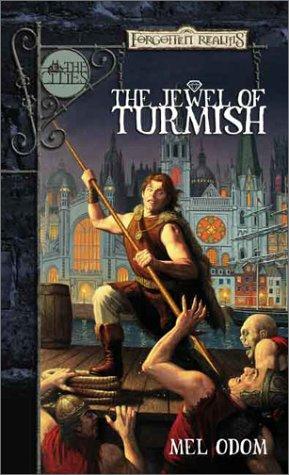
The Jewel of Turmish by Mel Odom

I've recently mentioned the perils of shared settings. That sometimes the setting can work against the author and that I try not to take such books as more than popcorn reading. Even with that in mind, Mel Odom's The Jewel of Turmish, unless you find it in the bargain bin for $1 like I did, is probably better off skipped.

In terms of things I didn't like as a book, some of those may work in a game as a prelude or a highlight of an upcoming menance.

For example, we are introduced to a group of young thieves and given a run down of their various hardships and how they stick together. They are horribly murdered. We are introduced to a group of priests where their leader is granted a vision by his goddess. These priests are horribly murdered. In killing off such groups well after numerous little bits have been introduced, the author was in my opinion, wasting time. In terms of a role playing game though, where you as the Game Master want to showcase a powerful villain, giving the players some premade characters and having them struggle against some unknown horror can bring out some anticipation for the players.

Another bit is misdirecting the audience. Don't label your campaign as a heroic high end super hero campaign and then have the players run into Wolverine, the Punisher, and other gun totting murderous villains and heroes whose only goal is to increase their body count. Don't talk about running a high magic and epic campaign and then force players to keep meticulous track of their rations and arrows and copper pieces. In that vein, this book called the Jewel of Turmish and part of a series called The Cities, failed, to me at least, to bring to light anything about the city itself.

Another aspect is beware of overusing old cliches that you've already used. In Mel's previous work that I've read in the Forgotten Realms, the one about the old sea monster coming back after many years of imprisonment, why is Mel's next book bringing out a villain who is coming back after many years of imprisonment? It's a common enough theme but don't be the same author bringing the same plot where gods themselves couldn't kill the villain but some dumb kid can.

Another bit is know where your action lies. If you know that the main thrust of the campaign is going to involve demons and undead and betrayal by once loyal allies, don't bog the players down in long drawn out fights against such mundane foes as man eating wolves and the difficult decesions they must make in terms of balancing the right and wrong of their actions.

Mel can do better than this and I've say this book is actually worse then Revan which makes it, the worst book I've read in 2012. Here's hoping the next one brings up the averages a little.

Sunday, January 29, 2012

Lesserton and Mor by Joel Sparks and Jeff Sparks

I picked this and a few other OSR books up at Gen Con last year but haven't really had a lot of time to dig into it.

While waiting for some glazes to dry on some Khador models I'm working on, I figured I'd hit the Referee's Guide a bit.

One of the things I thought interesting, is that while there are 'half orcs', they don't call them that here. Instead, it's orckin. A simple enough change, but one that makes a lot of sense. There are so many half-X races in D&D and other fantasy games, that it seems lazy to just call a half orc or half elf by those names. One of the neat things about the Dhampyr is a unique sounding name that's still pretty recognizable if you know where its coming from. When using such races in your own setting, try to give them their own name.

Another neat little aspect, is the trade game. A lot of the humanoids here are known for their mastery of one particular type of large vermin; bees, crickets, frogs and spiders. Each one has its own economy of sorts but its all based on the barter system. Each tribe having its own specialty. A clever group can make some 'real' money on the small level if you will, but it can work.

One of the reasons it can work, is because like many older editions, the game focus isn't necessarily on money as a means of purchasing magic items so that you retain game balance or can overcome damage resistance.

This allows the authors to do some fun things that normally they might not be able to do without stressing the simple system to see if its going to break the economy of the game and push the players in one direction or another in terms of their relative power level.

In addition to playing various editions of Dungeons and Dragons, I hope that 5e design crew is scrutinizing what the current publishers and supporters of the OSR are doing and can take those best bits and learn from them.

Friday, January 20, 2012

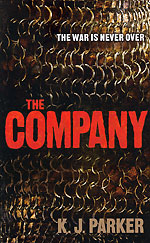
The Company by K. J. Parker

I continue to make my reading of K. J. Parker based on the findings at Half Priced books. I would love to purchase the ebooks and provide some direct support for the author, but when I can get the hardcover at half the price of the ebook, and that hardcover is in near mind condition, its not contest. The next book I read I'll have to decide if it's going to be something by this author, whose work I've run out of, but haven't read it all, or some of the other material I have siting dormant on my Toshiba Thrive via Kindle or in one of the many piles around the house.

Anyway, K. J. Parker continues to impress, but honestly, this book would be book three were I to rank them. I'm torn between the Hammer and the Folding Knife, although I think I like the former just a touch more and the Company has its moments but tends to fall a little short in my enjoyment level.

The Company is about a group of 'linebreakers'. This is a term used here to describe the specialist warriors who charge a pike line and break through them so that those ranks can be decimated by the opposing side. I forget what they were called in the various mercenary companies but they were generally paid a lot of money because they were often the first to engage the enemy and the first to die.

The thing that makes A Company unique is that outside of their last fight, they have as a unit, survived every engagement they've been in. This gives them a bit of a legend, an aura of invicibility that provides a lot of backing to whatever they say.

In a role playing game, allowing the character to develop a reputation and allowing that reputation to have an impact on others is something the GM should keep track of. Mind you, that reputation may vary a bit depending on what the players are doing, but if the players are known to have overcome the Temple of Elemental Evil and helped the towns and been generally awesome in their display of prowess, the people should give them their props. It's not a reward that necessarily comes with any mechanic benefits, but clever players will be able to use those props for their own rewards.

Another bit is that when the novel starts, almost all of the characters are broke. In many games, the spending of cash isn't necessarily a big deal. Some games don't even really cover it, instead relying on a vague 'level' of wealth, like Hero of FASERIP, the old Marvel Super Heroes game, does. Others like Dungeons and Dragons have a pretty detail intensive level and various methods of removing said cash from the characters.

In earlier editions, characters might have to pay various maintenance fees to maintain their lifestyle. In 3rd and 4th edition, those funds are assumed to go almost exclusively to the purchasing of magic items.

In The Company, I'd say its more of the former than the later. The characters and wealth are not connected. Wealth in and of itself is something nice to have for them, but isn't their main goal. Their main goal seems to be to stay 'The Company' due to their experiences in 'the war'.

This is an important issue though when looking at games like Dungeons and Dragons. What role do you want wealth to play in your campaign? If you engage the players and allow them to hunt down items they want or allow them to make items they want using various rituals and rites, then in later editions, gold in and of itself can be used for other purposes as it used to be. This is a campaign decision that should be made before the start of the game, and it is one that the players should be informed of.

If for example, you are playing with people you don't know and have it at the back of your mind that you'll allow them do pretty much build their items, or give them quests when they let you know what the items they're looking for are, they might not be expecting it and can grow frustrated if you cut back on the funds, thinking that they will need that gold for magic items.

In another aspect of the book, some of the characters have secrets. Some games are build around bringing out the role playing aspect of such party conflict. In my experience, especially with the older editions, blows might have come out over magic items, especially those high powered ones that might not ever come around again like a Girdle of Storm Giant Strength. In other games like Burning Wheel, probably not, but the fact that you killed someones favored cousin or something along those lines might be an issue that has to be resolved in play.

Depending on the maturity level of your group, and their interactions with each other and you, allowing players to have such 'dirty' secrets can be fun. This is something that you have to be careful with though as some people take their gaming very seriously and things done in the game transfer over to the real world in terms of real anger or disappointment.

The Company is also great for showcasing how large government may think. There are several individuals brought out and quickly brought out of the story, just to showcase how slow things may move. The end conflict is actually about something that has been under investigation for years, showcasing yet again, the inefficiencies of the government.

It is ironically enough in a position that like where individuals can shine. Player characters may have opportunities to gather fame and fortune if they are able to outmaneuver and outhink and outperform those who are in competition with them and the GM should allow it when appropriate.

Tuesday, January 17, 2012

The Hammer by K. J. Parker

While I found the Hammer didn't involve a lot of material in terms of fighting, combat, or other standards of fantasy role playing games, there is still plenty of rich material to mine.

The first thing to review, is base campaign assumptions. In this setting, Gig, the third son of the noble exiled family, has no expectations on him that are standard. If the family was not exiled, he would have been sent off to the priesthood because the eldest stands to inherit, the second is a back up so to speak, and the third... well, he's extra and even historically, they were often sent off to the church. What happens in noble families in the setting you're using? Are they given command of legions that they are no qualified for? Are they made heads of guilds through marriage? Do they form unique organizations like Pathfinders?

In that vein though, what happens with other people? Teuccer, a young lady from the mainland, fresh to the colony island, wants to be a doctor. Back on the mainland, that would never happen because it wasn't a woman's place. In her new home though, while some may consider her eccentric, they trust her abilities and treat her like the specialist she is. In some ways though, this is part of what Dungeons and Dragons has suffered a little from.

I don't want to say that the game is politically correct, but when looking at most eras of history, things are hard for the common man. Slavery is a common occurrence. Strength of law is enforced by actual strength. Women in many instances, are limited in what jobs they can take. They face real social barriers and have real hindrances.

By being so modern in its outlook, Dungeons and Dragons takes away some of that potential struggle. Now if your game is all about going into the dungeons and collecting the loot, that is appropriate. After all, you don't want to make it more difficult for one player than you do another in terms of buying equipment and getting solutions that the other players have.

But if its about role playing struggles and every one is the same and everyone has the same benefits and the same flexibility, then you might want to look at some of the old social limits. This includes something like looking at the wearing of certain colors, the use of weaponry outside of the nobility. One of the ideas that the old d20 Excaliber book mentioned as a role playing bit was that only knights could use swords. This didn't prevent other social status characters from making fighters, but they would be known by others weapons. Indeed, some weapons are distinctively peasant in nature or not meant for the higher ranking soldiers.

Another aspect of the colony life, is whose paying for it? Is there a single organization that pays for the people to move there? To pay for the people to live there? what are the obligations of the people who live there? In The Hammer, the colonist are expected to turn off a certain amount of beef in exchange for the necessary tools for living like nails, hammers, hoes, clothing and other farming tools. The isolation of the setting means that often the characters have to make due with what they have. In this book, there is 'the Company', but we don't find out too much about them in this book. Considering I'm reading another book by the same author called, 'The Company', it wouldn't surprise me if that some how all tied in together.

The Hammer is a book that is filled with characters breaking their standard background roles and fighting against the limitations imposed on them from society. It is worth reading to see how island life might cause innovation among the least likely people.