Showing posts with label Magic Items. Show all posts

Saturday, September 17, 2016

Liar's Blade by Tim Pratt (Appendix N Edition)


Below I'll be talking about some of the things I found in Liar's Blade that I think would make for good gaming material.

First off, you've got Rodrick and his talking sword, Hrym to start with. They could make dubious allies or the players could be looking to learn something from them. In Liar's Blade itself, the duo initially thinks they've been hired to be bodyguards but their employer knows right off the bat that they are thieves and con men. No reason why the players wouldn't know either.

Next, you've got Hrym, a talking sword with numerous magical abilities. One of the problems with gaming is the need to codify everything. It's a natural need as in playing a game, rules are handy to have around.

At the same time, they can kill the fun. You don't want something that the players can abuse left and right with minutia, which they tend to, but by tying the abilities into a separate entity, in this case, an intelligent sword, you've got the fun stuff that can make ice bridges and spare the Rodrick from extreme cold, as well as something that doesn't just go, "Yeah, freeze the blood in everything around us."

Another benefit of a magic sword that talks, is that it allows the Game Master to have a presence in the game that he can feed the players useful and not-so-useful information. After all, there's nothing to say that an intelligent sword doesn't have its own agenda or can't be wrong just because it's an intelligent sword.

Third, don't overprepare. Rodrick and his talking sword cover a lot of ground in this novel. They meet Sword Lords, travel through the River Kingdoms, and do some deep lake exploration. If you as the Game Master has spent a long time making numerous encounters in each location and place that the characters have stopped, you might be upset that they haven't had all of the encounters you've mapped out.

It's a rock and a hard place situation. I've been in games where it was clear that the game master had no idea what was supposed to happen next. They had no monsters ready. They had no NPC's ready. It was a sit-down and well, we'll figure something out.

If you're sharp on your feet and can quickly change up the pace, this is not a problem.

Most people won't admit it, but they are generally not that guy. Have your stat blocks, have a flow chart of how you're expecting the adventure to go, have some 'generic' encounters that you can slide into the campaign at any time, but don't plan each and every second out of the game because it's not all going to be used. Make sure you've left yourself enough wiggle room to handle something that happens in the campaign.

Fourth, use false employers. Most players are not self-directed. They don't decide, "Hey, today we're going to do X." Mind you that might just be a scenario that happens because they don't have the information themselves to go do X. Player's usually have plenty of motivation.

But false employers are those who hire the players for X and instead, it's actually Y that the players are doing.

And when you use this little gem, the double cross, don't be afraid to switch it up. Have the characters guarding some shady individuals who are actually up to good. Perhaps the players have been hired to guard a few halflings who happen to have a magical cure for the disease rampaging across the region but need guards because they are being hunted down.

Liar's Blade provides a lot of entertainment and is a quick read for those looking to explore the Pathfinder setting proper.


Tuesday, April 21, 2015

R is For Roland

I've been watching the History Channel's completely historic-unhistoric show Vikings. Currently on season three, the Vikings are invading Paris, an actual historic event with of course the History Channel's usual flourishes.

The King of France is the grandson of King Charlemagne. Worthy of his own entry, suffice it to say King Charlemagne was reknown for many attributes and deeds that his children would strive to live up to and often come up short. But of those who served under King Charlemagne, it is Roland who has his own tales, told most famously in the book The Song of Roland.

Outside of the Song of Roland, this Paladin also features in the Matter of France or the Carolingian Cycle.

Personally, I remember Roland best not for his foolhardiness displayed in the book, but rather, for his appearance in Dragon Magazine and it's regular feature, Lords and Legends, issue 127 . This was a feature that often took characters from history or myth, and provided gaming stats for them.

In some ways, it was nice. You could see what a professional thought such and such would be in an actual game of Dungeons and Dragons. On the other, often because of the historical nature or at best 'legends' of the character, these heroes were woefully under equipped for Dungeons and Dragons having few magic items.

Roland is a part of France's history and his sword a part of what many could consider the first Holy Avengers in terms of its legend.

But those magic items they did have... For whatever reason, the author of that article, made Roland's sword, a named blade called Durandal, a +7 long sword holy avenger with other abilities like automatically hitting anyone with non-magic armor. As a power gamer even back in the day, I was impressed with it.

But I was also impressed because I had read the Elric saga when I was younger. These books are ancient so beware the spoilers ahead. In the later volume, Elric seeks out a Horn. It's Roland's Horn he seeks out and the Elric and Roland duel with Elric being the victor. In my youth, I had visions of Stormbringer, stats pulled forth from the original Deities and Demigods, and Durandal.

But the reason that fascinated me, was I had read the Song of Roland. I knew who Roland was. If you're reading a book and it throws an odd character in there whom you've never read about before or know anything about, the result probably isn't going to be the same.

That's why I always urge people to expand their horizons. Don't stick with just the popular current stuff. Dig into the older material not only so that you can see where the foundations of the modern authors often lie, but so that you have a broader appreciation of the genre as a whole.


Tuesday, December 2, 2014

Stag's Helm: Magic Item For 5th Edition Dungeons and Dragons

One of the things that is terrible in running 5th edition is the lack of magic items. Well, that problem should be resolved somewhat by the publication of the Dungeon Master's Guide, which if you didn't go 'Black Friday' at your FLSG, you still don't have.

But that doesn't solve the problem of unique magic items, such as the Stag's Helm in the Pathfinder setting. It's an item that the Stag Lord has about him. But it's a relatively simple magic item so here's my take of it:

Description:
This striking helmet is crafted to resemble the skull of a mighty stag. Although made from bone, the antlers and helm are as strong as metal. When worn, the helm greatly enhances eyesight and hearing, granting a +2 bonus on Perception checks. In addition, once per day the helm may be called upon to enhance any ranged attack made by the wearer to make an insightful shot. Activating this ability is a free action, and once activated, your next ranged attack against a target within 30 feet is made with advantage. If you don't make a ranged attack within 1 round of activating this power, the insight fades and is wasted for that day.

A worshiper of Erastil who wears this helm may utilize the insightful shot ability up to 3 times per day.


The Perception check isn't a big deal as both games have Perception skill checks. The original item had a feat and I didn't want to break down the feat and go into all that detail when there was already a mechanic to represent gaining some advantage, in this case, having advantage on an attack roll.

The image is from the Kingmaker Game Master Item Cards. They're inexpensive clocking in at under $10 and can give you some visual cues to various things that don't necessarily just copy the art from the RPG products. The cards are a nice idea but it's rare that the bottom of the deck's stay together and even rarer when I can open the set without inflicting some damage to the box itself. Argh!

Anyone else rolling up new magic items or are people still waiting on the official book?


Tuesday, February 18, 2014

The Crimson Sword by Eldon Thompson


I continue to read through my dollar spinner rack from Half Priced Books. This time around, the length of the book kept me from posting for a few days. The Crimson Sword, written by Eldon Thompson, website here, clocks in at over seven hundred pages. What's worse is that this is merely book one of the Legend of Asahie meanings that there are more books in the series.

The cover piece is a nice scene taken from the book itself. I have the 'widescreen' edition where the top and bottom are in blue borders but we see more of the art itself. Shame though as the art is smaller and while the design is highly workable, this is a nice piece that I'm sure would look fantastic as a poster.

The Crimson Sword follows more along the paths of the old Terry Brooks series like the Sword of Shanara in that despite the length of the book, things are done. The story is told in one shot. Do not mistake me in saying that every single thing is wrapped up and finished, but at the end of the story, characters have moved from point A to point B and the world is not the same as it was at its start. It does not take twelve books each of 700+ pages to get us to that point. 

For which I'm grateful.

Eldon Thompson isn't the best writer I've read. I wouldn't put this in my top ten list or anything but the writing is smooth enough and the characters enough of an archetype, that despite its page length, it's an easy read. 

If you're looking to get your money's worth out of a book, The Crimson Sword has you cleared. I'll be discussing some spoilers specific to the novel below so if you'd rather avoid spoilers, read no further. 

1. Hidden Kings: A common enough theme in fantasy is the peasant hero who turns out to be related to, or is a king. It's been a while since I've read a story that actually went with this theme, so ingrained is it in fantasy fiction. For a while, especially when reading the Wheel of Time and other series, I worried that readers would drown in peasant heroes saving the world in their newly found kingly guises.

But it can work when its not used in every story. When its not the hook of every tale. And for a role playing game? If you want to elevate the characters from fighting giant rats and goblins to fighting against things that endanger the whole of the land while working their way up? It works well.

2. Magic Items: Another nice nod to older stories, is the powerful magic item. A very distinctive blade with red fire burning inside it that protects the user from hostile magic and is capable of cutting through the strongest enemy, the Crimson Sword itself makes a nice addition to the field. It's in many ways a Advanced Dungeons and Dragons artifact in that it does things that magic items normally can't do and that's okay for a weapon of that caliber.

For example, when Jarom is fighting in combat with it, he feels no fatigue, no fear, no pain. Those who fight with him, have a touch of that as well. Such an ability could be something like +2 to allies within 50' saves vs fear effects and endurance tests. It lets the GM throw new revelations into the setting later on as things can change or move around what the sword can and cannot do. Much as the unique spear in The Desert Spear by Peter V Brett, the Crimson Sword also functions as a rallying point for those who follow the character.

3. Archetypes Modified: While I could easily see several of the characters falling into place as standard archetypes, the shadowy assassin with a heart of gold, the country ranger whose bow skill is second only to his loyalty, etc..., one of the characters is an elf from what I could only describe as one of Robert E. Howard's 'Pict' backgrounds in taht they are savage and feral and broken into different tribes, some of which are man eaters. Having an elf be that true to nature goes well beyond even the 'wood' elves that many fantasy settings strive to bring in terms of the naturalist to play.

4. Multiple Quests: Initially it seems enough to retrieve the Crimson Sword but that's only the start. The forces, which Jarom initially thinks are lead by his brother, a wizard who conquered the land and killed the king, is actually only the tip of the iceberg. That wizard lacks the power of the Demon Queen who rises, and she has other more powerful allies like a dragon that can create dragonspawn which in turn act as an army for that Demon Queen to conquer the land.  The nice thing about the variance in enemies though is it allows more than just the Crimson Sword to shine through as the one who needs to kill the dragon isn't the wielder of the Crimson Sword, but another altogether whose had his own unique weapons when introduce whose origins prove the ideal method of killing the dragon.

5. Multiple Eras: One of the things that tends to be a downer in some fantasy setting is that while they usually have multiple eras and ages to them, that everything that comes about to the 'now' is of that one era. Here the Demon Queen is from one era while the Crimson Sword from an older, more ancient and legendary time. It makes for an interesting clash of times and eras.

6. Temptation: One of the things I'd mention to GMs who are inspired by their readings, is that the Demon Queen is part tempress. While Eldon Thompson doesn't go into great detail about her seductive looks and mannerisms, he does so enough that when he offers the wielder of the Crimson Sword anything he wants, that it could make a good moment in a role playing game. Have a plan for when the players yield to that temptation. To be the mate of a demon queen, at the head of a dragonspawn army, and to ask for your hated brother's life in the bargain? What gamer wouldn't want to do that? I'm not saying don't put such opportunities in the game, but I am saying have a plan for whatever the characters decide to do.

The Crimson Sword is available from Amazon for $8.09 in paperback, prime eligible, or $6.99 in kindle format.

Chances are I'll probably pick up the second book in kindle format. It's running like $4.99 right now so that's not a bad price at at the page count, I'm sure it'll earn it's ratio of page/price.

For those who've read further in the Legend of Asahiel, does Eldon's writing pick up? Are the stories relatively self contained? More of the same?

Wednesday, February 5, 2014

Shadow Prowler by Alexey Pehov

Anyone else ever find they have books that they have no recollection of buying? I have this in hardcover, new, and don't remember when I bought it or for how much. I've never heard of Alexey Pehov (website here) before and as I was cleaning through my various stacks of unread books, came across this. The thing that moved it to the top of the pile?  "Reminiscent of Michael Moorcock's Elric series, drawn from the great heart of Russian folklore, Shadow Prowleer is the first work to be published in English by the bestselling new-generation fantasy author Alexey Pehov."

Elric? Alright then!

After reading it, no, not quite. There isn't a spellcaster whose doomed to slay his own people. There isn't a magical sword that drinks souls. There isn't travel to other planes and times. Those are some of the hallmarks of Elric at least to me. Oh, and short. Relatively short novels too. In terms of Russian folklore? I'm not learned enough in that field to say yea or nay but I didn't see a lot of the common tropes poking out like any visits from a certain Hut.

I don't know if it's a translation problem or something else but Shadow Prowler didn't make it up to the heights that other books I've read this year have. It's not bad by any means, and its more 'serious' than I consider 'popcorn' fiction like the various Magic the Gathering novels I read. But I'm not interested in it enough to buy the next book in the series when I'm still running through dozens of other books that need to go to make some room in the cramped apartment.

Part of it may be the naming conventions. The main hero is Shadow Harold. His mentor is For. One of the guides he speaks with it Bolt. The names are a little off to me which may be part of the translation or may just be common names in the native tongue.

The book has a nice nesting doll structure. The characters have to go to the Hall of Bones to retrieve the Ogre's Horn to fight the dark magic of 'The Nameless One' but along the way Harold winds up exploring a magically locked off part of the city, fighting assassins and goat men and using magic left and right. It has its up moments and is high fantasy with some questing thrown in for good measure along with a handful of interesting characters.

I'll be discussing some of the specifics below and how they might apply to a role playing game.

Racial Reimaginings: In this setting, orcs are the firstborn. They are the oldest race in the series. Elves have fangs and are not the creatures of beauty that other settings have them as. Gnomes and dwarves hate each other, and gnomes, while still shorter than dwarves, are the ones that have beards and cannons while dwarves have no beards but are still master craftsmen.

Background Dumps: Harold finds himself learning things through extrasensory methods three times in the book. The first is when he enters the forbidden zone of the city. The magic of that section overhwhelms him with the origin of the sector and how it came to be. The second is when he is mystically attuned to a magical key and learns how that key was forged. The third is when sleeping in a field and he learns how all of the bones came to be in that field. These methods of providing an information dump on the characters might be overwhelming but if the GM can provide the players with some pregenerated characters, the players can actually be the ones doing the fighting and determining how the story worked out. This may steal some time away from their regular characters but the investment may show them how it all went down in a way that the history books don't talk about.

Magic For Money: One of the things about the setting that reminded me of D&D, is that Harold is able to buy magic items and even use scrolls. The magic items are all locked up and take time to get to to prevent easy loss or theft and cost an arm and a leg but in a high fantasy setting, they are available for purchase. If your setting should logically support such commerce, there should be a good reason, perhaps a social or religious one, why it is not.

The Gods: One of the things I enjoyed about the setting, is that when a thief agrees to do something and is bound to it, not through magic, but tradition and the watching eye of the god of thieves, it's called a Commission. This provides a solid reason why anyone would trust a thief to do something that they might normally not want to do. By entering into these contracts, both parties can be sure that the other will hold to their end of the deal. The Forgotten Realms had something similar with mages and their unique sigils where Azuth would curse someone who copied the moniker of another mage. When looking at things that bind people to causes and duty, having the active hand of the gods be one of them, is an easy way to insure that word given, word kept.

Shadow Prowler is available at amazon in hardcover, for $19.24, mass market paperback for $7.19, and kindle for $6.83. The physical copies are prime eligible.

For those who've read other books by Alexey Pehov, is the series worth continuing into? Any recommendations in that vein?


Thursday, December 27, 2012

Honor Among Thieves: Book Three of the Ancient Blades Triology

David Chandler wraps up the Ancient Blade trilogy with Honor Among Thieves. I have to say, I'm no art critic but this is a terrible cover. The whole angle of the main character is way off for some reason. Colors aren't doing it any favors either. The dark nature of the previous covers were solid in contrast to the colors. This to me, is muted and awkward.

Writing wise, the book continues to follow the previous established pattern. If you enjoyed the first two books, this one follows through in that manner. The material continues to expand the setting, has large scale conflicts, and some 'fantasy revolutions' in technology and portents for future material set in this series.

Again, perhaps because I read it prior to this one, I find myself doing some contrast to Riyria Revelations by Michael J. Sullivan. In the third book of that series, the elves have their time and quickly wipe out most of the resistance. In Honor Amongst Thieves, the barbarians have free access to the lands and quickly decimate most of the opposition leaving only one city, the Free City of Ness, left to resist.

One of the problems with some campaigns is that they become like glass. You want to look at them and admire them. To insure that they're is a continuous flow of one thing to another. Authors know better. Smash the setting. Unleash the hounds of war. If you don't like the way it goes down, next campaign do another variation of the campaign. Mind you, that's easier to do with a new group as the old group, at least in my experience, is often interested in seeing how things 'went down'.

Another interesting aspect is the rise and fall of characters. Malden, who started off as a simple free lance rogue, gained membership, and in this volume, not only becomes the guild master, but then the 'mayor' of the free city. Mind you, at the end of the volume, he's back to being a freelance rogue but the shifting nature of power, especially social power, is made clear here.

Sir Croy, whose been fairly boring in some instances, by design I suspect, has his chance to shine through. He rises from being an exiled knight to becoming the regent of the kingdom. It's not what he wants mind you and his interest in it is slim compared to the longings of his heart, but he is a duty bound man who does not run from his responsibilities. At the end of the novel, while he has indeed lost his heart's goal, his political position and social status are higher than they were at the first novel save for one important thing that I'll mention later.

Cythera on the other hand, whose initial role was a ward against poisons and curses, comes into her own as much more than the rival love of the main male characters. Her mother, who laid the protections against curses on her, now trains her to be a witch. However, as her father was the most powerful of sorcerers, she's inherited that talent as well and winds us using a bit of that. Now in this setting, sorcerers are demon bound and their use of such magics mark them. In this instance, she gains some gray hair.

Open Ended. While the bulk of the story is resolved, there are many parts that are not. This is a good thing as it evolves organically from the story. The barbarian invasion force splits due to differences between brother and sister. This leaves the main invading force of barbarians defeated, but a goodly sized portion still in control of several fallen cities. This leaves the series open for future investigation as to what will happen with the mingling of different cultures there. This doesn't count the pass open from the destroyed mountain either. More barbarians could wander forth. More trade could be established.

More interestingly to me at least, is the fate of the ancient blades. The barbarian war chief, Morget, found some very potent dwarven weapons last volume. One of these, an axe, is apparently able to smash through the ancient blades themselves. This is fascinating. I'm always advocating that new methods and new techniques should be able to overcome things of the past. If the modern world ran like most fantasy stories, someone would unearth a copy of MS-DOS and destroy the modern Internet with it's ancient and archaic powers. On the other hand, those ancient blades were craft with magic for a specific purpose. With only one left at the end of the series, wielded by a rogue who doesn't know how to fight even, the author sets up a return of demons and sorcery for future volumes and the creation of new blades even.

Mind you, not all the loose ends are so interesting. Elves were introduced to the setting, or reintroduced to the setting, and not a peep out of them. Some of the elements, like the introduction of a canon by the dwarf Slag, may seem awesome at first and indeed, worthy of a player character doing, but with the nature of the setting showcasing so much that appears to take place in several different eras in terms of how it might be first introduced, still feels somewhat forced. Minor things for me but others might be more irate about it.

Honor Among Thieves is a good source of inspiration for role playing games like Dungeons and Dragons or Rolemaster where the character is the star of the story and not necessarily just the mechanics of the character.


Friday, December 21, 2012

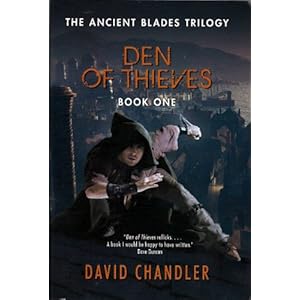
Den of Thieves: The Ancient Blades Trilogy I

When I ordered the Riyria Revelations from the Science Fiction Book Club, I also ordered the Ancient Blades Trilogy. Or at least two of the three books. See, when I first looked around, the ebook from Amazon was less expensive then the physical hardcover so I bought that from Amazon. It's since gone up in price but still probably less expensive then the hardcover unless you get a good deal, which the Science Fiction Book Club has more than it's fair share.

Anyway, Den of Thieves is Book One of the Ancient Blades Trilogy by David Chandler. It touches on a few points I enjoy. A 'free' city in a medieval style setting. Dwarves on the decline, but still in high demand for their high quality. Thieves. Knights. Magic swords with unique backgrounds. Broad over arching themes that tie into the current story. It does fall into my 'popcorn' reading bucket mind you, but I don't have a problem with such material.

I'll be discussing spoilers from the book below so if you have no interest in such, read no further. Know that Den of Thieves is a fun ride but not the 'serious' stuff of Wheel of Time or A Game of Thrones. Anyway...

In terms of city setting, much of the book takes place in the Free City of Ness, a place that while part of the 'dark ages' styling so common to fantasy, has its own freedoms. The city has a bit of personality tied into magic. In the long ago past, a powerful sorcerer used his magic to take the mind of one of the rulers and put it in a crown. This intelligent crown then takes control of the heirs and essentially makes them imbeciles who couldn't run the city without it. The idea of an eternal ruler passed down from heir to heir, each one becoming more and more stupid and less capable is an interesting one and could easily by yanked for a campaign.

The city also has it's own thieves guild run by one Cutbill. It is he who first brings in one of the heroes, Malden, and puts a heavy burden on the young man. The thieves guild doesn't get a lot of attention in terms of its characters, and I'm sure if A Gallery of Rogues gets funded and gets actually completed, it will be more useful in terms of gaming, but there are several thieves that come out named with their own personalities and traits. There is also an interesting use of children as beggar lookouts. Children as lookouts I'm used to but beggar children ready to swarm their enemies is a bit different.

For magic items, the series title itself, Ancient Blades, comes home. There are seven magic swords that are crafted to destroy demons. Turns out that many moons ago, sorcerers would summon a lot of demons. In some ways, it evokes imagery of how I'd imagine the price to be paid for sorcery in Dungeon Crawl Classics might work. Powerful stuff but not good for the caster. Regardless, these seven swords have long histories, are passed down, and each do a specific thing. In that aspect, they reminded me of Fed Saberhagen's Book of Swords.  I remember reading those as a teenager and thinking, "Damn, some of these are awesome." Ditto here although these swords aren't as powerful.

Den of Thieves also features a lot of traps, both mundane and magical. Reading through it should give any GM a few ideas on things that can be added to dungeons including illusions and floor traps among others.

In the end, the strongest thing I can say about Den of Thieves, in terms of gaming, is that David Chandler wrote a game that features characters in scenarios with items that wouldn't seem that out of place in an OSR game.


Monday, January 16, 2012

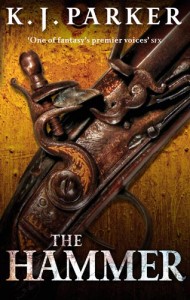
The Hammer by K. J. Parker or more blathering about 5h Editio

The Hammer, by K. J. Parker, is another done in one book that I found well written and entertaining. While it takes place in some psuedo-historical context and doesn't necessarily involve any magic or fantasy elements, it is engaging reading.

In terms of pricing, well, I bought it during one of the Borders Bookstore closings with others at something like 4 books for ten dollars so say, $2.50. Which is a shame because I see the ebook is something like $10 in and of itself. A further shame because my local Half Price has numerous books by the author, and while I'd love to directly support the author, as Cage the Elephant would say, "Ain't no rest for the wicked, money don't grow on trees' so instead of paying $9.99 for an ebook, I'll pay $3.49 for a paperback that the author gets zero of. Not what I want to do but hey, the publisher has right now four books on sale for $2.99 so they are fully aware of the pros and cons of various models of pricing.

Anyway, onto gaming thoughts.

Like The Folding Knife, I initially didn't see a lot of room where the material could be considered inspiring outside of getting the reader thinking and engaged with the book and working on the readers own thoughts and awareness.

But as I continued to read, and this might, in part, be caused by all the talk of 5th Edition of Dungeons and Dragons, I came to some interesting observations about what one might look at in terms of making the new edition more playable, that takes its pages from some of what 4th edition did.

In the Hammer, Gignomai or Gig, is a member of the met'Oc, a family of nobles in exile on an island colony. This island colony pays dues to 'The Company'.

Gig though, hates his family. They are not good people. Having been out of contact with the mainland for so long, they have grown decadent and survival is a daily struggle in the overall reach of things. The implications of such struggle are showcased through a variety of methods but...

Looking at 4th edition, there was a bit of a setting called a 'Points of Light' setting. It was supposed to be where things were dark and dangerous and could be problematic.

The problem was that actual game play didn't necessarily feel like that in the games I played or those I've heard of. This is for the most part mind you. In older editions, there were tons of random encounters and these random encounters didn't necessarily rely on the player character's level, they relied on where they were at. Only 3rd level and going to the old dwarf ruins some two weeks travel out of the city? Wandering encounter says you encounter a group of stone giants with two cave bears. Roll for imitative.

The sheer random chance of such an encounter was part of the danger inherent in the setting. On the other hand, you could encounter a group of giant rats or one cave bear by itself. There needs to be more random elements to things while providing players, in the option of the stone giants, with the opportunity to retreat if and when needed.

Another aspect of The Hammer, is that Gig is different. The whole 4e thing should have been the players were rising in a world of decay, not one that was necessarily full of decadence or evil, but one that needed new blood, new ideas and new methods to get things moving. In some instances, this might not even be new methods or new ideas, but motivation and energy. By having the players be the ones who are adding and changing the scenery, the GM is giving them  far more power than giving them a slightly magical sword or dagger.

For example, in The Hammer, Gig creates a factory and with it, guns. This isn't new technology to the setting. It's not a new method. But no one has done it before because no one thought of it. No one took the time to do it. No one was interested in it. Everyone was interested in keeping things the exact way they were, fighting that inevitable decline of their ways as society collapsed slowly, ever so slowly about them.

This, the spirit of exploration, the spirit of fighting against the standard, is what D&D can be about without changing game mechanics and instead working on the settings.

But in order to do that, there would have to be some changes to the core structure of the game.

As much as I enjoy magic, and magic item shops, and schools of wizardry, to get the new feeling, to get the 'shinny' feeling, Dungeons and Dragons has to drop kick it to the curb. Oh sure, in an appendix, perhaps next to the wandering harlot one, put some notes about adding colleges of magic and magic item shops, but for the most part, in order to keep magic different and new and special, it has to be extremely limited and random.

When you provide the opportunity for players to buy anything other then the most mundane of magic items, you've destroyed magic. Now mind you, for many genres and games, this is perfectly acceptable. Magic in and of itself becomes another form of technology.

But then you need to drop the whole concept of a dark savage age where a few independent city states struggle for survival because when players can go to a magic shop and pick up an enchanted sword, if the local government isn't doing something with that magic to safeguard the people in the first place, that logic is flawed.

And magic colleges? Part of the problem with spellcastersspellbooks, and the numerous costs associated with all of that ranging from the inks used to copy the spells, to the spellbooks themselves.

On the altar of game balance, those flavor elements have been fairly neutralized but in exchange, the wizards have become nothing more than fighters that don't use a sword to attack people but rather use spells that do similar damage and have similar effects.

Limiting spell selection, limiting the ability to buy spells, limiting the number of spellcasters in the setting, these all go a long way in making magic, well, magical again.

As I think of it, limiting the scope of what the players can access, when they can access it and how the can access it, is far more of a campaign element than what rule system you're using. If plate armor is something that only the highly skilled can create, then towns and villages won't have it. If players are looking for magic items, they have to hunt down rumors of such and hope that the gods are kind to their request when they hear of haunted ruins where an ancient elf crafted drifted in madness but may, mind you may, just have something similar to what the seeker wants.

And speaking of seeking out magic items, here is another area where I think earlier editions were able to throw in a bit of fun. Magic items tended to be a little more random in their power and abilities prior to 3rd edition and this allowed paladins, who always seemed to have holy avengers, have this iconic weapon with them, despite the fact that it was such a powerful magic item and probably level inappropriate. It allowed White Plume Mountain to be stacked with items of vast and great power. It allowed rings of wishes to wind up as random treasure.

Game balance may have to take a couple of blows to the face in 5th edition if Wizards of the Coast is serious about uniting fans of all editions and that's not necessarily a bad thing.

Sunday, November 6, 2011

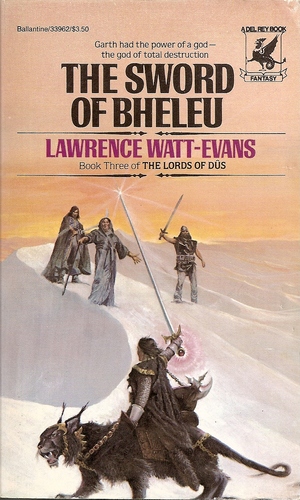
The Sword of Bheleu by Lawrence Watt-Evans

Written by Lawrence Watt-Evans, the Sword of Bheleu is apparently the third in a series. This is another one of those novels that I picked up for $1.00 at Half Priced books. Hell, maybe I had a coupon and picked it up for eighty cents or something.

The interesting thing is that at the time of its printing, it was $2.50. Yeah, inflation in a specific field gone wild again eh? More interesting to me, is that at Amazon, you can buy it in ebook format for $5.59 which to me is a little overpriced considering the original cover price but not horrible.

Knowing nothing of the series, the author, or what happens after, as I'm still reading it,  but I'm going to hit some spoilers below.

First off, the book is sword and sorcerer. Magic is fairly rare but those who have it tend to be powerful. Magic items are also fairly rare, and in this case, while we have a few of the standards, like the crystal ball, the Sword of Bheleu itself turns out to be a major artifact, effectively making the user a avatar of the god of destruction. This isn't a one way ticket though. Indeed, the sword often compels its user to destroy, to attack, to kill. this is often indicated by the massive ruby on the hilt of this two-handed bad boy glowing with an inner fire. A great visual cue but if you're playing the prototypical dumb fighter, all the visual cues in the world aren't going to help.

The sword is also a bit of old school in that it seems it can do many things. For example, when the wielder, Garth, is spied upon with a crystal ball, his connection to the got of destruction travels back on that feed and destroys the crystal ball. Garth can also use the weapon to set fire to buildings, to burn through stone itself. This doesn't count that others don't seem to be able to use the weapon without suffering massive burns and wind up dropping it.

By not pinning everything the sword does, the author provides himself some space in which to use the sword for different elements. One of the terrible things that third edition started, and fourth edition fully embraced and has been struggling to get back ever since, is removed the magic from magic items. I haven't played a lot of 4e lately and I know that some others, like the Fourthcore group, have also tried to bring some of the magic back to the magic so to speak. Damn shame that it ever got that far to begin with.

Anyway...

Another interesting aspect of the book is that Garth isn't human, he's what's called an overman, humanoid but physically better than a human. The problem is that the overmen lost the Racial Wars that happened some odd three hundred years ago. Turns out that like orcs and some other humanoids, while they may be great independent fighters, they are terrible fighters when it comes to war as they are not great social creatures, each too headstrong and independent to do any group warfare that doesn't involve a numerous commanders involved with many levels of the soldiers. Their home life structure isn't that great either, they essentially borrow the idea of marriage to provide some stability to their lives.

I like this factor because it provides the overmen some character and showcases why they are where they are when I read this book. It's not some nine hundred page beast that I feel compelled to read because it's trying to teach me history. Rather, it's a quick sword and sorcery romp that showcases  bad things happen and sometimes, more bad things happen. Heck, I think Rolemaster old versions may even have something similar to this guy. I know that they had High Men, which were essentially homages to Strider's people, but I think they had something even bigger and stronger and with even fewer background points in one of their series of companions.

In addition, it gives me some ideas as to why elves and dwarves and other long lived races don't rule the world. They're just not able to compete with humanity. It's not that elves aren't the best archers, rangers, or masters of magic. It's just that they're so tied up in their own thing they never think, "Man, these humans are going to take it all over." For the dwarves, they might have so much going on in their various book of grudges, that they don't necessarily care that humans are taking over until those humans get into the book of grudges themselves, and because humanity at least if often allied to dwarves, the dwarves are only worried about specific humans to hunt down. The decline of their race isn't something directly attributed to humans often, but rather to their many numerous other enemies ranging, at least in say, Warhammer, to goblins, trolls, orcs and Skaven, to even chaos dwarves. Humans may provide worthy foes, a few may even go into the book, but for the most part, allies and trade partners.

Speaking of those bad things, in that war three hundred years ago, when the overmen lost, they got some bad terms. But interestingly enough, the garrison, the town, the fortress that provided them? Well, as Garth notes, humans have short memories and yesterday's heroes are today's useless dregs of society. The town that has its borders with the overmen is poor and feeble and easily overcome. Mind you this isn't necessarily a good thing because as I read its indicated that yeah, this was a wasting outpost but its just a part of a larger entity. Still, showcasing how decay can ease up onto these elements of society, especially those that might have been considered the most important at one part of a setting's history, are important.

The overmen have another advantage here in that they have warbeasts. These are essentially large, black massive hunting cats that, like like worgs, wargs, or dire wolves, are actually more dangerous than the overmen themselves. This makes fighting overmen even worse when they come prepared. Worse still, the beasts aren't too concerned with what they eat as at one point Garth is worried about the warbeast eating patrolling soldiers if they're not feed soon. Scary but entertaining stuff.

A third interesting factor, is the use of the King in Yellow. Now I'm not saying it's the exact character from the Mythos, but when you read a little on the author's page about the series, yeah, it's pretty much him. He comes off as a tragic character with a terrible destiny but also a little like the dude of Many Eyes and the Faceless mentors of the Twain from Fritz Lieber's various Swords Against series. Good stuff.

So, still reading, and may/may not get the ebook versions, but they're out there, the paperbacks are still out there, and there's even an omnibus edition. It's old school with a bit of a twist and well worth reading for those looking for a non-human hero with a kick ass magic weapon.
and come on, how can you not lover a cover where the guy in the middle of these enemies isn't looking like he's going, "What, you wanna piece of this?"

Thursday, November 3, 2011

Brunner: Equipment Evolution

One of the interesting things about Brunner, the bounty hunter from the Warhammer series of books, is that unlike a lot of fantasy characters, he tends to accumulate some toys along the way.

Don't misunderstand me, there's a lot of cash he's collected. Somehow we never see him spend it. I suspect that like the manga Lone Wolf and Cub, we'll see he's been saving these coins for a very special rainy day.

But that's not what I'm talking about. I'm not even talking about how he names his large serrated cutting knife because that's what he uses to lop the heads off his bounties or his horse or his pony that he carries various items. I'm not even talking about the 'standard' weapons he starts with, which include some expensive ones like a highly polished gun that works almost every time he needs it to.

Rather, I'm talking about loot!

In one of the stories, he 'liberates' a sword from a false noble. The blade is of a special magical  variety against those of chaos.

In another, he earns a repeating crossbow from an encounter with Skaven.

These items in and of their own, become a bit of a signature thing with Brunner.

This is something that happens in movies and books and comics all the time. A nifty weapon makes an appearance and then everyone wants one! Admit it, how long after the Phantom Menace came out and we saw Double Light Sabers did you see one at the game?

Signature weapons can be useful and fun if used correctly. In level based games like Rolemaster or Dungeons and Dragons, they can be a little more difficult to efficiently fit in the actual game as unless you allow the player to upgrade the item, no matter how signature the Blade of the Family Blood is, it's it's +1 +2 versus Undead and the character gets an opportunity to get a +3 weapon... well, we can all see that old blade hanging on the shelf right?

Another thing about signature weapons and items is that they may have history and significance that showcases some aspect of the character's own background. For example, some weapons may only work for individuals of a specific race or a specific family line. Others may take rites and rituals to activate. Others may just look so unique that they are known wherever they go. One of the fun things to do is allow these items to provide hooks into the game, but not dominate it.

Use and reward players with special items that fit into their own goals and background and don't forget to use them against them when the players are trying to sneak around. "The Dagger of St. McMac! No lowly acolyte would have that item! Arrest them!'

Good times.

Saturday, March 5, 2011

The Heroes by Joe abercrombie


I've read the previous books written by Joe Abercrombie with much enjoyment. There is a lot of character building going on with a lot of emphasis on people as people as opposed to heroes or high morals. In some ways, much like the Black Company in its gritty take of standard high fantasy elements.

I'll be discussing some of the material below, so if you want to avoid spoilers, read no further.

Names: One of the characters in the book has a weapon called the Father of All Swords. Now this isn't the first time Joe's come up with some great naming conventions. His term for Death? The Great Leveller. I snagged that right away from my old character's fullblade as it fit him. Weapons don't have to be magical or unique one of a kind for it to have a name.

In addition, when you see the name of the book, The Heroes, it makes you think that its going to be about heroes right? Well, that's another nice trick. The name is the reference point for the actual circle/ring of stones that is called The Heroes because its supposed to have famous heroes buried under it. Another great use of the 'gotcha' by Joe.

History: The Father of All Swords had several names before it was the Father of all Swords. While the history isn't a significant part of the book nor does it take up much space in telling, the same is true for role playing games. Giving weapons a history gives them depth. Even if it's just another NPC telling the player that he heard of the Dreaded Black Wand of Agnash when it was called simply the Death Kiss of Korrus, before the dread lich Agnash had it.

Hoarding Resources: One of the things that gets a lot of talk on the internet is the '15 minute adventuring day' that is supposed to have been I guess, an everyday thing in older editions of Dungeons and Dragons. You know, go into the first few fights while expending all of your spells and abilities and some how finding your way back to territory safe enough that you can just rest and recover your abilities while the bad guys sit around wondering who just broke into their home and killed uncle Bob?

Since the Heroes is set during war time, there's no such thing really as 'break off' the engagement. You beat the first wave of soldiers? The next wave is up. You have a paladin in the party with super high AC? The archers are targeting dexterity. You have that great fire and poison resistance? Its force damage. The point being not that war is a great excuse to punish your players for their hoarding of resorces, but to get them to engage the system, to push them to the limits, to give them the Die-Hard experience.

It also helps break up the standard if that's what your players are actually like. Perhaps its just a reduction of wandering monsters in later editions. Perhaps its the GM not being forceful enough with the players to get more done in the alloted time. Perhaps its the diseased thinking that D&D is a online game where you can just retreat to the town at any time.

But its easy to break players out of the habbit by forcing them to actually fight beyond what they think they can handle. Minions and specialized forces in 4e with roles appropriate to test those defenses the party is lacking in can push the party. Forces that have a lot of hit points and ability to soak up damage to keep the party pinned up until the party finds that their enemies have reinforcements.

But this is only useful advice if you're not out to murder the characters. Don't get me wrong. My expectation as a GM is that if your character does something stupid, that's not a kid glove, it's a boxing glove with a horseshoe that I'm going to punch your character in the jaw with and as Drago said in Rock IV, "If he dies, he dies."

Part of this, for me, goes into building a world that's bigger than the character. If the party of first level adventurers thinks they can take out a family of hill giants and their cave bears because I mention the hills are thick with such monsters, then the party needs to adjust their thinking and try to focus on what their characters can and more importantly, cannot do with innate abilities. Some clever thinking, hiring of mass groups of henchemen, and control of the land could make it possible for a low level group to perhaps survive such an encounter, but the thinking that just because its there means its level appropriate? Out the window with that thinking.

The internet is full of great builds. Its full of useful advice for Max-Min play. It is sadly lacking in talking common sense as that seems to often fall under the umbrella "The GM's job is to take it." so to speak. To allow the players utter freedom to act without consequence. Perhaps I'm too old school in my GMing mentallity but if you charge a group of orcs thinking that they're all minions because if they were anything else they'd be too powerful, well, it's a good think that the DDI has a great online character generator cause chances are you'll need it.

Well, I seemed to have wandered off the deep end there away from the idea of using war as a method of mixing what players expect a standard encounter and resource measurement to be to a rant against some modern thinking in D&D I've seen.

Hang in for next post where I'll talk some more about the actual book!

Thursday, February 18, 2010

Powerful Artifacts? Why Not? Glen Cook's The Swordbearer


It's been a while since I've read the first novel in the Elric series. I recall Elric having to do quite a bit of questing in order to secure his artifact black blade, Stormbringer.
Here, the main character Gathrid is essentially handed an artifact level blade.
Should you do such a thing for your own campaign? The immediate response many people may have would be no, but its possible to have the players have powerful items and still not be undefeatable.
Gathrid stopped. He was surprised at himself. "Oh. Yes. All right." He felt a moment of shame. He was becoming arrogant behind his despair. He was getting too confident of his immunity from every peril but Rogala's dagger." (p.135)
Rogala is the one who presents Gahtrid the sword. He's also the one who usually ends the life of the sword bearer. As the old saying goes, "I brought you into the world and I'll take you out." Having a specific individual that can claim responsibility for the artifact that isn't the player can quickly qell certain types of player behavior common to those mad with power.
"Nieroda picked up a javelin. She bounced it in her hand like an athlete getting its feel. She cast it too quickly to follow. Gathrid brought Daubendiek round to deflect it.... He was not its target. It slammed through his mount's breastplate. The animal dropped instantly. It never made a sound." (p. 157)
Say the character is very difficult to handle. He's still got to get places. If using standard modes of transportation, those themselves can easily come under attack. Even in several of the Elric stories, despite the pale prince's sorcerous abilities and his black blade, he's found himself in dire situations. The oceans aren't impressed with a powerful sword.
"Gathrid reflected on the Mindak and grew cold. Ahlert was as much Choosen as he. They were pawns of the Great Old Ones." (p.197)
As powerful as the characters may become through their items, they are not the only ones in the world that may have such powerful items. And generally, items of such a nature tend not to work too well together, although they are notable exceptions (such as the old Hand and Eye of Vecna).
"On the narrow veranda surrounding the Raftery the remaining Toal were assembling ballistae and training them down the Hundred Steps. One salvo would end the threat of the Swordbearer. He might deflect a shaft or two, but not an entire flight." (p. 219)
It's mentioned at several points in the book, that as powerful as his sword is, the swordbearer isn't invulnerable. Mind you, characters in a role playing game tend to be a little... I don't want to say sharper, but have a lot of options, especially in terms of outside powers and abilities that characters in literature are never meant to have.
Be that as it may though, next time you see a powerful weapon and think it's not for your campaign, think about it again!

Sunday, December 6, 2009

The Berserk Armor


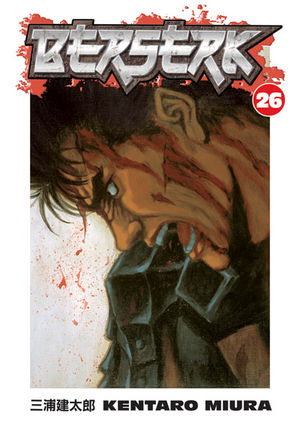
Berserk 26 provides Guts with his power up. Now since he's not going to get rid of his sword, what else is there?
Most characters can be defined in game terms by how hard they hit and how hard they are to hit. Guts has some great armor crafted by a master smith, but it is still only human armor.
Here, the title comes into play again, Berserk, as he's giving, the Berserk armor. Now in the past, we've seen the title referred to as part of Guts standard fighting style. We've seen the title as part of Guts being possessed. Now we see it as a magic item that Guts gains.
But the item is both beneficial and harmful. See, it doesn't care how injured you are and it doesn't actually patch you up, it merely allows you to keep fighting.
In many ways, this type of armor is perfect for Dungeons and Dragons 4th edition. As a minor action, it would allow a user to burn off a healing surge and keep the user fighting to the point of death. However, if there are no active foes around, the user must make a save or attack the nearest creature, even if it's a comrade. It would also have to have a high enchantment but the bonus of the armor is minor compared to the ability to keep fighting. In 4th ed, the healing surges represent every ability to recover, but usually they have to be burned off with help like from a cleric or warlord. The ability to burn through your own healing surges makes the armor very powerful but once it's done, it's done. There are no extra points off life to keep going.
On another venue, the book continues to explore perception. Here, Grunbeld, the draogn night, battles a very weakened Guts and is vastly disappointed that Guts proves to be so weak. Expectations versus reality. What are the players expecting to fight against what they are fighting. It works both ways though. If a dragon goes all out on the party using allies, minions, traps, and the environment to best the party, it may think the party weak. When the party gets the dragon on their terms, they may be able to show the monster the error of its ways.
And lastly, a look at motivation again. If the players understand the motivation of those they're battling, it makes it easier for the players to relate and see how things work in that manner. For example, Grunbeld, despite being a monster, much like Zodd, wants the thrill of fighting an equal. He wants to showcase his loyalty to Griffith. In this case, that's by attacking an old woman in a remote forest. But by having a chance to cross weapons with Guts? Makes it all worth it.
Earlier, Guts encounters one of the five angels. The female member of the God Hand, Slan, materializies in the lower reaches to toy with Guts, she does so because of her fascination with him and his ability to survive on hate and fear and pain. However, she also enjoys the pain and agony that comes to herself when fighting someone like Guts. Being a member of the God Hand, merely having her physical form destroyed though is no guarantee of her destruction and hence, may in part expalin her love of pain, both her own and others.