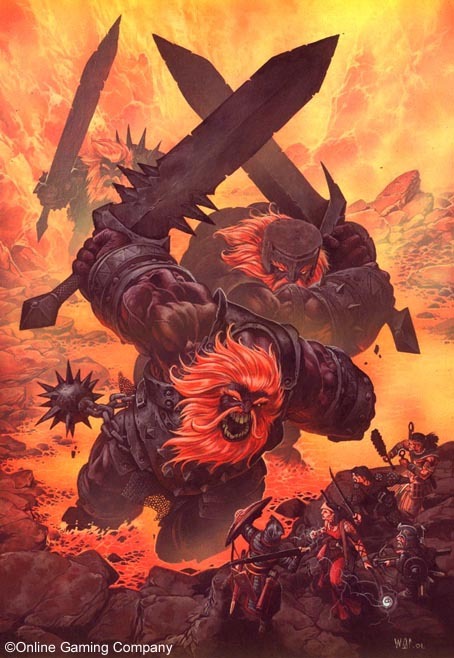
This is a screenshot of Wizkids site I took the other day.
The very first thing? Pathfinder Battles Iconic Miniatures.
The third thing? Not the second mind you. D&D with two brands, Attack Wing and Icons of the Realms. And those icons look way too crowded and way too busy. You can't see anything that's happening there except maybe you might think, is that Godzillia by the D&D brand?
I went to Wizkids because I was just at my FLSG, Games Plus.
While there, they had the NEW random collectable miniatures.
Usually WizKids is real good about providing a poster or some other means of, you know, KNOWING what the buyer can at least potentially get.
No such poster here.
So when I got home, I checked out Wizards of the Coast site. I knew that was probably going to be futile. For some reason, WoTC doesn't want people on their D&D section of the site as they didn't have a gallery of their previous release either.
And nope, at the time at least, no gallery. A few previews which is nice mind you but no actual gallery.
So I wandered over to Wizkids site.
Bam, Pathfinder at top.
That's gotta hurt.
I don't know if that's because Pathfinder is paying more, allowing Wizkids a bigger share of the cut, or just random weirdness but if I was WoTC, with a brand new set out, I'd want my brand on top.
I'd also want a gallery of what the miniatures people can buy look like.
But you aint' going to get that from Wizkids son. Last time I looked around the site, you could see some of the Attack Wing figures and the figures from the first set, Tyranny of Dragons.
That's not good marketing on WoTC site. It's not good marking on Wizkids site.
I've heard some people say, "Well, if you go to site X, you can see the full release."
And that's okay but it's certainly not what either of these companies should want to happen. If I have to rely on 3rd party sources to get information that should be gushing from your sites? You're doing it wrong.
But that's just me.
Anyone buy any of the new figures? I like some of the previews we've seen, but I'm also a miniature painter and I buy these things to either fill out gaps in my collection or because the miniatures are inexpensive. As the cost of the blind randoms have gone up, I've cut waaayy back. Part of that is my ownership of miniatures like Reaper's Bones or say, Mantic's Kickstarters. Other parts are that WoTC made D&D itself less reliant on miniatures.
I also can't help but notice that there are still no Dragonborn. Maybe I'm missing it. So WoTC makes Dragonborn a core race in two editions now, and we've got, including all the old ones, less than five I want to say? That's terrible. I assure you WoTC, we don't need elves, dwarves, or adventuring humans these days. But dragonborn and other IP that you own and few other people have touched? Might want to look at hitting that eh?
But some of them do look nice. I'd buy a few packs to take a chance on getting say a firesnake or an ettin.
In terms of what WoTC long term miniature plans are? Anyone have any guesses? I can't see the Gale Force 9 miniatures being a priority or long term way of handling things. It's not that the miniatures aren't solid. I've bought many of them myself.
At clearance prices.
From a "limited run".
Nice figures. Resin makes them brittle mind you but nice.
Nice and expensive.
I think WoTC needs to get Reaper on board with their miniature program. Put the well established brand of Reaper at work on their miniatures that are non-random and non-collectible.
Some may say that Pazio and Pathfinder are already established at Reaper.
Yeah, take a look at that Wizkids screenshot again. If Wizkids can't make a new set their priority on the web and have a gallery for it, and WoTC isn't on them like white on rice? WoTC can swallow whatever may pass for pride there and acknowledge that Reaper can do them justice without limited edition runs, without being made of brittle resin, and can capture the spirit of D&D.
But that's just me. I can't see either the Gale Force 9 miniatures lasting too much longer (which is a shame because they have a Red Dragon coming up that looks fantastic) nor can I see the random miniatures sticking around much longer when they can't even get top billing for a new release.
Others? Am I out of the water here? Is WizKids pushing WoTC IP into all new directions and all new fanbases? Let me know. I'm old and senile and keep telling these damn kids to get off my lawn!
Showing posts with label Paizo. Show all posts
Tuesday, March 10, 2015
Wednesday, January 21, 2015
Steppe by Piers Anthony
While it doesn't seem that long ago, 2009, Steppe by Piers Anthony, was brought back to print by #Paizo Publishing, the makers of the Pathfinder role playing game.
It fell under their Planet Stories. This line didn't do well despite it bringing some of the classics of the science-fiction/fantasy line back into print. Paizo didn't quickly give up mind you though as they tried different formats to save it but eventually give it up.
Mind you in the modern era, they might have been able to do more with it as they didn't have rights for the e-books when they were publishing these novels.
I haven't read all of them. I have read many of them though. I don't consider it my 'duty' or anything of that nature to read 'classic' or older science fiction or fantasy books, but I do try to stretch my wings and read a variety of authors and pieces when possible. It helps provide a grounding effect for books I'm reading now, or even how far society and technology has come.
Many people are probably familiar with South Park. Last year, 2014, they did an episode about Youtube Stars.
In Steppe, which looks to have been first published in 1976, Alp, the main character of the book, is an early example of a star made by passive viewers.
You see Alp was taken from his time, hundreds of years ago, into the future, so that his knowledge of that time may be useful to those playing a game that to modern readers would seem to combine elements of the Matrix, in that it's not real, but also elements of MMO's in that the characters are in different times and eras.
And it was in 1976.
So through passive viewing, Alp at the end of his adventurers, becomes an 'internet' celebrity years before such a thing could even be possible.
I know people point to shows like Star Trek and other popular science fiction bits and look around at our current technology and go, "Ah Ha!" but don't underestimate the unexpected places you may find those predictions of the future coming true.
Piers Anthony hits it out of the ball park in quite a few fields in Steppe. For example, invasion of privacy in terms of when a person voluntarily subjects themselves to being view, such as say through modern Youtube, and involuntary, such as brought to our attention by Edward Snowden.
If you want a quick read of a man out of time, a genre for which Planet Stories was known, Steppe is a great yarn. If you want to see how far Piers Anthony could see the future from before 2000, Steppe takes on a deeper view of technology and man's use of it.
It fell under their Planet Stories. This line didn't do well despite it bringing some of the classics of the science-fiction/fantasy line back into print. Paizo didn't quickly give up mind you though as they tried different formats to save it but eventually give it up.
Mind you in the modern era, they might have been able to do more with it as they didn't have rights for the e-books when they were publishing these novels.
I haven't read all of them. I have read many of them though. I don't consider it my 'duty' or anything of that nature to read 'classic' or older science fiction or fantasy books, but I do try to stretch my wings and read a variety of authors and pieces when possible. It helps provide a grounding effect for books I'm reading now, or even how far society and technology has come.
Many people are probably familiar with South Park. Last year, 2014, they did an episode about Youtube Stars.
In Steppe, which looks to have been first published in 1976, Alp, the main character of the book, is an early example of a star made by passive viewers.
You see Alp was taken from his time, hundreds of years ago, into the future, so that his knowledge of that time may be useful to those playing a game that to modern readers would seem to combine elements of the Matrix, in that it's not real, but also elements of MMO's in that the characters are in different times and eras.
And it was in 1976.
So through passive viewing, Alp at the end of his adventurers, becomes an 'internet' celebrity years before such a thing could even be possible.
I know people point to shows like Star Trek and other popular science fiction bits and look around at our current technology and go, "Ah Ha!" but don't underestimate the unexpected places you may find those predictions of the future coming true.
Piers Anthony hits it out of the ball park in quite a few fields in Steppe. For example, invasion of privacy in terms of when a person voluntarily subjects themselves to being view, such as say through modern Youtube, and involuntary, such as brought to our attention by Edward Snowden.
If you want a quick read of a man out of time, a genre for which Planet Stories was known, Steppe is a great yarn. If you want to see how far Piers Anthony could see the future from before 2000, Steppe takes on a deeper view of technology and man's use of it.
Labels:
Paizo,
Piers Anthony,
Planet Stories,
Steppe
Tuesday, December 30, 2014
Pathfinder Mystery Monsters Revisited
I normally don't hit up actual game products because there are so many other things out there but this one holds a special "ha!" for me.
I picked it up at Half-Priced Books along with several other Pathfinder books by Paizo. It was also during the 20% off sale. On one hand, that's awesome for me. $8.00 for a Pathfinder book? Awesome. But seeing multiple copies of each book indicates to me that it was a 'dump' and that Paizo is making too many books and that those books are being dumped into used book store chains. If we had any Powel bookstores around, I'd be curious to see if they had any as well.
But that's not what I get the "ha!" from.
Rather, it's that this book includes "cryptids", creatures from the 'real world' that are 'mystery' monsters in that even with all of our modern science, we can't find them.
Some of these are classic bits like the Mothman, the New Jersey Devil (aka the Sandpoint Devil in Pathfinder), Yetis, and Sasquatch
But that's not what sold the book to me.
Rather it was the Death Worm!
How can you not love a monster from Mongolia that is not only poisonous, but has electicity as well? I actually have a few miniatures of the thing that i got for cheap when I was looking for some monstrous creatures.
For me, I got my money's worth right there. The monsters themselves are a CR 11 so it's not a piddling threat either!
Some of the other beasties will get to see immediate use. For example, the bunyip has a 'muck' variant. My group is in the River Kingdoms right now with a lot of rivers and waterways so I'll get to throw one of those big bastiches right at them.
Some of the other stuff may come up later but between the death worms and the bunyip's immediate use in my game? Well done Paizo.
The book also includes the standard bits. An example monster for each type. One of the bigger bads is a sea serpent, the mourning one, that clocks in at CR 19.
It also includes names and historical/setting information on monsters not statted out. For example, also under sea serpent, the ashen worm, a white worm that is never about in the daytime but hunts at night.
It's a fun little book that can allow some quick use for a variety of CR's.
Saturday, November 22, 2014
Death By Dragon: Week Five of Kingmarker with Lost Mine of Phandelver
I've made mention before that my campaign started off as a combination of elements from Lost Mine of Phandelver and the Paizo Kingmarker Adventure Path.
As a quick note, Lost Mine of Phandelver to me, is the best 'official' adventure Wizards of the Coast has put out yet and if you haven't picked up the starter set yet, Amazon has it for $11.99.
I'm still digesting the kingdom rules from the hardcover Ultimate Campaign, so didn't want to run Rivers Run Red just yet. While there are elements that don't rely on the player's having the kingdom in play, I wanted to give the players as much Kingdom awesome as I could and well, wasn't ready. Thankfully the group is cool about that and I mentioned that they should follow up on their missing Dwarf co-Pathfinder member. It costs them!
Instead of using Phandalin as presented, I swapped it out with the River Kingdoms city of Pitax.I felt this worked out well in several ways. First, it's a fairly decent sized city. Important when the players are looking for spells and other mundane items that might take a while to find out their current outpost. Second, I don't know if it's a deliberate attempt or not, but Pitax feels very much like Rome in that it's almost a 'renaissance' city with lots of families doing various corrupt things and having a pleasant facade to hide behind. After watching the series Borgia, I was ready to role play some of that out.
It also didn't hurt that the players will eventually have different things to come to Pitax for in the future if we follow through with the entire Kingmarker series.
In Pitax, the players learned a bit about the city, about River Kingdoms in general, about some of the families here, and sought out information on their dwarf friend whose been held prisoner since oh, week one of the game I want to say?
They learned the whereabouts of a druid who knew the local region well and sought him out. During that bit, they encountered some twig blights. These are little evil halfling treants basically and the party made quick work of them. Why WoTC wants to keep using them as I don't think they've ever been popular since their introduction in Sunless Citadel in 3e era, I can't imagine.
There were also some unique zombies, ash zombies, that had a little extra ability, a nice example of a mini-template.
But the druid? He had the information that the party wanted, but needed a certain young green dragon gone. One of the players had a bit of background in his campaign that I used to include the dragon, Venomfang, in as his main antagonists.
Now the dragon's in a tower. The tower is so many feet wide and so many feet deep. It's basically a cooking oven for the dragon's poisonous breath.
Remember that elf monk I've mentioned in the past? That I painted up a Stonehaven miniature for?
Missed his first save. Took 42 points of damage in first round of combat. Erdan Nailo, who put clan above self, an elf that could hold a grudge? Dead.
The party made some good efforts at killing the creature. The druid casting some resistance from poison on himself, the halfling rogue having an innate resistance to poison. The dragonborn leaping upon the creature's back, which I gave him advantage for as long as he stayed on.
But then, at the player's roll, as few things are as entertaining as making the players roll their own potential doom, the dragon's breath weapon recharged. Another blast and Damaia, a tiefling warlock, who the player hadn't updated to 4th level from 2nd yet, went down, as did Naronel, an elf wizard. The elf player screwed that up and I allowed it, because he mentioned that he wanted to leave the tower, but then didn't actually do so. Who was I to allow him to not stay for the barbeque? At that point, the dragon had taken over half his hit points in damage, which the text calls for a retreat.
If I had been running things to kill, oh yeah, it would've been an easy TPK but that's no fun. Especially as the dragon was taunting Kontos, the dragonborn who had him written into his background, pissing the other players off who felt that the dragonborn knew more about their foe than he let on.
So the dragon shakes off the dragonborn fighter, who fails his Athletics roll and takes 4d6 falling damage, and the party claims the loot!
At this point I'm giving the new characters 1,000 gold pieces, no access to magic items, and half experience points of the lowest level character. How do other people handle introducing new characters?
The group voted on the experience rules, so I don't feel bad about them, but as the Dungeon Master's Guide isn't out, still a little 'weirded' out by allowing magic items. I might just rule that those killed by dragon breath had all their items destroyed and that their new character can start off with similiar items.
Next week we're taking a break. I'm still reading Ultimate Campaign from Paizo to get the Kingdom building rules in place. Some interesting stuff there. Too bad for the group that they just lost three positions! Take that stupid adventurers!
One of my players is going to do a paladin and wants to use the rules for assimar that are available from the Dungeon Master's Guide preview which I said okay. It's not like the rules are going to make THAT big a difference and the book will be out soon enough. Another is making a wild mage with a charlatan background.
That charlatan background bit is particularly funny to our group because one of the other players, in our last campaign, Warhammer Thousand Thrones, was an Imperial Wizard, who our hedge wizard initially labeled as a charlatan and it stuck with that character till his death.
The last player hasn't decided what she's making yet. Hopefully all of her goods and abilities are fully up to date this time!
As a quick note, Lost Mine of Phandelver to me, is the best 'official' adventure Wizards of the Coast has put out yet and if you haven't picked up the starter set yet, Amazon has it for $11.99.
I'm still digesting the kingdom rules from the hardcover Ultimate Campaign, so didn't want to run Rivers Run Red just yet. While there are elements that don't rely on the player's having the kingdom in play, I wanted to give the players as much Kingdom awesome as I could and well, wasn't ready. Thankfully the group is cool about that and I mentioned that they should follow up on their missing Dwarf co-Pathfinder member. It costs them!
Instead of using Phandalin as presented, I swapped it out with the River Kingdoms city of Pitax.I felt this worked out well in several ways. First, it's a fairly decent sized city. Important when the players are looking for spells and other mundane items that might take a while to find out their current outpost. Second, I don't know if it's a deliberate attempt or not, but Pitax feels very much like Rome in that it's almost a 'renaissance' city with lots of families doing various corrupt things and having a pleasant facade to hide behind. After watching the series Borgia, I was ready to role play some of that out.
It also didn't hurt that the players will eventually have different things to come to Pitax for in the future if we follow through with the entire Kingmarker series.
In Pitax, the players learned a bit about the city, about River Kingdoms in general, about some of the families here, and sought out information on their dwarf friend whose been held prisoner since oh, week one of the game I want to say?
They learned the whereabouts of a druid who knew the local region well and sought him out. During that bit, they encountered some twig blights. These are little evil halfling treants basically and the party made quick work of them. Why WoTC wants to keep using them as I don't think they've ever been popular since their introduction in Sunless Citadel in 3e era, I can't imagine.
There were also some unique zombies, ash zombies, that had a little extra ability, a nice example of a mini-template.
But the druid? He had the information that the party wanted, but needed a certain young green dragon gone. One of the players had a bit of background in his campaign that I used to include the dragon, Venomfang, in as his main antagonists.
Now the dragon's in a tower. The tower is so many feet wide and so many feet deep. It's basically a cooking oven for the dragon's poisonous breath.
Remember that elf monk I've mentioned in the past? That I painted up a Stonehaven miniature for?
Missed his first save. Took 42 points of damage in first round of combat. Erdan Nailo, who put clan above self, an elf that could hold a grudge? Dead.
The party made some good efforts at killing the creature. The druid casting some resistance from poison on himself, the halfling rogue having an innate resistance to poison. The dragonborn leaping upon the creature's back, which I gave him advantage for as long as he stayed on.
But then, at the player's roll, as few things are as entertaining as making the players roll their own potential doom, the dragon's breath weapon recharged. Another blast and Damaia, a tiefling warlock, who the player hadn't updated to 4th level from 2nd yet, went down, as did Naronel, an elf wizard. The elf player screwed that up and I allowed it, because he mentioned that he wanted to leave the tower, but then didn't actually do so. Who was I to allow him to not stay for the barbeque? At that point, the dragon had taken over half his hit points in damage, which the text calls for a retreat.
If I had been running things to kill, oh yeah, it would've been an easy TPK but that's no fun. Especially as the dragon was taunting Kontos, the dragonborn who had him written into his background, pissing the other players off who felt that the dragonborn knew more about their foe than he let on.
So the dragon shakes off the dragonborn fighter, who fails his Athletics roll and takes 4d6 falling damage, and the party claims the loot!
At this point I'm giving the new characters 1,000 gold pieces, no access to magic items, and half experience points of the lowest level character. How do other people handle introducing new characters?
The group voted on the experience rules, so I don't feel bad about them, but as the Dungeon Master's Guide isn't out, still a little 'weirded' out by allowing magic items. I might just rule that those killed by dragon breath had all their items destroyed and that their new character can start off with similiar items.
Next week we're taking a break. I'm still reading Ultimate Campaign from Paizo to get the Kingdom building rules in place. Some interesting stuff there. Too bad for the group that they just lost three positions! Take that stupid adventurers!
One of my players is going to do a paladin and wants to use the rules for assimar that are available from the Dungeon Master's Guide preview which I said okay. It's not like the rules are going to make THAT big a difference and the book will be out soon enough. Another is making a wild mage with a charlatan background.
That charlatan background bit is particularly funny to our group because one of the other players, in our last campaign, Warhammer Thousand Thrones, was an Imperial Wizard, who our hedge wizard initially labeled as a charlatan and it stuck with that character till his death.
The last player hasn't decided what she's making yet. Hopefully all of her goods and abilities are fully up to date this time!
Saturday, October 25, 2014
Kingmaker: Dungeons and Dragons 5th Edition Second Session
I continue my bastardization of running the Mines adventure that comes with the Dungeons and Dragons starter box set mixed in with the Kngmaker Pathfinder adventure path that takes place in the River Kingdoms.
This week's adventurers included:
Gerak: Thief halfling: The player is using an old prepaint from the Dungeons and Dragons miniature line.
Kantos: Dragonborn Fighter: The player is using an old prepaint from the D&D line. He's lucky that my friend, Tom, whose house we're playing at, has a ton of these. Tom was quite the collector back in the day.
Amun Ramas: Druid: Using a metal Reaper cleric with an Ankh staff to represent his Osiron (Egyptian) character. I painted this for him a few campaigns ago but thanks to the Army Painter dip I used, it's still in great shape. That stuff keeps a nice hard shell around the figure.
Erdan: Elf Monk. Using a prepainted figure from the batch, but that prepaint is not an elf. I just finished painting an actual elf monk from Stonehaven, but the gloss coat I threw on it to protect it hadn't dried yet so I'll bring that over next week. Note, there aren't a lot of figures that fit this race and class combination. I think that Reaper has one and that's about it. Too bad I'm personally not a fan of either sculp but you take what you can get.
Erik, who is playing the elf monk, was running late so the group decided to do a little exploring and to hunt down Tuskgutter, one of the side quests in the adventure. This would be one of the things that set the tone for the game in that monsters look like they have a lot of hit points but that tends to be countered with poor Armor Class values.
The group killed the giant boar and make their way back to the encampment as Eric had arrived at that time. With their elf monk in hand, they made their way down to the bandit hideout, which they knew its location from capturing a bandit in an attack against the outpost. On the way, the encampment leader, Olog, asked the party to check in on the hermit who provides the outpost with potions.
The party had an encounter with some wild hogs, rolled off the random encounter table, but after fighting Tuskgutter, I didn't want to fight out another combat with pigs so I ruled that the party made short work of them and that they continued on their way.
Meeting the eccentric potion maker, they did him a little favor, gathering some various berries, during which time I described a few of the local bits of fauna and flora to give the players more information on the River Kingdoms region. The eccentric old man offered them 25% off potions but hey, when they looked at information on Potions of Vitality, no actual prices. I ruled that if a potion of healing for 2d4+2 was 50 gold, that Vitality, which does a lot more, was 100 gold.
Looking real forward to that Dungeon Master's Guide. The current download also didn't have prices, not does the starter adventure.
A few set encounters on the way to the bandits included some kobolds that were resting in a field of radishes, and a huge trap door spider, both of which the party made relatively short work out of. One of the players got a little too enthusiastic in his cleaning of the trap door's spider lair by using his dragon breath on the lair and set aflame the webbing and some paperwork that was down there.
Ooops for him. It's like when players smash open a chest with potions. If you insist on doing things the violent way...
I had an NPC cleric join the party while they were fighting the bandits. I figured that they were short one character so it shouldn't be that big of an issue. The fight was run with generic bandits and a bandit captain and the players did fairly well although the dice sometimes turned against them.
The party returned to the outpost and encountered a few more travellers who'd either come here due to visions, a priest looking for an ancient temple, or because they were here to 'officially' fight bandits from the home kingdom.
I had the druid of the party have a vision of the White Elk, a herald of 'Old Deadeye', a farmer's god of battle so to say. The White Elk showed the druid where the ancient temple was and the party managed to clear out the cursed individual there who was a maddened Polar Bar (aka Cave Bar variant from the Monster Manual.)
The party made enough XP to get up to third level.
In terms of the original starter adventure, the I switched out the Forgotten Realms city for Pitax, a city of scum and corruption in the River Kingdoms, and the party will probably head there after fighting against the 'Stag Lord', the main antagonists of the first chapter of Kingmaker.
While using the 5th edition Monster Manual, not a fan of it in some instances. In many ways, 3rd edition brought animals into a meaner place with the various 'Dire' versions of things. There's no template for that in 5th edition that I saw but I was able to use various animals like the giant spider and polar bear to make up for most of the things I needed. Running kobolds and bandits also proved easy.
Another quirk of 5th edition? And it could be I'm missing it, no masterwork items. I could have introduced them to the game but m'eh. I'll live with those not being available.
The relatively low armor class of the characters, the highest being the dragonborn fighter with a shield and his armor, was 18. Everyone else tends to be in the 14-15 range.
Still haven't handed out any inspiration. Think I'm going to have to ask the players to write the various bits that they get inspiration for and use it for reference or something. The Dragonborn player described his handling of Tuskgutter well and I probably should have given him a point for that. But to be honest, I'm not feeling the love for this mechanic. It seems very limited, especially if you can't have more than one at a time.
Maybe I'll offer to give them a point if they write up campaign session recaps? Not sure. How's everyone else handling it?
In terms of props, I used the old map tile set Ancient Forest. Let me say that I'm thankful Paizo figured out a better way to store and keep those tile sets? The new one, Forest Trails for example, the new forest pack and it comes in its own holder and has a miniature version of itself on the back. This allows you to see which tiles go with which set and allows you to keep them together without having to rubber band the package? Fantastic work there! It's an actual evolution of a product.
Compared to the flip mats, the tiles are still a pain in the ass. The flip mats, you bust out the mat and slap it down. These you still have to assemble. Mind you, I like a little variety so I have both but in terms of easy of use? Yeah, the flip mats take the cake here. I have the old one by Gale Force 9, but as we're playing at a friend's house, I'm not carrying my whole library over there every week.
Note for those who might be interested in the Pathfinder setting in this region, Paizo offers for free, a Player's Guide that's supposed to allow players a bit of customization to fit in the region here: http://paizo.com/products/btpy8dqh?Pathfinder-Adventure-Path-Kingmaker-Players-Guide
In terms of Dungeons and Dragons 5th edition itself, I'm actually kind of disappointed and okay with it at the same time. The dearth of support coming from WoTC, especially in terms of content that would keep me interested in coming back to the site, is amazing in this digital day and age.
On the other hand, the game system, from a few plays so far, seems a lot easier to wing. It seems a lot more compatible with the material that's already available. Good for me, bad for WoTC. I wasn't impressed with their previous hardcover adventure Hoard of the Dragon Queen and am seriously thinking about cancelling my preorder for The Rise of Tiamat. If I can run any of the hundreds of older bits I have, if not completely free range it, my need for actual new product drops pretty close to zero.
How's everyone else finding the system? My players haven't complained about the lack of fiddy bits like Prestige Classes or Feats, which is surprising in it's own one as one of the guys is a master of manipulating game systems. To see him 'cool' with the relatively limited amount of options in the Player's Handbook is interesting.
I still need to find my old make your own game master screen and put together a few of the rules on combat, although we didn't run into any show stoppers this session.
Next week I imagine that the players will take on the Stag Lord and then move back into the starter adventure so I'm curious to see how that goes. They may be a little more powerful but I doubt they'll be much higher.
Labels:
Dungeons and Dragons 5th edition,
Kingmaker,
Maps,
Miniatures,
Paizo,
Pathfinder
Tuesday, May 28, 2013
Ultimate Combat
This is just me poking some fun at Ultimate Combat. Recently in a Shackled City game which my friend Tom is running, my barbarian King was killed by a trap. Part of the actual problem was the bonuses when raged and when using a two handed weapon. My math skills were not putting all of the bonuses to their highest numbers.
Eeek!
So after King died and our NPC expert trapfinder died, one of my friends who is a maestro of making characters crafted for me a ninja. But no trapfinding skills. Still, it did inspire me to flip through Ultimate Combat myself.
Personally I think Wayne Reynolds is one of the better artists we have in the industry but this cover is terrible.
The samurai on the right facing his enemies, the yeti or what have you on the left semi-facing their enemies and the core fighter thinks that this is an episode of You Think You Can Dance just standing there in the middle of the page making the action too dense and adding nothing of value to it. Who is he looking at? His blades aren't in position to actual strike anything. Worse still, he has the flailing arms thing going on.
We all appreciated Wayne making Orcus have short stubby arms. I mean sure he was the demon prince of the undead but not only was he in the first 4e Monster Manual and therefore a punk, he also had short fat arms.
Fire giants also have this horrible genetic curse. Terrible. It's why their always so pissed off. Imagine never being able to wipe your backside with your stubby little arms? Anger management isn't going to do the trick.
Seriously man. Wayne needs to take one of those little sticky pads, write no backwards flailing arms on it, and then move on.
I also challenge Paizo, if you ever reprint Ultimate Combat, take the fighter out of the center of the picture. You'll have a stronger illustration with a moment of tense potential conflict instead of some moron busting his movies in between two warring forces.
Eeek!
So after King died and our NPC expert trapfinder died, one of my friends who is a maestro of making characters crafted for me a ninja. But no trapfinding skills. Still, it did inspire me to flip through Ultimate Combat myself.
Personally I think Wayne Reynolds is one of the better artists we have in the industry but this cover is terrible.
The samurai on the right facing his enemies, the yeti or what have you on the left semi-facing their enemies and the core fighter thinks that this is an episode of You Think You Can Dance just standing there in the middle of the page making the action too dense and adding nothing of value to it. Who is he looking at? His blades aren't in position to actual strike anything. Worse still, he has the flailing arms thing going on.
We all appreciated Wayne making Orcus have short stubby arms. I mean sure he was the demon prince of the undead but not only was he in the first 4e Monster Manual and therefore a punk, he also had short fat arms.
Fire giants also have this horrible genetic curse. Terrible. It's why their always so pissed off. Imagine never being able to wipe your backside with your stubby little arms? Anger management isn't going to do the trick.
Seriously man. Wayne needs to take one of those little sticky pads, write no backwards flailing arms on it, and then move on.
I also challenge Paizo, if you ever reprint Ultimate Combat, take the fighter out of the center of the picture. You'll have a stronger illustration with a moment of tense potential conflict instead of some moron busting his movies in between two warring forces.
Labels:
Art,
Paizo,
Pathfinder,
Ultimate Combat,
Wayne Reynolds
Saturday, March 3, 2012
Death's Heretic by James Sutter
Death's Heretic as a novel, would make a great Gumshoe adopted Lorefinder Adventure. It's a tale about a man who comes from a nation of atheists that serves the god of death.
Note that here, the setting is using this country of atheists not as not believing in deities. They know that these entities exist. They know that the outer planes are real. They know that they have souls. However, they do not believe in giving themselves over in worship or accepting that aid in return.
That's just a touch of background on the main character. Before I move onto some of the other elements, I'm going to put the big flashing warning notice on. If you wish to avoid spoilers, read no further.
The main thrust of the book is Salim Ghadafar's quest to discover what happened to a missing soul. There are several red herrings and much exploration of the planes in the setting. There are several characters that come under investigation that interplay with Salim.
In looking at a more investigative style adventure, it's important to have a wide selection of non-player characters in your library. By having these NPCs build up before hand, you can use them as a buffer in terms not only of time, but in setting up future adventure seeds. These individuals may be offended by the manner in which they are questioned. They may see the players as potential future allies, henchemen or catspawns to be used at a later date. By providing some interesting encounters for the characters to navigate through that don't necessarily rely on combat, the Dungeon Master is setting the stage for future use if he ever needs it.
In terms of exploration,most fantasy game settings have some type of belief system that physically exist. There is often a real heaven and a real hell. These places might be able to provide a quick shot of exploration and investigation. It allows the Dungeon Master to showcase some of the unique beings and inhabitants of the setting. In this case, Salim's quest takes him to a Limbo state where he meets the pure chaotic inhabitants that run that particular aslyum. This is in addition to his association with a Marut, an agent of law, and his middle man, the black angel on the cover. These elements bring the setting to light.
One of the better written books in the Pathfinder series, Death's Heretic manages to be done in one and provides some interesting ideas for how a soul could be yanked in the first place and how someone would go about finding it again.
Note that here, the setting is using this country of atheists not as not believing in deities. They know that these entities exist. They know that the outer planes are real. They know that they have souls. However, they do not believe in giving themselves over in worship or accepting that aid in return.
That's just a touch of background on the main character. Before I move onto some of the other elements, I'm going to put the big flashing warning notice on. If you wish to avoid spoilers, read no further.
The main thrust of the book is Salim Ghadafar's quest to discover what happened to a missing soul. There are several red herrings and much exploration of the planes in the setting. There are several characters that come under investigation that interplay with Salim.
In looking at a more investigative style adventure, it's important to have a wide selection of non-player characters in your library. By having these NPCs build up before hand, you can use them as a buffer in terms not only of time, but in setting up future adventure seeds. These individuals may be offended by the manner in which they are questioned. They may see the players as potential future allies, henchemen or catspawns to be used at a later date. By providing some interesting encounters for the characters to navigate through that don't necessarily rely on combat, the Dungeon Master is setting the stage for future use if he ever needs it.
In terms of exploration,most fantasy game settings have some type of belief system that physically exist. There is often a real heaven and a real hell. These places might be able to provide a quick shot of exploration and investigation. It allows the Dungeon Master to showcase some of the unique beings and inhabitants of the setting. In this case, Salim's quest takes him to a Limbo state where he meets the pure chaotic inhabitants that run that particular aslyum. This is in addition to his association with a Marut, an agent of law, and his middle man, the black angel on the cover. These elements bring the setting to light.
One of the better written books in the Pathfinder series, Death's Heretic manages to be done in one and provides some interesting ideas for how a soul could be yanked in the first place and how someone would go about finding it again.
Labels:
Adventure Seeds,
Death's Heretic,
Gumshoe,
James Sutter,
Lorefinder,
Paizo,
Pathfinder
Thursday, March 1, 2012
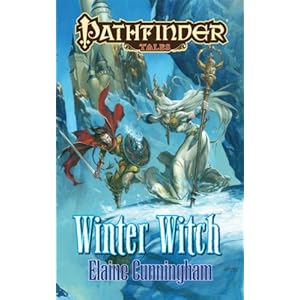
Winter Witch by Elaine Cunningham
Winter Witch is a fantasy novel by Elaine Cunningham set in the Pathfinder setting. It's a done in one that introduces new characters and provides some brief exploration of the setting. I'm going to hit real quick on a few things.
First, damn am I old. A paperback that runs $9.99 eh? A fantasy paperback that runs $9.99 eh? Ah well, at Amazon it's part of their 3 for 4 bit so that's not too bad. No kindle version eh? Let me get this straight, a relatively new line of fiction that is not taking advantage of every possible revenue stream and on the Paizo site, charging $6.99? Sure, it's available in PDF and you get an ePub version with it. I'm using a 3rd party app on my Toshiba Tablet to read it in ePub version. I bought my e-copy as part of a 2 for 3 deal so once again, I'm not feeling too bad but at this point, I would never pay that much for a ebook. Cheap? Stupid? Whatever. I'm the customer. I could've bought it at Half-Price for $2.50 not that long ago but I'm getting more and more into e-books.
Two, when the main character joins a caravan. He doesn't do so as a guard, but rather as a passenger. That was slightly different. What make the scene stand out to me though, was the caravan master asking him if he was worried about being killed and all his possessions taken. The caravan 'people' are the stand ins for the Gypsies of the setting so yeah, that's possible, but it struck me as something I personally haven't worked into any of my own games and something that could easily be a quick encounter.
Such a scenario could occur in a few ways. There is the unassuming method where the party is just hiring on as guards for the caravan and then once away from civilization, they get ambushed by the people they've been paid to protect.
Another scenario could occur if a relative of a former guard comes by the characters and hires them to investigate the caravan. Now the players have a reason and a potential payoff at the end of it. The players could even have a relative who is also an adventurer whose disappeared the last time this caravan went off and now have to find out what actually happened.
Another option may be that the caravan isn't actually doing the dirty work themselves. They are hiring adventurers and taking them down a path that leads to a very dangerous encounter and the caravan master sends scouts ahead that inform the monsters of what the players can do and where they're at and recommends some strategy to them based on how the players act and what they do up to that point.
The last thing (for this post!) that I thought was interesting was the Nolanders. Different tribes of barbarians get rid of the undesirables by banishing them to dark and dangerous places. So what happens when these murderers, betrayers, and most vile of the vile get together? It's like a Warhammer Marauder tribe with cannibalism and raiding becoming the norm. I thought for a second it was a weird spelling on Northlander because of where one of the characters comes from, but nope, it's No Lander and wherever they go, it makes it a no-man's land. A great bit when you want to throw real savages at the players.
Winter Witch has some good stuff to it and gives some nice details to the Pathfinder setting. Worth a read if it's in your comfortable purchase price zone.
Labels:
Adventure Seeds,
ebooks,
Elaine Cunningham,
Paizo,
Pathfinder,
Winter Witch
Sunday, January 15, 2012
Paizo and Open Design versus Wizards of the Coast: Round one: Monsters
For some, when it comes to game mechanics, less is more. For example, when looking at 3rd edition, on one hand, one of the things many people say it did right, was make things more universal. While there are benefits to having one method of creating an NPC that will match up with a player, and of having standards for lowering and raising monsters, either based on hit dice or giving then levels, the problem almost becomes that you are no longer player Dungeons and Dragons.
Because you know what other systems use such a methodology? GURPS, Hero, Mutants and Masterminds, and I'm sure many others. But in Dungeons and Dragons 3rd edition, the player creation aspect is so highly specialized and customized that for the Game Master, to honestly use it all the time, can be nightmarish. This isn't to say that many Dungeon Master's don't love to tweak or design or create. In some venues, this is WHY they are Dungeon Master's. In other's, because they are Dungeon's Masters and not playing, they get to tweak that part of the game like a player gets to do so with their character.
Each player though, generally only controls one character. If a Dungeon Master is making highly unique and customized characters and monsters each game, even if his enjoyment is high, his prep time is going to be huge. And taking up large chunks of prep time is never seen as a good thing.
So 4th edition went back to the drawing board on the monster side, and in terms of how monsters work, I think they largely succeeded. Oh, they screwed up the damage dealt and hit points possessed, but those aspects are able to be tweaked fairly right away. The presentation, the building, the roles, these things are shorter and sweater.
Yet in terms of Monster Manuals, after the third one, WoTC went back to the drawing board to tweak monsters because of the tweaks they did to the players in the relaunch of the Essentials line. It was another case of, "We're not going to reprint the core book because that's unnecessary, but here, have a book that fills the exact same role, including takes on all the old stuff, but is not actually a reprint." They followed up that Monster Vault boxed set with another monster product that failed to go epic but was well received due to the amount of information each monster had. It was almost like world building through the monsters. Very well done and very well received.
In terms of making monsters more, Open Design has their own Ecologies compiled from Kobold Quarterly. Paizo, while publishing Dragons and Dungeons, printed a compendium of Ecologies. Currently Paizo has a line of products that revisits monsters and expands them. The focus isn't on the game mechanics, its on making the monsters more useful to the Game Master by expanding information on where they live, how they live, why they act the way they do.
This was a fairly regular feature back in the day for Dragon magazine. Wulfgang's Ecology of the Ghoul is still one of my favorites from 2nd edition.
4th edition may have had some, but I honestly cannot recall Dragon online having any great impact on how I look at monsters. It's focus has been weak. There was a brief time when they created a new feature called Creature Incarnations. It featured a variety of monsters pulled from one monster. You can see one free article of it here. Its not bad in my opinion but...
I've mentioned before that Dragon Magazine used to be a fantastic resource for Dungeon Masters and players and I feel its become a little more than a preview and feedback machine. Back in 'my day' we had The Dragon's Beastiary and Ecology articles. When Dragon was feeling real generous and wanted to make the reader feel he got a huge bonus, we'd get a Creature Catalog, almost like a miniature sized Monster Manual.
If Dragon continued to support and publish the Incarnation articles, that would be one thing. You could say that they went in that direction. In the years, and its got to be going on something like four years, so over forty eight issues, there are less than twenty articles that fall in the heading according to a search on the article compendium.
When other companies are publishing books, in what is supposed to be a depressed buying market, especially for what are niche products, products that focus on the background and organization, and methodology, not on new game stats, if Wizards of the Coast is serious about learning from its past efforts, this is one of the directions they need to embrace.
Because you know what other systems use such a methodology? GURPS, Hero, Mutants and Masterminds, and I'm sure many others. But in Dungeons and Dragons 3rd edition, the player creation aspect is so highly specialized and customized that for the Game Master, to honestly use it all the time, can be nightmarish. This isn't to say that many Dungeon Master's don't love to tweak or design or create. In some venues, this is WHY they are Dungeon Master's. In other's, because they are Dungeon's Masters and not playing, they get to tweak that part of the game like a player gets to do so with their character.
Each player though, generally only controls one character. If a Dungeon Master is making highly unique and customized characters and monsters each game, even if his enjoyment is high, his prep time is going to be huge. And taking up large chunks of prep time is never seen as a good thing.
So 4th edition went back to the drawing board on the monster side, and in terms of how monsters work, I think they largely succeeded. Oh, they screwed up the damage dealt and hit points possessed, but those aspects are able to be tweaked fairly right away. The presentation, the building, the roles, these things are shorter and sweater.
Yet in terms of Monster Manuals, after the third one, WoTC went back to the drawing board to tweak monsters because of the tweaks they did to the players in the relaunch of the Essentials line. It was another case of, "We're not going to reprint the core book because that's unnecessary, but here, have a book that fills the exact same role, including takes on all the old stuff, but is not actually a reprint." They followed up that Monster Vault boxed set with another monster product that failed to go epic but was well received due to the amount of information each monster had. It was almost like world building through the monsters. Very well done and very well received.
In terms of making monsters more, Open Design has their own Ecologies compiled from Kobold Quarterly. Paizo, while publishing Dragons and Dungeons, printed a compendium of Ecologies. Currently Paizo has a line of products that revisits monsters and expands them. The focus isn't on the game mechanics, its on making the monsters more useful to the Game Master by expanding information on where they live, how they live, why they act the way they do.
This was a fairly regular feature back in the day for Dragon magazine. Wulfgang's Ecology of the Ghoul is still one of my favorites from 2nd edition.
4th edition may have had some, but I honestly cannot recall Dragon online having any great impact on how I look at monsters. It's focus has been weak. There was a brief time when they created a new feature called Creature Incarnations. It featured a variety of monsters pulled from one monster. You can see one free article of it here. Its not bad in my opinion but...
I've mentioned before that Dragon Magazine used to be a fantastic resource for Dungeon Masters and players and I feel its become a little more than a preview and feedback machine. Back in 'my day' we had The Dragon's Beastiary and Ecology articles. When Dragon was feeling real generous and wanted to make the reader feel he got a huge bonus, we'd get a Creature Catalog, almost like a miniature sized Monster Manual.
If Dragon continued to support and publish the Incarnation articles, that would be one thing. You could say that they went in that direction. In the years, and its got to be going on something like four years, so over forty eight issues, there are less than twenty articles that fall in the heading according to a search on the article compendium.
When other companies are publishing books, in what is supposed to be a depressed buying market, especially for what are niche products, products that focus on the background and organization, and methodology, not on new game stats, if Wizards of the Coast is serious about learning from its past efforts, this is one of the directions they need to embrace.
Thursday, September 29, 2011
Tome of Horrors Complete for Pathfinder
One of the things I tell people is that they have to support the things they like with money. I can't always do it and my priorities aren't always where they should be, especially on luxury purchases. But when I look at the Tome of Horrors Complete, I see both failure and success.
Failure is on the path of WoTC. Their restrictive licensing, instead of embracing the OGL, put this puppy right into the hands of a third party instead of killing it. Oh sure, it was dead for a while but the potential for it to be released under the OGL under Pathfinder was always there. For 4th ed? No using that license and not apparently by anyone who just wanted to run a book of 4e monsters out there using this material under a heading of "For the world's most popular role playing game" as I've seen some try to avoid the license WoTC is currently offering.
And it's a damn shame and yet a good thing. If such a book had come out at the start of 4e's lifespan, it would be using the 'wrong' math. Yeah, while we haven't got a 4.5 edition (ha!) the game plays differently now in combat and other aspects (rituals anyone) than it initially did.
The sad thing is its not like WoTC couldn't have used more monster support, especially up in the higher levels of things. Perhaps when they were talking about keeping core monsters like the Frost Giant out of the original Monster Manual to insure higher sales for the 2nd Monster Manual, they should have been working on some more epic material?
Anyway, for WoTC, the publication of this book is failure. On their part.
For Paizo, and for Frog God Games, it's a success. Even without cracking it open and talking about what I'm sure needs to be errata'd, the book sold out of its initial Pathfinder print run and went back for a second print. To me, this indicates that the Pathfinder market is healthier than the end run of 3.5. I'm not saying this is AWESOME news or anything but Necromancers games kept things close to the vest in order to avoid over printing at the end of times and well, we didnt' get a lot of reprints. The fact that this book is being reprinted? Good news.
In terms of errata, I'm disillusioned of it. WoTC has put out so much errata for their games that when I see another company or book with errata, I can't really muster a lot of energy to go, "sonofabitch" as opposed to 'm'eh'. Now if it's really game changing errata or just plain damn errors, like missing pages, yeah, the nerd fires get stoked there.
Better news in that if you were a fan of the old books, or a fan of 1st edition monsters and wanted to see them in Pathfinder, well, you've got them. there's a ton of inspiration to be found here. Hell, the book itself is like some primitive printed monolith waiting to be placed on the shelf.
WoTC, I hope that when 5th ed rolls around you realize you're not the producers of D&D being sold in Toys R Us and open up to the OGL again and Paizo, I tip my hat off to you and Frog God for this success.
Failure is on the path of WoTC. Their restrictive licensing, instead of embracing the OGL, put this puppy right into the hands of a third party instead of killing it. Oh sure, it was dead for a while but the potential for it to be released under the OGL under Pathfinder was always there. For 4th ed? No using that license and not apparently by anyone who just wanted to run a book of 4e monsters out there using this material under a heading of "For the world's most popular role playing game" as I've seen some try to avoid the license WoTC is currently offering.
And it's a damn shame and yet a good thing. If such a book had come out at the start of 4e's lifespan, it would be using the 'wrong' math. Yeah, while we haven't got a 4.5 edition (ha!) the game plays differently now in combat and other aspects (rituals anyone) than it initially did.
The sad thing is its not like WoTC couldn't have used more monster support, especially up in the higher levels of things. Perhaps when they were talking about keeping core monsters like the Frost Giant out of the original Monster Manual to insure higher sales for the 2nd Monster Manual, they should have been working on some more epic material?
Anyway, for WoTC, the publication of this book is failure. On their part.
For Paizo, and for Frog God Games, it's a success. Even without cracking it open and talking about what I'm sure needs to be errata'd, the book sold out of its initial Pathfinder print run and went back for a second print. To me, this indicates that the Pathfinder market is healthier than the end run of 3.5. I'm not saying this is AWESOME news or anything but Necromancers games kept things close to the vest in order to avoid over printing at the end of times and well, we didnt' get a lot of reprints. The fact that this book is being reprinted? Good news.
In terms of errata, I'm disillusioned of it. WoTC has put out so much errata for their games that when I see another company or book with errata, I can't really muster a lot of energy to go, "sonofabitch" as opposed to 'm'eh'. Now if it's really game changing errata or just plain damn errors, like missing pages, yeah, the nerd fires get stoked there.
Better news in that if you were a fan of the old books, or a fan of 1st edition monsters and wanted to see them in Pathfinder, well, you've got them. there's a ton of inspiration to be found here. Hell, the book itself is like some primitive printed monolith waiting to be placed on the shelf.
WoTC, I hope that when 5th ed rolls around you realize you're not the producers of D&D being sold in Toys R Us and open up to the OGL again and Paizo, I tip my hat off to you and Frog God for this success.
Labels:
Monster Manual,
Monsters,
Paizo,
Tome of Horrors Complete,
WoTC
Saturday, September 17, 2011
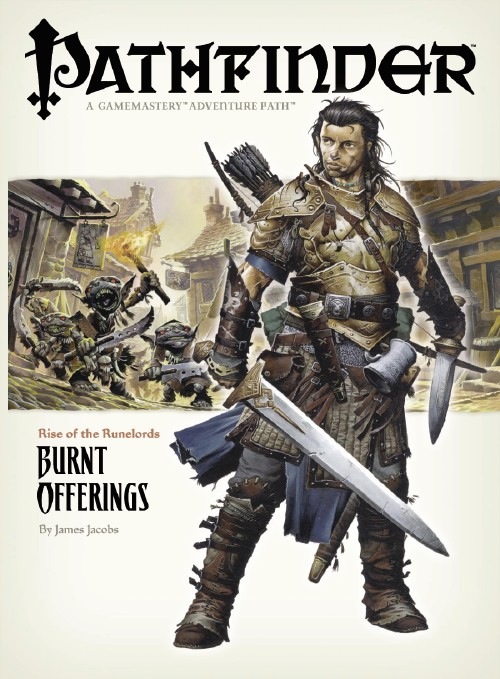
Rise of the Runelords: Burnt Offerings
My new 3.5 game started the other day. My skills are a bit rusty but things went fairly well. We had a bit of page turning as many of us were used to 4th edition. The look of horror on players faces when they realized they didn't have the cushion in terms of dying that 4th ed allowed was pretty priceless.
I already put in a few minor mods which don't necessarily work in the players favor. For one, I'm not confirming criticals or fumbles and I am using the decks that Paizo makes for each. Its good stuff as I got to use both of them. For another, point buy and fixed hit points. I hate to say it but I am a bit of a control freak and that was one of the things that 4e had that does appeal to me.
For the initial combat, my main problem was that there were many players; from my left to the right were Ryan playing a sorcerer, Sergio playing a halberd wielding fighter, Angel playing a druid specializing in shape changing, Tom, our host, playing a warlock, Erik playing a cleric, and Ana, playing a halfling rogue. I needed to add some most monsters to the three encounters but failed to do so, still getting my feet back under me.
On the other hand, the players didn't get as much experience as they might have otherwise. And ugh, the 3rd edition experience point system is still an ugly dog. Of all the things Monte cribbed from Rolemaster, that was one of the worst. Challenge rating against character level is good in theory to prevent players from gaining experience from slaughtering things many levels beneath them but its also another layer of complexity in the game that doesn't need it.
In terms of what works, Paizo does a great job of providing information on the locations and the locals. This allows you to add in a lot of minor flourishes that might otherwise be missed. For example, in the Iron Dragon tavern/inn, I explained to the players the different garb that the barbarians and tinkers were wearing and drew a few interested eyes in terms of the sword-shield the barbarians have.
The real winner of the game, and the one that gets the inspiration going here, is the reimagining of the goblins. In addition to a catchy little goblin tune, the players also get to meet a skilled ranger whose battled the goblins numerous times, and she can act as an information dump allow you to humorously highlight the strange behaviors of the goblins of this setting.
In terms of providing details though, Paizo offers a free player's guide, that provides some minor game mechanic information (3.5 at this point) as well as role playing details on the region. Because this is a free download, I'd recommend anyone who wants to see what the praise being passed along on the setting is about, download the guide. Paizo has continued to offer free guides for each of their adventure paths so they allow the players and Game Masters a chance to see if there might be some hooks for them.
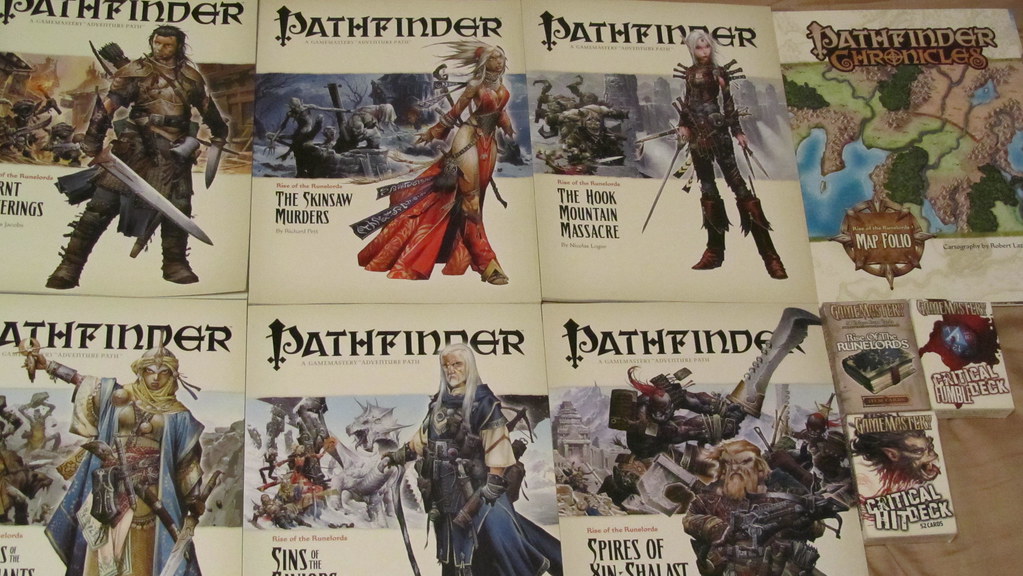
The only flawed thing I find in Paizo's logic here is that with the print books being out of print, and the whole first series, Rise of the Runelords, getting revised latter, that they should drop the price of the original six books by a substantial amount to generate more interest and allow those that may not have purchased the adventure paths when first brought out, into the fold.
Labels:
Burnt Offerings,
Campaigns,
Paizo,
Rise of the Runelords,
Third Edition
Saturday, September 10, 2011
Rise of the Runelords from Paizo
I used to subscribe to Dragon and Dungeon when they were print magazines. When 4th edition was announced, there were problems for third party supporters. The OGL was being dropped in favor of a different license. In addition, although I don't think it was an issue at that time, WoTC own digital offering, for character generation especially, I think put a big block on any 3rd party player resources that might have come down the line.
Anyway, Paizo was starting their own stuff, in this case, Pathfinder. This is still using the 3.5 rule set as it was well before Pathfinder as an RPG was out.
I had left over issues from my subscriptions and allowed that to fall into the Pathfinder adventure path.
In the real world...
I've been working many hours of overtime but that was recently rewarded with a week off with no pay so that the company can post larger profits. Made me evaluate what's important to me and while I'm not putting running Dungeons and Dragons ahead of working, I'm not going to take work so serious from now on. This gives me opportunities to indulge my game master side.
Still, I will be working most Saturdays. It's not like the company said screw you and I decided I don't need that overtime, especially after having a week off, and decided to cut my nose off to spite my face.
So I find I'm able to work with a pregenerated adventure, especially if it's a pregenerated adventure path. I've already read the books multiple times so I'm pretty sure I'll have no problems running it. I also still have all my WoTC 3.5 books, so that'll be no problem either.
But why 3.5? I'm not some fanatic that thinks one edition is better than the other and that all other editions must be cast into the first.
For one, I like the fact that Paizo is supporting the setting. For me, WoTC dropped the ball here. Sure, we just got Neverwinter as a hardcover (way to screw that one up WoTC) and it's not a bad book but... it's a heroic campaign and it's set in a Forgotten Realms I don't like. That is a personal preference. I don't like what they did. To me, as a reader of the fiction line, right before 4th ed, they had done a lot of setup that would have made the Forgotten Realms an exciting place to adventure in.
Sembia falling under control of the Shades?
The Elf Kingdom starting to rise?
Thay becoming an undead nightmare land?
Dragons on a rampage that destroyed or damaged many towns or lands?
Now some might want to have some influence in those areas, and I agree, that would be great. But these are campaign changers that have made the world more unsteady. For the new setting, they took even bigger steps and allowed the players to partake in none of that . The fans of Eberron dodged a bullet here.
So on one hand, I like how Paizo is treating the campaign setting. Hell, in the new adventure path, they use material that was introduced in the first adventure path.
Next, Paizo did some fun stuff with goblins and ogres. The Paizo goblins have a standard all of their own and their use of ogres, making them into inbreeds that resemble something out of the hills have eyes, works perfectly.
In terms of adventure structure, add in the 'missing' Revenge of the Giants stone giant adventure, and we have a nice call back to earlier editions. It's such a neat call back that WoTC has decided to do something similar. Only about three years behind the curb here.
Next, well, I already own it. I'm familiar with 3.5. Sure, it can be a nightmare system when doing everything off the cuff or doing everything by hand, but I still own a ton of 3rd party material, all the official books, and the adventure path itself. I don't think I have to worry too much about my personal time being bogged down.
What about miniatures? While there is not a metal miniature for every encounter in Rise of the Runelords, I'm pretty sure we have more miniatures for this adventure path than we do for any WoTC adventure path. For me, this is baffling. When you run your own miniature division, how can you not tie the miniature production to the actual campaign material being written? I know that the miniatures have a long lead way, but it would not be impossible to provide details of what's coming on down the line. But to be fair, how can I expect WoTC to support the adventurers when they couldn’t' even support the core races in the Player's Handbook? "Dragonborn are hard to design!" Uh... you didn't know that they were going to be a core race and decided to put more elves, halflings, and dwarves as random figures in the set? Go WoTC! Ugh.
Last, and this is again, a matter of opinion, WoTC adventure writing lacks too much. For one, both the completed adventure paths they have, such as the printed one that started with the Keep on the Shadowfell or something, and ends with a brawl against Orcus, is using 'the old math'. Yeah, while there has been no .5 edition of 4e (which again I disagree with), the math of the monsters has dramatically changed and many other features have changed. Only post Essentials plays differently then only pre Essentials. The e-adventure, Scales of War, also lacked something. On one hand, I didn't want to print all that information out. On the other, it seemed more haphazard than any previous Adventure Path.
I was willing to forgive that because really, it was WoTC second effort at doing an adventure path after the printed one.
But... they're not doing any more.
WoTC has fallen into a pattern of not quite exclusive, but heavily focused Heroic tier support. This makes little sense as the platform of 4e was to include epic. Paizo at least acknowledges that high level play can be beyond any prewritten adventure and bows out at about 15th-17th level. WoTC decided to add another ten levels to the core and then promptly decided not to support said levels.
The recent campaign book, Neverwinter, is heroic. The recent boxed set Madness, is heroic. The Dungeon Master's Guide 3, which was supposed to cover epic, cancelled. The latest monster book, no epic foes.
Now this might not be an issue if characters gained levels in a manner similar to how they did in 1st and 2nd edition. It could take a damn long time, dozens of adventurers and many many gold pieces and magic items. In 3rd and 4th edition? A few adventurers will prop the characters right up there in levels. I guess after every three adventurers you're supposed to trash your campaign and absorb what WoTC is sellinng.
Now for those who have more free time than I do, this might not be a problem. 4th edition, to me, harkens back a bit to 2nd and 1st edition in that monsters are easier to craft. Encounters are easier to craft. Magic items, while sucking mightily in 4th edition, are almost optional and allow the players to focus on being the star and not the magic item.
And I'm not against 4e in terms of what was done with the system. I've played it and I've run it. I ran it when it first came out. I've run it at Game Day events. I've run it for different groups. I've played it numerous times.
Hell, maybe at the end of the day, I just miss a well-supported campaign setting that takes the old and standard and makes them new and exciting. Anyway, that's my thoughts for today. If anyone's interested in how the campaign goes, let me know and I'll see if I can post some post even plays here.
Friday, January 8, 2010
It's Evolution Baby
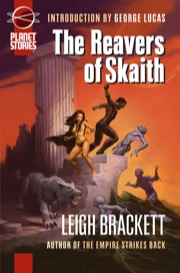
The Reavers of Skaith, published by Paizo, written by Leigh Brackett, is the third book in a series following The Ginger Star and The Hounds of Skaith. Below I'll be discussing some ideas that floated through my brain as I read it. This includes spoilers so if you insist on knowing nothing of the book, do not read on.
First off, the cover. Here, Eric John Stark is fighting off Children of the Sea. These are people who in the long ago past were changed at a genetic level so that they should thrive under the waters.
When looking at the origins of the races in your campaign, what if you throw a touch of some of the old school in there. In several campaigns that span the earliest time of the RPG origins, the past was not always one of swords and spells. Both Blackmoor and the Wilderlands, as well as Arduin and even parts of Greyhawk, have their nods to technology in one form or another.
In 4e, this would almost make more sense. Suppose that Dragonborn and Tielflings are NOT the results of devilish bargains and dragons making martial guardians. Suppose instead they have one common origin and were supposed to guard the land against all others and the other races were put into place as servants and guides for their perspective duties. Most would say that elves, still being elves, still being known for their forest lore, have succeeded. Ditto for dwarves and perhaps even plausible for halflings. But Tielflings and Dragonborn who've never had a strong root in gaming history?
In the core of 4e background, they each had a mighty empire and both were destroyed in a clash. What if that mighty empire's origin lies in genetic engineering and super science? What if they were one empire at a time until a race divide seperated the two and eventually lead to war? It provides a lot of opportunities to expalin with genetic engineering some of the strange races and monsters in the game as opposed to merely hand waving everything away as magic or some crazy deity.
The other thing that comes clear from The Reavers of Skaith is the powerful place of religion. There are several different sects with various followers here. Many of them with fanatics willing to die for the cause. If the Game Master can impress upon the players the importance of religion, not necessarily to the characters, but to certain factions within the campaign, it can act as a guide for what to expect if those factions ever come into conflict with the players.
For example, there are several instances here where the fantatics fight to the death. In the real world, even with all the advanced secruity and technology we have, unfortunately, we've learned the power of a man determined to die who has explosives with him. The point being it's hard to reason with someone whose already determined that if they're going to die, they're taking you with them.
Lastly, there is Halk. A broad shouldered swordsman who wishes to kill Eric John Stark, but keeps finding reasons not to. If the players do a good job at their various duties, if they treat the NPC's with respect, if they work out their differences, show that it has an effect on the game by changing the way that the Non-Player Characters react to them. At times the reader isn't sure if Halk is going to go for that vengance, but at the end with the characters have their last verbal confrontation, we know that Stark has Halk's grudging admiration.
Keep in mind the various points of origin of your world. Keep the role of religion and the various things it can make a man do in mind. Keep in mind that the players can effect real change in the campaign and have the world react to it.
Labels:
4e,
Game Master,
Leigh Brackett,
Paizo,
Planet Stories
Thursday, January 7, 2010
Leigh Brackett's The Hounds of Skaith
The Hounds of Skaith, written by Leight Brackett, and this edition published by Paizo, a company whose RPG interest in Pathfinder, their own online store, and other fields, includes bringing back many books of the Planetary Romance field. The Hounds is book two in the trilogy featuring Eric John Stark, following the Ginger Star.
But what does that mean for a role playing game?
A bit of it can be looked at in terms of world creation. Skaith is an old world. It's star far past its prime. The planet suffers from a slow cooling that prevents the world from supporting as many people as it had in the past. Many fantasy campaigns tend to have strange sections of the landscape that don't impact others. In the old Mystara world, it was hand waved away with some expalantion bout those parts of the setting that were vastly different than others as being closer to an elemental realm. In others, it's a pure magic expalantion like the Great Glacier in the Forgotten Realms series.
When putting the fantastical in the setting, think about the wider implications it may have. Especially if the phenomena is new. While it might be more effort than it's worth to try and assign ecological issues to an already existing problem, what if something causes one of these magical ecological disasters in a different spot that they players have to fight against?
The Hounds also brings in the old cursed magic item in the form of the Hounds themselves. These dogs are telepathic and kill with their minds. They cause a form of paralysis that allows the pack to chew on down. However, they must have a strong leader and they have ties to different factions that prevents them from coming into full use. In 4e, these types of items aren't that common anymore. The closest one might think of might be a bloodthorn item where it does a little extra damage than standard but the user takes some damage in return. In older stories, heroes would often use items that were powerful, but had unintended consequences or could turn against them. Think of Elric and Stormbringer or Corum and his original hand and eye. Items that brought pain and death to those around the Prince even when he didn't wish it so. In that way, the Hounds also function. Great to have on your side, but something you have to watch at all times.
The book also brings up environment as the enemy. I've mentioned it before in other Stark books and I'll mention it again. The environment, while lacking a personal face, while being an enemy that can only be survived and truly beaten, is one that is worth looking at adding to the game. While some may cry out against the lack of personality, the GM has a lot of variety in how the environment can play a role in the campaign. For example, a youth tries to lead Stark to a sinking swirl of sand and lose Stark in the desert. While Stark avoids the trap, it does showcase that you have to watch out for those you think can cause you no physical harm. Sure, the boy couldn't kill Stark, but by using the environment to do his dirty work, the boy doesn't have to. He can get the environment itself to do it.
Use the environment's deadliness as a reason why the players may need guides. And if players act as they sometimes do with the lording and the superiority, have the guide abandon them and spread word to others not to hire on for the players. On the other hand, if they treat the guide with respect and listen to him, perhaps even save his life, have the guide insure that the party is never without a trustworthy scout.
The Hounds of Skaith has one last bit that's hard to use in the campaign. A timeline. Stark must move quickly in his efforts to secure passage off world for his foster father because the lords of the world are cutting off all contact with outsiders. Failure to act quickly means complete failure. If the party is dithering and not moving, spending too much time planning, too much time with intra-party bickering, or just too much time messing with the Gameboy and PSP, give them a time limit that something has to be done in. The biggest problem with a timeline though is the opportunity for failure if that timeline is passed.
If the timeline motivated the players and got them into the game, don't punish them for missing it. Provide them another opportunity to make up their failure but make it one they have to work for. This way the game keeps moving even as the palyers have to work for their goals.
When looking for ideas on both dune dwellers and the strength of one man's resolution, The Hounds of Skaith is a good book to have.
Wednesday, October 21, 2009
Ancient Magics in the Secret of Sinharat
Once again a thanks to the folks at Paizo and their Planet Stories line for bringing back some of the older material that I've never read. Page references will be using the Paizo edition that also includes People of the Talisman.
"There are those who doubt me, I say! Those who scoffed when I said that I possessed the ancient secret of the Ramas of long ago-- the secret by which one man's mind may be transferred into another's body." (p. 30)
The implications of this type of technology are vast and far reaching. In this story, the idea and lore are used to gather an army but that's just the naked value of it as opposed to some of the potential of it.
For example, others in the novel have indeed used the ancient secret to live for hundreds if not thousands of years.
How could that be useful in a campaign though?
Imagine the players are hunting down demons, undead, or other long lived foes. Through their live, they've developed a cadre of methods to handle these menances. Would it be the right thing to do to pass on their knowledge and lore hoping that future generations would use it correctly, or would they themselves take over the youth and insure that the fight continued on more equal terms?
Imagine that the players capture a vile slave lord. What if the players decide to use this secret of changing minds to send one of their own into the slaver's own stronghold and perhaps even bring the other players along as favored slaves?
"There is trouble coming, greater trouble than Kynon knows." (p.41)
Even as the characters are in the heart of one adventure, it's never too early to start the seeds of another adventure. Even as the players are hunting down the last of a kobold tribe, it's never to late to have the players discover a map to another lair, to discover the kobolds have allies that they sell slaves to, that the kobolds are this far south because they've been pushed out of their homelands. Always keep multiple options open to the characters so that they always have options and are aware of the challenges on the horizon.
"But one place is as bad an another when the storm wind blows, and the only thing to do is to keep moving. You're a dead dog if you stop - dead and buried." (p. 54)
In this case, the character speaking is talking of a massive sand storm. And during this storm, others take their opportunity to have a go at vengance. The sandstorm after all, does throw up a lot of cover for certain actions to be taken.
But in and of itself, it's important for another reason. It's another reminder of the power of the forces of nature. There is no armor class that can be hit. There are no non-magical swords that can cut the wind.
There are opportunities for using the mundane and making them as awesome as the most fantastic fantasy elements.
"Sinharat, the Ever-living... Yet it had died." (p. 69)
In the current edition of D&D, 4e, the core concept is points of light. Here, empires are things of the past. Allow the players to trod in the bones of those ancient empires and to gather things strange and new to the world that have been lost. In the Forgotten Realms, there are many ruins of ancients times and these make great 'living' dungeon delves that happen to occur on the surface and provide numerous options. Always make sure to try and bring ou the historical weight of the ruins, the mammoth feel of time pressing down on the ancient empires and how so much has been lost.
"This was the old city of the Ramas, and its name still has power. The people of the Drylands don't like to enter it. When the hordes gather here, you will see. They will campa outside." (p. 69)
Another elment to consider in these ancient ruins, is why are they still ruins? Is it tradition? Is it in memory of the old city? Is it haunted? Is it's location lost to time and only the unlucky and foolish wind up finding it?
"Shrill, idstant voices as of the desert pipes, raging from the cavern cornices of buildings far across the city.... The massive coral pedestal on which the city stood was indeed a vast honeycomb of tiny air-passages, and the wind forcing up through them could create this eery effect." (p. 79)
When looking at some of the reasons why such ruins may be abandonded, try to insure that when ever there is an element of the supernatural, that it may not actually be supernatural, that it may be some local phenomena.
"Whoever of the two killed the other, must himself die by Kynon's decree." (p. 96)
When the players are masters of their power and in full control of their abilities and are working like a team, there is often little that can be done if the Game Master is running encounters in a 'fair' manner that will provide danger that makes the characters think of tactics that don't involve their powers. In this example, both individuals have been threatened with death if they attack one another and one of them has been drugged so that his mind is no better than an animal. The other realizes this and now has some difficult decesions in front of him that may not necessarily be solved by strength alone.
The Secret of Sinharat provides the Game Master with a quick read, a fast tour of an ancient ruin, some survivors of an ancient race and the promise of potential immortality. What more do you need for a campaign seed?
Wednesday, October 14, 2009
A last look at Robert E. Howard's Almuric
Almuric is a rather short book by today's standards of mega multi-volume epics but it gets it done in one while leaving the setting open enough that further adventurers could have been written in the vein. Like a good campaign ending at that.
But now for some specifics and what I thought of in regards to role playing as I read this tome. Page references are from the Paizo edition.
"On the remnants of flesh were the marks of fangs, and some of the bones had been broken, apparently to get the marrow." (p.83)
The characters are not the only inhabitants of the world. They should see signs of other live on the setting all around them. On the road there should be shrines and way markers with richer countries having way stations and havens for travellers. In dungeons there should be evidence that the things that live there, unless undead or animated objects, are eating and doing their business. Make the players realize that they are moving through a world and not a passive setting.
"By Thak, it is he! Do you not remember me, Tharn Swordswinger, whose life you saved in the Hills?" (p.133)
4th edition, perhaps more so than any other edition, does not have a huge implicit love for the good factors of the game. Unaligned, not neutral or chaotic neutral or some other hinged alignment, is fairly sellf expalanatory. However, this should't necessarily be license for the players to run wild.
When they do deeds for no reward, when they help those who can't at the time help themselves, insure that these strangers mark the players as potential allies and possibly even potential friends. Have the players hear of those they've helped. Have the players develop a reputation. In a typical fantasy setting, it'll take time for players to have a reputation that goes far and wide, but make sure it's one they've earned. If played with a little heart, they'll have allies and friends in many corners of the setting as well as the enemies they've earned by helping those who could not help themselves.
"Runners were sent to the cities, to give word of what went forward. Southward we marched, four thousand men of Koth, five thousand of Khor. We moved in separate columns, for I deemed it wise to keep the tribes apart until the sigh of their oppressors should again drown tribal feelings." (p.139)
The old saying is the enemy of my enemy is my friend. I've seen this used in various pieces from the animated series Robotech with threat of alien attack to the same plot in the Watchmen graphic novel. If you have an enemy but at least know that enemy, it's better to ally with that enemy against the unknown enemy who overpowers all of you individually. In some ways it's even a good motivation to keep a party together. The members are not friendly towards one another but because of the recent changes in the campaign, they've been thrown together and have to make the best of it least they all fall.
Almuric is a quick moving book and Game Masters who want to learn from Robert E. Howard need to keep their own campaigns moving foward.
Labels:
4e,
Almuric,
Appendix N,
Dungeons and Dragons,
Paizo,
Robert E. Howard
Monday, October 12, 2009
Robert E. Howard's Almuric
One of the things I love about Paizo's Planet Stories line is that it brings back a lot of material that is often hard to find in today's modern shelves of the latest fads. One of those books is Almuric, Robert E. Howard's take on the whole Planetary Romance inspired by a certain hero who went to Mars...
Below will be some quotes with some ideas of how they'd fit into one of my games and how I try to keep some things in mind when I'm gaming. Page numbers come from the 1st printing Paizo edition. Spoilers may follow so beware!
"It was chance led him there, the blind instinct of the hunted thing to find a den wherein to turn at bay." (p.15)
Often, when one door closes, another opens. If the party finds themselves overmatched, the Game Master must have a plan outside of the party runs for their lives. In some instances, whole campaigns can be built in this fashion. For example, back in the day, Orcus or Necromancer Games mentioned how he'd like to start an "Iron Tower" adventure path with the characters battling gnolls in treacherous terrain that plunges both character and monster into new venues.
Having an out that is a lead in for future adventurers provides the Game Master an opportunity that he may not need, but always has ready.
"Boss Blaine could not understand that he was dealing with a man to whom his power and wealth meant nothing." (p. 17)
This one's a little close in page numbers to the previous one and also hits on a theme I've mentioned before.
Players tend to run their characters unlike how people of those times would act. They're not real living breathing characters save to the most dedicated role player and the players are often willing to take chances with a character that any normal person would find insane. The Game Master needs to be careful that when dealing plot lines and making NPCs that none of them so motivate the players to action, that the action the players take is straight out murder that thrusts the entire party into a situation that requires either a whole new group of characters of a quick change of setting.
"The tangible and material can never be as grisly as the unknown, however perilous." (p. 22)
One of the great things about H. P. Lovecraft's work is the whole theme of the unknown. That there are things man isn't meant to know. That man is at his best, ignorant of the lowly position he has in the universe.
One of the great things about older Ravenloft material is how it would remind the Game Master to use description and details but not labels. Speak of an ogre's massive height and powerful frame, the low gleam of intelligence in it's eyes, the size of it's mammoth fists and the cruel edges to it's teeth, but do not actually call it an ogre. Players love to label things because they gain an accuracy of the enemy's strength.
By providing description without naming something though, while the Game Master is giving the players something solid and tangible to face, they still have the potential fear of the unknown. 3rd edition and 4th edition Dungeons and Dragons take this a long way too. Not only could an ogre be an ogre, it could be an ogre with some type of template or an ogre that is no mere soldier, but an elite brute.
"I made out only a dim gigantic shape, which somehow seemed infinitely longer than it was broad- out of natural proportions, somehow. It passed away up the vallye, and with its going, it was as if the night audibly expelled a gusty sight of relief." (pg. 32-33)
In addition to describing things that are tangible threats, the Game Master should be sure to include those that are simply beyond the ability of the characters at the moment. In the Stephen King novel and movie the Mist, there is a scene where the group witnessess a massive creature whose size makes the term behemoth seem too little. Showcase the awe of the setting, showcase the scope of the campaign. Allow players to note the hights and the lows even when they are not directly interferring with them.
Robert E. Howard wrote with an energy that was almost tangible to the reader. Make the players your readers and entrance them with description, but make sure that description not only leads to action, but leads to opportunity.
Labels:
4e,
Almuric,
Dungeons and Dragons,
Game Master,
Paizo,
Planet Stories,
Robert E. Howard
Monday, July 6, 2009
In Honor of the Henchmen
Let's start off with Planet Stories line with one Elak of Atlantis by Henry Kuttner.
"Lycon stirred and writhed in his arms. "More grog!" he muttered. "Oh gods! Is there no more grog?" A maudlin tear fell hotly on Elak's neck, and the latter for a moment entertained the not unpleasant idea of dropping Lycon and leaving him for the irate guards. (p. 80)
"What will you pay?"
"A thousand golden pieces."
"Fifty thousand cups of mead," Lycon murmered sleepily. "Accept it, Elak. I'll await you here." (p. 83)
"I won't kill you qucikly," said Lycon, a fierce grin of satisfaction on his round face. "No. I've suffered your insults too long. I must bring an offering each day to the altar of your stinking god, eh? An ear for that!"
"He brought down his sword in a vicious sweep.
"Good! Now your nose, Xandar- you've sniffed out too many victims with it already. Thus-" Again steel flashed.
"And an eye, Xander - see? I remove it with the point. Very carefully. For a copper coin I'd make you eat it."
"Drunker little fool, " Elak said, coming over to the table. "Leave the roasted pig alone. It won't be fit to eat after you've finished carving it." (p. 99)
Now in the same line of books, let's go to Leigh Brackett's The Sword of Rhiannon.
"He gives them a secret worth a kingdom!" wailed Boghaz. "I have been robbed!" (p 110).
The fat Valkisian seemed genuinely affected. There were tears in his eyes as he looked at Carse.
"Yes, like my own brother, " he repeated unsteadily. "Like brothers, we have quarreled but we have shed blood together too. A man does not forget."
He drew a long sigh. "I should like to have something of yours to keep by me, friend. Some small trinket for memory's sake. Your jeweled collar, perhaps your belt you will not miss them now and I should cherish them all the days of my life."
He wiped a tear away and Carse took him not too gently by the throat. ( p. 119)
The Valkisian closed his eyes. "I am tempted," he murmered. "As a craftsman, as an artist, I would like to see the flowering of this beautiful deceit." p. 120.
In looking at henchmen or the loyal sidekick, there have been many throughout the years of fiction, both fantasy and more historical. One of the more well known uses of such a character may be the red headed Moonglum or indeed, any of the companions (Eternal Companions) of the writer Moorcock's themed Eternal Champion characters, like Elric.
In some game systems, the henchman is some one brought into focus by the character's charisma or power of personality. The loyalty to the character is determined not only through that personality, but by other factors like alignment and how the non-player character is treated by the player.
But in new editions, the idea hasn't taken a lot of root. It's an artifact of the old editions.
How would you use henchmen in today's game?
1. Used to provide the players friends and allies in various ports that they stop in. The characters get a chance to talk big of their old friends, show them off, and provide future plot lines for the characters as they move along the locations.
2. Used in a game missing some players. So you've only got three players and the scenario is really designed for four or more? Break out some loyal characters to the players. That paladin of Torm whose always been about healing the sick and donating his funds to the church? It's touched a priest, a cleric of Torm, who has sought out the paladin to learn his ways and spread that strength of faith to other lands.
3. Used in a game to betray the players. Yeah, you know that one was coming. Sometimes it could be a magical construct or duplicate that only looks like the loyal sidekick. Othertimes, if the players treat their henchement poorly or don't acknowledge them at all, then let the dice fall where they may. Note, the GM should provide some warning in the latter case. In some casual games, the players may not expect that they have to 'babysit' the NPC character whose show such personality in the past.
4. Used as a source of information/entertainment. Sometimes the party may be wandering off the tracks and an NPC can ask, "Is this really the way we're going?" Other times the GM may want to lighten the mood of the campaign with NPC's with lines those those found above.
5. Take that final blow! It's an old cliche, but if the players are down to the last chips and are getting ready to be killed, it never hurts to have the NPC bite the dust instead. That last blow that would have finished off the player now turns into a fatal blow against a loyal friend. In 4e, you might want to make it even more dramatic and rule that the player can spend a healing surge in his horror and anger to avenge his long time friend.
Henchemen can be useful for all sorts of roles and if the players and GM are comfortable with them, these old style parts of older editions, should not be left on the stepping stone.
"Lycon stirred and writhed in his arms. "More grog!" he muttered. "Oh gods! Is there no more grog?" A maudlin tear fell hotly on Elak's neck, and the latter for a moment entertained the not unpleasant idea of dropping Lycon and leaving him for the irate guards. (p. 80)
"What will you pay?"
"A thousand golden pieces."
"Fifty thousand cups of mead," Lycon murmered sleepily. "Accept it, Elak. I'll await you here." (p. 83)
"I won't kill you qucikly," said Lycon, a fierce grin of satisfaction on his round face. "No. I've suffered your insults too long. I must bring an offering each day to the altar of your stinking god, eh? An ear for that!"
"He brought down his sword in a vicious sweep.
"Good! Now your nose, Xandar- you've sniffed out too many victims with it already. Thus-" Again steel flashed.
"And an eye, Xander - see? I remove it with the point. Very carefully. For a copper coin I'd make you eat it."
"Drunker little fool, " Elak said, coming over to the table. "Leave the roasted pig alone. It won't be fit to eat after you've finished carving it." (p. 99)
Now in the same line of books, let's go to Leigh Brackett's The Sword of Rhiannon.
"He gives them a secret worth a kingdom!" wailed Boghaz. "I have been robbed!" (p 110).
The fat Valkisian seemed genuinely affected. There were tears in his eyes as he looked at Carse.
"Yes, like my own brother, " he repeated unsteadily. "Like brothers, we have quarreled but we have shed blood together too. A man does not forget."
He drew a long sigh. "I should like to have something of yours to keep by me, friend. Some small trinket for memory's sake. Your jeweled collar, perhaps your belt you will not miss them now and I should cherish them all the days of my life."
He wiped a tear away and Carse took him not too gently by the throat. ( p. 119)
The Valkisian closed his eyes. "I am tempted," he murmered. "As a craftsman, as an artist, I would like to see the flowering of this beautiful deceit." p. 120.
In looking at henchmen or the loyal sidekick, there have been many throughout the years of fiction, both fantasy and more historical. One of the more well known uses of such a character may be the red headed Moonglum or indeed, any of the companions (Eternal Companions) of the writer Moorcock's themed Eternal Champion characters, like Elric.
In some game systems, the henchman is some one brought into focus by the character's charisma or power of personality. The loyalty to the character is determined not only through that personality, but by other factors like alignment and how the non-player character is treated by the player.
But in new editions, the idea hasn't taken a lot of root. It's an artifact of the old editions.
How would you use henchmen in today's game?
1. Used to provide the players friends and allies in various ports that they stop in. The characters get a chance to talk big of their old friends, show them off, and provide future plot lines for the characters as they move along the locations.
2. Used in a game missing some players. So you've only got three players and the scenario is really designed for four or more? Break out some loyal characters to the players. That paladin of Torm whose always been about healing the sick and donating his funds to the church? It's touched a priest, a cleric of Torm, who has sought out the paladin to learn his ways and spread that strength of faith to other lands.
3. Used in a game to betray the players. Yeah, you know that one was coming. Sometimes it could be a magical construct or duplicate that only looks like the loyal sidekick. Othertimes, if the players treat their henchement poorly or don't acknowledge them at all, then let the dice fall where they may. Note, the GM should provide some warning in the latter case. In some casual games, the players may not expect that they have to 'babysit' the NPC character whose show such personality in the past.
4. Used as a source of information/entertainment. Sometimes the party may be wandering off the tracks and an NPC can ask, "Is this really the way we're going?" Other times the GM may want to lighten the mood of the campaign with NPC's with lines those those found above.
5. Take that final blow! It's an old cliche, but if the players are down to the last chips and are getting ready to be killed, it never hurts to have the NPC bite the dust instead. That last blow that would have finished off the player now turns into a fatal blow against a loyal friend. In 4e, you might want to make it even more dramatic and rule that the player can spend a healing surge in his horror and anger to avenge his long time friend.
Henchemen can be useful for all sorts of roles and if the players and GM are comfortable with them, these old style parts of older editions, should not be left on the stepping stone.
Labels:
Dungeons and Dragons,
Elak of Atlantis,
Paizo,
Planet Stories
Subscribe to:
Posts (Atom)