Not too long ago, Dark Horse Digital had a sale on their Star Wars titles. Having some extra funds after pulling mucho overtime, I plunked down the cash and downloaded my comics.
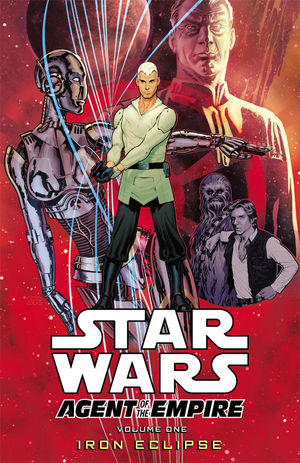
Among the sale items, was Agent of the Empire. In short, 007 meets Star Wars. Done well too mind you.
The main character, Jahan Cross, is a graduate from the same academy as Han Solo who makes a few appearance that quite aren't cameos but don't fall into full fledged team up status either. It works for the most part and brings the new in with the old.
One of the fun things about the Star Wars setting, when done right, is that the area that the setting encompasses is huge. In a science fiction setting like Star Wars, or others of that nature, this allows the action to take place in areas that aren't formally controlled by only one faction. It puts Cross outside the boundaries of the Empire and relies on other bits of history in the long line of Star Wars history to get more of the connection to the setting inherent in.
Another thing done well is the threat. One can only have so many Death Stars, Planet Bursters, and other overpowered Star Killers around before you have to wonder why the Empire could ever lose.
In this instance, it's a virus that will override all droids and make them dance to one tune. This is a viable threat in a Star Wars setting where droids are basically smart tech everywhere. Your toaster could be a droid in the Star Wars setting.
While it would be hard to translate such a direct threat to most fantasy campaigns, those that have machine men, like Eberon and the War Forged, could be in for some potential issues. Otherwise the standard virus threat is pretty handy.
In terms of Jahan himself though, he is right up there with Bourne or other super spies. If trying to run such a campaign, the Game Master should insure that the characters are highly proficient in their field compared to about 90% of the people around them with only some real big threats having some similar fire power.
The characters need to have access to fancy goods. This could range from unique items to one shot items or items that don't necessarily work unless the user has a certain skill set. By making this items one shot or consumable, the Game Master can provide some more powerful items then he might normally slip into his campaign. Even better if these items come for a specific person who doubts the characters worthiness to use them.
On a tangent that I find most interesting though, is how Jahan perceives the universe around him. He works for the Empire because the Empire represents order. During the various assaults at the end of the old Clone Wars, he lost his sister due to the rioting and chaos and confusion. And he blames that on the Jedi.
Here, to an outside reader whose more familiar with the Star Wars setting and knows how everything turns out, it showcases how perception can be warped and how things can be viewed through a narrow focus.
In a super hero setting, some factions may work for what others perceive as an evil power but those who work for it perceive as a stabilizing force. Pitting these types of viewpoints against the players as opposed to the standard 'evil' ones can make for some more challenging encounters.
On the other hand, if the series continues for a while, I am curious as to how Dark Horse will handle the long term effects of the character against the setting. For one thing, Jahan doesn't hate aliens. Such entities generally don't have the good life in the Empire. For another, he respects droids. For another, he doesn't tolerate corruption and well, the Empire is rife with it.
If you've never thought of using the Star Wars setting to run something like a Spycraft game, Agent of the Empire provides a lot of direct inspiration drawn from other sources that shows how to stir, not shake, it all together.
Showing posts with label Star Wars. Show all posts
Friday, May 18, 2012
Wednesday, March 21, 2012
Revan by Drew Karpyshyn
Writing a novel in a shared universe must be a difficult task. It may be more difficult if the era you're writing about is not the standard, such as this Star Wars novel set during the Old Republic. Revan is a character in an older game that helped make that Old Republic a viable property and one that companies like Dark Horse and Del Rey have visited several times, not to mention a very popular MMO that's supposedly stealing players from World of Warcraft.
But in terms of this specific novel of the Old Republic? Pass. My brief review is that its jumbled by time skips and by making too many choices that seem very odd to even a casual reader of Star Wars. Mind you that the Clone Wars sometimes have this problem as well where characters apparently forget they have other abilities than just jumping around and swinging light sabers so maybe it was the set up which caused this novel to fail. It's not the worst novel I've ever read, but it is the worst novel I've read this year.
Having said that though, there were some things I'll discuss specifically so if you wish to avoid spoilers, read no further.
The Jedi in this book are portrayed as narrow minded idiots who brim with hostility and no common sense. While it goes against their own code, and something that the main character verbally jabs another one of the Jedi for, it showcases that any organization, no matter how noble or righteous, can go rogue or too far in one direction.
Even the fabled comic, Order of the Stick recently touched on this subject as well. I myself played a paladin who took a PrC that allowed him to smite anyone, not just evil enemies. Pushing the boundaries of what is good and normal can make for some interesting role playing experiences but if the Game Master does it and does it too often, there should be a valid reason for it that needs to be reflected in the campaign.
For example, if an order of paladins doesn't like the players, and the players are typical murder hobos, that's probably understandable. On the other hand, if the players are members of the local militia and have saved the town several times and the town folk are reacting as if the paladins are right, the players are getting screwed in this deal unless all of them are under mind control.
Am I saying that the paladins can't dislike the players? No. And if the players hear the paladins out preaching about the evils of the characters and how despite those characters military victories that their spiritual hollowness rings out, that can go a long way in establishing a rivalry. Indeed, if the players aren't careful they could end at burned at the steak as witches.
Another bit that might not work well in a game is a time skip. There are two of them here. One when Revan is captured for years and that time just snaps by and another where Revan is.... yes, captured again but this time the span is much longer and he doesn't escape. If you and your group are comfortable with large time skips, then by all means do so. It's a great way to introduce younger siblings, or on a large enough jump, a new generation of characters. Mind you this doesn't always work as the readers and writers of Dragonlance, and of course, Star Wars the New Republic know, but nothing ventured nothing gained.
From a gaming prospective, one of the things I least like about the skip ahead, is trying to determine if the characters gain any power, lose any prestige, suffer any permanent wounds or things of that nature. Runequest has a Cities supplement that back in the 2nd edition days I would gladly roll on and it had all sorts of useful bits to it.
Anyway, when reading a book you're not too fond of, keep looking for things, both positive and negative, that you can take to your own game.
Tuesday, January 5, 2010
The Inevitible Crossover?
As the caretakers of the comic side of the Star Wars setting, Dark Horse has a lot of material to play with. This gives them access to numerous timelines, each one essentially acting as it's own setting.
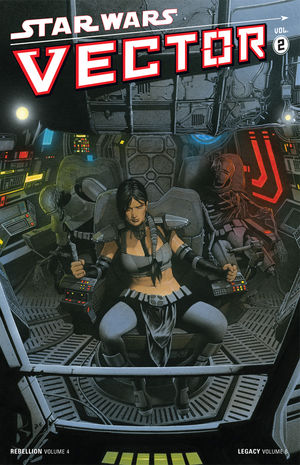
In Vector Volume 2, we get a little of the more modern bits with the 'star' of this time delayed crossover, Celeste Morne, is a jedi with a sith artifact that feeds her knowledge of the old rackghouls, entities first introduced in the video game Knights of the Old Republic (and don't quote me on that as I know there are some rabid Star Wars timeline guardians out there.)
Her apperance in the Legacy era though, allows he to meet Cade. Her impression? Close to the dark side but a desire to be left alone.
Remember that assassination mission I mentioned in my last Star Wars based post that the Jedi Council decided to pass on? She's intrigued enough by Cade's ability to heal the ravages of the ghoul plague to help out.
There's a massive battle, Celeste almost falling to her artifact, Cade taking up said artifact and destroying it, the fall of a sith lord, not at the hands of Cade, but at the hands of one of his own, and a future that well, despite the 'success' of the hero, looks bleak.
But as always, what does that mean for your game?
One, if it's a game system based on ye old Dungeons and Dragons rules, it probably has multiple settings. Don't be afraid to mix and match elements to get a better game of out of the engine. I can't be the first person to use draconians in a non-Dragonlance game, and in 4e, they're not even based in Krynn anymore.
Don't be afraid to use 'official' materials to bring said worlds together. While there are whole settings devoted to the concept such as Spelljammer and Planescape, the author Michael Moorcock never had a problem using gates and other dimensional spanning devices, like the Ship the Sales the Planes, to have his characters such as Elric and Corum meet to have truly cosmic adventures. And don't let others tell you it's not 'old school' as the Judges Guild used to have a series of four sourcebooks that also acted as adventurers that included such classic as the Portals of Torsh, Irontooth, Twilight and another whose name escapes me at the moment. Each had a meta story that tied together but the actual ties to each other where shallow.
Don't be afraid to bring in characters that might not fit the setting. While character crossovers can be terrible if done ham fisted, when done in a manner where it all meshes, everyone can enjoy it. In the short stories collection of Elric/Eternal Champion based tales, Karl Wagner does a hell of a meeting between Elric and Kane.
In overall campaign arcs, love your NPCs but don't be afraid to let them die. Celeste, despite going through several phases and timelines, doesn't get an easy off. Darth Krayt, despite his power, suffers the same fate many who rely on evil minions do, the inevitible betrayal. Let the NPCs have their storylines, let them have their moment of glory, and then, let them go into that good night.
Have fun when mixing up the pace and let the NPCs do their duty before heading off into that final sunset.
Thursday, December 31, 2009
Backstory Begets Backstory
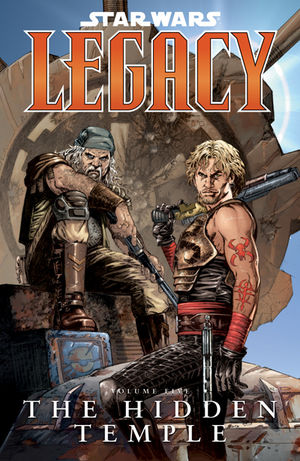
In The Hidden Temple, the crew visits Cade's uncle. Here is more backstory. Not everything Cade knows is dead.
While there, Cade is visited by Azlyn Rae, another bit of Cade's past. A fellow student who appears to be a bounty hunter but is in fact working for the empire.
So while some have allied with the old emperor that Azlyn serves, spying on old friends tends to make them... trust you less no matter how good the good times were.
This can be problematic at times when the character's backstory continues to influence the current course of the campaign. However, when running a non-standard dungeon crawl campaign, the Game Master may need to expand his own ranking of NPC's and having the characters make backstory allows the Game Master to hang more backstory onto them.
The first thing the GM should do in these cases is explain that the character's backstory is 'open' and that you'll occassionally be adding bits and pieces that mesh with the bits and pieces they've added to it already. This allows the player to have an uncle whose got all sorts of skills, but then allows you to add another contact that the character once knew and who served under the uncle giving the character a solid in to the setting.
In terms of the Hidden Temple itself, it acts as a focus for this book in many ways. First, it's a place of refuge for Cade who has a bounty on his head. Players should have some type of safehouse that allows them some downtime, even if it's not in the best and brightest of situations.
Two, it allows the GM to parade out other NPCs who may be useful in the future. There are a few more potential easter eggs in the jedi that Cade finds waiting for him.
Three, with those NPCs, it allows the GM to showcase one opinion and force the player to take his own action. In this case, Cade suggests assassinating the Sith Lord. With a bounty on his head and the Sith Lord committing genocide, he figures it's time for the jedi to do make some tough decesions.
The jedi debate it, but the outcome is never really in doubt. If you want to do the job, do it yourself.
This is one of the important elements to think of when players may want to question why someone else isn't doing something that they could do. In games like the Forgotten Realms, where there are a lot of powerful NPCs, why aren't they always out saving this or doing that? Sometimes, it may simply be that it's not their way.
That to take direct action isn't their philosophy and that it's better to move through others.
Sometimes it may be a deliberate ruse to see if the enemy will act.
Sometimes it's because to act would be a suicide mission.
Here, while the Jedi might be able to take out one Sith, they don't know who will rise to replace him and they don't have the numbers or manpower to take out all the Sith as a Jedi army. Even though many of these Jedi have shown themselves to be more powerful than the average dark force user, even though they could probably inflict some horrific damage to the enemy, to do so would be their end.
In some cases, the players don't need to know why the NPCs aren't taking care of things, all they'll know of it, is that they're not taking care of things. If the players wish to spend time pursuing why the NPC's aren't taking care of it, then that in and of itself can become an adventure.
For example, I ran a Champions campaign using the Palladium setting of Nightbane. Many of the super heroes quickly started working with the invaders. The players initially couldn't figure out why until they began to follow the American. In the campaign, the America was essentially a Superman clone. What they discovered was that the Night Lords kept the American's family under constant surviellance and that any disloyalty by the heroes would result in family member's torture and then death. This was something the players accidentally caused to happen in their own explorations.
It didn't matter to most of the players, because that group was a Wolverine love child where there were no parents or children or relatives or DNPC (Dependent Non-Player Characters) to be found on the character sheets.
That campaign took a few interesting twists and turns but it showed that sometimes even the powerful factors have their hands tied by things that have nothing to do with their own innate abilities.
Even as you give the players a safehouse to rest and recover, to debate and analyze, remember that they're not filled of the motivations and methodology of the Non-Player characters and that motivations for anyone outside of their own group may be far different than they know.
Labels:
Dark Horse,
Dungeons and Dragons,
Game Master,
Graphic Novels,
Star Wars
Tuesday, December 29, 2009
Actions Lead To Consequences Which Lead to Actions...
Legacy Volume 4 brings two things to mind for me.
The first is that action begets action. There is a bit of rebellion and it leads to the Sith lord declaring genocide. This of course is an action and reaction bit, but it has further consequences down the road.
Next up, is that to be as stupid as the Sith are, you have to be really powerful. Much like Vader from the original trilogy of movies, the Sith here have no problem in killing high ranking military officers.
This would be a tremendous lack of motivation but yet, they keep coming.
In such cases, if the players ask why, the Game Master should have some reasons.
1. Overwhelming arrogance. How many bad guys think that they aren't the guano? How many top teir villains are going, "Man, I'm so happy at rank three, I hope this goes on forever." Most of the time it's an arrangement of failures by multiple tiers that cause the top bad guy to fail in the first place, but hey, I won't have that problem right?
2. They had it coming. Similiar to the arrogance factor, these individuals may not think of themselves as being better as being top bad ass, but may think of themselves as being better in that they and they alone are surely indespensible and nothing would ever happen to change that.
3. No other option. When you're the number two man and the number one gets axed for failing to live up to his job, what do you think they'll say if you go, "No, I'm good here." These types of organizations tend to be move up or move out.
There are other bits here and there. The former Emperor, a military man with a touch of force training and a carde of elite knights, also with their own force training, is still in rebellion against the Sith Emperor. This leads them to an alliance with the old Alliance... It's just about as classic as curse you for your inevitable betrayal but as I've mentioned in other posts, it's a classic for a reason. The immediate needs of the many take priority over the urge to kick the snot out of that foe whose done you a personal wrong.
Of course not all players may see things that way so be aware that when trying to set up such an alliance that things may not work out as you envision them. In a purely mercenary game or one with highly driven plots determined by the players, all of whom might not be on the side of angels, one of them taking the time for some personal sweet revenge isn't that far out of the line. There's more than one classic story of the 'hero' winning through his initial plot only to go back for seconds because of someone that did him a personal wrong in order to finish it. Sometimes the hero doesn't make it out of those situations...
Star Wars Legacy continues to build on the previous issues by expanding the scope and range of the universe with new characters and different viewpoints. Keep the plots of the game wide and far reaching and allow the players to pick their own paths.
Labels:
4e,
Dark Horse,
Dungeons and Dragons,
Game Master,
Graphic Novels,
Legacy,
Star Wars
Wednesday, December 23, 2009
Easter Eggs and Other Surprises
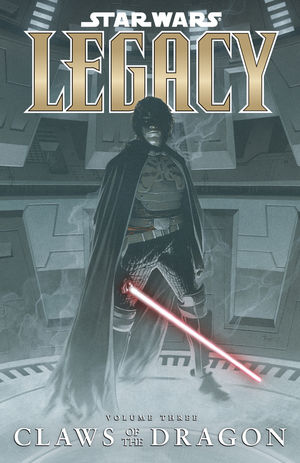
In volume 3, we get the name of the Sith master, A'sharad Hett. For those who've been following various other Star Wars books, set in different time lines, this is no stranger to the Star Wars universe. Indeed, by using sith techniques to prolong life and spending time in statis, Darth Krayt has managed to live through the Clone Wars, the movie's time line, and this time line, set over a hundred years after the movies.
This allows the authors to use the expanded universe to its fullest and bring in individuals that the reader may care about. It also allows the authors to use various other trappings and add little so called Easter Eggs all through the series allowing the reader to enjoy the ones they like and skip over those they don't know.
In a role playing game, this has to be done off of previous experiences in the actual game itself. If none of the players are familiar with any of the old Non-Player Characters or haven't played with your gaming group before, bringing out some of the most interesting and well loved characters of the past campaigns as villains will have no shock value and no real emotional impact.
In the 'greater' realm of the shared experience on the other hand, the greater experience of the Dungeons and Dragons game, Wizards of the Coast does this all the time ranging from book titles, to updating magic items, to updating concepts that fall into and out of favor. For example, demons. During second edition, demons and devils were given the boot, the demon lords removed from the game until they were brought back later on, still during second edition, and even allowed players to have a huge potential role in the bringing back of one of the most famous of the big bads, the demon prince of the undead, Orcus himself.
By using the wider mythology of the Dungeons and Dragons game itself, Wizards of the Coast and back in the day, TSR were able to try and bring bridges to gap not only the edition differences, but also the differences in years from when various people may have started playing the game. This allows people who haven't played with one group to still have some background elements in common thanks to the shared background of the game, to share those elements in the game that nether has played before.
When planning out encounters, and using characters that may make multiple apperances, let synergy by your guide. Nihl was one of the Sith that killed Cade's father and cost Cade's mentor his arm. Here, Cade cuts off Nihl's arm. Tit for tat but also synergy in how wounds dealt may come back. Showcase how past actions may be reflected in the game as it continues to unwind.
This doesn't always have to be true though. For example, many characters have a masked identity. This ranges from the modern era of Super Heroes and Pulp Heroes to older heroes like Zorro. What if the players have an ally whose actually an enemy or an enemy that's actually an ally? Masks, methods of preventing detection, and other methods, can go a long way in concealing someone's identity. Give the players a start next time they hire on a torch bearer who is actually the mayor of the town.
For combat, don't forget the social aspects of it. When Cade fights against the Sith master, the Sith taunts Cade numerous ways. When Cade returns the favor, it drives the Sith into a near berserk rage that makes him forgo any style or panache and costs him the fight and drives the Sith lord onto a horrible plot for revenge latter. If the players are able to get under the skin of their enemies, give them some type of bonus. Perhaps the bad guy doesn't use his best attack. Perhaps he only targets one of the players instead of all of them. Perhaps he targets the rogue with the glib tongue even though the fighter gets a free attack by doing so. Don't let the game mechanics dictate everything. Let combat unflow through the use of social and martial methods.
In terms of character opportunities and role playing potential, Cade Skywalker works with the Sith while trying to determine what he is going to do. Doing so is potentially dangerous for anyone as the whole Force and Dark Side bit tends to be addicting. As the Darth master himself notes, "What we pretend to be we often become."
In terms of character planning, the author shows the readers a recuse attempt being crafted and how the characters go through equipment and use their skills to insure that no stone goes unturned. It works well. This is not to say that there should never be an issue, some surprise, some last minute problem that crops up, but if the players are smart and spend the time and resources and back those plans up with the abilities, allow that planning to go through.
Labels:
Dark Horse,
Dungeons and Dragons,
Game Master,
Graphic Novels,
Star Wars
Tuesday, December 22, 2009
The Lesser of Two Evils Is Still Evil
Volume Two, Shards brings the reader an Empire torn apart. See, the old Emperor was betrayed by the Sith and civil war tears apart the lands.
So there are numerous factions that the people in the middle may have to deal with, and not all of them are completely dedicated to the cause, some of them not dedicated to the cause at all, and some of them loyal not to an idea or to personal power, but to their allies and personal friends.
In looking at Shards, if the Game Master is not running a dungeon or site based campaign, that campaign needs to have numerous enemies and threats within it to motivate the players. The actions of the players against those various factions can lead to different elements coming into play.
For example, the Skywalker viewpoint here, Cade, is responsible for a jedi being caught and he sees a vision of that jedi being tortured. So now Cade has an oracle inspired mission. Well, not an oracle, but it's something that the Game Master can use, in this case, the Force, to 'nudge' the player along.
In typical fantasy games, the Game Master always has the use of dreams, omens, prophecy, priests, ancient texts, and other things that may tie to a character and that character's recent actions that can be used to spur the party onto the next big thing.
For example, say the party meets and defeats a group of bandits on the road. Unknown to the party, that group of bandits was part of a fallen group of knights being lead by the younger brother of a knight in retirement who now wants vengance against those who've done his family wrong.
Or the party meets a group of bandits on the road and avoids them to betraying their own travelling allies and handing them over to the bandits only to be troubled by visions and dreams that those comrades they've betrayed may have been more important to the party than they initially realized.
When leaving the dungeon, personal motivation, the acts of the characters, the ripples those characters have on the setting, ranging from their backgrounds, weapon choice, career choice, and current methodology, all become tools necessary to keep the campaign flowing.
Labels:
Dark Horse,
Dungeons and Dragons,
Game Master,
Graphic Novels,
Star Wars
Friday, December 18, 2009
Living Up To The Legacy
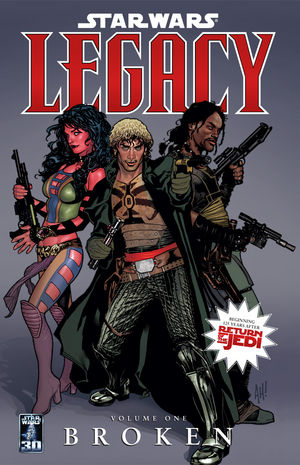
In addition to manga, Dark Horse has long been the comic care taker of the Star Wars property. One of those veins of gold they mine, is the Star Wars Legacy era, 125 years after Return of the Jedi. Over here is a summary and preview of the first collection of legacy comics.
As with all Star Wars comics, one of the first things a Game Master may take from it, for any game, system, or genre, is that apperance matters. When I was a kid, Darth Vader didn't stand out so much because of the high end special effects and fighting sequences, but rather, the visuals that came with him. The bounty hunters like Fett? Ditto.
Giving the main characters a distinctive look will go a long way in ingraining them to the players they must interact with.
In addition, because these are Star Wars comics, even though they are in a different time line, they share many of the same elements.
If your group is looking for a standard game of Dungeons and Dragons and they start off as breaking out of their shells as lizard men in some swamp that has no humans and is a pre historic world with dinosaurs and dragons as the masters, it may be an awesome setting, but it's not what they've signed up for. The elements of the familiar can help the players quickly get into the game. When people look at Dragon Age and claim it has no originality, that doesn't seem to stop it from selling or from people enjoying it immensely. When critics talk about Terry Brooks, Ryamond Feist, or a certain Dennis of being Tolkien copy cats to various degrees, they may be over looking the fact that many people like the 'comfort' food category that these elements fit into.
For players, Star Wars Lgecay has a few words about being a legacy character. "The point is-- I have a legacy, too. And I'm just as trapped by mine as you are by yours. Sometimes I wish I could just change my name-- make a new life...I envy you your freedom but I'm not walking away from my responsibilities."
When looking at a legacy character, is your character like Roy from the dreaded Order of the Stick? Willing to go the distance for the family honor and legacy but going against the wishes of the one who sent him on the path? Is he like Cade from this series? Possessing of the powers and abilities but seeking to surpress them in order to ignore that legacy? How a character interacts with the elements that make up the character's legacy will define the role that the character takes in the campaign.
Legacy characters can be a lot of fun. Like the new Batman, who started off as Robin and moved onto Nightwing, they can represent a logical growth and extension for the character. Like the various comic extensions of Marvel's 2099 line, they can be either inspired by the originals or perhaps even time displaced copies of the original who have a name and title to live up to. When using legacies in the campaign, as either a player or a game master, make it interesting enough so that its fun for the whole gorup without overshadowing eveyrone else.
Labels:
Dungeons and Dragons,
Game Master,
Legacy,
Player Characters,
Star Wars
Subscribe to:
Posts (Atom)