Showing posts with label Rogues. Show all posts
Monday, September 19, 2016
The Wizard's Mask by Ed Greenwood (Book Review)
The Wizard's Mask
Written by Ed Greenwood
Pathfinder Tales
400 pages
$9.99
Ed Greenwood should need no introduction to any role players of Dungeons and Dragons nor anyone whose read fantasy fiction in the last 25 years. My own introduction to Ed comes from Dragon Magazine and his numerous articles for the Forgotten Realms, leading up to the publication of the original 1st edition boxed set of the Forgotten Realms and many books beyond.
For those who don't know Ed, he's got his own website over there: http://edverse.officeedgreenwood.com/ and he's got a Wiki entry as well: https://en.wikipedia.org/wiki/Ed_Greenwood
Ed's writing isn't for everyone. While I've highly enjoyed his gaming material, his fiction often is hit or miss for me.
This book is both.
On the negative side is the believability of the story. It's not that a fantasy tale needs a high level of such a factor, but if the characters are given to X, then they should be able to accomplish it. If they are given to X and all of the sudden they are doing things that require the whole X, Y, Z, and a hand on from the higher powers, it stretches the enjoyment of the story.
The other thing is probably just me. As I get older, I'm more aware of how writers handle their female characters. In this novel, we are introduced to two characters, the "man known only as The Masked" and "an escaped halfling slave named Tantaerra."
"So...a halfling woman, probably in her thirties and with the lined face of someone who'd known hunger often enough, despite the fact that she still had plenty of chest and hip on an otherwise scrawny frame."
This doesn't count the numerous times' she's made naked or that she's actually shorter than a regular halfling. It's just a weird thing. This extra short child sized individual clearly suffering from hunger with big tits and ass.
Okay...
The other problem I had with the book is Ed needs to know when to let a villain go. The villain that the duo tangles with most isn't even the 'big bad' but Ed keeps using him and as a reader I didn't find him interesting at all and was just waiting for him to die. It's like, "Okay, we know the author likes this bad guy for some reason, but really? He sucks. Let him die this second time, this third time..."
In terms of popcorn reading though?
Top notch.
The story starts with action. The action easily goes across one hundred pages. If you dig chase scenes like those you'd find at the start of the newer James Bond movies, you'll enjoy those parts. Ed has a great way of moving the action from left to right with the action dancing across the page.
Ed also keeps the action flowing.
The author is hit or miss on the names. For example, one of the magic weapons in the novel, the Whispering Blade? It's a blade that telepathically communicates with those it's seeking to dismember and does so in an ominous voice that Ed captures perfectly. The name fits it.
And then there's the magic item that the duo are sent out to seek in the Shattered Tomb to begin with. The Gauntlet of Fear or the Fear Gauntlet. Really? Ugh.
Ed also uses some odd choices in his monsters. The creature on the cover is a particular type of monster native to the Pathfinder Tales region and Ed puts it to good use. Little nods like that are great.
If you're looking for some light reading heavy on the action than the Wizard's Mask is going to do you right. Ed's not building up a setting like some authors in the Wheel of Time or A Game of Thrones but the Pathfinder Tales are not about that.
There's enough character development that another book is possible but all of the main plots and threads of this novel are done in one and that in and of itself is a refresher.
Labels:
Ed Greenwood,
High Fantasy,
Pathfinder Tales,
Rogues,
The Wizard's Mask
Monday, December 24, 2012
Thief in the Night by David Chandler
Thief in the Night is the second book in the Ancient Blade Trilogy by David Chandler. I see over on David's website that when I found the first book for $2.99, that was a temporary sale. Man, dude needs to update that blog some more or have some links to his more modern work or more complete work. Last updated on 2011? And I thought I was bad.
Anyway, Thief in the Night continues the tale of Malden and Croy and the woman who they both love as well as dwarfs, dungeon ruin exploration, barbarian introductions and all manner of other interesting bits that would feel right at home in most role playing games. I'll be talking about specific spoilers below so if you would rather avoid that, read no further.
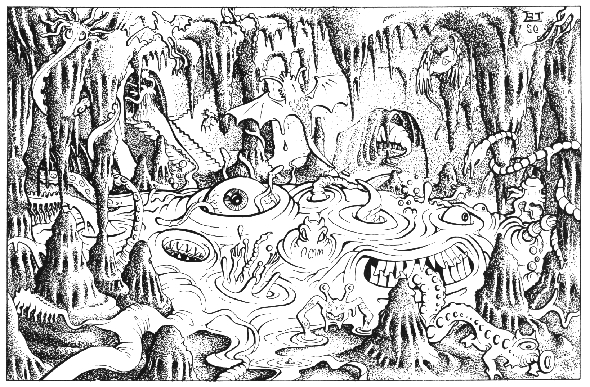
1. Racial Changes: I've mentioned before that in various settings, one way to make things stand out a bit is to change the 'core' fantasy races around. In the Riyria series by Michael J. Sullivan, the elves were vastly powerful and held at bay only through honorable agreements with their ancient pacts. Here, the elves were wiped out. Well, apparently not all wiped out as Malden and his friends discover in this novel as the elves have changed to more suit an underground civilization. This includes breeding large beetles for meat, fungus farms, and using the 'ancient's, which appears to be a thing that resembles an old Shoggoth by a Erol Otus from the old Deities and Demigods book.
Yeah, all eyes, and teeth, and hands, and strange bits to it.
When the elves die, they 'feed' themselves to it and their knowledge is then absorbed by it. This allows the elves to draw forth on knowledge that is ancient and rare and powerful. And in the case here, to survive their imprisonment in these ancient dwarven halls.
The dwarfs continue to be fleshed out a piece at a time. Slag showcases his vulgarity with vast amounts of swearing. It's entertaining to a point mind you. He also illustrates how dwarfs have changed. They have taken to some human vices such as gambling and this has lead some, like Slag himself, to do things that lead to exile. Their numbers are also on the decline. So some of the same old same old and some new.
2. Historical Nonsense. Again, the Riyria series covered similar ground. The humans have told themselves some pretty lies about how the war against the elves went but as Malden and his comrades explore the ancient ruins, which no dwarf in modern times could ever recreate, they learn that the elves weren't beaten by the humans, but betrayed by their allies, the dwarfs at a time when they didn't necessarily want to even fight anymore in the first place. This taking huge chunks of history and reworking them can also work in a RPG but care needs to be taken so that it actually works. Here, Croy and Malden are young enough that they wouldn't know the truth. In RPGs some long lived races, like elves, or even some immortal races, would know would actually happened. Not necessarily a problem for all games, but as Dungeons and Dragons tries to throw more and more material against the wall to see what sticks, its not entirely unusual to see such a player character pop up.
3. Expanding Setting. The first volume dealt mainly with the free city of Ness. This volume, by its nature of exploration of a ruined dwarf city outside Ness, expands upon that some. We see for example, Morget, a barbarian from the opposite side of the mountains, is seeking out Croy because his destiny is to kill a demon that looks like a strange slithering thing of arms, eyes and teeth. Morget is also a wielder of one of the ancient blades, one that explodes with light. This light is painful to undead and would make a good substitute for a Mace of Disruption with an area effect were the GM wanting to incorporate something like it into their own game.
In many ways, this is a natural in role playing games. You first dungeon leads to your second dungeon. Your first exploration in the sandbox leads to the second exploration in the sandbox. Your first departure from Sigil or the Rock of Bral leads to further exploration. Don't try to cram the whole campaign into one setting. Let it develop from the actions of the players.
4. Big Changes. One of the things I've been guilty of myself, is trying to keep things, to a certain point, at a status quo. To not have any huge effects happen to the setting. David doesn't have that problem. By the end of the novel, the characters have collapsed the mountain on the elves. This leaves a pass open from Morget's people, barbarians who have a lot in common with say, vikings and crossbreed with Mongolians. So that opens up a whole new vista for them to say attack the kingdom.
5. Character Optimization: One of the things that role playing games tend to suffer from, especially when they get pregnant with rules, is that there are 'builds' and abilities that almost become mandatory to take. Malden, while perhaps one of the best 'thieves' in the setting, one of the most agile, one of the most able, is still a terrible fighter. In 3rd edition and 4th edition of Dungeons and Dragons, its almost impossible to play such a character as so much of the setting focuses on their tremendous back stab damage and 4th ed kicking that up even more of a notch with special abilities that put them right into the fighter's arena.
The Game Master and player should have an understanding of what type of campaign is happening and the players should try to work with the Game Master to build characters that will thrive within it. In Malden, we have a character that is charismatic, works well with a party, and is a master thief. If the campaign requires only martial powered characters that can dish out damage, Malden would be useless. Check with the GM and hope you have one that's willing to work your abilities into the campaign.
Anyway, Thief in the Night continues the tale of Malden and Croy and the woman who they both love as well as dwarfs, dungeon ruin exploration, barbarian introductions and all manner of other interesting bits that would feel right at home in most role playing games. I'll be talking about specific spoilers below so if you would rather avoid that, read no further.
1. Racial Changes: I've mentioned before that in various settings, one way to make things stand out a bit is to change the 'core' fantasy races around. In the Riyria series by Michael J. Sullivan, the elves were vastly powerful and held at bay only through honorable agreements with their ancient pacts. Here, the elves were wiped out. Well, apparently not all wiped out as Malden and his friends discover in this novel as the elves have changed to more suit an underground civilization. This includes breeding large beetles for meat, fungus farms, and using the 'ancient's, which appears to be a thing that resembles an old Shoggoth by a Erol Otus from the old Deities and Demigods book.
Yeah, all eyes, and teeth, and hands, and strange bits to it.
When the elves die, they 'feed' themselves to it and their knowledge is then absorbed by it. This allows the elves to draw forth on knowledge that is ancient and rare and powerful. And in the case here, to survive their imprisonment in these ancient dwarven halls.
The dwarfs continue to be fleshed out a piece at a time. Slag showcases his vulgarity with vast amounts of swearing. It's entertaining to a point mind you. He also illustrates how dwarfs have changed. They have taken to some human vices such as gambling and this has lead some, like Slag himself, to do things that lead to exile. Their numbers are also on the decline. So some of the same old same old and some new.
2. Historical Nonsense. Again, the Riyria series covered similar ground. The humans have told themselves some pretty lies about how the war against the elves went but as Malden and his comrades explore the ancient ruins, which no dwarf in modern times could ever recreate, they learn that the elves weren't beaten by the humans, but betrayed by their allies, the dwarfs at a time when they didn't necessarily want to even fight anymore in the first place. This taking huge chunks of history and reworking them can also work in a RPG but care needs to be taken so that it actually works. Here, Croy and Malden are young enough that they wouldn't know the truth. In RPGs some long lived races, like elves, or even some immortal races, would know would actually happened. Not necessarily a problem for all games, but as Dungeons and Dragons tries to throw more and more material against the wall to see what sticks, its not entirely unusual to see such a player character pop up.
3. Expanding Setting. The first volume dealt mainly with the free city of Ness. This volume, by its nature of exploration of a ruined dwarf city outside Ness, expands upon that some. We see for example, Morget, a barbarian from the opposite side of the mountains, is seeking out Croy because his destiny is to kill a demon that looks like a strange slithering thing of arms, eyes and teeth. Morget is also a wielder of one of the ancient blades, one that explodes with light. This light is painful to undead and would make a good substitute for a Mace of Disruption with an area effect were the GM wanting to incorporate something like it into their own game.
In many ways, this is a natural in role playing games. You first dungeon leads to your second dungeon. Your first exploration in the sandbox leads to the second exploration in the sandbox. Your first departure from Sigil or the Rock of Bral leads to further exploration. Don't try to cram the whole campaign into one setting. Let it develop from the actions of the players.
4. Big Changes. One of the things I've been guilty of myself, is trying to keep things, to a certain point, at a status quo. To not have any huge effects happen to the setting. David doesn't have that problem. By the end of the novel, the characters have collapsed the mountain on the elves. This leaves a pass open from Morget's people, barbarians who have a lot in common with say, vikings and crossbreed with Mongolians. So that opens up a whole new vista for them to say attack the kingdom.
5. Character Optimization: One of the things that role playing games tend to suffer from, especially when they get pregnant with rules, is that there are 'builds' and abilities that almost become mandatory to take. Malden, while perhaps one of the best 'thieves' in the setting, one of the most agile, one of the most able, is still a terrible fighter. In 3rd edition and 4th edition of Dungeons and Dragons, its almost impossible to play such a character as so much of the setting focuses on their tremendous back stab damage and 4th ed kicking that up even more of a notch with special abilities that put them right into the fighter's arena.
The Game Master and player should have an understanding of what type of campaign is happening and the players should try to work with the Game Master to build characters that will thrive within it. In Malden, we have a character that is charismatic, works well with a party, and is a master thief. If the campaign requires only martial powered characters that can dish out damage, Malden would be useless. Check with the GM and hope you have one that's willing to work your abilities into the campaign.
Subscribe to:
Posts (Atom)