Showing posts with label Game Master. Show all posts

Monday, August 1, 2016

Vagabond: Gaming Edition Version

Welcome to Vagabond Gaming edition! I debated including some ideas on how I’d use Vagabond in my previous post but decided I wanted that to just sit as its own post as a review of the book. Any opinions on that or is it better to just keep review and inspiration ideas all together? Sound off in the comments!

Note, a lot of what I pull from most sources, isn’t necessarily for dungeon crawl games. It’s not that I have anything against such games, far from it. It’s also some advice that you may have read before. Perhaps even here on this very blog!

But when reading books, most don’t involve dungeons at all. Most involve characters and locations and when you enjoy a book and can bring the elements of the book you enjoy to the table? That’s a win.

Names: “As well as Hellgiver and Widowmaker, thee was Stone-Hurler, Crusher, Gravedigger, Stonewhip, Spiteful, Destroyer and Hand of God.” In the book these are the names given to siege weapons but damn, don’t they sound powerful? They give each siege weapon their own identity outside of siege weapons one through nine.

Names can also be descriptive in terms of the person they belong to. Beggar for example. “…but Beggar was an enormous man, a shambling giant with a face so bearded that his nose and eyes alone could be see through the tangled, crusted hair beneath the brim of the rusted iron cap that served as a helmet.”

Languages: I appreciate that almost every fantasy and science fiction setting includes a “common” tongue or a “trade” language. But it the real world that’s such nonsense eh? Even if you give players a “trade” tongue, keep an eye out for how you can use other languages in your game. At this point in England’s history, the French language is seen as a “noble” language. Latin is a “scholar” language. English itself may be a common tongue but it’s the vulgar one if so.

Give ethnicities their own languages and have them use it to communicate amongst themselves in front of the players. Give one culture historical reasons why it doesn’t like speaking another culture’s languages.

Holidays: There are numerous named days for various saints. These peppering of saints’ names throughout the book act in a few manners, but one of them is to tell the passage of time.  Other holidays may be very localized. For example, in Thomas’ old village, they used to drown rats on ships at high tide from boats weighed down with stones and those rats that sought escape, it would be similar to the old Simpson’s “Snake Whacking Day”. Hey, there was no television back in those days!


Freedom of Choice and Consequences From Freedom of Choice: I’m sure there’s a better way to say this so sound off in the comments if you have one.
At the start of Vagabond, Thomas is on a mission to retrieve information on the Grail from an elderly priest. He decides instead that he’s going to hang around and fight and sends his lover and friend to get that information. 


By not choosing to go, Thomas unintentionally gets his lover and friend killed. See, in a “living” setting, the bad guys are doing things too.

The villains of the campaign, especially one that’s not a dungeon crawl, should never be sitting around sighing that their bored waiting for the hero to come and kill them. They should be doing their own things and these things should be on a set schedule that can change as the setting changes.

For example, if Thomas has gone, the book would have taken a much different turn as Thomas would lose half his motivation for the rest of the book and might actually be done in about a third of the pages!

In your own campaigns, are there situations that require the players to be in two places at once? If they don’t go to both, what happens? A lot of the older adventurers set up adventures with rumor wheels but often, nothing happened regardless of which order the players took the challenges.

If you have time, don’t do that. Update the rumors. Change things up. Make sure the players know that the world is not waiting on them to do things.

Destroy Your Village: The small village Thomas comes from is an overgrown ruin. It was destroyed in a raid. Animals have taken over. How many times has a traditional Dungeons and Dragons campaign started in a small village that couldn’t handle a wild owlbear much less a powerful foe? When the players leave the village and if they ever return, have it destroyed. Showcase the power of something like a dragon or wizard who were something for something the characters were rumored to have left there in the past.

Places changes. People change. Settings change. Sink Waterdeep and think about how that changes the power structure in the north. Do the sea elves and merfolk take over the drowned ruins? Do aquatic dragons guard the still shielded libraries? Modern ruins are much more relevant to characters than ancient ones because there is a personal connection to them.


Vagabond has a lot going for it. If you’re one of those who picks up on different bits when you’re reading, it’s well worth the read.

Friday, July 22, 2016

Talk Like Ted: The Nine Public-Speaking Secrets of the World's Top Minds

Talk Like Ted
The 9 Public-Speaking Secrets of the World's Top Minds
Carmine Gallo
$9.52 at Amazon


I've mentioned before that when running or playing a role playing game, having a large expanse of reading is only going to be a good thing.

I know some are going "Yeah, but Talk Like Ted?"

Absolutely.

The book breaks down nine different tips for speakers and even if you're just looking at it from a Game Master view, you're a speaker and the audience is the players.

Here's a quick recap of why you should Talk Like Ted:

1. Unleash the Master Within
This one boils down to the question, are you passionate about the subject matter?

I can't speak for anyone else, but man, there have been some games when the guy running it was not into it. Sometimes during the game they'll pick up as they become engaged with the players but often, it's a drag to play in a game where it's obvious that the DM would rather be doing something else.

If you're going to run, run it like you mean it.

2. Master the Art of Storytelling
This should be a no-brainer for roleplaying games which are, after all, about a 'type' of story ,even if it's just a dungeon crawl.

Often though, people forget to weave stories in the games their weaving. One of the reasons for Dungeons and Dragons having so much fan support for the settings of the 90s isn't necessarily because the dungeon crawls were so awesome but because the settings were ripe for stories and the fiction lines helped reinforce that.

3. Have a Conversation
A chapter discussing the importance of practice, of reaching out to your peers, of trying your material first.

It's a lot easier to do these days then when RPGs first started! With communities like RPG.net and others around, you can share stories, ask about power levels of different monsters and all manner of sharing that just weren't possible at the start of the hobby.

4. Teach Me Something New
People want to learn.

In roleplaying games, this can take the form of important background information or showcasing how some new rules work.

I had planned at one point to run a campaign based around the Magic of Incarnum set in Waterdeep where the traditional roles of magic were challenged by this new power source. It would have slowly feed the new information of the book into the campaign and allowed players the option of being in the old guard learning about it or in the new rules rolling out.

5. Deliver Jaw-Dropping Moments
Shock!
Awe!

These are more than just buzzwords. A lot of this in a role playing context, may be in the setup of where a big fight is going to take place. Having a battle at a huge castle with armies of orcs and allies on the wing for one popular example.

Modern action movies have kicked this up a notch so be on the lookout for bits you can steal and add to your own games.

6. Lighten Up
While I am a fan of "grimdark" you don't want to sink the mood at the table. People are coming together to have a good time so don't forget that it's a game and you should relate to the players as a fellow enjoyer of the game as well as the Dungeon Master.

7. Stick to the 18-Minute Rule
This one is about attention span and hey, if I was going to steal this rule, it's be about when players are floundering. I'm not a Game Master that thinks role playing with other characters in the setting, trying to get deals on various shopping, hunting down information or other activities are time wasters, but if the party is sitting around trying to figure out what their next move is, maybe give them a push in the right direction.

8. Paint a Mental Picture with Multisensory Experiences
I've known gamers who hate modern rpg books because the cost is so high. A cost they associate with the art, fancy layout and design and other factors that go into making a book physically appealing.

I don't want to say that their personal opinion is wrong, but for the great mass of people, art matters. Layout matters. Design matters.

And again, with easy access to the internet, it's no problem to grab images of what characters, monsters, and locations look like.

With the Lord of the Rings and other movies like Beowulf out, there's also no reason not to dabble in music.

With the music, in my experience, you might want to make sure that it's not overpowering the session. I've known some Dungeon Master's who when playing something like Cyberpunk will be blasting Korn, Nine Inch Nails or another industrial group and it competes with the gaming.

9. Stay in Your Lane
This one gets to authenticity. For role playing purposes, I'd say run games you want to run. Run games you'd want to play in. Make sure that the group knows what's going on. Nothing like starting off the night in a gritty police setting and fifteen minutes later having Superman and Batman show up because the Game Master wanted to run a DC Heroes game in the first place.

Talk Like Ted is a fun book that anyone reading it should get a lot of use of in both the dreaded real world and in role playing games.


Monday, August 19, 2013

Gen Con 2013: The Games I Ran

I ran two different game systems this year and was glad of it. In previous years it's been three or more. It's certainly possible but it's easier, at least for me, when I only have to split my attention between a few game systems. Even better, of the eight games I ran, only one of them was not The One Ring.

That one was Keltia. Last year one of the games I ran was Yggdrasill. Keltia is the tales of the Celts and the original ad mentioned King Arthur. Maybe something like Cornwell's Warlord trilogy? The later is Vikings. It uses a d10 system and isn't that bad but some of the layout in terms of where everything is and some of the rules are a little wonky.

The fun thing about Keltia is that there was no book this year. Thankfully it uses the same rule set as Yggrasill so when I finally figured out that there would be no PDF even of a pre-release, I hunkered down.

The game allowed an assorted group to hunt down rumors of dark magics and fight against the supernatural. It was a fairly straightforward romp which was great compared to last year's Yggdrasill game which ran over the four hour limit for me on both games which for my games, if anyone's played in one, is rare. Like super rare. But it appeared everyone had a good time.

The One Ring on the other hand, is one I'm a bit more familiar with as I've run it before and its crunch level isn't that bad. The only bad thing about it is it's what I call "fiddy". There are all sorts of little things to take into account. Did you meet your target number? Did your roll an edge? Did you remember to roll your battle dice at the start of the combat? Did you note your starting fatigue?

The other 'problem' with the One Ring is that it's not really designed for a con game. You see characters have an attribute Hope. Players can spend them like action points but doing so makes them more vulnerable to being miserable which leads them to have bouts of madness. Chances of that happening in a one shot game? Possible if there are a ton of things dishing out shadow points but not too likely.

There are also other elements, like recovery in sanctuaries after the 'adventure' is over but again, not something that's probably going to get hit too often in a con game.

The adventure, The Wind From the South I think, was fairly straight forward. It involved several combats against a variety of enemies. With the two separate journey checks, there was opportunity for more potential misery to be heaped on the players. The best thing? The open ending where the players have a HUGE variety of things they can do. You see they must rescue a daughter of Rohan from some rogue Woodsmen who seek her cursed magic right to fight against the forces of Dol Ghuldur.

I can't recall every instance but...

In one campaign, one of the players who was playing a Woodman of a similar background challenged the chieftain to single combat. The elf sang to bolster his spirits and reduce the Hate score of the villain. The player took a good beating but with some excellent rolls on his part and the elf's part, the chieftain broke down in tears at the foot of the Fellowship realizing that his dream of opposing the 'Master' with such a meager item of magic was doomed from the start.

In another one, the players did a fighting retreat which wound up with a few of the players again taking a fair beating but managing to fight their way out with the Rohan Rider and the ring which they purified of evil.

In another, the players caused a distraction in the main hall by starting a brawl while their other comrades searched for the woman of Rohan.

In another, the players caused a distraction by singing and creating a festival mood. The men of the fort, while 'evil' so to speak, weren't at open war with the Woodmen and there were two woodman who just immediately joined into the dinner and began eating and roaring and role played it out till they were singing and doing tests to make the nose louder while the 'bard', a giant Beoring, started a 'wave' of people shouting and smashing cups against tables.

I try to be ready with the rules and had hand written a few pages of notes. In most instances it didn't matter or they weren't needed. For example, I mentioned the whole battle dice check at the start of combat? Yeah, I probably forgot that more often then not.

The good thing though, was I continued to learn from the players. Last year someone showed me how to put together a quick chart to visualize the character's stances for combat and I brought some miniatures along with me to throw into that chart so the players could easily see how they were arranged not in line order or anything, but what rolls they needed to hit or be hit.

This year was pretty good on my side and I hope my voice, which I started to lose on the first day after the first game but never fully lost, wasn't too bad When I ran, I asked every group if there were things they wanted to see or things I might want to incorporate for the next group I had to run and either they were all shy, and trust me, most of them didn't seem the type, or they had a good time. I'm hoping it's the later.

Personally, I haven't run into any 'real' problems with gamers. I keep hearing horror stories about it but its all been good for me. I hate to say it, but I think a lot of those problem players are in the D&D or Pathfinder camps. Not necessarily because those games draw those people, but because those are the most popular games.

When I ask if people were playing the One Ring, the almost universal answer was no. It wasn't because they didn't want to, it was because "this is D&D town". I know where they're coming from but at the same time, I know where the people who only want to play D&D are coming from. It's like an old familiar boot you can wear whenever.

There were a lot of great moments in the game. In one failed Journey test, the players could either take some automatic fatigue or test for poisoned water in Mirkwood. One of the woodman boasted of how everything at his pond was alright and then rolled the Eye of Sauron so of course was poisoned while everyone else was fine. The player did a good job of doing the whole poisoned stick too so that made it even better as some of the other people were like, "Man, he must've drank all of the poison because I feel fine!"

I did learn that gamers apparently don't like to be up at 8:00 AM though. Both my Saturday and Sunday games at that time slot were cancelled due to no-shows. It would be AWESOME if Gen Con could have a Check In App or something where people could see how open a game is. I say this because all of the games I ran were in the system, sold out. I think I had one game where all the tickets I collected were for that event and every other game I had some generics. If people could check an app and see that "Hey, there's still room here", these games might be able to be filled at a better ratio. Maybe something like Foursquare but for games run? Scan the specific tickets and it sends out 'alerts'?

Anyway, what did everyone else play or run? I was hoping to get in some games myself, and this may sound stupid, but when I realized my voice was going, I decided against it. Cubicle 7 was awesome enough to bring me down to run games and people signed up for them and they deserve "the full Kushner" so to speak, not some half mute guy waving his arms franticly in the air to indicate damage.

Sunday, July 21, 2013

The Four (Movie)

Based on the recommendation of +Gareth Skarka , I fired up the old Netflix to watch The Four. In short, if you enjoy Wuxia style films and always wondered what it would be like if the X-Men were in Ancient China, this movie is right up your alley. Indeed, there are elements of the plot that could easily be filed off and run as a whole adventure.

I'll be discussing some specifics below so if you'd rather avoid spoilers, read no further.

1. Source Material: When I did a quick search for the Four after watching the movie, I found manga but didn't see the novels. In addition, there is a television show. One piece of source material may lead to many different interpretations. Unless you're doing something strictly by one portion or interpretation steal as much as you can.

2. Mixing Genres: While I'm only half way kidding when I speak of X-Men in Ancient China, the main characters are essentially super heroes in terms of their powers. What if they were in the Wild West though or Victorian England? In such cases, how do you adjust the setting to account not only for the existence of such individuals, but their role in society? One of the things I enjoyed about The Four is that there isn't a lot of time spent on why and how of each person's special abilities. It's almost a "gimmie" in that "This person is trained and has mastery of X and is therefore quite powerful."

3. Main Foes Becoming Minions: I've mentioned this before, and some games like Mutants and Masterminds allow you to do so but having a foe that is almost unstoppable and then shows up in large numbers? Well, looking at the X-Men, we see that happen with things like the Sentinels all the time. Here it's a special type of zombie that can really only be stopped by a powerful blow to the skull. If your game system has rules to simulate the different stats for monsters you can make a creature into a minion just by changing it's type. Otherwise provide it a huge damage penalty to it's 'soft spot'.

4. Legal Immunity: There are two organizations here that seek to discover the villain in the show. While the rivalry does have it's potential problems, the political levels involved showcase how difficult it can be to take down someone whose in a favored position. This is probably more true in today's modern society with catch phrases such as "Too big to Jail" and "Too big to fail" tossed around. Think about it. Billions of dollars gone from the economy in a heartbeat and no one goes to jail for it? Think about how slow things move in terms of corruption cases as corporations go back and forth and laws themselves are changed around it. Depending on the nature of the game, you can tweak the players a bit by having their opponent so high up the food chain that unless all of their is are dotted and their ts crossed, or their can force their opponent into doing something  clearly illegal, that their efforts will require a lot of preplanning.

5. Rivals. There are several rivalries that move throughout the story. One is of the love interest and another on the group level. The interesting thing here, is the writer's didn't go for making one group bad and this makes it more difficult to have any permanent resolution in terms of just pulling the swords out and finishing off the other group. When two people are trying to do the same job, it can create extra levels of stress, especially if the rewards for success or failure, are high.

6. Subterfuge. While rivals are seeking to outdo each other and high placed merchants have their way, there are also double agents involved. While one of these double agents is essentially known from the start, there are others who are not. Having motivations that are below the surface for characters below your games can provide another layer of game play as the players seek to understand who is with them and who is against them. Depending on the ruthlessness of the opposition, their enemies may be willing to sacrifice those spies they have in order to show the surviving spies are 'really' on the character's side.

7. Multiple Motivations. In the original Star Wars trilogy, Darth Vader's ultimate motivations or drives aren't fully known until push comes to shove and instead of ruling the galaxy by the Emperor's side, he decides to essentially kill himself and save his son. His motivation to rule the galaxy, to serve, and to have his son at his side were all in conflict. Using a flow chart, you can map out several motivations for the non-player characters and draw their personal conflict into the game in such a fashion. In Dragonball Z, Piccolo is out to destroy Goku but when they discover there are bigger fish to fry, put aside their hostilities towards one another. During that time, while Piccolo and Goku don't necessarily become best friends, Piccolo's loyalty to Goku's son, Gohan does, which provides Piccolo a different set of motivations then he had previously. Character growth occurs when multiple desires come into conflict with one another.

Saturday, March 9, 2013

Game Masters Versus Technology

So life continues to beat me soundly across the face while sneering, "You like that." My mother, who after having her foot amputated and spending months in physical rehab, because she also had leg bypass surgery at the time in order to do the amputation, has a kidney infection and was running 103 fever and is back in the hospital. My job was supposed to change in January and is only now starting to take effect and while I'm grateful for the opportunity, there are so many things that are off in the way the reports are run and so much to learn in terms of the data sources, that I'm a little over whelmed.

Having said all that, I decided to go hang out with my friends who were playing Mage the Awakening. I myself didn't play, I just wanted to hang out with some of my peers and crack some terrible jokes, drink some Svedka , enjoy some tostados and some Cuban style bean dip. The Svedka was interesting as it was their new pina colda version and the bean dip was all sorts of excellent.

As I was just there as a noisy guest though and not playing, I noticed that everyone had a laptop or a tablet. These devices were being used to house character sheets and the core book and supplements. They were also being used to play music and other bits.

Now I'm not saying Game Masters need to put a ban on technology at the table, but the lure of technology is strong. On a blog about writers I follow, the author was discussing one of the potential reasons for e-book sales being flat, is that as full range tablets, not readers, continue to grow, people have better things to do with those tablets than buy a $14.99 e-book. For that price, have many variants of Angry Birds can you get eh? Well, for a PDF reader, how many other aps might a player be using when they should be paying attention to the game itself. And how many times if you need to reference the book during game play, should they have read it ahead of time?

There are no short cuts. Reading has to be done at some point. Doing it at the game table because you don't know how your abilities work, how the game system works, or other issues, can be a potential heat death of the game as every time it comes to your action, you now have to look it up. It's a bit of a clutch in that aspect. Mind you, I understand that people are busy. I understand that games tend to be larger in volume and more complex than they were thirty years ago.

But read the book all the way through at least once and make your notes from there because at the end of the day, you're still going to have to read it, but now you're doing it on other people's time.

Which, if everyone has a tablet, can be a bad thing because now those other bored people are... yes, surfing the net, reading a book, playing music, using IM, watching a movie or playing a game.

That was in part my experience yesterday and hell, I thought I'd be the disruptive one, but I can't hold a torch to technology gone wild!

How about other people? What have you experiences with tech at the table been?

Sunday, October 7, 2012

The Harsh Lessons of DMing: Level Balance

My friend Tom Wright is running several of my friends and I through the Shackled City using Pathfinder as the rule engine. He's got some rules and notes and is fairly consistent in the way he runs. It's one of his greatest strengths.

However, he had a vision about how the game was going to work this time. He was going to incorporate various ends and odd bits of our characters backgrounds into the game. To accomplish this and still run the campaign, he decided to use the slow advancement table.

One of the great things about roleplaying games is the ability to modify things so that they work the way you want. However, if you are going to do that in a manner that keeps the pace with a prewritten adventure, you need to verify that your doing the right thing.

At the end of the first adventure, we were too low level to handle the big bad who wiped out a few members of the party and the rest of us managed to retreat. How did that happen? No side quests. When the xp goal was changed without bringing in additional xp, the end result has to be characters that are lower level.

After that, he decided he was going to use the medium or normal level of advancement. He's very good about listening to player feedback in terms of it not being 'his' game but 'our' game. But he also decided that new characters would start a level lower than the standard characters. Does anyone see any potential problems here?

So when we got to the big bad in the next adventure... yeah, essentially another TPK.

Take the time to read through the adventurers. Take the time to review the character sheets. Review not only their abilities that are level based, but also their choice of 'fiddy' bits like feats and spells. Make sure that if there are encounters coming up that rely on magic items or silver items or something of that nature, that if the party doesn't already own them, they can own them. Make some routes of escape.

Mind you, in a freestyle campaign where you let the first level party know, "Over here are rumored to be dragons and giants" and they go there anyway, well, I'm old school enough to say kill away. But if you're running an adventure and it says, "Party should be level X when they reach area Y" and they get blitzed by the baddies? Well, was party level X? Did party have level X equipment?

In some games, its easier to tell when players are min-maxed then others. Try to keep onto of it and don't wait till the last minute to find out that the party didn't have a wand of cure light wounds and that the party didn't have a method of deciphering that ancient script. DMing can be a great thing but it also often requires some homework. Do that homework!

Thursday, September 27, 2012

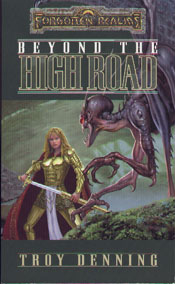
Beyond The High Road by Troy Denning


Because I have several Half-Price Bookstores within driving distance, I’m rarely at a loss for reading material. Time on the other hand… but reading material? Inexpensive reading material? The Half Price store on Touhy has a nice dollar spinner rack and I buy a book or ten from it every now and again. It’s one of the reasons I have a hard time paying some of the prices that Kindle books are marked at when not on the Daily Deal or the monthly deal.

In this case, Troy Denning brings us Beyond the High Road, a Forgotten Realms novel set in the Forest Kingdom known as Cormyr. This is one of those that I believe is set firmly during the 3rd edition era and while it has a lot of bells and whistles and some efforts at political materials, is really a good quick popcorn read. I finished it in a few hours and enjoyed it for what it was.

When I look over at Amazon, it is available as a Kindle Book , http://www.amazon.com/Beyond-High-Road-Cormyr-ebook/dp/B0060B6GRY/ref=sr_1_2?ie=UTF8&qid=1348787446&sr=8-2&keywords=beyond+the+high+roadfor a little over $5 bones. Not a bad price but I’m more happy with the $1 paid from the ole rack.

The novel does bring up a few interesting threads that can be fun when throwing them into a campaign.

1.       The Old Evil. Yeah, overplayed extremely but if it’s a well known old evil, that usually works out better in my opinion that some whack job monster that is some ancient evil that no one has heard of or bothered with before. In those cases I wish the author would just go to a “NEW” thing. “Yes, I have brought about never before seen enemies and powers to deal with you. Forget Orcus. You’re my bitch now.” Or something along those lines.

2.       Politics. While the book is certainly no Game Of Thrones, Troy does bring in the problems of having a Royal Church, one approved by the royal family, when the setting is home not to one faith, but home to many deities, some of which have actually walked in the country before. It adds a nice touch when the idea of having a royal church is first introduced and then the feedback, both from other religious organizations wondering when they can get their official royal church and from organizations already well established that quickly seek to hold onto their current power by shutting out any competition.

3.       Old Friends: While Cat and her man Grigori aren’t the main stars or even really anything other than a cameo here, it’s always nice to see a character well known in another series in the same setting make a pop up here and there without taking over the story. If you have some NPCs that the party knows are in the area, don’t go out of your way to hide or not-use them but make it clear that those individuals are not there for the story, just there to keep the continuity of the setting alive.

4.       Magic Items. If you’re playing in a high magic game, use it. There are several individuals here who use the Cormyr armory to armor themselves in magic. It makes sense in the context of the story because the Forgotten Realms is a high magic setting and the Forest Kingdom is known for its war wizards.

5.       Slap Magic Down. On the other hand, when magic becomes too easy, there are often things in the game that are designed to get around those limitations. Sometimes it’s a well placed Dispel Magic spell or an Anti-Magic Shell or a monster with immunities to various common spells or a monster that has a high magical resistance or a mirror like ability to reflect attacks. In this instance, the monsters can absorb magic. It’s a good trick that doesn’t make them exactly completely immune and doesn’t take place instantly but does bring up the limits of magic.

6.       Magic Commonality: One of the problems with magic follows the old saying if all you have is a hammer, all of your problems become nails. In this instance, the head war wizard finds himself, while not helpless, at least far less able then he should be given the resources at his disposal. In a society where magic has replaced technology, imagine what happens when it fails. It’s a similar theme we see in modern takes when electricity or physics fail and man is forced to a more primitive life style. Whatever is making you too comfortable then becomes a crutch you must endure all to save.

7.       It’s a Dangerous World Out There. One of the things that draws the characters out, is blighted farms. Initially its thought that the orcs, often a dark and cave dwelling race, have brought some type of fungus based blight to the lands they raid due to the various locals they inhabit. In other venues, the characters come under attack by goblins. Most Dungeons and Dragons settings are not for the faint of heart and a good reminder of that every now and again with ‘random violence!’ is a good way to remind the characters.

Troy Denning made Beyond the High Road a quick read and while the Royal Family does come across as a bit spoiled and out of their element in a market where A Game of Thrones and other novels try to emulate a deeper and richer complexity, the magic and relationships of the characters in the book to each other make it worth a read.

Friday, September 21, 2012

Heartstone by C. J. Sansom


Heartstone is the fifth book in the Shardlake lawyer series set in the 1500s. This one involves Shardlake going to unravel a mystery that involves many a party interested in him not finding out the root cause of the problem against the backdrop of war. I'll be discussing the book in full below so if you're eager to avoid any spoilers read no further. A quick review would be that C. J. Sansom is a solid writer and if you want to bring something like mystery to your games, you could do worse then read some of the Shardlake series for inspiration.

War is often written in fantasy genres as something that the main characters are themselves involved in. That they are at the forefront of. But sometimes the material fails to bring home some of the common practices of war preparation. For example, England has a rich history of archery. I've spoken of archery in the past and some of the battles England was involved with that were turned by the skilled English longbow man thanks to another writer of historical material, Bernard Cornwell, but there are still some differences.

For example, in Bernard Cornwell's archery books, the main characters are consummately skilled archers. They are at the forefront of things. Here not so much. Shardlake's servant, Barak, is almost recruited to the war effort because of his backtalk to a recruiter. Well, recruit is too kind a word. Drafted is more accurate.

And these soldiers are supposed to keep their own gear and weaponry. Many people didn't have them. So of the fees they earn, they have to pay back the crown. And those who are supposed to provide those equipment? Well, if you can charge a premium price for something and provide something old that's already paid for? You can pocket quite a penny in the process.

Another venue of war, is how much it takes. I'm not just talking about the manpower fighting in the war, but the manpower not fighting in the war. Depending on the length and duration of the war, the farming back home may not go well. Farming in these times is heavily labor dependant. In addition, the manpower recruited for the war may not be all that useful if it's made up of individuals not suited for such a life. Mind you it can be fun to have a campaign staring a 'Dirty Dozen' type of individual but that's not necessarily on a large scale such as portrayed here.

A third venue of war is the scope. On a huge ship with some odd five hundred people, Shardlake almost drowns when the ship sinks. The root cause of the ship's issue's aren't made known but could include incompetence. In the anima and manga series Berserk, one of the reasons Griffith, a charismatic and effective commander is able to rise so rapidly, is that most of the people at the top are grossly incompetent. Being wealthy and a noble does not provide some magical and mythical ability to rule wisely not command smartly. Too many people in this battle on both sides prove to be useless in terms of winning.

The size of the ship, with five hundred people, may not be that impressive if you think of something like the Death Star that had to have thousands and thousands of people on it, or indeed of the first planet destroyed by the Death Star where millions of people were. Imagine players being in those situations where something like a flying citadel is under attack and is going down regardless of what the player's do. It can provide them with an experience that actually repelling the attack may not.

Another bit about war and the resources it consumes, is how much money it all consumes and what it does to the economy. In his time here, the King has literally debased the money to pay for the war effort. Currency takes on a new name. Funds take on new values. People can tell the difference based not only on the look, but the feel of the coins. Players may come across silver and gold coins that aren't what they are supposed to be. Will people in the town accept them? Will they have to accept a lesser amount for them? Are they worthless? In the modern edition, coins like electrum and brass pieces have been given the boot to keep things simple. It's a worthy goal.

But in a long term campaign that isn't dependent on gold coins to be some type of magic fuel, it can be fun to throw a wrench into the works. "No lads, I'm sorry, these are Mulgin Silver. The darker red color means there's a lot of copper mixed in there. Takes three Mulgin to make a standard." Or something along those lines.

Of course the opposite can also be true. In most games. the age of the coins isn't a deciding factor but when talking about the purity of the coins, the older coins may be more pure or have more face value due to people having better ideas about what those coins are actually made of. All of the sudden a few hundred silver might be worth a few thousand silver.

For characters, both in terms of character development and the sign of the times, the notion of a woman's empowerment during these times is a theme that crops up at the end. Some find that its easier to pretend to be a man during these times and take advantage of the strengths that men have, not in terms of physical power, but in terms of social movement.

Mind you, in most fantasy games, there is a passing effort to make such issues moot to begin with but when actually looking at the setting, if you're not seeing stripper ninjas or what not, the social structure upon anything resembling a closer inspection tends to be based on the same old same old. This can be fun to play against if its something the group wants to explore.

For character growth, having a family will change a body. Barak for instance, has gone from a street smart agent of Cromwell to a husband and in this book, to a father. He is not quite so quick to put his life on the line. In a role playing game, that can be a difficult role to get a player to embrace and some Game Masters abuse the whole thing by giving the players contacts only to have them brutally taken away and then putting the min the position of vengeance seeker.

In terms of gaming inspiration, there is a investigative book out for Pathfinder called Lorefinder. It's a well done short book but in my experience, running a game as a mystery can be a little harder than just throwing some monsters into the balance. C. J. Sansom does a good job of providing a lot of characters, which is what makes a good mystery, into a very detailed setting, which helps cement where the mystery is taking place. If you're looking for something to add details to your campaign in the little things, this is a good book to read about the various events in a setting that could easily be a fantasy one.

Saturday, September 1, 2012

Games I Ran At Gencon Four: The One Ring

Sorry about the pause in updates there. Came back from Gen Con and had to pull overtime on the weekend both Saturday and Sunday and then some ten hour days in the last week as well, you know, end of the month push and all that. Thankfully I was still able to get into my regular Pathfinder game yesterday and because of a cold or allergies or something, decided to avoid the booze so am relatively sane this calm Saturday morning with no hangover.

Anyway, another game I ran at Gen Con was The One Ring. It's been out for a while and it's a great looking book with a fairly simple system that revolves around a target number and all sorts of other nifty bits. Cubicle 7 also had a new screen that came with some information on Lake Town, as well as a new adventure source book, all with the same format and art and style as the core book.

Despite having owned The One Ring for a while, I'd never run it before. While my friends all dig the movies and the original stories, they are all about the Pathfinder/3.0/3.5/OGL variants. So while I'd prepared myself to run, I was uncertain how things would actually roll out.

In my first two games, I had some fantastic players in terms of knowledge base. They really added to the game and helped move things forward. With their assistance I was able to kick up my rules mastery of the system very fast.

In the first game I ran, the players and I fumbled the first combat a little in terms of the stances and how they worked in terms of player going on group initiative and monsters going on their initiative. Some of this was due to my lack of actual play but by the end of the session it was under control. One of the players was such a rules guru that he had a few links for me, that of course I promptly lost, that had links to a massive twelve page index. Despite being a beautiful book, the One Ring's index is not one to make you go, "Ah, found it first try." It's a modest two pages so there was some page flipping during that all.


In this game, I didn't bring up the ability of traits to make automatic successes because I had completely forgotten about it and in their haste to play, apparently the rules guru always ran, they didn't actually take advantage of it themselves. But at the end of the game, I always ask for feedback either positive or negative and this one was one of the things brought up so I made a note of it.

In my second game, one of the players took a blank piece of paper and some prepainted minis he had and did a grid for the stances. Wow. That worked fantastic in terms of not only keeping the players in line for their initiative stances and their target numbers, but quickly and easily showing the players where they were in combat order and what they were committed to and made a great visual reference. I snagged that for my third game with no problems.

Traits still didn't get a use as I don't think the players were absolutely sure of what they were used for but I did try to go through their utility at the start of the session.

For my third game, one of the players, a dwarf, was always in the most aggressive stance and rarely got hit in return. The dice were kind to him, even as they were not kind to others.

This one traits came into their own for a few skill checks as we had several new players and I tried to make sure to point out when they could use them.

The 'problem' with a convention adventure was in full swing here though. The One Ring is a pretty rich game for home gaming where things are going to take a long time. For a convention game, there's really not a lot of fear of burning through your starting hope. There's no chance of getting blight. There are no cursed magic items. These limitations make the characters far more powerful then they would be in a home campaign because all of those things become 'real'. You might not necessarily have to conserve hope, but you're not going to be spending multiple points in multiple combats over the course of a single session.

Overall the experience for me got better and better but as it did, the adventure got shorter and shorter. The players were able to take advantage of my growing knowledge of how to run combat for example, and cut through those combats far quicker. One of the prebuilds for example, has a character with a spear that has a fairly low 'Edge' and that came up a lot and took out a lot of foes. The dwarf, as mentioned, took out a lot of foes in that third game. The more aggressive and lucky the players, the better off they were in terms of getting combat done quickly in most cases although a few did take a Wound here and there.

I'm looking forward to trying to get my players into this one again but since I'm a player in a Shackled City campaign using the Pathfinder rules and we'll still stuck in that first adventure, I think it will unfortunately be a while.

Wednesday, May 16, 2012

Kell's Legend by Andy Remic

Another victory from the dollar rack at Half Price Books. I'd never heard of Andy Remic before, or of the Clockwork Vampire Chronicles but on the other hand, I like the cover. Small wonder there, it's by Adrian Smith, an illustrator with a ton of talent whose own web page is here: http://www.adriansmith.co.uk/ On the dollar rack for a fairly large book with a great cover? I'll give it a whirl.

Mind you, that's one of the reasons I prefer to test out the lower priced ebooks when I buy them. There are more authors out there that I haven't heard of then I have. Those I have enjoyed, well, many of them are dead and won't be producing any more work. Those that are alive are producing work that is not often in the same vein as their earlier work. Much like music or any other type of art when the artist change and move on. Sometimes the fans of the earlier work enjoy it, sometimes they don't.

Speaking of ebooks, I was pleased to see that the kindle versions of this puppy are fairly reasonable in price, $2.99 for the first one, and was shocked that the omnibus collection was under $10. I'll probably be picking it up after I catch up on some of the other physical stuff I have around the apartment so that I can have some more free space.

Anyway, Kell's Legend is a bit too on the 'adult' side for some of my basic reader preferences. A bit too graphic in some of the details that Andy pops out there. Mind you, it didn't stop me from enjoying the book or anything like that. It's not a consistent thing either but Andy doesn't back away from any field in terms of the heroes wading through the shit, literally and figuratively so to speak.

The only thing I wasn't too keen on is the ending. I prefer my books, part of a series or not, to stand on their own. This book doesn't really do that. Much like a good gaming session, it ends right in the middle of a conflict. Just when the dice are getting ready to hit the table and the Game Master goes, "Oh gee, is it that late? We'll have to pick it up next week." I get why people do it, and as a Game Master, it's an effective tool at keeping the player engaged with the game as they now have a vested interest in getting back to the game.

I'll be prattling a bit about some specifics of the book below so if you'd rather avoid spoilers, read no further.

1. The Random Encounter: During a boat escape while Kell and his comrades are trying to make a getaway, they come under attack by a clanker. This is essentially a lion like man-machine warped by its failure to take its machinery. Anyway, as Kell dives into the water to save his comrade, they are saved by an outside encounter as a giant ell some fifty feet long decides it doesn't like the disturbance to its peace and takes care of the issue. When planning random encounters and show casing the dangers, mix it up a little by having two of the random encounters meet. Perhaps the players stumble upon a group of ogres but in turn the ogres become attacked by trolls. In the Paizo setting, this is actually fairly common as the two races don't get along.

2. Don't overuse it. While it was great to see an element of the unknown pop up in that one encounter, Andy then does it several more times so that after a while as a reader I was just like, uh, let's avoid having some weird crap come out of left field to save and or frighten the main characters? You can add some spice to the soup but too much ruins the soup.

3. Named Weapons. Yeah, it's an old cliche and all that mind you but even though Kell's weapon is magical and it does have purpose and it does communicate with him, that still makes it more interesting than pretty much every other weapon in the game. Intelligent weapons in particular though, can be daunting for some Game Masters to run because it is often like adding another NPC to the group and in many ways, that's exactly what it is. Such a character, if you will, can do things for the party outside of being a named weapon. They can be a source of information and a knowledge base that players may need to tap into.

4. Not everyone gets out alive. I've played in some games where the Game Master was determined not to kill any of the characters and would go out of the way to insure that they didn't die. Those games for me at least, weren't as fun as the ones where I knew as a player that there was a chance of having my character killed. It made playing intelligently more rewarding as those who did not were often cut down and died thanks to their stupidity. On the other hand, as a player, it also showcased that there were some players I just wouldn't play with because they would wind up putting the whole party in danger time and time again. It's one thing to die because the dice were against you, it's another to die because some members of your party drag a host of monsters back to your camp or aren't using their own abilities with anything resembling competence.

5. Keep it Moving. There is a brief pause in the action here as Kell and his comrades take a breather after escaping from a city that has fallen. Their rest doesn't last long as that town too comes under attack. The Game Master needs to be able to read the mood so to speak. If things are slowing down too much, keep things moving. This can be a random encounter, a planned encounter, or some other weirdness. Keep a deck of things that you use to keep the party moving.

Kell's Legend doesn't shy away from blood shed or from making things difficult for the heroes and in those veins, you can find rich ore to tap in a reading.

Sunday, May 13, 2012

Duty Calls by Sandy Mitchell


Duty Calls by Sandy Mitchell is yet another book from the mighty dollar spinner rack at Half Price Books. Fortunately for me, its another winner. Like several books I've bought from the spinner rack though, this one takes place in the middle of a larger series. Unlike some series though, I didn't feel at a loss or that I was missing vital background or details.

Duty Calls uses first person for most of its tale through the viewpoint of Ciaphas Cain, a commissar with quite an interesting outlook for the grim future of 40K. There are a few breaks between chapters that help fill in the blanks though as these are told almost in a memoir style. Overall it works very effectively in providing a broader view of the setting and the events that take place there.

The book is well written in that it flows quickly, was easy to read, and easy to enjoy. It ends in a logical spot even though there are vast potential other bits that could be tackled and probably have been in the series. At this point though there was no Kindle version and the Black Library  ebooks tend to be higher than I enjoy paying for so I'll keep looking at the Half Price Books and its mighty dollar spinner rack.

In terms of gaming though, there were some things that nudged their way into my brain. Note, there will be specific spoilers for some parts of the book so if those aren't up your alley, read no further.

1. The five senses. Cain is a man whose aide is a man of intensely odorous smells and manners. This repetition helps enforce it. In doing so, the author brings up a great use of smell. The description for how the Tyranids move and how it sounds is another good example of the senses. When describing enemies or the landscape or the locals, don't forget that while the sights are important, the other senses can be just as useful in conveying mood and tone.  Is the floor even? Does the room stink of old meat? Is there the buzzing of insects? In terms of smell, sometimes it can be so powerful that people can taste it.

2. Repetition. Sandy Mitchell makes excellent use of variance in repetition on several factors including the smell of Cain's aide, as noted above. When trying to enforce something, the Dungeon Master's tools include repetition. It also serves as as reminder of the familiar when the reposition brings home the things the players enjoy.

3. Reputation. One of the most interesting things about Cain is that he's not quite the typical hero of such a story. He knows his weak points. He knows his issues. He does not claim to be brave or a leader, but because his history has placed him with a reputation, he has to maintain it in order to keep the benefits that it brings him including troops morale, trust, and cooperation. Everyone wants to keep on the good side of a competent and dangerous Commissar.

4. Allies. One of the interesting things that Sandy does here, is weaves the Inquisition of 40K into the more militant guard duty and makes it all fit. Cain's ally, or boss, or part time comrade or however you want to look at it, opens up different venues that Cain has to follow. This prevents all of the tale from being only about hunting down the bugs and makes it part investigative as well. In Role Playing Games, there are often organizations, factions, guilds, and other elements, that specialize in a venue of the setting that the players may not normally be involved in. Having some cross over with those organizations allow the Dungeon Master to pull the players in directions that they may not normally have went into. This is particularly useful if the game tends to have a narrow focus and you don't want the players to grow too bored or comfortable in their familiar environments.

5. Multi-Layered Issues: While Cain is doing his work for the Inquisition on one side, others in that faction are trying to assassinate him. While that is going on, the planet he is stationed on is under attack by Tyranids. While that is going on, the local population has to be watched because that are agents of Chaos within it and oh yeah, the Tyranids have GeneStealers and other methods of infiltrating the planet. Sandy brings all of these elements together in a manner that makes sense at the end with a villain whose presence has been felt, but not revealed until the end.  As a Game Master, trying to keep track of multiple elements can be challenging, but tools like Flow Charts can be helpful in determining which route the players take and what may happen if they take another path.

6. Bio-Mass: One of the things interesting to me about the Warhammer 40K setting is how they do the Tyranids. While they are a biological murder machine, they need bio-mass to keep creating more monsters to keep accumulating more bio-mass to.... yeah, it's pretty circular. One of the things about taking all that matter though, is that means there are generally no corpses left behind from such an attack. In a fantasy campaign, while I'm sure it wouldn't be hard to create fantasy equals of these monsters, if you already have something like the Undead, would you need to? When remote forts, towns, villages, and throps start winding up empty, the Undead would be an easy hook to explain it. All those who are killed become part of the enemy. The consequences of the battle don't necessarily stop with the cleaning of the weapons.

I enjoyed Duty Calls and hope that I can keep finding the gems in the old Half Price dollar rack as I work my way through the library.


Sunday, March 25, 2012

Harlequin by Bernard Cornwell


The first book in the Grail Quest series by Bernard Cornwell, Harlequin is another look at one of England's greatest weapons, an archer and his adventurers.

Without going into too much detail, if you like adventure based historicals, this one has plenty of it and is a meaty tome. It took me a few days of reading between the overtime and the dreaded real world, but I was pleased by how well the book worked out and how open it leaves itself to the sequels.

Now on for some specific mentions so those who want no real spoilers so read no further!

One of the things I've usually enjoyed about Bernard Cornwell's material, is that it doesn't shy away from the harsh realities of life in these dark times. For example, families are huge in theory, but so many people die of so many mundane issues that in practical terms, they are boasting a few members aside from those lucky ones. One discussion talks about the plague. Another talks about how a simple cut from a farming implement becomes infected and the person dies. The state of doctors is terrible so wounds that might not be fatal in our time are essentially a death sentence here.

The other thing I enjoy, is how comfortable Bernard seems to be in describing everyday things like the red herrings that the English eat, or how archers are fairly limited to England because of the time and training it takes to master the bow. How things like cannons are starting to roll out here but aren't at their peak yet.

There is the occasional interjection of the idea of chivalry in terms of trying to gain honor in combat. Often it meets with the brutal realities of having to win in combat as opposed to showcase combat prowess.

In terms of character development, Cornwell does a few interesting things that are worth noting for Game Masters who have players engaged in more than only dungeon crawls. For example, Sir Simon is a powerful knight of great skill and ability for the English. He is a noble born. Thomas on the other hand, is low born and an archer and a bit of a wild card. The two do not mix and through various bits and pieces, the two become enemies that seek to kill one another to the point that Thomas is hung and Sir Simon defects from the English to the French.

By having Sir Simon be noble born, it prevents Thomas from just decking him out in the street, although it does not prevent him from trying other methods. But by being noble born, there are certain expectations of status put upon Sir Simon and his own actions make him enemies enough that he is banished. By providing characters with enemies whose role isn't only on the battlefield, the Game Master is able to push them in ways that a sword in the face can't necessarily cure, or at least, can't cure right at the time it happens.

Another useful reminder, is the background about the characters. With a climactic battle at Crecy, which is the start of the Hundred Years War, Bernard Cornwell makes sure that his characters are going to be in the thick of things. There will be wars, and opportunity due to the chaos of war. In the manga Berserk, it is this chaos, this turmoil, that allows the Band of the Hawk to rise to nobility. The same can happen in any role playing game.

When I think about the various event changing novels that Wizards of the Coast often threw out on the Forgotten Realms, as a fan of the setting I often though, "Man, another epic tale eh?" and not in a good way. As someone who looks around at modern history these days and sees things like the Arab Spring and other world changing events, the pace of history stops for no man. Indeed, the real problem with those game changing novels from Wizards of the Coast isn't that they changed the setting, it's that they often went to a near status quot at the end.

Imagine if you take the bits from the Threat from the Deep where the oceans and seas become more dangerous, and add in the threats from the Nehtril Shadow Wizards, and add in the reclusion of the Elves, and add in the dragons rampaging across the realms, and add in Thay becoming an undead nation with negative energy all over the lands and Sembia becoming a Thrall state to Nethril and and and... It may sound like a lot, but when you think about everything that is going on all the time, isn't there some sense in a setting as large as the Forgotten Realms having multiple crisis points going on all the time?

Part of this though, is how the Forgotten Realms works. In Harlequin, the English think they have God's blessing. The French also believe this. As do other countries. And yet, the 'heroes' of this tale are murderers, they are rapists, and they are thieves. In short, they are complex. Thomas watches his father killed and eventually allies himself to the ally of the man who killed his father because that man too has been betrayed. A woman Thomas loves uses him during her time of need and moves on but tries to keep him close like a chess piece. Various priest speak of old threats and heresies even while being part of war and partaking of those benefits and plunder.

And the problem is that the Forgotten Realms novels tend to work in a manner familiar to the game system so the paladins are usually good and trustworthy, the clerics god fearing folk, and most of the people with views and outlooks that encapsulate the best of what we currently think we are. In short, it can be damn boring at times.

The one problem I can see happening with players who read this book, is they're going to wonder why the long bow is so lame in whatever game system you're playing. As described here and in other works and through the victory at major battles, the longbow should be a killing weapon almost unequalled in any game. It should far surpass the crossbow and even any early guns introduced in terms of killing power.

But then there's that training issue. If the longbow becomes an ultimate weapon, what are all the players going to make to maximize their character's damage output? Yeah, that one is pretty much a no-brainer. It's game balance on a generic and bland scale but its necessary in some forms.

If you're looking for some high action reading with character based plot and motivations, The Harlequin will provide much fodder for the imagination of both player and Game Master.

Wednesday, March 21, 2012

Revan by Drew Karpyshyn

Writing a novel in a shared universe must be a difficult task. It may be more difficult if the era you're writing about is not the standard, such as this Star Wars novel set during the Old Republic. Revan is a character in an older game that helped make that Old Republic a viable property and one that companies like Dark Horse and Del Rey have visited several times, not to mention a very popular MMO that's supposedly stealing players from World of Warcraft.

But in terms of this specific novel of the Old Republic? Pass. My brief review is that its jumbled by time skips and by making too many choices that seem very odd to even a casual reader of Star Wars. Mind you that the Clone Wars sometimes have this problem as well where characters apparently forget they have other abilities than just jumping around and swinging light sabers so maybe it was the set up which caused this novel to fail. It's not the worst novel I've ever read, but it is the worst novel I've read this year.

Having said that though, there were some things I'll discuss specifically so if you wish to avoid spoilers, read no further.

The Jedi in this book are portrayed as narrow minded idiots who brim with hostility and no common sense. While it goes against their own code, and something that the main character verbally jabs another one of the Jedi for, it showcases that any organization, no matter how noble or righteous, can go rogue or too far in one direction.

Even the fabled comic, Order of the Stick recently touched on this subject as well. I myself played a paladin who took a PrC that allowed him to smite anyone, not just evil enemies. Pushing the boundaries of what is good and normal can make for some interesting role playing experiences but if the Game Master does it and does it too often, there should be a valid reason for it that needs to be reflected in the campaign.

For example, if an order of paladins doesn't like the players, and the players are typical murder hobos, that's probably understandable. On the other hand, if the players are members of the local militia and have saved the town several times and the town folk are reacting as if the paladins are right, the players are getting screwed in this deal unless all of them are under mind control.

Am I saying that the paladins can't dislike the players? No. And if the players hear the paladins out preaching about the evils of the characters and how despite those characters military victories that their spiritual hollowness rings out, that can go a long way in establishing a rivalry. Indeed, if the players aren't careful they could end at burned at the steak as witches.

Another bit that might not work well in a game is a time skip. There are two of them here. One when Revan is captured for years and that time just snaps by and another where Revan is.... yes, captured again but this time the span is much longer and he doesn't escape. If you and your group are comfortable with large time skips, then by all means do so. It's a great way to introduce younger siblings, or on a large enough jump, a new generation of characters. Mind you this doesn't always work as the readers and writers of Dragonlance, and of course, Star Wars the New Republic know, but nothing ventured nothing gained.

From a gaming prospective, one of the things I least like about the skip ahead, is trying to determine if the characters gain any power, lose any prestige, suffer any permanent wounds or things of that nature. Runequest has a Cities supplement that back in the 2nd edition days I would gladly roll on and it had all sorts of useful bits to it.

Anyway, when reading a book you're not too fond of, keep looking for things, both positive and negative, that you can take to your own game.

Thursday, March 8, 2012

Monsters Resurrected: To Hyper Specialize or Not Hyper Specialize?

So one of the stranger dinos on this show, Spinosaurus is showcased as being another of these dreaded 'apex' hunters. (Seriously guys, get a thesaurus or something.). It's one of the largest dinos in its time. It's arms actually look to have some functionality to them. They end in massive claws. It's so powerful that it's teeth aren't designed to rip meat off the bone, but rather, it shakes the prey until it is ripped apart and then repeats the process.

But... and here's that dreaded but again, when its own food source goes away, it now has to compete with another type of creature that's smaller, faster, and uses pack tactics. In some ways, sounds like the good old terror birds against the wolves.

Acrocanthosaurus aka the Great American Predator, is like a variant of the T-Rex in that its another top level predator. It's jaws are designed to pull that meat right off the bone. Its neck designed to not break. Its arms, despite their small size, having vast strength. Its downfall? Its food source goes out and all these specialized features it has aren't that handy in taking down the other types of prey about. And it too has to compete with smaller and dangerous predators. And yeah, there's the whole "my eggs are laying on the ground and easy for predators to eat thing."

And as I'm watching these shows, and they push out millions of years at a time like I would discuss waiting for a bus. "In a manner of 15 minutes, the bus had arrived." but you know, "in a mere fifteen million years, the reign of this predator was over." But no, brain, come back to the point.

Because so many of these creatures are hyper specialized, when their niche is gone, so are they.

And to be honest, as a GM, I both play to, and play against players who do that.

In terms of playing to? I'll let the players know what type of campaign I'm setting up, What I expect to be using in terms of some of the major enemies. It allows the players to theme out if they wish. If I'm going to run the Age of Worms, they know that undead are probably going to be popping up left and right for example. In such instances, I encourage the players to pick up the pace when it comes to making characters that may specialize in the field of destroying undead, even offering them some advice in terms of useful feats and Prestige Classes they may not have heard of.

But at the same time, when I see a player whose so dug into his niche, like a warrior without a single missile weapon, yeah, it's on. Kobolds have slings, goblins have short bows, gnolls and orcs have longbows, duergar and hobgoblins have crossbows and of course other such assaults.

Mind you, I give them plenty of time to shine as well, but I've got no problem hitting them with the highlights just to point out, "Uh, you might at the very least want to you know, carry a hand axe or something to throw."

The same can also be done with wizards. I've seen some get so into their theme that they refuse to work out anything that goes past that. In some cases, this can be great as its the player roleplaying their differences, their style, their choices. In others, they're just bin min-maxers. I'm not going to tell you what's going on at your table. You're already there. You'll know from the way the player acts, how he reacts, and what he does in the future as his character advances.

Just don't be reluctant to shine a little light on them.

Thursday, January 5, 2012

Under Fallen Stars by Mel Odom


One of the interesting things about how the previous book, Rising Tide ended, was the heroe's quest to get to Baldur's Gate. This is a fairly famous city in the Forgotten Realms for several reasons ranging from its initial launch point in the gray boxed set back in the day with the mercenary group the Flaming Fist, to its importance in a video game called... yes, Baldur's Gate.

At the end of the previous novel, the hero discovers that he needs to be at Baldur's Gate and so, he goes on an overland journey. Due to the raids and attacks, the pirates in alliance with the various horrors of the depths, the goods going north must now do so through land. But here Mel pulls out another set of sharpened stakes and notes that even overland journeys are more dangerous because everyone is doing it so the orcs, goblins and other land based monsters, are essentially having a field day. This is a good example of showcasing how one change in one part of the setting can effect other parts of the setting. Sure, soldiers and sailors are in more demand than ever, but that doesn't guarantee victory!

At the start of this novel though, the journey is finished. There is no daily recap of the heroic quest to reach the city. They made it. When running your own game, how important is each and every potential conflict? In some games I've played in, the GM insisted on careful calculations of every gold piece spent and earned, of every item of clothing and possession written down. Depending on the GM and the players, this can be fun and serve some distinction between games. In other groups and GMs, it can be tedious to a level that makes the players simply not want to play.

This gets back to another old adage around this blog; know your players. If your players are highly detail oriented and enjoy noting their possessions and are always on the lookout for the strange bits, then indulge them in it. If they don't, have some common ground where the players understand X amount of wealth will be lost on housing and supplies and in exchange you want bring the ban hammer down on them when they make assumptions that might be... presumptious in another style of game.

Now the big bad of the series, his attack on Baldur's Gate is meant to shatter it. To cast the city to the four winds. Well, at least according to this book and the 4th edition version of Baldur's Gate, that didn't quite happen. Which makes sense. Previous novels and material have established Baldur's Gate as well, not invincible, but something that would require such a major upheaval that having it taken down by some fish men might prove problematic to those readers heavily involved with the series.

And here's another old adage; kill your babies. If you, as the GM, are running some epic material and want to do the old styling of showcasing just how powerful and vile the enemy is, destroy a few major cities, kill some major NPCs, and create havoc on the shipping lanes. This lets the players know that the stakes are very high and that they need to be at the top of their game if they are to thrive.

The only potential problem in such cases though, is that if you are running multiple campaigns in the same setting and want things to not be so smashed or if you're running a group with other GMs in the same setting. You can either let the other Game Masters know ahead of time or you can decide that the epic nature of the story requires you to bring the setting to a different level than the players have assumed and this in and of itself will let the players know that something big is happening here.

As a GM though, unlike an author, you have to be ready to follow what the players do after the attack. In the previous novel, Waterdeep took a beating. In this one, it's Baldur's Gate. What if you're players are like true old school players, not like the 3rd and 4th ed ones, but characters who have build their towers, created their castles and have their thief guilds? Chances are good that they may want to rebuild their schools, recreate their schools, and renew their alliances prior to moving on to attack the ones who attacked them.

You can either push them onto the 'adventure' that is waiting, or you can craft material out of their rebuilding efforts. If supplies are limited, then there will be struggles over those supplies. If the players have not made firm alliances with the local politicians, then they will have even greater struggles. At the end of the day, depending on the previous actions of the players and their current activities, they may have to actually pack up and leave the city. If they are ready though, and they do have supplies, then let them reap those rewards. Perhaps they have foodstuffs that the city needs or access to magic that allows them to quickly clean and rebuild the city. Perhaps the fighter is in alliance with the thief and they keep the rougher rogues of the city in check allowing people to come into the city and make new opportunities for themselves until they learn that the beneficial players perhaps have a few 'taxes' of their own that they are going to lay down.

Another factor that comes into play here is a massive gate that allows the villain of the piece to move from the Sword Coast to the Sea of Fallen Stars. There are also nods to Spelljammer with a Helm, used tospelljamming helm on a ship or want that much magic in the setting, if it's not overly abused and isn't a sign of the campaign tone and focus shifting, and just an nod to those other elements, even the most jaded player may get a gidding feeling about knowing what a helm is and how the ship is going to meet up with others in the Sea of Fallen Stars from a river that ends long before it gets there.

Use the setting and the rules are bones to build the structure of your game and if those tools don't let you do what you want, smash them and make some new ones.

Monday, July 25, 2011

Vampire Wars by Steven Savile

Onto some rambling now about the actual book as opposed to the evolution of the beasts in the Warhammer setting eh? Spoilers will follow so those who aren't interested in Steven Savile being spoiled for them, read no further.

There were monsters. Real monsters. he had grown numb to fear. A life of seclusion in the temple, of births and naming days, marriages and funeral rites, such mundane things they somehow combined to turn the monsters into lesser evils and eventually into nothing more than stories. He had forgotten that the stories were real.

One of the themes of many fantasy books is an old evil returning. Something that showcases the old adage about those who forget history being doomed to repeat it. And often, it is the shorter lived races, such as humans, that are the cause of this conflict. When you have races that can live for hundreds, if not thousands of years, if not in fact, effectively immortal, the burden of being the most populous race also seems to come with the tag of being the most ignorant. Try to switch things up every now and again. Have it be the elves who long for a return to their former glory. Have it be the dragons who decide that they've given humans long enough to get their act together and are unimpressed with them. Don't have it be humans being stupid doing stupid things unleash the great evil. More to a different venue to unleash it.

Would that it was otherwise, but I am not the law-maker. By accident of birth you came out... female. With no sons your father's line ends, and mine, as eldest surviving male begins. With your betrothed coming to such an... untimely end... well, that is just the way it is. You can't tamper with tradition, after all it becomes tradition for a reason.

The above statement may be true for the background characters. It may be true for the characters who've come before. But say in this instance the character being spoken to was a female player who was a character of no small power herself? Yeah, be prepared for players to do things that go against tradition and roll with it. If the characters are high charisma, good looking engines of social marvel in addition to being powerful figures in their own right, or at least have numerous friends who are powerful figures, their ability to directly impact a setting should be much higher than some traditional princess.


Isabella joined him at the broken window, linking her fingers with his, slick with her uncle's blood. But for the blood the gesture might have been mistaken for an intimate one. Instead it hinted at the darkness inside her: by taking his hand she was claiming him and the life he offered every bit as much as he was claiming her and the power her heritage represented.

Adventurers are a funny lot. I've mentioned it a few times, but in essence, many adventurers are like the main characters from the movie, "Hobo With a Shotgun.", dangerous, homeless wanderers out to set what they see wrongs to right. Individuals with few hesitations about using their physical power to effect the world about them, even if the higher social powers aren't too crazy about that.

But what happens if they marriage into politics? Into the higher social realms? Do they change their ways or use that as a stepping stone?

"The loss of anyone so young is a tragedy we can ill afford to bear. It was only a token, and it cost me nothing."
"Truly, but few would have taken the time to pay their respects to a stranger. It is the way of the world, I fear. We forget the suffering of others all too easily, especially those left behind."

By providing the players some set scenes, encounters where the things going on around them do not involve combat, you can see how they react to more mundane conditions. This allows you to customize further encounters more suited for their behaviors and attitudes. What do they do when they see a wedding? What do they do when they come across a funeral? What do they do when it's a holy day and celebration is full on? These events don't have to have thieves or strange events at them to see the stuff the characters are made of, they just need to present them opportunities to flex their roleplaying muscles should they chose to do so.


The pair had been in Leicheberg for a week. They had rented a small room in a seedy tavern off the central square called The Traitor's Head. The name more than suited the establishment. It was a den filled with iniquities galore making it the perfect place to gather rumors. People's lips loosened when they drank. They talked out of turn. Spilled secrets. Skellan was not about listening to the drunken ramblings of braggarts and the pillow talk of prostitutes.

One of the standards of most fantasy games is the bar as a place to gather information and to gain work. The above passage shows why even in a setting like Warhammer, where the streets run with rats and grime, the tavern is still a useful place of employment. While some struggle mightily against the tavern as a gathering ground for adventurers, don't be afraid to embrace it when its useful. When the players are in a new town and need to know what's going on. When the players are looking for a place to get out of the rain. When the players are looking to lay low in the seedier parts of town. These are opportunities for the tavern to shine with its host of myriad characters.


'Always...too late...' Fischer spat bitterly. He was trembling as the adrenaline fled from his body.
'Not always,' Skellan

The old one too punch relies on the setup that the players have done their absolute best to save someone, but have failed. And then the second punch is that even though they may have failed at what they thought they were doing, they have helped others, perhaps others not as fortunate, out. It sets up the down beat, and then follows it with an up beat.


The further north they travelled the worse the condition of the roads became.

It's a simple sentence, but it carriers weight. Roads and other public concerns, like waystations or road markers, are kept up by taxes. If the taxes are not being used to keep the roads in standard fare, what then are happening to the taxes?

There are more bits I'll quote later but that's a good start. Vampire Wars starts off with a viewpoint of normal characters who are striving to avenge an old wound done to their families by seeking that vengance but in doing so, move onto something far worse. If you're looking for some light popcorn reading about Vampires in the Old World, Vampire Wars is a good palce to start.

Tuesday, July 5, 2011

The Burning Land by Bernard Cornwell

Fifth up in the series of the Saxon Tales, Bernard Cornwell continues to push Uthred on in ages and in character. The series continues to be told in first person, continues to be a quick read, and continues to be a solid source of inspiration for those looking for ideas on what a game where the Vikings are invading England during the 9th century would be like.

Below I'll be spouting out some random nonsense fired off from the reading. Note that I'll try to limit the reputation where previous books have already struck those nerves so this might be a short posting. Much of the series enforces previous books and continues on the themes already established. At this point, reading Uthred is like visiting an old friend.

History Lies: I've mentioned this before, but written history, the oral history of the short lived races, the history that gets passed down to those who come after? It's at best diluted by the viewpoint of those who've survived and how they interpret it. Those who are in favor are hailed as mighty warriors and leaders and those who are merely nightly wanderers, such as adventurers, might be lucky to be hailed as a foot note. In a setting like the Forgotten Realms or Greyhawk, dragons, undead, elves, and dwarves, all who live longer then men, might be able to provide different aspects of those histories that they share, but each will still be approaching it from their own perspective and their own take on it.

Home Matters: Even thought there are several characters in the series that share the same religion, that of Christianity, such as Finan, their own history, or their countries own history, has warped many of those elements so that while the broad picture is still there, the individual elements have mutated and changed from the whole cloth. Native myths and origins and spirits become saints and angels under the new cloth.

Kill Your Children: I've mentioned it before, that people die all the time. In book five, Uthred's wife and child die during childbirth. When NPC's die off of the mundane, it provides a solid grounding for the campaign setting. It reminds the player's that they're not in their nice clean and comfortable condo or that they don't have the luxury of ordering up a pizza. It's a tough world and if plague and pestilence doesn't get you, the orc and goblin raiders will.

Politics: When not dungeon delving and when dealing with the cities, it's all about the politics. For example, Haesten allows his wife and children to convert to Christianity so that he may gain King Alfred's trust. Uthred, due to his heretic ways and worshipping the pagan god Thor, is easy prey for a living Saint who speaks in tongues and prophecies but is feed them through his own master. Politics move the game in a manner that isn't effected necessarily by the might or menace of the characters, but how they socialize, how they interact, how they fit into the overall society.

The Enemy of My Enemy: It's an old saying but it bears repeating. While not always true, when the players overcome an adversary, but don't kill him, that adversary may have other foes and may be eager to sick the player's on them. After all, if the players could overcome him, why could they not overcome others and allow all to benefit?

Fire: I haven't mentioned it much, but fire is a hell of a thing in a dark age setting. Many buildings are made of wood and thatch and water isn't as portable and easy to gather as it is today. A society may have volunteers and friends and neighbors set up in case of fire and when it strikes, there will be a real free that a whole village may burn down.

Information is Golden: Even as organizations may dole out select information to one another, there will be those runners and guides and bards and spies that specialize in gathering information and sharing that information for a cost. Players need to act with caution when dealing with them because even as they are providing the players with information, they will be gathering their own information. GM's familiar with the old school of doing this can provide the interaction through the dreaded role playing, or having the spy ask tit for tat, or playing out a scene from Silence of the Lambs. Those with the newer editions can merely have the players roll against the spy in skill checks to see who gathers the information from who and what it costs. At the same time, players have to beware of simply gathering the information and killing the spies. After all, if the spies keep coming to the characters and dying off, even the most dim witted of them will pause before providing the players any information for fear of their own life.

Hostages: I've mentioned hostages before, but what of high ranked hostages? Such individuals will often come with their own tutors, with their own instructors, with their own honor guard. These individuals all have to be clothed, feed, and sheltered. Each one may have their own motivations for being there, and some of those motivations may not require them to actually be there to guard the prized hostage but to perhaps spy or steal.

Family: The one thing I've always hated about Dungeon Crawls and Adventure Paths, is that too little time is baked into them to allow for little else outside of the adventure itself. In an organic setting where travel and exploration and seeking shelter from the cold winter months can be expected to take time, the climate is slightly different. For example, UthredUthred, as Uthred has done with him. Other characters have family as well. It's one of the ways Uthred keeps getting into trouble. For you see, this Dane had a brother, and that Dane had a brother, and well, that Dane had a son. the intricate webs that family and relations can have on the campaign should not be underestimated.

The Burning Land continues the tale of Uthred and it continues to be a fast paced, enjoyable take on The Saxon Tales.