Showing posts with label Osprey. Show all posts
Monday, May 4, 2015
Dragonslayers From Beowulf to St. George
Osprey has many lines in its military series. Osprey has expanded beyond those in their Osprey Adventurers series. One of those lines is Myths and Legends. It takes the information gathering plus art aspects crouched with resources related to the time in question, and presents it in a nice easily digestible format.
Dragonslayers is written by Joseph A McCullough. Jospeh has done other series in the Osprey Adventure line and his blog can be found here: http://therenaissancetroll.blogspot.com/
Illustrated by Peter Dennis. A Google Image search shows a vast array of his work. If you enjoy the cover, the interior has more work in a similar vein. I'm impressed with the artwork and glad to have picked up the book just for that alone. He's a talent I'll be looking more for in the future. His painting of Robin Hood for example? Top notch stuff.
The book is broken into different eras of Dragonslayers. Some of them people might be familiar with based on recent movies. Regular readers of this blog might even recognize some of them such as Beowulf who I mentioned during the A to Z Blog Challenge.
Joseph brings a lot of variety to the table. He not only talks about the actual 'slaying' itself, but what other significance it may have held. There are several bits that I found interesting just in an 'evolutionary' style.
For example, Dragons in the past were mainly known for having poisonous breath. As time passed, that changed to fire.
In terms of slaying a dragon not always being about slaying a dragon, when discussing St. Carantoc and King Arthur, Joseph brings home that the tale survives in large part thanks to the association with King Arthur. He also notes that it's another example of a religious force having greater authority over the Earth than any mortal ruler. Little bits like this are great examples not only of how history works, but how such elements can be incorporated into your own world building.
The role of Church and State is one that goes back and forth. St George himself is another religious figure and despite his 'knightly' role, he's on the side of the Church not only for his ability to kill dragons, but for his faith and ability to resist temptation and to throw off the ills that caused others to fall from the grace of Christ.
Not all such tales are so heavy though. There is a sidebar about various dragon slayers. Fans of the History Channel's Vikings show, will be pleased to see the name Ragnar Lodbrok included. It's interesting to see such bits as Joseph A. McCullough hits it from the fact that as 'unproven' or 'old' history if you will, there could be several interpretations.
There are a lot of things that I knew in here, that I'd long since forgotten. It's one of the reasons it's nice to read these semi-summary style books. For example, the tale of the Lambton Worm. It's one I was familiar with a long time ago. The tale of a young foolish man who leaves a foul worm to grow to monstrous proportions and has to come back and fight it. To claim victory he places various sharp objects about his armor. This theme of 'spiked armor' actually shows up several times around this era and it's an interesting twist to see how using your foe's own strength against him works.
The book also includes some non-Western dragonslayers including Japanese, Native Americans, and Russian. It makes for a nice break up of the standard 'Western' style fire breathing dragons. The only bad thing is that there are so many different types of dragons and so many different stories, that even at 80 pages, the book feels thin. That's just me wanting more great art and more tales of dragonslaying thought.
In addition to the art by Peter Dennis, several full page paintings, there are various images taken from historical sources ranging from wood grain carvings to photographs. It's a nice touch and adds that extra something that makes the Osprey books so entertaining. In addition to the main body of the text, due to the amount of information Joseph A. McCullough is breaking down, he includes a great bibliography for those who want more information.
For those who've been reading the other book in the Myths and Legends series, any recommendations? I'm excited by this direction Osprey has taken. This in addition to their numerous miniature table top games, like Ronin, give me more options from a brand I already trust.
Wednesday, September 4, 2013
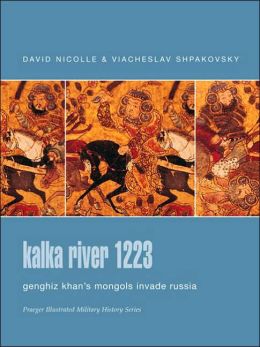
Kalka River 1223 Genghiz Khan's Mongols Invade Russia
I like the Osprey series. They have a wide variety of material that speaks to my arm chair historian as well as my role playing sensibilities. Their break up of book types provides bite sized chunks of history that have a ton of references to further materials for those so inclined.
Kalka River 1223 by D Nicolle & V Shpakovsky is illustrated by V Korolkov. And the art? That's another one of the reasons I love these books. In addition to showcasing a variety of real and recreated bits ranging from armor, clothing, and weapons, the artists that Osprey picks generally knock the ball out of the park and Victor Korolkov is no exception to that rule.
Another thing I like about these books is it showcases how little I know about the subject matter. This isn't something I have a problem with as if I knew it all, or heck, even remembered it all from other sources I've read, what fun would that be eh?
And the names! It's great to see some of the names for things in the book. Take some of the following for example:
Oldest or Best Guard: The most important constituent of Russian prince's armies. Heavy cavalary.
Youngest: Consisted of lightly armed archers. The guard is split between professionals and auxiliaries.
The Black People: The urban military called up by the Russian princes from towns under his control.
Simple naming conventions but quick ways to indicate difference in rank and importance. There's this type of fun stuff all over the Kalka River.
There are also lots of little reminders of things that make interesting bits to add to a campaign or to reinforce in existing campaigns if such situations are already there.
"Wars seemed to flare all across Europe and Asia between states large and small, between kings, princes, emperors and even between local barons." That set up right there provides a lot of back ground as to why an opposing force that was able to act in one unified position is able to attack a country that in theory, is much larger. The lack of combined military forces, of combined purposes, and combined method, allowed Genghiz Khan's Mongols to get farther than they should.
Indeed, in most fiction, this seems to be one of most settings problems. The good guys are just so organized and built into so much static state of being, that is strains the setting when wondering how they could fall or even why anyone would attack them. History is not like that for the most part.
There's a lot of great stuff in Kalka for those looking for some historical inspiration and a lot of great illustrations. Some of the bits showing the Russian metallic full face masks for example? I hope we see something like that for Khador in War Machine real soon. Great stuff.
Kalka River 1223 by D Nicolle & V Shpakovsky is illustrated by V Korolkov. And the art? That's another one of the reasons I love these books. In addition to showcasing a variety of real and recreated bits ranging from armor, clothing, and weapons, the artists that Osprey picks generally knock the ball out of the park and Victor Korolkov is no exception to that rule.
Another thing I like about these books is it showcases how little I know about the subject matter. This isn't something I have a problem with as if I knew it all, or heck, even remembered it all from other sources I've read, what fun would that be eh?
And the names! It's great to see some of the names for things in the book. Take some of the following for example:
Oldest or Best Guard: The most important constituent of Russian prince's armies. Heavy cavalary.
Youngest: Consisted of lightly armed archers. The guard is split between professionals and auxiliaries.
The Black People: The urban military called up by the Russian princes from towns under his control.
Simple naming conventions but quick ways to indicate difference in rank and importance. There's this type of fun stuff all over the Kalka River.
There are also lots of little reminders of things that make interesting bits to add to a campaign or to reinforce in existing campaigns if such situations are already there.
"Wars seemed to flare all across Europe and Asia between states large and small, between kings, princes, emperors and even between local barons." That set up right there provides a lot of back ground as to why an opposing force that was able to act in one unified position is able to attack a country that in theory, is much larger. The lack of combined military forces, of combined purposes, and combined method, allowed Genghiz Khan's Mongols to get farther than they should.
Indeed, in most fiction, this seems to be one of most settings problems. The good guys are just so organized and built into so much static state of being, that is strains the setting when wondering how they could fall or even why anyone would attack them. History is not like that for the most part.
There's a lot of great stuff in Kalka for those looking for some historical inspiration and a lot of great illustrations. Some of the bits showing the Russian metallic full face masks for example? I hope we see something like that for Khador in War Machine real soon. Great stuff.
Labels:
Campaign,
Historicals,
Kalka River 1223,
Osprey
Subscribe to:
Posts (Atom)