Showing posts with label Non-Player Characters. Show all posts

Monday, September 11, 2017

The Red Knight and the Art of Making NPCs

The Red Knight
Book One of the Traitor Son Cycle
Written By Miles Cameron
$11.80 at Amazon

When making Non-Player Characters in Dungeons and Dragons, the question is really how much is too much? How many game stats do we need for the effective playing of such characters?

If you're an artist or have an artist friend willing to help out, portraits are a quick way to customize your NPC's.

If you're strapped for time though, having a list of names and associations with those names is another route. It's a route Miles Cameron takes in the Red Knight to describe many of the mercenaries who follow their nameless Captain, the Red Knight.

Some examples:

Sauce had won her name as a whore, giving too much lip to customers. She was tall, and in the rain her red hair was toned to dark brown. Freckles gave her an innocence that was a lie. She had made herself a name.

Ser Thomas: Bad Tom to every man in the company was six foot six inches of dark hair, heavy brown and bad attitude. He had a temper and was always the wrong man to cross.

Two Veteran archers - Kanny, the barracks room lawyer of the company, and Scrant, who never stopped eating.

Bent, the eldest, an easterner, and Wilful Murder...

Geslin was the youngest man in the company, just fourteen with a thin frame that suggested he'd never got much food as a boy...

The book is filled with such characters. Sometimes a few sentences of description, sometimes not even a single whole sentence.

Giving the characters something for the players and the Dungeon Master to latch onto, makes the keeping of said characters easier, even if you don't list out height, weight, hair, eyes, or even armor. This is probably much more important to keep in mind when dealing with characters that the players are not going to engage in anything more than banter in. Extra work that the Dungeon Master enjoys is never wasted work but is it work that you could be doing something else you enjoy, that will see game play?

Miles Cameron brings his wide cast of the crew to life with quick descriptions and it's a great mining pool for those Dungeon Masters who want examples of how the pros do it.


Thursday, September 15, 2016

Master of Devils Appendix N Edition


Note this is my 'gaming muse' edition of Master of Devils. There will be spoilers below.

The Pathfinder setting is vast. In Master of Devils, Dave Gross takes his two main characters,  Count Varian Jeggare and bodyguard Radovan, to Tian Xia.

Tian Xia is the Pathfinder equivalent to Kara-Tur from the Forgotten Realms or Rogukan from Legend of the Five Rings.


In terms of gaming ideas, a few things hit me:

Missing Players: You ever play with someone on military leave due to being a reserve or someone who got a new job? In this novel, Radovan and his boss, Jeggare are separated at the start of the novel. Radovan goes through intense training and multiple encounters that in most situations would be far too dangerous for him.

At the end of the novel, Radovan goes back to his normal form and his normal abilities.

In such a situation, it would seem to me that the GM decided to run Radovan as an NPC and have him in the action even if he wasn't in the direct action. This allows the character to keep moving and doing things even if the player isn't there.

Chaosium way back in the day used to have a Runequest Cities book with a catch-up table that provided some fun stuff.

If you're looking to keep the group together, running one of the characters as an NPC for a brief time, even if you go ahead and make them into something a bit different can be one way to do it.

Mundane Encounters: One thing I see people post about running Kara-Tur or other 'Oriental Adventure' style games, is what type of adventurers should they have?

Normal ones.

Ancient China has numerous ruins. It'd be hard to believe that the fantasy versions of said settings don't.

Heck, even mundane encounters like bandits are acceptable. The very first thing we see in Master of Devils is that the duo and their wagon and guards are under attack by bandits! Sure, they have a funky name and my be using weird attacks or a different strategy, but at the end of the day, they're bandits!

This doesn't count that in a side quest going on later, there is an introduction to a goblin possessed of a kami. But mind you, this goblin has been kicked out of his clan. Numerous companies have a lot of great visuals if you're looking for ideas on how such goblins might look. The miniature game, Confrontation for example, has numerous goblins and ogres donned in Samurai and Ashigaru

The Exotic: So one of the things you can do when characters move to another setting, is bring out the strange things. There are numerous named characters here ranging from Jade Tiger to Judge Fang. Play around with appropriate names to the new setting but dont' go overboard with it because if every character name, every item name, every magic item, every spell, every combat maneuver starts sounding like an episode of Samurai Sunday, it'll become harder for the players to remember what all of that means.

But if you want to introduce the 'Shadowless Sword' a blade that moves so fast the sun cannot give it a shadow, or a few unique spells to the region, now's the time do to so.

Secrets: Along the telling of the story, there is a certain criteria that must be met in order for the characters to gain access to a dragon's 'heart pearl' and to use that to make a wish. (Dragon Ball Z in the house!). One of the characters that the readers, or at least most readers, assume is X, turns out to be Y and has that very criteria needed!

Another character appears initially to be merely a humble farmer but has too much skill and dedication and knowledge to be merely a farmer and turns out, he's actually a prince!

Characters that are more than one dimensional provide a great opportunity to add to the player's role-playing experiences. It can be boring in a campaign that's not focused on merely hack-and-slash, if all of the non-player-characters are one-dimensional pieces. Give them patrons that the characters might not appreciate. Give them hobbies that the players do appreciate. Give them outlooks that challenge the player's out outlooks.

The Big Dogs: Being the 'Oriental Adventurers' of the Pathfinder setting, it's great to see famous characters used. In this case, we get to see both the avatar and the Monkey King himself. The Monkey King is a famous religious/legendary character from various parts of China, similar to say, Thor or other more familiar deities.


Having a known element make an appearance can provide the characters a touchstone in the unfamiliar. This can work against you if you as a Game Master if you make those characters the focus of the campaign though so a light touch is needed with them.

Master of Devils looks as a non-standard setting and provides a lot of inspiration for game masters who might normally not appreciate running a non-standard campaign and is worth picking up for that reason alone.


Monday, April 2, 2012

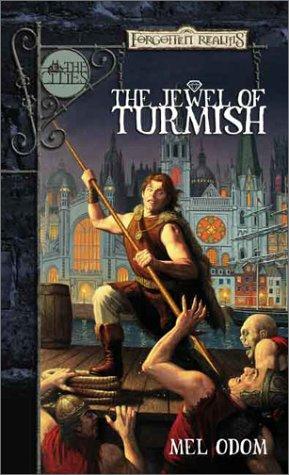
The Jewel of Turmish by Mel Odom

I've recently mentioned the perils of shared settings. That sometimes the setting can work against the author and that I try not to take such books as more than popcorn reading. Even with that in mind, Mel Odom's The Jewel of Turmish, unless you find it in the bargain bin for $1 like I did, is probably better off skipped.

In terms of things I didn't like as a book, some of those may work in a game as a prelude or a highlight of an upcoming menance.

For example, we are introduced to a group of young thieves and given a run down of their various hardships and how they stick together. They are horribly murdered. We are introduced to a group of priests where their leader is granted a vision by his goddess. These priests are horribly murdered. In killing off such groups well after numerous little bits have been introduced, the author was in my opinion, wasting time. In terms of a role playing game though, where you as the Game Master want to showcase a powerful villain, giving the players some premade characters and having them struggle against some unknown horror can bring out some anticipation for the players.

Another bit is misdirecting the audience. Don't label your campaign as a heroic high end super hero campaign and then have the players run into Wolverine, the Punisher, and other gun totting murderous villains and heroes whose only goal is to increase their body count. Don't talk about running a high magic and epic campaign and then force players to keep meticulous track of their rations and arrows and copper pieces. In that vein, this book called the Jewel of Turmish and part of a series called The Cities, failed, to me at least, to bring to light anything about the city itself.

Another aspect is beware of overusing old cliches that you've already used. In Mel's previous work that I've read in the Forgotten Realms, the one about the old sea monster coming back after many years of imprisonment, why is Mel's next book bringing out a villain who is coming back after many years of imprisonment? It's a common enough theme but don't be the same author bringing the same plot where gods themselves couldn't kill the villain but some dumb kid can.

Another bit is know where your action lies. If you know that the main thrust of the campaign is going to involve demons and undead and betrayal by once loyal allies, don't bog the players down in long drawn out fights against such mundane foes as man eating wolves and the difficult decesions they must make in terms of balancing the right and wrong of their actions.

Mel can do better than this and I've say this book is actually worse then Revan which makes it, the worst book I've read in 2012. Here's hoping the next one brings up the averages a little.

Wednesday, March 21, 2012

Revan by Drew Karpyshyn

Writing a novel in a shared universe must be a difficult task. It may be more difficult if the era you're writing about is not the standard, such as this Star Wars novel set during the Old Republic. Revan is a character in an older game that helped make that Old Republic a viable property and one that companies like Dark Horse and Del Rey have visited several times, not to mention a very popular MMO that's supposedly stealing players from World of Warcraft.

But in terms of this specific novel of the Old Republic? Pass. My brief review is that its jumbled by time skips and by making too many choices that seem very odd to even a casual reader of Star Wars. Mind you that the Clone Wars sometimes have this problem as well where characters apparently forget they have other abilities than just jumping around and swinging light sabers so maybe it was the set up which caused this novel to fail. It's not the worst novel I've ever read, but it is the worst novel I've read this year.

Having said that though, there were some things I'll discuss specifically so if you wish to avoid spoilers, read no further.

The Jedi in this book are portrayed as narrow minded idiots who brim with hostility and no common sense. While it goes against their own code, and something that the main character verbally jabs another one of the Jedi for, it showcases that any organization, no matter how noble or righteous, can go rogue or too far in one direction.

Even the fabled comic, Order of the Stick recently touched on this subject as well. I myself played a paladin who took a PrC that allowed him to smite anyone, not just evil enemies. Pushing the boundaries of what is good and normal can make for some interesting role playing experiences but if the Game Master does it and does it too often, there should be a valid reason for it that needs to be reflected in the campaign.

For example, if an order of paladins doesn't like the players, and the players are typical murder hobos, that's probably understandable. On the other hand, if the players are members of the local militia and have saved the town several times and the town folk are reacting as if the paladins are right, the players are getting screwed in this deal unless all of them are under mind control.

Am I saying that the paladins can't dislike the players? No. And if the players hear the paladins out preaching about the evils of the characters and how despite those characters military victories that their spiritual hollowness rings out, that can go a long way in establishing a rivalry. Indeed, if the players aren't careful they could end at burned at the steak as witches.

Another bit that might not work well in a game is a time skip. There are two of them here. One when Revan is captured for years and that time just snaps by and another where Revan is.... yes, captured again but this time the span is much longer and he doesn't escape. If you and your group are comfortable with large time skips, then by all means do so. It's a great way to introduce younger siblings, or on a large enough jump, a new generation of characters. Mind you this doesn't always work as the readers and writers of Dragonlance, and of course, Star Wars the New Republic know, but nothing ventured nothing gained.

From a gaming prospective, one of the things I least like about the skip ahead, is trying to determine if the characters gain any power, lose any prestige, suffer any permanent wounds or things of that nature. Runequest has a Cities supplement that back in the 2nd edition days I would gladly roll on and it had all sorts of useful bits to it.

Anyway, when reading a book you're not too fond of, keep looking for things, both positive and negative, that you can take to your own game.

Friday, February 10, 2012

Breaking Bad Season 3 Character Archetypes

Breaking Bad season three continues to build things from many angles and allows some characters that may not have had a chance to shine previously more showtime.

One of these characters is Mike. A former law enforcement agent, Mike is a 'cleaner', such as those in old assassin movies like The Professional or the original La Fem Nekita. He is the one they send in to get answers and eliminate issues. In many role playing games, the players will probably be characters like Mike. They will be the fist in the iron glove. In some though, especially those that might be role playing focused or heavy into allowing characters a great deal of custimization that doesn't rely on combat, it might be possible that the players will run into someone like Mike.

At times such a character can appear to be on the player's side, especially if both the 'cleaner' and the players have the same patron and employeers. At other times, especially if the cleaner is someone whose loyalties aren't to the players but to a patron, they may clash. In such isntances, it should be made clear that this is an individual whose skill set goes above and beyond the standard. If the players can witness it in action, they will have a good idea of what the character is capable of. If they go drinking with such a character, he should have horror stories for them.

One way of showcasing how skilled player character's are, is by showcasing another individual with a similiar but inferior talent. In this case, Walter works with Gale, a fellow chemist. Gale seems fairly standard in terms of his skill set, but he knows great work when he sees it. Gale, without knowing Walter, is impressed by the skill inherent in the 'cook' that Walter performs when Gale gets some of the drugs. This is not the first time Walt's skills are noted upon, but when there is a character that can do the same thing, but not as well, it allows the player character to have a little bit more of a stepping stone.

Another interesting use of characters here, is in moving the stars into action. Jessie initially starts off intenting to sell the meth to recovering addicts. His 'crew' find it difficult to do so. Jessie decides to show them how its done. The woman he approaches to do so has a child. This challenges Jessie's belief in what is right. His encounter earlier with children of drug addicts still weights on his mind.

When players or their characters showcase certain attributes, you can look at it like a flag saying "I want this" in the game. This may not always be true, but if the character does involve himself with orphans, their care and feeding, the Game Master can quickly use that as a hook by threatening the children. If one of the players is a weapon's collector, when he hears of a new ambassador from a far away land who uses a wide variety of exotic weapons, this should perk that character's interest.

NPC's should be there to expand the setting and fill the world with opportunities for the players to interact with it.

Monday, October 17, 2011

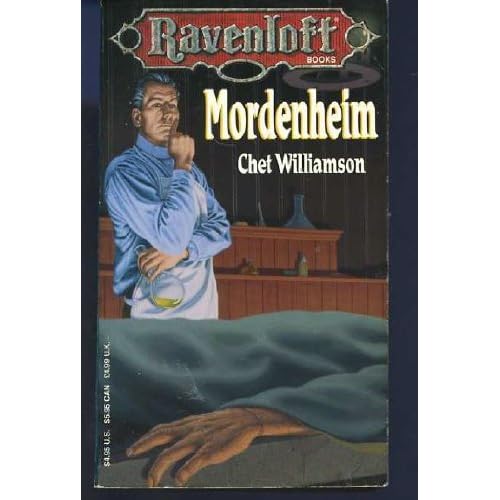
Mordenheim by Chet Williamson

In between reading the Invisible Man on my Toshiba, the Brunner trade paperback collection, and various other books, I've been reading Mordenheim by Chet Williamson. This is another book I bought at Half Priced Books for the kingly sum of $1.00.

Mordenheim is one of the books in the Ravenloft series. This series brought a touch of gothic horror to the Advanced Dungeons and Dragons setting initially through a single module and then through a meta-setting that could reach any other setting and was heavily inspired by many a tale of the classics.

Mordenheim is in many ways the answer to Mary Shelly's Frankenstein. The interesting thing, to me, is how the author plays off the differences inherent in such a take. Mordenheim, the name of the doctor, lives in a setting where magic is real. Being a true man of 'science' however, he has long discounted magic and relied only on those things that he himself can bring to the table.

This makes him an interesting stand out from other villains. He seeks a deeper understanding of the world through the physical attributes that he can disect. This started off with animals and worked its way up to humans, including the associated grave robbing inherent in such a task. But his goal, of extending life, of curing disease, or making man immortal and invicible, well, to him, and to many throughout history, the ends justify the means.

And that makes him a dangerous villain and makes for a great nemesis motivation. If the GM can play such a villain correctly, if he can choose his words and examples with great care and catered to the players, he may even be able to lure some of them to the villain's side. But it has to be a compelling arguement. It has to be something grand.

And more importantly, there has to be some evidence that the villain is capable of doing what he wants. In this case, Mordenheim is no idle scientist, he has created Adam, which in Dungeons and Dragons, amounts to a unique, advanced Flesh Golem with its own will and mind and its own desires. But to Mordenheim, it is a truimpth of science. And to anyone who sees it, physical proof that Mordenheim is capable of showing his theories in the flesh.

Keep the motivation of the villain out front where the players cna see the strength of it and either take up arms in rebellion against those ideas which tye consider foul or pause and wonder if indeed, the ends do justify the means.

And for one more furthe price rant, the cover price of this book was $4.95 in 1994 and most paperbacks these days cost $9.95. So... 100% inflation in less than twenty years... but surely everyone is making double what they made back then right? The minimum wage has doubled since then right? Righ? Ugh. And the Kindle Price? No such animal. Ugh again.

Thursday, October 6, 2011

Prince of Thorns by Mark Lawrence


I love the cover of this book. It's a simple piece that would work fantastic as a miniature with a character in apparently some type of light armor with a nice fancy hilted sword with a hooded cloak where the cap is moving. Dynamic but static.

In terms of the book, it's got a lot of grit going for it but I'm a little undecided if I like it or not. the main character is a little too competent either through blind stupid luck or through bad assery that makes me think this kid could bitch slap Elminster and while that would be amusing, it just rubs me wrong in some ways.

In terms of spoilers, they'll be coming below because I'm going to talk about intangibles as they relate to setting the tone of a campaign.

Prince of Thorns isn't heroic. It's not even friendly. the character isn't even an anti-hero. But how could you do this in a role playing game? How could you model having 'brothers', a group of murderous bandits, working with the Prince, a player, and showcase the tone you're trying to set?

First off, let's discuss the brothers. By being part of a bandit group, Mark Lawrence has provided the main character with a group of characters he can easily kill off and most people aren't going to care or blink an eye. This almost harkens back to older editions of Dungeons and Dragons with hirelings. "You there peasant, take this mighty one silver and take up arms against yon ogre for a further single piece of gold!" Of course morale was a game factor too in the day eh?

But in terms of showcasing a setting, you can crib the following without having to resort to game mechanics.

1. Life is worthless. The main character is almost assassinated by an enemy from one of the Hundred Kindgoms that make up the setting and his father, instead of taking vengeance against the murderer or his wife and his youngest son, makes peace through concessions from the enemy king.

2. Life is worthless. Kill some of the 'brothers' or bandits, or hirelings in standard tasks or fights. For example, in the book, while the characters are climbing a mountain, one of them falls to his death. Another character suffers a cut from a farming implement and dies as a result of infection.

3. Life is worthless. Introduce a whole new race of creatures and entities that the players interact with a bit and have a few of those new found humanoids join the player characters. Then destroy the rest of the race while the players continue their trials and journeys.

4. Life is worthless. Have the players use every means at this disposal to win, even if that win results in mass overkill and the destruction of hundreds of people. Some may argue that the method used in the book needs rules when Jorg, the Prince of Thorns, destroys another kingdom. They may note that it is science that destroys it! Humbug. In Eberon and the Forgotten Realms we've got numerous scars and blisters on the land that are the direct result of magical armagedon. Rules only matter when destroying a kingdom if you want them to matter.

5. Life is worthless: In having the players use every means at this disposal, push them against the boundaries of the standard fantasy tropes. This is done twice in the novel. The first time, Jorg kills a man so skilled with the blade that this knight is able to out fence Jorg's champion, who himself is a master duelist. Jorg however has no problem provoking the knight, running into a guard, snatching a crossbow and putting one through the blademan's skull. This is allowable because Jorg is the King's son and the king is impressed with this show of ruthlessness. In another venue, Jorg is in a knightly tournament and goes for the kill on numerous knights. Because Jorg not only survives in that arena but takes out the king of that realm, he is able to avoid repercussions from it.

6. Life is worthless. Have the 'brothers', the brigands that you've been so eager to kill off in the most minor of fashions to showcase how fragile life is, ready to turn on the players if they're not always at the peak of the game. It's not just that life is worthless for them, it's worthless for the players if those slip and showcase mercy or weakness. Have some of the 'named' brothers challenge the players after a particularly tough battle or when a loved one dies as an opportunity for the player to man up or be put down.

By focusing on the things you want the campaign to convey, regardless of the game you're running, you can do a far better job than if you sat around making up rules for diseases that lice may be carrying or what the chances of players catching infections from having sex with villager's unwilling daughters. Focus on the mood. Focus on the atmosphere. Focus on the tone.

Sunday, September 4, 2011

Robert V. S. Redick's The Red Wolf Conspiracy

Sorry for the lack of posts, but like the end of every month, it was time to take my beating at work. Then to add the awesome to the sauce, they gave me a week off without pay to help bolster company profits for the 3rd quarter. Ah well, there is neither here nor there but just a warning to the readers that I may have a bit more free time to post and assault the internets with my thoughts this week.

One of the things I mentioned about Robert V.S. Redick's book is that he introduces a race of savage Littles. Tiny humanoids with their own origin story and own purpose and own deeds that intermix with the, ahem, excuse me, larger action going on around them.

But Robert wasn't happy just leaving things alone there. Indeed, he also added awakened animals. These are various animals that discover how to talk and reason. When it happens to a rat, the revelation of thinking, of the greater world, of how things work, is almost too much for him. Another rat it happens to, does indeed turn him mad. The animals can still communicate with their own kind, but when you're a rat, the conversational skills of the other rats aren't quite up there and well, the only others you're size, the murderous littles, aren't too keen on making friends with a carnivore such as yourself.

It's another example of taking a standard of a fantasy setting, and putting it on its side. While I've seen the magical companions done up in such a fashion before, I get the feeling that Robert is going to be taking these characters a little further. In a point based game, you might be hard preseed to use everything in a manner that didn't make you a super rat unless it was a very low point buy game, but in a game like D&D or other level based game... unless it's something like Rifts, the GM would have to do a lot of handwaving.

When designing your races, you don't necessary have to design just for the players side of things. To me, this is part of where 3rd and 4th edition took a nosedive into their own kool-aid. When the dark elves became nothing more than just common player races, where was the mystery? It's must the same as I've noted on the Archon in Dungeon Siege III, limited playable attributes and lack of background information can make for an interesting unique character. Turning everything into something everyone can play? Not so much.

In short, unlike the yes motto of third and fourth edition, don't be afraid to design some really weird races and cultures and explicitly tell the players, "this is not for you."


Another thing I'd like to hit here, is the ship that is almost another character in and of itself. From the inside cover, "The Imperial Merchant Ship Chathrand is the last of her kind. Six hundred years old, the secrets of her construction long forgotten, the massive vessel dwarfs every other sailing craft in the world. It is a palace with a sails, a floating outpost of the Empire of Arqual."

That whole bit sounds awesome to me. while Dragonlance did bring us the floating citadels, a fortress ship sounds pretty plausible too. As a matter of fact, it reminds me a little of the old carton, Pirates of the Dark Waters, where there was a huge vessel.

By making such a ship, and making it the last of its kind, and hinting that the details of how to make these ships were lost to intra-guild warfare and greed, it showcases a destination that few can claim to have travelled and sets up the stage for elements to come further down the road.

By being so huge, much like the Macross from the Robotech saga, it allows the author to throw in dozens of characters that won't push the boundries of "how many damn people are on this boat.".

When looking at the military might of your setting, or when looking to how trade works, don't forget the ships. For example, the miniature company Forge World, has a massive land ship that is perfect for soldiers of the Warhammer setting army, The Empire.

Much like the war wagons used in Earth's own history, a little unique elements go a long way.

Monday, August 15, 2011

Dungeon Siege III

I don't play a lot of video games. Between work, the g/f, my vast reading pile, and the occasional movie, it's rare that I'm willing to sacrifice a huge time chunk to a full fledged video game.

Dungeon Siege III is probably the first new game I've bought in quite a while. The last one probably being Assassin's Creed years after it was out.

Dungeon Siege III is far more character based and in some ways, limited than previous entries. You have a choice of four different characters to select. The interesting thing is that the characters all play different in terms of appearance, style, and abilities. They can be highly customized with various attributes that rise as you gain levels, allowing a user to play through the game multiple ways with the same character. I'll be mentioning some specifics below so if you want to avoid spoilers, read no further.

That reminds me of one of the strengths of D&D. As a whole, it's generally good to have a well rounded party. While 4th edition may have given these roles terms like striker, defender, controller and leader, in many ways, they've been a part of the game since thief, fighter, magic user, and cleric. Perhaps not always in exactly the same role, and perhaps some customization could change how classes worked in the game, such as multi-classing demi-humans in the OSR realms, but for the most part...

The game hits on a lot of high points I've mentioned in the past.

Religion plays a huge role. The main villain of the series is called the Living Saint and has a massive following in the East where the church is strong.

Family relations play another big role. The villain is after the heroes because they murdered her father. The villain is also related to the current queen and has a legitimate claim to the crown. Two of the selectable characters are related to each other.  One of the characters is a direct descendant of one of the most powerful spellcasters in the history of the setting. These things have an influence on how people see each other, they provide illumination into motivations and provide insight into what someone might do.

The game isn't that open in some aspects, but it does allow a few variations including redeeming foes, sparing foes, and taking different paths that wind up crossing the paths not taken. The writing isn't bad and there are probably a few ideas that could easily be yanked for your own campaign.

The side quests aren't always fighting either, even if they may have an ultimate effect of providing some damage to the enemy. For example, while the Queen's forces are under siege, you can set up a cannon and prevent the enemy from entering the cave complex where the Queen is holding up. There are a few examples of this combat handy but not actual combat skill tests throughout the game. When setting up challenges for the players, see what options you can provide them that don't necessarily rely straight up on dealing damage.

Sunday, July 17, 2011

Sharpe's Fury by Bernard Cornwell


Sharpe's Fury continues the trend of Bernard Cornwell to throw Sharpe into all of the interesting parts of history that occur during this time. That in and of itself says a lot about characters and how they get to where they are going.

Looking at some settings like the Forgotten Realms and Greyhawk, one might wonder how they can use all of the coolest elements of the setting while keeping it consistent. It only has to be consistent to the characters. If the GM wants to run a certain part of the campaign world and then move on to another, it's up to the GM to get the characters moving, not expect the characters to decide on their own where they're going.

The GM can do this through a few methods, depending on what type of campaign the players are enjoying. In a campaign that focuses on dungeons, the easiest way to move the party, is to inform them of a famous dungeon or a ancient dungeon just found where people are either being killed in mass droves as they descend downwards, or are coming out with vast treasure and vast losses making it a combination of meat grinder and Monty haul. Of course what's actually going on may be far different than what people are talking about. Rumors after all, need to be validated.

In campaigns that take the form of the players having a patron, this one's pretty easy. The patron needs the players to leave their regular unit or army and move onto a different location for a different McMuffin of the week.

In games that are player drive, using elements of the character's own previous adventurers or backgrounds, the GM should be able to devise something that ties into the new local he wants to use and something that's in the character's history. For example, if there are undead hunters in the group, rumor of an outbreak of zombies or ghouls, or perhaps hints of a weapon that destroys such entities, can be thrown into the campaign. Those players seeking lost relatives, can hear tales of slavers and other similar themes that lead them to the new local.

Another interesting point in the book though, is night fighting. I know that I'm a child of the city and man, I've been out all hours of the night and because of all the so called night pollution, barely realize that it's night. On the other hand, I've got relatives in Indiana and when I drive out that way, the night driving is a thing of terror resembling something out of Stephen King's The Mist where the only way you know you're still on the road is the splat of massive bugs against the windshield and the occasional dip in the road.

RPG's can negate this somewhat by having races that see in the dark or having torches, magical light and other options, but its up to the GM to note the unusual aspects of night fighting. In some games, if all of the party has night vision, the GM show showcase that potential terror by having them stumble across enemies that don't have it. The benefits of fighting opponents who are effectively blind should be massive and should give the players a leg up.

Also in terms of giving players a leg up, is having them be on an 'inside joke'. Here, one of the wealthy officers, who doesn't like Sharpe, mainly because Sharpe's humble origins, falls for what is essentially a gold digger high class prostitute who passes herself off as a high end woman suffering from the times due to the war. While Sharpe and others know who she is, the officer doesn't. It's a good laugh for the players and a potential piece of information that Sharpe can use at a latter date.

In terms of player ingenuity, doesn't punish them when they use the tools they have at this disposal. Shapre is asked to help another man deliver funds for the blackmail. Shapre takes the imitative and goes to the drop point well ahead of time to scout it out and make plans in case there is a double cross since the last person who went there wound up dead. Its a good tactic. Encourage the players to be smart. Allow them to get the drop of the villains when appropriate.


Another nice touch Cornwell brings, is the city of Cadiz itself in the first few paragraphs talking about the stink of sewage and the direction the wind blows. If you can introduce a city with a few words and enforce that imagery later, the players, even if they only spent a short time there, will come away with memories of that place and a method of distinguishing it.

One of the things that I enjoyed about the book, is outside the war, there are various missions that Sharpe needs to be involved with. One of them involves blackmail as well as the messy business of unfinished business. When NPC's take actions against the characters and those actions are hidden by happenstance, dont' be afraid to let the player's find out later, even if it's years later in the campaign, what has happened. Friendships can grown between those who've been wronged and finding out latter that a man you've trusted with your live has killed a woman you loved or a man you respected can cast new light on such an individual.

In terms of religion, Cornwell shows little mercy to any faction. Here, we have divisions between Protestants and Catholic, using that difference as reason why, for a religious man, it's okay to commit the bloodiest of murders and the breaking of one's word. In most fantasy campaigns, pantheons are used so the opportunity to use a division within a church isn't always available, but that doesn't mean the GM can't use such a schism or break. The Forgotten Realms used one in the Church of Lathander for example.

Despite the year, 1811, the medical field is still way behind current times. For example, Sharpe suffers a glancing blow to his skull and is told in no uncertain terms that "We know almost nothing about head wounds." In most fantasy games, healing is built into the system through magical means. Those few that don't however, often have some harsh penalties. When looking at trying to make a game realistic or grim and gritty, don't forget that players will only put up with so much of that before they make a new character.

Sharpe's Fury, despite having nothing to do with fantasy warfare, provides a wealth of inspiration ranging from character focus and intrigue, to revenge and utility. Well worth a look.

Sunday, July 3, 2011

Lords of the North by Bernard Cornwell


The Lords of the North is the third book in the Saxon Tales written by Bernard Cornwell detailing how King Alfred's kingdom is crafted during the Danish invasions.

Like previous books, this one is told in first person with the teller, Uthred, being a pagan who worships Thor among the Christian nation making him outcast yet a valuable outcast.

I'll be discussing some general and specific points of the book below but let me start by saying that if you want some inspiration for a viking or late English based game, one mired deep in the grim that the entire series of the Saxon Tales is well worth a look.

Anyway...

Character Motivation: Uthred is pretty simple at this point of the game. He want his ancestral home back and he wants to take revenge on those who've done his adopted family wrong and he wants reputation and gold and wealth and power. Sounds a lot like an adventurer. Note that he doesn't have a single motivation here and other elements to his personality will come back to haunt him throughout the book but by knowing what the character wants, the GM can have a better idea of what the player is looking to get out of that particular character.

This depends a lot on the player though. I've had players who have diverse characters in theory, yet they all play the same. Doesn't matter if they're playing an elf wizard or a dwarf cleric, they all play them the same in terms of how they role play them. Others can play the same class and race and you'd never know it was the actual same player due to the various differences the player gives the characters. As a GM, put the effort where it'll be most rewarding.

Non-Player Motivation: Often the Game Master doesn't have all day and night to paint how he wants the NPCs of the setting to be seen. But sometimes he is able to get the gist of it across quickly enough and once the motivation of a character is known, don't be surprised if the players work on that nerve to either get their way, annoy the character, or if the NPC is an antagonist, to work against them.

The News: One of the things that can be hard to remember, is that in the dark ages and in the times of non-electric news, that news has to be taken by hand, by horse, by word of mouth. Organizations that are large, like a monolithic church, may have an advantage over other organizations in that because of their size, indeed, spanning multiple countries, they may be able to get information prior than others.

In some ways, the exchange of news is in and of itself, an event. When strangers come to town, they might be given free drink and meal in exchange for news of the outside world. In some cultures, the exchange of news is part of the social events and worthy of small events.

Naming: Uthred has a name for his blades, Wasp Sting for the smaller sword and Serpent Breath for his longsword. But he also names his horses, such as the horse Witnere, which means Tormentor. Names can provide a lot of color to the game and if you've got a book of Baby Names or access to the internet, aren't that hard to come up with. Putting together a list ahead of time provides you with some quick ways to personalize things.

This doesn't count the potential for earned or given names that go beyond the birth name. The naming can be based on physical traits, such as Sven the One-Eyed, or on traits like Tormentor.

Continuity: When the series started, Uthred's father was killed by clever planning on the Dane's side. Here, he comes across an old foe who has his father's helmet. Of course it's not a magical helmet, this being a historical, but it does has great significance to him. The feel of a campaign can be influenced hugely by having small things crop up in latter sessions.

Distinctive Features: Uthred earned a limp in the last book, but it wasn't one that slows him down. It's merely a distinctive feature. When providing details such as this, remember the game system. If you're playing Hero or GURPS, you might have some game penalties and game benefits, but in playing games like Dungeons and Dragons where there really are no mechanics for it, the GM should not start imposing penalties on the players when they come up with distinctive features because one of the first things that players will do is seek to cure them and remove that unique aspect about their character.

Superstition and Ritual: Soldiers generally have many superstition and perform little rituals to reassure themselves.  But this isn't limited to just soldiers. Sailors have their own list of do's and don'ts aboard the ship and their own belief system about what must be done to appease the sea. When dealing with different social circles, each one probably has their own rituals and habits that go into the make up of their meetings, or starting a project, or of going to war. They add small touches to the game but also add depth.

Conflict is Good: Many of Bernard Cornwell's books are focused at times of war. This is good because conflict provides opportunity. Conflict acts as a catalyst. In times of peace, what is a sword master supposed to do outside of be a trainer? But during war? When armies need to be raised, homes defended, and enemies taken? When the landscape can potentially change in a single battle? These times are the times when character's can thrive.

Life Happens: Not everything involving the world needs to involve the characters fighting goblins and orcs

Misinformation: Even as news spreads and the continuity of a campaign grows, remember that people, or at least men, have short memories and events attributed to one race may change as time moves on and that people will want to ascribe their own deeds alongside the greatest of the great in history. That those who were great builders in the past may be attributed to have super human powers or physical status to have achieved their wonders and advancements. In his historicals, Bernard tends to ascribe an almost alien level of ability to the Romans as the 'modern' people living in those ruins can't compete with the stone work and road work and general skill of the Roman's.

Bandit Kings: Depending on the location in the campaign, anyone can declare themselves a king. After all, if a tree falls in a forest and no-one hears it, does it fall? In the same way, if you're in a winter wasteland or a highly contested land and no one can take it away, aren't you the king? This can lead to a land of a Thousand Kings or something similar. Many campaign settings, including the Forgotten Realms and the Warhammer FRPG, have areas that are meant to be Border Kingdoms.

Tradition and Ceremony: Weddings are often a huge part of a woman, or indeed, a man's life. These solemn events provide a cause for celebration. And yet, they often have a bigger hold in small ways than just the event itself. For example, Bernard Cornwell notes that women who have their hair free and not bound, are not married. In today's society, we have the wedding ring. Little things like that can provide a lot of depth to a setting.

Oaths and Oathbreakers: When a man's worth is only as good as his word, to be called an oathbreaker is not a good thing. In a land where they don't have digital cameras watching you try to sneak past the red light or electronic meters to time your parking, Kings had to rely on a man's word for his worth. Breaking such a thing though could be equal to committing career suicide as once broken, who would want you after that?

While much of Lords of the North repeats material found in earlier books, it is a repetition that moves the story forward. It is a story told quickly. It is a story that keeps the pages turning. Bernard Cornwell's take of 9th Century England moves quickly and provides a lot of color for those looking for dark age tales.

Saturday, July 2, 2011

Pale Horseman Round 3

Sorry for breaking up the book into multiple posts but time has only just recently opened up for me thanks to the July 4th holiday. The end of the month and end of the quarter has allowed me to quickly catch up on some reading including the other books in the Saxon series as well as some Sharpe books. Quite glad I gave Cornwell another shot after not being impressed with the Stonehenge book.

Below will be some quotes and my ramblings on how they might relate to gaming so if you'd rather avoid the spoilers, read no further.

"...he wanted me to think him defenceless... he ignored me. He just stared past my shoulder.... So I turned my back... and I saw that Cippanhamm was burning."

Here the young Uthred is battling the mighty Steapa. He is losing. Not badly but it seems inevitable. However circumstances outside either combatant's control come to the front of the action, Dane's invading Cippahnhamm and looting and burning.

If the scene is not living up to its potential or its dragging or something just seems off, don't be afraid to throw in some new combatants or events into the fray in order to juice up the scenario.

There are also times when the elements themselves come into play. For example, during a siege late in the book, a storm breaks out with thunder and lightning and thick rain covering the entire field turning dirt into mud and making bows and spears useless. Don't pause when adding some wild natural elements into the setting when it fits.

Other factors that I've mentioned also come into play here.

The wheel of fate for example, has its way with Alfred who is forced to retreat to a swamp. Alfred, known as Alfred the Great, suffered many serious setbacks. Depending on the nature of the game, don't be hesitant to let players lose occasionally. In more recent editions, the themes seem focused on 'yes' and focused on keeping the game moving forward. I have no problem with the latter and think that failure, in and of itself, doesn't necessarily mean the halt of the game. But the players have got to want to push through the bad times their characters endure instead of rolling up new characters.

Another bit is isolation. When Alfred loses his kingdom and retreats to the swamp, the people of the swamp are isolated from the rest of the world. They know little of what goes on outside of their home. This should be something that players who explore, find time and time again. Lost valleys and hidden cities where the natives speak some variant of the local tongue because travel is difficult, dangerous, and without huge cities and trade, not particularly worth it for most.


'...by taking sixteen coats of mail to the river's edge I had given the Danes an irresistible lure. And they snapped at it."

One thing that annoys me as a player, is when the habits and mentality of an enemy are well known and their behavior doesnt' vary much or their intelligent level isn't that high and then the GM, probably inspired by Tucker's Kobold's, decides that every goblin, orc, and other low level, low intelligent monster is suddenly John Rambo. There's a time and a place for such smack downs, but if it becomes every encounter with the creatures and it does so for no reason other than to enforce a smack down, that style of GMing might not be to every player's tune. The mood and establishment should have some consistency. If kobolds are weak little things barely able to string a rock against a stick to make a crude spear one session and the next are using plant based grenades and hit and run tactics, something is wrong.


"Wulfhere let us live."

Wulfhere spoke to Uthred before about how dangerous things would be when the Danes invaded. And by saving the Dane Ragnar, he insured his own life, and his own prosperity. This didn't come clear out of the blue. Readers of the Pale Horseman had hints of what Wulfhere would do if push came to shove.

By sprinkling little bits of motivation about various factors in an NPC's ethos around, the players might have a better idea of what to expect to terms of motivations and actions. By allowing the NPCs to speak with the players about religion, survival, home and hearth, the players gain an insight into the characters.

In the same vein though..

'Steapa was good to his mother,' the man said. 'He brought her money. She was no slave any more.'

Steapa is first depicted as a monstrous, unfeeling machine capable only of murder. Which he does quite well. But this little detail, about how he cared for his mother and raised her from slave status, provides more to the character than just sword and armor. Little details even on the most basic enemies can sometimes provide more depth to the campaign world than all the elaborate descriptions of weapons and armor.


'...Saint Vincent's Day had been the day when Iseult drew Alfred's son, the AEtheling Edward, through the earth. And somewhere, Iseult had told me, a child must die so that the king's heir, the Aetheling, could live."


female's blade, but it is something to think about when describing events in war and even in peace.

..I wanted to come with you.'

'Why?'

'Because I miss this life. God, I miss it! I loved being a warrior. All that irresponsibility! I relished it. Kill and make widows, frighten children. I was good at it, and I miss it. And I was always good at scouting. We'd see you Saxons blundering away like swine and you never knew we were watching you. Don't worry, I'm not going to talk Christ into you, whatever the king wants."

This section does two things for me as a reader.

First, it helps provide some motivation for player character's. Most of the time if you stop to think about it, being an adventurer, a wanderer, a landless man, seems madness. And the quest is to ever gain further gold and power to gain further gold and power. But when Pyrlig puts it like the above, you have to figure, why not eh?

The second, is that Pyrlig puts a different face on priests, especially Christian priests. Up to this point, most of them have been fairly insufferable from the main character's point of view, including Alfred. By putting Pyrlig into the setting and showcasing him as a warrior and a priest happy to have God on his side as opposed to forcing him onto everyone else, the author provides a wider spectrum of the religion and provides another viewpoint to it.

In the Forgotten Realms, what if there is a sect of Tempus Worshippers who relish fighting not for fighting, but for the peace it brings afterwards? They make themselves the best and most frightening enemies not to cause chaos, but to cure it. Putting a slant on things provides the setting with more variety that's not just stuck to the player's who've read a new issue of Dragon and want to play an Albino Drow with a black runeblade that's brand new and never been done before!

A third bit that comes through, is the individual in the army. While Uthred is part of an army, part of a huge army, he is the main character and it is often through his actions, and the actions of those close to him, that victory comes. This happens either though a quick trick or plot of his, or through the declaration of single combat where the heroes clash among the army deciding the fates of all those around them. In a role playing game, unless it's Warhammer Fantasy Battle and the GM is actually using the miniature game, the players should have some ability to influence things. The old 3.5 book, Heroes of Battle did a nice job introducing various things that players can do to influence combat one way or another and provide some sample missions worthy of player attention.

Saturday, March 12, 2011

This Crooked Way by James Enge


Since I already own the first three books by James Enge that feature his character Morlock, I figure I'd delve right into the next one; This Crooked Way.

Unlike the first book, this one isn't told from a single viewpoint by a single character. We get several first personal views of what Morlock is like, as wel las numerous interludes and a few of the standard third person chapters. Overall it works but doesn't work as well as I've seen in other places including Usagi Yojimbo.

Below I'll be pulling some quotes out of the book and there will probably be spoilers. Read no further if you'd care to avoid that sort of thing.

"My name is Vost. I was Lord Urdhven's right-hand man. His cloest friend. You killed him. Destroyed him. And now you come here." pg. 17

When players are fighting the good fight, their foes may be more than just the ones that are immediately in front of them. In a military based battle, there are numerous chains of command and if the players are focused on one level, the highest level, those below the military commanders the players slay, could one day seek vengance.

"They called it the winterwood. The trees stood on high rocky ground; it was cold there, even in summer. the trees there, of a kind that grew nowhere else, flowered in fall and faded in spring. They resembled dark oaks, except their leaves were a dim blue and their bark had a bluish cast." pg .54

Providing the local forest with some unique color goes a long way in establishing the players need to pay attention to things going on around them. Providing unique elements to the campaign severs to provide some unique game play options to the setting. The standard of classic fantasy are that way for a reason, but that very ample soil leaves plenty of room for customization.


"Yet you wander from place to place... like some kind of magical tinker, when you might command fear and respect the way a general commands an army."
Morlock shrugged irritably. "Why?" pg. 71

One of the things that's interesting about Morlock is that his ability as a maker allows him to manufacture a wide vareity of devices. If he so choose, he could set up shop in a major city and become a world reknown power. But those things doen't interest him. He's an adventurer you see.

When you have players who are interested in the actual adventuring process, of going forward for the experience itself as opposed to the gold and glory, you're able to throw a little more into the campaign. Gold and glory are great motivators in and of themselves and can be useful carrot and stick approaches, but when the players want to adventure on their own in the first place, this makes the GM's job easier.


"That's the one law the Riders carry with them through the lawless hours: bring the bodies out. For every body left in the woods after dark became the subject and sustenance of our enemy, the Boneless One, the Whisperer in the woods." pg 109

When possible, think about the long term effects of the magical and other unnatural elements of the campaign. For example, if there are undead in the campaign, either zombies or skeletons, those that can be crafted from the dead, or ghouls or those that feast on the dead, why are there corpses?


"The crowd's horror burst into panic. I wasn't the first person to rush for the door, but i wasn't thel ast one either." pg. 131

This one is a simple one. Not everyone in the setting is hard core ready to fight to the death and ready to kill for whoever tells them to. When things from beyond creep into the game, try to recall that the players are a step above most of those they encounter and that whats normal for them, may seem especially strange to the 'normal' people in the setting.


"A shape flew between Besk and me- a darkly luminous green bird whose form would not quite come into focus as if it were wrapped in a dark mist. It flew around Besk's head three times. With the first pass his eyes closed; with the second his head slumped; after the thrid he fell to the ground. The green bird flew back to where it came from: the door of the smith. Morlock, standing there, caught it in a glass bottle and closed the bottle with a stopper.
"What is that?" I asked.
"Sleep," Morlock said. Pg. 138

One of the things I like about 4th ed is that it's all about 'reskinning'. Its all about providing your own flavor and your own description to abilities. I've seen this done in the past as well where Dragon articles would encourage you to customize your character by describing special effects that your spells had about them. For example, elves using magic missles that were living wood or frost mages using frost missles. The problem happens when players try to take the extra step and throw in some other abilities that the core ability they're reskinning doesn't have. Allow description to run free but don't allow it to provide additional game mechanics unless you're doing some stunting like found in Exalted.


Morlock shook his head. "You go on," he said. "I have to find Tyrfing." pg. 153

A character with a unique signature weapon isn't going to leave it behind unless he absolutely has to. On the other hand, as Morlock revoers his weapon less than a page latter, he shouldn't have too do that too often. It's an abuse of the character concept and if the GM is dead set against that type of character with that type of weapon, he shouldn't allow it in the first place.

There are few thing more angry than a player told he can use X, Y, and Z and watching as X, Y, and Z are nerfed to whatever the GM prefers. Take the high road and just disallow it in the first place.

"May I offer you something, my boy? A glass of wine, or perhaps something stronger?" pg. 288

One of the thigns I haven't really touched on is that Morlock is the son of Merlin. And they're not really on good friendly terms with his father trying to kill him and all. Family can provide many a useful plot hook to the campaign and is of far greater use to the GM than some loner with no family and a mysterious past.

In this case though, the father is pushing the envelope by offering Morlock wine. One thing I may not have mentioned is that Morlock is an alcoholic. While it doesn't feature prominently in this book and didn't overall effect the previous book in the series, it's part of Morlock's character. Unless you're using a point system that has the characters roll to resist vices or be rewarded for falling into them, in games like Dungeons and Dragons and Rolemaster, this should be trapping or surface flavor.


"Morlock walled away quickly. He had the feeling that Trannon was intent on doing something that would wreck everything Morlock had done." pg. 352

One of the things about the real world is that you can't save everyone. Some people don't want to be saved. Depending on how the GM introduces such concepts to the game, this could involve alcohol like Morlock himself, drug use, or enuii. People may struggle to overcome their base instincts but cannot do so. In some instances, if the players are heroes higher than Morlock whose involvement is almost more of an honor thing, such as good friends of such a character down in the dark, they may be able to acheive a true intervention. But as Hollywood celeberties prove time and time again, having all the money, wealth, and adoration of millions might not be enough and the dark roads may be calling.

This Crooked Way continues the adventurers of Morlock with James Enge providing some solid humor and a stoic character that is at once heroic and self contained. His unique weapon and James take on the magic of that setting provide solid twist and turns along with a unique bestiary.

Those looking for fantasy entertainment that's not too high strung and isn't thousands of pages long with dozens of carefully created NPCs will enjoy it.

Tuesday, March 8, 2011

Blood Of Ambrose by James Enge

In between working like a slave for a company currently under sale, I also game, paint, and read numerous forums and blogs.

On one of ye old blogs, I stumbled across a book called This Crooked Way by James Enge.  Sounded right up my alley but didnt' sound like the first book in the series. After a trip to Half Priced books, as well as a visit to Borders with a 40% off coupon and Amazon, I was the proud owner of Blood of Ambrose, This Crooked Way and The Wolf Age by James Enge.

Good enough and time to start on the series.

Blood of Ambrose isn't as gritty as any of The First Law series or the books that come after it. It is not a ground breaking series like the Wheel of Time was thought at one point or A Game of Thrones currently is (thank you HBO).

However, that doesn't stop it from being a fun read. Taking some cues form Arthurian mythos and bits of fantasy, James Enge provides some interesting characters in interesting enough situations that Blood of Ambrose is well worth a read.

Below I'll be talking about some of the bits that I found interesting. If you wish to avoid spoilers, read no further.

"In all his life he had one friend, and now that friend was dead. What was an empire compared to that?" pg. 136.

Okay, a cheap start I know, but perhaps I'm reading too many blogs and forums where the basic question of why do characters fight and die for each other. It's not a question I gave much thought to when I first started gaming. My first role playing experiences were with Marvel Super Heroes. It was pretty much the standard that you'd rather die than abandon your friends in the middle of combat with the Red Skull or Thanos.

As I moved into fantasy games, that wasn't always the case. As I played with more and more people though, it seemed to fall into the category of 'dick players'. If everyone in the game but you dies, you're not a hero, you're a dick.

Sorry, but whose going to travel with you once its known that you've left other player's characters die, especially if the new characters are made by those same player's? Sure, you can say its the players being dicks in and of themselves, daring to use that foul meta-knowledge that your character values his own life so much that he'd abandoned them but hey, the other players are going to make their decisions based on what you've already done and meta-knowledge be damned.

I'm not saying that if you as a player had your character say, "Hey, this is crazy. We can't go in there and expect to live." and then stayed behind and didn't do everything in your power to help others out. But if you're the mage or other high level caster and your combat spells consist mainly of those which get you and you alone out of a tight situation? Yeah, good luck with that next group of adventurers wanting to travel with you.


"But no one knows him as well as I do. And I know not only that he's breakable, but that he's broken." pg. 145.

In making characters, one of the standards seems to be that everyone has feet of clay. Morlock ,one of the main characters of the novel, and the hero in many ways, has a lot of faults. But those days of being inactive and doing nothing are behind him. When players are designing their characters, I encourage the GM not only to point out the obvious faults with them, but to note how those might come back into the came to haunt her. If the player is dead set on making a drunk whose will is so weak that even in a game with no penalties for doing so, that they fall to alcoholism when drink is merely mentioned, they might be taking it too far. The clay should be something that the characters are working against as they start the game, not something that they are so rigidly defined by that any NPC with a roll of 15 or less on 3d6 knows that weakness.

"The sunkillers had taken an interest in our world and intended to conquer it." pg. 149

The whole thing here of another race deciding to take over the world is one that bears some mentioning not necessarily because you want to start the players off against such seemingly epic foes, but rather because it indicates that the width of the campaign is larger than the pond they're currently in. They should want to fight their own Sunkillers some day and to take their own steps "beyond their world" so to speak.


"When was the last time any of you guys heard any news from Invarna?" pg. 156

One of the hardest things for me to remember as a GM, and something I have to enforce with that same authority, is how little modern communications played in the settings we're often playing in. In order to enforce some of that feeling, it's good to have news come in from outside via caravans and other travelers. But sometimes, especially when the players are seeking to stir up trouble, they might ask, "Hey, when was the last time anyone heard anything about X." and because modern communication standards aren't in effect, they should get the benefit of the doubt. The opposite is also true of course...


"All that is left of that once was Urdhven is a slender thread of ego trapped inside that slab of meat." pg. 181.

The main villain at this point is the Protector to the king. He's a man obsessed with taking over the lands and ruling. He appears normal enough at first until his head is cut from his body and he still lives. When such things happen, well, there has to be something else behind it no? It's a good way to set up the otherness behind some of the villains in the campaign and to hint at things to come down the road.

In the same vein,

"He says there is a danger we aren't facing-"
"Yes, I know: the Protector's Shadow, Urdhven's magical patron." pg. 208.

When the players do manage to take out one villain, they may discover that he was just a puppet of a stronger villain. When you face cultist, their leader is a necromancer, who gains strength from demons, who gain strength from their patron Orcus, and in between the cultist and Orcus are numerous encounters and challenges ranging from champions and servants to unique monsters and environmental issues that require more than just brawn and power to overcome.


"...among the crystalline shards was one_ long, swordlike, and dark_ which fell into Morlock's outstretched hand. It was tyrfing, the accursed sword, its blade like dark basaltic glass glimmering in the fitful light of the stormy evening." pg. 182

Not every game models every genre or even every weapon within a particular genre well. The first thing I thought of when I read about the "veins of glowing white crystal within the dark blade" wasn't D&D, it was Rolemaster. The blade has more of a magical nature than a mere bonus and that made me think of an essence multiplier or addition to the power points a character would gain from holding it. Keep the game you're playing in mind as you read, but don't be afraid to let bits you read find their appropriate place among other game you might enjoy.


"this time I got there in time," pg. 190.

Players fail. It happens in almost every game and every genre. In fiction, the writer has the ability to give the characters a second chance at doing what they failed to do. When possible, take a nod from this and allow the players to enjoy success at something they failed at before.


"that satisfied some of the Protector's Men; others, who knew or had heard a truer version of the fight in the Great Market, quietly deserted." pg. 206.

You've got this awesome villain but he's such a scum bag that if people truly knew what a vile source of scum he is, they would quickly leave him but yet the players have found him out and proven his vileness! What to do. Depending on the nature of the outing, have some loss of power occur. If you don't you're taking away from the player's victory. Why bother exposing the villain if there's no effect of doing so?


"You don't sign peace treaties with your friends, Wyrth; you sing them with your enemies." pg. 212

Wow. What a piece of advice for a game that may have too many foes for a typical party to overcome. when dealing with things like war, as I mentioned in my ramblings of the Heroes, there may be too many foes for the players to overcome. In order to cut back on sheer bloodthirst and rampage, hinting that the players may want to capture enemies and resources so that they may barter with their foes for terms of peace may be a way around the death toil that could otherwise come around.


"It looks as if you're going to have to continue those lessons in the Sight." pg. 249

One of the things that always brings out my Internet fighting form, is talking about game design versus game play. I've seen Champions characters built with 350 points that look nothing like Champions characters that were played from 250 to that 350 point total. Game play in and of itself indicates a LOT of what will happen in the game. Worried that wizards and clerics and druids are just too damn powerful? Allow them in the campaign and see what happens through, you know, actual game play. Sure, they may want spell X, Y, and Z, but the campaign may call for them to use A, B, and C. The theory of game design and optimal choices may be vastly different that what's useful for your own campaign.

I'm not saying ignore advice and bits of wisdom you come across when seeing how people deal with a particular issue, but understand what your own campaign issues are prior to adapting someone else's solution. It may not be a problem in your campaign if Clerics are the most powerful class in your campaign and they don't need nerfing at all.


"Suppose that the magical adept is not, in fact, Urdhven's patron. Suppose that Urdhven is merely the dupe or pawn of this adept, who uses him to distract us from some under taking of the adept's own." pg. 250

There may be times when the foes of today's game are the allies of tomorrow's game. There may be times when the depth of the characters you've developed to interact with the players go beyond merely killing them. The motivations of some of the cast may clash against the motivations of others of the cast. In those times, allow the characters to grow through the actions of the player's characters and the world they inhabit.

There are a few others bits within Blood of Ambrose that are worth quoting and thinking about, but the Patron is flowing  strongly and it's well past the old sleepy time form me.

Monday, March 7, 2011

The Heroes: Bayaz, First of the Magi

If you're a fan of fantasy fiction, and of Dungeons and Dragons, chances are, you've stumbled upon Elminster. He is often used as a reason to actively dislike the Forgotten Realms setting. He is pointed at as being one of the root causes of the setting having issues.

Elminster, in terms of raw power, is probably more powerful than the person I'm about to talk about here, Bayaz, First of the Magi.

In Heroes, Bayaz is out field testing some canons on the bad guys. Pretty much whatever the canons hit, they destroy. He is in full love of technology and progress wishing it to continue its advancement so that he can use it to pound his mortal enemies back into the dirt.

In 4e, the canons would be too powerful to use against characters directly, but in The Heroes, there is a scene where one of the stones is struck and it sends shards of rock flying everywhere. You could use this as a hazard in 4e where if the characters occupy a space where a shard is lodged, they loss a healing surge. Sure, no obvious fatal damage, but the use of resources is still felt.

But back to Bayaz. Not only does he work the Union, the people fighting the Northmen, he's using the 'Celt' analog further north of the Northmen, he's using elements within the Northmen. In short, he's backing every player and his goals and plans will simply not be stopped. They may no proceed as he wishes them to. They may not be over as quick as he wishes them to. But he is going to get his way.

In a role playing game, if you're the player and you've go the Bayaz thing going on, awesome job. You've managed to showcase a lot of social skills, pure power, and the ability to manipulate. If you're the GM and you run a charaacter like Bayaz is run here, you're doing a terrible job if the players know that they are being manipulated by Bayaz.

As terrible as Elminster is as a all powerful NPC, he's not the complete and utter vile scum that Bayaz is. Letting the players know exactly up front that whatever they do and seek out that they are doomed to only stay within your pet NPC's maze? Not good.

This isn't to say such a character can't work. He just can't work as someone who lets others know that they're under his thumb and when his actions are discovered, the players, unlike the characters in a novel, better damn well be able to do something about it.

Thursday, February 24, 2011

Usagi Yojimbo: Grey Shadows- The Courtesan


One of the things I didn't get around to, is the later part of the book where Usagi becomes involved with a courtesan. Now low wage bar wench, this is a high class professional who even lords see. There are some similarities in western European, but I cannot think of the name of the infamous madame now. Nontheless, it's still a profession today that can have its own 'clout' if you will, but only for the very best who service the highest paid as United States senators and other politicians can attest to.

1. Foreshadowing: Lady Maple, the courtesan in question, is mentioned prior to this in terms of her beauty. This is a good way to showcase an aspect of an upcoming event or character. If speaking of some monsters, have the character meet survivors of the last raid of those attacks. Let them learn second hand what they will be prepared to deal with.

2. Self-Character Involvement: Usagi, as always, is sticking his nose into other people's troubles. Because of his good nature, Usagi doesn't immediately go for the financial or the other rewards that might come from defending a high end courtesan. Know your players. If that angle won't work for them, perhaps those in the higher ends will still have use for such a character and can be paid out in the standard methods of adventurerers or as Skull from PvP would say, "Ales and Whores."

3. Character Motivations and Secrets: I was reading an old issue of Dragon during the 3.5 reign that featured Vecna in his new status of godhood. One of the things it mentions is his desire for secrets. The courtesan here has a hell of a secret. The players could be working for such a lady as body guards but not know her secret. Her motivation, keep the secret and keep what that secret is, proteced. Due to her kind nature and apperance, those around her have motivation to serve and protect her. Give a moment to thinking about the character's around the player's and what their motivations are.

This motivation goes in the opposite direction as well. Those seeking to end the life of Maple's son, aren't doing it because they are random baby killers. They are doing it for political motivation, for the right to be free from what they fear will happen should the child grow into his own ends and power. These motivations are at ends. Usagi in and of himself is just someone in the way, despite the fact they want him dead for interferring.

4. No World Wide Web Yet: Depending on the setting and access to magic use and the size of the location the players are at, they may become involved in huge events that have massive ramifications, such as the murder of a noble or a lord. Yet not everyone has a camera on their phone in these RPGs we favor. There are no eye in the sky close up shots. There may not even be a pony express! This can be vital for keeping the characters viable for player in a setting if things go wrong in one corner of the setting. Mind you Usagi has some help of his own through the inspector, but the point of non-instant identification should resonnate with those playing in lower magic, lower end sword and sorcery style settings.

Remember the limitations of the setting and run with them. The players will get theirs one way or another sooner or latter if that's the end goal.

Saturday, October 23, 2010

The Last Ino Story

When you're running a campaign, sometimes an NPC doesn't fit into the overall plot you had. Sometimes an NPC is poorly conceived. Sometimes you give the NPC a goal that, hey, he acheives.

On the other hand, sometimes you have a player who had a memorable character, but the player had to drop out of the campaign or wanted to play something else.

What happens to those old characters?

While on the road, Usagi and Gen are haunted by a premonition of death in the form of an owl. The owl almost seems to have a keen intellict and a mocking nature that upsets Gen. It haunts them through the whole story. In some ways, the owl is a character in and of itself. The idea of superstion is highly in use here and it's a common theme for Usagi, and indeed for 'primitive' socieities that want to provide their own structure and order to the unknown.

The owl's vision of death comes true when Usagi and Gen, on a narrow ledge, are set upon by bandits with bows. Clever shots, the duo are forced ohit directly under them and climb up hoping not to fall to their deaths. The use of the environment an enemy is clear here. A few skill checks or dramatic naration would do the job.

After Usagi and Gen make quick work of the bandits, they get drenched and seek shelter from an abandoned building. When they get to the building, a character familiar to readers, but not to Usagi and Gen is there trying to kill the duo ronin. They quickly disarm her and learn that their old comrade Ino is here, injured to the point of death by the bandits, a deep arrow wound that's infected.

The duo go through several stages in helping Ino, with Gen chasing and trying to fight off the owl and its vision of death.

While Ino lives, he doesn't know why the duo saved him and the owl? It meets a gruseome end of it's own completing it's vision of death.

Giving the players some closure on an old character or a character that they know of can provide some glimpses to how the rest of the setting works when not in use by the players. At the same time, at least in this case, by not simply killing off Ino, Stan is able to go back to the character if the need ever arises. This gives him the best of both worlds.

Try to give the NPCs a good send off, even in retirement. Make it something that the players talk about after the game session.

Thursday, October 21, 2010

Gen's Story

One of the things I've mentioned before, is that in the Usagi setting, everyone has a backstory. We might not always get to see it but that backstory helps expalin who the characters are and what their motivations originate from.

Here, Usagi meets an old woman and her single retainer asking for a meal. Usagi obligies, recognizing the noble spirit in Lady Asano. Turns out that the Lady's house was betrayed and they have spent all of their money and time looking for the traitor.

Gen's father? A famous general who also sought out the traitor, even though it meant his family had to live like destitute beggars and the mother had to perform acts that perhaps bordered on prostituion although full details are never given.

In this light, Gen's character and shape come into sharp contrast. Events of the past, such as his reluctance to help the poor children or his self serving attitude, those come into a more reasaonable being.

But Gen is not a one dimensional character. When Usagi is in trouble, Gen helps him. When the chips are down, Gen is there for him. In some ways, Gen is even fooling himself. "Well, he does have all the money." It's important that characters in a campaign, even if they are not all friends, even if they don't all have the same motivations and the same purpose in adventuring, are all loyal to one another. It just makes the game run smoother. If the players have to come up for reasons why they'd help each other, like Gen, they need to fake it.

I know there are some games that thrive on inter party conflict or at least the promise of it, but in most standard games, especially those not necessarily design for 'clan' politics, it's best to keep all the players loyalties above the surface unless one is deliberately running a deeper game of espionage where trust itself is a treasure well worth having.

Bringing in Gen's background is a sort of 'round robin' technique that GMs can incorporate into their own games. If the players provide some background elements at the start of the game, and the GM isn't necessarily running adventurers out of modules (nothing wrong with that in my own opinion), he can use a round robin method of having someone's background crop up every other game or so to keep the character's past in the now and to use different characters to move the characters against different elements.

In terms of GM tricks though, Stan pulls out a great one. When Gen and Usagi are captured by the tratior to the house, Gen rummages through the weapon storage and grabs some new weapons. He even notes that he was never as attached to his weapons as Usagi is to his own specialty blades. After the fighting is all said and done, Gen notices that the swords are those of his father, the famous general, and takes a moment to reflect how they must have come into the traitor's hands.

Providing characters in a game with legacy items, not necessarily those of power, but those that have a connection to them, is a way to establish a powerful bond between the campaign history and the player's place in it.

Wednesday, October 20, 2010

Kitsune

One of the things that I enjoy about Usagi's travels over his imaginary Japan, is the wide variety of characters that he meets. One of those, Kitsune, is a street entertainer who uses tops, knives, fans, and other objects to provide street shows and accept tips. Of course, sometimes these tips are not enough to even eat off of and then her other skill, that of being a thief, comes into play and is the source of her catchphrase, "A girl's gotta do what a girl's gotta do."

When players are on the road a lot, it falls to the GM to fill the rest of the world. Often those that the players meet may be enemies. Usagi has left a crimson tide behind him of dead bandits, rogue ronnin and those who thought they were above it all. However, when he meets someone like Kitsune, even though she robs him, he's not a cold hearted killer and when she helps him in a fight, he doesn't even bring it up. It's a strange relationship they have and one that might be difficult to do in a role playing game where money is a constrant source of contention between the players and the Game Master in the first place.

For example, if the players need X amount of funds in order to purchase Y items, as is often the standard in 3.5 and 4e, then having one of the party memebers be a rogue who steals from them, unless they are providing some service equal and above that in terms of value, simply isn't going to work no in game terms, much less the players putting up with it.

The nice thing about bringing Kitsune in for Stan however, is he gets to talk about tops, battle tops, name some entertaining moves that the Fox does, as well as what the tops are made of and how they are quality, made by a reknown crafter. by adding those touches, it adds depth to the setting.

Lastly, the art. While the whole rabbit samurai thing may not be for everyone, Stan isn't one to shy away from work. When looking at the double page spread of Kitsune doing her show, you have children pearched atop a wall watching, you have someone walking in the background on stilts, you have the woodcutters, peasants who are often seen on the move and have run into Usagi on several occassions. There are tokai moving about as well as bugs on the floor. The depth of detail can capture your attention for a few moments and remind you as the game master that you are responsible for making the world come to life for the players.

Unless you and the players are using a lot of shared experiences and commonalities that you know each player and you share, the players are blind when you say, "It's like the anime Berserk." or "You know, like that movie." Those can be useful shortcuts in description and in setting the tone but if you're the only one whose read the Black Company, describing your campaign as the Black Company meets Berserk isn't going to do anyone any good. Be ready for the little details that life is full of and it will expand the depth of the setting.