Showing posts with label GMNPC. Show all posts

Sunday, June 30, 2013

Mercadian Masques: Magic the Gathering

I may have mentioned before that I tend to hunt through the dollar spinner racks at Half Price Books on occasion. They tend to have a LOT of line fiction. I probably have ten or so books in the Magic series. Mind you it's usually not all of them or in the correct order but it's a shared fiction setting so how in depth and detailed can things be that I'll be like, "Oh noes! I iz lost! How will I ever catch up?"

Over at Amazon, I see that there is no current version in print. An odd thing considering how popular Magic still is. One of their regular hits as far as I understand things.

In terms of how the novel reads, it reads okay. When speaking of not worrying about where I'm at in the novels, it's a good thing because this one starts immediately after some previous major stuff happened in the other novels but that's okay. It provides enough background and detail that I sat back and enjoyed the read.

It's not going to compete with A Game of Thrones but it's not a bad shared world story. It has a few things going on that I truly hate but I suspect such things were well beyond the author's control. I'll be discussing some specifics below so if you need to avoid spoilers, read no further.

1. The MacGuffin. The book relies on gathering several MacGuffin's and does so by bringing the background of the setting heavily into focus. When getting ready to use such a plot device, decide ahead of time how much actual game time is going to be spent gathering these things. Is it a one shot deal? Is it a multiple game spanning quest? Is it a specific number? In D&D, there is already a long tradition through magic items such as the Rod of Seven Parts and other items that may be made up of multiple smaller items.

2. Kill Your Children. One of the villains here is killed twice in the last few chapters. The one time was enough but then to see the guy pull himself together after being almost cut in half and then get his ass handed to him again only to escape death again? This is one of the things I was betting that the author didn't have a lot of control over. Me? I would have rather seen the villain run away before the defining trouncing. It doesn't make the character more interesting. It doesn't define the villain more. It just makes the villains one of those, "Oh I guess we have to wait until that card set comes out for him to die." If the players beat the bad guy, hey, congrats to them. They've done their job. There are millions more when that guy game from. Heck, monster books are one of the most popular and consistent sellers for role playing games. What's Pathfinder up to know? Bestiary 4? And that's not counting the unique monsters per each adventure path and the little sourcebooks? Let that guy die. He's just not that cool.

3. Treachery! One of the things I did think well done was the use of a shapeshifter to try and drive a wedge between the heroes. It works when you don't see it coming and can work well. In one campaign I ran, I purloined an idea from a Dragonlance short story where a dragon shapechanges into a patron and hires "the best!" dragonslayers around only to lead them to their deaths. Worked well for my game when I used "Red Raven", a Red Sonja rip off in appearance that the players never bothered to check against until she used a breath weapon on the dwarf fighter and incinerated him leaving the others to flee for their lives after losing many resources.

4. Don't lie to the players. The Weatherlight is a flying ship that can travel the planes. It's a pretty powerful toy. It's broken in the very start of the novel and the characters spend the rest of the novel gathering the MacGuffin's to repair it. When they do so, the author goes on and on through hthe various heroes about how much more powerful the ship is. Only it turns out that it almost gets destroyed in its first outing. This is something that anime is famous for. For example, Dragonball Z is famous for the "Its Over 9000!!!" bit. It is something that seems to matter a lot until we get many episodes going on and on and Goku squeaks out a victory. If it was such a big deal, you'd think Goku would've just came over and whipped on those guys but that would make a boring episode. Don't overplay the character's power level.

This is especially true if you're playing with people who already know how the game works. You go up a level, the monsters go up a level. Sure, the scenery and stakes may get bigger, but unless the GM is kindly throwing some small fish your way, the math, outside of a terrible swing in most high level games, tends to stay the same. Don't beat them over the head with how awesome they are as chances are their going to have similar issues to the foes they face as they did in the past.

5. Myth weaving. One of the other good things the novel does, is bringing the storm of Ramos to live through different cultures and their mythology. Turns out all of the myths have some elements of true to them but are fundamentally flawed. Making your mythology like this allows you to move things about without having to completely rewrite them.

6. Multiple Settings. Another nifty thing about the setting is that there are multiple worlds and planes in play. We have Rath and the homeworld of the Magic setting itself alongside of this setting where the characters initially land and I'm sure many others in the setting. Providing several settings, as WoTC and others have done with Planescape and Spelljammer, allows the GM to switch up the menu without completely throwing out the core of the campaign.

Mercadian Masques is a good quick read and is the first book of another trilogy set in the Magic the Gathering settings.


Saturday, October 20, 2012

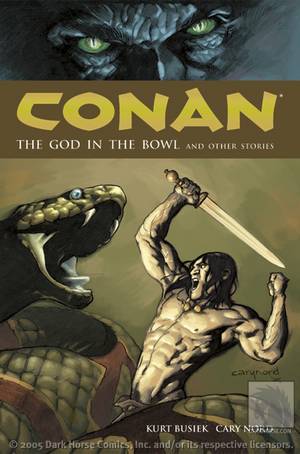
Conan: The God In The Bowl by Kurt Busiek and Cary Nord


Continuing to go through the old collection as I'm trying to organize things. Not easy as I tend to get distracted a bit too easily but nonetheless ongoing.

Conan continues his adventures in this collection of the single issues. Cary Nord does a fantastic job of illustrating the series and the colors are fantastic to view. This volume again presents stunning visuals if nothing else for any sword and sorcery campaign. Kurt provides some interesting interpretations of old stories and introduces new characters to the setting.

I'll be discussing specific spoilers below so if you'd rather not have any of that, read no further.

In terms of characters, the Bone Woman and her servant, Janissa are probably the 'big news' here. The Bone Woman was retroactively introduced in the zero volume and in many ways would be a GMNPC where the character is too powerful and can do no wrong. Thankfully her actual use is minimal here.

Janissa is... I don't want to say a poor substitution for Red Sonja, but... she's a red head warrior (and not in every illustration mind you, in some its brown hair) woman whose origin is tied into rape. More elements of the supernatural here? Yes. Similar enough to be a substitution? I'll let people more learned in the whole Conan mythos argue that one.

The thing I thought would fit with most campaigns though, is that the Bone Woman offers her services to those who seek her out. However she does make those who take her services work for her. This makes her a perfect patron for those campaigns that use an employer model. This can be anything from "Go kill this guy" to "retrieve this artifact." What do the players get out of it? Training, unique skill sets, magic items, spells, or other trinkets? Depends on the nature of the campaign.

Part of Conan's tales this volume involve a trip to Hanumar, "once a stronghold of learning and still a place of ancient power." It's necessary to go there because of the Eye of Tik-Pulonga, "Dark and tainted beyond measure." See, one of the few places that Eye can be destroyed is in Hanumar so off Conan and his new patron and allies go.

In standard campaigns, there is often little need to consider how to destroy magic items. Rather the opposite is often sough. But in looking to destroy magic items, it presents something of a different challenge not only in getting to the destination, but in keeping the item from those who would abuse its powers.

Are there items in the campaign that in the right hands would do vast harm and must be destroyed? Are there ancient powers out there that seek to use those powers for their own gain? A patron allows you to add those things in relatively simply.

For example, in older editions of AD&D, there were tables that broke spells down into their rarity. The more rare the spell, the harder to find, and the more to purchase, it cost. Having a patron allows you to sprinkle those things into the game with a ration for it.

In newer editions of the game, magic items became baked into the math that characters required to have. However, their accumulation then felt artificial since they HAD to have them. This mean you had to sprinkle them through the adventurers by 'chance' or allow magic shops on every corner. The patron is a somewhat mix of the two in that there is a source of magic but isn't one that the characters can necessarily just 'buy' things from.

There are other elements in The God In The Bowl worth reviewing but the main story itself is more about the build up of suspense. Its something that I've rarely been good at unless I'm 'on' so to speak. The building of good terror can be accomplished in a lot of ways, the peeling of the onion so to speak, but for most games these days, unless that is the genre you're playing in, such as Call of Cthulhu, which is excellent for this type of scenario, the pay off may take too long. There may be too much investigation. There may be too much questioning.

At the end of the day, Conan the God In The Bowl provides more fantastic visuals and some interesting monsters in the tales of Conan the barbarian.


Friday, November 20, 2009

GMNPC: Thy Name is Griffith


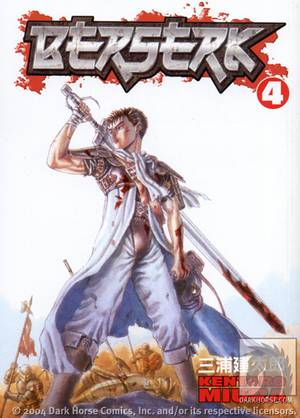
Over at the ole Dark Horse website, we've got the cover, summary, and preview for Berserk #4.
Here we get a lot of background on Guts. We learn that as a chid he continued to use weapons larger than he could handle because the mercenary company he was a part of didn't carry 'child' weapons and so he overcompensated for it.
We see some horrific things happen to him.
We see the fickle nature of mercenaries as they go from mocking Gut's adoptive father and both hating him and fearing him to hating Guts for being born from his mother's corpse under a hanging tree and brought back from near death by Gambino, Gut's adoptive father's woman, Shisu, a prostitude who recently miscarried.
But more than any of that, we meet Griffith. To put it in short, he's a GMNPC. This is a Game Master Non Player Character. Now in theory, every character that's not being controlled by a player, is a NPC. A GMNPC however, is special.
In Griffith's case, he's handsome. He's charismatic. He's a military genius. The biggest 'sin' though of Griffith, is that he's a better swordsman than Guts.
Or at least those would be Griffith's sins in a role playing game where the players have no patience for a long term and told story and don't want to have to share the spotlight at any time.
For example, in future volumes, Griffith's abilities rarely come into play as far as they interact with Guts. It's a campaign tool that allows Griffith to move Guts into positions and 'missions' that Guts is best suited for.
A good fiction example with potential similarity is the Lady from the Black Company. Far too powerful for the Company to even think of fighting until they believe she's betrayed them, the Lady is the one who provides the Black Comapny with employement.
The thing about NPCs though, unlike the players, is that they are capable of changes in many fields ranging not only from attitudes and outlooks, but in power levels. Those who've read far along in the Berserk Manga or the Black Company series know that the Wheel of Fortune is often not kind to those it keeps at the top for a long time.
When thinking about patrons for the players, be aware of their own personal likes and dislikes. If they have an intense hatred of GMNPCs, even if those characters are merely used to provide opportunity for further advancement of the player's own goals, there's a good chance the players will walk away from that NPC and perhaps even from the campaign. Some players have no problem accepting a fantasy society where technology has stayed the same for ten thousand years but get up in arms when asked to do a mission for a high powered NPC who they feel should just "do it themselves."
Keep that in mind and use when and where appropriate.