The Art of War in Italy 1494-1529, written by F. L. Taylor, is apparently a classic in the genre. I didn't know this. Rather, I was drawn to the book thanks to my viewings of Borgia and Borgias, seasons I caught up on Netflix that provided two different takes on an infamous family of the pope Borgia and his family.
This book isn't a book on those battles mind you. It mentions then by name and date, it provides who was where and who wrote what, but that is not its focus. Rather it is a discussion of the evolution and changing nature of war in this time and how those living at this time either embraced these changes or didn't and suffered defeat and lose of status as some mercenary companies grew in power and reputation and others didn't.
It's a relatively short read and provides some good grounds for why warfare changes. Those who've seen the military might of America, one of the greatest spenders of funds on military, change from it's roots in one type of warfare to counter terrorist methodology, know that war is ever changing.
In terms of role playing games? Some potential here or at least some things to provide fodder for.
1. Names. I've mentioned it before, but history books are a great source of authentic sounding names. In addition, they are great for names with titles attached to them. For example, "Gonsalvo de Codova, known to his contemporaries as The Great Captain." or "Lautrec the stormer of cities". You read a few of thoes and you're like, "No, go ahead and keep your nickname, I've seen worse."
2. Scouting: One of the things that comes up, is how vital knowledge of the landscape is. See, if you're using canons and horses, you need to know if the terrain will support their use. You need to know how quickly you can deploy them. You need to know if there is any fodder for the animals around. You need to know if the enemy can quickly get to you or you to them. Mastery and knowledge of the landscape provides those things to you. Characters that can scout out the terrain may encounter guards. They may encounter random monsters. They may encounter terrain difficulties that they can lead the enemy into. They may discover old abandoned mines that lead under the city.
3. Changing Methods: One of the things that frequently bores me about most fantasy games, is they love full plate mail and all of the other neat stuff of the times, but seem to forget how early guns actually get into history. They also tend to completely ignore all of the specialized forces in their own settings. In the real world? Well, if your enemy is using new guns to shatter your castles, you need to figure out a way to make better castles and make better methods to repel the invasions.
In addition, the changing field of battle may encounter remnants of the past in terms of social outlook. For example, one of the nobles would cut the hands and blind any gunners because he felt it wrong that a commoner would have the ability to kill someone nobly born.
Some found that attacking a foe while he was down after defeating them in the initial combat, was wrong and allowed their foes to retreat as opposed to destroying those forces and ending future conflict.
Imagine a scenario where orcs that routinely gathered in hordes started to use hit and run tactics, keeping the larger portion of their forces in reserve to destroy those that came after their own retreating forces? Imagine orcs that use some native herd beast to stampede them into a conflict against armored paladins. Imagine where they poison the landscape so that mounted knights can no longer give chase because their horses die when eating the grass.
4. War: One of the other things that tend to be boring in most fantasy campaigns, is that they're based on some of the harsh times of history, but usually have a few 'evil' countries, a few 'evil' organizations, and the rest of the setting is m'eh in that it's usually a bunch of good individuals and countries taking up the landscape with the threat of 'real' war very rare. Smash your setting. Have skirmish level combats breaking out all over. If you don't want to have it be nations, have it be monsters. Have things from other planes, like good ole Feist and Magician coming into the setting to take resources and supplies. History is violent and full of opportunities for clever individuals to make their mark on history.
The Art of War provides numerous observations on how and why warfare changed from armored knights on horse to canons and gunners whose role goes from supplemental to becoming part of a machine that must work together in unison with all other parts in order to achieve victory.
Showing posts with label War. Show all posts
Saturday, April 26, 2014
Saturday, January 11, 2014
Stands A Shadow: The Heart of the World Book Two by Col Buchanan
After finishing the first book in the series, The Heart of the World, Farlander, I looked at Amazon and saw that in hardcover, the second book was ten dollars. Bam! Ordered and now read. The bad thing? This one came out in 2011, or at least is copy right 2011 and Col Buchanan's website, which is both cool and infuriating, has no information on the next one.
Stands a Shadow continues several threads from the previous book and introduces new ones. It stands in stark contrast to a lot of the 'rules' of writing when talking about introducing a gun in scene one to use it in scene ten because it moves the cast around a lot. In that venue, it actually reminds me of A Game of Thrones in that you may think, "Ah, here's the main character." and then, nope, sorry, that was not the protagonist you were looking for.
I don't know if that's everyone's thing but it makes a nice change of style. It breaks the rules. I think writers like George and Col Buchanan can get away with it though, because first and foremost, they are good writers.
In Stands A Shadow, we have the assassin Ash seeking revenge for the death of his pupil, Nico in the first volume. His order though, is forbidden from doing this as it makes the chances of the guild, the Roshun, being hired again lessened as it tarnishes the image of their professionalism. At this point, as he's an older man, I think the book quotes sixty, Ash is okay with this making him a piraha among his own people.
The author uses a few techniques to bring out more of Ash's backstory including dreams, delirum, and Ash speaking with a monk about the troubles he finds himself in. These work well to bring out different aspects of the character as each method reveals something in a way that the others don't. The dreams are more akin to memories, while the delirum brings forth unwanted and guilt laden memories.
But despite the heavy focus on characters in the novel, there is more going on. The empire of Mann, where the only virtue is strength, is seeking to end the resistance of the so called Free Ports. This invasion brings armies into clashes and brings a lot of action and new characters to the scenario like Bull, a man released from jail, an extremely dangerous man who killed a hero of the war and is now offered a pardon and the opportunity to engage his anger at the enemy of his people. He takes it with both hands.
Other characters from the previous book, like Che, also are featured here and find their loyalties tested in many ways that they might never have expected.
Stands A Shadow is fairly self contained. While the end does offer the potential for another book, it is more the potential of hope itself that it offers, of the journey not being over, thing things can get better. Still, when Col Buchanan does get that next book out, I'll be down for the next copy.
Stands A Shadow is available in hardcover from at least one vendor using Amazon Prime for under $8.00 here on in kindle format for $6.83 here. If you have not read the first book in the series, Farlander, I would highly recommend getting it in hardcover because Amazon has it for $2.92, under three dollars, in hardcover, and shipped from Amazon Prime, here.
Having said all of that, how might this be useful for role playing games like Dungeons and Dragons or Rolemaster? Below I'll be discussing several specific bits from the book so there will be spoilers aplenty. Read no further if you wish to avoid them.
When I was reading this book, I kept thinking of Wizards of the Coast, Heroes of Battle. I kept thinking how that book would be a good resource to delve into after reading Stands A Shadow because of the war which has a large focus on the unexpected actions of characters and the armies that follow them, as opposed to just long grinds.
1.The Best Laid Plans of Mice and Men: The army of Mann uses ships to transport its soldiers. In even the best of circumstances, crossing the world over a hostile terrain even in the largest ships, is a dangerous and challenging prospect. If you've seen Frank Miller's 300, there is a scene where the invading army loses ships to a storm. Something similar happens here. Despite the greater strength of numbers that the army of Mann brings with them, they still cannot control the weather or the elements. Remember random events in the campaign and how they may impact the overall campaign itself.
When looking at these elements, you should determine how big an impact they will have. Will they effect the whole army? For example, this book would have been pretty short had the entire army of Mann washed up on the shores dead and broken. Instead they lost a lot of their high powered weapons and their mounts and several people suffered injury including the Holy Matriarch suffering a broken arm.
2. Camp Followers: Where they are soldiers, there are those who will serve them. The book has Ash befriend a group of prostitutes after the ship's crash as he is seeking the warmth of their fire and scares off a group of soldiers who had intended not to pay. These camp followers are not the only ones though. There are also food sellers, carpenters, leather workers, and a whole host of other professionals whose survival comes from following the army. In some games like Games Workshop's Warhammer, at least in some editions, the players may even start off as a camp follower! Not ever character need be a camp follower though. For example, the young woman Curl is a battle doctor. Well, not quite, more like a nurse who stitches up the wounded and provides them with water and drugs to get them either back into the fight or out of it.
The camp followers can have many roles in the game. When the camp is not actively engaged in war, the soldiers need to do something. They will seek out different forms of entertainment and food and alcohol. This makes the camp itself like a moving city with all of the challenges of such a city.
For example, what if one of the food vendors is using the dead to supply his special brand of meat? This is a fairly common theme for a game like Warhammer for example.
What if the entertainers keep certain types of characters behind when the rest of the troop leave and devour them?
What if one of the prostitutes is a serial killer and picks out targets that won't be missed for weeks if ever as they were prime targets for desertion in the first place?
What if the players infiltrate the enemy camp and use the resources there to hinder the opposing force, or use it as cover to try and assassinate the enemy leadership or destroy key resources?
3. Characters change the game. Che is a 'diplomat' which is another code word for assassin. His doctrine into the religion of Mann is one that required him to undergo a change of personality to be trained as the Roshun assassin and then betray them. But it also requires him to be kept wide read and learn of the world. These elements make him a poor honest worshipper of the ways of Mann and while he does part of his duty, he also abandons the empire of Mann and saves the life of Ash while doing so. His actions bring further conflict to the empire of Mann, as well as resulting in more 'diplomats' being sent after him for his ways.
The world can be as big and vast as you want it, but the events around the players should be influenced and influence the characters in them. If the players take the fight to the enemy in the dead of night in a strategic movie to deprive the enemy of their leadership, can it work? If the enemy then decides to do the exact same thing against the players, will they be prepared?
4. Strong character opposition. While the army of Mann itself is powerful, I again find the head enemy, the Holy Matriarch of Mann, a physically weak character who while having a few moments more than she did in the previous book, still getting taken out almost as an after thought. This in turn leads to a huge event, civil war in the empire of Mann as multiple factions vie for the supreme rulership of the empire. The empire? Still a big bad overarching theme of do as thou will but the actual agents of this empire? So far both the Matriarch and her son have not proven to be that impressive. Mind you this goes in contradiction to how I feel about the heroes where I'm not necessarily expecting each one to be so skilled in dealing death as long as they have some character to bring to the story, but if the heroes are motivated to overcome these villains, if they have no problem doing so once they meet in the flesh, it feels a little demotivating.
5. Survival: On the other hand, if the game master doesn't provide some logical reason why the enemy isn't overwhelming the character, when appropriate, it can make the game seem off key. If the players are faced with overwhelming force, there needs to be a solid reason why the players haven't been overwhelmed. In the case of the book, part of this boils down to how the empire of Mann operates. The heroes of the Free Ports get a break when civil war breaks out in the empire, and this is something that's happened at least one time before as one of the generals notes it happened fifteen years ago. If you put up unbeatable opposition against the players, make sure they have an out.
6. New Characters: War brings out need. In this case, the need for bodies to press into the grinder of war. In so doing, new characters are introduced from dubious sources such as the mad house, the prisons, and the hospitals. If they can walk, they can fight. If in the course of the game the players lose a character or two, having a reliable way to introduce new characters is useful. This can range from a character from the opposition seeing the light, to someone seeking justice against the same foes the players are currently fighting against.
Stands A Shadow is a strong sequel to Farlander and well worth a read.
Stands a Shadow continues several threads from the previous book and introduces new ones. It stands in stark contrast to a lot of the 'rules' of writing when talking about introducing a gun in scene one to use it in scene ten because it moves the cast around a lot. In that venue, it actually reminds me of A Game of Thrones in that you may think, "Ah, here's the main character." and then, nope, sorry, that was not the protagonist you were looking for.
I don't know if that's everyone's thing but it makes a nice change of style. It breaks the rules. I think writers like George and Col Buchanan can get away with it though, because first and foremost, they are good writers.
In Stands A Shadow, we have the assassin Ash seeking revenge for the death of his pupil, Nico in the first volume. His order though, is forbidden from doing this as it makes the chances of the guild, the Roshun, being hired again lessened as it tarnishes the image of their professionalism. At this point, as he's an older man, I think the book quotes sixty, Ash is okay with this making him a piraha among his own people.
The author uses a few techniques to bring out more of Ash's backstory including dreams, delirum, and Ash speaking with a monk about the troubles he finds himself in. These work well to bring out different aspects of the character as each method reveals something in a way that the others don't. The dreams are more akin to memories, while the delirum brings forth unwanted and guilt laden memories.
But despite the heavy focus on characters in the novel, there is more going on. The empire of Mann, where the only virtue is strength, is seeking to end the resistance of the so called Free Ports. This invasion brings armies into clashes and brings a lot of action and new characters to the scenario like Bull, a man released from jail, an extremely dangerous man who killed a hero of the war and is now offered a pardon and the opportunity to engage his anger at the enemy of his people. He takes it with both hands.
Other characters from the previous book, like Che, also are featured here and find their loyalties tested in many ways that they might never have expected.
Stands A Shadow is fairly self contained. While the end does offer the potential for another book, it is more the potential of hope itself that it offers, of the journey not being over, thing things can get better. Still, when Col Buchanan does get that next book out, I'll be down for the next copy.
Stands A Shadow is available in hardcover from at least one vendor using Amazon Prime for under $8.00 here on in kindle format for $6.83 here. If you have not read the first book in the series, Farlander, I would highly recommend getting it in hardcover because Amazon has it for $2.92, under three dollars, in hardcover, and shipped from Amazon Prime, here.
Having said all of that, how might this be useful for role playing games like Dungeons and Dragons or Rolemaster? Below I'll be discussing several specific bits from the book so there will be spoilers aplenty. Read no further if you wish to avoid them.
When I was reading this book, I kept thinking of Wizards of the Coast, Heroes of Battle. I kept thinking how that book would be a good resource to delve into after reading Stands A Shadow because of the war which has a large focus on the unexpected actions of characters and the armies that follow them, as opposed to just long grinds.
1.The Best Laid Plans of Mice and Men: The army of Mann uses ships to transport its soldiers. In even the best of circumstances, crossing the world over a hostile terrain even in the largest ships, is a dangerous and challenging prospect. If you've seen Frank Miller's 300, there is a scene where the invading army loses ships to a storm. Something similar happens here. Despite the greater strength of numbers that the army of Mann brings with them, they still cannot control the weather or the elements. Remember random events in the campaign and how they may impact the overall campaign itself.
When looking at these elements, you should determine how big an impact they will have. Will they effect the whole army? For example, this book would have been pretty short had the entire army of Mann washed up on the shores dead and broken. Instead they lost a lot of their high powered weapons and their mounts and several people suffered injury including the Holy Matriarch suffering a broken arm.
2. Camp Followers: Where they are soldiers, there are those who will serve them. The book has Ash befriend a group of prostitutes after the ship's crash as he is seeking the warmth of their fire and scares off a group of soldiers who had intended not to pay. These camp followers are not the only ones though. There are also food sellers, carpenters, leather workers, and a whole host of other professionals whose survival comes from following the army. In some games like Games Workshop's Warhammer, at least in some editions, the players may even start off as a camp follower! Not ever character need be a camp follower though. For example, the young woman Curl is a battle doctor. Well, not quite, more like a nurse who stitches up the wounded and provides them with water and drugs to get them either back into the fight or out of it.
The camp followers can have many roles in the game. When the camp is not actively engaged in war, the soldiers need to do something. They will seek out different forms of entertainment and food and alcohol. This makes the camp itself like a moving city with all of the challenges of such a city.
For example, what if one of the food vendors is using the dead to supply his special brand of meat? This is a fairly common theme for a game like Warhammer for example.
What if the entertainers keep certain types of characters behind when the rest of the troop leave and devour them?
What if one of the prostitutes is a serial killer and picks out targets that won't be missed for weeks if ever as they were prime targets for desertion in the first place?
What if the players infiltrate the enemy camp and use the resources there to hinder the opposing force, or use it as cover to try and assassinate the enemy leadership or destroy key resources?
3. Characters change the game. Che is a 'diplomat' which is another code word for assassin. His doctrine into the religion of Mann is one that required him to undergo a change of personality to be trained as the Roshun assassin and then betray them. But it also requires him to be kept wide read and learn of the world. These elements make him a poor honest worshipper of the ways of Mann and while he does part of his duty, he also abandons the empire of Mann and saves the life of Ash while doing so. His actions bring further conflict to the empire of Mann, as well as resulting in more 'diplomats' being sent after him for his ways.
The world can be as big and vast as you want it, but the events around the players should be influenced and influence the characters in them. If the players take the fight to the enemy in the dead of night in a strategic movie to deprive the enemy of their leadership, can it work? If the enemy then decides to do the exact same thing against the players, will they be prepared?
4. Strong character opposition. While the army of Mann itself is powerful, I again find the head enemy, the Holy Matriarch of Mann, a physically weak character who while having a few moments more than she did in the previous book, still getting taken out almost as an after thought. This in turn leads to a huge event, civil war in the empire of Mann as multiple factions vie for the supreme rulership of the empire. The empire? Still a big bad overarching theme of do as thou will but the actual agents of this empire? So far both the Matriarch and her son have not proven to be that impressive. Mind you this goes in contradiction to how I feel about the heroes where I'm not necessarily expecting each one to be so skilled in dealing death as long as they have some character to bring to the story, but if the heroes are motivated to overcome these villains, if they have no problem doing so once they meet in the flesh, it feels a little demotivating.
5. Survival: On the other hand, if the game master doesn't provide some logical reason why the enemy isn't overwhelming the character, when appropriate, it can make the game seem off key. If the players are faced with overwhelming force, there needs to be a solid reason why the players haven't been overwhelmed. In the case of the book, part of this boils down to how the empire of Mann operates. The heroes of the Free Ports get a break when civil war breaks out in the empire, and this is something that's happened at least one time before as one of the generals notes it happened fifteen years ago. If you put up unbeatable opposition against the players, make sure they have an out.
6. New Characters: War brings out need. In this case, the need for bodies to press into the grinder of war. In so doing, new characters are introduced from dubious sources such as the mad house, the prisons, and the hospitals. If they can walk, they can fight. If in the course of the game the players lose a character or two, having a reliable way to introduce new characters is useful. This can range from a character from the opposition seeing the light, to someone seeking justice against the same foes the players are currently fighting against.
Stands A Shadow is a strong sequel to Farlander and well worth a read.
Labels:
Assassinations,
Col Buchanan,
Military,
Stands A Shadow,
War
Friday, January 20, 2012
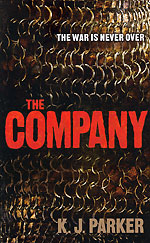
The Company by K. J. Parker
I continue to make my reading of K. J. Parker based on the findings at Half Priced books. I would love to purchase the ebooks and provide some direct support for the author, but when I can get the hardcover at half the price of the ebook, and that hardcover is in near mind condition, its not contest. The next book I read I'll have to decide if it's going to be something by this author, whose work I've run out of, but haven't read it all, or some of the other material I have siting dormant on my Toshiba Thrive via Kindle or in one of the many piles around the house.
Anyway, K. J. Parker continues to impress, but honestly, this book would be book three were I to rank them. I'm torn between the Hammer and the Folding Knife, although I think I like the former just a touch more and the Company has its moments but tends to fall a little short in my enjoyment level.
The Company is about a group of 'linebreakers'. This is a term used here to describe the specialist warriors who charge a pike line and break through them so that those ranks can be decimated by the opposing side. I forget what they were called in the various mercenary companies but they were generally paid a lot of money because they were often the first to engage the enemy and the first to die.
The thing that makes A Company unique is that outside of their last fight, they have as a unit, survived every engagement they've been in. This gives them a bit of a legend, an aura of invicibility that provides a lot of backing to whatever they say.
In a role playing game, allowing the character to develop a reputation and allowing that reputation to have an impact on others is something the GM should keep track of. Mind you, that reputation may vary a bit depending on what the players are doing, but if the players are known to have overcome the Temple of Elemental Evil and helped the towns and been generally awesome in their display of prowess, the people should give them their props. It's not a reward that necessarily comes with any mechanic benefits, but clever players will be able to use those props for their own rewards.
Another bit is that when the novel starts, almost all of the characters are broke. In many games, the spending of cash isn't necessarily a big deal. Some games don't even really cover it, instead relying on a vague 'level' of wealth, like Hero of FASERIP, the old Marvel Super Heroes game, does. Others like Dungeons and Dragons have a pretty detail intensive level and various methods of removing said cash from the characters.
In earlier editions, characters might have to pay various maintenance fees to maintain their lifestyle. In 3rd and 4th edition, those funds are assumed to go almost exclusively to the purchasing of magic items.
In The Company, I'd say its more of the former than the later. The characters and wealth are not connected. Wealth in and of itself is something nice to have for them, but isn't their main goal. Their main goal seems to be to stay 'The Company' due to their experiences in 'the war'.
This is an important issue though when looking at games like Dungeons and Dragons. What role do you want wealth to play in your campaign? If you engage the players and allow them to hunt down items they want or allow them to make items they want using various rituals and rites, then in later editions, gold in and of itself can be used for other purposes as it used to be. This is a campaign decision that should be made before the start of the game, and it is one that the players should be informed of.
If for example, you are playing with people you don't know and have it at the back of your mind that you'll allow them do pretty much build their items, or give them quests when they let you know what the items they're looking for are, they might not be expecting it and can grow frustrated if you cut back on the funds, thinking that they will need that gold for magic items.
In another aspect of the book, some of the characters have secrets. Some games are build around bringing out the role playing aspect of such party conflict. In my experience, especially with the older editions, blows might have come out over magic items, especially those high powered ones that might not ever come around again like a Girdle of Storm Giant Strength. In other games like Burning Wheel, probably not, but the fact that you killed someones favored cousin or something along those lines might be an issue that has to be resolved in play.
Depending on the maturity level of your group, and their interactions with each other and you, allowing players to have such 'dirty' secrets can be fun. This is something that you have to be careful with though as some people take their gaming very seriously and things done in the game transfer over to the real world in terms of real anger or disappointment.
The Company is also great for showcasing how large government may think. There are several individuals brought out and quickly brought out of the story, just to showcase how slow things may move. The end conflict is actually about something that has been under investigation for years, showcasing yet again, the inefficiencies of the government.
It is ironically enough in a position that like where individuals can shine. Player characters may have opportunities to gather fame and fortune if they are able to outmaneuver and outhink and outperform those who are in competition with them and the GM should allow it when appropriate.
Anyway, K. J. Parker continues to impress, but honestly, this book would be book three were I to rank them. I'm torn between the Hammer and the Folding Knife, although I think I like the former just a touch more and the Company has its moments but tends to fall a little short in my enjoyment level.
The Company is about a group of 'linebreakers'. This is a term used here to describe the specialist warriors who charge a pike line and break through them so that those ranks can be decimated by the opposing side. I forget what they were called in the various mercenary companies but they were generally paid a lot of money because they were often the first to engage the enemy and the first to die.
The thing that makes A Company unique is that outside of their last fight, they have as a unit, survived every engagement they've been in. This gives them a bit of a legend, an aura of invicibility that provides a lot of backing to whatever they say.
In a role playing game, allowing the character to develop a reputation and allowing that reputation to have an impact on others is something the GM should keep track of. Mind you, that reputation may vary a bit depending on what the players are doing, but if the players are known to have overcome the Temple of Elemental Evil and helped the towns and been generally awesome in their display of prowess, the people should give them their props. It's not a reward that necessarily comes with any mechanic benefits, but clever players will be able to use those props for their own rewards.
Another bit is that when the novel starts, almost all of the characters are broke. In many games, the spending of cash isn't necessarily a big deal. Some games don't even really cover it, instead relying on a vague 'level' of wealth, like Hero of FASERIP, the old Marvel Super Heroes game, does. Others like Dungeons and Dragons have a pretty detail intensive level and various methods of removing said cash from the characters.
In earlier editions, characters might have to pay various maintenance fees to maintain their lifestyle. In 3rd and 4th edition, those funds are assumed to go almost exclusively to the purchasing of magic items.
In The Company, I'd say its more of the former than the later. The characters and wealth are not connected. Wealth in and of itself is something nice to have for them, but isn't their main goal. Their main goal seems to be to stay 'The Company' due to their experiences in 'the war'.
This is an important issue though when looking at games like Dungeons and Dragons. What role do you want wealth to play in your campaign? If you engage the players and allow them to hunt down items they want or allow them to make items they want using various rituals and rites, then in later editions, gold in and of itself can be used for other purposes as it used to be. This is a campaign decision that should be made before the start of the game, and it is one that the players should be informed of.
If for example, you are playing with people you don't know and have it at the back of your mind that you'll allow them do pretty much build their items, or give them quests when they let you know what the items they're looking for are, they might not be expecting it and can grow frustrated if you cut back on the funds, thinking that they will need that gold for magic items.
In another aspect of the book, some of the characters have secrets. Some games are build around bringing out the role playing aspect of such party conflict. In my experience, especially with the older editions, blows might have come out over magic items, especially those high powered ones that might not ever come around again like a Girdle of Storm Giant Strength. In other games like Burning Wheel, probably not, but the fact that you killed someones favored cousin or something along those lines might be an issue that has to be resolved in play.
Depending on the maturity level of your group, and their interactions with each other and you, allowing players to have such 'dirty' secrets can be fun. This is something that you have to be careful with though as some people take their gaming very seriously and things done in the game transfer over to the real world in terms of real anger or disappointment.
The Company is also great for showcasing how large government may think. There are several individuals brought out and quickly brought out of the story, just to showcase how slow things may move. The end conflict is actually about something that has been under investigation for years, showcasing yet again, the inefficiencies of the government.
It is ironically enough in a position that like where individuals can shine. Player characters may have opportunities to gather fame and fortune if they are able to outmaneuver and outhink and outperform those who are in competition with them and the GM should allow it when appropriate.
Labels:
Campaign Design,
K. J. Parker,
The Company,
War
Subscribe to:
Posts (Atom)