Showing posts with label Appendix N. Show all posts

Friday, September 6, 2024

Conan is the Choosen One

 So I've mentioned it before, but Conan, the barbarian, is saved through all sorts of things or just doesn't die when he should.

He falls further than he should be able to survive but hits something that saves him.

He's overcome but his enemies leave him for dead.

He's about to be killed, but unexpected allies show up.

He's about to be killed, but unexpected enemies show up.

He's about to be hunted down, but his enemies realize he's on sacred ground or something similar and leave him alive.

One could argue those are all just bad writing plot devices. They are and these examples all happen under Robert E. Howard's pen. If you were going to add other writers the list would be nearly endless. The list of Conan being a chosen one would be near endless too,

But for Howard himself? Yeah, Conan is still the chosen one.

Here's a princess literally being told by the servants of Mitra in Black Colossus, available in The Coming of Conan the Cimmerian https://amzn.to/4dYywVh, to place the kingdom in the hands of the first man she meets.

It's Conan.


And that's fine.

But it's another showcase that Conan, even under the hand of his original author, is a chosen one.

He'd kinda have to be since the very first story of Conan is him as a king.

There's no worry that he's going to be killed ahead of that eh?

So when you see the Bro OSR chest thumpers talking about how the old school is the best school because it's sword ad sorcery origins give it a more fatal scenario of how characters live and die, know that they either haven't read the original Appendix N books or they're ignoring the heroes of those books to utilize the old school rules as a club to kill characters.


Sunday, September 1, 2024

Conan, Dungeons and Dragons, and Surviability

The difference between Inspiration from a source of material, even one found in Appendix N, and game play itself, can be vast.

One of the things that cracks me about personally about some of the 'Bro OSR' or the hardcore OSR players, is that it's too hard to die in 5th edition and the character death is needed to make the stakes real.

Those folks either ignore all of Appendix N or decide it's inspiration was in the monsters and dangerous bits.

Even the blood soaked savage Conan is saved often through sheer nonsense.

In the first tale of Conan ever penned, The Scarlett Citadel, available in this collection, The Coming of Conan the Cimmerian (Conan the Barbarian Book 1) https://amzn.to/3TfFPzI , Conan is saved from certain death by some dude we as the readers have never heard of before.


It's literally the first time this sort of hand waving to save Conan occurs, but it's far from the last time it happens. There are times when Conan is left for dead, as happens in The Hours of the Dragon (available The Bloody Crown of Conan (Conan the Barbarian Book 2) https://amzn.to/3X5GdBX ). Heck, a re-read of Hour of the Dragon shows it happens several times including once when he's left in a field where ghouls try to eat him and he awakens 'luckily' enough in time.


If you've ever seen some of that 'hardcore OSR talk', you'll know what I'm talking about. Stabbing downed enemies and mounting their heads on pikes and that sort of stuff. and other times when some other unlikely circumstance saves him.


Elric, Corum, and others in the original Appendix N all have similar moments.


When deciding what the fatality levels of your campaign are, don't feel too bad if you push them to not be as strict as the original 1st ed AD&D where death at -10 is something mentioned in the DMG but not the Player's Handbook. You're staying true to the source material that inspired the game.

Sunday, September 10, 2017

Three Hearts and Three Lions by Poul Anderson


Three Hearts and Three Lions
Written by Poul Anderson
$6.15 at Amazon

Three Hearts and Three Lions is another book by Poul Anderson that is recommended in the original Appendix N of the original 1st Edition Advanced Dungeons and Dragons game in the Dungeon Masters Guide.

Despite that, I'd never read it until now. It's a book fit to be placed in the same realm as the Red Book of The Illustrated Bulfinch's Mythology, the Legends of Charlemagne. While Charlemagne and his paladins are perhaps not as popular as King Arthur and his Knights of the Round Table, heroes such as Roland hail from the time of Charlemagne and one of TSR's green historical books focused on those paladins.

Being an older book, Three Hearts and Three Lions has many covers. The current one is serviceable enough, but my favorite would probably be the following:

Holger atop his black horse, the mighty swan behind him, his wood dwarf comrade at his side. The sense of motion with the clouds moving from left to right. It's a great piece.

Concerning writing, Poul Anderson is a writer worthy of reading just to study his word crafting. His descriptions are not overly long but provide a reader with detail enough to know where the characters are, what the character looks like, and what the mood of the land is. He tells in one book something that another author might have taken six to do so.

The main hero, Holger, is a 'modern' man who while fighting Nazis is grazed in the head by a bullet and awakens in another world. Poul doesn't spring everything on the reader at once. There is a build up of one scene to the next, each increasing the hero's awareness that he is not in his own time anymore, indeed, not even in his own reality anymore.

This time traveling hero bit borrows a little from the even older A Connecticut Yankee in King Arthur's Court: by Mark Twain and is even referenced in the book itself.  The adventures of 'modern' man in other worlds was a favorite device before it fell out of favor. Even authors like Robert E. Howard used it as a means of taking modern giants of the world into environs more fitting for their strength and powers.

Holger's trip to the fantasy realm is one of the troublesome issues in that he appears to be of this new world. The horse he spies upon awakening seems to know him. The arm and armor he spies fit him perfectly. His knowledge of the language of the world is quickly mastered. His knowledge of deeper issues comes and goes at times prodded to the surface by current happenings.

This book brings many bits to fantasy. Here the troll is not a mythic race like those of the Norse, able to use magic and arms and armor, but rather, a massive brute with a huge nose and black eyes with green skin. Its most fearsome power though is its ability to heal from any wound.

Here is also perhaps one of the earliest examples of Law and Chaos in war. Chaos is wild and free and often evil while Law being civilization and the uplifting of man. Even in his time, Nazis were known for what monstrous acts they'd committed, and Poul Anderson puts them firmly in the grip of Chaos, evil entities intent on ripping down the civilization of humanity.

We also get a taste of courtly love as Holger travels with a swanymay, Alianora, a young woman raised outside of the norms of humanity and kin more to the wood dwarves and spirits of the woods like the unicorn she rides. Being a swanymay, Alianora is capable of becoming a massive swan with powerful wings and a stinging bite.

She does this through a magical garment, gifted to her supposedly from the Valkyries, as opposed to being an innate shape changer.

The use of Chaos and its minions, like the timeless and fey elves, who aren't evil necessarily, but are bored and are capricious at best, are intent on spreading their world. For them, the sun and its light, for example, are anathema. Their own world lies in a subtle shade that protects them, and there is a distinct difference between the world of man and that of the Fey.

The arrival of Holger is during a time when Chaos is on the rise. A time when Chaos may make a great play for the world. A time when Giants stalk the land and when those whose inheritance may have a touch of the old blood, are stirred to action.

Holger's travels bring him against wild men of the woods, fey courts, and one of the most powerful allies of the Fey and of Chaos, Morgana of Avalon.

The novel ends with Holger knowing who he finally is and wielding his sword, Cortana, a blade made of the same material as King Arthur's Excalibur and Roland's sword Durendal. In the restored Holger, better known as Ogier the Dane, a hero who, like King Arthur, went to dwell on Avalon until he was needed, rides forth to save the world form Chaos.

Given how far removed modern readers are from the story, it's hard to emphasize how unique and enjoyable this book must be to someone who's spent years reading Games Workshop's various tales and their own Moorcock inspired tales of Chaos. How far Dungeons and Dragons have taken the rare and powerful paladins of older editions and made of them another class that's equal among the others with their own distinctions.

Given its age though, the novel's prose remains top notch and easily readable. If you're looking for a way to kill an afternoon and to wonder at where some of the foundations of modern fantasy come from, Poul Anderson's Three Hearts and Three Lions fits the bill.


Monday, September 4, 2017

The Broken Sword by Poul Anderson


The Broken Sword
Written by Poul Anderson
$6.15 Amazon Kindle
208 pages


Let loose the red tide! Let the men be heaped like reaped golden wheat! Fall back in this telling in one book what would take modern authors a dozen times more pages!

Poul Anderson, one of the original quoted Appendix N authors in the original Dungeon Master's Guide, brings a tale of Norse revenge across generations.

If you are a fan of the show Vikings, if you're a fan of Elric of Melnibone, of cursed swords, of dire destinies, or cruel, uncaring gods, or things that never were but fit into the tales of old lore, then you should read The Broken Sword.

Poul Anderson weaves together some things that we say now are not true, such as the winged helmets of the Vikings, as well as land conquest as England suffers the raids of the Vikings. Of the rise of the One True God against those gods who used to rule. It showcases many different elements of mythology into one where there are still differences, but the mythological world is shared.

The gods of old Ireland are half gods, the elves here, not mere mortals with long hair who are good with bows. The trolls here are ancient and elderly powerful creatures that are not mere brutes that only know how to howl, but how to plan, how to set forth on ships warded against the wild seas, of using weapons of massive stone and bone because their strength allows them to do so.

The elves here are masters of magic, they control the weather, they can heal, they speak with the dead and are all things cruel and capricious. But they are few in number and even as they are timeless, they are not immortal. So when the opportunity arises to steal a man-child and add his mortal strength to their own, they take it.

Sadly they take this man child from a family that has wronged natives of England, and one woman who survives grows powerful in the dark arts of Witchery and sells all including her soul to darker powers to cast dark fate against the family that slew her own.

Into this mix comes the elves who when they capture the man-child, replace him with a troll born changeling. A heartless brute who has sisters and brothers and who will find his destiny leading the trolls against the elves and their kin.

Here the elves and trolls share a weakness to iron, they share magics even if the trolls are not as advanced as the elves, the two are both moral-less entities that are unseen by men as their battles are not fought in the mortal world. They both dislike the sunlight...

Poul Anderson crafts the tale and moves through the lives of these twins, the elf raised Skafloc, a champion more elf than man, more inhuman than human, and his pale troll kin shadow, Valgard.
Their lives intersect in unknown ways as the witch sets her sights on Valgard, a non-human raised among men whose brutish lusts for battle and his desire for the women who manipulate him through the whole of the story.

So much happens in The Broken Sword, that Poul only hints at some of it. When Skafloc must seek to mend the Broken Sword, this cursed weapon forged long ago, a weapon whose fate spirals down time with such doom, that mighty Thor himself shattered it, Skafloc seeks out the heroes of Ireland. He sails with the lord of the Sea to the lands of Jotun where the sword is forged anew but the travel there and back is merely hinted at.

Even at the start of the tale, when we are introduced to how much of the culture of elves flows through Skafloc, we are given a description of Imric, the ruler of the elves, the one who stole Skafloc, fighting against "with a troop of exiled gods, grown thin and shrunken and mad in their loneliness but still wielding fearsome powers."

That in and of itself sounds worthy of more pages! Who were these old mad things that were once gods?

Other gods, more familiar, are still about. The Dark Prince himself, claims to have known Odin in the guise of Loki and liked not the one-eyed Lord. Odin, the master manipulator, the one who pulls strings, who would be a good fit for Merlin from Excalibur, weaves a fate to the son of Skafloc that is again, only hinted at here. The final fate of the gods, or mankind, or the Broken Sword itself? Vague prophecy but no finality.

And for this book? It works perfectly. It casts the net of the tale against a background much larger than what we see here. We are visitors to the tragedy that besets violence and only for a limited time. We see how the effects of the coming of a new religion forces out the old, we see those ancient powers still mighty, still magnificent in their own realms, know that their time is limited even as they themselves are timeless.

Poul Anderson brings us no glowing heroes. There are none here who escape without the reader seeing their faults. The elves, proud and haughty, the witch consumed by vengeance, the old gods striving to survive, the trolls, equally proud and equally haughty, the old glory of Ireland, the sorrow of the fauns who survived the passing of the old Gods of Greece and Rome... it's a tale that set forth so much more than modern readers, especially those who say enjoy A Game of Thrones, might even be aware of.

If you want to see where the roots of modern fantasy come from if you want a rousing Viking tale of old gods and cursed blades, The Broken Sword by Poul Anderson is the perfect fit.


Sunday, May 3, 2015

Battle in the Dawn: The Complete Hok the MIghty by Manly Wade Wellman


In the original Dungeon Master's Guide, one of the authors listed in that original Appendix N, is Manly Wade wellman.

I had never read any of his material before.

I don't feel too bad about it. Much of his material, like many writers of his era, has long since been out of print when I was growing up.

On G+, where fellow readers had mentioned Manly Wade Wellman, one of the posts leading directly to an older Grongnardia post, that I decided to buy one of the books. Paizo has collected Manly Wade Wellman's material into two separate volumes.

One is Battle of the Dawn, the Complete Hok the Mighty. The second, which is out of print at places like Amazon, but still available from the Paizo site directly, is Who Fears the Devil.

Being an Amazon Prime member, I went with the Battle in the Dawn.

Battle of the Dawn is a trade paperback weighing in at 272 black and white pages. It collects all of the Hok the Mighty short stories and some additional material by Manly Wade Wellman.

I hate the cover. With some of their Planetary fiction line  the covers sometimes have nothing to do with the interior. I'm assuming that the blonde haired barbarian on center, is Hok. With an ornate two-handed sword that doesn't exist in the volume and a red haired lass in danger which also doesn't exist in the collection.  Shame as I know that one of the editors at Paizo, Erik Mona, is quite the collector and aficionado of these older stories.

While the cover is disappointing, the fiction of Manly Wade Wellman is not. The introduction by David Drake provides a peek into Wellman's mind and it's one that focuses on bringing elements of realism or at least what was thought of at the time as scientifically accurate.

Wellman's fiction compared to today's lumbering novels and multi-volume sagas is quick and to the point but never boring. While compared to the in-depth analysis of character's and motivations that might take place in today's fiction, Manly Wade Wellman brings you a colossus of a hero in Hok, the strongest, fastest, most clever of all his people as they fight against the more physically powerful neanderthals, called Gnorrls here, who are not tool users, or at least not to the same extent, that Hok and his people are.

During this trials and tribulations faced by Hok, we see the barbarian take a wife, create the bow, explore 'Atlantis', create a sword, and other adventurers in which Hok, who is at heart an explorer, partakes and triumphs in.

The biggest negative about the tales? Hok is untroubled by his troubles. Wellman makes it clear how powerful, clever, and what dynamic physical prowess Hok has and it's difficult to picture him in any real danger regardless of what he's facing. It makes him a fearless explorer, but also a touch one-dimensional. It works for these tales which hail from 1939-1941 and would make Hok a great contemporary in terms of ability, to say, Conan.

Manly Wade Wellman also provides some background to the tales. For example, I put 'Atlantis' in ' because Wellman doesn't actually refer to it as such in the text, In the text, it's called Tlanis. Wellman indicates that the tales of Hok are later attributed to other heroes such as Hercules. It's an interesting writing technique to pass off some legitimacy to his own hero and fits in well with the short narratives of the stories.

One of the things that stood out to me was Maie. She is a native of Tlanis and to me, she is far more of a warrior woman the the first attributed one, Jirel. "I have many such beads," Maie told him. "I am rich, I have lands and servants and warriors."

Although only a short story, Maie shows that she is not subject to others desires such as when Cos, the ruler of Tlanis attempts to take her by force. Rather, she leads a rebellion against him. She seems to have more agency although her actions due result in her passing.

In addition to the Hok tales, collected here is Day of the Conquerors. It's a tale of Hok's tribe versus Martian Invaders. It works surprisingly well and was clear of some of the more amusing antics of say, Mars Attacks. It's the only story that derails the 'historical' methodology.

Many Wade Wellman is one of the original Appendix N authors. The writing is fast and easy to read. If you're looking for a quick moving action based story, Battle in the Dawn is right up your alley.


Tuesday, January 12, 2010

New To Me: Harold Lamb

I had several goals in mind when thinking about books I wanted to read for Appendix N.

1. Books I already own. I have some serious collector issues going on. I own more books than I've actually read. In Chicago, there is a wide variety of methods of getting books for very little cash thanks to an over abundance of book fairs and other events. Mind you, I haven't gone to any of these in quite some time, but Half Priced books, library sales, Science Fiction Club blow outs and other things keep the books coming in at a pace greater than I've read. I've tried to curb this, no, I've tried to stop this completely as I live in a small apartment and it's overflowing with paper but so far no complete luck. It's how I wound up reading the Crown of Stars series by Kate Elliot. The Sci-Fi club had a booksale on one of her series in a bundle and I snagged it where it sat on the shelf for many years.

2. Books of the New: This isn't quite accurate. For example, Steven Brust. I've read some of his material. His work isn't quite as old as say, Robert E. Howard or Michael Moorcock. I've heard good things about it. Karen Miller, Brent Weeks, and Joe Abercrombie are also authors I've heard positive reviews of and they are on the list.

3. Books of the Old: Part of this was inspired by seeing Paizo reprint Planet Stories, as well as other reprints, like Doc Savage, coming back into vogue again. Part of it was seeing authors like Charles Saunders with an older book, Imaro, with a different menu than typical sword and sorcery. In that vein, I picked up Harold Lamb's Wolf of the Steppes, volume one of the Complete Coassack Adventures. To me, these older books act as a lense through which one can view some of the ground work of the role playing games origin point. These books have far less to do with a lot of how games are designed these days that are not deliberate 'retro clones', for example, Exalted, but they do showcase how a genre came into being from myth and legend and historical action adventure tales to its own thing.

Harold Lamb's book is good stuff. While there are no overt elements of the supernatural in it, and it does suffer a bit from the time in which it was written, Harold Lamb does a great job of providing life to an era not often explored in the venues I normally read. I'll be posting more about Wolf of the Steppes but thought that for those looking for 'old school', to see some of the authors that influenced Robert E. Howard and others of his time, you can't go wrong looking at Harold Lamb.

Wednesday, October 28, 2009

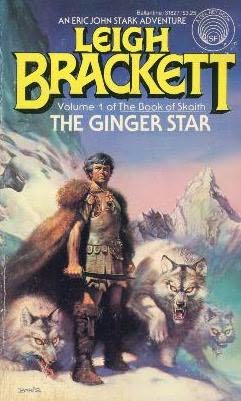
The Ginger Star by Leigh Brackett


The Ginger Star is another book I've plucked from the Paizo Planet Stories line. It's part of my 'back to basics' in terms of trying to catch up on the older books I've missed. Material which may or may not have had an influence on the progression of role playing games, but which should have been known in those early eras.


Leigh Brackett's main character here, Eric John Stark, is a man of a setting that's somewhat space opera. Technology exists in many fashions including planet to planet travel, but it's more of a background element as Start often solves things not with lasers or ship to ship combat, but through his own barbaric nature.


For those who haven't had a chance to read any of the Eric John Stark books, unlike today's mammoth beasts, they're fairly easy to digest and they have the benefit of already being 'done' as opposed to some other mega series which are impressive in scope and depth but never seem to end.


Anyway, below are some thoughts I had that I'll try to keep in mind when I'm running my Dungeons and Dragons 4th edition game. Page quote numbers come straight from the Paizo edition.


"He was, as the old phrase had it, a wolf's-head- a totally masterless man in a society where reveryone respectable belonged to something. He bestowed his allegiance only where he chose, usually for pay. He was mercenary by trade, and there were enough little wars going on both in and out of the Union, enough remote peoples calling on him for the use of his talents, so that he was able to make a reasonable living doing what he did best. Fighting." (p.16)


In terms of character motivation, sometimes it's a natural talent that brings the character to their chosen profession. It's not a matter of being raised proper, it's not a thing for pondering why, it's a life style determined by the character's raw ability and how best they use it. It's a popular theme and one of Marvel Comic's most popular characters, Wolverine, has his own line, "I'm the best there is at what I do." If the characters are struggling for motivation, having them take pride in their own physical prowess isn't a bad thing.


He let the city flow around him, absorbing it through all the senses, including one that civilized men have largely lost." (p.21)


Try to engage the players on multiple levels with the setting: How does the road they walk on feel? What does it look like? What scent is carried on the air? What background noises are standard and which don't belong? Is there a sense of wrongness in the air? By bringing all of a character's senses into play, it makes it potentially easier for a player to get into character. The setting is more real the more they can relate to it.


"He is the Dark Man of the prophecy." (p. 27)


When looking at oracles and divination, the more vague they are from the Game Master's point of view, the more wiggle room the players and Game Master have in what actually happens next. Some prophecies may be so open to interpetation that it applies to everyone. In the comic Nexus, there is a sequence when Nexus and his good friend are teamed with the insane Badger, a martial artists of questionable sanity, and the three come to a village where they are hailed as saviors, or at least better then the three that came before and Nexus and his allies are smart enough to head out even as the next three of prophecy come along.


"Start sprang like a wild beast for Gelmar and bore him into the sea." (p.28)


Expect the unexpected from the players. If the characters are on a mountain and driven to the edge over a sea, don't be surprised if they jump into it and try to take some of the enemy with them.


At the same time, if the Game Master can think of things that the players can use in the environment to augment any encounters, all the better. Building different elements into an encounter that may or may not be used can be aggrevating in terms of work lost by the Game Master, but it can all be worth it when the players take advantage of it.


"You took him into the sea. Don't you know that it is forbidden, absolutely forbidden on pain of death, to lay hands upon or interfere with a Wandsman in any way?"


"I was already under pain of death, and it seemed to me that in any case, Gelmar needed a lesson in manners." (p. 37)


When you push the players, the players push back. The game master must keep note of any potential campaign elements that can derail the game if the players push too hard against those elements and more importantly, why the players wouldn't push in that direction if the game master is herding them in that manner.


If the game master has a nobel and his loyal followers meet the party on the road and has it in his mind that the party will take the absuse of the noble because after all, the character is a noble, the game master may be in for a rude awakening.


When such potential issues come up though, the game master should work with what the players have actually done and why they've done it and incorporate that into future game sessions not only in how they've effected the world, but in building future encounters that don't encourage the behavior that the Game Master may have issue with.


"Killing is a solemn matter," Mordach said, "and salutary. It ought not to be wasted." (p.56)


In terms of taking the players alive, depending on who the players are fighting, their deaths and more importantly, the manner of those deaths, may be more useful in keeping the campaign going then in merely killing them out of hand. For example, in the campaign I'm currently running, the players are on a section entitled, "The Well of Demons". There are numerous gnolls practicing dark arts here and that provides a great opportunity to allow any defeated players to be captured and taken for future sacrifice, allowing the other players a chance to rescue the player or the downed players to showcase some of his skills. The end doesn't necessarily have to be the end if there is a good reason for it not to be.


"One is born on a world. It may not be perfect, but it's the world one knows, the only world. One adjusts, one survives. Then suddenly it appears that there is no need to struggle because one has a choice of many worlds. It's confusing. It shakes the whole foundations of life. Why do we need it?"


"It isn't a question of whether or not you need it," said Stark. "It's there. You can use it or not, as you please." (p.100)


In most fantasy games, there are other worlds beyond that the players live on. In some cases, the players may actually come from those other worlds. What do normal people think of these old worlds? Do they close themselves off form it? Do they try to ally themselves with it? In 4th edition, right from character creation, there is evidence of multiple worlds with tielflings having pacts with ancient and dark powers and eladrin coming from a fey home. Do people seek to recreate those pacts that made the original tielflings? Do they seek to exploit the eladrin's home land? What trade opportunities are there? What long term ramifications for such vast span to the world?


"We live all our lives in a state of siege. Anyone, anything, may come. Sotmetimes the great snow-dragons, with the frost white on their wings and their hungry teeth showing. Sometimes a band of Outdwellers who run demented across the world and take whatever they can lay claws on. And there are creatures who wait, hidden just out of sight, smelling the warm food that walks and hoping they can snatch it." (p.124)


Keep the players on their toes. Let them know that it's not merely a matter of a kobold cave or a wild bear or a single dragon. The world is filled with danger and anything that the players are unaware of is merely that, their own foolishness in thinking that things are normal and safe. There is an air of caution in a setting where anything can happen. The brave and the bold may take powerful stakes in such a setting by fighting through these terrors.


It also allows the Game Master to lay down the footwork of future encounters. Just because the player's haven't encountered the snow-dragons doesn't mean the snow dragons don't exist. Just that the players havent' encountered them.


"In the time of the Great Wandering we were the free plunderers who fed on the roof-dwellers."


Stark thought that probably she meant that quite literally." (p.135)


Foreign cultures do things differently. They think differently. Their whole morale compass may be so alien to the players that they seem monstrous. Keeping the differences of those the player's don't know in mind and showcasing those differences can send some strange thoughts into the character's thinking when they see the foreigners do the same things that the characters do in terms of how they relate to their friends and allies.


The Ginger Star showcases an alien world that would fit into most D&D games with some of the humanoid monsters being the result of ancient genetic engineering that the modern survivors couldn't replicate. It has the old masters, things of such power that they cannot be replicated in today's standards, but in this case, it's from a technological mastery. Readers looking for a quick read could will be in for a surprising ride.

Wednesday, October 14, 2009

A last look at Robert E. Howard's Almuric


Almuric is a rather short book by today's standards of mega multi-volume epics but it gets it done in one while leaving the setting open enough that further adventurers could have been written in the vein. Like a good campaign ending at that.
But now for some specifics and what I thought of in regards to role playing as I read this tome. Page references are from the Paizo edition.
"On the remnants of flesh were the marks of fangs, and some of the bones had been broken, apparently to get the marrow." (p.83)
The characters are not the only inhabitants of the world. They should see signs of other live on the setting all around them. On the road there should be shrines and way markers with richer countries having way stations and havens for travellers. In dungeons there should be evidence that the things that live there, unless undead or animated objects, are eating and doing their business. Make the players realize that they are moving through a world and not a passive setting.
"By Thak, it is he! Do you not remember me, Tharn Swordswinger, whose life you saved in the Hills?" (p.133)
4th edition, perhaps more so than any other edition, does not have a huge implicit love for the good factors of the game. Unaligned, not neutral or chaotic neutral or some other hinged alignment, is fairly sellf expalanatory. However, this should't necessarily be license for the players to run wild.
When they do deeds for no reward, when they help those who can't at the time help themselves, insure that these strangers mark the players as potential allies and possibly even potential friends. Have the players hear of those they've helped. Have the players develop a reputation. In a typical fantasy setting, it'll take time for players to have a reputation that goes far and wide, but make sure it's one they've earned. If played with a little heart, they'll have allies and friends in many corners of the setting as well as the enemies they've earned by helping those who could not help themselves.
"Runners were sent to the cities, to give word of what went forward. Southward we marched, four thousand men of Koth, five thousand of Khor. We moved in separate columns, for I deemed it wise to keep the tribes apart until the sigh of their oppressors should again drown tribal feelings." (p.139)
The old saying is the enemy of my enemy is my friend. I've seen this used in various pieces from the animated series Robotech with threat of alien attack to the same plot in the Watchmen graphic novel. If you have an enemy but at least know that enemy, it's better to ally with that enemy against the unknown enemy who overpowers all of you individually. In some ways it's even a good motivation to keep a party together. The members are not friendly towards one another but because of the recent changes in the campaign, they've been thrown together and have to make the best of it least they all fall.
Almuric is a quick moving book and Game Masters who want to learn from Robert E. Howard need to keep their own campaigns moving foward.

Monday, September 28, 2009

The Gathering Storm by Kate Elliott... Part Two!

"You would even teach the common-born folk?" Bertha demanded. (p. 692)

In a pseudo middle ages fantasy role playing game, the assumptions about class and status, outside of the players, are fairly woven into the standards of those eras with a lot of equality spread around.

But what if the players want to push those boundaries? What if they want to make of the campaign something different?

As the old quote goes, "So be it young Jedi."

Let them change things around. Let them showcase new abilities and new methods. Let others come to them to learn. Let them have an active effect on the campaign.

Now in a campaign that has a definate start, middle, and end, that's pretty easy to do. Regardless of what happens, the campaign is going to have some type of ending and the players will be able to look back on that campaign and indicate where they made their mark. In an 'open' campaign that needs to have a certain level of... same old same old, like a television show, you should think long and hard about what the changes the players are trying to make to the campaign will mean.

It's not that the players methods or motivations are wrong, but if it's an open campaign that's going to continue to host characters for long periods of time, what will the long term ramifications be? It's one of the reasons why Marvel and DC, despite having characters smart enough to create interplantary and time travel, still use gas in their cars. The further you get away from the 'root' of the game, the further the 'connection' to the game gets.

On the other hand, it's always fun to take what the players are teaching others and use it against them. One of the best moments of the original Squadron Supreme limited series back in the 80's is when Nighthawk is explaining that the only reason the Utopia project of the Squadron is working, is because the Squaadron is so good. But this machine that they've set up is easily prone to abuse and those that come after the Squad may not be so pure of heart that they can be trusted with so much power.

"If the children hadn't explored here, none of the othersm ight ever have noticed." (p.735)

How are old ruins discovered by those in the 'modern' era? How do old horrors come to light? Often, one old staple is having the characters awaken something that man was not meant to know about. But there are other individuals in the setting whose intentions are far more innocent than the characters. In addition, if the Game Master uses a little elbow grease, he can turn the discovery of such ancient ruins into an adventure in and of itself as the players now have to go and find the children who haven't returned.

"The lapis lazuli ring Baldwin had slipped on his finger winked blue." (p.776)

In this instance, Ivar is about to be attacked by otherworldly elves. However, a ring given to him by a friend glows. The ring may or may not be magical, but the important thing is that the elves recognize it and allow him safe passage.

What are the signs and sigils of the world that people in power recognize? What tokens of friendship pass between kings and nobility? What wizard marks indicate that the bearer of such a mark is not to be triffled with.

When desinging adventurers, have players note elements of those they come across that could be taken as them having some sort of royal protection. Have them receive such gifts and call upon those lords who offered them such friendship in the first place.

"To go against OldMother was beyond him. He bowed his head, knowing he had lost Alain and the hounds. He had failed his brother." (p.876)

Here, Stronghand, a ruler among his people, was set a task, to find Alain, his blood brother. Yet now he has a new mission.

If the party is floundering, give them direction. If they don't know what to do, use a vision, a sign, a divine inspiration, an NPC, something to get them moving again.

And to challenge the party, don't be afraid to throw multiple elements at them at the same time. Throw quests at them that have a limited time frame open to them that are all vital and allow them the decesion of which quests they will follow. By doing so, you'll not only see the party in action, but you'll get a taste for what type of adventurers their more interested in.

There are more passages I could quote but in the end, the Gathering Storm is another huge novel with a huge cast that tries to cast realistic aspirations onto its many characters whil thorwing many hindrances in their way. Game Masters looking to move beyond the world of hack and slash and dungeon crawls should remember to keep the NPC list full and connected to the characters even as they continue to add things that the players enjoy to the game.

Sunday, September 27, 2009

The Gathering Storm, Volume Five of Crown of Stars by Kate Elliott

While I didn't skip over volume four, I didn't take any notes outside of a general mental note that the cast is growing wider and vaster and that the numerous little details that Kate uses in her writing contribute to a sense of a gritty realism in the story.

I picked back up my notes for Volume Five and below are notes that may be good reminders for your own game. As always, beware of spoilers if you're interested in reading the material.

"Because there will be a price." (p.74 paperback).

One of the main characters is off on essentially, a player character type of quest. While the "NPC's" of the setting are involved in political schemes, Sanglant is off trying to save the world from the doings of evil spellcasters. One of his plans involves griffin feathers which are of use against magic, but he's also interested in allying himself with others who have mastery of magic.

When the plarers are looking for something, be it a magic item, an ally, or information, what is the cost that they will have to pay for it? Is it in time thanks to travelling? Is it in coin thanks to barter and merchant services? Is it doing something for someone else to get what they want in the first place? Try to insure that things aren't as simple as walking into a 7-11 and that the characters have to earn what they're trying to get.

"Too many travellers came into a port like Sordaia for three scruffy visitors to create lasting wonder." (p.114)

When dealing with samll land locked villages and low population density hamlets, any visitor is a visitor worthy of making note. Any news they bring is news worth hearing. In a massive walled port city that has hundreds if not thousands or tens of thousands of visitors by the day, they may not exactly be the grand news anymore.

If the players have struck out on their luck and crossed one too many locals at the small towns they visit, it might be time to lose oneself in the big city.

Game Masters can use a port city to introduce a wide variety of things. This can range from missions for the players to go on ranging from the mundane of guarding spices, to the more exotic of locating new lands. Of course there's also the benefit of shaking things up. If the current campaign isn't moving along and things are locked up in the campaign, shake them up by having the characters become enslaved and win their freedom out at sea where they'll now be forced into a new direction even though they're free.

Even in cities that in and of themselves don't tolerate slavery, slavers may merely be waiting for the unweary to fall into their hands. In Waterdeep for example, there is a whole city underneath the main city that deals in all manner of goods. In a fantasy campaign, the limits as to where a 'dark mirror' of the city are limitless. This can range from bad parts of a city, such as dock wards or slums, to a negative image of the city on another plane or an underdark counter part to the city as in Waterdeep.

"His armyr rushed heedlessly past the bodies, although some of the dogs stopped to feed on the corpses and had to be driven forward through the open gate." (p.168)

Okay, I know I'm not the only Game Master whose guilty of this, but I have on many occassions had mosnters not act in a manner appropriate to their intelligence. Too often creatures with beastily intelligence don't actually behave the way they're supposed to. In part I do it to keep the game challenging and in part so that players, especially the defenders, feel that their abilities are coming into play.

However, when it makes sense for the animal to act a certain way, don't begrudge players attacks of opportunity caused by marking the enemy or when the enemy tries to make a full get away. Sometimes they'll miss and it'll lead to other interesting opportunities.

"When Biscop Constance raised me to the abbacy of Herford Monastery, she strickly enjoined me to see that travellers were well cared for." (p.218)

All too often, clerics in a fantasy game are used as band aids to quickly heal a near dead party back to full strength to continue their dungeon looting.

But what else does the church do? Does the church have any political standing in the setting? Is the church known for it's kindness? Does the church take in orphans? Does it send doctors out to fight the plague? Does it take in the homeless? By mapping out what role the church plays in the campaign setting, the game master is providing the setting with more detail than merely having the church be another arm of the government to pull up templars and other religious knightly orders. The Game Master should ask himself, "What does the church do when the players don't see it. What happens behind the gates when the clerics aren't fighting. What does it mean to the campaign overall and in details to this particular church."

"The bench rocked back. The ground jerked so hard that she slammed into Margret. She fell forward, banging her knee on the bench in front of her." (p.265)

Player characters tend to focus on one thing in the game and that thing is their enemy. But what if they're in the midsts of something that isn't necessarily a physical foe like say an earthquake, flood, plague, or fire?

In 4e, the use of Skill Challenges can be used to determine how players stay safe in such a harmful environment. The players can describe what skills they're using to safeguard themselves and the Game Master can explain what happens if they meet an appropriate level DC. For those who don't necessarily enjoy the default skill use, over on good old RPG.net,
damilir has posted some of his ideas on using Mouse Guard, a Burning Wheel variant, as a substitute for standard skill challenges.

"Do not fear. The creatures that abide in the earth have done no harm to us. I wish I could say the same of our human brethren." (p.304)

For me, 1st and 2nd edition D&D were an interesting mix of having seperate rules for NPCs where the NPCs could pretty much do what you want, stated up as monsters, or follow player rules and even have specific classes, often more powerful than the core classes. Other games like Mutants and Masterminds or Hero went a rotue that 3e tended to emulate that an NPC was essentially a PC.

4e returns the NPCs to either monster or character status, whatever the GM is looking for. In that, it allows humans to be done up relatively quickily and can make humans a viable threat for characters of any level again.

In making humans, or demi-humans, the enemy, the Game Master should have some sound reasons why those who are of the same race as the players would wish them ill. This could be as simple as the 'bad guys' worshipping a dark god, such as Vecna or Asmodeus, or being Unaligned and the players being in the wrong place at the wrong time.

"Who will notice if a handful of isolated nuns vanish?" (p. 326)

I bring this one up for a point. In a fantasy game, dozens if not hundreds if not thousands of small sects and cabals can exist for no other reason than for the players to meet them, learn at their hand, and then disappear. It's cliche but it's a well used one. It's something that heroes often encounter ranging from Elric meeting the Ship that Sales the Planes to this passage where a small cabal of nuns is in danger of being exterminated with extreme prejudice. As long as things make sense to the players and it fits into the context of the world that the players will see, everything should work out fine.

"What does his lineage and mine and yours matter then? Isn't it true that in the Chamber of Light before God, we all stand as equals?" (p.547)

In many ways, this is a player truism. Players, at least my players, are often reluctant to embrace what it would really mean to be in a more realistic dark age setting where nobles would have a much stronger rule over the people than players are prone to accept. Still, the old saying is something like, "It rains on king and commoner alike" and players, who often follow the whims of Fortunes Wheel, are often at the certain of important happenings merely because they are the players.

Even if none of the players have any relation to nobility, even if the Game Master isn't using churches or other social structures to give divine characters a reference to hang a framework on, the Game Master must remember that without the players, there is no story. All that rich background and effort goes to the wayside if the players aren't put front and center of the story.

On the other hand, there is a saying about giving the players enough rope to hang themselves with. If they engage in the odd bits of role playing here and there, don't be afraid to take those threads and run with them. You might just surprise the characters with what effects their actions have on them latter on down the road.
Providing variety in the scenery while making that scenery more than backdrop for the players to loot dungeons in, can provide the Game Master and players with a deeper connection to the campaign.

Sunday, September 13, 2009

The Dark World by Henry Kuttner


One thing that Paizo has been doing for a few years now is, no, not bringing sexy back, but rather, bringing old school back. I don't mean by supporting old editions of the game, but rather, by supporting some of the foundations upon which the old game systems were build. Today's fiction library is far different than yesterday's.
In that vein, what could you possibly gain from some old school fiction?
"Listen," she said, and I felt a soft touch on my shoulder. "You must understand this. You have lost your memories." (p. 28)
Memory loss is a great way to get a higher level campaign started. How does your character, whose never been heard of before, know how to do exactly what he does? Why is he so powerful?
Memory loss.
This can be useful for a wide number of things but is most often seen when the character was a former villain and is now on the side of angels. Next time one of your players is prepping a new character and he has a blank look on his face when you ask him about his background, ask him if he'd mind having memory loss and is a foundling. This will allow the Game Master to plug different pieces of the campaign around the character.
The important thing though, is to not overdue it. Unlike a novel, the role playing game has other players and each one should be as important as the next.
"Beside me, Medea had risen in her stirrups and was sending bolt after arrowy bolt into the green melee ahead of us, the dark rod that was her weapon leaping in her hand with every shot."
The Dark World at first seems to rely on a lot of wizardry but in fact, most of it is science disguised as magic.
"The wands. Though no technician, I could understand their principle. Science tends toward simpler mechanisms; the klystron and the magnetron are little more than metal bars. Yet, under the right conditions, given energy and direction, they are powerful machines.
"Well, the wands tapped the tremendous electromagnetic energy of the planet, which is, after all, sipmly a gargantuan magnet. As for the directive impulse, trained minds could easily supply that."
Which brings us to...
Exotic Weapon Proficency:
Black Rod: 1d12 damage, +3 profiency bonus, 10/20
A Black Rod is a device of science that requires a user to attune himself to the object through the expenditure of a feat. Unlike standard weapons, if the user is not attuned, he cannot use the weapon at all as opposed to just losing the profiency bonus.

Sunday, September 6, 2009

Prince of Dogs Final

When reading an epic length book like Prince of Dogs, there are probably dozens of ideas that you can grab ranging from names and organizations, to mannerisms for your Non-Player Characters.

My finishing off of the book leaves me with the following.

"Lady's Blood!" swore Leo. "Fire!" (p. 326 SFBC edition.)

It's easy to get caught up in the fantastic of a campaign setting. However, the mundane should always be ready to be pulled out when needed. Fire is a terrible threat to a city with no easy means of water or manpower to utilize it. When looking at your cities, think of which parts are made of stone and which of wood. Are parts of buildings, like old forts, made of both? If a fire were started, how would it spread? How would it be fought? Are there people enough to have a professional force of fire fighters? Are there spells or rituals that can be called into in order to combat a fire?

Fire in and of itself is powerful, but the results of the fire can be even more so. Nobles and peasant alike may lose their land and all their possessions. Who steps in to remove the burnt down husks? Are any old family secrets brought to the light when the basements are laid bare? Use the fire as an event that can be a springboard for other adventurers in the campaign.

"No, my lord. Duke Conrad closed the pass." (p. 337).

Fantasy campaigns, especially at lower levels, tend not to have the quick benefits of using instant transportation. Unlike modern settings, characters can't just get in a car and cover vast distances quickly.

While 4th edition tries to showcase some of this hardships with the concept build into the 'core' setting of points of light, the Game Master can easily increase the time needed to get from one place to another through a few simple methods. In this case, an Eagle, a king's messanger, is initially cut off from the pass by natural disaster and then latter, through efforts of royalty not aimed at halting the King direclty, but at handling a rival and indirectly coming into conflict with the Duke.

Being put in a situation where the characters have to go out of their way, and out of their way several times, gives the Game Master time to do several things. First, it showcases that things don't always go the way of the players. Second, it allows the GM to throw in some more random encounters. These can range from random assaults by various fiends always lurking in the background, to chance encounters with Non-Player Characters that have access to something that the players may need. This can also act as foreshadowing if the NPC is befriended and can be of use again latter.

"This food is scarcely fit payment for such tales as you have told us this night." (p. 365)

To further point out the differences in how things work in the here and now with the there and then, the Game Master should try to remember that events happening in one part of the world, even if not very far, may be unknown to another part. Normal citizens with little cause to travel may not know if the king is dead or alive, if a heir has come of age or even if there are more dire situations around the bend.

Without access to virtual instant communication such as we have today, many people in the psuedo historical fantasy settings remain woefully ignorant of the events of the world. The players, due to their travels, generally have a head start on others when it comes to the lay of the land. Remark on how common folk stand in awe of the player's experiences. Have bards try to woe them in exchange for tales of their doings. Have nobles invite them for dinner in order to learn what events have transpired recently. Remember that knowledge is power and that most people in such a setting would fear to venture beyond their own homes.

"No ambition for myself. For my son." (p. 558)

In terms of doing good deeds or of doing deeds for various patrons, the players should be aware that not all that is done is done for the here and now. In this case, Lavastine has taken a city under hostile control not only for the glory of doing so, not only to secure for his son a well made marriage, but because by doing so, in the future those lands may pass through his son's inheritance. These are potentially long term plans.

In these events, if the campaign is mainly about stomping dragons, it could be difficult to place something with a long term pay off into the campaign. Most foes that the players meet will quickly fall to blades and most plans contain no more depth then onto the next dungeon.

To foster some type of longer term plans in such a campaign, the Game Master should let some clue of what's to come further down the road into the player's hands. By doing so, the Game Master gives the players the opportunity to properly arm themselves. For example, if the Game Master knowns that undead will be in an upcoming crypt, clues of the undead's presence should be felt. If creatures with a specific vulnerability to silver are to be featured, the players should have time to arm themselves with such.

"You know what they call you now, some of them, don't you? The prince of dogs." (p. 576)

Names have power. Names grant recognition. If the players don't take a name for themselves, don't hesitate to give them one. This can come from numerous things ranging from the way they dress, arm themselves, the foes they've fought or the items they've used. In some cases it may be seen as complimentary and in others, an insult. For those who don't take the time to name themselves, take that power away and name them as you would.

Prince of Dogs finishes off with more potential story lines and a lot of character driven events that proper it onto the next book. If the Game Master can draw out the characters of his own campaign and interact them with the players to propel them onto the next adventure, then the Game Master is continuing to do his job.

Sunday, August 16, 2009

Fortress In The Eye of Time or How to Host A Party


"...There have been now ten attempts on my life, of which the south gate is witness save the last, where we lost good men in my stead, and yet Lord Heryn swears the district under his control - ah, what else of gossip have I forgot? Armed bandits in the countryside, of which there now are fewer. Perhaps you have had such difficulties, my lords. If so I earnestly pray you advise me." (p. 242 hardcover sci-fi version.)
It's easily possible for a group of players to meet numerous factions and gain from them information. One way to allow the players a wider degree of control in what they may seek out in terms of adventure, is to have a gathering of like minded friends and allies and have them speak of their recent adventurers, issues, and potential problems. This allows the Dungeon Master to throw out several plot lines and see which ones the players are interested in before working fingers to the bone on something that the players may have no interest in.
Players have characters that are generally not the standard citizen of a fantasy realm. They go out and risk live and limb for treasure if not for personal reasons. Have them meet wagon masters who gather together and speak of the trouble on the roads. Have them meet nobles from different corners who gather together to tell old tales and speak of problems yet unsolved. Have them gather together with rival adventuring bands and share tales of woe.
The larger the DM can make the setting ahead of time as the players travel through it, the more options possible when presenting adventurers from those different venues. The trick is to have something that brings all of these elements together and adventurers being far from the normal citizen, can be that. Mayors they've helped in small communities may call for a feast in their honor. Warrior Kings whose aid they're secured may call for a show of might, allowing the players to show off their abilities while gathering new information.
And don't forget, during any such meeting, the chance for adventure is always there. Do all of the assembled like the characters? Do unfriendly forces know of the assembly and have the means to attack it? Are there any poisoners in the crowd? Any assassins?
Don't limit the danger to the dungeon. Provide the characters opportunities to use the world as a springboard for further adventurers and this will give the world more depth and character then only allowing the players meeting time with NPC's during mission hirings.

Tuesday, June 16, 2009

Using Inspirational And Educational Reading

In my old weather worn and well used Dungeon Master's Guide for 1st edition of Advanced Dungeons and Dragons, on page 244 is Appendix N: Inspirational and Educational Reading. Numerous fan favorites of the authors are listed there. Appendix N has also been used as a reference point by many bloggers ranging from gaming professionals to those who love to game.

My own Appendix N would vary depending on what I was running and what I was trying to emulate. The materials I enjoy referencing in Mutants and Masterminds are very different than those I would return to or seek out for a dark and gritty game of Warhammer Fantasy Role Playing.

The.. 'purpose' of this blog will be to occassionaly discuss what things I find useful for gaming purposes in the fiction I'm reading or have recently read. Older stuff that I've read, outside of some great quotes like Stormbringer's parting words to Elric, is still in my brain, but my recollections of it and how I'd react to it now are probably much different than what I thought of it at the time of reading.

Be warned though. My first few posts will probably focus on stuff I've been reading for direct inspiration for my Forgotten Realms 4e game (set in the pre-Spellplague/Spellscar/4e era) will probably focus on several Forgotten Realms novels and what I take from them and may/may not directly plunder!

Until then though, good reading!