Walter Simonson is probably best known for his work on Marvel Comic's character, Thor. His tales epic in scope and size.
So imagine what happens when he does his own series based on Norse myths? You get Ragnarok and in this collection, Last God Standing, collecting issues 1-6, you get a Thor after Ragnarok, an undead Thunder God. One whose hammer still has power but is designed more like the mythological version with the short handle.
Yes, Thor as an undead god of Thunder. With Walter's traditional touches. He brings the character to life as few could.
In this tale, someone wants Thor gone and sends a dark elf assassin to do the job. It's a nice touch as the dark elves have a long a tradition in Norse mythology. Her comments to others remind me of what an adventurer would be like.
That in and of itself could almost be the start of half of Dungeons and Dragons games the way people online talk.
And Thor himself? Still a god of action.
Walter's art does a fantastic job of selling this new world and this new mythological vision. We see Thor awaken and learn how to deal with this new world. Not as strong as he once was, not as wise as Odin, we see Thor trying to piece together the bits of the new world from what remains of the old world.
One of the most powerful bits to me? When Thor finds the old Well and its seer, Mimir. Like Odin, Thor must sacrifice an eye for knowledge. But after the well is drained? There are two eyes left in it. One Thor's freshly sacrificed eye, the other? The original eye of Odin. Thor places it into his skull to gain his father's knowledge. It's a powerful sight and touching at the same time.
Thor's tragedy here is lain at the reader's feet with every step Thor takes in this new world. When he visits Asgard and sees his dead wife and children? When he uses a Fire Giant's essence to set aflame old Asgard as a proper monument to their time? It shows the weight and cost of Thor's sleep.
But Thor is not the only inhabitant in the world. The Dark Elf assassin had a husband who seeks to finish her work and the hunt is on. Gifted with a cursed sword that must draw blood, Regn and his daughter, Drifa, seek out the Thunder God to bring him down.
This collection ends with Thor in the ruins of Asgard and Regn and Drifa seeking him out with a cursed sword.
In addition to the comics, this collection includes the full covers as well as sketches. Walt's sketches in various degrees of completion. It's a wonder to see the art unfold from one stage to the other.
Right now Last God Standing is part of the IDW sale and is going for $3.99.
Showing posts with label Mythology. Show all posts
Saturday, October 22, 2016
Saturday, April 18, 2015
O is For Odyssey
Another entry into the 'classics' that I've been hitting on, The Odyssey is the homeward journey of Odysseus from the War at Troy.
If you were looking at it from the modern perspective, it would be the end of a trilogy that started with The Iliad, moving into the Aeneid, and finishing in the Odyssey.
The Odyssey is filled with a great number of bits that have been incorporated into most fantasy role playing games.
1. The Greek Gods: While not present in every fantasy RPG, the influence of them is often heavy. Not only in fantasy though, but often in Super Hero comics. For example, Marvel Comics and DC Comics have both made extensive use of the Greek Pantheon including the use of Hercules and Ares, and even going so far as to make Wonder Woman an actual daughter of Zeus in the new 52.
2. Monsters: Man seducing sirens who sing men to their death. Great and towering cyclops who eat men whole while guarding their flock of sheep. The terror of sailing between Scylla and Charybdis.
3. Strength of Arms: When Odysseus makes his return home, he finds his wife under siege from numerous suitors. Her solution? Only the one who can string and fire the boy of Odysseus may claim her.
4. Dangerous Journey: One of the worst aspects of most role playing games is the tedium of ship travel. Here that wasn't quite a problem as Homer puts his characters through the paces several times, including having them come within sight of their home only to have the foolish men above the ship unless the bag of winds and blow them back off course.
I've mentioned previously that unless I've personally read a different version, I go with the Penguin Classics. In this case, the Penguin Classic I recommend isn't the standard one, because there are several, but the one translated by Robert Fagles. His work didn't do much for me on the Iliad, but man, his version of the Odyssey was fantastic. It flowed like a calm river carrying me with it and allowing me to enjoy the ride.
Labels:
Mythology,
Odysseus,
Robert Fagles,
The Odyssey
Friday, April 10, 2015
G is For Gilgamesh
I know I've been hitting some of the old bits in this month's A to Z Challenge but I think it's important to have a good grounding.
The more you are a reader, gamers, consumer of media, are able to relate information back to its roots, the more you can know how things relate to each other, how they build on each other, and that Warhammer Fantasy was around long before World of Warcraft!
In this case, Gilgamesh doesn't seem to have the love that some other classics like Robin Hood, Kind Arthur, or even Beowulf have. This doesn't mean that there have not been popular adaptations or modern takes.
But that doesn't stop it from being important.
The writer and artist Jim Starlin, creator of Dreadstar and Breed, did Gilgamesh II, a series in the far future about a leader who was an outcast among his people and only found kinship with an alien. The depths that this Gilgamesh went to in order to raise his friend mirror some of the original tale.
Gilgamesh is a demigod. A ruler of an ancient land in Mesopotamia. His gods are ancient and include some like Tiamat. Again, a name that should be familiar to many who enjoy Dungeons and Dragons. Again, a reason to know some of the mythology and historical context that games are built on.
Gilgamesh also had a comrade, a prototype of the wildman, Enkidu. This 'eternal companion' was a loyal ally to Gilgamesh onto the point of his death.
This demigod finds himself fighting fantastic creatures, fighting against the gods themselves. In doing so, his comrade dies and so shaken is Gilgamesh by this, that the demigod seeks out immortality only to have that slip from his hands.
The tales of Gilgamesh are ancient, short, and can provide sound solid foundations to Mesopotamia deities like Ishtar, Shamash, Enlil an others. There are enough myths and monsters that the old Necromancer Games (now Frog God) did a Mesopotamia book for the d20 system.
I generally recommend the Penguin version unless another version has popped out ahead of the pack. If anyone knows of a more trusted version, leave a comment.
Sunday, February 20, 2011
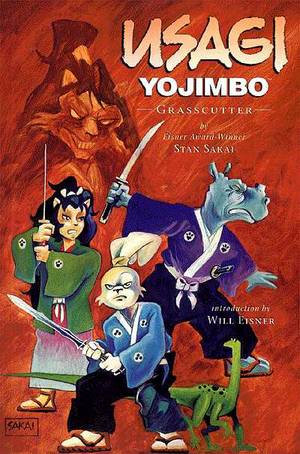
Usagi Yojimbo: Grasscutter
Usagi Yojimbo continues its trail of one rabbit samurai wandering the countryside as a ronin who keeps a circle of friends close while the world about him continues to come together in ways that are not always seen by the main character, but that the audience sees as ties that bind.
Below I'll be discussing some of the bits from Grasscutter, previewed here, the twelfth volume graphic novel collection of Usagi Yojimbo published by Dark Horse comics. Spoilers will follow so beware!
Mythology: Either Stan does a fantastic job of researching the history of Japan and presenting it to the reader or he does it in such a way that it's fun to read and doesn't negatively impact the story. In many cultures, there are magical weapons but too often the origin or founding point of these weapons are left to the readers imagination. There's nothing wrong with that. Was the infamous sword Blackrazor better before it gained excessive background or worse? Readers will be divided on that issue. Here, we are introduced to Grasscutter through both myth and historical events as to how it was lost to Usagi's Japan.
Nemesis: Ah, the dreaded tale of the nemesis. I've hit on this several times but well, here it hits again. Jei, the demonic warrior that Usagi has 'killed' several times prior to this returns in this novel. He showcases his powers against several entities that may have even been kin in their own way to him, but the path Jei walks is one that he walks unopposed. This can be an important thing to showcase with the villains in your setting.
In some setting such as the Forgotten Realms, there are so many high level villain and heroic organizations that it's often difficult to imagine the setting not resembling Gamma World more than a pseudo fantasy setting but those organizations dont' tend to ally with each other and even with 'good', may have their own ideas on how certain things, like artifacts and knowledge, should be shared, putting them at odds with one another. Have the party stumble upon a group of dead orcs and hobgoblins to showcase that just because they all hate the players, doesn't mean they love each other.
The Villain's Weakness: Most of the time when Jei and Usagi fight, Usagi doesn't do to well and generally is saved either by circumstance or luck. This volume is no different but it showcases a different side of Jei in that he leaves himselve open protecting 'his innocent'. This is essentially a follower of Jei who doesn't understand or care about what Jei is, only that he protected her at a dark period in her life and looks out for her. Usagi doesn't deliberately use her against him, but events conspire to put her in danger and Jei can choose to either end Usagi or save the 'innocent'. He saves the innocent.
Foreshadowing: Stan does this with a saint's patience. While probably not as noticeable in the individual issues that make up the series, the graphic novels allow the reader to see Stan setting up events so that they fall like domino's. Could you guess the events that will happen? Possibly. Do they make sense in the context of the story and keep the story moving forward?
Yes. In this instance, Inazuma, introduced only last volume, is hunted by Gen for the large bounty on her head. the two fight, Gen barely escapes with his life but ironically, due to an accident, it's Inazuma that's badly injured and passes out in front of Jei who at the bidding of his follower, leaves Inazuma, suffering from delusions and hallucinations, at a temple to heal. When Jei is 'killed', his spirit finds a new host in Inazuma, whose storyline will come back into play way down the line in volume 24.
Grasscutter: Grasscutter exhibits some interesting bits to it but doesn't shine through as something like Excalibur or Strombringer in terms of raw sword power. Rather, it's something that is a unique cultural artifact that could upset the political power of Japan and send the whole of it into further warfare. The thing is, Usagi is generally a 'good' individual and has no desire for political power. Don't put the gun in the room unless you're ready for the players to use it. I can easily envision a scenario where the players are supposed to pass an object to another individual but hey, when is this opportunity going to come along again? Always be ready for the players to take the path not offered and be ready for the consequences of it.
In my opinion, if you don't want to deal with the players potentially getting their hands on such an object and using it as players instead of as story element, it's better to not put it into the game rather than having some highly unlikely series of events conspire to steal the item from the players.
Below I'll be discussing some of the bits from Grasscutter, previewed here, the twelfth volume graphic novel collection of Usagi Yojimbo published by Dark Horse comics. Spoilers will follow so beware!
Mythology: Either Stan does a fantastic job of researching the history of Japan and presenting it to the reader or he does it in such a way that it's fun to read and doesn't negatively impact the story. In many cultures, there are magical weapons but too often the origin or founding point of these weapons are left to the readers imagination. There's nothing wrong with that. Was the infamous sword Blackrazor better before it gained excessive background or worse? Readers will be divided on that issue. Here, we are introduced to Grasscutter through both myth and historical events as to how it was lost to Usagi's Japan.
Nemesis: Ah, the dreaded tale of the nemesis. I've hit on this several times but well, here it hits again. Jei, the demonic warrior that Usagi has 'killed' several times prior to this returns in this novel. He showcases his powers against several entities that may have even been kin in their own way to him, but the path Jei walks is one that he walks unopposed. This can be an important thing to showcase with the villains in your setting.
In some setting such as the Forgotten Realms, there are so many high level villain and heroic organizations that it's often difficult to imagine the setting not resembling Gamma World more than a pseudo fantasy setting but those organizations dont' tend to ally with each other and even with 'good', may have their own ideas on how certain things, like artifacts and knowledge, should be shared, putting them at odds with one another. Have the party stumble upon a group of dead orcs and hobgoblins to showcase that just because they all hate the players, doesn't mean they love each other.
The Villain's Weakness: Most of the time when Jei and Usagi fight, Usagi doesn't do to well and generally is saved either by circumstance or luck. This volume is no different but it showcases a different side of Jei in that he leaves himselve open protecting 'his innocent'. This is essentially a follower of Jei who doesn't understand or care about what Jei is, only that he protected her at a dark period in her life and looks out for her. Usagi doesn't deliberately use her against him, but events conspire to put her in danger and Jei can choose to either end Usagi or save the 'innocent'. He saves the innocent.
Foreshadowing: Stan does this with a saint's patience. While probably not as noticeable in the individual issues that make up the series, the graphic novels allow the reader to see Stan setting up events so that they fall like domino's. Could you guess the events that will happen? Possibly. Do they make sense in the context of the story and keep the story moving forward?
Yes. In this instance, Inazuma, introduced only last volume, is hunted by Gen for the large bounty on her head. the two fight, Gen barely escapes with his life but ironically, due to an accident, it's Inazuma that's badly injured and passes out in front of Jei who at the bidding of his follower, leaves Inazuma, suffering from delusions and hallucinations, at a temple to heal. When Jei is 'killed', his spirit finds a new host in Inazuma, whose storyline will come back into play way down the line in volume 24.
Grasscutter: Grasscutter exhibits some interesting bits to it but doesn't shine through as something like Excalibur or Strombringer in terms of raw sword power. Rather, it's something that is a unique cultural artifact that could upset the political power of Japan and send the whole of it into further warfare. The thing is, Usagi is generally a 'good' individual and has no desire for political power. Don't put the gun in the room unless you're ready for the players to use it. I can easily envision a scenario where the players are supposed to pass an object to another individual but hey, when is this opportunity going to come along again? Always be ready for the players to take the path not offered and be ready for the consequences of it.
In my opinion, if you don't want to deal with the players potentially getting their hands on such an object and using it as players instead of as story element, it's better to not put it into the game rather than having some highly unlikely series of events conspire to steal the item from the players.
Labels:
Dark Horse,
Foreshadowing,
Mythology,
Nemesis,
Stan Sakai,
Usagi Yojimbo
Subscribe to:
Posts (Atom)