This seven series book, Crown of Stars, was one I've taken two pauses in. The first was because I only owned the first three books in science fiction book club edition. The second because I waited and purchased the second two books at Half Price and then finally used some of the old e-mail coupons to buy the last two at Borders.
While not a challenging tale in and of itself, it does illustrate that people have options. In a fantasy campaign, it's important to keep those options in mind when designing encounters not because you want to put a clamp on them, but because the more aware you are of what the characters can do and how your players think, the more likely you'll have results ready for anything they try to do. You don't do this to pin them down to a predetermined course, but rather, so that you can keep the game itself moving. When the game slows down because the game master wasn't prepared for something the players didn, everyone loses.
Anyway, onto some thoughts on Crown of Stars.
"I am puzzled," said Rosvita, "by what he meant by men with animal faces." (p.19)
Description without explanation is a mysterious thing. A large humanoid can be any number of things. In the case above, the men with animal faces are actually primitive elves who wear animal masks. Coming to the people third source however, it may craft images of a far different manner. Think about how the players learn about the campaign setting. If they're willing to play with the background details you've given them, while they won't experience that first rush of discovery at an orc as they may have once, it will prevent things from being same old same old.
"No one would ever know the whole, now that Anne was dead, and even Anne could not have comprehended everything because in many ways she had also been their pawn, their creation." (p.163)
Often I hear bitter complains about the evils of railroading.
Let me tell you something.
If you're doing a good job running things, the players not only won't know if and when they've been railroaded, they'll enjoy the story as it moves along like a thing of destiny. This isn't saying put up massive impenetrable forests if they move off the road or to have a quest spell laid on them to get a certain item but if the events require a certain way to do things, run it to the players fun as much as possible and they'll go with it, often not even knowing it was a rail road.
"Or she could stay in the Eagles, like Hathui, always and forever, because she loved being an Eagle even after all this, even after everything. Here she felt at home, standing watch in the middle of the wilderness with enemies all around and a few stout friends at her back, all in service to the regnant. Here she felt a measure of peace, perched on the wall with the damp air and the spattering of rain and the night wind breathing on her. Not knowing what the next day would bring and aching with the misery of wondering what has happened to the ones she loves." (p.184)
Why do the characters do what they do? Sometimes it could be easier to show them through an NPC. A ranger or other wilderness styled individual who still owes alliegance to those in power can be a showcase of how one can be rugged and on the outside, yet still serving a greater cause. The old post over here on Grongnardia offers some interesting thoughts on that.
"Laws are silent in the presence of arms, so it is said." (p.206)
In America, most of us are very fortunate in that we live in a world of laws that are not necessarily enforced by strength of arms. In most fantasy campaigns, that's not true. The further from civilization with its many layers of protection the characters are, the more likely they are to discover the value of the presence of arms.
Game Masters can work this contrast between safety and civilization and the wilds and danger. Using the times the players are in the city to highlight the various options they have to them ranging from different types of food, clothing, and even companionship and past times to what they have to make do with on the frontier and how a well forged sword may be worth someone's life.
Of course civilization, especially in a fantasy setting, doesn't necessarily only have to showcase how things stay together. But that's a topic for another post.
"Hugh had no power of his own except what he could wreak against others, a man armed wit ha sword who must stand on the field against disciplined ranks of archers and cavalry. This made him no less dangerous. A man with a sword can still kill anyone who comes within arm's reach. As long as Hugh could twist others to do his will, he could and would, harm his enemies and every innocent soul who got in his way." (p.235)
In a civilized land, it's all about who you know. After all, if you know the captain of the guard and he's one of the greatest warriors around, whose going to mess with you? The ability to confuse men and make them serve causes not necessarily their own has been showcased in many classic characters including one Gríma Wormtongue of Lord of the Rings fame.
"The ancient law?"
"Stil lheld to in Alba, I might add, and in much of Varre. The identity of a woman's children is always known, since they have sprung from her womb. That of a man's offspring-- well, no matter what anyone says, i nthe end it is always a matter of faith."
In dealing with the laws of succession in a kingdom, how does it fall? Does it fall to the eldest son? Does it fall to a woman who can prove her fertility and thus worth of carrying on the bloodline? Most fantasy settings assume the eldest male with young men going into church or other forms of service but don't be afraid to mix it up.
"We hear rumors of reavers with poisoned arrows harrying travelers along the roads leading east into Fesse." (p.267)
I've mentioned it before but always keep the rumor mill flying. Things should always be happening, even if the player's don't follow up on them. The larger the setting feels to the players, the larger it effectively is.
On the other hand, "reavers with poisoned arrows" is just a damn fine encounter. How dangerous is the poison? Where is the supply coming from? Can the supply be cut off? Is there a common cure? Is there a anti-toxin that adventurers can take before hand to minimize the threat? Foes who have methods of dealing great death and destruction always get a player's respect right out of the box and make them think more than mere numbers.
"Henry should have killed Sabella after the first revolt!" said Liutgard. "He was too lenient!"
"Wendish do not murder their kinfolk, not even to the pursuit of power," said Sanglant mildly. "We are not Salians, Liutgard. Thank God." (p.350)
I've mentioned it before, but trying to prevent a group of players from being men men reavers who kill all they encounter can be a difficult thing. Most fantasy engines are designed to reward the defeat of the enemy and keeping an enemy alive is often more problem than its worth.
But what about family? What about family that may be redeemed? What about family that's very close to the character, a direct relative as opposed to a distant one? Is it still loot the dungeon and let the deities know their own? Kinslayers can have a nasty reputation that could easily mar the reputation for the whole party if they are known associates of such an individual.
"Liutgard smiled tinly. "There is no traitor's gate, Cousin."
So named in the book as a crawling spaced where a small group of men could creep in to surprise the defenders of a castle. Sound like a job for adventurers or what?
"It was Hugh of Austra who murdered her, when she was sleeping and helpless, and for no better reason than that he wanted no apprentice of Meriam's to challenge his knowledge of the magical arts." (p. 379)
When looking for motivation for the bad guys, one simple thing may be that they like their toys so much they don't want anyone they don't directly control to have them. Liches and other ancient undead can horde power by killing those who may know their arts or similiar arts. Great warriors may hunt down those who know their style in order to maximize the effectiveness of their own murderous arts. Always look at what the players can do and think who doesn't want them to have that ability. In some instances, it may be a whole race. For example, what if the elves so regret teaching humans the magic arts that they send out highly trained assassins to kill all human mages?
"Ai, God," whispered Alain... "He is a good man. Can you not fly after him and bring him back?"
"Why should I?"
"Because Heribert loved him." (p.455)
A good villain may not be well rounded but it should have something to it that the players can understand and that the players can work against them. In the above instance, Sanglant is essentially unkillable by man or woman but this entity Alain speaks with is essentially a other planar entity that rips his soul out, leaving his body souless. The thing does this looking for Heribert, whom the entity loves above all others thinking Sanglant is hiding him. By appealing to the thing's love of Heribert and that motivation of doing what the one he loved would want down, Alain manages a victory without combat. In D&D and Burning Wheel, among other games, skill checks can be a great way of engaging this types of challenges without rolling for damage.
"Despite the trappings- the primitive standard, the gaudy lacework that gridled his hips and thighs, the jewels drilled into his teeth, and the bare chest painted in spirals and crosshatches- he was not what he seemed. He might appear savage, but far more dangerous current surged within." (p.477)
Appearance isn't everything. One easy way to shake things up is to pit the characters against an enemy who seems to be one type of thing but is actually far beyond those humble origins and in fact holds a far different role than the players may assume.
"it was the king of grunt made by a person who has just realized that, in fact, he will have to haul those damned logs all the way back up the hill and that there is no use complaining because the master is harsh." (p.484)
If you have a gaming group and they're always complaining about the way the game is going, it might be time to find a new gaming group. There is a massive difference between grumping in character because things aren't working the way you'd like and grumping that the game sucks, that the magic item ratio is too low, that the game master is against you, etc... Engage the characters when possible but don't waste your time as a game master on people who are only there to complain.
There are numerous other parts of a Crown of Stars I could quote, but instead I'll do a dreaded summary.
The Crown of Stars itself. This item is found late in the series, the old artifact of the old emperor. At the end, instead of using it as a symbol of old power, they return it to the original statue where the old king is buried and forge ahead on new paths of unity.
The ending. I'll admit, it didn't do it for me. It took a generational look at a character I just didn't care about. However, it also had a small "what happened to" section on a character I did care about and that part redeemed the ending. When ending a campaign, it might be better to do a fade out shot of the characters, especially if they're reached the upper tiers of the campaign, as opposed to having the players hear some wish washy NPC they never liked speak of the deeds of their children.
The length. Try to maintain a sense of the campaign for the long run. A series like Crown of Stars runs thousands of pages and can be a beast to devour all at once. Don't be afraid to take side journeys on that path as long as you return to the road.
Last but not least, make sure that you as the Game Master, are enjoying the road you are on. There is no point in making the group happy if you're misearable because sooner or latter that misery will make itself manifest!
Showing posts with label Kate Elliott. Show all posts
Showing posts with label Kate Elliott. Show all posts
Wednesday, November 4, 2009


Monday, September 28, 2009
The Gathering Storm by Kate Elliott... Part Two!
"You would even teach the common-born folk?" Bertha demanded. (p. 692)
In a pseudo middle ages fantasy role playing game, the assumptions about class and status, outside of the players, are fairly woven into the standards of those eras with a lot of equality spread around.
But what if the players want to push those boundaries? What if they want to make of the campaign something different?
As the old quote goes, "So be it young Jedi."
Let them change things around. Let them showcase new abilities and new methods. Let others come to them to learn. Let them have an active effect on the campaign.
Now in a campaign that has a definate start, middle, and end, that's pretty easy to do. Regardless of what happens, the campaign is going to have some type of ending and the players will be able to look back on that campaign and indicate where they made their mark. In an 'open' campaign that needs to have a certain level of... same old same old, like a television show, you should think long and hard about what the changes the players are trying to make to the campaign will mean.
It's not that the players methods or motivations are wrong, but if it's an open campaign that's going to continue to host characters for long periods of time, what will the long term ramifications be? It's one of the reasons why Marvel and DC, despite having characters smart enough to create interplantary and time travel, still use gas in their cars. The further you get away from the 'root' of the game, the further the 'connection' to the game gets.
On the other hand, it's always fun to take what the players are teaching others and use it against them. One of the best moments of the original Squadron Supreme limited series back in the 80's is when Nighthawk is explaining that the only reason the Utopia project of the Squadron is working, is because the Squaadron is so good. But this machine that they've set up is easily prone to abuse and those that come after the Squad may not be so pure of heart that they can be trusted with so much power.
"If the children hadn't explored here, none of the othersm ight ever have noticed." (p.735)
How are old ruins discovered by those in the 'modern' era? How do old horrors come to light? Often, one old staple is having the characters awaken something that man was not meant to know about. But there are other individuals in the setting whose intentions are far more innocent than the characters. In addition, if the Game Master uses a little elbow grease, he can turn the discovery of such ancient ruins into an adventure in and of itself as the players now have to go and find the children who haven't returned.
"The lapis lazuli ring Baldwin had slipped on his finger winked blue." (p.776)
In this instance, Ivar is about to be attacked by otherworldly elves. However, a ring given to him by a friend glows. The ring may or may not be magical, but the important thing is that the elves recognize it and allow him safe passage.
What are the signs and sigils of the world that people in power recognize? What tokens of friendship pass between kings and nobility? What wizard marks indicate that the bearer of such a mark is not to be triffled with.
When desinging adventurers, have players note elements of those they come across that could be taken as them having some sort of royal protection. Have them receive such gifts and call upon those lords who offered them such friendship in the first place.
"To go against OldMother was beyond him. He bowed his head, knowing he had lost Alain and the hounds. He had failed his brother." (p.876)
Here, Stronghand, a ruler among his people, was set a task, to find Alain, his blood brother. Yet now he has a new mission.
If the party is floundering, give them direction. If they don't know what to do, use a vision, a sign, a divine inspiration, an NPC, something to get them moving again.
And to challenge the party, don't be afraid to throw multiple elements at them at the same time. Throw quests at them that have a limited time frame open to them that are all vital and allow them the decesion of which quests they will follow. By doing so, you'll not only see the party in action, but you'll get a taste for what type of adventurers their more interested in.
There are more passages I could quote but in the end, the Gathering Storm is another huge novel with a huge cast that tries to cast realistic aspirations onto its many characters whil thorwing many hindrances in their way. Game Masters looking to move beyond the world of hack and slash and dungeon crawls should remember to keep the NPC list full and connected to the characters even as they continue to add things that the players enjoy to the game.
In a pseudo middle ages fantasy role playing game, the assumptions about class and status, outside of the players, are fairly woven into the standards of those eras with a lot of equality spread around.
But what if the players want to push those boundaries? What if they want to make of the campaign something different?
As the old quote goes, "So be it young Jedi."
Let them change things around. Let them showcase new abilities and new methods. Let others come to them to learn. Let them have an active effect on the campaign.
Now in a campaign that has a definate start, middle, and end, that's pretty easy to do. Regardless of what happens, the campaign is going to have some type of ending and the players will be able to look back on that campaign and indicate where they made their mark. In an 'open' campaign that needs to have a certain level of... same old same old, like a television show, you should think long and hard about what the changes the players are trying to make to the campaign will mean.
It's not that the players methods or motivations are wrong, but if it's an open campaign that's going to continue to host characters for long periods of time, what will the long term ramifications be? It's one of the reasons why Marvel and DC, despite having characters smart enough to create interplantary and time travel, still use gas in their cars. The further you get away from the 'root' of the game, the further the 'connection' to the game gets.
On the other hand, it's always fun to take what the players are teaching others and use it against them. One of the best moments of the original Squadron Supreme limited series back in the 80's is when Nighthawk is explaining that the only reason the Utopia project of the Squadron is working, is because the Squaadron is so good. But this machine that they've set up is easily prone to abuse and those that come after the Squad may not be so pure of heart that they can be trusted with so much power.
"If the children hadn't explored here, none of the othersm ight ever have noticed." (p.735)
How are old ruins discovered by those in the 'modern' era? How do old horrors come to light? Often, one old staple is having the characters awaken something that man was not meant to know about. But there are other individuals in the setting whose intentions are far more innocent than the characters. In addition, if the Game Master uses a little elbow grease, he can turn the discovery of such ancient ruins into an adventure in and of itself as the players now have to go and find the children who haven't returned.
"The lapis lazuli ring Baldwin had slipped on his finger winked blue." (p.776)
In this instance, Ivar is about to be attacked by otherworldly elves. However, a ring given to him by a friend glows. The ring may or may not be magical, but the important thing is that the elves recognize it and allow him safe passage.
What are the signs and sigils of the world that people in power recognize? What tokens of friendship pass between kings and nobility? What wizard marks indicate that the bearer of such a mark is not to be triffled with.
When desinging adventurers, have players note elements of those they come across that could be taken as them having some sort of royal protection. Have them receive such gifts and call upon those lords who offered them such friendship in the first place.
"To go against OldMother was beyond him. He bowed his head, knowing he had lost Alain and the hounds. He had failed his brother." (p.876)
Here, Stronghand, a ruler among his people, was set a task, to find Alain, his blood brother. Yet now he has a new mission.
If the party is floundering, give them direction. If they don't know what to do, use a vision, a sign, a divine inspiration, an NPC, something to get them moving again.
And to challenge the party, don't be afraid to throw multiple elements at them at the same time. Throw quests at them that have a limited time frame open to them that are all vital and allow them the decesion of which quests they will follow. By doing so, you'll not only see the party in action, but you'll get a taste for what type of adventurers their more interested in.
There are more passages I could quote but in the end, the Gathering Storm is another huge novel with a huge cast that tries to cast realistic aspirations onto its many characters whil thorwing many hindrances in their way. Game Masters looking to move beyond the world of hack and slash and dungeon crawls should remember to keep the NPC list full and connected to the characters even as they continue to add things that the players enjoy to the game.
Sunday, September 27, 2009
The Gathering Storm, Volume Five of Crown of Stars by Kate Elliott
While I didn't skip over volume four, I didn't take any notes outside of a general mental note that the cast is growing wider and vaster and that the numerous little details that Kate uses in her writing contribute to a sense of a gritty realism in the story.
I picked back up my notes for Volume Five and below are notes that may be good reminders for your own game. As always, beware of spoilers if you're interested in reading the material.
"Because there will be a price." (p.74 paperback).
One of the main characters is off on essentially, a player character type of quest. While the "NPC's" of the setting are involved in political schemes, Sanglant is off trying to save the world from the doings of evil spellcasters. One of his plans involves griffin feathers which are of use against magic, but he's also interested in allying himself with others who have mastery of magic.
When the plarers are looking for something, be it a magic item, an ally, or information, what is the cost that they will have to pay for it? Is it in time thanks to travelling? Is it in coin thanks to barter and merchant services? Is it doing something for someone else to get what they want in the first place? Try to insure that things aren't as simple as walking into a 7-11 and that the characters have to earn what they're trying to get.
"Too many travellers came into a port like Sordaia for three scruffy visitors to create lasting wonder." (p.114)
When dealing with samll land locked villages and low population density hamlets, any visitor is a visitor worthy of making note. Any news they bring is news worth hearing. In a massive walled port city that has hundreds if not thousands or tens of thousands of visitors by the day, they may not exactly be the grand news anymore.
If the players have struck out on their luck and crossed one too many locals at the small towns they visit, it might be time to lose oneself in the big city.
Game Masters can use a port city to introduce a wide variety of things. This can range from missions for the players to go on ranging from the mundane of guarding spices, to the more exotic of locating new lands. Of course there's also the benefit of shaking things up. If the current campaign isn't moving along and things are locked up in the campaign, shake them up by having the characters become enslaved and win their freedom out at sea where they'll now be forced into a new direction even though they're free.
Even in cities that in and of themselves don't tolerate slavery, slavers may merely be waiting for the unweary to fall into their hands. In Waterdeep for example, there is a whole city underneath the main city that deals in all manner of goods. In a fantasy campaign, the limits as to where a 'dark mirror' of the city are limitless. This can range from bad parts of a city, such as dock wards or slums, to a negative image of the city on another plane or an underdark counter part to the city as in Waterdeep.
"His armyr rushed heedlessly past the bodies, although some of the dogs stopped to feed on the corpses and had to be driven forward through the open gate." (p.168)
Okay, I know I'm not the only Game Master whose guilty of this, but I have on many occassions had mosnters not act in a manner appropriate to their intelligence. Too often creatures with beastily intelligence don't actually behave the way they're supposed to. In part I do it to keep the game challenging and in part so that players, especially the defenders, feel that their abilities are coming into play.
However, when it makes sense for the animal to act a certain way, don't begrudge players attacks of opportunity caused by marking the enemy or when the enemy tries to make a full get away. Sometimes they'll miss and it'll lead to other interesting opportunities.
"When Biscop Constance raised me to the abbacy of Herford Monastery, she strickly enjoined me to see that travellers were well cared for." (p.218)
All too often, clerics in a fantasy game are used as band aids to quickly heal a near dead party back to full strength to continue their dungeon looting.
But what else does the church do? Does the church have any political standing in the setting? Is the church known for it's kindness? Does the church take in orphans? Does it send doctors out to fight the plague? Does it take in the homeless? By mapping out what role the church plays in the campaign setting, the game master is providing the setting with more detail than merely having the church be another arm of the government to pull up templars and other religious knightly orders. The Game Master should ask himself, "What does the church do when the players don't see it. What happens behind the gates when the clerics aren't fighting. What does it mean to the campaign overall and in details to this particular church."
"The bench rocked back. The ground jerked so hard that she slammed into Margret. She fell forward, banging her knee on the bench in front of her." (p.265)
Player characters tend to focus on one thing in the game and that thing is their enemy. But what if they're in the midsts of something that isn't necessarily a physical foe like say an earthquake, flood, plague, or fire?
In 4e, the use of Skill Challenges can be used to determine how players stay safe in such a harmful environment. The players can describe what skills they're using to safeguard themselves and the Game Master can explain what happens if they meet an appropriate level DC. For those who don't necessarily enjoy the default skill use, over on good old RPG.net,
damilir has posted some of his ideas on using Mouse Guard, a Burning Wheel variant, as a substitute for standard skill challenges.
"Do not fear. The creatures that abide in the earth have done no harm to us. I wish I could say the same of our human brethren." (p.304)
For me, 1st and 2nd edition D&D were an interesting mix of having seperate rules for NPCs where the NPCs could pretty much do what you want, stated up as monsters, or follow player rules and even have specific classes, often more powerful than the core classes. Other games like Mutants and Masterminds or Hero went a rotue that 3e tended to emulate that an NPC was essentially a PC.
4e returns the NPCs to either monster or character status, whatever the GM is looking for. In that, it allows humans to be done up relatively quickily and can make humans a viable threat for characters of any level again.
In making humans, or demi-humans, the enemy, the Game Master should have some sound reasons why those who are of the same race as the players would wish them ill. This could be as simple as the 'bad guys' worshipping a dark god, such as Vecna or Asmodeus, or being Unaligned and the players being in the wrong place at the wrong time.
"Who will notice if a handful of isolated nuns vanish?" (p. 326)
I bring this one up for a point. In a fantasy game, dozens if not hundreds if not thousands of small sects and cabals can exist for no other reason than for the players to meet them, learn at their hand, and then disappear. It's cliche but it's a well used one. It's something that heroes often encounter ranging from Elric meeting the Ship that Sales the Planes to this passage where a small cabal of nuns is in danger of being exterminated with extreme prejudice. As long as things make sense to the players and it fits into the context of the world that the players will see, everything should work out fine.
"What does his lineage and mine and yours matter then? Isn't it true that in the Chamber of Light before God, we all stand as equals?" (p.547)
In many ways, this is a player truism. Players, at least my players, are often reluctant to embrace what it would really mean to be in a more realistic dark age setting where nobles would have a much stronger rule over the people than players are prone to accept. Still, the old saying is something like, "It rains on king and commoner alike" and players, who often follow the whims of Fortunes Wheel, are often at the certain of important happenings merely because they are the players.
Even if none of the players have any relation to nobility, even if the Game Master isn't using churches or other social structures to give divine characters a reference to hang a framework on, the Game Master must remember that without the players, there is no story. All that rich background and effort goes to the wayside if the players aren't put front and center of the story.
On the other hand, there is a saying about giving the players enough rope to hang themselves with. If they engage in the odd bits of role playing here and there, don't be afraid to take those threads and run with them. You might just surprise the characters with what effects their actions have on them latter on down the road.
Providing variety in the scenery while making that scenery more than backdrop for the players to loot dungeons in, can provide the Game Master and players with a deeper connection to the campaign.
I picked back up my notes for Volume Five and below are notes that may be good reminders for your own game. As always, beware of spoilers if you're interested in reading the material.
"Because there will be a price." (p.74 paperback).
One of the main characters is off on essentially, a player character type of quest. While the "NPC's" of the setting are involved in political schemes, Sanglant is off trying to save the world from the doings of evil spellcasters. One of his plans involves griffin feathers which are of use against magic, but he's also interested in allying himself with others who have mastery of magic.
When the plarers are looking for something, be it a magic item, an ally, or information, what is the cost that they will have to pay for it? Is it in time thanks to travelling? Is it in coin thanks to barter and merchant services? Is it doing something for someone else to get what they want in the first place? Try to insure that things aren't as simple as walking into a 7-11 and that the characters have to earn what they're trying to get.
"Too many travellers came into a port like Sordaia for three scruffy visitors to create lasting wonder." (p.114)
When dealing with samll land locked villages and low population density hamlets, any visitor is a visitor worthy of making note. Any news they bring is news worth hearing. In a massive walled port city that has hundreds if not thousands or tens of thousands of visitors by the day, they may not exactly be the grand news anymore.
If the players have struck out on their luck and crossed one too many locals at the small towns they visit, it might be time to lose oneself in the big city.
Game Masters can use a port city to introduce a wide variety of things. This can range from missions for the players to go on ranging from the mundane of guarding spices, to the more exotic of locating new lands. Of course there's also the benefit of shaking things up. If the current campaign isn't moving along and things are locked up in the campaign, shake them up by having the characters become enslaved and win their freedom out at sea where they'll now be forced into a new direction even though they're free.
Even in cities that in and of themselves don't tolerate slavery, slavers may merely be waiting for the unweary to fall into their hands. In Waterdeep for example, there is a whole city underneath the main city that deals in all manner of goods. In a fantasy campaign, the limits as to where a 'dark mirror' of the city are limitless. This can range from bad parts of a city, such as dock wards or slums, to a negative image of the city on another plane or an underdark counter part to the city as in Waterdeep.
"His armyr rushed heedlessly past the bodies, although some of the dogs stopped to feed on the corpses and had to be driven forward through the open gate." (p.168)
Okay, I know I'm not the only Game Master whose guilty of this, but I have on many occassions had mosnters not act in a manner appropriate to their intelligence. Too often creatures with beastily intelligence don't actually behave the way they're supposed to. In part I do it to keep the game challenging and in part so that players, especially the defenders, feel that their abilities are coming into play.
However, when it makes sense for the animal to act a certain way, don't begrudge players attacks of opportunity caused by marking the enemy or when the enemy tries to make a full get away. Sometimes they'll miss and it'll lead to other interesting opportunities.
"When Biscop Constance raised me to the abbacy of Herford Monastery, she strickly enjoined me to see that travellers were well cared for." (p.218)
All too often, clerics in a fantasy game are used as band aids to quickly heal a near dead party back to full strength to continue their dungeon looting.
But what else does the church do? Does the church have any political standing in the setting? Is the church known for it's kindness? Does the church take in orphans? Does it send doctors out to fight the plague? Does it take in the homeless? By mapping out what role the church plays in the campaign setting, the game master is providing the setting with more detail than merely having the church be another arm of the government to pull up templars and other religious knightly orders. The Game Master should ask himself, "What does the church do when the players don't see it. What happens behind the gates when the clerics aren't fighting. What does it mean to the campaign overall and in details to this particular church."
"The bench rocked back. The ground jerked so hard that she slammed into Margret. She fell forward, banging her knee on the bench in front of her." (p.265)
Player characters tend to focus on one thing in the game and that thing is their enemy. But what if they're in the midsts of something that isn't necessarily a physical foe like say an earthquake, flood, plague, or fire?
In 4e, the use of Skill Challenges can be used to determine how players stay safe in such a harmful environment. The players can describe what skills they're using to safeguard themselves and the Game Master can explain what happens if they meet an appropriate level DC. For those who don't necessarily enjoy the default skill use, over on good old RPG.net,
damilir has posted some of his ideas on using Mouse Guard, a Burning Wheel variant, as a substitute for standard skill challenges.
"Do not fear. The creatures that abide in the earth have done no harm to us. I wish I could say the same of our human brethren." (p.304)
For me, 1st and 2nd edition D&D were an interesting mix of having seperate rules for NPCs where the NPCs could pretty much do what you want, stated up as monsters, or follow player rules and even have specific classes, often more powerful than the core classes. Other games like Mutants and Masterminds or Hero went a rotue that 3e tended to emulate that an NPC was essentially a PC.
4e returns the NPCs to either monster or character status, whatever the GM is looking for. In that, it allows humans to be done up relatively quickily and can make humans a viable threat for characters of any level again.
In making humans, or demi-humans, the enemy, the Game Master should have some sound reasons why those who are of the same race as the players would wish them ill. This could be as simple as the 'bad guys' worshipping a dark god, such as Vecna or Asmodeus, or being Unaligned and the players being in the wrong place at the wrong time.
"Who will notice if a handful of isolated nuns vanish?" (p. 326)
I bring this one up for a point. In a fantasy game, dozens if not hundreds if not thousands of small sects and cabals can exist for no other reason than for the players to meet them, learn at their hand, and then disappear. It's cliche but it's a well used one. It's something that heroes often encounter ranging from Elric meeting the Ship that Sales the Planes to this passage where a small cabal of nuns is in danger of being exterminated with extreme prejudice. As long as things make sense to the players and it fits into the context of the world that the players will see, everything should work out fine.
"What does his lineage and mine and yours matter then? Isn't it true that in the Chamber of Light before God, we all stand as equals?" (p.547)
In many ways, this is a player truism. Players, at least my players, are often reluctant to embrace what it would really mean to be in a more realistic dark age setting where nobles would have a much stronger rule over the people than players are prone to accept. Still, the old saying is something like, "It rains on king and commoner alike" and players, who often follow the whims of Fortunes Wheel, are often at the certain of important happenings merely because they are the players.
Even if none of the players have any relation to nobility, even if the Game Master isn't using churches or other social structures to give divine characters a reference to hang a framework on, the Game Master must remember that without the players, there is no story. All that rich background and effort goes to the wayside if the players aren't put front and center of the story.
On the other hand, there is a saying about giving the players enough rope to hang themselves with. If they engage in the odd bits of role playing here and there, don't be afraid to take those threads and run with them. You might just surprise the characters with what effects their actions have on them latter on down the road.
Providing variety in the scenery while making that scenery more than backdrop for the players to loot dungeons in, can provide the Game Master and players with a deeper connection to the campaign.
Saturday, September 12, 2009
The Burning Stone by Kate Elliott

The Burning Stone continues the epic Crown of Stars by expanding an already large cast and using a larger net to continue to link events to one another. Below I’ll be discussing some of the various happenings in the book which could be considered spoilers for those who haven’t read it. If you’re interested in reading and wish no spoilers, do not read further.
“IN any village, a stranger attracts note and distrust. But Eagles weren’t strangers, precisely…” (p. 16)
When characters are moving from town to town, as often happens in lower level fantasy games, the people of the town will not only want news of the outside world from these characters, but will be notable to those in the town. They will come under a great deal of scrutiny. Depending on the nature of the town, guards may want them to bind their weapons, if they allow them to keep their weapons at all.
In this way, most fantasy games give the players a ton of options that may not have actually existed. In essence, if they’re not nobles, the adventurers are essentially riff raff. But much like the Eagles, special messengers for the king, they’re not normal armed bandits. Rather, in a setting where adventurers are a known quantity, they might be very welcome to any town they come to once their mettle is known.
Let the players know that they are under observation. Let the people ask questions of the players such as who do they serve? What deities do they worship? Do they have any weapons of a unique nature or design that would mark them as servants of an enemy empire? Do they speak any languages that would mark them as outcasts?
“Margrave Judith’s procession came into view on the road. Her banner, a panther leaping upon an antelope, flew beside a banner marked with the Arconian guivre set between three springing roes, two above and one below, the sigil of the old royal house of Varre.” (p. 69)
Sometimes when reading, I’ll come across a word I’m vaguely familiar with. In this case, Margrave. The last time I remembered actually seeing it in fiction, was probably in a Moorcock book in the Corum line. Heading over to the old Wikki, I was impressed by the amount of information this title has. In many ways, players who are going to be made into royalty, or into part of the royal estates, would fit the concept of a margrave perfectly.
“IN any village, a stranger attracts note and distrust. But Eagles weren’t strangers, precisely…” (p. 16)
When characters are moving from town to town, as often happens in lower level fantasy games, the people of the town will not only want news of the outside world from these characters, but will be notable to those in the town. They will come under a great deal of scrutiny. Depending on the nature of the town, guards may want them to bind their weapons, if they allow them to keep their weapons at all.
In this way, most fantasy games give the players a ton of options that may not have actually existed. In essence, if they’re not nobles, the adventurers are essentially riff raff. But much like the Eagles, special messengers for the king, they’re not normal armed bandits. Rather, in a setting where adventurers are a known quantity, they might be very welcome to any town they come to once their mettle is known.
Let the players know that they are under observation. Let the people ask questions of the players such as who do they serve? What deities do they worship? Do they have any weapons of a unique nature or design that would mark them as servants of an enemy empire? Do they speak any languages that would mark them as outcasts?
“Margrave Judith’s procession came into view on the road. Her banner, a panther leaping upon an antelope, flew beside a banner marked with the Arconian guivre set between three springing roes, two above and one below, the sigil of the old royal house of Varre.” (p. 69)
Sometimes when reading, I’ll come across a word I’m vaguely familiar with. In this case, Margrave. The last time I remembered actually seeing it in fiction, was probably in a Moorcock book in the Corum line. Heading over to the old Wikki, I was impressed by the amount of information this title has. In many ways, players who are going to be made into royalty, or into part of the royal estates, would fit the concept of a margrave perfectly.
Even the lowliest lady with her small estate and dozen servants must contend against bandits and the depredations of her ambitious neighbors.” (p.119).
It just goes to show, no matter what your status, there will always be those out to take what you have for your own. In a points of light setting, the range of things that would want to destroy you just to make a meal of you if far higher than your typical pseudo middle ages fiction.
In addition to bandits, you have monsters. In addition to monsters, you still have all the problems of people wanting what’s yours. In fantasy campaigns though, that’s generally not only about your land and your titles, but rather, your individual possessions because most fantasy characters will have items of some power. Items that will grow in potency as the players do. Characters also tend to have first hand knowledge of different magics than most people due to their travelling.
When having the characters interact with patrons, insure that the patrons also speak of their own problems that are being handle in the mundane fashion and don’t need the players help with. The patrons must be more than simple quest givers for the players to have a way to interact with them outside of ‘clicking’ the yes/no option.
“It was hard going. Roots had torn up portions of the old pavement; water and ice had shattered others. Liath stayed on her horse and didn’t complain. Eventually the woodland opened out and beyond a river they saw a thread of smoke marking a village. The old bridge had fallen to pieces, planks lost or gaping. Sanglant scouted the shore but could find no boat, and in the end he volunteered to lead the horses and mules across one by one. In some places he had to shove planks together. In others, he simply laid his shield down over the gaps so they could get across. In this way they made it to the other side. Of the servants he saw no sign, but one of them blew in his ear teasingly.”
Sanglant and Liath are at this point part of a royal kingdom. This kingdom though, is not as grand or powerful as the old one. When trying to create a ‘points of light’ feel for your campaign, even if the players are going from kingdom to kingdom, little things that the players see and experience first hand along the road can quickly give the players an idea of what the overall setting can be like.
Bridges and roads in dire need to repair alongside forests that are no longer taken care of alongside wide spread bandit attacks and a lack of food and goods to serve all of the kingdom speak much higher than telling the players that it’s a long way between cities.
“You have served God and this throne faithfully, Alain. I offer you this choice, that you walk away from Lavas Holding now and never return to any lands under its watch on pain of death, or that you accept a position in my Lions, fitting to your birth, and serve me.”
That fast, he had tumbled down Fortune’s wheel. It was simply too stunning to grasp.” (p.580)
Alain’s rise and fall is based on the court. In a role playing game, where characters tend to carry their power with them, the Game Master must dance delicately if he is going to strip them of their power. This is more true in a level based game than in a point based one. The difference in point based games is generally lower until the players have achieved a lot of experience. In a level based game, a 5th level character and 10th level character are often like different animals completely.
The major things a character tends to hold include personal wealth, magic items, and power. If the game master doesn’t want to tinker with those things, and those things are dear indeed to most players, then the game master needs to weave a world about the characters that the players like and whose loss will strike them like taking away wealth, magic items or power.
On the other hand, if you’re a bastard GM, having the characters encounter a horde of undead rust monsters with some type of wrath template put onto them will do the trip in a heart beat.
“It was shaped something like an eagle with a tufted eagel’s head and a noble beak, but it wanifestly no eagle. They couldn’t grow so large, and eagles didn’t have gold feathers, as if they’d been gilded by flying too close to the sun. It was magnificent, with tail feathers that seemed to blaze and eyes that even from this distance sparked and glimmered like starlight. It was the most beautiful thing he had ever seen in his life.” (p. 585).
When describing monsters to the players, try to insure that the sense of wonder you had when you first encountered a strange monster is there. Try to insure that each meeting with a new creature is not simply one of charge and attack. If you can give the players pause with your description, then you’re doing your job as a Game Master.
Sunday, September 6, 2009
Prince of Dogs Final
When reading an epic length book like Prince of Dogs, there are probably dozens of ideas that you can grab ranging from names and organizations, to mannerisms for your Non-Player Characters.
My finishing off of the book leaves me with the following.
"Lady's Blood!" swore Leo. "Fire!" (p. 326 SFBC edition.)
It's easy to get caught up in the fantastic of a campaign setting. However, the mundane should always be ready to be pulled out when needed. Fire is a terrible threat to a city with no easy means of water or manpower to utilize it. When looking at your cities, think of which parts are made of stone and which of wood. Are parts of buildings, like old forts, made of both? If a fire were started, how would it spread? How would it be fought? Are there people enough to have a professional force of fire fighters? Are there spells or rituals that can be called into in order to combat a fire?
Fire in and of itself is powerful, but the results of the fire can be even more so. Nobles and peasant alike may lose their land and all their possessions. Who steps in to remove the burnt down husks? Are any old family secrets brought to the light when the basements are laid bare? Use the fire as an event that can be a springboard for other adventurers in the campaign.
"No, my lord. Duke Conrad closed the pass." (p. 337).
Fantasy campaigns, especially at lower levels, tend not to have the quick benefits of using instant transportation. Unlike modern settings, characters can't just get in a car and cover vast distances quickly.
While 4th edition tries to showcase some of this hardships with the concept build into the 'core' setting of points of light, the Game Master can easily increase the time needed to get from one place to another through a few simple methods. In this case, an Eagle, a king's messanger, is initially cut off from the pass by natural disaster and then latter, through efforts of royalty not aimed at halting the King direclty, but at handling a rival and indirectly coming into conflict with the Duke.
Being put in a situation where the characters have to go out of their way, and out of their way several times, gives the Game Master time to do several things. First, it showcases that things don't always go the way of the players. Second, it allows the GM to throw in some more random encounters. These can range from random assaults by various fiends always lurking in the background, to chance encounters with Non-Player Characters that have access to something that the players may need. This can also act as foreshadowing if the NPC is befriended and can be of use again latter.
"This food is scarcely fit payment for such tales as you have told us this night." (p. 365)
To further point out the differences in how things work in the here and now with the there and then, the Game Master should try to remember that events happening in one part of the world, even if not very far, may be unknown to another part. Normal citizens with little cause to travel may not know if the king is dead or alive, if a heir has come of age or even if there are more dire situations around the bend.
Without access to virtual instant communication such as we have today, many people in the psuedo historical fantasy settings remain woefully ignorant of the events of the world. The players, due to their travels, generally have a head start on others when it comes to the lay of the land. Remark on how common folk stand in awe of the player's experiences. Have bards try to woe them in exchange for tales of their doings. Have nobles invite them for dinner in order to learn what events have transpired recently. Remember that knowledge is power and that most people in such a setting would fear to venture beyond their own homes.
"No ambition for myself. For my son." (p. 558)
In terms of doing good deeds or of doing deeds for various patrons, the players should be aware that not all that is done is done for the here and now. In this case, Lavastine has taken a city under hostile control not only for the glory of doing so, not only to secure for his son a well made marriage, but because by doing so, in the future those lands may pass through his son's inheritance. These are potentially long term plans.
In these events, if the campaign is mainly about stomping dragons, it could be difficult to place something with a long term pay off into the campaign. Most foes that the players meet will quickly fall to blades and most plans contain no more depth then onto the next dungeon.
To foster some type of longer term plans in such a campaign, the Game Master should let some clue of what's to come further down the road into the player's hands. By doing so, the Game Master gives the players the opportunity to properly arm themselves. For example, if the Game Master knowns that undead will be in an upcoming crypt, clues of the undead's presence should be felt. If creatures with a specific vulnerability to silver are to be featured, the players should have time to arm themselves with such.
"You know what they call you now, some of them, don't you? The prince of dogs." (p. 576)
Names have power. Names grant recognition. If the players don't take a name for themselves, don't hesitate to give them one. This can come from numerous things ranging from the way they dress, arm themselves, the foes they've fought or the items they've used. In some cases it may be seen as complimentary and in others, an insult. For those who don't take the time to name themselves, take that power away and name them as you would.
Prince of Dogs finishes off with more potential story lines and a lot of character driven events that proper it onto the next book. If the Game Master can draw out the characters of his own campaign and interact them with the players to propel them onto the next adventure, then the Game Master is continuing to do his job.
My finishing off of the book leaves me with the following.
"Lady's Blood!" swore Leo. "Fire!" (p. 326 SFBC edition.)
It's easy to get caught up in the fantastic of a campaign setting. However, the mundane should always be ready to be pulled out when needed. Fire is a terrible threat to a city with no easy means of water or manpower to utilize it. When looking at your cities, think of which parts are made of stone and which of wood. Are parts of buildings, like old forts, made of both? If a fire were started, how would it spread? How would it be fought? Are there people enough to have a professional force of fire fighters? Are there spells or rituals that can be called into in order to combat a fire?
Fire in and of itself is powerful, but the results of the fire can be even more so. Nobles and peasant alike may lose their land and all their possessions. Who steps in to remove the burnt down husks? Are any old family secrets brought to the light when the basements are laid bare? Use the fire as an event that can be a springboard for other adventurers in the campaign.
"No, my lord. Duke Conrad closed the pass." (p. 337).
Fantasy campaigns, especially at lower levels, tend not to have the quick benefits of using instant transportation. Unlike modern settings, characters can't just get in a car and cover vast distances quickly.
While 4th edition tries to showcase some of this hardships with the concept build into the 'core' setting of points of light, the Game Master can easily increase the time needed to get from one place to another through a few simple methods. In this case, an Eagle, a king's messanger, is initially cut off from the pass by natural disaster and then latter, through efforts of royalty not aimed at halting the King direclty, but at handling a rival and indirectly coming into conflict with the Duke.
Being put in a situation where the characters have to go out of their way, and out of their way several times, gives the Game Master time to do several things. First, it showcases that things don't always go the way of the players. Second, it allows the GM to throw in some more random encounters. These can range from random assaults by various fiends always lurking in the background, to chance encounters with Non-Player Characters that have access to something that the players may need. This can also act as foreshadowing if the NPC is befriended and can be of use again latter.
"This food is scarcely fit payment for such tales as you have told us this night." (p. 365)
To further point out the differences in how things work in the here and now with the there and then, the Game Master should try to remember that events happening in one part of the world, even if not very far, may be unknown to another part. Normal citizens with little cause to travel may not know if the king is dead or alive, if a heir has come of age or even if there are more dire situations around the bend.
Without access to virtual instant communication such as we have today, many people in the psuedo historical fantasy settings remain woefully ignorant of the events of the world. The players, due to their travels, generally have a head start on others when it comes to the lay of the land. Remark on how common folk stand in awe of the player's experiences. Have bards try to woe them in exchange for tales of their doings. Have nobles invite them for dinner in order to learn what events have transpired recently. Remember that knowledge is power and that most people in such a setting would fear to venture beyond their own homes.
"No ambition for myself. For my son." (p. 558)
In terms of doing good deeds or of doing deeds for various patrons, the players should be aware that not all that is done is done for the here and now. In this case, Lavastine has taken a city under hostile control not only for the glory of doing so, not only to secure for his son a well made marriage, but because by doing so, in the future those lands may pass through his son's inheritance. These are potentially long term plans.
In these events, if the campaign is mainly about stomping dragons, it could be difficult to place something with a long term pay off into the campaign. Most foes that the players meet will quickly fall to blades and most plans contain no more depth then onto the next dungeon.
To foster some type of longer term plans in such a campaign, the Game Master should let some clue of what's to come further down the road into the player's hands. By doing so, the Game Master gives the players the opportunity to properly arm themselves. For example, if the Game Master knowns that undead will be in an upcoming crypt, clues of the undead's presence should be felt. If creatures with a specific vulnerability to silver are to be featured, the players should have time to arm themselves with such.
"You know what they call you now, some of them, don't you? The prince of dogs." (p. 576)
Names have power. Names grant recognition. If the players don't take a name for themselves, don't hesitate to give them one. This can come from numerous things ranging from the way they dress, arm themselves, the foes they've fought or the items they've used. In some cases it may be seen as complimentary and in others, an insult. For those who don't take the time to name themselves, take that power away and name them as you would.
Prince of Dogs finishes off with more potential story lines and a lot of character driven events that proper it onto the next book. If the Game Master can draw out the characters of his own campaign and interact them with the players to propel them onto the next adventure, then the Game Master is continuing to do his job.
Friday, September 4, 2009
King's Dragon Part Two!
Had some free time and managed to finish off this mammoth tome.
"And lastly," Wolfhere said, "no man or woman is given the Eagle's badge until she has seen a comrade die. Death is ever at hand. We do not truly become Eagles until we accept and understand that we are willing to pay that price for our service and our king." (p. 260 SFBC edition).
In most campaigns, the players will have numerous options when it comes to organizations to join. One of the quick hits in the Forgotten Realms would be the Harpers. In many such settings, guilds have a tremendous amount of power.
If the players are part of a guild, or members of multiple guilds, what is expected of them? What do they have to do in order to 'earn their wings'? What do they have to bring to the guild to make it accept them? If a wizard is always out adventuring with his fellow sellswords, what does the mage guild expect of him in turn?
It's not that you want to make these memberships in and of themselves a burden, but rather, a springboard. If the players are always out and about, then the guilds the players are members of would not only recognize this, but use it to send them out for various guild business. It's essentially free labor for them and plot points for the campaign. Are there certain monsters you want to use? The warrior's guild informs the fighters and rangers that their time away from the guild must be earned back with varlous battle against these invaders. The mages guild informs the wizard that certain bits of these creatures can be used as components in a ritual. The divine elements dream of their deity demanding the death of these offending monsters.
"This is certainly grave news, but what am I to tell the people of Gent? Given enough time, the Eika amry outside will burn and batter down Gent's bridges, and when they have done that, they will have free passage up the Vester whether we will it or no." (p. 274 SFBC)
The Game Master should make efforts to show why the players are needed. In some campaigns like the Forgotten Realms, one of the 'strikes' against it is that it is filled with NPC's who should be able to solve all of the problems. But well, so is reality. America for example, truly has enough wealth to offer health care to everyone, but it's not necessarily in the interest in all of the powers that be to spread that around.
The 'good' NPC's of a setting have their own problems to deal with and even when what the players are involved in is campaign shattering, it's up to the players to pull themselves up by the bootstraps and be the heroes of the campaign setting.
"The soft ones are not true people, of course, but they are a kind of people. People can talk. It is the lesson the WiseMothers teach. It is what they whispered to him when he was a half-grown pup and dared venture up the mountainside to the sacred palce tended by the SwiftDaughters to see whether the WiseMothers would speak to him or else kill him for his presumption.
"The knife and the tongue are equally strong weapons."
One of the interesting things about 4th edition is that it somewhat eliminated the wide range of alignments that Dungeons and Dragons has relied on to guide so much of its behavior. Players and NPCs may have motivations that aren't necessarily so crystal clear that every orc child must be battered against a rock.
If the players are able to make a real influence against their enemies, either by sparing them, communicating with them, or showing them a better way, if the Game Master can incorporate that into his campaign instead of just shrugging his shoulders and having the monsters continue to attack brainlessly, the players will see that their actions have a direct influence on the growth of the campaign.
"So do some of us work today to ban inheritance through the male line." (p. 453 SFBC).
When looking at parts of the campaign world, how are things determined in a time of inheritance? The old joke is the son of my daughter is my grandson and the son of my son may be my grandson as one never knows. Of course with modern technology and all that comes with it, and possibly with rituals and magical aid to dtermine in a fantasy campaign the same could be said, but it does bring into question rights of inheritance, differences in culture, and things that players may not be used to in a standard psuedo historical setting.
King's Dragon boasts a wide cast and uses a huge array of characters to tell merely a part of a story despite being over five hundred pages. If the Game Master can take some of the ideas for setting that don't necessarily happen in his game now, ranging from humanoid invaders that are harsh because they come from a harsh land and climate, to patrons that can't always protect their wards, then King's Dragon can act as your own book in your own Appendix N reading list.
"And lastly," Wolfhere said, "no man or woman is given the Eagle's badge until she has seen a comrade die. Death is ever at hand. We do not truly become Eagles until we accept and understand that we are willing to pay that price for our service and our king." (p. 260 SFBC edition).
In most campaigns, the players will have numerous options when it comes to organizations to join. One of the quick hits in the Forgotten Realms would be the Harpers. In many such settings, guilds have a tremendous amount of power.
If the players are part of a guild, or members of multiple guilds, what is expected of them? What do they have to do in order to 'earn their wings'? What do they have to bring to the guild to make it accept them? If a wizard is always out adventuring with his fellow sellswords, what does the mage guild expect of him in turn?
It's not that you want to make these memberships in and of themselves a burden, but rather, a springboard. If the players are always out and about, then the guilds the players are members of would not only recognize this, but use it to send them out for various guild business. It's essentially free labor for them and plot points for the campaign. Are there certain monsters you want to use? The warrior's guild informs the fighters and rangers that their time away from the guild must be earned back with varlous battle against these invaders. The mages guild informs the wizard that certain bits of these creatures can be used as components in a ritual. The divine elements dream of their deity demanding the death of these offending monsters.
"This is certainly grave news, but what am I to tell the people of Gent? Given enough time, the Eika amry outside will burn and batter down Gent's bridges, and when they have done that, they will have free passage up the Vester whether we will it or no." (p. 274 SFBC)
The Game Master should make efforts to show why the players are needed. In some campaigns like the Forgotten Realms, one of the 'strikes' against it is that it is filled with NPC's who should be able to solve all of the problems. But well, so is reality. America for example, truly has enough wealth to offer health care to everyone, but it's not necessarily in the interest in all of the powers that be to spread that around.
The 'good' NPC's of a setting have their own problems to deal with and even when what the players are involved in is campaign shattering, it's up to the players to pull themselves up by the bootstraps and be the heroes of the campaign setting.
"The soft ones are not true people, of course, but they are a kind of people. People can talk. It is the lesson the WiseMothers teach. It is what they whispered to him when he was a half-grown pup and dared venture up the mountainside to the sacred palce tended by the SwiftDaughters to see whether the WiseMothers would speak to him or else kill him for his presumption.
"The knife and the tongue are equally strong weapons."
One of the interesting things about 4th edition is that it somewhat eliminated the wide range of alignments that Dungeons and Dragons has relied on to guide so much of its behavior. Players and NPCs may have motivations that aren't necessarily so crystal clear that every orc child must be battered against a rock.
If the players are able to make a real influence against their enemies, either by sparing them, communicating with them, or showing them a better way, if the Game Master can incorporate that into his campaign instead of just shrugging his shoulders and having the monsters continue to attack brainlessly, the players will see that their actions have a direct influence on the growth of the campaign.
"So do some of us work today to ban inheritance through the male line." (p. 453 SFBC).
When looking at parts of the campaign world, how are things determined in a time of inheritance? The old joke is the son of my daughter is my grandson and the son of my son may be my grandson as one never knows. Of course with modern technology and all that comes with it, and possibly with rituals and magical aid to dtermine in a fantasy campaign the same could be said, but it does bring into question rights of inheritance, differences in culture, and things that players may not be used to in a standard psuedo historical setting.
King's Dragon boasts a wide cast and uses a huge array of characters to tell merely a part of a story despite being over five hundred pages. If the Game Master can take some of the ideas for setting that don't necessarily happen in his game now, ranging from humanoid invaders that are harsh because they come from a harsh land and climate, to patrons that can't always protect their wards, then King's Dragon can act as your own book in your own Appendix N reading list.
First and Lasting Impressions: King's Dragon by Kate Elliot
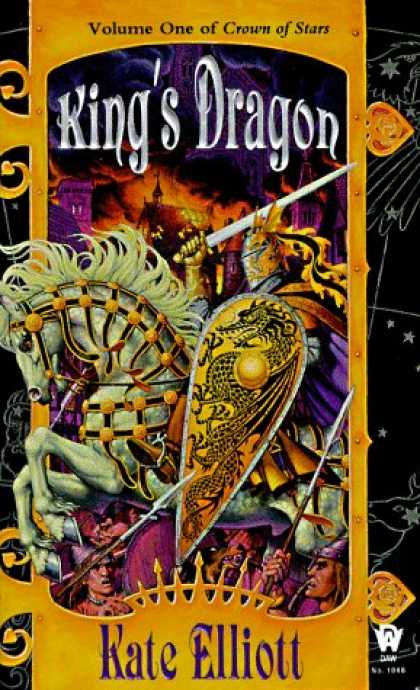
“A rider approached. Armed in bright mail, it guided its horse forward at a sedate walk, untroubled by the raging wind. ..The horse was beautiful, as white as untouched snow, almost blinding, and the woman- She was a woman of middle age, scarred on the face and hands, her boots muddied and scuffed, her coat of mail patched here and there with gleaming new rings of iron. Her long sword, sheathed in leather, swayed in front of him. A battered, round shield hung by her knee, tied to the saddle… Her gaze was at once distant and utterly piercing. If her eyes had color, he could not make it out. They seemed as black as a curse to him.” (p. 27 SFBC hardcover)
“Who are you?” he whispered. The sword, like death by pain, was lifted. Her reply rang out and yet was muted by the howl of the wind. “I am the Lady of Battles.” (p. 28 SFBC hardcover)
A good description goes a long way. Ask each player to not only describe themselves, but make sure they have a description written down so that they can refer to it for future reference. Do the characters dress in a certain fashion? Do they wear certain styles of cloth? Are their clothes new or old? Do they have fine silks or worn through materials? Are their weapons nicked from long use and battle or well oiled?
Having a good description for an NPC goes a long way too. Make sure that when doing so, you have the description ready if you plan on using the character again. Insure that things that are unique about the NPC are bolded so that the players can recognize these characters when meeting them in the future. When introducing them, give them a unique persona not only through what they wear and what they are, but by your own actions as a GM. Hand gestures and voice are some of the greatest tools you have at your disposal in such a case and making the same hand gestures in association with a certain NPC, will ingrain that habit into the minds of the players.
“It is necessary that we act. We must find another to consecrate at the altar. One who will not be missed.” (p. 170 SFBC hardcover).
This falls under the rule of no good deed goes unpunished. When attempting to push their own views of right and wrong on the setting, the GM has many options, especially when trying to showcase that the players cannot be everywhere and do everything at the same time. In this example, Alain has saved a savage humanoid from a gruesome death. In response, another is taken in place for sacrifice.
If the players are known defenders of one place, can they be at another? If the players champion one cause, do they directly or indirectly, oppose another and cause people who follow that cause hardship?
When trying to follow the old adage of no good deed goes unpunished, it’s not necessarily that you as the GM are trying to showcase that the world is a harsh and cruel place, but rather, that actions has consequences both intended and unintended. In some games, one of the standard methods here is the players freeing something long dormant from an ancient crypt in their running around and digging up the dead.
“But the blessed Daisan fasted and prayed for seven days! He didn’t suffer!”… “So the church taught falsely for years. So this truth was proclaimed as a heresy at the Great Council of Addai over three hundred years ago.” (p. 175 SFBC hardcover).
“Which fort?” she asked, then knew what he meant: This fort, the old Dariyan fort built by order of Arki-kai Tangashuan seven hundred years ago, reckoning by the calendars she knew. Now of course it was known as Steleshame, a small estate under the authority of the freeholder Gisela that was also an official posting stop for the King’s Eagles and thus under the king’s protection rather than that of the local count.” (P. 250 SFBC hardcover)
Depending on what campaign setting you’re using, either home brewed or store bought, the history may be so vast and grand that things players tend to take as everyday events and elements may be prone to change. One way to introduce these changes is to simply note that some time in the campaign’s past “THIS” is what had actually happened.
But then why doesn’t the campaign reflect it? Take the Forgotten Realms and it’s new incarnation for 4th edition. It incorporated many elements of the 4e default setting by taking a massive hammer to the setting and instead of allowing that unknown history to be discovered by the players, its thrust upon them. Have the characters be the ones who discover these ancient things. Have the players be the ones to discover that Lathandar is actually a different deity. Have the players discover that in prewritten history there was another land. Have the players discover these hidden facets of the setting so that they may be the new authorities and can be part of the change as opposed to just being battered about the head with it.
And as the second quote shows, sometimes the campaign will reflect it. People change. Monsters migrate. Fortress rise and fall. Things have multiple names and multiple purposes depending on who you ask and whose living there now. When dealing with something of great age, have multiple names for the old forts that stretch back into history. Have multiple names for the elves who have seen hundreds of years. Have variety when the players discover a long lost weapon that once served on the front line of battle against shadow and shade.
“Who are you?” he whispered. The sword, like death by pain, was lifted. Her reply rang out and yet was muted by the howl of the wind. “I am the Lady of Battles.” (p. 28 SFBC hardcover)
A good description goes a long way. Ask each player to not only describe themselves, but make sure they have a description written down so that they can refer to it for future reference. Do the characters dress in a certain fashion? Do they wear certain styles of cloth? Are their clothes new or old? Do they have fine silks or worn through materials? Are their weapons nicked from long use and battle or well oiled?
Having a good description for an NPC goes a long way too. Make sure that when doing so, you have the description ready if you plan on using the character again. Insure that things that are unique about the NPC are bolded so that the players can recognize these characters when meeting them in the future. When introducing them, give them a unique persona not only through what they wear and what they are, but by your own actions as a GM. Hand gestures and voice are some of the greatest tools you have at your disposal in such a case and making the same hand gestures in association with a certain NPC, will ingrain that habit into the minds of the players.
“It is necessary that we act. We must find another to consecrate at the altar. One who will not be missed.” (p. 170 SFBC hardcover).
This falls under the rule of no good deed goes unpunished. When attempting to push their own views of right and wrong on the setting, the GM has many options, especially when trying to showcase that the players cannot be everywhere and do everything at the same time. In this example, Alain has saved a savage humanoid from a gruesome death. In response, another is taken in place for sacrifice.
If the players are known defenders of one place, can they be at another? If the players champion one cause, do they directly or indirectly, oppose another and cause people who follow that cause hardship?
When trying to follow the old adage of no good deed goes unpunished, it’s not necessarily that you as the GM are trying to showcase that the world is a harsh and cruel place, but rather, that actions has consequences both intended and unintended. In some games, one of the standard methods here is the players freeing something long dormant from an ancient crypt in their running around and digging up the dead.
“But the blessed Daisan fasted and prayed for seven days! He didn’t suffer!”… “So the church taught falsely for years. So this truth was proclaimed as a heresy at the Great Council of Addai over three hundred years ago.” (p. 175 SFBC hardcover).
“Which fort?” she asked, then knew what he meant: This fort, the old Dariyan fort built by order of Arki-kai Tangashuan seven hundred years ago, reckoning by the calendars she knew. Now of course it was known as Steleshame, a small estate under the authority of the freeholder Gisela that was also an official posting stop for the King’s Eagles and thus under the king’s protection rather than that of the local count.” (P. 250 SFBC hardcover)
Depending on what campaign setting you’re using, either home brewed or store bought, the history may be so vast and grand that things players tend to take as everyday events and elements may be prone to change. One way to introduce these changes is to simply note that some time in the campaign’s past “THIS” is what had actually happened.
But then why doesn’t the campaign reflect it? Take the Forgotten Realms and it’s new incarnation for 4th edition. It incorporated many elements of the 4e default setting by taking a massive hammer to the setting and instead of allowing that unknown history to be discovered by the players, its thrust upon them. Have the characters be the ones who discover these ancient things. Have the players be the ones to discover that Lathandar is actually a different deity. Have the players discover that in prewritten history there was another land. Have the players discover these hidden facets of the setting so that they may be the new authorities and can be part of the change as opposed to just being battered about the head with it.
And as the second quote shows, sometimes the campaign will reflect it. People change. Monsters migrate. Fortress rise and fall. Things have multiple names and multiple purposes depending on who you ask and whose living there now. When dealing with something of great age, have multiple names for the old forts that stretch back into history. Have multiple names for the elves who have seen hundreds of years. Have variety when the players discover a long lost weapon that once served on the front line of battle against shadow and shade.
Subscribe to:
Posts (Atom)


