Showing posts with label Spartacus. Show all posts

Sunday, March 1, 2015

Spartacus: Top Five Reasons To Play Gladiators

Watching Spartacus, there are a lot of gladiators. There are a lot of tales told about specific gladiators before one even sets foot in the arena.

There are gladiators who are visually designed to appeal to both the crowd and in a meta sense, the viewers. 

For gaming, gladiators can be broken down into a few different venues.

1. Colorful Names: The Undefeated Gaul! The Shadow of Death! Gladiators are colorful champions and they have names that reflect that need. These names can be a combination of homeland and status or a fearsome name designed to strike fear into enemies. Spartacus own name isn't his name mind you but it is the name of an ancient Thracian king.

2. Variety of Characters: The show includes a wide range of characters from different ethnic backgrounds. These include almost anyone of the ancient world ranging from Gaul, Roman, Thracian, Assyrian, and others. This melting pot of different characters allows players to select from a wide variety of racial origins without having to over think "Why on earth is this dragon born here?"

3. Variety of Weapons and Fighting Styles: Spartacus and the former "God of the Arena" are both masters of the two sword fighting style. Others are masters of spear and shield or trident and net. An arena is the perfect place to have characters wield those odd weapons that might not make sense in a more conventional setting.

4. Variety of Enemies: The types of foes that gladiators encounter ranges from other gladiators to captured beasts. In a fantasy setting, this can be changed up dramatically with constructs built specifically to battle the gladiators or to train them. It can include summoned creatures brought forth to test the gladiator's mettle. It may also include the odd wanderer who fancies himself an unstoppable swordsman who needs a little money and so signs up for an encounter.

5. Patrons: By having characters fight in an arena, chances are they may have patrons that sponsor their fights are award them when they win. This provides the Game Master with a quick "In" as to why the players are fighting. Patrons with ambitions that go beyond gladiator arenas may have other odd jobs for their skilled men at arms and may have them act as bodyguards, fight in underground arenas or even act as thug and assassin when needed.


Sunday, February 22, 2015

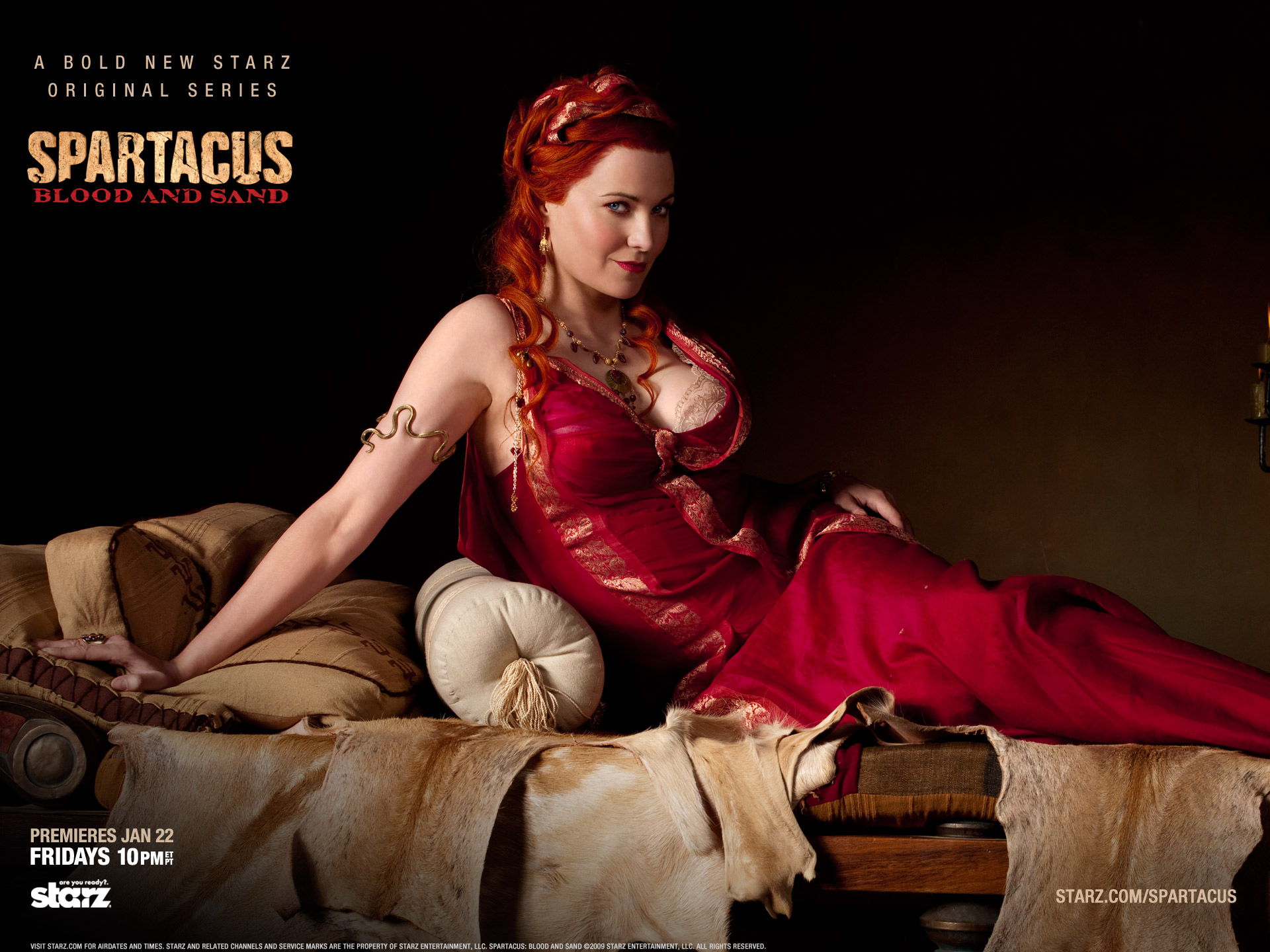
Spartacus: Character Study Lucretia


Having recently just finished watching Spartacus on Netflix, I thought I'd take a look at another villain of the series. This time, Lucretia.

How you view Lucretia may depend on how you watched the original series. If you watched it as aired for example, you might have a different mind then if you watched it in chronological order.

Lucretia is the wife of Quintus Gnaeus Cornelius Lentulus Batiatus. She brings no dowry, no name and nothing outside of her own cunning and ambition to the marriage. This is something that Quintus' father notes many times, even trying to get Qunitus to dissolve the marriage.

But perhaps 'beloved' father had reason to? Quintus has dreams far beyond being a mere gladiator owner. Far beyond providing blood and spectacle to the crowds. And his father doesn't approve.

Lucretia on the other hand, does. She helps Quintus wherever she can including doing things that may be beyond the standard of such services that a gladiator house may offer. 

Her initial motivation in taking 'the Undefeated Gaul' to her chambers are to get pregnant so that she may provide her husband Quintus a son. As the chronology advances, it becomes obvious that it evolves far past that and into a strange sort of lust/love/ownership issue. That she, a woman, has this thing with Crixus that is hers and hers alone. Something that she is willing to do much to keep.

This includes changing some of her services that she normally provides to others with the gladiators as sex slaves and does so in a manner that brings shock to all parties involved. See one of Lucretia's friends and allies is a bit of a cruel mistress herself, always looking down on Lucretia and her way of life, but enjoying it as 'scandalous' in its own way.

When said friend seeks the company of Crixus as sex slave, Lucretia instead substitutes Spartacus, a man that the friend has many reasons to hate. It works out well in Lucretia's favor as she then has sufficient blackmail material over friend.

Like any, when she feels wronged, she seeks her own brand of vengeance. When Crixus takes a lover of his own, Lucretia's own 'virgin' slave, it wrongs her on many levels. On one level, Lucretia is a proud woman. It hurts her to think that her slave would want anyone outside of her. On another, Crixus, despite status as gladiator, is still a slave, still property and this betrayal is one of defiance. On another, at this point, Quintus has already told her that he knows about it and allowed it because it made her happy.

With those elements in place, Lucretia works to have Crixus killed by Spartacus in an exhibition match by poisoning the Gaul.

After the Spartacus uprising and so many are left dead or left for dead, Lucretia survives but is a pale shadow of her former self. Her possessions are gone from her. Her husband is dead. Her lover is dead. She is taken against her will over and over by a former slave.

And yet she still possesses keen mind and is able to take advantage of a rapidly changing order. She manages to use her surviving status to appear as a oracle, a bridge between man and god. She stays close to her good 'friend' and eventually has the last laugh on her.

A former shadow that kills.

In looking at Lucretia's nature I'd peg her with some of the following attributes:

Loyalty: 

This may seem a strange one. She has her own lover outside of her husband but... With her husband, she seeks to further said husband's ambitions. This includes killing her husband's father with poison and making it appear to be a rival of said husband in order to further her husband's own schemes as she knows without a doubt that husband will strike back at false slight.

For Crixus, she works tirelessly to keep him at the top of the pecking order. 

For her old friend who is murdered, she works to avenge her.

Adaptable:

Her husband's fortunes wax and wane and Lucretia manages to take advantage of one and weather through the other. She forges alliances with those who think themselves her better and when her own status is completely destroyed in the rebellion, is able to reinvent herself as oracle and seer.

When she sees the nature of lust and decadence that some of the better placed Romans has, she is willing to indulge that whim at personal cost to the honor of her own slaves, which results in many secrets being kept in the house afterwards.

Despite her complete inability to fight, despite her standing as a woman in a society that does not value them, Lucretia navigate the world in both its highs and lows and is an interesting character study.


Tuesday, February 17, 2015

Spartacus: Character Study: Ashur

I've been watching Spartacus on Netflix.

I consider it a guilty pleasure.

One of the things I thought interesting, was how the different relationships and the different characters play off of one another on numerous levels.

Let's look at one of the 'bad' guys, Ashur.

Ashur is an Assyrian brought in with another Assyrian, Dagan. Of the two, Dagan is the superior warrior, but Ashur has value in that Dagan doesn't speak the local tongue and Ashur does. This allows Ashur some measure of diplomacy between Dagan and others.

Initially Ashur seems eager to honestly be a part of the 'Brotherhood' where the Gladiators respect one another.

Problem is that he doesn't earn it the way the other gladiators earn theirs.

See Ashur and others follow their master, loyaly, and do things that Gladiators aren't normally a part of. Something evil and sly, assassination for their lord and master.

The reward? The brand of the gladiator and the scorn of those gladiators at the same time.

Ashur's use in translations continues to be useful but at the same time, because Dagan is the superior combatant, Ashur, who wasn't accepted in the first place, continues to fall further and further behind in estimation. This causes Ashur to make some decisions that don't please Dagan.

Things continue to go south when in a duel, Ashur 'cheats' and winds up blinding Dagan in one eye.

It goes further south when later, in a duel against another house's gladiators, Ashur suggests an alliance between himself and Crixus against the champion of their own house. Crixus responds by slashing Ashur's leg and pushing him into flames resulting in Ashur's status becoming even lower.

But somewhere during that low period, Ashur puts to use his wits and takes bets and controls money. He also spies for his lord while in the city and spreads disinformation and fakes alliances with those who seek to bring his house down.

At one point, his owner values him so much that he declares that Ashur is no mere gladiator but almost like one of his lord's hands.

Of course things come crumbling down with the whole Spartacus rebellion thing mind you...

But Ashur survives that as well! Using cunning, he escapes his fate by hiding among the dead and even helping another survive the fall of the house.

And in so doing, is rewarded with a new master who demands Ashur remove his old brand. Never mind that this requires cutting off a nice chunk of skin with that brand and takes forever to heal. It also requires Ashur to prove his point that one gladiator is worth three soldiers when he is forced to fight for his live against soldiers, but while winning, wisely holds back from killing those he fights.

His street connections enables him to gather a crew of unique mercenaries and to be a valuable asset but all is set to waste for poor Ashur when he is accused of a crime he didn't actually commit and he winds up proving his loyalty one last time taking a message to Spartacus where his overconfidence in battle leads to him being slain.

Interestingly enough, while the series Spartacus doesn't delve too deeply into racial relations, the fact that Ashur was Assyrian is enough to poison the thoughts of the slaves when they encounter another Assyrian later on. It's a subtle dig at how racism, either between Gaul and Thracian, or between Celt and Gault, is portrayed in the series.

In looking at his motivations overall, I would throw the following on him.

Petty Ambitions: While there are some in the Spartacus series that have grand overpowering ambitions, Ashur's are much simpler. An easy life, wine, food, women, and whatever else it takes to survive.

Respect: Perhaps even his number one ambition. Ashur seeks to be champion, even when he knows not capable of it. He seeks to return to the arena and win respect, even disappointed as his master tells him that he's far too valuable for such a position.

Vengeful: Much of what Ashur does that is vile, including his treatment of Naevia, is in part a result of the way others have treated him. Most think that because Ashur is the least physical among them in terms of fighting prowess alone, that he is not worthy of consideration only to learn later on that he is a master manipulator.

Loyal: While I list it last, it's important to note that Ashur had opportunity to escape his circumstances on more than one occasion and made the decision to stick with his master at the time, even thought in the end, this results in his death.

By making Ashur more than just a mustache twirling villain, the writers of Spartacus give us a character whose motivations may be easy to see, but there are motivations nonetheless.

Were there any characters that stood out for other views of Spartacus? Any villains where you were like, "Man, I can't wait to see this guy get his!" or surprised at how they went?

Sunday, January 3, 2010

I Am Spartacus!


So while sick for the New Year's, I noticed an abysmal amount of reruns, unscripted live shows, game shows and other horrid things that my mind seeks to purge in a fit of medicinal use.

To help ease the congestion of my illness, I put on the Criterion Collection of Spartacus.

But how can this be of use to a role playing game?

1. The player might not be the important part of the campaign setting. While this attitude and opinion may not be popular, in Spartacus, the main character's final fate and indeed, his whole movement is little more than the political power players of Rome making their moves back and forth on a massive chessboard that includes not only Spartacus and his army, but various alliances with fellow senators, future leaders, and pirates. If the players remain ignorant of the wider world despite knowing of it and that comes back and crushes them in the face... well, they too may suffer the final fate of Spartacus, which from a legend standpoint, probably isn't bad but from a gaming standpoint...

2. The players have interesting things happen to them. Consider it fate, but when first introduced to his new life style, that of being a gladiator, Spartacus has been condemned to die. Why doesn't he die there? Does he spend an action point and someone shows up and goes, "Hey, I'll buy that slave!" or is it merely background story? What about later during his initial fight to the death? Spartacus loses that fight but doesn't die. Why? Perhaps because the other gladiator isn't a player character? But note what happens immediately after. The setting changes. The gladiator school falls. And it falls at the hands of the player.

3. I Am Spartacus: One of the main character's greatest abilities, isn't his fighting ability. He realizes that he's going to lose early on in the film. He realizes that in many ways, he's an ignorant man. He admits he can't even read. But he has a powerful believe and he knows the power of words, of poetry, or touching the human spirit and striving for equality for all. When his comrades and co-gladiators are given a chance to turn him in, to return to a live of slavery or die a brutal death of crucifiction, a fate they can avoid if only they will turn Spartacus in, one by one, they stand and each proclaims, "I am Spartacus!" If the players can engage the Non-Player characters of the setting, if they can prove by deeds, words, and a legacy, that they are worthy of such loyalty, give it to them.

4. Unintended Consequences: When the film starts, there appear to be certain characters that are going one way and at the end of the film, they are in nearly opposite stances. Take a young Ceaser in this moive. His initial apperance would not put him where he ends up at the end, nor where he will be placed in history later on. Indeed, it could be argued that the events of Spartacus' rebellion and how the Senators of Rome try to handle it mold the political power of Rome not by the act of rebellion, but by how the various factions within it wish it handled. Some hold onto old traditions, others act in a way that will end things quickest. Those that wish for the best of both worlds find that they can't have it. When the players engage vile sorcerers for spell components, when they work for cruel warlords, even if it's merely removing goblins or orc raiders, have those actions have consequences. The sorcerer can now afford the components necessary for his master summoning, the warlord, unhindered by humanoid raiders, is ready for a full scale invasion. It shouldnt' be something that hits the players out of the blue, but doesn't necessarily have to be a "ignore the man behind the curtain" moment either.

Give the player a background in which they can influence events and be epics in and of themselves and even if meet with failure and death, their efforts will have changed the campaign world and make them eager for another go around.