Showing posts with label Arthurian. Show all posts

Tuesday, August 9, 2016

The Skystone By Jack Whyte (Book Review Edition)


Written by Jack Whyte
Book One in the Camulod Chronicles

Still experimenting with format of these blog posts. Trying to keep the reviews separate from thoughts on how I’d use the material in a game. Any opinions on that? Keep them separate? Bring them back together?

The King Arthur mythology is well tended. It’s had numerous books, comics, and even movies done about it. Some of these are classic. For example, Excalibur with a young Patrick Steward and a fantastic soundtrack.


Despite the age of the myths, despite numerous classic books like the Quest for the Holy Grail and modern books, such as Bernard Cornwell's own fist person telling through the Warlord Chronicles, there’s still room for others to plant their vision.


In the Skystone, the first book of the Camulod Chronicles, we’re introduced Pubius Varrus. He is our first person narrator for the tale of the Skystone. 

Varrus is a bit of a Mary Sue. He does face adversity. He does face loss. But when the chips are done, he always comes through smelling of a rose. 

He often finds himself in situations where no, he should be dead, but nonetheless, comes out on top. As a main character though, his flaws, such as his injured leg, help make up for the overwhelming good fortune he has.

Unlike some books on Arthur, this one takes place well before Arthur, or even Uther is introduced to the reader. This is a tale that takes place when Britain is a land still under the control of the Roman Empire but that control, over a number of years, slips and begins to vanish away.

Jack Whyte takes his time in the slow descent of Rome. It doesn’t happen overnight. There are signs and portents of it everywhere. Some people looking at things in America now might draw some parallels to how things work in Jack’s Rome. For example, discipline in the Roman army is down. They used to dig trenches prior to setting up for an overnight stay on the road for defensibility purposes.

That in and of itself may seem small, but coup it with soldiers not being treated right by Rome in the first place. In tandem with the Roman empire accepting people of various nationalities that aren’t Roman but who leave after service, bringing those skill sets with them. When people in other countries have been under assault for years by the Empire, their children killed, their resources drained. There are some parallels if one chooses to look for them with modern America.

By the end of the tale, Varrus and his good friend Caius Britannicus, have started to forge their own colony for the former Romans who are of long standing British birth. They have their own plan and their own method.

And more importantly, they have access to the fabled Skystone!

Jack Whyte puts a little too much description and detail into his writing but the good news is that it flows quickly. In terms of writing style, it’s not an “as it happens” 1st person. It’s an “as it happened” first person. The author is alive and well. We might fear something bad is going to happen to Varrus, but we know he’s not going to die. An editor who wanted to reduce this novel could probably have lopped out 50 pages without doing it any harm as it would still weigh in over 400 pages.


With such rich details and interesting characters, Jack Whyte has hooked me for at least the next two books as I already own the third and will shortly hunt down the second.

Wednesday, November 20, 2013

Percival and the Presence of God by Jim Hunter

I can't remember when, where, or for how much I bought Percival and the presence of God, but I know I bought several of the Arthurian novels at that time. I had never read anything written by Jim Hunter prior to this. It was a well written short first-person novel that took me an afternoon to finish off.

In many ways the novel  is timeless.  Well that's not quite true.  But it doesn't seem to be set in a specific  time frame outside of  being in a dark age or a middle-age  or a  medieval style setting .The author is free with a lot of description in terms of what the character is feeling  but not necessarily and say  what the characters wearing, what style armor the character has,  what manner of sword the characters using or other  bits and pieces that some modern authors  drown the reader with.

In short if you're looking for a quick  read  about  Percival  you could do worse  then this book  by  Jim  Hunter.

 In terms of gaming because the novel is short  and combat  is secondary, not even secondary  maybe fourth  or fifth  six place  in the scheme of things  there are still some bits  that can be yanked  for your home  campaigns .

For example  that many people  take  Percival's  quest  to be a worthy and in and of itself.. There is the question  of leaving  not just one home  but many homes  in the pursuit  of something that may not come  to fruition  but it is that characters  drive .  in looking at characters drive  it's important  that the player and GM understand it  but not necessarily important that the other characters  or the NPCs  agree with it.

Another thing to consider  is  the lack of light.  in the wintertime for example  there is not much time to be on the road.  indoors  there is not much light  to do anything  without candles  or torches or lanterns  and many of these things  produce smoke  and heat and fire.

Lastly there is the presence of ruin. Percival thinks he sees King Arthur's castle from afar. As he draws closer to it though, it is merely a ruin that he almost gets himself killed in. IN so doing, he learns deep despair. Ruins are full of potential 'traps' from rotting ceilings and stairwells to support beams and floors that can all fail when a character puts weight on them.

Percival and the Presence of God is not filled with combat and clashes but is an interesting character look at a knight's wanderings as they take him further and further form home.

Thursday, November 24, 2011

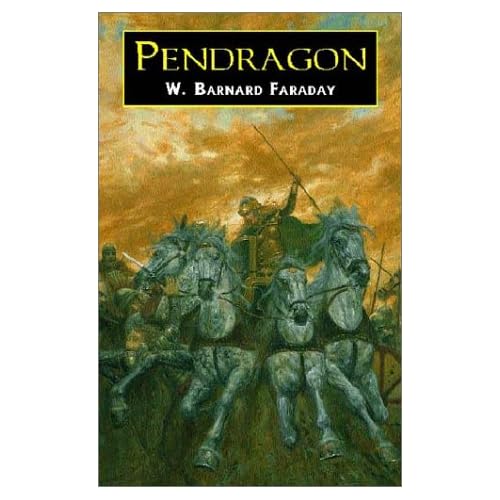
W. Barnard Faraday's Pendragon published by Green Knight


Having finished off Pendragon, I thought I would take a few moments on an actual day off, to post a few more thoughts on the book.

Even in a time when war with the Saxons and Pics if upon them, the land is not singularly united. This theme plays out in the book in several instances that would make for good role playing opportunities.

For one, Gwendaello, the actual Pendragon in this version, is not well loved. Her former leader was conspiring with the Saxons to take the lands and lords down in exchange for treasures and plunder. His plan didn't work out too well but did leave Gwen in charge of things. However, the other rulers are not pleased at this prospect and try to take away her lands and titles.

This results in a large meeting where diplomacy is at full bloom. The various lords and ladies vieing for attention and trying to determine who has the right of things. It works well in the novel, showcasing a deep amount of mistrust between the rulers as well as showing how things can quickly move from one assumed finale to another with the right placed bribes and blackmail.

3rd edition brought out a lot of rules, well, not a lot of rules, but some rules, to try and bring these role playing elements to the table top with dice rolls and for some, they work. Others, used to having to actually speak and interact with the other participants around the table, are able to talk a fantastic game. 4th edition brought this more into the game with skill challenges that allow different characters to bring different things to the game.

For example, a skill challenge here might involve some of the more obvious candidates like intimidation and diplomacy, but a GM who has players that know the setting and details of it, and have the appropriate skills like ancient history, should be allowed to persuade people through speaking of the land and its past and how those ancient lores may be effecting the here and now. Others may speak using their religion skill to detail how the gods will be angered or pleased by the path being taken here.

I can agree with this because it helps get people who might not have any will or desire to roleplaying, or worse, who have no skill at it, to still contribute to the game with a dice roll and some idea to me how they're trying to achieve their goals.

I also allow role playing 'stunting' for those who get into it. I'll allow them to make a speech and detail what they have in mind and why they think it'll work and provide a bonus to the roll. Now if there are things that the characters don't know, like their speech is hostile to the locals around them, or that they've gotten several things wrong, or if they just flub it, I'll give them a penalty. Of course, the natural 1 always rolls around as well so perhaps while they were talking, they choked on a chicken bone or something of that nature.

For those who don't enjoy such politics though, and are more action based, what about assassination? In this instance, Artorious learns of an attempt on Gwen's life. Of course he does! He's the main character of the book. This is the same deal players can expect for their characters when the DM wants the characters to be able to effect the game. While hearing about an assassination is powerful stuff because it potentially reminds everyone at the table that they are mortal, being the ones to stop such an event carries with it the promise not only of stopping a murder, but the thanks of whatever lord they saved. Finding out who did the deed and what to do about it then become further adventure seeds.

Another issue that arises when the land is in turmoil, is bandits. Artorius notes during his journey, that by travelling alone, if necessary, he can usually hide from such bandits, but a small group is easy pickings as the bandits ten to travel in groups of ten to one hundred. Seeing this in print makes me smile because I don't feel bad when I do it to the players. I'm sure the AngryGM would love having that quote above his DM Screen so that he could point out the 'semi-historical' accuracy of a hundred man bandit attack.

Despite some of the problems in these times though, people do tend to pull together and the rulers must respect those that do so. While talking about the problems with bandits, he recounts how a well liked merchant sought justice for the loss of his goods to bandits and had to pay a legal fee, that was provided by his fellow merchants who wanted to see justice done. When nothing was done and the fee not returned, social unrest sprouted up.

In Usagi Yojimbo, there is an instance where a Samurai tests his sword on a beggar, killing the man instantly. The surviving beggar, the father of the slain one, goes to his guild and they pool their funds together and hire an assassin who kills the son of the samurai.

In short, just because one person is not a problem, does not mean that one person lacks the means to become a problem, even if they themselves are never wielding a sword or casting a spell.

Tuesday, November 22, 2011

Pendragon by W. Barnard Faraday


I love me some Arthurian fiction. It can take a wide variety of shapes and styles. It can be written in a deep dark gritty style or as a take on modern events. This version tends to feel more historical in nature and brings some differences to the table.

I'll be laying into the spoilers fairly quickly here and note, I haven't finished reading it, so there may be some more random thoughts shot out on another post soon.

King Arthur is replaced here by Artorius. His lady love is now Gwendaello, and we have a druid bard known as Merddin. The little changes in name give it a more archaic feel, more ancient, more fitting perhaps to some of the themes within.

One of the interesting things is that here, Gwendaello is not some princess to be rescued. She meets Artorius, who is a general at this point, after she has escaped capture by killing those who sought to despoil her. Artorius is a bit unsure of her, perhaps because she's already tried to kill him at this point!

She's brash and bold and has a love for the Island of the Mighty and sees in Artorius, someone who will do all he can to save the people of that island, even if they themselves are not going to do all they can. She is a battle queen here, and it's a role that fits her well.

Another interesting bit was reading on what were accepted common courtesies of the time. For example, when stopping at someones home. The thing that struck me was the author mentioning that people were welcome in such instances not only because of manners, but because there were hungry for gossip, for news, for things outside of the norm. This was their chance for entertainment.

In an era where there are no phones and no Internet, human interaction and communication becomes vital. The going door to door, as the bards do here, to raise spirits and showcase confidence, are of great importance as well as providing that touch of entertainment that people long for.

While there is no G4 network, there is still paper.  Artorius is written to by Princess Gwendaello and she wishes him luck in his efforts to preserve the Isle of the Mighty even as she explains to him that forces she herself will be leading. Letters are an excellent way to do some 'Blue Booking'.

Pendragon has a lot of historical richness in its veins and that material can come through in any setting should the GM focus on it. For example, when looking at the spot where two rivers meet, Artorius notes that people will always go to such locations regardless of how many times they are destroyed or occupied because of the utility of such a boon. Towns build on rivers or bodies of water are a staple of fantasy games because they are all over the place in history. Survival becomes much more achievable when water ways become involved not only for trade and transportation, but food and well, water.

If you're looking for a Pendragon with a bit more weight in its heft, Pendragon by W. Barnard Faraday is for you.