Showing posts with label Adventure. Show all posts

Wednesday, November 21, 2012

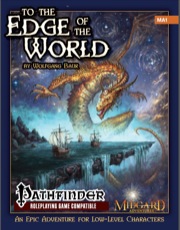
To The Edge of the World by Wolfgang Baur

One of my friends has been running the Shackled City with no break for many moons and done so through several essential TPKs. I told him that I saw an adventure that I could get for review purposes but I wanted to actually play it. I’ve already read it a few times and I like the idea that “To the Edge of the World” is high in scope in terms of not killing rats and other low level vermin that players have to traditionally slough through.  Should have played it last week but work was beating me down mightily with overtime and with all the Kickstarters I’ve been supporting, I had no space to say no.
However, with the days of Turkey Slaughter upon us, I’ve managed to reread the adventure. One  “To The Edge of the World” by Wolfgang Baur.
Railroad.
This isn’t necessarily a bad thing in and of itself. I already told the players to expect a one shot with some second levels characters to give Tom a break. They were okay with that although they were a little disappointed in the level as we’ve already got past that in Tom’s Shackled City.
In terms of layout and appearance, the book is great looking. This is bad for a PDF. Great looking full color cover, full bleed yellow background pages. Anyone want to print this out for me for reference? No? Okay, I’ll keep using my Toshiba Thrive Tablet to read it but man, it isn’t easy. The tablet is great for some reference work but not necessarily for reading full on. One reason I was hoping that 13” Excite Tablet was coming out….
So fancy borders, full color interior art, full color interior maps… yeah, it’s a fantastic looking piece.  In terms of PDF, it has a nice section in its bookmarks and is easy to navigate around. Great art, solid maps, and if this was a print product, it would earn some oohs and ahhs for its appearance. As a PDF that I’d like to print out? Not so much.
While that’s an annoying problem that I can overcome, what’s no quite so easy to do are the numerous references to other works.  We hit page four for example, and get a reference to Midgard Campaign Setting and then another one for Journeys to the West. Neither one of those is vital mind you and this is a campaign specific adventure so I can see those being included.
Looking at a potential encounter on page five though, we have seaweed leshy with like three monster stats and a reference to Bestiary 3 and right above that, a reference to Bestiary 2. These stats, in my opinion, are not enough to run the encounters. In addition, there aren't even full descriptions of the monsters.
That might be okay for something like a goblin or an orc. For a reefclaw? No. If you cannot run the adventure without outside references you are doing it wrong. That’s my opinion. In a PDF especially, there is no need to reduce the amount of pages if it would’ve taken extra room for it. Some might go, “What about the file size?” To which I’d point out the elaborate graphics and full color illustrations. There’s also a reference to the Midgard Bestiary. So… something like five extra books to get all the references here? Disappointing.
I’m still going to run it but will have to make sure to have all those game stats printed out or haul around several big books and well, as I don’t even own the Midgard Campaign, Journeys to the West or Midgard Bestiary,  that would be even more problematic.
I’ll post a playtest report. With my group and their foreknowledge that it’s just a one off, I suspect that it’ll be a fun romp. Someone may say, "Man, you just spent all that time talking about the problems and think its going to be fun to run?" For me, I know my friends. These are all people I've gamed with for years. Not having the full stats and descriptions is annoying but since i have most of the material thanks to the recent Paizo sale and have it the Bestiaries in hardcover anyway, I'm just thinking of how muc MORE annoying it would be for other people who don't have that material.
Anyone else read this one yet? Playtest reports?
 

Sunday, October 7, 2012

The Harsh Lessons of DMing: Level Balance

My friend Tom Wright is running several of my friends and I through the Shackled City using Pathfinder as the rule engine. He's got some rules and notes and is fairly consistent in the way he runs. It's one of his greatest strengths.

However, he had a vision about how the game was going to work this time. He was going to incorporate various ends and odd bits of our characters backgrounds into the game. To accomplish this and still run the campaign, he decided to use the slow advancement table.

One of the great things about roleplaying games is the ability to modify things so that they work the way you want. However, if you are going to do that in a manner that keeps the pace with a prewritten adventure, you need to verify that your doing the right thing.

At the end of the first adventure, we were too low level to handle the big bad who wiped out a few members of the party and the rest of us managed to retreat. How did that happen? No side quests. When the xp goal was changed without bringing in additional xp, the end result has to be characters that are lower level.

After that, he decided he was going to use the medium or normal level of advancement. He's very good about listening to player feedback in terms of it not being 'his' game but 'our' game. But he also decided that new characters would start a level lower than the standard characters. Does anyone see any potential problems here?

So when we got to the big bad in the next adventure... yeah, essentially another TPK.

Take the time to read through the adventurers. Take the time to review the character sheets. Review not only their abilities that are level based, but also their choice of 'fiddy' bits like feats and spells. Make sure that if there are encounters coming up that rely on magic items or silver items or something of that nature, that if the party doesn't already own them, they can own them. Make some routes of escape.

Mind you, in a freestyle campaign where you let the first level party know, "Over here are rumored to be dragons and giants" and they go there anyway, well, I'm old school enough to say kill away. But if you're running an adventure and it says, "Party should be level X when they reach area Y" and they get blitzed by the baddies? Well, was party level X? Did party have level X equipment?

In some games, its easier to tell when players are min-maxed then others. Try to keep onto of it and don't wait till the last minute to find out that the party didn't have a wand of cure light wounds and that the party didn't have a method of deciphering that ancient script. DMing can be a great thing but it also often requires some homework. Do that homework!

Friday, September 9, 2011

Okko the Cycle of Earth by Hub


The second book in the Okko graphic novel series, Okko, the Cycle Of Earth, continues the travels of the demon hunter Okko and his motley band of allies.  The illustrations are strong, crisp whil still having tons of detail. The setting comes alive under the artist here and the feel of the setting is made clear through careful placement of little details.

The story line here works fantastic for a RPG and could be lifted whole cloth. In short, I highly recommend anyone running Oriental Adventurers, Legends of the Five Rings, or other manner of games where a little Samurai Sunday attitude is called for, look it over. This isn't to say that a standard fantasy game of Dungeons and Dragons couldn't swipe the plot by changing a few things.

The book starts off with an introduction to a city. The youngest of their group, Tikku, acts as our outsider. Because he is not well versed or travelled, his mentor must inform him, and through him, the audience of the importance of places and events going on around them.

For example, in the city they are at, it's a celebration for the first day of winter. Floats are carried on the streets, dragons manned by multiple people dance around, masks are worn and "every kind of outlandishness is allowed."  We discover that Bakuyaku's nicnmake is "Black Poweder City" because the seven monastery range has a lot of despotis of the stuff around them.

Okko himself becomes involved in greater events by having a man seek him out and die in front of him from an assassin's attack. His ally, Noburo, seeks to hunt down the assassin, but during the celebration, the tightly wound city with all of its masked inhabitants makes this a difficult task.

In looking at such a set up for your own campaigns, this is one of the reasons its good to have a calendar of the holidays and what those holidays mean. If people are all out celebrating in the streets and the streets are crowded with floats and other obsticales, it can make for a more challenging race against individuals that are seeking to escape. It also makes things more colorful and takes away some of the 'generic' that some settings can suffer from as they all seem so similiar.

Now on the hunt for the assassins and for the person that was identified by the slain courier, Okko begins wandering the Seven Monstary Range looking for the Raven Mon. This allows the characters to learn about the setting and details of background even as they suffer some random encounters.  It also provides some background on the senior monk as he used to be a student at one of the monastaries.

This is another useful trick when a player has information in his background about where he came from and what he did. Some players put it there for active use, some to just have a grounding part of their characters. the players will generally give you a good idea of what they'd like done with that information and pulling a little of it into the game when appropriate is never a back idea.

One of the things the monks encounter is an oracle who provides information, but that information relates to what they are seeking only on the very edges of that mission. This is a fairly standard method of providing some information, to not hand out the exact answers that are sought, but to provide perhaps more details to the overall scheme of what the players may be involved in.

Inthis instance, no search could be complete without visiting all seven monastary's, and only at the end, learning that "An eight exists, perched atop the roof of the world. There dwells an order of illuminators in their hands ap riceless collection of books! nly the powerful and the prvileged few have access to this immense source of knowledge... or even know of its existence..."

That bit right there does a few things. It takes the knowledge that is commonly known, that there are seven schools, and expands it. It then names the location, the location of which, is known to their guide as "oneo f the highest mountaints known to man! I know none fool enough to dare is heights. And I do not know the path." This bit of player knowledge is like having a player talk about a demon inhabited realm or a blasted wasteland. It may add a little more inherent danger in the trip, but overall, it's not going to stop the players from going there.

Here though, the author provides some hope in the form of the Sanctuary of the 47 Geysers. By placing these unlikely found but named locations throughout the book, the author is cementing the setting. By allowing the players to visit these locations that are few and out of the way, he is providing color and character to the landscape. This is a useful trick for any game master and not every encounter has to end in a fight. The wonder of the setting should also strike the characters as much as the monsters.

When Okko does meet the samurai that the courier died trying to name, the meeting is like oil and water. Okko, being considered a ronin and an outsider of the standard civilization of his time, is not necessarily respected in the manner that other Samurai are. This happens in role playing games all the time as adventurers are generally not land owners and only have themselves to be responsible to. This allows them to do and say things that might get say, a farmer a trip to the gallows but to which an adventurer might reply, "Do you really want me to kill the garrison and leave you vulnerable to the giants in the area?"

When the whole group comes under attack, the monk is taken out in the first volley of the assault. This is something to remember for the Game Master when playing monsters that have intelligence or tactics. In pre-4th edition games, the wisdom is go for the spellcasters.  Nothing like a group of fire balls or turning efforts on the undead to quickly undermine a horde of minions and monsters. To counter this, don't act like the monsters are stupid. If a lich, an undead spellcaster, is among the villains, he's going to know exactly how powerful an opposing spell caster is and want that creature dead.

Eventually, when they do find the forbidden libraries, they discover that they are there too late. The library has been ransacked and its men killed. What they learn though, is that their enemies started off as healers but seeing the land plunged into such deep war, decided that they should be the ones to rule as they could, using their forbidden studies, control the dead of all the clans. With the land in such a constant state of warefare, they are not left wanting for raw supplies.

This is part of the appeal of running a campaign during a time of trouble. If everything is normal and the characters are merely looters, then their overall impact on the setting, as great as it may be, is one of the outsider. If on the other hand, the setting is alive and thriving with its own series of conflicts, things that no one adventurer will be able to solve, then it allows them to gather into different places and impact the setting in different ways. They are not necessarily merely dungeon crawling, but choosing sides in a multi-angled war. If they choose to do so. After all, with so many dying on the battlefield, that just means more empty castles for looting right?

The whole thing comes to a conclussion as Okko and his allies hold down an old fort against the legions of undead and their spellcasting masters.  It has very much the feel of a Seven Samurai, a group of skilled individuals against a horde of nameless enemies. Okko and his allies are only able to claim victory though the use of a surgecial strike against the leaders of the undead.

Which is something that the Game Master has to look out for. Unless you're dealing with a group of brand new players, the characters will often go after the puppeter, not the puppets. You have to be ready with appropriate challenging counters if the villains are clver enough to have them. If your bad guys aren't expecting a scrying, teleportation, assassination attack, then you're not playing at mid-high levels of D&D with thinking villains. Prepare and defend appropriately, but don't provide everyone the exact same type of defense. Vary things up. Provide differences.

Okko the Cycle of Earth provides investigation, strained alliances, exploration, and combat against dark masters insistant that their rule would be better for the land then those currently ruling.

Wednesday, September 7, 2011

Okko: the Cycle of Water by Hub

While at Gen Con this year, one of the things I picked up was Okko, the Cycle of Earth and the Cycle of Air, both by Hub, sold through the Archaia both. They had a deal where it was buy one get one free and as these are sturdy hardcovers, the cover price of $19.95 seemed more than fair for two of them. I was so enthralled with them, that I immediately ordered the the Cycle of Water, which was waiting for me by the time I made it back to Chicago.

I'd heard of Okko before. Thinking back on it, it was during my numerous trips to Games Plus where I first saw it, but it was in a miniature game format there. The figures always looked interesting but since I wasn't playing anything that would require them, and I have a ton, perhaps more, or miniatures, I always passed on them.

But reading? Hell, I could read that with no problem, especially in a graphic novel format.

So what is Okko about? A group of, well, they're not all quite friends, but allies in some aspects with Okko, the demon queller, serving as the master of the group, go about Pajan, that is not a misspelling, and take care of demons and other supernatural entities.

After reading the thee graphic novels, I am more fist shaking at the skies then before that I didn't have material such as this to inspire my Oriental Adventurers and Legend of the Five Rings games.

In the first volume, The Cycle of Water, which by the way, I'm going to start spolier alerts now so read no further if you wish to remain unaware of what's coming....

Anyway, in the first collection, Okko and his friend Noburo, an oversized warrior who always has a red demonic mask on, is visiting Little Carp, a young Geisha, who Noburo informs her, is preganent. During the night, the house is attacked and Little Carp taken away. Here we see something resembling a hencheman coming into play as Tikku offers his service to Okko if he will rescue his sister, Little Carp.

This is a standard of some stories where the characters have the action brought to them. If the players are sitting around too much, doing too much role playing with the weapon smith and the tavern keeper, have something happen. Force them to engage the setting.

During the investigation to find Little Carp, we are given some glimpses into the setting. This includes visiting Tagakka Uchi, the port of the hundred Morays, and upon that, a trip to the Red Lotus, "the most infamous and dangerous casino in the city.". We also get to see what sets this setting apart from merely being 'Japan' with some misspellings in the form of a demonic water creature that Okko has killed, a summoning of a water spirit, and a combat 'Bunraku', a so called 'puppet' which is actually similiar to a giant robot piloted from within.

Okko and his allies manage to do a lot of investigating in a little time at the Red Lotus. This involves looking around the massive casino, finding secret passages, and finding an abaitor pit in the heart of the casino. One of the things that happens though, is that their 'stealth' is blown early because Noburo, being a masked giant of a man, is quite easy to spot and quite distinctive.

This is something that the GM should keep in mind with the players in his own game. While some players, especially those of rogues or rangers, prefer to stay out of the limelight with dirty grimy cloaks, the fighters, paladin, clerics, and mages, often have very distinctive clothing, weapons, and reputations. If the players are looking for information by those on the run, and they carry such distinguishing marks with them, make things a little more difficult for them.

The next thrust of the adventure takes place on an island. In fantasy role playing games, islands work fantastic to provide some weird things because they are isolated from the main land and can have vastly different rules and structures. In this case, Here, the island is ruled by the Satorror Clan, the rulers of the northern archipelagoes. An ancient, and supposedly dead clan...

The author makes good use of the characters here in providing more challenges and more story.

The drunken monk for example, seeks spiritual guideance, but in exchange, must rebuild the temple left to rot.

The warrior Okko himself, tests out the head samurai here and manages to get a look around the compound.

The giant manages to fit in with the other commoners, finding out details of what else is happening.

Tikku, being new to the whole thing of being an adventurer, does some unofficial scouting of his own and gets a brand upon his forehead of the thief. This brand is a permanent mark and is noted on in later issues. When looking at the cost of failure, I've mentioned before that death does not have to be the only alternative. Having something happen that marks the players, is one way to move the story forward with a complication, but still move the story forward. Perhaps the mark is common and everyone knows it. Perhaps the mark is more obscure and only a select group of people know of it.

In a game like Hero, this would be a distinctive feature and be worth points. In GURPS, or at least the last version I played, while it's still a distinctive feature, earning one during game play provides no points. In class and level based games, such earned scars and marks often do not have any game play mechanics to them but the role playing opportunities can be huge. If nothing else, they are a point of conversation starters for those various nights adventurerers spend at the taverns.

Another twist is that in the battle between the giant and the puppet, our giant masked warrior finds even his strength isn't enough to overcome a giant robot and has to use different tactics. In 4e, some skill checks to provide ideas on how to beat a puppet, even a combat one, might lead to what happens in the comic. In this case, it's a chase to wear the driver down, and then a sneak attack to knock the puppter off a ledge and crush the drivers inside the machine. While 4e skill checks can be some what odious at times, the ability to do things that only combat mechanics would result in failure, is a nice change of pace and does allow the players to use a larger variety of skills.

In the end, it turns out that the enemies Okko faces are a pair of pennagolans (in D&D they're the vampire undead creatures that are just heads with organs) who seek to create a child. To do so, they needed a woman that was already preganent because of their undead nature.

After Okko and his comrades defeat the undead, Okko reads up on the notes of the Lady of the house and discovers their ties to the Red Lotus, and where they originally came from. By putting the details in the back, the author allows the characters to pursue the information at their own leisure. In D&D or other action oriented games, this is a fine possibility, while in a game like Call of Cthulhu, whose nature is mostly centered around investigation, it might be better to have those documents found earlier.

Okko brings together a varied cast of characters in a manner that would work well for any role playing game. By making them demon hunters, the Game Master can avoid a lot of the whole clan and hnor issue that can drag down  certain aspects of OA style games and focus on the demon hunting and exploring a setting different than the standards.

If you're running a fantasy game, especially something like Legend of the Five Rings, Okko is a visual inspiration with a solid story running through it.

Sunday, September 4, 2011

A Day Dark As Night by Carl Bowen

I bought A Day Dark As Night at Half-Priced books on Touhy for $1.00 off of the spinner rack. The low price that the store has, and the huge number of books, continues to tell me that epublications have a long way to come till I'm reading them in anything resembling a normal pattern.

Part of this just strikes me as odd though because if these various media industries haven't seen what's happening with the music industry, to start off with, and they think charging people the same thing for a trade paperback as for an ebook by a first time out author... well, truly the drugs are in need of passing.

Anyway, off that stand onto the Exalted stand.

I know some people who don't like anime. I'm not one of them. I find there there are a lot of interesting bits out there and that much of it doesn't try to fold itself into the standards as many block buster movies do in terms of being so formulaic. Now on one hand, that means we get some great series but on the other, it means we get some thing that could've been great series but ended up in some strange location where even the original author is shrugging his shoulders in trying to explain what happened. I try not to judge the whole of anime by what I've seen of it, because much like Hollywood is finding out with CGI and other methods over here, movie making magic doesn't necessarily have to be just one type of story.

But back to Exalted. The high energy and action vibe I get from some of my favorite anime is something I 'get' from Exalted. It's a role playing game where you're coming back from the dead, from a past life, from betrayals that are deep and hidden. It's one where upon your return, you are blessed with vast powers, the powers of a demi-god, or perhaps even greater. The setting, monsters, foes, allies, sourcebooks, region books, and other bits, all point towards an awesome experience.

Unless someone else is running it, even more so than 3rd edition Dungeons and Dragons, I tend to stay away and must ask for assistance when it is my turn to make a character. See, I've always found it a bit too over the top in terms of how the system runs. and whenever I look at say RPG.net, despite several fans of the system, many admit that its highly crunch and that it takes a certain... willingness to run as is. Add on that its probably got as much errata as 4th ed... well, you can see why I might want to read the fiction line but avoid the game itself.

But why read the book, even for $1.00? Part of the epic scope of the setting, is in the naming. Take one of the villains of the setting, Adorjan, the Silent Wind. I dig that. How about the Witness of Lingering Shadows? How about one of the main characters, Harmonious Jade? Her love interest, Disciple of the Seven Forbidden Wisdoms? Very inspiring, especially if you're going for over the top names. Perfect for D&D Death Knights who've given up their old titles, ancient monks who no longer have standard names, or the arrogant player character's who feel that to name oneself in such a fashion is the top of the list.

It's also got a pretty standard storyline that can easily be snagged. While out for revenge, the characters learn that their enemies have made allies of powerful undead who are seeking to unleash a demonic entity into the world and unless they can stop them, more villages and towns will be wiped from the face of the world. This requires them to dig into the ancient vaults of their home city, pit themselves against the corrupt politicians and police, and try to determine where the entity that works the cities will stands and exactly ow powerful is he. And what exactly is stored in those old vaults anyway? Why were they constructed as they were? Were all the rituals performed correctly? Are there any secrets buried down there?  Along the way they must deal with old friends and rivals who have their own stake in the happenings of the city.

A Day Dark as Night has a lot of high action going on and while it has a few heavy handed bits and a few cop out sections, as an introduction to the bones of the setting, it provides enough details to showcase how powerful the Exalted are as well as how much they're needed and indeed, how much they don't know about the world in which they've risen.

Friday, August 12, 2011

100 Fantasy Adventure Seeds

One of the books I picked up for my demoing was 100 Fantasy adventure Seeds by James 'Grim' Desborough. I love the cover which features an undead warrior standing over an injured warrior while it appears that a wizard prepares to blast him as a female with a mace, I'm assuming a cleric, watches over the fallen fighter. The cover is done by Andrew Hepworth. It's eye catching.

I don't mention too many RPG based books on my blog here because when I do review such materials, its often on a dedicated channel, and that remains true here as well. I just wanted to talk a little about how the sum of what I've read tends to interact with what I'm reading.

Anyway, adventure seed seven is 'Plague of Permutations'. the idea is that the inhabitants of the river town Oakreach, are suffering mutations and the mutations are effecting everyone. The source is alchemical waste. It's a solid idea in and of itself that could present the players with all sorts of strange mutated monsters to fight.

But there are certain settings where such a twist of a possible innocent action, can take on a more sinister nature. For example, in the Warhammer setting, the mutation effects could be caused by warpstone. Imagine a lone alchemist doing his standard deeds who happens to come under the watchful eye of the Skaven who make him perform various rituals using the Warpstone? A situation that people who've read C. L. Werner's Witch Hunter series will find familiar.

But what if instead of Skaven, the alchemist is indeed a villain and is using the warpstone to spread chaos for his patron demon deity, Nurgle?

It's not that the book doesn't have a few twists of its own and doesn't offer some follow up adventure potential, it does, but when you can look at the material and adapt it.

The greater pool of material you have access to, the great the possible mash ups you can see in sample adventure seeds and the easier time you'll have flushing them to match your home campaign.

Thursday, July 7, 2011

Shape's Gold by Bernard Cornwell

I've quickly become a fan of Bernard Cornwell's material. It is easy to read and makes good popcorn fiction light yet satisfying, leaving the reader wanting more, and when we get it, devouring it eagerly. I haven't read many of Sharpe's books in the series but thanks to the destruction of Border's Book Store by modern science and market forces, I did manage to pick up a few of them on the cheap.

Sharpe's Gold stands as a great potential adventure for any Game Master that wants to rip it apart.

1. Sharpe: He's a rogue. Well, not really. He's a damn hell of a warrior who uses a sword that he's not supposed to and has an Irish ally that uses a seven barrel gun that he's not supposed to. But he gets the job done and gets the girl. These elements make him prime character material.  How many Dungeon Master's have seen the player who picks the Whip Sword or some other obscure weapon that looks cool? That's Shapre. Getting the girl? Well, we could look at various heroes who get the job done ranging from Conan to Bond, but that's also Sharpe.

2. The Gold is Gone. Regardless of how awesome the task or how mighty the reward, Sharpe is sure not to keep enough gold to do anything other than continue to serve. Why you might ask? What's the motivation if he doesn't? Sure, he receives acknowledgement on some occasions from those who are his 'superior' but the real thrill for Sharpe is in doing the job and having some reward for those who are with him. If he's got all the money and happiness he needs, why would he ever adventure again? The loves of his life are temporary either through his own transient nature or through their own untimely death. His riches go to fill the armies coffers, pay for his friend's expenses, or to win women some freedom.

3. The Action is Fast: Sharpe is not a patient man. Sharpe is not invincible. Shapre is often captured and thrown into prison or into a state that most players would blanch at. These failures only serve to hone Sharpe to an even more dangerous weapon whose vengeance is terrible to suffer yet entertaining to read.

In Sharpe's Gold, the mission Shapre is given is to retrieve Spanish gold.

In theory, it's to give to the Spanish government, but well, at the time of this book's writing, the little guy of France has managed to beat Spain so badly that there really isn't much of a government so what is all that gold for? None of Sharpe's business but by England he'll get it. So it starts off with much the same bravo that many an adventure has. Sharpe being told by his patron "hey, go get this."

The villains are not all obvious and indeed, are named men. This is a common theme through the Shapre books that his foes are greatly skilled, intelligent, and often, well connected men. This works well as we don't want Sharpe to face a bunch of weak willed fools to whet his blade on.

But here, the enemies are the sometimes the ones he's supposed to be giving the gold to. This provides a bit of contrast in that his 'official' yet unofficial orders are to get the gold, but to return it to his patron regardless of who steps in front of him.

In some instance, imagine a group of adventures that has the gold. They have enough to set themselves up as powerful agents in this fallen country. They have enough that should they choose to support one faction or another, that the person they provide the gold with, will become powerful in and of themselves, perhaps a robber baron or border prince. Here the fun is seeing what the players will do with the opportunity. In some ways, this element of the unknown is missing from most adventurers simply because most authors don't have the intestinal fortitude to give the players those options anymore. Part of it is probably related to the whole Adventure Path or Mega-Dungeon madness. If the players take option A, then the rest of the series is fairly useless so we don't want that to happen now eh?

Sacrifices have to be made. Sharpe isn't willing to forgo friends or country, but pretty much everything else is fit to be sacrificed in the name of completing the mission. This makes Sharpe a dangerous man and if most adventurer's don't follow that motto, well, I've been playing a very stranger version of Dungeons and Dragons for years where players are ready to wheel and deal to make sure that their own goals come into the light.

Sharpe's Gold is a short read and filled with beautiful women, swing swords, and a series of small victories and defeats that can inspire some serious gold hunting, regardless of the campaign.

Monday, May 2, 2011

Kingdom of Shadow by Richard A. Knaak

One of the things that prevents me from busting out with a Kindle or other e-reader, is the prices of the books. Some of them range from $7.99 to $9.99 or higher. To me, that's just a stupid pricing point that says, "Not for you."

There are benefits to the e-reader. Instant accessibility, accessibility to material out of print, and perhaps to me, most importantly, no physical book. There are huge drawbacks though. Is that technology going to be around for one, among others.

When I can go into Half-Priced books and wander through the dollar spinner rack and pick up a novel by one of several New York Times best sellers, like Richard A. Knaak, I'm not buying a Kindle to pay $7.99 for the same book. But that's just me.

Anyway, Kingdom of Shadow would make a pretty good D&D module with a few adjustments. There will be no directly call outs below, but expect spoilers. You have been warned.

The main characters are hunting down a jungle ruin that is empty, it's real presence only felt on the world once every X amount of years. The players are there just in time to view the city emerge into the world and manage to make it into the city and begin to interact with the ghosts and shades of this city, seeking to learn its mysteries.

The biggest problem in terms of the book, are a few, in terms of riffing ideas from it. One, while the book isn't short, the difference between game play and reading is huge. A story that takes four hundred pages, especially if it's a fairly straight forward tale like this, in terms of gaming, might be a night or two. Maybe three if you really padded it out.

Next, the core characters are stupid. Well, I shouldnt' say that. The author makes them stupid. It's not that they are unbelievably stupid mind you. I've spoken before of internal character conflict. Of putting something the players want in front of the characters and seeing how they react. However, its done here so ham fistedly, any players who did indeed fall for the lure wouldn't be able to overcome the lure as the fictional characters do.

Positive aspects?

The book keeps things moving.

The book keeps playing with base assumptions. This allows the players to hunt down the 'real' information and try and push aside numerous red herrings.

The book provides some nice snippets of world view through interaction with the characters. By talking about how the world sees necromancers, how they've developed their abilities in response to this, etc..., it allows a snippet of the setting to shine through.

The action is fast and flowing. One of the thing I dislike about some books, even by writers I really enjoy, is that hundreds of pages can move by with detailed backgrounds and side plots and other bits moving back and forth. Here, the combat is fast and furious ranging from natives of the jungle like 'tentacle beasts' and gargoyles, to various denizens of the undead world itself.

Kingdom of Shadow is a quick read that can be the foundation for a ruin exploration for GMs looking to snag some quick encounters and ideas.

Friday, October 22, 2010

Return of Kitsune

One of the things Stan is able to do with his characters that brings me back to the reading, is not only to have Usagi meet a wide cast, but also how those Usagi meets also, usually at least, get to meet that cast and how different their reactions are to those individuals.

For example, when Gen meets Kitsune, he is taken with her beauty. Of course latter on he discovers that she's a thief and pick pocket and has suffered her skills he's a little annoyed at fellow Ronin Usagi who uses Gen's own words about being a busy body as to why Usagi didn't warn Gen.

But more than that, Kitsune, as a thief, has a habbit of stealing the 'wrong' thing which leads to many individuals coming after her, requiring her to need her own protection. In this case, Gen and Usagi provide ample protection.

This is easy to do in a RPG as well. If the players know some street urchins or if there is a thief in the group, having them rob the wrong person at the right time can lead the party into all sorts of trouble.

In this case, Kitsune steals a letter that promises war and oil shortages. An oil merchant is trying to corner the market and has no problem killing a thief and a few grubby ronin to do it.

That in and of itself might be enough to satisfy the needs of a game, but Stan goes one further. Seems the initial note is a fraud set up by the oil merchant's rival in order to trick that rival merchant into purchase his own oil supplies at a premium price. These little touches showcase how a 'living' campaign isn't necessarily about all of the exact things going on around the players at that very moment, but branch off and touch different 'departments' of the setting.

Other little touches Stan does, like Usagi polishing his sword, are part of the repetition of the things Samurai do that aren't straight out combat, even if it involves combat. Little touches go a long way in making the atmosphere of the campaign something that the players can not only follow along, but participate in. They may do this in degrees, for example, one warrior may not bother to clean his weapon, hoping that it infects others with disease, even as his fellows long down on him for the poor care he keeps it in. Another may always be forgetting about it and be embarrassed when he does remember to do so. Little character traits don't necessarily have to overwhelm the game but can easily add depth.

Tuesday, October 5, 2010

Usagi Yojimbo: The Dragon Bellow Conspiracy

The Clouds Gather
Book Four of Usagi Yojimbo, The Dragon Bellow Conspiracy, is a bit different than most of the previous work by Stan Sakai. The entire book is devoted to one story and is of a more traditional nature that graphic novel formats are often used for and which, according to many fans of individual issues, is a loathsome thing as it forces deconstruction of the story to fill so many issues. Regardless, I'm not here to talk about comic collections and methodologies!

The Clouds Gather is a setup for several of the 'main' characters of the series to meet and have a large scale adventure.

Tomoe, the ever loyal samurai, is sent by her master to investigate a nearby lord's activities and report back to her. Tomoe is often seen in the employee of her lord. The benefits of having a lord to tie plot progress into can be overused, especially in a role playing game, but it is also very easy to handle additions to the game by having the players act on behalf of  an employer.

Usagi on the other hand, is out in the rain when he sees Tomoe as a prisoner. The author has already set up Usagi's role here in his introduction of Tomoe's piece by noting that this lord is hiring many ronin. Of course as a ronin himself, it provides a perfect position for Usagi to work his way into the lord's hire.

The other two threads that start here and are further interwoven through the series are Zato Ino and Gennosuke. This is probably the first time I can recall Stan setting up Gen's bounty targets as having an easy time of things while Gen, hot and heavy on their trail, has a loathsome time catching up to them. It's a running gag.

The Wind Howls
In further terms of bringing the main characters togther, Usagi comes across a vilalge that has been slaughtered. He cleans up the bodies to prevent scavengers from getting to them, but does so under the eye of Shingen, a ninja that he has foiled in the past.

So in short order, Usagi and Shingen wind up battling. The ninja seems to die as he falls of a cliff. I've mentioned before, especially in the Usagi setting, that if there's no body, there's no death. That proves to be true here as well. If as a GM you want a character to make a recurring apperance, set up some scenario where the players are unsure if the character has been killed or not.

While Shingen isn't a major character, he has proven to have a high level of competency and is a worthy adversary of Usagi.

More importantly perhaps though, by being a minor character in a cast of larger characters, what will his fate be in the end? You could almost compare Shingen to a guest player at a sesson. While his death isn't guaranteed and he may rise to the occassion or merely fade again into the background, the status of being a 'minor' character places him in a different perspective.

When having guest players over, see if they have any long term plans to show up or if they'd mind taking on the roles of characters already introduced in the campaign to maintain more coherency to the setting.

Downpour
This chapter continues the role of poor Gen running after Zato in the rain and having to forgo the company of two beautiful woman who are interesting in drinking. As a GM, you could either run this as a running gag or make it a skill check where if the player fails, he gets to pick his poison. Keep on the trail of the bounty in potential, or give it up and take the pleasures of shelter from the rain with those who are looking for compaionship. Gen being a true professional, who despite mere seconds earlier in his inner monolog was thinking that nothing coudl get him out in the rain, decides to follow the bounty.

For Usagi, now as a member of the lord's ronin forces, he is able to quickly recognize several elements of the lord's tactics. If the players aren't getting what you as the GM are trying to do, engage them in casual conversation with some of those around the area. In this case, Usagi is able to bounce ideas not only of bushido off of Captain Rorame, but also some information that he might otherwise not have access to.

In this, the use of NPCs to relay information and showcase similarities in thinking, Stan is also setting up the inevitable betrayal. Usagi isn't here to join the captain's forces. He's here to rescue Usagi. The ideas they bounce off each other of loyalty and feidielty to a lord are clothed in the real meanings. The captain is loyal to his lord and will follow that lord even down bad paths and Usagi's first loyalties, now that he has no lord, is to his friends, specifically Tomoe. Without either knowing the other's path, the two could easily be friends and it is this interconnection between characters that makes things more personal when the end does come.

Usagi tries to rescue Tomoe but instead has to leave her behind in the downpour and is then cut off from his own escape and as he plummets to darkness in a fade to black scene, sees the enemy ninja above him with a cruel look.

The ending of a comic depends on where in the story its ending. Here, the author is building anticipation in the next issue. In a role playing sesson, if you can end on such a note, where the players are going to be talking about what's coming up next sesson and reviewing their own actions of the past to see what lead to this sesson, you're doing something right. The ability to place anticipation into the game isn't dictated by what game system you play, but by the timing of the elements and how much buy in the players have in the setting. A lot of that unfortunately, is on the Game Master's shoulders and it's not always something you'll be able to bring to the table.

Sometimes the game doesn't flow the way you want. Sometimes the players get caught up in role playing with the smith and his attractive daughter. Sometimes they bump into a group of guards and instead of apologizing or even giving them the cold shoulder, decide to attack and possibly wind up dead in the street or in jail. But knowing where you want the campaign sesson to end that night and taking into account the actions of the players will go a lot farther than just hoping it ends where you want it.


Thunder and Lightning brings us to a gathering of forces at last. The ninja has learned the truth about hsi slaughtered people. The blind swords pig and the bounty hunter have it out but before they cam complete their duel, are interrupted by Usagi and his new ninja ally.

There are a few elements here that bounce back into the continuity of the series. One is that the blind swordpig doesn't necessarily like anyone. When offered a chance at a reward, he scoffs at it. However, with his pet 'Spot' there, he realizes he can't keep running forever.

Gen doesn't come out unscathed. He suffers the loss of his horn during the fight. Not a mortal blow or anything 'serious' but it is nontheless like a scar and it's something he carries with him in even the latest volumes. If the players are sometimes out of their leauge and despite warnings and efforts to 'scare' them off the trail, if you as the Game Master don't want them to die, scarring them and leaving them with another opportunity to fight again may be an option you want to look at.

Now with almost all of the pieces gathered in one spot, the forces attack the castle and this 'issue' ends with a splash shot similiar to the cover with all of the forces in alliance attacking the fortress.

Mind you, the four heroes here also have assitance from the ninja clan and Tomoe is still insdie but it's a pretty big moment. A group of heroes fighting against a lord in that lord's own castle under cover of night and rain. It's big. If your players are always fighting bandits and random encounters, try to occassionally break out the 'cool' for them. Even if at the end the results don't necessarily change the campaign setting one way or the other, if the players have the spotlight to look and do cool things, chances are they'll enjoy the sesson more.

The Heart of the Storm
Several important battle scenes take place here with some strange matchs ups.

Gen and the blind sword's pig stick together. Gen wants to make sure that if something happens to the pig, he gets the bounty. Heck, he wants to make sure that he's the one who does something to the pig. But the pig is injured saving Gen's life. A moment changer for Gen who despite his tough outter shelf is actually a decent person in many aspects.

Usagi duels the captain. Usagi knew he wasn't loyal but swore loyalty and now has to fight the man he swore that loyalty to. Note that Torame showcases himself here as a badass cutting through ninja and surviving their ambush while his allies are kileld about him. It's another way of showcasing the character's strength, of implying that "this is one bad mother."

For Usagi though, it's another one of those battles that is oven quickly but showcases that Usagi is a ally well worth having. Having the players have to fight those they know and may even agree with showcases a 'reality' if you will where alignment is not the end all be all of determine who your actual friends and allies are.

Due to the involvement of the ninja clan, the entire affair is covered over fairly quickly, and what isn't covered over, is passed onto Tomoe's lord. Usagi and Gen, being the wanderers they are, move on. Zato, injured while saving Gen, is 'taken' out of the setting so to speak and put on a path to peace where he encounters an isolated village where he can live in peace of he chooses to do so.

With an epic scope in nature, that of preventing a civil war with the Shogun, the story is relatively self contained and doesn't need future expansion. The author manages to bring all the characters together relatively quickly and move onto the action. In a game setting, this could probably be done in a sesson if all of the character of a relatively independent nature, such as Super Heroes that don't belong to one group, or players in a more traditional game that only game one off now and again. It allows for the passage of time and for the flowing of character destinies in a more organic way.

Stan is a master of pacing and timing and bringing up and down 'ticks' to the reader in order to encourage them to see what happens next. If you're not a fan of shorter stories or want something a little more epic, The Dragon Bellow Conpiracy would work great for a Legend of the Five Rings mini-campaign or as a Jadeclaw adventure.


Monday, October 4, 2010

Usagi Yojimbo: A Mother's Love

One of the things I enjoy about reading Stan's work is that he throws in the odd vocabulary here and there but doesn't overwhelm the reader with it. For example, as the ronin is sitting with an elderly woman, he calls her obaasan (old woman). Little touches like these can add flavor to the game that has nothing to do with game mechanics.

In the 'old days', Planescape was famous for it's method of speaking, the 'cant' so to say. Thieves also have their own way of speaking and the whole thieves tongue is one of those old bits where you can lay down some words without going completely overboard to showcase how a different style of life lives. Harold Lamb and Chalres Saunders were also good with this placement of foreign words to bring their settings alive for the reader.

But that's not what I wanted to talk about in the story, A Mother's Love. Rather, it's that you can't trust old people!

The story would work perfectly well for almost any setting. A chance encounter with an older woman whose out to pray for her son leads the characters to befriend her. She invites them to her home where the players learn that the son is a poison upon the town.

While Usagi initially doesn't take up the challenge of killing the son at the mother's request, player's might do so. In the story, Usagi is forced into fighting the son's minions as the mother has warned the son that Usagi is coming to kill him. When Usagi fights throught the minions, he learns that the mother has already killed the son and wishes for Usagi to kill her as well because she doesn't have the strength to do it.

In a role playing game, the character, as noted, might decide to take the job in the first place. This makes it a fairly straight up mission of taking out the son. After the son is slain though and the pay is collected, do the players then follow through and honor the mother's final request? Do they put the mother out of her misery and allow her to join her son in the next life?

And if the player's don't take the mission, the GM can still roll with the option that Stan uses here. The mother sets the son against the party members and the party members have to fight their way through the minions anyway. They might even be surprised to learn that the mother did it to divest the son of his bodyguards so that she could finish the job herself.

Let the motives of the NPC's surprise the characters and let their actions showcase what their intentions are about. While them other doesn't want Usagi to get hurt, and indeed, after seeing his swordskill, is confident that he won't be, she could have been mistaken. She was willing to put a stranger, a kind stranger at that, in risk so that she could end her son's life because the damage he was doing to the town was that horrible that she felt that much responsiblity for it.

Other aspects to remember when working on a setting also come through though. There is a reverance for the elderly. For example, Usagi carries the old woman home because he doesn't want to leave her on the road by herself. Even though he doesn't want to get involved in a family matter, he also intimidates the son into apologizing to his mother for his cruel treatment of her.

Little touches like this, and like how samurai are an honored caste, allowed to stay as peasants houses and share their meals, shine through in various adventurers that Usagi has. While not all of these touches are appropriate for all campaigns, try to keep in mind the way the characters perceive and are perceived by the world about them.

Sunday, May 30, 2010

The Culture of Liquor

I work with a wide variety of ethnicities. Many of them Mexican. In the recent past, they've introduced me to Sol, Modello and Modello Dark, the beer responsible for "the World's Most Interesting Man", as well as various types of Patron and other tequilla based liquors.

What does this have to do with a RPG thought?

Many cultures have their favorites and their opinions on what makes those drinks so good. In looking at some of those drinks, like good old Grand Marnier you learn that some fruits are grown that may in and of themselves not be edible, but may lead to the creation of various liquors.

In a fantasy campaign, this lends itself to some interesting options. For example, what if there are magical fruits. What type of ambrosia may that lead to? What if healing potions or another highly valued potion is only capable of being harvested from a specific type of fruit that only grows from a speicifc type of tree or vine? What is soil is a key ingrident in something the liquor makers need? What if a grove comes under attack?

Other venues of course, can be minor in tasting competitions. In any competition, the playing field can be intense. For example, Adult Swim recently premiered an episode of the Boondocks, Red Ball, where a simple ball game is given the intensity of a Dragon Ball Z fight. If there's something highly desirable coming from the outcome, some of the sides may even, dare I suggest it, cheat. This could invovle poisoning the tasters, impriosoning the tasters, replacing the tasters, or something else along those lines. What if one of the players is a fine drinker of wines and finds himself under threat of assassination if he doesn't vote a particular way? What if he's such a good judge of wine that a local whose just as good challenges him, but instead of focusing on that rival, the player happens to notice that while his rival is out drinking, that rival's wife is left home alone and desperate for company from a less borish source there her drunken husband?

The lure of beer can have many more applications than merely being the catch phrase then, "I spent all of my money on ale and whores."

Tuesday, February 23, 2010

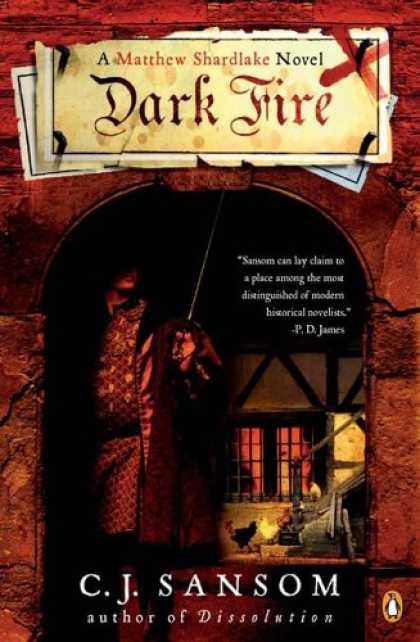
Dark Fire: A Historical with Punch!


I read historical from time to time. They provide a nice touch of what was and perhaps some potential elements for a role playing game based on such elements. A good one is a great stepping stone into another time. I saw Dark Fire on sale at Borders during one of their various fire sales and picked it up. Even though this is the sequel to Dissolution, I had no problem reading it from start to finish and pondered its evocative images of a time long gone by.


But how does that help a person running a RPG? Below I’ll be discussing Dark Fire, using quotes from the trade paper back by Penguin books.


“There was a pleasant breeze; we were too far from the City walls here for London smells to penetrate.” pg. 31


When describing the background, remember that there are five senses. Smell can be a powerful one. Sight is the standard. Hearing can be used to point out some unusual elements or some very standard ones when trying to reinforce how a particular place is. For example, the lull of the waves against the shore. Taste is one not often used because it’s often only thought of during eating. However, a thick mist that taste of sea salt… not so different but still telling.


“His face hardened. ‘And because you care too much for the fate of the Wentworth girl and, finally, you are too afraid of me to dare cross me.’ Pg. 63


“What’s that in your pocketA?” Barak asked as we rode up Bishopsgate.” (pg. 75


One of the ways to get to players that they are in a place that matters, that what they are doing matters, that where they are going matters, is to put effort into it by providing names to locations, events, and people. It definitely takes more time as a game master and can be frustrating when the player’s don’t bite, but at the very least, at least you’ll have those names if the players come around that way again. This is most often useful for places that the players will be again and again. It allows the players to get an idea of the size of their home, the types of people that live there, and what is currently going on.


Shardlake’s patron is none other than Cromwell who has charged him with finding an ancient formula for Greek Fire, also known as Dark Fire. The important thing though, is this isn’t a simple “here’s 50 gold to do the mission.” This is a patron of many passions whose good to his friends, but always a hard man. If the players have a leader that is a Non-Player Character, why do they work for him? What does he do? How well connected is he? Is he a man with a reputation that insist one should not cross him? With the alignments in 4e simplified, it’s probably a little easier to handle a patron like that then in previous editions where players were often assumed to be working for the ‘good’.


“You’ve killed Sam?’ Toky’s voice was a horrified croak. “You’ve killed Sam!” pg. 446


Toky and Sam are two mercenaries who have been a plague on Shardlake and his comrades, getting into the spots they need to long before them, killing those they need to talk to, and seeking to end the life of Shardlake and his comrade.


However, they do not come across as nameless brutes or thugs. While doing research on whose attempting to get in their way, the backgrounds of Toky and Sam and brushed up and they’re given a little more character.


When you can give the bad guys flavor and flair, don’t be afraid to do so. It’s far more interesting to fight Toky the former mercenary with the plague ravaged face than another level 6 brute.


“He took a shuddering breath. ‘Lord Cromwell has fallen!’ Pg. 482


One of the continuous criticisms of the Forgotten Realms, is the wide plethora of powerful characters. Here, the author takes a real world figure, one of great power, perhaps only second to the king, and show cases that even when the players are successful in their own mission, that it may not always be enough. With their patron fallen, Shardlake and his comrade have new venues to explore and new adversaries and allies to discover. If the campaign is getting stagnant, don’t be afraid to kill the NPC’s and leave the players to their own devices. They might surprise you.


“She shook her head. ‘Class is everything. I am a Vaughan. Once I would have been happy to know you, you are one of those fit to be raised up, as my husband was. But not now, given your past loyalties and who the new powers are in the land. And I will not be lowered to your status Matthew.” She shook her head again.” Pg. 489


For a game based, in theory, on a certain time period of history, it does a bad job in many aspects of capturing those elements. One of those, is in class status and social levels. Perhaps back in the day when Unearthed Arcana first rose as one of those original hard cover supplements and its random tables allowed you to roll on them, did the core game concern itself with those elements.


And in those elements, there are a lot of potential role playing opportunities. Class in and of itself, is often seen as a divine right. It’s often seen as a right of arms. It’s seen as a right of inheritance. It’s seen as a right of the noble blood.


The benefit of using class in this manner, is that most characters are completely unconcerned with class. Now mind you, if your game is heavily focused on social class and status and you’ve been running such games for a long time, you already know this. But it’s a potential gold mine of role playing for characters because when they don’t care about who you are, but rather, as most players do, what you can do, it upsets the existing standards greatly.


This can be a useful tool for launching various aspects of the campaign. It can also be one for showcasing personal failings. For example, despite Shardlake’s kind spirit, he has failed to notice that one of his own workers is half blind and that is the cause of the numerous failings we find the lawyer yelling about in terms of quality. Even Shardlake, the hero of the story, has his own flaws as he merely thought his man incompetent and lazy, not suffering.


Dark Fire is full of great descriptions and it comes through by using a wide cast of characters and having numerous plot lines in the air. It provides descriptions that often come to light latter and provides a twist at its ending that doesn’t cheat the reader. If you’re looking for something to inspire, C. J. Sansom’s Dark Fire might have what you need.