Showing posts with label Conan. Show all posts

Sunday, September 8, 2024

Conan vs Barbarianism

 One of the themes that Robert E. Howard returns to again and again in his Conan tales, is the idea that civilization is a temporary thing that must be wiped out by barbarianism.

That's nonsense, even in his own writing.

Conan on the other hand?

Well, as the protagonist, even when he should be dead multiple times over from a wide variety of sources, he changes the tide and sets the course.

If barbarianism had been the superior way, Conan would've died multiple times over because as often as he's written in the bowels of deep civilization, he's also against those with whom he shares more in common.

And because he's the protagonist, he's better at almost every single thing they do than they are.

Conan is a Cimmerian. It's hill country.

Try telling that to the dozens if not hundreds of Picts Conan has killed. Doesn't matter if he's ambushing them in the woods, his own hunting and woodcraft far outstripping 'barbarians' whose lifestyle Conan is emulating, or just outrunning them over open terrain and avoiding them shooting at him as he's climbing up a ledge and casually pulling arrows out of his legs.


It doesn't matter if he's on the frozen plains fighting against the Vanir. He's better than the Vanir at everything they do.


It doesn't matter if he's a Pirate off the coast and raiding countries that no civilized people even know about when he's fighting with and for the Kushites.

Barbarianism isn't the answer to civilization.

It's Conan.

Saturday, September 7, 2024

Conan Is Not A Hero

 One of the things that I've debated with others about is the difference between Conan being the protagonist and Conan being a hero.

Sometimes herosim can be a difficult thing to define.

For example, Conan often has a sense of honor and a sense of fair play. It's rare for him to betray someone even if he knows that person is going to try to do him in.

And Conan meets a lot of fellow rogues and slayers and he trusts them because of the whole honor among thieves.


Because Conan is the protagonist, this works well for him. Things don't even well for the Prince of Thieves here.

But here's the thing.

Conan is here breaking into someone else's place. Mind you, those who try to cast Conan as a hero often note, rightfully so mind you, that those Conan steals from, are often the worst of the worst. In this case a wizard necromancer who tortures and enslaves others.  Whose wealth and power give him full domination over the city and its rulers.

But we have to be clear.

Conan isn't doing it to rid the city of the necromancer. He'd rather not even meet the necromancer if possible.

This doesn't count other times where due perhaps to his nature, Conan repays those wrongs done to him even if those wrongs were done while helping Conan. For example, in A Witch Shall Be Born, ther'es a scene where Conan is nailed to a tree. It was made popular in the movie, but it took place in this story first.


This is another one of those things where Conan should've been dead but he gets saved by an outside force. But when he's saved, his savior does not do it gently and Conan suffers a bit for it. As soon as he's well, he repays that saving by crushing the dude 's wrist and banishing his savior from his own band of rogues.

There's another story where Conan drags himself out of the Sea into a boat, ingrains himself into the crew, follows the Captain ashore, and literally murders him. And note, since we're talking Cimmerian September, I'm just sticking with Robert E. Howard stories.

Again folks, Conan is no hero.

One could argue that in the world of Hyborea, where Conan is an adventurer, there are no real heroes, and today's allies may become tomorrow's enemies. 

These things are true.

But those elements don't fit into D&D and its nine alignment systems. Conan commits great acts of savagery and also acts as a savior. He's almost never a casual murderer and does not go after women and children.

When looking at the idea of inspiration for your TRPG games, try to remember, games like GURPS and Hero, where one can take disadvantages that indicate one's personality, like 'Honorable Strong' or 'Fears Magic' etc... are more likely to be useful than D&D where it boils down to "What's your alignment?"


Friday, September 6, 2024

Conan is the Choosen One

 So I've mentioned it before, but Conan, the barbarian, is saved through all sorts of things or just doesn't die when he should.

He falls further than he should be able to survive but hits something that saves him.

He's overcome but his enemies leave him for dead.

He's about to be killed, but unexpected allies show up.

He's about to be killed, but unexpected enemies show up.

He's about to be hunted down, but his enemies realize he's on sacred ground or something similar and leave him alive.

One could argue those are all just bad writing plot devices. They are and these examples all happen under Robert E. Howard's pen. If you were going to add other writers the list would be nearly endless. The list of Conan being a chosen one would be near endless too,

But for Howard himself? Yeah, Conan is still the chosen one.

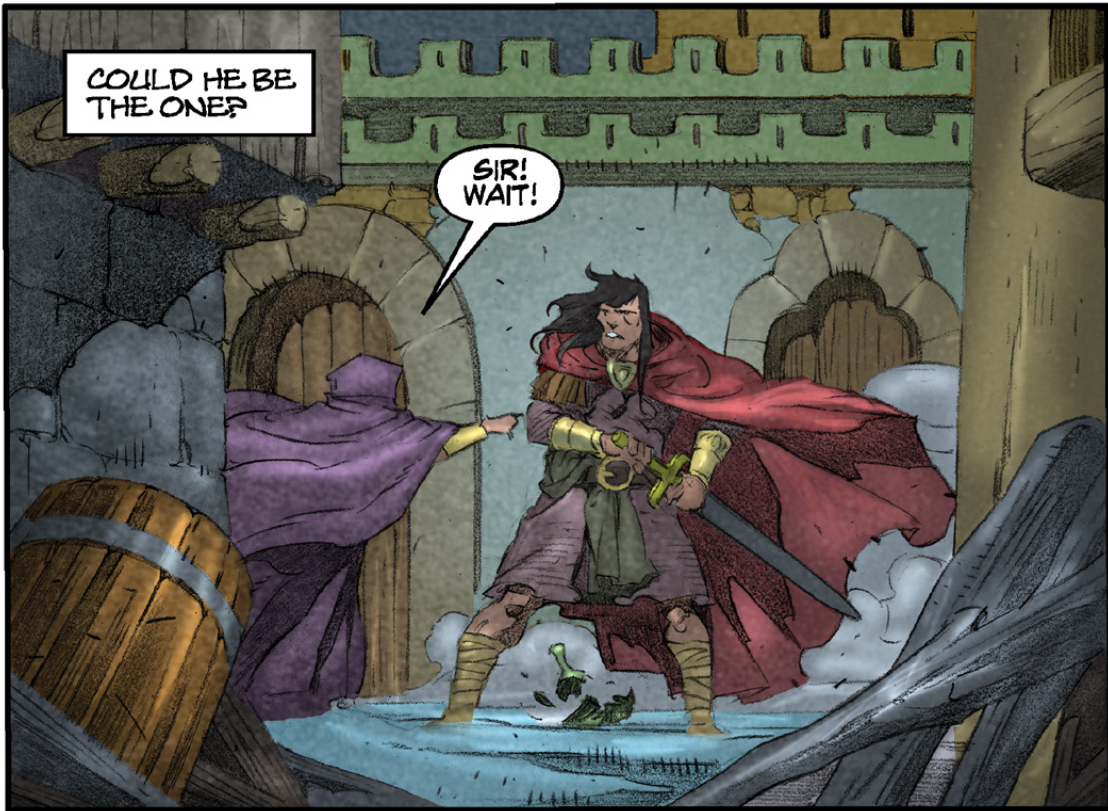
Here's a princess literally being told by the servants of Mitra in Black Colossus, available in The Coming of Conan the Cimmerian https://amzn.to/4dYywVh, to place the kingdom in the hands of the first man she meets.

It's Conan.


And that's fine.

But it's another showcase that Conan, even under the hand of his original author, is a chosen one.

He'd kinda have to be since the very first story of Conan is him as a king.

There's no worry that he's going to be killed ahead of that eh?

So when you see the Bro OSR chest thumpers talking about how the old school is the best school because it's sword ad sorcery origins give it a more fatal scenario of how characters live and die, know that they either haven't read the original Appendix N books or they're ignoring the heroes of those books to utilize the old school rules as a club to kill characters.


Sunday, September 1, 2024

Conan, Dungeons and Dragons, and Surviability

The difference between Inspiration from a source of material, even one found in Appendix N, and game play itself, can be vast.

One of the things that cracks me about personally about some of the 'Bro OSR' or the hardcore OSR players, is that it's too hard to die in 5th edition and the character death is needed to make the stakes real.

Those folks either ignore all of Appendix N or decide it's inspiration was in the monsters and dangerous bits.

Even the blood soaked savage Conan is saved often through sheer nonsense.

In the first tale of Conan ever penned, The Scarlett Citadel, available in this collection, The Coming of Conan the Cimmerian (Conan the Barbarian Book 1) https://amzn.to/3TfFPzI , Conan is saved from certain death by some dude we as the readers have never heard of before.


It's literally the first time this sort of hand waving to save Conan occurs, but it's far from the last time it happens. There are times when Conan is left for dead, as happens in The Hours of the Dragon (available The Bloody Crown of Conan (Conan the Barbarian Book 2) https://amzn.to/3X5GdBX ). Heck, a re-read of Hour of the Dragon shows it happens several times including once when he's left in a field where ghouls try to eat him and he awakens 'luckily' enough in time.


If you've ever seen some of that 'hardcore OSR talk', you'll know what I'm talking about. Stabbing downed enemies and mounting their heads on pikes and that sort of stuff. and other times when some other unlikely circumstance saves him.


Elric, Corum, and others in the original Appendix N all have similar moments.


When deciding what the fatality levels of your campaign are, don't feel too bad if you push them to not be as strict as the original 1st ed AD&D where death at -10 is something mentioned in the DMG but not the Player's Handbook. You're staying true to the source material that inspired the game.

Saturday, April 11, 2015

H is For Howard


Back to the semi-regular A to Z Challenge.

H is for Howard.

Robert E Howard to be more specific.

On one hand, some people might think that Robert E Howard needs no nod, needs no recommendation, needs no introduction.

I would ask those people how they enjoy Robert's historical fiction. How they like his Western stories. What they think of his horror writing. How they like his boxing tales. Yes, a genre devoted to boxing! Hey, the 20s and 30s were a different time man, don't judge!

For some people, I don't want to generalize and say most, but for some, Robert E. Howard only comes to their mind thanks to the movies about Conan. With three movies under his belt and another supposedly on his way, Conan has earned a bit of that fame. No shame in that.


Some might have been introduced to Robert E Howard though one of the other movies including Kull or Solomon Kane. Neither of which actually has much to do with the material it was based on. Well, in that aspect at least the Conan movies share some similarities as much of the material in the movies has little to do with the fiction.


Outside of the movies, Robert E. Howard has benefited greatly from the efforts of +Dark Horse Comics who have not only kept Conan alive and relevant in today's market, but have also brought many of his lesser known characters, including the aforementioned Kull and Solomon Kane, to comics. Even better, they have reprinted many of the older books, including the magazines. This brings the older era of comics to a modern audience who otherwise would not have that historical context to enjoy. For an example of not Conan action, check out tehir Robert E. Howard's Savage Sword with a free preview here.

Equally important, not that long ago, Del Rey publishing brought back numerous stories and not just Conan. This allows those with an interest in one of the giants of many genres, not just sword and sorcery, but horror, history, pulp, and western, to get a taste of tense, action packed writing.

When I talk about a solid foundation, one of the benefits of reading material written long ago, is no matter what the author's intention, you also get a touch of the author's time. Robert E. Howard was no stranger to the recently ended horrors of slavery. He spoke with numerous people whose relatives had been freed in living memory. Whose relatives might have directly come from Africa. He knew the horrors of the boom town. The lure of money and the desolation of the wastes. His America was a different one that we currently live in.

Take some time and get to know Robert E. Howard beyond Conan, beyond Solomon Kane, and beyond Kull. You'll be glad you did.


Sunday, July 13, 2014

Savage Sword of Conan Volume Six

This is the last of book of the Savage Sword of Conan that I own in physical print as well as digital copy. Dark Horse did a fantastic sale not too long ago on the Savage Sword of Conan where the whole bundle was a little under $90 bones for like sixteen volumes of black and white nostalgia.

This volume, like many in the series, is a massive tome that clocks in at well over five hundred pages. Roy Thomas, Michael Fleisher and Bruce Jones are the main writers this time around, and included the Conan gold standard of artists, John Buscema, as well as Gil Kane, Ernie COlon, and one of my favorites, Ernie Chan.

This volume collects issue #61-#71 and retails for $19.99, although Amazon has it for $14.04. Those who want to see a free preview of this collection, can check out the Dark Horse website.

This volume tends to be heavy of the 'solo' stories with done in one tales. These usually pit Conan against the wizardry or military might of someone who thinks they know better than the barbarian and well, they usually don't live to regreat it. Some of my favorite bits that come through the title, tend to overlap with material I'm looking at in terms of RPG gaming right now.

For example, in one of the tales, Conan is sent to seek out the secrets of the sorcerer Tamar-Shar Khun. He is sent there because the sorcerer is supposed to "devised a means of making both crops and beasts grow swiftly to sizes most wondrous." And that's needed because the king conan is serving is in a country where famine is upon the land. That whole bit could easily be from any Dungeons and Dragons campaign.

But in terms of gaming, I'm reading the sourcebook, Seclusium of Orphone of the Three Visions, a sourcebook for Lamentations of the Flame Princes, and it's about wizard's domiciles. Kind of reminds me of the old bits from The Complete Wizard's Handbook back in the day. But it reminds me of it because of some of the things that Seclusium talks about, correspond to what happens in the lair of Tamar-Shar Khun. There are magic and mundane traps, guardians of supernatural and standard variety. It's a nice pace and it's done in one issue! Great stuff.

Similar but of more 'high magic' is when Conan is part of a caravan bringing gifts to the alien entity Giyune of the Three Eyes. Here is another ancient power with his own unique lair and unique aspects of the lair that can challenge even the most resourceful characters.

Another thing that occurs, is that the 'bit players' are there to essentially die in order to warn Conan of danger. For example, Zerbo is a giant of a man, but a terrible fighter. When he fails to kill Conan over jealousy, he warns Conan that the queen is after his life and shortly dies thereafter. Next up, Conan's love at the time, is also cruelly handled and dies of torture, but not before affirming what Conan already knows.

Slogans: This is one I've hit before. I've mentioned that a good battle cry is a signature for characters and is often used in super hero comics ranging from Avengers Assemble to It's Clobbering Time to the more simplistic Hulk Smash. Here though, it seems that the gods are the ones to call on. This ranges from Favors of Kilili, By The Holy Eyes of Mitra, Merciful Mother of Mitra, Loins of Ishtar, to.. well, let's just do a quick table:

1. In Crom's Name
2. Crom's Devils
3. Crom and Mitra!
4. By The bones of Crom!
5.By the bears of Crom!
6. By Crom!

Thee are probably a few more I could have grabbed but I thought those sufficient.

One of the most interesting things to me, is that the authors have no problem abandoning a storyline before it's conclusion. Conan, as a pirate leader, takes a merchant vessel's cargo, and one of the ladies of the ship, tells Conan that she knows where there is treasure to be found. Before that story goes anywhere, the crew mutinies and the ship is sunk and Conan, in the same tale, is off to an ancient tribe of immortal Amazon's. Perhaps that tale picks up later but I found it interesting. It was like the author said, "Are people enjoying this? Nah, let's move the action."

There are also some bits that Conan never learns, but that the author is kind enough to provide the reader. For example, Black Cloaks of Ophir, features two military groups, the Black Cloaks and the Iron Maiden Corps. They seeks to have power over the people like Thanus, the Hyborian who first founded Ophir. Turns out that Thanus was buried alive and became a huge ghoul, feeding off the family as they were buried in the same crypts that he was. A neat little twist to things that Conan never learns, but the reader is cued in on.

Some writers will also talk of 'killing your babies'. Find something in the setting and smashing it. Conan is responsible for the destruction of an Amazon society, and does damage to a group of man bat's society. Both are fantastic and fit into the 'weird' aspects of the sword and sorcery age, both isolated from the rest of the world by distance or special means. Both easily added to any game and just as easily destroyed.

Again, for the art and for the various bits that can easily be lifted for any role playing game, I highly recommend the Savage Sword of Conan.


Sunday, February 9, 2014

Savage Sword of Conan Volume Two

Dark Horse comics have long brought new life to Conan. I'm old enough to remember the many times the Conan stories have fallen out of print and when there were no new Conan books nor comics. In their revival of Conan, Dark Horse did something that hasn't been done in decades. They've taken the older Marvel Comics material, and made it available again.

These reprints have taken two forms. The old color comics were collected into graphic novel sized trades while the old magazines, the darker, more violent, more adult material? Reprinted into the Savage Sword of Conan. Volume Two has a host of excellent artists and fantastic covers. For a preview, the Dark Horse site has one available here.

It's always a pleasure for me to read these old trades. Their done up like the Marvel Essential titles in that they're huge thick volumes on 'newsprint' style paper but that's not the joy. Rather it's seeing some of my old favorite artists, most notably John Buscema. This volume collects 11-24.

There are always nifty bits in the series that are perfect for nicking for your RPG. I'll be discussing specific spoilers below so if you'd rather not have your knowledge of ancient tomes of Conan ruined, read no further!

Because it's such a meaty volume, I'll be going easy on how many tales I'll pick this time around. I'll limit it to the first two. The volume starts off with Abode of the Damned, based off the story The Country of the Knife by Robert E Howard.

1. The Abode of the Damned requires specific methods of entry outside of the obvious sneaking or storming. The first is to be vouched for someone who is known in the Abode. The second is to kill an armed person of the city. The third is as a slave. Conan manages the second quite easily. Not only that, the Abode is a special type of place, one for rogues and outlaws whose sword skills or other talents may be in high demand. Locations like this are perfect for those out of the way spots on your maps that don't have any information on them.

2. Hidden Identity: When Conan meets those going to the Abode, he claims to be someone else. this allows him to easily enter into the city and perform his business until his true identity is learned. Having hidden identities isn't something that should just be limited to villains. If the players can reasonably do it, such as being in an area where their names are known but not their likeness? Or those descriptions of them are wrong? But even as Conan goes about hidden, so does one of his foemen who if his true identity were known, would result in him losing power and prestige due to the racial enmity between the various factions of the land.

Having different ethnicities in a campaign can add a lot of complexity and if the game is merely about plundering dungeons, such details may be unimportant. But if the players can gain leverage by pointing out the differences in tribes and politicians and even religious beliefs, they can force one side or the other to come to them for assistance.

3. Timer: The Abode has an ancient planet consuming alien disguised as a gem stone. Three strangers come to the city to destroy it. The unsatisfying thing about this from a RPG prospective is that the characters don't really learn about this fact until nearly the end. In a role playing game, you can put a timer up and see if the players take any special action. I've read reports where the GM did this and every time the timer hit zero, a PC's head exploded. Provided lots of motivation to them.

4. Destroy your Idols: The writers had no problems destroying the cities and landscapes of the setting. By having a rough idea of what the city is and what its purpose is, the GM isn't necessarily going to ruin a lot of work by destroying it. By the end of the story, the Abode of the Damned is crushed below its foundations by powers from outside space and time to stop the alien menace inside it.

Next up is the Haunter of Castle Crimson.  This story is adapted from The Slave Princess by Robert E. Howard. The comics never had a problem borrowing from the Robert E. Howard library and liberally applies those ideas and concepts to the character of Conan.

1.Start the action! The book opens with a city in its death throes. A group of raiders have taken the city and are busy slaying the last of those alive in it. Into this maelstrom of death and carnage comes Conan who thanks to his own sword skills and abilities, is able to take from the takers including jewels and a specific slave. If you start the adventure off with the players in a situation that they have to act, it brings them to the table much faster as they have to figure out how they're going to interact with the mayhem around them.

2. Old Friends: Conan is made welcome at Castle Crimson because he knows the lord of it from olden days. Assuming the players don't murder and mutilate all that they come in contact with, provide them quick updates from time to time on where their old contacts and associates are. For example, if you've run an Adventure Path and the players initially took work from some merchants or low ranking nobles at one time, have those characters show up later either further up the ranks of their profession or fallen on hard times and looking for assistance to win back their former glory. They make good methods of adding adventure side quests or providing the players places to hide.

3. The Big Swindle: Conan saved the slave from the falling city because she looks exactly like a missing princess who is promised to someone who is offering a lot of money for her return. Conan's plan is to get the money and pawn the slave off as the princess. This falls into the pattern of the writers of using one person's identity, false or not, to hide the true personage. If the players meet people that appear to be of no importance, having one of them turn out to be of great importance later that have seen the players at their 'true nature' could come back to haunt them. Then again, there's nothing preventing the players from doing something similar themselves, especially if they have hirelings and or henchmen.

4.Complications: Ah, that brilliant plan of Conan's is cut short when his old ally and friend falls in love with the slave and is willing to kill Conan to keep her. Conan though valuing his friends more than money merely defeats his friend and doesn't kill him. In role playing games, such a fate might not happen and the GM should be ready to have any complications he throws into the game go multiple ways.

5.Secret Passages: The Castle Crimson is old and it has secret tunnels through its bones. Having secret manners and methods to enter such a place may allow the players more freedom than others might have. Such locations also make good ambush points since if the players weren't supposed to know of them, who can they go to for help without revealing themselves?

6. The Antechamber of Hell! While assassins sneak off with the slave pivotal to Conan's trade, Conan hunts the assassin down and finds him in a sunken cell where bones have been laying for over twenty years. This bone filled chamber does a few things here. The first is that amists the bones are weapons. This could allow players to find new items if for some reason they have lost their own, or if they have fallen behind the 'tread mill' in games like 3rd edition and 4th edition of Dungeons and Dragons where items of X power are assumed at Y level.

The second is that the bones come to life when blood is spilt upon them. In a fight with others, say bandits or other attackers, for every round that edged weapons are used and successfully draw blood, more skeletons could be activated, attacking the person whose blood awoke them. This could cause the players to shift tactics quickly or to maneuver themselves out of the chamber and allow the undead to overwhelm their enemy.

7. The Big Swindle Undone: Turns out the slave girl Conan thought was a princess is actually a princess. The case of mistaken identity works to Conan's advantage though as the complication from earlier is turned to his advantage. When having cases of mistaken identity, don't be afraid to reveal that it is no mistake. Or is she? For example, the slave girl is actually a slave girl but takes to the role so well that even the girl's father is fooled.

An inexpensive collection with some fantastic art from the greats of the 70's of comics, Amazon has this available in Kindle format for $9.99 here or in paperback version for $14.05 here and it is Prime eligible.

Saturday, April 13, 2013

The Savage Sword of Conan Volume One

As I'm going through my books, some reorganized, some being boxed up in case I have to move, one of the series I've gone through again and again, is the black and white compilations of the old Savage Sword of Conan reprinted by Dark Horse Comics. At a cover price of something like $17.95 when I bought it, probably cheaper through Amazon, you would be hard pressed to find a better visual deal.

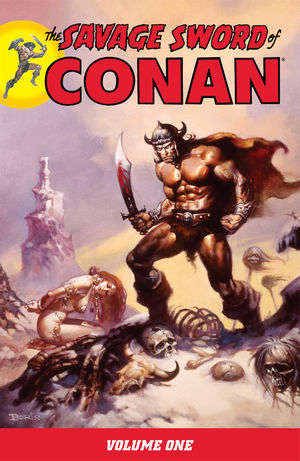
When I say visual, I mean that it has a lot of well known comic artists ranging from Barry Windsor-Smith, John Buscema, Jim Starlin, Al Milgrom, Walter Simonson and others. The cover itself is an old Boris image and probably not one of his better ones. While the background and skeletons and material look fantastic, Conan himself looks like he has some intenstinal problems and the lady looks like she's just turned her head to avoid seeing something.

But the stories inside also contain a wealth of inspiration both visual and written. Some of it drawing on Robert E. Howard's original material but much of it new. Well, new at the time eh?

So what could a role playing GM take from it?

Atali: In the first story, one I believe reprinted from the comic proper, and one done up by the master himself, Conan meets Atali, the First born of Ymir, the Frost Gian't daughter. While she has no combat role in the encounter, she does lead Conan into an ambush and is whisked away from trouble by her father before Conan can have his way with her. Seemingly innocent people leading characters into ambushes is an old favorite of Robert E. Howard and he's used it in many situations. In some instances, the person leading the ambush doesn't even have to be 'innocent' looking but may have something that the players need.

Red Nails is the next story up. It showcases Conan and Valeria of the Red Brotherhood against a decadent city of savages who've fallen from their once timeless strengths. Some try to sacrifice Valeria for the promise of everlasting youth. Some Conan because he's simply too dangerous to keep around. There is an ancient item that in D&D would act as a wand of disintegration or something along those levels. The war between the internal factions also makes a good set up for a good 'hex crawl'.

Another bit here is the fate of the horses. The characters aren't in visual range of their horses, but they hear something happening to them. "Horses in terror and agony and mingled with their screams, the snap of splintering bones." It also showcases that in isolated regions, some strange monsters may pop up as Conan winds up fighting a dinosaur in this far off region.

Among the old adages here, Conan comes into contact with more treasure that he could ever possess or take back. "Precious jade? Surely not in such quantities!" The walls themselves are covered with it. If as a GM you put in vast decorative wealth, don't be surprised if the player's try to steal it. On the other hand, it is a common trope in Sword and Sorcery settings.

In another yarn, The Secret of Skull River, the inhabitants of a small town are poisoned, turning into horrid mutant things suffering from boils and a leprous appearance. This is a byproduct of magic being done at a nearby tower. In addition to the poisoning effects, the wizard has turned brothers into what can be described as either hill giants or ogres. This method allows the GM to put some monsters that might not fit into a standard Sword & Sorcery campaign by using magic to turn normal people into limited monsters that may never show up again but can fit the bill at the time. One interesting twist here, is that Conan winds up befriending one of the giants, Grandall, who only seeks to be human again.

This isn't necessarily another 'standard' but even in some of the old fantasy video games, when you beat an enemy, you can 'befriend' that enemy or use them in your party. The GM can set up the character to have a 'health bar' that resets on the players side if the players beat the monsters but do so in a way that brings the monster to their side. This can be as simple as communicating with it, some odd ritual if they need the monster or something else that fits he campaign.

Curse of the Undead-Man starts off in a manner that some games can use. For example, if your players have been like mine, at times they may have too much freedom. They may be pondering things to do. They may be debating and discussing and the game may not get started for hours. That's when you bring the game to them. Curse starts off with Conan merely walking down the street and having first one group running into him seeking to escape from some pursuers, and then another group, this one armed and waiting to deal death, seek them out and in doing so, run into Conan. It also brings in Red Sonja, who at this point, we've not seen as readers before, but knows Conan. The recurring NPC or the 'guest player' make a good fit here.

Black Colossus is a story I've covered in a different post. This one is a single issue as opposed to the five issues that Dark Horse took to tell it in the graphic novel. This one benefits tremendously from John Buscema's art in its showcasing of 'cyclopean blocks and shattered stone images amid the sheer breath taking sweep of the naked desert beyond." It also brings in the hand of the "railroad" in that a princess in dire need seeks wisdom from the temple and her god Mitra bids her "Go you forth alone upon the streets of your capital and place your kingdom in the hands of the first man you meet there." Who of course turns out to be Conan. Another example of the story coming to the characters.

A Witch Shall Be Born has a few goodies to yank. The first being 'the evil twin'. The second being 'the mark'. Mind you in this case the evil twin has the mark so it's one and the same here. In other settings though, having a birth mark of a certain type can put the characters in a position of notoriety or fame. The evil twin can have many implications. For example, if the players are new in town, they may be mistaken for someone else. They may be the 'evil' twin so to speak.

The Savage Sword of Conan has many unique monsters with great visuals. The black and white ink work showcases the Cimmerian age well.


Sunday, April 7, 2013

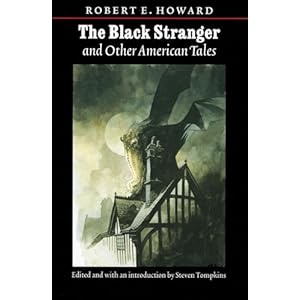
The Black Stranger and Other American Tales by Robert E. Howard

Robert E. Howard is best known for his sword and sorcery contributions including Conan, Kull, and Solomon Kane. Each of which has had movies, comics, and other good stuff developed around them. Having said that, Robert E. Howard also contributed a lot to the horror genre. Mind you, things weren't quite so broken apart that Conan never experienced some horrific situations.

In many ways, the heroes of the horror tales, are more similar to August Derleth's tales in which there is opportunity to battle against the horrors as opposed to the original Cthulhu myths proper where well, even finding out about how insignificant you are was enough to send your pansy ass shrieking to the abyss.

I was lucky enough to pick up this volume, along with several others in the Bison Books reprints for cover price. Now the only two I don't have, that I'm aware of, are the Boxing Stories and Lord of Samarcand, both of which tend to veer up in price. Perhaps those two were limited, or even more limited printings. On the other hand, I've read most of Robert's work before thanks to the old Baen reprints way back in the day and the more recent Del Rey publications.

This volume, starting off with the Black Stranger, makes me smirk when it has "Other American Tales" on its cover because the Black Stranger is actually a Conan novella. I'll be discussing some specific spoilers below so if you'd rather not know specifics, read no further. Short review would be it's Robert E. Howard and unlike say Tolkien, Robert manages to put more story in a handful of pages, or at least more action, than Tolkien does in sixty.

Onward!

1. Starting in the middle. As the tale opens, Conan, unnamed at this point, is in the middle of a dead run. His equipment stripped from him, his body ravaged by minor cuts and bruises, he is on the lamb from a legion of Pict enemies. When running your own campaigns, if you have enough trust and buy in from your players, don't be afraid to start in the middle. Have them roll dice for initative. Have them already be in the middle of the story.

2. The Human Foe: While there are supernatural entities here, Conan's main enemies are those who like himself, are reavers and pirates. He has to spend more time navigating the quickly turning truces he forges among the powers in the manor and pirate boats, then he does fighting against the Picts and the Black Stranger himself.

3. Treasure is Fleeting. In 3rd edition and onward, the game made some changes to how a character was assumed to be armed. In this volume, Conan boasts, "What are a handful of jewels to me, when all the loot of the southern seas will be mine for the grasping?" (pg. 76) It's a feature of the Sword and Sorcery genre often where after horrific odds and suffering and loss, the character gives up some or all of the meager treasures to others more in need of them. Mind you, it often doesn't matter to these characters because they are so self assured that more will be coming down the pipeline, they are free with the funds. In a game where the treasure is built into the balance, if the GM makes no effort to compensate for those level assumptions, either in allowing players to have more powers, abilities, statistics, hit points or something, then there is no reason why the players would do so. They will NEED that treasure by the book to survive.

Marchers of Valhalla, The Gods of Bal-Sagoth, and the Horror From the Mound, showcase another interesting facet of these older tales. That its okay to destroy cities, civilizations, and indeed, whole island if it serves the story. Marchers of Valhalla and The Gods of Bal-Sagoth have differences in the way their approach their methodology, but the end result is the same.

In your campaign, ahead of time, have those ancient and decaying civilizations whose glory is held on only by the thinnest of threads that can be snipped by the players if events work out that way. Having the players so equipped that thousands may live and die on their choices, gives them a much greater impact on the setting.

On the other hand, if you do as Robert E. Howard and others have done, and make these isolated civilizations, places that are difficult to find, places that are not normally easy to access, then while the players still have such an ability to impact that society, the overall campaign will only be minimally impacted.

Mind you, in today's society where you can travel sixty miles in an hour or less in a car, the spread of civilization in olden times might be so vastly different that no real mountain range or other magical needs of keeping civilizations separate from each other may need to apply. Distance itself may prove to be the solution.

Black Vulmea's Vengance hits a theme that Robert is good with. Throwing characters together that have no reason to trust each other outside of their mutual need for good sword arms and keen eyes. The initial 'heroes' hate each other due to the deeds each has performed against the other but by the time the novel ends, they at least have tolerance for one another. In role playing games, it can be difficult to have such a situation in terms of the players trusting each other.

On the other hand, if you have players who are okay with such back stories being woven, and they know ahead of time that if they can work things out for the good of, you know, actually playing the game as a team instead of breaking the party down loyalty lines, then it can be well worth doing so. In one of the Elric tales, when he is attacked by pirates, one of the pirates turns against his 'allies' and helps Elric overcome them. The two remain good friends until the typical Elric ally fate falls on that individual.

Another aspect of the old tales, at least by Robert E. Howard, is that equipment is transitent. This isn't to say there aren't fine and quality weapons out there. Even Conan is given a magic sword at one point in the old stories. But rather, by having the characters be more... self sufficient, the characters are the showcase of the story. In certain genres, such as the superhero one, this is far easier to do than in others, like Cyber Punk, where much of the game revolves around who has, or at least knowns how, to use their toys the best.

If looking for some short stories and novellas to get the images of action flowing, Robert E. Howar'ds The Black Stranger has a lot to offer.

Thursday, November 22, 2012

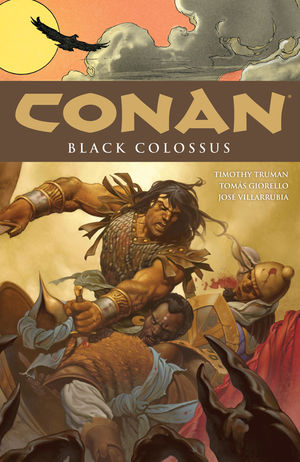
Conan: Black Colossus Volume 8

Recently I was at Half Price Books when they were having one of their sales. In this instance, it was 50% off on a Sunday so I picked up this volume of Conan for like a fiver. From what I know, there are already several volumes past this one but I'll have to wait for the store to have it in stock and for another sale. Thankfully one of those criteria will be met tomorrow and I'll have to see if the other is when I go there.

And sorry if I'm pitching out so many of those mini-notes on the Conan books but while I've got some time off, I figured I'd better take advantage of it.

In the collected Conan comics that make up volume 8, Timothy Truman is joined by Tomas Giorello and Jose Villarrubia. This collection features a new telling of Black Colossus which has had a few interpretations over the years.

One of the biggest problems this volume faces is found in the early version with art by John Buscema. His line work is fantastic. It's not that the artists here are bad mind you. The artist who does the chapter breaks, Joseph Michael Linser, is top notch and I'd love to see him fully illustrate some Conan.

John's artwork though, is gigantic in scope. From the first page of the original, where Shevatas a thief stands on an outcropping of rock locking over the ruins of Kutchemes, the tone is set. In the new version... it's almost a little too carton like in scope in terms of the line work. It's too bright, too vivid. John's artwork relies on the almost impossible to appreciate details he puts into it. His pages are often packed with illustrations while the new volume uses pages like they were going out of style.

Now mind you, that may be part of the whole publishing bit. When stories like this are told for today's audience, the intent is usually to collect them which requires a certain number of pages and issues to do so. John didn't necessarily have to worry about that and may have had to ram the page with art.

The good news though, is the new version is actually more... useful for mining for role playing ideas. It has a few things that I've mentioned are useful to gaming before. For example, Conan has work as a mercenary. His patron keeps him around because he's the best swordsman he has. Sounds like something players would fall into with their unusual skill sets.

In addition, dreams are a part of the scenario here. The princess who hires the mercenaries Conan is allied with is haunted by visions of a sorcerer who desires her for his queen. She on the other hand seeks out wisdom in the temple of Mirtra and is provided instruction. Dreams and the messages of the gods working their ways on the campaign may seem a bit high fantasy for a Conan tale but they're in both versions. Visions and omens from the gods and supernatural elements shouldn't be overlooked as ways to hint at things.

Conan also discovers that working for mercenaries means that there are those who might not like a potential threat to the status quo. In this case, he makes an enemy of a fellow officer who causes a bit of trouble for him. Having rivals that the party members can't simply kill right away due to time or circumstance can add a level of pressure to the players as they have more things to take into account when they make their plans.

Speaking of that circumstance, having something ready and on hand to throw into the campaign to keep it moving is always a good idea. When the mercenaries here are at rest, Conan's patron finds out that they're not getting paid and so that leads to the mercenaries sacking the town and then moving on. Be prepared to move the adventure forward and push the players so that they're not always just sitting around waiting for the next mission.

In terms of my biggest fault with the new version here, is something that probably wouldn't hurt to throw in the campaign every now and again just to add that dreaded 'realism' to the setting. In this collection, the sorcerer who survived three thousand years and the sacking of his own city, loses his powers because he was so focused on getting his queen that he failed to abide by the terms of his pact with his demon god Set. Love makes people do crazy things. Throwing some weakness like this into your master villain can make them more interesting and rounded.


Conan: Cimmeria Volume 7

So we get Timothy Truman, Tomas Giorello, Richard Corben and Jose Villarrubia this time around for the collection from Dark Horse Comics, Conan: Cimmeria Volume 7.  There's some great art this time around as Conan learns, as others before him have, that you can't go home again.This volume felt... cleaner than previous ones. While there is some callback to other events and events here do become incorporated into the ongoing bit in their own way, the whole felt more accessible and stood on its own.

The art is top notch as well. Richard Corben does a bang up job of bringing the adventures of Conan's grand father, the one who in many ways set him on his path, to fantastic light with great coloring to provide some differences between the 'current' story and the flash backs.

In terms of adventure seeds, alas, much of it is old ground.

No Good Deed Goes Unpunished versus Rewarding Good Behavior. On the one hand, you don't want a campaign to become stagnant and only have elements flow in one direction. The world is larger than the characters, larger than the current backgrounds. Those who adventure forth without bothering to learn legend and lore may find themselves stepping into deep waters.

In this instance, Conan's grandfather interrupts a ritual where a mother is slain and her two children are about to be. Turns out those kids were werewolves but the twist is that one of them is 'good' and the other bad. The further twist? Turns out that it's not the wolf that makes the one rogue, but his humanity. O the irony eh?

The other one, the 'good' one, winds up saving Conan and relates that tale to him, even coming back later to provide further assistance.

Giving the game layers and multiple options, allowing it to evolve based on the player's actions, even when their good intentions have bad results, should effect different parts of the campaign differently. Those that are pragmatic and suffer thanks to the players actions may think of them as foolish do gooders who aren't ready for the world. Those that are always on the side of right and righteous may want to take them under their own wing, may want to provide them their own tales and background of how decisions they themselves made went wrong and how they are seeking to undo those negative effects now. Not only does that provide the players an option to bond with some non--player characters, but it also allows the Game Master to sprinkle campaign lore and legend through the use of the NPCs.

I mentioned that this book isn't heavy with ties to previous material. On the other hand, Conan comes across Caollan, his first lover, in chronological order, introduced in the collection Conan 0 although I think printing wise that comes later. The ability for writers of all material to invent the past is one that can be useful when adding details to NPCs and cities and other elements of a campaign. Tread carefully when doing so with the players though. It doesn't hurt to ask a player if they mind you doing X and adding it to the campaign. Many will look forward to seeing what you do but some are very protective of every aspect of their character.

In addition to Caollan though, she is being hunted by Horsa, one of the Aesir who Conan claims to know. Now on one hand, this provides a bit of deeper context to the fighting Conan does and Conan, while I won't say goes out of his way NOT to kill Horsa, it does provide some interesting things to consider when running a campaign. For instance, if two friends come across each other at opposite ends, how far will they go? Will one drop the job? Will they both try to finish it without getting in each other's way? Will they go straight for each other's throat? The impact shouldn't be limited to just that incident though.

For example, if the players are known for being ruthless to former allies, what will future allies think of that? Some may find it appropriate and be prepared for future eventualities including meeting the players again. Allow things to evolve organically.

For the environment, Conan winds us using some weakened ice to escape some pursuit on a narrow ledge. In another instance, to prevent himself from being surrounded, Conan retreats into a cave and the cave ends in a massive cavern that is covered in pitch. Pitch and torch against monstrous flesh? For Connacht, Conan's grandfather, when travelling the passes to his home of Cimmeria, he was almost killed by an avalanche that buried him in snow and broke his legs.

Where are the players? How stable is their footing? How stable is the ceiling? Can things be set afire? Will they have to climb? Will they have to hold their breath?

In terms of switching the visuals around, of using old stats with at least new looking monsters, we have the Skrae. I saw that because while they look impressive and they are excellent trackers, they, like pretty much everything, gets cut down like wheat. They are terror inducing and unique in appearance, but man, Conan's already at this stage met a few relics of ancient eras and killed worse so... Yeah. If your players are looking for some interesting twists, you don't have to reinvent the wheel each and every time you want to throw some 'new' monsters at them.

Conan Volume 7 showcases the old adage you can't go home again quite well and its end throws Conan somber and weary of soul back onto the road.


Wednesday, November 21, 2012

Conan: The Hand of Nergal

Written by Timothy Truman and art by Tomas Giorello, the
Written by Timothy Truman and art by Tomas Giorello, the barbarian's collection travels in this sixth volume have some pros and cons.

For one, it ties up some old business. It also has Tomas Giorello as the full time artists here and he provides some great visuals.

On the other hand, while I like the story well enough, some of it felt kind of "m'eh". And this isn't a bash on the guys doing the work but I've been reading Conan comics for years and Ernie Chan and John Buscema left a huge void for anyone to fill and with the numerous Savage Sword of Conan reprints, even the color art here may not be enough to compete with that old school goodness.

Anyway, in terms of some of the ideas that are good for yanking into any campaign...

1. Recognize talent. Often times players are fighting just to survive but here Conan sneaks past some guards and knocks out the largest of them in order to sit by a warm fire and have some food. Instead of having the soldiers attack him, the commander rewards him for his abilities.

2. The Old Switch: During some battles, a young female magician thief who has come to warn Conan of a great darkness following him is wearing a Princesses robe. She is then mistaken for that princess.

3. Saving Throws. One of the things that was kind of m'eh to me in terms of the story was this ultimate bad ass that looks and people and they crumble before him. Works on everyone. Conan just kinda kills him. It was very anti-climactic. Still, when you have monsters in the game that have an all or nothing effect, be prepared for the players to always make those rolls and at the same time, be prepared for them to fail it. Nothing kills a game quicker faster than a bunch of bad rolls because you didn't plan on the whole party failing their saving throws versus the basilisk glare. I know that in the old computer game Baldur's Gate that was a section that was VERY annoying when all of the sudden you've got a whole party of stone and didn't even know what happened.

4. Swap out the Appearance. The things Conan battles look to be chaos spawn from the Warhammer world but are more or less, animated skeletons or zombies. Still, the art of Tomas Girello brings such vivid features to life that it makes the appearance at least more impressive. Don't have the things that party fights be dictated solely on the standard. Switch them up even if you don't change a thing in the stats.

5. Reminders: Conan is battling an elder evil in this volume when the place starts going up in flames. This ties back to using the environment to spice things up when possible. Maybe every round the players have to make a save or take some minor fire damage or worry about some of the treasure they're there to save? Another bit is Conan gets a good whipping put on him so that the enemy actually thinks he's dead. Well, the book is called "Conan' so yeah, he does survive that and like any true adventurer, quickly recovers and sets back off on the road of victory. Sometimes if the enemy isn't specifically out to murder the players, like they're just guards on a caravan or something, maybe the enemy passes them by while they focus on their real mission?

Conan continues to have some impressive visuals but story wise here I think they were trying to tie up too much material and 'open' up new material for the next volume. Sometimes in these collections it works better than others.


Tuesday, November 13, 2012

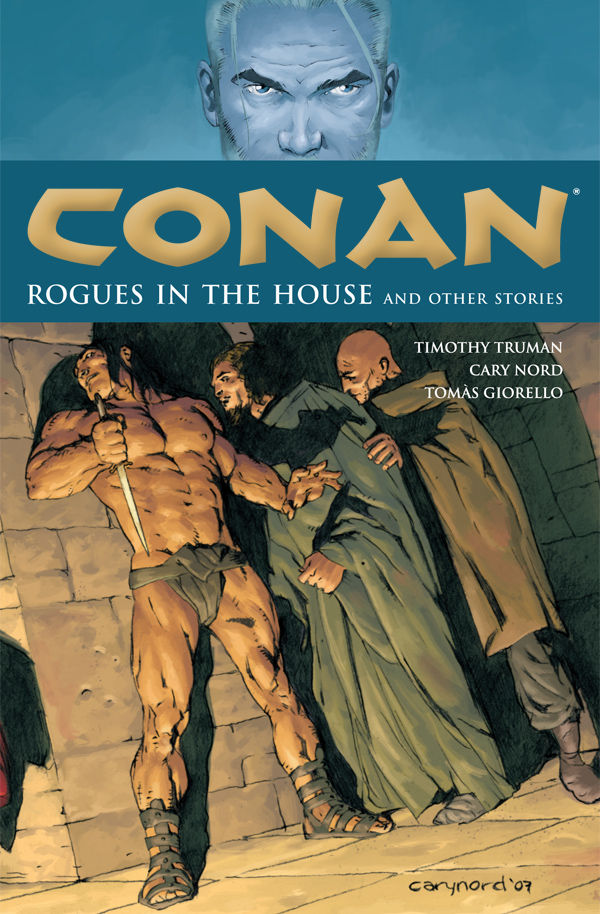
Conan: Rogues in the House by Timothy Truman, Cary Nord and Tomas Giorello

Conan's adventures by Dark Horse comics continue in this, volume 5 of the collected single issues of the series. Written by Timothy Truman this time around with art chores still handled, at least in part by Cary Nord, who does the cover, the series continues to provide a quick sword and sorcery fix for those who prefer a visual run of their material.

In looking at what elements bring conflict and potential adventure, there are a number of elements to put into a check box.

1. Relationships. Conan's ladylove Jiara is a bit tired of the low life living and when a suitor of apparent means and manners comes to woo her, she quickly throws her former comrades to them in exchange for a life of comfort. Of course nothing ever goes as planned but this brings into focus the need to keep characters around the players that can involve them in future adventures.

2. Failure is not the end. Through the series, in both the originals and in various forms of media, Conan is often captured. This in and of itself is something that players often don't like due to the lose of control of their character. However, it can be used to launch new adventures. In this volume, Conan is released from jail in order to hunt down 'The Red Priest'. In other series, such as in the Theft of Swords, when the main characters there are captured, they are put on a new mission in exchange for their freedom and their lives. By putting the game back into play from failure, the GM can keep the continuity of the campaign going while allowing the events to have played out.

In the Shackled City campaign I'm playing in right now, the group recently lost a fight. No one died in the actual fight itself but we were all down and unconscious. The GM decided that one of the players that wasn't there in person that night came in and saved us at the last minute. At first I was a little annoyed at that 'break' in the game but the more I thought about it, the more I thought, "You know, it's probably for the best." A few of the other players had been suffering from some numerous character deaths and didn't want to make another character, a few others were okay with it either way it went, and in the end, the game wasn't hurt by the incident and it fits well into the old movies "fade into black" followed by "to be continued!".

3. Gonzo. By this I mean having a variety of weird elements. In the case of Conan mind you, Robert E. Howard tried a bit to throw in some pseudo science into the game where a lot of the 'elder' beings were aliens who'd fallen into decadence. In this book, the Red Priest's home is host to numerous traps that can be activated through various manners and some of them are almost science-fiction in nature. If it's good enough for Robert, it's good enough for you. Don't be afraid to throw some odd elements into the campaign from time to time.

4.Apes! Gorillas! Monster Men! I've read a bit of Conan through the years. I don't know if it was Howard's initial intent or what but between the old Conan #100 where his lady love there is killed by a carnivorous winged ape, also of a decadent race mind you, or Thak, the monstrous semi-man ape here, as well as others I'm sure I missed, it seems there are a lot of ape potential in the series. This might be more of the 'near' man bit but unfortunately, it's a niche well filled in most fantasy games. Bringing to light the savage and the civilized, the morale and the unfit into contrast is not always an easy thing, especially in traditional D&D games where there are alignments with monsters hard coded to fit those elements but bringing those characteristics to the game can provide more than combat to the game.

Rogues in the House is well told and provides the reader some great visuals and while the classic confrontation between Conan and Thak isn't necessarily up with the iconic image from Fazetta, it gets the job done.


Sunday, November 11, 2012

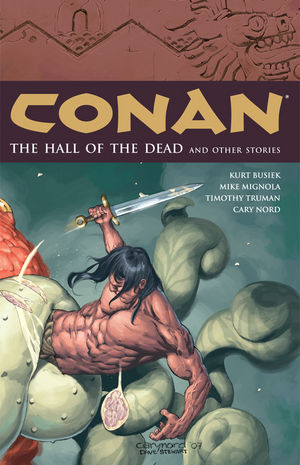
Conan: The Hall of the Dead and Other Stories by Kurt Busiek


One of the interesting things about cleaning up is that you often find things not as you left them. For example, this is volume 4. I can't find my volume 3 anywhere. I shall have to continue the search and hope that it eventually springs up.

In the meanwhile though, Kurt Busiek continues to work his talents on the barbarian and is joined this time around by Mike Mignola, Timothy Truman and the ongoing efforts of Cary Nord, who did the cover in this case.

I'll be discussing some specific spoilers below so if you want to avoid any of those, read no further.

Relationships can be a source of almost infinite adventuring seed generators in and of themselves. The book starts off with Conan wooing a magistrate's wife as he plunders her treasures. This in turn angers his current lover who then goes and has her own affair and in the process, does some more selling out of her own. The back and forth between the two in this instance directly sets Conan against the law and against other rogues.

The 'problem' if you will in such instances though, is that the Game Master has to have a world to hang these characters on. Conan's relationship with Jiara is not necessarily that of true love so while they are both out with others, then those others have to be created and then the people who deal with those others, such as the magister or the nobles, have to be fleshed out. It can be effort, especially for those that are only going to have a few appearances but keeping a set of generic game stats around for such characters can cut down the preparation time considerably.

In terms of good deeds, its often the motto, "No good deed goes unpunished." While that may come around true eventually, allowing the players good deeds to have, at the very least, some good karma, is not necessarily a bad thing either. Kiresh, a young woman who is practicing magic and at such a low level of the social strata that she is thieving her dinner when caught and Conan saves her, then works, behind the scenes mind you, to check on Conan. This allows the GM to return NPCs to the field when they work in the background and provide a reason for them to do so.

For foes, one of the creatures Conan fights here is a gigantic demon toad. When Conan hides from it, his presence is given away by another toad that bellows his presence to his master. Having themed monsters can make for memorable encounters. For example, a gigantic spider, such as the one from the Lord of the Rings, who has smaller spiders talk out her prey.

While Conan encounters his share of soldiers, he also encounters those that include would be bandits. The twist of a 'hero' like Conan though, is that even when killing bandits, he's not necessarily doing so out of a pure motive. Turns out that he winds ups stealing for those who were already being robbed. Mind you he doesn't kill or rape the people he's stealing from and even this robbery comes back to haunt him but having characters that are neutral in a campaign means the GM has to be prepared for more 'work' in terms of what the players will do. They aren't necessarily going to always follow a 'good' script and always be predictable in that fashion.

In terms of bringing old troupes to fantasy gaming, the old horror movies The Hills Have Eyes has been a source of inspiration in Pathfinder with their Ogres, but also in Conan as he encounters a clan of inbreed brigands whose intentions are as monstrous as their mutations. Despite that though, they still have contacts with the outside world including people who bring them fresh victims in exchange for getting the use of their muscles against specific enemies of their own.

In terms of overcoming foes, sometimes you can provide methods to the players that don't necessarily just involve battering the enemy until they die. When Conan battles the demon toad, it's not his sword that kills it, but rather, he drops a massive statue on it. He he's fighting against the hill folk, while his sword does indeed do a lot of killing, knocking out the support for a carved cave and then cutting a rope bridge does an excellent job of bringing that death total up even more.  Provide your players options to do things a little... easier and see if they talk them. These cinematic events can work against the players too mind you if they're not all up to the challenge of navigating the new terrain.

For example, if there is a monk, a barbarian, and an armored knight crossing that bridge and it gets cut, do all three make it across? Does the knight have to tie himself to the bridge to avoid falling to his death? The lightly armored characters, especially in this example, already benefit from a faster movement rate, both because of the lack of armor and the innate abilities. Try to provide situations that doesn't always favor one type of character over another in these instances.

Volume four of Conan from Dark Horse continues to bring the fantasy to a medium that could certainly use more variety and if your looking for some well illustrated tales with some interesting background bits on Robert E. Howard, this graphic novel has you covered.

Saturday, October 20, 2012

Conan: The God In The Bowl by Kurt Busiek and Cary Nord


Continuing to go through the old collection as I'm trying to organize things. Not easy as I tend to get distracted a bit too easily but nonetheless ongoing.

Conan continues his adventures in this collection of the single issues. Cary Nord does a fantastic job of illustrating the series and the colors are fantastic to view. This volume again presents stunning visuals if nothing else for any sword and sorcery campaign. Kurt provides some interesting interpretations of old stories and introduces new characters to the setting.

I'll be discussing specific spoilers below so if you'd rather not have any of that, read no further.

In terms of characters, the Bone Woman and her servant, Janissa are probably the 'big news' here. The Bone Woman was retroactively introduced in the zero volume and in many ways would be a GMNPC where the character is too powerful and can do no wrong. Thankfully her actual use is minimal here.

Janissa is... I don't want to say a poor substitution for Red Sonja, but... she's a red head warrior (and not in every illustration mind you, in some its brown hair) woman whose origin is tied into rape. More elements of the supernatural here? Yes. Similar enough to be a substitution? I'll let people more learned in the whole Conan mythos argue that one.

The thing I thought would fit with most campaigns though, is that the Bone Woman offers her services to those who seek her out. However she does make those who take her services work for her. This makes her a perfect patron for those campaigns that use an employer model. This can be anything from "Go kill this guy" to "retrieve this artifact." What do the players get out of it? Training, unique skill sets, magic items, spells, or other trinkets? Depends on the nature of the campaign.

Part of Conan's tales this volume involve a trip to Hanumar, "once a stronghold of learning and still a place of ancient power." It's necessary to go there because of the Eye of Tik-Pulonga, "Dark and tainted beyond measure." See, one of the few places that Eye can be destroyed is in Hanumar so off Conan and his new patron and allies go.

In standard campaigns, there is often little need to consider how to destroy magic items. Rather the opposite is often sough. But in looking to destroy magic items, it presents something of a different challenge not only in getting to the destination, but in keeping the item from those who would abuse its powers.

Are there items in the campaign that in the right hands would do vast harm and must be destroyed? Are there ancient powers out there that seek to use those powers for their own gain? A patron allows you to add those things in relatively simply.

For example, in older editions of AD&D, there were tables that broke spells down into their rarity. The more rare the spell, the harder to find, and the more to purchase, it cost. Having a patron allows you to sprinkle those things into the game with a ration for it.

In newer editions of the game, magic items became baked into the math that characters required to have. However, their accumulation then felt artificial since they HAD to have them. This mean you had to sprinkle them through the adventurers by 'chance' or allow magic shops on every corner. The patron is a somewhat mix of the two in that there is a source of magic but isn't one that the characters can necessarily just 'buy' things from.

There are other elements in The God In The Bowl worth reviewing but the main story itself is more about the build up of suspense. Its something that I've rarely been good at unless I'm 'on' so to speak. The building of good terror can be accomplished in a lot of ways, the peeling of the onion so to speak, but for most games these days, unless that is the genre you're playing in, such as Call of Cthulhu, which is excellent for this type of scenario, the pay off may take too long. There may be too much investigation. There may be too much questioning.

At the end of the day, Conan the God In The Bowl provides more fantastic visuals and some interesting monsters in the tales of Conan the barbarian.


Friday, October 19, 2012

Conan: THe Frost-Giant's Daughter by Kurt Busiek and Cary Nord

As I continue to go through my various graphic novels and other bits, I find myself looking at my Conan collection one more time before putting them into storage to free up room for various other projects around the apartment.

This volume, the first collection of the monthlies by Dark Horse comics, brought Conan back screaming into the comics field. While no small part of that is thanks to the writing chops of Kurt Busiek, let me be honest and say its Cary Nord's powerful artwork and the amazing coloring job they did on these first issues that brought fans of the genre flowing towards the comic.

I'll be discussing some of the specifics below so if you would avoid spoilers, read no further.

Kurt uses an old method of starting in the middle of the action. Conan comes across a woman just about to suffer some unspeakable horror from raiders when he decides to interfere. By doing this, it puts him firmly into the conflict. This is something that has happened to Usagi Yojimbo many a time. In a role playing game, if your players are even slightly motivated by stopping atrocities, this is an easy method to use.

They are leaving the bar in the middle of the night and hear a scream. Being the poor part of town they would be the only ones to react. What do they do? They are travelling between towns and come across a group of merchants suffering a goblin raid. What do they do. By starting where action is, you firmly put the ball into the player's lap. They have to do something. This is something used in written adventurers as well. The first book in the adventure path by Paizo has the players in a city that comes under attack by goblins. What do they do?

This being Conan though... well, the villagers he saves are grateful but the menfolk who return as Conan's done are a little suspicious of him. After all, he is a Cimmerian. What the hell is he doing so far away from his own people? Most games downplay the differences between cultures and have universal languages. This isn't necessarily a bad thing and playing the differences up too much can lead to its own problems. Having some cultural animosity that can be overcome by actions isn't necessarily a bad thing.

The other part about this being Conan though, is best to lock up the ladies! Conan quickly works his way into one of the village lass's.... er... hearts, but of course she already has a man. Jealous is a powerful motivational tool. When looking at the motivations of those that could be enemies in the campaign and looking for the why of it, jealous is a quick villain motivation.

Another part that follows here, is Conan's lack of experience in the world. He wants to see the Hyperboreans who his grand father described as being something akin to the elves of other fantasy games but turn out to be more like Melnibonians from Michael Moorcock's Elric series. His grand father never ran into them personally but had heard about them and passed that information down. This second hand information allows the Dungeon Master to put out some feelers and if the players don't bother to gather more information then whatever befalls them next is firmly on their shoulders.

In terms of the Hyperboreans themselves though, Kurt does a good job of bringing this ultra-high fantasy race into the otherwise grim and gritty sword and sorcery world of Conan. They are a race of near immortals powering their decadent society with the souls of the dead and using individuals like Conan, whose captured thanks to betrayal, into the arena to fight for their entertainment. Others are turned into monstrous albino hulks that are used to in turn capture further people.

The interesting thing about this volume though, and perhaps its because its the first one, is that Conan doesn't actually 'win' if you look at the big picture. While in many tales his wealth is lost in order to motivate him to keep adventuring, here his big 'win' if you will, is merely his escaping the Hyperboreans.

In some campaigns, the assumption is that if the players go there, they should win through. In some cases though, it should be clear that is not a real possibility and the best they can hope to do is emerge with some new knowledge and know to never go that way again.

Kurt's early work on Conan stands the test of time although the high magic within it may not be to every one's favor and the artwork of Cary Nord is brimming with violence and power. The visuals alone should be able to provide some inspiration if the whole trip of Hyperborean fails to do so.

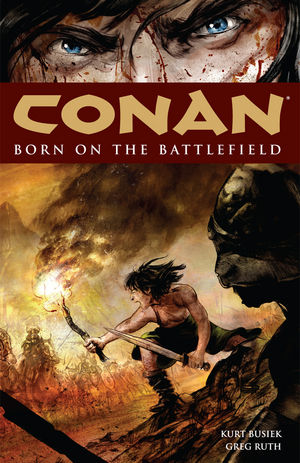
Conan: Born on the Battlefield

Dark Horse comics has been publishing Conan comics for a while now. Not only have they done brand new stories, as well as stories based on Howard's original material, but also reprints of Marvel Comics own Conan stories as well as the stories of Conan from the magazine via the Savage Sword reprints.

In this volume, Born on the Battlefield, labeled 0, Kurt Busiek writes of Conan's youth with illustrations by Greg Ruth. Greg does a great job of illustrating Conan in his various stages of life. I've always been one who thinks more of Conan in his 'pantherish' style rather than the hulking style that is often incorporated into some of the icongraphy associated with Conan.

This volume itself is a nice collection as, like many of the Dark Horse collections, it not only has a great introduction, this time by Ed Brubaker, but has a nice set of additional materials including various sketches by Greg at the end of it. It's a bit of an odd task as Conan is a fairly well known character but it is not the first time Conan's early years and birthing even, have come under scrutiny. I'll be talking about some of the spoilers specific to the book below so if you don't want any information ruined for you, read no further.

First off, as a Dungeon Master, I am not that interested in starting backgrounds for some games. This may sound cold or callous but in a AD&D 1st or 2nd edition game, I'm not too worried about building in too much until the survivability factor comes into its own. If you're a first level wizard with four hit points, I don't need to see six pages of how and why you came to learn sleep and magic missile.

In more... I hate to say story driven games, because I've played plenty of D&D games where it wasn't about dungeon crawling at all, but in games like Hero or GURPS, even starting characters in those games, and others like them, tend to have a little better survivability factor and more reason to have a certain set of skills and a background story can flesh that out some.

As a player, the more complex the game system is without survivability, like Rolemaster, the less likely I'm going to invest any time into making a detailed background myself. For a convention character, I might whip a few paragraphs together if he's not starting past first level.

On good old RPG.net, when the question of background comes up, there are some who prefer only what is revealed during actual game play. It makes the characters more organic and real to them. I can see that point.

I suspect that many Dungeon Masters fear that players try to build too much into their background. That player's are looking for that 'gimmie'. In some aspects, its not a goal without effort. While writing may come naturally to some people and like pulling teeth for others, it still involves some effort to write it down, to provide it in context of the setting, and to present it to the Dungeon Master. Is that worth a reward? Depends on how the DM is going to run the game and what the long term intentions are.

Anyway, most of Conan's background doesn't really lend itself too well to a RPG outside of the events of his birth where his mother is fighting on a battlefield, hence the title of the volume. Events like these can fall under an 'omens' table if you will.  The old Central Casting: Heroes of Legend provided a few different types of tables to roll on for these bits. Mind you though, there are differences between where your born and what happens when your born. The battlfield for example, is merely a location. Making the birthplace an unusual local isn't a bad thing mind you, but what if it'd been in a castle during a siege? What if it happened in jail or a brothel?

Adding other details like a twin tailed comet being visible to all on that night, or all the milk turning sour or the birth of farm animals with hideous mutations? That's an omen.

For much of the material, Conan's personality traits tend to emerge, but that would be somewhat difficult to mine for much outside of modeling a character directly on them.

However, the importance of Conan's grandfather is reinforced here. I say reinforced because while this is volume 0, it is certainly not the first in the actual printed publication and Conan's grandfather has been referenced as the one who helped instill the wanderlust in Conan.

This bit of background building, of relatives who help mold the character, are useful in a few ways. It allows the player to claim to have some knowledge of X, but that knowledge of X is coming from a third party, is coming from a perspective that's some odd twenty to thirty years off, and may be embellished to provide entertainment. This can easily smooth over any differences between what the player thinks he knows and what the setting actually is.

Perhaps more importantly, Conan's grandfather dies at the end of this volume. While that may sound harsh, it does allow Conan to go wandering without too many ties left to his home country.

For gaming purposes, Brita's Vale from its initial description alone makes a worth addition to a setting, "Dark forces seep from the blood-soaked ground. The vale attracts wizards, madmen who feast on human flesh, and worse they say." Now many game settings already have such a location as the Battle of the Bones in the Forgotten Realms, but its good to have a spot where the fields of the dead are stacked high and strange things wander.

The closer one gets to such a location, the more things can be of the 'other'. In this comic for instance, Conan dreams of a panther he has slain providing him with dire omens. When he gets to the vale itself, breathing in the dust of the dead provides him with visions of how the fighting went. In the midst of that he is forced to fight for his life against a cannibal and sees a bone-witch who appeared in other comics that series wise, take place later, although again, the printing chronology make that reversed in when the reader initially saw them.

Having such a location allows the setting to have graveyards that aren't man made but yet, are visited by men. In settings that are soaked in superstition, many sword and sorcery ones for example, the Game Master can run counter to those traditions and have it be where individuals meet to discuss various business matters as normal people stay away from these 'haunted ruins'. It could also be a place where survivors of the wars come yearly to pay their respects to the dead. It could also be a place where certain items have been rumored to be lost ever since the original conflict.

One 'moral' lesson of this series though, is an old one; No Good Deed Goes Unpunished. Conan, as a youth, sees strangers coming to his homeland, a wizard and her daughter. The daughter grows up even as Conan does and the two becomes lovers. While playing, the daughter falls into a field and startles a bull. Conan leaping in to save her winds up putting the strange girl in front of his fellow villagers and that in turn brings her wizard father. The two sides do not see things eye to eye and soon the civilized lands know of the value of ore and other valuables in Conan's home.

That in and of itself leads to a war where Conan takes a place among the men and the end result? The girl and her father are dead. Not at Conan's hand mind you, but the end result is still the same. The very thing Conan sought to prevent, the death of the girl, comes about in a long drawn out way that costs many their lives on both sides, because Conan tried to do the right thing. Are there events and elements in your own setting that can trigger a negative? Something that should be done for the greater good but isn't because the current cost of doing that would be too high?

The destruction of the invaders and their fort though, follows another example of one of Howard's themes that barbarism is the natural state of the world and that it will sweep away civilization.

Born on the Battlefield is an interesting take on Conan's early years. It makes him a little "too" much in my opinion as he's always killed various animals, experienced the supernatural and taken part in a war, well before leaving the homeland, but at least its not so far out there that future adventures he has are reduced to repetition or lesser actions. If you're interested in seeing how Kurt Busiek, known his his initial tenure on the story, The Frost Giant's Daughter, back in 2005, this is a good volume to pick up.


Saturday, December 3, 2011

Conan the Barbarian 2011

While I rarely get to the movies, having Netflix and RedBox does allow me to occasionally pick up some of the more modern releases. I'm not going to talk about Conan the Barbarian 2011 version in terms of a review, just what might be useful for those looking for Appendix N style inspiration.

1. A brief history of the character. Conan has gone through many incarnations ranging from his origins in the pulps to Fazetta's covers renewal and Marvel Comics to Dark Horse Comics with the movie, television show and cartoons in the middle. It's not an intensely detailed section or anything of that nature, but it does showcase how an idea can change and grow and become something different.

2. A brief history of Robert E. Howard. I know little of the man and a little more of his now that I've watched the special. I note this in terms of inspiration because Howard would interview older people and they lived through some things back then. As some of my inner city friends, they had "for realzies" experiences like taming the west, the civil war, and slavery. Not the type of sex slave trade we have going on now mind you, but actual legal ownership of people. It helped inform him of various bits of foreign lore not native to the shores and expanded his horizons quite a bit there.

3. Visuals. While Conan the Barbarian may have some script/pacing/action sequence issues for some, there are some great vistas that can be used for fire up the imagination. One of my favorites is the walking fortress that is pulled along by some odd eight elephants. It also serves as a battering ram.

4. Monsters. There are not a lot of monsters in the movie. Really, I only get two real monsters. The first are what I'd call Sand Stalkers. Summoned by a witch, these creatures look like muscular humans with skin too tight the color of sand. The only exception here would be their eyes which appear startling human. They wield weapons of hard sand that can be used in melee or thrown. They appear fragile, being smashed to pieces through falls that wouldn't even stun a normal person. They can be pretty simple in game terms as in 4e, something like a Minion status would work well with one good hit providing shattering them. The second would be the Dweller. In infiltrating a fortress, Conan is chest deep in the sewage. His friend, a prince of thieves, is pulled under by a tentacle. Conan saves him. This tentacle turns out is only one of many that is brought out by sacrificing people to it. The creature isn't ever really dealt with. In this instance, it serves more as a trap or an obstacle to overcome. This might be resolved either by making it a constant effect like a Evard's Black Tentacles, or an ongoing attack, or an ability check. Most game systems are versatile enough to handle a variety of methods to prevent similar encounters from being exactly the same.

5. Unique Looks and Weapons. This is one I've mentioned numerous times. The main villain has his own goofy version of a double bladed sword that reminds me of some funky 90's remix of the three blade sword from the ancient times of the 70's-80's. Many of the henchman we are first introduced to are very unique looking either with special weapons, tribal tattoos or massive frames and scars or other distinguishing marks that make them stand out. for the most part, they pose no threat to the main character, but viewers are able to instantly recognize them and this provides a quick intro to them that doesn't have to be anything other than a visual. Robert Jordan was actually pretty good with this, not even bothering to name some of those who fought Conan outside of their physical traits. This is true for the main character as well as his daughter who has a very unique hair style and a set of rings that covers her fingers and acts as a set of claws as well.

6. Enjoy it for what its worth. Too often you might get  caught up in a game thinking of ways to pile on the action, pile on the threat, pile on the meaning. sometimes you might just need to take a step back and bring out some minions and let the dice roll. Beer and pretzels games have been part of the game from the start and not every game will roll the way you as a GM or even as a player want. Try to recognize the situation you find yourself in and see if its something you can enjoy for what it.