Showing posts with label Imaro. Show all posts

Sunday, June 8, 2014

Roleplaying and the Lack of Inclusive Characters

Over at http://blackroleplayersorganization.blogspot.com/ , the author has many a note on how race and roleplaying fall together for him. Its interesting reading and I wander over there every now and again to see what is being written about. Another good one for fantasy and race is the chronicles of harriet, http://chroniclesofharriet.com/.

I've mentioned it before but I think getting more authors and creators of content of various ethnicities will bring far more diversity than other white people creating more 'token' pictures and places. I think that for a company, a corporation, like WoTC to be more inclusive they've got to have a 'show me the money' moment as sales of say, Nyambe and other non-standard European knight settings tend to be flat or poor.

Studies and other benefits of how inclusion is awesome for morale and confidence levels are all well and good, but if there's no MORE money to be had from it, a company whose making a new edition to make money off of the old edition fans, isn't probably worried about that. Then there's the 'lame horse' argument that the company 'has to get it right' so that they're not accused of using racist portraits and stylings in the first place. 

In terms of successful African styled fantasy games and popularity, or lack of, this isn't always the case though. Recently Spears of the Dawn, an OSR style project on 'fantasy' Africa, ran a fairly successful kickstarter and delivered ahead of time!

This isn't necessarily just a RPG problem as much as a 'geek' problem. How about comics? I remember reading Milestone when they first came out. Hardware and Icon were some of my favorites but that imprint didn't last and DC's later efforts to incorporate it into the mainstream have fallen flat every time. 

The fact that the initial imprint didn't last, I believe, has more to do with comic glut, the failure of new comics in general, and well, DC being a bone head about things. If you're name isn't Deadpool and you started out in the 90's and are still around now as a comic character with your own title, good work!

Take Hardware for example. Marvel has three movies about a rich guy in a suit. If there was anyone looking for a character like Iron Man in the DC universe, they don't have a lot of options there. Hardware would also give DC another rich person who wasn't Bruce Wayne or Lex Luthor and more opportunity to play with the tech side of the universe. 

In terms of fiction, even one of the original non-Caucasian fantasy heroes, Imaro, couldn't have his initial series published by Night Shade Books through all the way through and had to take the last two volumes self publishing. If you're one of the people who wants to see more inclusion in fiction and other mediums, you have to support it when it's available to start off with so guy buy a copy of Griots, a sword and soul anthology and speak with your wallet. Show your support with money, not internet posts talking about what you want. 

Is there a potential audience that they could be missing? As role playing games shrink in total, the potential buyers of any type shrink. Could more inclusive art reverse that? Well beyond my scope but...

I don't think that's what WoTC is betting on. I think WoTC is betting on, "We've bent over backwards to show how OSR like we are and how cool we are despite you know, not having any of the old artists or losing so many of the old writers but hey, OSR feel in the rules amirght?"

You want real inclusiveness? Get Charles Saunders to write a book for WoTC or Paizo. 

More importantly though, with the low cost to content creation, and the cost getting lower all the time, if you want to see something, if you rely on the corporations to bring it to you, you may be waiting a long time. Paizo makes good use of the OGL license and other people can build on that success or do material like Spears of the Dawn with a different take on things altogether.

All my own opinion and subject to change and be expanded upon as the topic goes back and forth. The internet is at best a poor substitute for 'real' communication.

Friday, February 1, 2013

Griots: A Sword and Soul Anthology


Milton J. Davis and Charles Saunders assemble a variety of material here that reminds me of some of the older anthologies in that, for me, it's a lot of names I didn't recognize and a lot of different writing styles with some good, some bad, and some great stuff. I initially didn't realize that there was an Imaro story in the book itself until I got to the end.

I'll be discussing specific spoilers below so if you'd rather avoid those, know that for the low price, it's worth looking into.

Among my favorites are the following:

Skin Magic by P. Djeli Clark. It has a few elements I enjoy in a story. A different style of magic, in this case, a cursed thief who can summon monstrous creatures from inside himself. In some ways, this ability reminded me of Corum's early ability in the first trilogy where can can summon monstrous creatures that are undefeatable. It's also got the 'young' hero going on where the character is still learning of his abilities and learning how to work this curse into an actual ability. The character is still very vulnerable at this point. Very much like a low level character.

The Three Faced One by Charles Saunders. In terms of role playing games, I think the concept of a high level character, as Imaro is here, looking for rest and recuperation, but most importantly, anonymity from his previous heroism, is an interesting twist on a hero's rise to power. Imaro did all that in the last of the series and paid a heavy price for it. Now he needs time to heal and recuperate. It's not that he's all the sudden in a boring situation, for after all, what fun would that be, but that he is no burdened with the weight of all his previous expectations.

In a role playing game, as the players gain more and more levels and powers and toys, the weight of those background elements can weight heavily on them. One of the fun thing about Spelljammer, Ravenloft, and Planescape, is the ability to quickly move the campaign to fresh territory. Big hero in country X? You're nothing in country Y. This leaves the opportunity to revisit older material in future stories while also expanding the campaign setting.

In The Wake of Mists and The Generals Daughter, the former by Kirk A. Johnson and the later by Anthony Nana Kwamu show some interesting choices that can be put into a RPG. In the former, the main character is essentially whisked away from a battle to go through a quest to gain power. The readers keep getting hints that there is a price for this power. In the General's Daughter, the main character's daughter dies and he is given the opportunity to save her, but at the cost of many others who would suffer from his actions.

In the Wake of Mists has enough naming conventions and ideas in it to mine for a small adventure in and of itself. In between encounters the character, Sangara, is healed of his wounds so that he may approach each challenge at full strength. Almost like having a cleric that.

Characters, no matter how powerful, may encounter situations where sacrifice may be called for. There may be an attack on multiple fronts that they can't handle all at once. Characters may also be called on to make tough choices. Do you save your friend, or a city? Do you save your wife, or a world?

Friday, April 2, 2010

The Naama War by Charles R. Saunders

The Naama War wraps up the Imaro series begun so long ago by Charles Saunders. Originally unpublished by the first and second publisher, through the magic of Lulu, we have a conclusion.

But what does that mean for a role playing game?

1. Temptation Awaits: Bohu, Imaro's nemesis first introduced in the previous volume, is much like Darth Vader in that in Imaro, he sees a worthy ally with many similarities to himself. Unlike Darth Vader though, there is no redemption for Bohu. Rather, he is there to act as a counter point for Imaro and as a source of temptation. As something to make Imaro think of his own life and the similarities that he and Bohu share.

2. Defeat Awaits: While being the 'star' of the book, Imaro is not invicible and suffers a few setbacks in his time. One of those set backs results in the death of yet another of Imaro's loved ones and showcases the dangers that normal people put themselves in when they associate with heroes.

3. Adventure Awaits: Despite his truimpth at the end of the novel, Imaro is a wanderer who seeks answers about himself rather than power over others. This isn't necessarily something that's a problem in 3rd and 4rth edition of Dungeons and Dragons, but in previous editions, when characters came of name level, they might retire and build their own little castles, allowing the adventure to come to them so to speak. Like the previous book, Imaro had a life that would be considered sheltered at the start of that novel and action happened to make him seek out adventure. Here, despite the lure of ruling a people who need him, Imaro heads out for further adventure. This allows the writer to place Imaro in all sorts of situations in the future should he choose to do so.

4. The Named: Shingane is known as the Great Elephant. He is a named character. he is a great and dangerous warrior who fights for the enemy. As I've mentioned before, giving a character a name and a title makes the players know that they are onto something and that their encounter with such a named individual will not be standard. Even giving weapons a name, such as the Great Elephant's stabbing spear with a barbed head has one, Ixwa "I eat". Named weapons, even when non-magical, have history and association attached to them.

5. Beware the Scope: While The Naama War is the most epic Imaro novel yet, it almost suffers from the lack of Imaro in it. While there are other important characters in there, Imaro is the star so to speak and having such a wide scope when the rest of the cast isn't... weak, but rather, not initially given the star time that Imaro was nor the build up, the sections between Imaro and the rest makes for a contrast. Try to insure that everyone is getting the star time they deserve but if there are players who aren't interested in such, move on.

Thursday, April 1, 2010

The Trail of Bohu by Charles R. Saunders

In the start of volume three, Imaro, the hero of Trail of Bohu in the third book in the series, is no longer the roaming adventurer he was of previous novels. Upon suffering a terrible loss, he embarks on a question for vengance! Now this is an old tried and true troupe of the genre, heck, of story telling, but there are some who feel that such plays are over used. 

But what else can one draw from this third book?

"Never did we guess that they would have their own equivalent of you." (pg 43)

Imaro is a great warrior in the first two books but now his fate appears to be evolving into something much more. And in a twist, the villains also have their own choosen one. Something done before and again, but usually such an enemy isn't the 'choosen' one like the main character, but rather the big bad. Here, Bohu is Imaro's nemesis in many ways without being the big bad of the series.

When named, Bohu is not just Bohu, he is the Disrupter and the Bringer of Sorrow. Giving things names, especially multiple names, gives the players an idea of their importance in the rank of things. By naming Bohu in such a fashion, the author has assured the reader that this isn't some nameless minion fit only to walk on stage and be slain by a thrown spear.

Imaro takes another voyage over the water and guess what? Yup, another sea attack, this time by the undead. The undead make good warriors to use at sea. You can fold them up for ease of conveyance and launch them at the enemy. Or as in the case here, they can cling to the underside of a ship and attack at night when those who live no longer have the advantage of sight.

Remember that as you set up the adventurers and if the players take their lead and provide their own, keep things in the background moving. While Imaro is the star of the series, things across the whole land are moving towards a conflict between good and evil which Imaro has a staring role to play. Having all of the generals and kings line up and prepare the way for the main character allows the players to feel their importance in a conflict even as the rest of the world continues to move without their direct presence.

As the players wander the world, remember not only is the world large, but unless your running a high epic fantasy campaign iwth lots of methods of near instant communication, news travels slowly or not at all. Imaro, despite his heroic and unheroic deeds of the past, isn't known everywhere and Imaro himself, doesn't know everything.

This leaves to some give and take. While Imaro initially sets out on a journey of vengance, some of the questions of his own heritage are solved. Here the book takes a huge step towards high fantasy as opposed to the more humble sword and sorcery origins where Imaro was strong and different than his fellows but was essentially still human. Here Imaro's heritage is traced to the Cloud Striders, a race of 'good' outsider deities that fight against the demon gods who seek to upset the balance of Imaro's home. In learning of his background, Imaro is able to close some of those gaps in his own details and is able to end some long standing mysteries. This can be an important element in a role playing campaign but can be hard to time. Does the player learn about the secret of his sword this session or next or ever?

In looking at the deities of the setting, there are three types; native, the earth bound entities, and outer, broken into the Cloud Striders and the Demon Gods. Of these native gods, each tribe tends to have their own specific beliefs and their own specific afterlife. When building your campaign or allowing players to wander wild and free, it couldn't hurt to have some basic roots of what each region they travel in does for the dead, how marriage works, what role the gods play, etc...

The Trail of Bohu sets the tone of the series in a different pace and may not be for everyone but the anticipation of seeing Imaro and Bohu's clash is set and leaves the reader eager for the next volume.

Wednesday, March 31, 2010

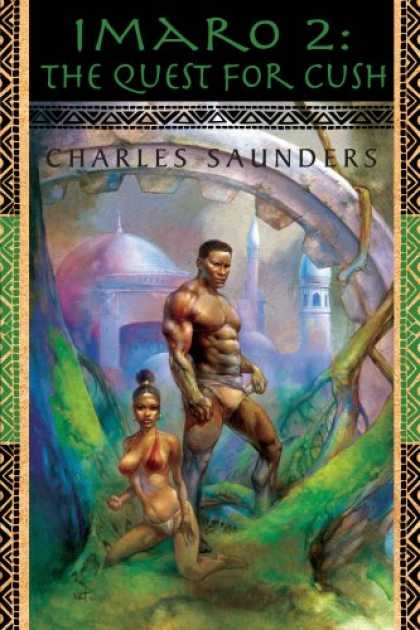
The Quest For Cush by Charles Saunders

The Imaro series, book 2, picks up immediately after the first one. Like the previous book, it's a rip romping sword and sorcery tale of Imaro against the vile sorcerers who haunt the land and his own background. 
Things I enjoyed about Imaro that could be used for the game:

1. Earning Money. Imaro is a big fellow with a natural talent for weapons. Where might such an individual make his funds easiest? Why, the arena of course!

2. Making the Enemy Fierce: Much like animated shows Dragonball Z and others, prior to Imaro's battle in the arena, he gets to see the current champions handled like a chump and knows that his new enemy is someone worthy of respect.

3. No Sea Journey Is Safe: While on board a boat to Cush in the middle of the stormy season, monsters equal to the old deep ones are called up thus proving that no boat journey is safe.

4. The characters draw attention to themselves: The players are probably not the standards of the setting. In that vein, they may draw attention to themselves and that attention may not play out too well for those around them. In this case, because there are forces that want Imaro dead, those around him have a nasty habbit of winding up dead. In a D&D game, the players are often walking treasure troves and bandit attacks and other problems would probably not be a rare occurance.

5. The players go where no one else dares. Here, we start off with Imaro's lady love being taken by Atlantians to the City of Madness. When we come near the end, he's off to a cursed bog. The players are the players because they ignore those old taboos. They go where others won't. It's also why they're such a high paid lot and why they tend to die off so quickly.

6. The players are often barbarians. In this context, I don't necessarily mean like Conan or even Imaro in that they're from a wild and savage land, but rather, they are often on the move so much that other cultures ways and methods may seem strange to them and it'd be easy for players to make enemies in a new city without meaning to.

In the end, the Quest for Cush has Imaro essentially settling down to become a black smith, but since it's not the end of the series, it's rather just a stopping point on towards further adventure.

Tuesday, March 23, 2010

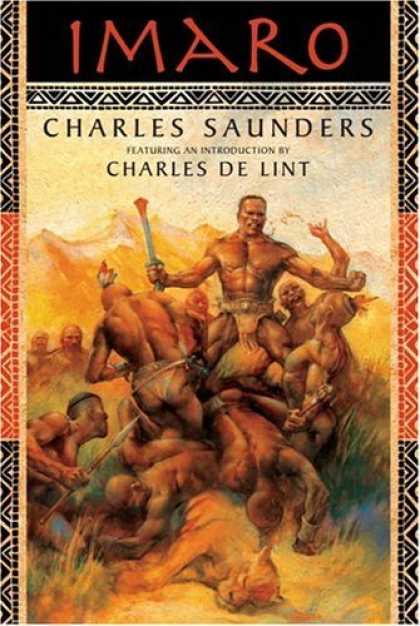
Imaro by Charles Saunders

One of the things I've been trying to do with my reading, is read more 'classic' material in the vein of some sword and sorcery background. I've heard of Imaro several times and Night Shade Books published some great Kane books back in the day that fall heavily into that category. With that in mind, I did a little research on Charles Saunder, who is quite accessible on the web having both his own page and a spot of Myspace.   The man is a historian and fiction writer but his work tends to focus on Africa. For me, Africa is one of those far away places that never had the 'cool' that the Far East did. It was never brought to gaming life by books like Legend of the Five Rings or the much older Oriental Adventures. Part of that, a huge part of that on my part, is just plain old ignorance. For the greater gaming community?
That I can't say. There have been several articles in Dragon Magazine through the years. One of the companies Gygax worked at brought us Æsheba: Greek Africa.  The d20 system, through Atlas, brought us Nyambe. Better than nothing mind you, but without a host of Samurai Sunday and other oddities to give vision to it, what did it mean for me as a gamer?

Not much. I pillage Greek Africa back in 2nd ed days. I yanked rules and ideas out of Nyambe. But actual use of them wasn't a strong point of mine because I wasn't quite sure what to make of it.

Imaro shows that strong writing, character, and the classics of the genre, of evil sorcery and the vile effects it has on men who dare to far, illustrate that even with the host of exotic language that Charles Saunders brings to Imaro, that a good story is a good story regardless of the setting.

So what were some of the things I thought of when reading Imaro?

1. Classic backgrounds are classic for a reason. While Imaro's childhood isn't as tortured as others in the genre, his is not a happy childhood. An outcast from his tribe his innate abilites force those about him to acknowledge them.

2. Classic themes: While the choosen one can get a bit overplayed, here, because it's Imaro and not a magical sword or some fantastic destiny that's hammered over the head, but rather, hinted at, it works. When using such old themes as a choosen one, don't play all of your cards right off the bat. Tantalize and tease with them. Hint at the greater world around the characters. Portray the characters as sailing on a sea of ignorance that they'll have to chart past if they want to know what's going on.

3. Not everyone is a 'good' guy. Imaro winds up leading a pack of bandits here. Sound familiar? Conan was all too often at the head of a group of bandits, thieves, pirates and cutthroads. The ability to wield men into a sword and cut through opposing enemies until brought down low by treachery, is one that should be familiar to any fan of Sword and Sorcery.

4. Curse Your Inevitiable Betrayal: There are those Imaro allies himself with that well, he suspects that they're up to no good. His good friends continually warn him of those foes. But with some bull headedness brought on by previous victories and his self confidence that he can handle any problem, Imaro suffers some serious setbacks.

Imaro is a strong entry into the classic sword and sorcery field. It is bristling with energy and while initially written as short stories, is woven together into one whole novel that leaves the reader wondering what happens next. If you've been looking for some Africian based inspiration, Imaro is a damn fine start.