While The Black Stars Burn
By Lucy A. Snyder
$4.99 on Amazon
166 pages
One of the things I enjoy about short stories, is I can fit them in when I'm waiting for someone, riding the busy, or just looking to kill a few minutes.
Not too long ago, Amazon had While The Black Stars Burn on sale for 99 cents. As I am a book hoarder, I picked it up. I'd never heard of Lucy A. Snyder previously and was eager to see how I'd like her writing style.
The book includes several short stories that fit straight into the 'horror' genre. A few of them fall into the Lovecraft vein. One of them is a Doctor Who short story.
I found that the original works tended to be a little more telling for me. Her writing chops are fantastic. If anything, the thing that annoyed me most about While The Black Stars Burn, is that a lot of the stories end just when their getting "good", when my interest in them was at its peak.
If you're a Call of Cthulhu "Keeper", you should pick this up. There are several bits that fit right into a horror story right away.
The Strange Architecture of the Heart: In a war ridden society, the bonds between people may be fragile but that between mistress and robotic sex slave? Priceless! I'm not even kidding. The strain of living in a foreign land and having to work puts a woman more at home with a robot that does all it can to please the woman and her desire for a family. Solid social opinion.
Approaching Lavender: Here's a great "Invasion of the Body Snatchers" using a different medium instead of plants. Imagine you marry someone but they turn out to not be who you thought? Imagine that you sadly find out you were right as your own life is taken over by a painting.
The set up and slow build in Approaching Lavender are fantastic and it would make for a great one off, where the characters notice after a large art show opening that people have changed, or as part of an ongoing campaign where one of the character's friends exhibits vast differences in outlook and opinion.
Dura Mater: If you've ever watched the horror-science fiction movie, Event Horizon, this one shares some themes. Isolation, horror, the unknown. It goes with a more traditional "alien/outer alien" then the whole "Warp/Hell" bit of Event Horizon, but again, if you run one off's, this would be a great story to structure around.
Cthylla: Of the directly inspired Cthulhu stories, this one is the best. A young woman, the daughter of a computer scientist and a model, finds herself like neither of them and in being an outside, gets caught up with another outsider. The layers of conspiracy that get pulled back and the descriptive prose make the "switch" ending worth while and provide a great "cult" enemy for Keepers looking to add something to their campaigns.
In terms of fantasy, there's one story that stands out, Spinwebs. A family owns spiders but the mob mentality against their ownership is turning hostile. A young girl and a newly hatched egg are going to fight against that tide. But just when that determination is made, the story ends. Still, in the span of a few pages, the world building that happens is great.
If you're looking for inspiration for horror one shots or direct stealing for a Call of Cthulhu RPG, While The Black Stars Burn is a well written book.
Showing posts with label Horror. Show all posts
Showing posts with label Horror. Show all posts
Friday, July 22, 2016


Monday, May 25, 2015
Pet Sematary by Stephen King

I vaguely remember seeing the movie Pet Sematary when it first came out in 1989. My recollections of it now, is that it was a mediocre movie. Like many of Stephen King's movies at the time.
I just finished the novel.
What a difference.
Pet Sematary has a small cast and a small local. The action is all relative to the area.
But it's tightly wound and amazingly well structured with every word written seeming to have a sort of inevitable lurch to the next one.
The novel focuses on the Creed family, freshly moved to Ludlow, an off the beaten path haven for raising a family. Save for the nearby road which thunders with heavy truck traffic. Early warnings of both mundane words and supernatural entities is ignored or forgotten until the unthinkable happens and then it gets worse.
In clumsier hands, the tale might have used short cuts to get to the main body of work. That would have been a mistake. One of Stephen King's strengths, or at least here and in other books with a small cast like the Shining, is allowing the build up of how believable the characters and their motivations are.
It's not interested in beating the reading over the head with how vile things are or how gross some particular vision is. Rather, it has a slow wind up that continues to beat the drum of anticipation while giving the readers glimpses into a larger world that has its own plans for the Creed family.
This is hinted at being something much older than the town, much older than America, perhaps older than the people who first lived there, coming from another country altogether. The opportunities to prevent the tragedy that happens, ignored.
To a point though, that brush off of the dangers, isn't natural. The book indicates strongly that everything proceeded as it must, because the power of the 'bad place' was on the rise. That there was no true ability to resist the flow of fate here.
But it's the struggle to do so which makes it a great read. It's the twists and turns that Stephen King puts the Creed family through that make it worthwhile. We get to see the origins of the animosity between Louis Creed and his father in law, and how after years, that when the opportunity to put that in the past arises, that Louis cannot. Not because he doesn't want to, but because it, indeed, the whole relationship with his father in law, is no longer important compare to the thing that Louis must do.
There are numerous instances like that, ranging from when Louis helps explain to his daughter the whole concept of death after visiting the Pet Sematary, to his daughter experiencing what happens when an elderly friend's wife dies to other, closer, more unconscientious horror happening.
As with other Stephen King novels, there is the occasional 'wink' as other work's he's written. For example, while under a sense of dread and driving on little sleep, almost falling asleep at the wheel, Rachel Creed passes the town of Salem's Lot. There were a few of these references in the novel and I'm sure in future novels, if Stephen King continues to write as he did here, there will be mentions of some tragedy happening in this small local.
I highly recommend Stephen King's novel Pet Sematary and hope that one day we'll get a limited series out of it that doesn't have to rush and ruin the mood and build up that the novel so skillfully delivers on.
Saturday, January 25, 2014
Storage 24

Now mind you, I may still never run anything but...
I recalled the Grey Citadel, an old Necromancer Games adventure that had some mystery, some urban exploration, and some dungeon crawling. The author put a lot of stuff in there that I enjoyed, and the old Dark Loch website still has a lot of fun free stuff on it.
While reading through the Grey Citadel and thinking of how I'd 'convert' it or add some of that Lorefinder stuff to it, I decided to flip on Netflix and watch Storage 24, Wikipedia link here. It's essentially one of those alien hunting people through dark and twisted corridor type deals. You know, like Alien, Aliens, Creature, Abyss, Leviathan, and I'm sure a ton of other movies that I'm missing.
I was surprised in that it wasn't terrible. I was expecting something to just listen to in the background while I took some campaign notes but there were a few things that that I noted that are used time and time again in horror films so thought I'd point a few of them out in case you're wanting to run some horror scenarios or at least some 'bug hunt' style games.
1. Visibility is terrible. This can range from visibility being cut off by there being no light, to visibility being blocked because there are obstacles, like say spider webs or other opaque yet light objects in the way.
2. Previous Victims: The party should find previous victims of the creature. The wounds they suffered shouldn't be noticible at first. For example, the party approaches the victim from the side or from behind and when they tap them on the shoulder, the victim falls over dead or the party member pulls a blood soaked hand back. Sometimes these victims are hidden in say, the vents or closets or some feeding area that the party may find later. The victims conditions might provide the party an idea of how large a creature their facing, how it's bite is (mandibles versus fangs for example) as well as if the creature has talons like a bear or claws like a crab.
3. Extra Characters: If it's a bug hunt, be sure to put a few munchable NPCs in the mix. Give them a little personality so that when the beast eats them, the party members are motivated to stop the creature more than they might normally be.
4. Red Herring Characters: When the party first comes across the situation, perhaps they are completely unaware that there are monsters at all and think that the murders are being caused by a madman. This can lead to some interesting scenarios and potentially the party killing an innocent person.
5.Sound Effects: Many monsters, like say Godzilla, have their own unique roar. You know when you hear the enormous roar of Godzillia well before he's seen on the screen that he's around. Have some special sound effect you can use when the players are deciding their next course of action just to let them know that the monster isn't waiting for them.
6.Larger Implications. In the movie Storage 24, even as the characters inside are fighting for their lives, there are hints of something much larger going on in the background. When the plane carrying the alien first fails, there are special agents on the scene. There are a lot of military on the scene. When the characters catch news of the plane crash, they see that the city is filled with military and more is incoming. When the movie finally ends? The city is under attack by aliens in spaceships. Yeah, the movie went there. But in other movies, like Alien or Aliens, there are other things afoot that the characters may not initially realize. After all, Ripley didn't know about the Corporate uses for the alien until later, after the android on the ship almost killed her, and of course in the sequel when she's betrayed again to the corporation's needs.
7. Creature abilities. One of the reasons why you want to throw the lights out on the characters is that often, the creature has much better senses than those it hunts. It may see in the dark, it may not have eyes at all. It may have movement abilities that make it so that it can easily outrun any person or even car.
8. The Roof! In many of these style movies, the first thing that happens is someone is looking down at some blood dripping from... somewhere and then they get it into their heads to look up and wham! That sucker can stick to the walls and move through the vents like they were going out of style. Giving the creature movement abilities means more than just making it faster than the characters.
9. Limited Room to Maneuver. In some games, characters can become powerful very fast. In some situations though, your ability to navigate is negated by not being able to move. For example, if you have to crawl through sewer pipes or through air ducts or vents or narrow hallways. The standard might be limited the types of weapons the characters can use as well as giving them the same penalty they might suffer as if they were prone.
Storage 24 isn't going to win any movie awards but its not a bad movie and hits all of the 'standard' bug hunt features tackled above as well as some interpersonal drama that if you can't figure out in the first few moments of the movie, aren't really paying attention.
Sunday, November 17, 2013
The Wolf's Hour by Robert R. McCammon
After reading Swan Song and asking about opinions for further reading by Robert R. McCammon, one novel that came up in a few posts was The Wolf's Hour.
The short review? Thumbs up.
Take one part James Bond, in high action mode, and add a dash of werewolf and you've got the basis of the story. Oh, it's also set during World War 2 and involves a vital plan to save the allies during D-Day.
The writing engaged me. Robert's use of flashbacks to break up the sections of the book worked well ranging from how young Russian Michael Gallatin first suffers the 'curse' and how he grows with it and eventually joins the 'civilized' world.
Some of the things that stood out to me, is that despite Michael's potent abilities, heightened sense of smell for example, great physical abilities, and apparently like catnip to the ladies, is that he rarely 'walks' through any conflict and suffers several set backs. Some of these set backs take time to overcome and recover from. Some of them have deeper costs.
There is also a lot of internal turmoil the character endures as he seeks to divine what exactly he is and what his role in society is.
In terms of gaming? Yeah, there were several bits that would be useful. Spoilers for the novel will follow. If you'd rather not be spoiled on some odd twenty + year old book, read no further.
1. Not everyone is a bad guy. One of the strengths of characters like Elric and Drizzt is that they play against the archetype of a member typical of their race. Here, just as in the Captain America movie recently, the author reminds the reader that not every German is a Nazi with the introduction of a character named Mouse.
2. The surreal. There are a few points in the novel where due to the excess of the Reich, that things that would be vastly out of place in the 'real' world are seen as normal. One example of this is a train that a big game hunter has set up as a death trap that keeps circling the city of Berlin while he hunts the people within it. Another is a exclusive Nazi club where atrocities are on display and excess is the standard.
3. Delayed combat. Robert has at least three villainous characters who get their comeuppance at a later date than their initial vile acts would lead the reader to hope for.
4. Mystery. A part of the story that takes a good chunk of time is the unraveling of the "Iron Fist" bit where Michael has to discover what a local German artist and an undercover spy have in common with stopping D-Day from happening. Pathfinder has a few supplements that can handle such additions to them like Lorefinder a bolt of the Gumshoe system straight onto the Pathfinder engine.
5. The exotic with the mundane. World War II has a TON of supernatural crossoever elements to it. Usually those elements though, are in putting the players against some type of horror from beyond. Cubicle 7 for example, recently did World War Cthulhu and one of the settings is World War II. But what if the players are the monsters? Imagine the monster of Frankenstein. "What did you say your name was again? Adam? What happened to you? You look horrible. What were you in some type of accident?" The monster's rictus grin was unnerving. "An accident? Yes. An accident of birth you might say..." There are many opportunities to take the standard super hero types from say the Invaders and put a little Mythos twist on it. Sub Mariner an American patriot first and foremost and a spawn of the deep ones secondary? Lots of potential there.
The short review? Thumbs up.
Take one part James Bond, in high action mode, and add a dash of werewolf and you've got the basis of the story. Oh, it's also set during World War 2 and involves a vital plan to save the allies during D-Day.
The writing engaged me. Robert's use of flashbacks to break up the sections of the book worked well ranging from how young Russian Michael Gallatin first suffers the 'curse' and how he grows with it and eventually joins the 'civilized' world.
Some of the things that stood out to me, is that despite Michael's potent abilities, heightened sense of smell for example, great physical abilities, and apparently like catnip to the ladies, is that he rarely 'walks' through any conflict and suffers several set backs. Some of these set backs take time to overcome and recover from. Some of them have deeper costs.
There is also a lot of internal turmoil the character endures as he seeks to divine what exactly he is and what his role in society is.
In terms of gaming? Yeah, there were several bits that would be useful. Spoilers for the novel will follow. If you'd rather not be spoiled on some odd twenty + year old book, read no further.
1. Not everyone is a bad guy. One of the strengths of characters like Elric and Drizzt is that they play against the archetype of a member typical of their race. Here, just as in the Captain America movie recently, the author reminds the reader that not every German is a Nazi with the introduction of a character named Mouse.
2. The surreal. There are a few points in the novel where due to the excess of the Reich, that things that would be vastly out of place in the 'real' world are seen as normal. One example of this is a train that a big game hunter has set up as a death trap that keeps circling the city of Berlin while he hunts the people within it. Another is a exclusive Nazi club where atrocities are on display and excess is the standard.
3. Delayed combat. Robert has at least three villainous characters who get their comeuppance at a later date than their initial vile acts would lead the reader to hope for.
4. Mystery. A part of the story that takes a good chunk of time is the unraveling of the "Iron Fist" bit where Michael has to discover what a local German artist and an undercover spy have in common with stopping D-Day from happening. Pathfinder has a few supplements that can handle such additions to them like Lorefinder a bolt of the Gumshoe system straight onto the Pathfinder engine.
5. The exotic with the mundane. World War II has a TON of supernatural crossoever elements to it. Usually those elements though, are in putting the players against some type of horror from beyond. Cubicle 7 for example, recently did World War Cthulhu and one of the settings is World War II. But what if the players are the monsters? Imagine the monster of Frankenstein. "What did you say your name was again? Adam? What happened to you? You look horrible. What were you in some type of accident?" The monster's rictus grin was unnerving. "An accident? Yes. An accident of birth you might say..." There are many opportunities to take the standard super hero types from say the Invaders and put a little Mythos twist on it. Sub Mariner an American patriot first and foremost and a spawn of the deep ones secondary? Lots of potential there.
Sunday, October 6, 2013
The Shining by Stephen King

My mom has owned the Shining for decades. Yesterday I finally got around to reading it. Mind you I've seen the movie adaptation with Jack Nicolas and parts of the television version but never read the book.
Recently Stephen King decided to write a sequel to this book, a new novel called Doctor Sleep. That prompted my mom to get the Kindle edition while it was on sale and I figured I'd get the Kindle version of the Shining while it was on sale.
Wow. What a great book. I'll would say I'm throwing spoilers out left and right but there wasn't that much I'd take from the novel to a game in terms of the characters. There are some bits that are fantastic, but really it's the strength of King's writing to get us inside the heads of the characters, in a very small cast, that carries the novel forward. Now I'll be very curious to see how the sequel is. When we write things decades apart, they may not have the same flow, tone, or 'voice'. I'll be curious to see how Danny compares now to how Stephen first wrote him.
But there are some things I like about the novel that would make for great bits.
For example, how about the hedge monsters? In the hotel, there are several hedge animals, lions, dogs, and others, that at times seem to move, to encircle the watcher, to advance only when they are not watched. At the end of the novel, they are definitely on the attack and there is no assumption that the character in question is hallucinating.
The Overlook, the hotel that in and of itself is a character in the Shining, has a few parts that make great role playing tools or at least the inspiration for them.
For example, the hotel feeds on psychic energy. For most people, it's just a normal hotel. But when Danny, a powerful psychic enters it, the hotel comes to life and does things its never done before. This can be anything from say, having a user of arcane magic enter the hotel, to any type of energy, like a psionic or a divine spell user enter it.
The GM could also just pull a Castle Amber or the Vanishing Tower, where the Overlook only comes into contact with the real world at certain points and certain times and that those who enter rarely leave.
In addition, the hotel is able to pull things from the entirety of its history. It does this without problem with Jack is losing his mind and does so in such a powerful way, that Wendy and Danny are aware of what's happening. These ghosts are even able to influence the real world such as freeing Jack from the temporary location his wife has placed him.
Imagine that the characters need a clue, a bit of information from another time. They've spoken with the elves, dwarves, and other long lived races but the bit they need is said to be known only to a particular sadist who died in your version of the Overlook. Imagine that there are those who might have their own agendas that may wish to escape from the Overlook and offer assistance to the players in exchange for such assistance?
The GM may have to determine if these are just ghosts, echoes of the real people or if they are actually able to escape. Or perhaps there is a mix? Previous adventurers who have become trapped in the overlook, some of them gone mad and others desperate to escape from the insanity?
The Shining was well written. It allowed the reader to delve deep into the characters heads. If your players give you enough back ground information that you can tweak them, give them 'alternative' versions of the history they wrote down, things seen as they might be from a twisted point of view, you'll be able to get them shaking their fist at the evil GM in no time.
Sunday, October 9, 2011
John Carpenter's The Thing
As Halloween comes around, I tend to watch more horror movies. So far this month I've knocked out Trick 'R Treat, the original Wolf Man with Lon Chaney, and today, John Carpenter's The Thing. I watched this one because of a few reasons.
One, it's a classic. It's almost thirty years old. There are some good things still going on here.
Two, there is a remake that is also a prequel coming out.
Three, there is a Dark Horse digital free comic; http://www.darkhorse.com/Blog/629/thing-returns-dark-horse-comics-free-digitally-now Some good stuff there, especially since it's in a dark ages setting.
The Thing relies on several common elements of horror.
The first of these, is isolation. By placing it in a far flung location that is physically isolated from the rest of the world, the director forces the characters to rely on only the possessions and knowledge that they have and can expand in a limited direction.
The second, is man against the elements. This isn't some tropical island where if they didn't have issues with an alien capable of assimiliating them all that they could just go play some golf. Survival itself is at stake here.
The third, is fear of the unknown. Like a good Call of Cthulhu adventure, the characters go about learning more and more about the nature of the enemy they face until its time for the final showdown.
John Carpenter's The Thing is definately worth a second look and could easily be a campaign in and of itself. Imagine that instead of the Far Realm sending out specific entities to the prime material plane, the 'Thing' arrives as a disease. Can players either stop it from escaping the planar workshop they are in or must they destroy the gates on the other side to insure that no one escapes?
One, it's a classic. It's almost thirty years old. There are some good things still going on here.
Two, there is a remake that is also a prequel coming out.
Three, there is a Dark Horse digital free comic; http://www.darkhorse.com/Blog/629/thing-returns-dark-horse-comics-free-digitally-now Some good stuff there, especially since it's in a dark ages setting.
The Thing relies on several common elements of horror.
The first of these, is isolation. By placing it in a far flung location that is physically isolated from the rest of the world, the director forces the characters to rely on only the possessions and knowledge that they have and can expand in a limited direction.
The second, is man against the elements. This isn't some tropical island where if they didn't have issues with an alien capable of assimiliating them all that they could just go play some golf. Survival itself is at stake here.
The third, is fear of the unknown. Like a good Call of Cthulhu adventure, the characters go about learning more and more about the nature of the enemy they face until its time for the final showdown.
John Carpenter's The Thing is definately worth a second look and could easily be a campaign in and of itself. Imagine that instead of the Far Realm sending out specific entities to the prime material plane, the 'Thing' arrives as a disease. Can players either stop it from escaping the planar workshop they are in or must they destroy the gates on the other side to insure that no one escapes?
Thursday, August 11, 2011
Sharktopus!

This is a bit of a silly movie but it has numerous great kill scenes. The set up is relatively simple in that it's science gone mad. There are the standard cast of characters including the professional mercenary, the amoral leader, the dubious military contacts and others of that ilk who fit in such a concept.
In terms of D&D though, the Sharktopus wouldn't even be that unusual. The film's biggest problem can even be seen as a bit of a strength in that the size of the creature varies from scene to scene. In one, it's big enough that a man can fight it off for a few seconds while a friend sees him die up close and personal. In another, it's big enough to rip a large boat in half.
But what if these are different creatures altogether? The smaller ones can be minions, killers in their own right, but pale immitations of the bigger creature.
The Sci-Fi channel has done several shows of this variety. In some ways, you coudl string them together as a modern mad science series where players are either military specialists or mercenaires that go from job to job, fighting genetically engineered horrors and various beasts that have survived slumbering for millions of years. Or a combination of both.
Tuesday, September 7, 2010
The Burrowers
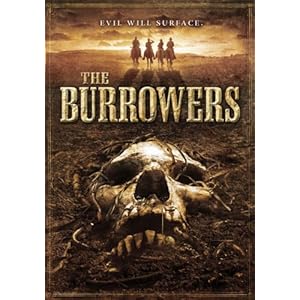
Some of these ideas are not new mind you. Looking at the first one where man is often responsible for his own plight. This was true when I was a young man watching reruns of movies like Them and Food of the Gods, to the Burrowers. In the former movies, it was often man's entry into the Atomic Age that caused natured to rebel against man and to spew forth giagantic and horrific monstrosities.
In these cases, its easy to see why man is responsible. Often these are thinly disguised lectures about the dangers of things man does not and perhaps was not meant to know. In fantasy settings, this is often replicated with some type of fantasy holocaust. Eberron has its Mournlands, the Forgotten Realms has Thay, now a land of the undead. There were several sights in the Forgotten Realms that because sources of Wild Magic during the Time of Troubles, the recent Spellplauge has added its own areas of unrest, and the examples flow from there.
These magical regions of chaos are usedful when creating new monsters, when providing a location for monsters, or for providing a safehouse that only a madman would use. In Eberron, the Lord of Blades has picked his home quite well.
In the Burrowers on the other hand, prior to all of this atomic age stuff, man was still doing bad things. In this case, the Burrowers, used to feast on the buffalo. Western settlers are responsible for the destruction of vast herds during their settling period and well, in this case, the Burrowers still have to eat. Next up on the food chain? Why man of course.
Another problem that is brought to light here, is that man often thinks he knows more than he does. In this case, those who investigate the Burrowers, by proxy of a missing family, think that it's a native attack and kidnapping which leads to the creation of the party of rescuers. There are small signs at first that things are not what they appear to be, but these go unheeded.
In this case, the casting of stones, the thinking that the Native Americas are to blame, leads to several gun fights with the Natives as well as casualties on the 'heroe's side. In a role playing game, this might be done through the use of red herrings. In this case, it's easier to ignore the tell tale signs that something different is about than it is to think that something unknown and unknowable is out there.
The ignorance is eventually lifted when the party encounters the Burrowers. These are some strange creatures that move about on all fours and use a poison that could be similiar to spider venom in that it essentially makes people easier to eat as it turns them... soft after a period of several days. Depending on the dosage, the individual may become completely paralized. In Dungeons and Dragons 4e, this might be represented with something like a disease track where after missing so many saves, essentially you're finished. Might start with Dazed, then Stunned, then Stunned and Immobilized. Not a good thing but in a system that features magic cure alls, not as bad as it would be in a historical setting.
In many adventurers though, the players are not allowed to stay in ignorance. The lifting of ignorance can be brought about by several means. One of those found most often in Call of Cthulhu games includes research into tomes, papers, recordings, and interviews with people who may be knowledable about the situation. In this case, the information comes through in bits from several natives that try to warn the search party away from the Burrowers and to go back to their homes.
The interesting thing here though, is the addition of the language barrier. When there is a language barrier and only a few characters can speak with the knowledge base, they are now on a different level of power. If that is the Dungeon Master's intent, he should go with it, providing the answers to any questions in written form only to those who understand the language being spoken. In some instances, such as the movie, where the one of the searchers is essentially finished from poiosning, he keeps that secret hoping that he can find a cure.
Another twist on things is the use of bait. In one scene, two of the characters wake up and realize that their leader has left the fire growing untended which makes them an easy target in the darkness. Latter on this circle is carried around as that leader is then poisoned and left for bait for the burrowers. It's a tactic used in the post apocalyptic Tooth and Nail as well. By poisoning a food source, the players can gain an edge up against thier enemies and the GM shouldn't hold that smart thinking against them.
The movie ends of a down note though as the last surviving character learns that his own guide to killing the Burrowers and his allies, have died under circumstances best described as embarrisngly stupid which leads us back to point one where man brings a lot of the pain he suffers in this movies upon himself.
In the end, The Burrowers showcases what could very well be a group of standard adventurers, each of them men with weapons enough to kill a dozen men over, meeting something of the supernatural and the horror of things man was not meant to know.
Saturday, March 6, 2010
Quarantine and the role of horror

Quarantine starts off with a mundane situation where the main casts is starting off with a normal assignment and then moving into a situation that quickly moves into the weird and strange. Strangely enough though, with the situation as it starts, in a role playing game, the characters, who tend to be specialists in their field and are used to dealing with a wide variety of situations, would figure out the problem in about three seconds.
In this case, disease. It's a disease that has familiar seeds to others we've seen in that it makes those infected into the enemy. Good old films like the whole Dead series, or most zombie films for that matter, have the zombie plauge hit others through bites. The diseases tend to progress from making one sick to making one into the monster. In this case, its super rabies!
The title of the movie is one of the quick ways of bringing horror into any setting. In many movies, such as Mimic or other old horror films, take the characters and cut them off from civilization. By removing the characters from the comfort of home, the characters cannot renew magic items. They cannot seek out help. They cannot learn how others may be handling things.
However, with role playing games, especially fantasy ones, the heroes are often cut off from civilization in the first place. Take a typical dungeon. Unless it is something like the famous Castle Greyhawk dungeon, most dungeons are far from civilization. There is often a dangerous trip to the dungeon in the first place. Now mind you, in most instances, the characters can walk away from the dungeon and return to civlization and restock and resupply. High level characters tend to have it even easier where the journey may be a simple spell or ritual. To give them more of the horror feel, isolating them by hook or crook can insure that they have to husband their supplies carefully.
In the city, in a situation similiar to the movie Quarantine, perhaps the lords of the city use magic, armed guards, constructs, golems, or other methods of keeping the characters stuck in a tower, crypt, castle, dungeon, or church. The players go in, but until the situation is resolved, they don't go out.
One of the ways to showcase how quickly things can turn agianst the players, is lots of non-player characters to bite the big one and turn against the players before the big end game. the larger the pool of potential enemies, the more the players will have to beware their surroundings. In older editions, players often tended to take henchement with them to do various tasks ranging from poking the floor with a ten foot rod to carrying the treasure to holding the torches. A situation where a merchant caravan takes a short cut through a mountain range or through a cave passage and winds up trapped there, can provide the players with a lot of potential fooder to look after.
When looking at the different types of characters, the Game Master should have a variety of types ready for 'stiring' the pot so to speak.
The Hostile Leader: There's always someone with a level of authority that doesn't like the way the players are doing things. These individuals may tend to have their own camp followers and may tend to be adventurers or otherwise be capable of handling themselves. The players might not be able to take out such a force directly but may have to work against them through subtle skill checks.
The Follower: Always getting in trouble and always ready to aid the characters, the follower can be both blessing and curse. Too many of them die and the players may find themselves ousted from any type of leadership position.
The specialist: In some cases, the specialist isn't the exact type that the players need, but rather, one that is of a related field. In Quarantine, the characters don't necessarily have a specific type of doctor who specializes in rare diseases, but they do have a doctor who treats animals who tend to suffer the symptoms of the disease that several of the 'zombies' here have. The specialist can be useful but can also send the players on the wrong trail.
The Scumbag: In many scenarios, there is often someone out only for himself. Even when the good of the group can be had and it doesn't negatively effect the scumbag, the scumbag may figure merely coming out alive isn't enough and work to make his own way in things, regardless of the cost to the others in the group.
The Authority: Sometimes the outside world seeks to keep a firm lid on things. There are things man was not meant to know after all. That's a well and good way of handling things if you're on the side of authority but if you're on the receiving end... perhaps not quite so good. There may be figures on the side of the authority that respect what the players are doing and will try to help them through their trials but don't expect to be saved by anything other than your own sweat and blood.
Subscribe to:
Posts (Atom)


