Showing posts with label History. Show all posts

Wednesday, June 29, 2016

The Geography of Thought by Richard E. Nisbett

The Geography of Thought
How Asians and Westerners Think Differently…and Why
Richard E. Nisbett
Free Press
Published by Simon & Schuster New York
$15.99 
$12.19 from Amazon: http://amzn.to/28ZUfe9


As someone who's been a gamer master and tinkered with writing, the idea of HOW people think and what makes them think that way fascinates me. When I heard of the Geography of Thought, I figured “Hey, now I can know why that dude from Legend of the Five Rings thinks differently than that Paladin in 5th edition D&D.”

Let me start by saying that I don’t know if I agree with everything that Richard E. Nisbett puts forward. And that’s okay because he makes a lot of allowances. He points out that NOT everyone in the different regions thinks this way. He points out that “Asians” is a huge umbrella and that there are differences within that vast branch, just as there are with Westerners.

Nisbett also points out that things are changing more and more as the world continues to become flat. As more cultures cross pollinate, there are more and more examples of each one’s thinking on the other side.

To get the ball rolling, chapter one, The Syllogism and the Tao, breaks down some of the historical roots as follows:

Westerners: “The Greeks, more than any other ancient peoples, and in fact more tha most people on the planet today, had a remarkable sense of personal agency – the sense that they were in charge of their own lives and free to act as they chose.”

Asians: “The Chinese counterpart to Greek agency was harmony. Every Chinese was first and foremost a member of a collective, or rather of several collectives – the clan, the village, and especially the family. The individual was not, as for the Greeks, an encapsulated unit who maintained a unique identify across social settings. “

Nisbett goes into several more differences and his thinking as to why those are vital to understanding and he tries to make his case for it with illustrations, examples, modern testing, and other fun bits over the course of the next few chapters.

For example, comparing Greece and its city states, it’s maritime trading, it’s piracy, it’s connectivity to a greater world, it’s desire to prove something right, to China and it’s huge centrally located empire, it’s farming, it’s connectivity to itself, and its desire to compromise between two opposite.

The good news is that the book is written so that anyone should be able to understand it. The illustrations as testing are a quick way to see which path of thinking you may fall under. The ideas presented testable.

If you’re a fan of creating cultures, the Geography of Thought can force you to think about why those cultures act the way they do and what causes them to evolve.


Thursday, December 17, 2015

Reading For Later: Example

Recently Mike Bourke, @gamewriterMike  on Twitter, asked many gamers for some advice for an article he compiled. I threw in my usual bit of reading and taking notes for future use.

After all, it's kind of what Appendix N is about.

But it's easy to say that. Especially for someone whose still knee deep in non-gaming, heck, non-fiction material, for the most part. Just flippantly offer some advice right?

Here's an actual example from a book I'm currently reading.


Concise Guide to Databases: A Practical Introduction (Undergraduate Topics in Computer Science) is a book I'm reading right now. I use Access and some SQL and I'm interested in learning more about the concepts of big data and all things of that nature. 
 “Religious orders and governments were the first large organizations to gather and actively exploit data to raise revenue. Recorded data has been  known to exist since at least 2800 BC in ancient Egypt….Records were held on limestone flakes and papyrus. The Rosetta Stone, famous for holding the key to translating hieroglyphics (the same information was written in three languages on the stone, one of which could be understood and was used to translate the other two) was created to show a temples exemption from taxes. (pg 3)"

Okay, so if you're building a history of you're setting and wondering why things are the way they are, having real world examples is a great way to expand upon your own campaign. This is talking about thousands of years ago. Now if you add dragons or other creatures who've had their own civilizations, the numbers can become quite larger, but the roots of "civilization" can take place long ago and far away and have reasons for it. Cut to….

"There needed to be data kept in multiple locations. With European colonization of other parts of the world, trading companies had to start keeping data locally as well as at head office. Some of these companies were huge, for example the East India Company came into being in 1600 and by the eighteenth century effectively controlled large parts of India and had its own army and navy."


Okay, a merchant company with it's own army and navy? One that controls it's own nation? Man, that's well worth reading up on or flat out stealing. Player's could work for or against such an entity. They may wind up doing both at some time.

…."It (East India Company) had been blamed in part for triggering American War of Independence (the tea in the Boston tea Party was company stock) and laying the foundation for the First Opium War where Indian opium was used to trade for tea."


So an organization so big that it's partial, if not fully, to blame for multiple wars? Players can easily get caught up in such historical events, or perhaps even cause them. I've known a player or two that wasn't above abusing a game mechanic in trading if it was going to bring him some extra gold.

But there are some more bits... ….."Modern banking had its origins in the city states of Renaissance Italy such as Venice, Genoa, and Florence. In the United Kingdom lack of trust in the government (for example the approximation of €200,000 of private money in 1640 by Charles I) led merchants to deposit gold and silver with the Worshipful Company of Goldsmiths. Originally the goldsmiths were an artisan company but over time incorporated silversmiths and jewelers. "

So if you don't see a scenario where the royalty stealing money from the people isn't an adventure, or where something like Goldsmiths become banks because they have access to all of this excess money isn't possibly worthy of adventure, then I got nothing for you.

Now it's not presented this way of course, but imagine if the player's are rebels against a royal family that has yanked all of that money. Plenty of things to do in such a situation.

Alternatively, imagine the players have enough access to coin of their own that they lend out money and in doing so, become their own power source in the setting.

Now I'm not going to sit here and tell you that the whole book is filled with examples of that nature. For one, that's the background chapter on how and why databases came about. For another, I'm still reading it. 

Anyone else ever read something and found yourself using the material not for it's intended purpose? If so, share below!


Sunday, March 15, 2015

Granuaile: Ireland's Pirate Queen Grace O'Malley c.1530-1603 by Anne Chambers

I was looking for the SteelBonnets, the story of Anglo-Scottish Border Reivers in the Half-Price in Skokie. I was fortunate and found it.

But in addition, I found Granuaile, Ireland’s Pirate Queen, Grace O’Malley c. 1530-1603, written by Anne Chambers.

For others more familiar with history and the women who shaped it, Grace O'Malley is probably old hat but for me?

As the old James Brown song goes, “It’s a Man’s World.” So when I see something that says, “Hey, in a time and era where women were not expected to be pirate queen’s, here we go!”, I was intrigued to say the least.

I’d never read any work by Anne Chambers before. This one read easy. It’s broken up into chunks of Grace’s life, her family’s life and history, and more importantly, the context of the time.

Grace’s family motto was “powerful by land and sea”. They were “lords of the seas around Ireland.” This included ‘the right to levy tolls for safe passage and the right to sell fishing rights to foreign fleets.”

Anne notes that “unlike most coastal families, the O’Malleys were themselves intrepid seafarers, whose seafaring was not confined to Ireland.” By having this skill set, the O’Malleys are already a step above many others who only use their coastal rights to set charges. They are in the action.
Being so in the action, the “plundered as far as Spain and Scotland.” Being so far afield from home sets a precedent that comes into play later. If one can get to Spain and Scotland from Ireland, one’s reach and grasp are further than those lords who only know Ireland itself.

I like books like this when the author gives the reader a bit of an idea of what people were doing. Here we see “Herring was the principal species caught, with hake, cod, ling, turbot, salmon, and shellfish. The fish was usually salted, sometimes dried and packed in wooden barrels for export. Hides, tallow, freize cloth, deer and sheepskins, furs such as pinemarten, considered a highly fashionable accessory in the sixteenth century, coney, fox and otter were other important commodities from the west of Ireland which found a ready market abroad.”

That’s a lot to take in, but provides a huge swatch of information at the same time. It was no simple thing that the O’Malleys did.

The tone of the book, in its era, in its time, reminds me of another time and another place.

In the late 14th century, Italy was no whole country. It was a collection of independent city-states. This made the country easy pickings for Spain and France, among others, who sought to conquer Italy and even sacked the Holy City of Rome.

The Ireland that Granuaile inhabits, is much the same. There is no collective so powerful that it rules the country entire. Being a pirate queen, one who’s known to have visited Spain and Scotland, she is reputed to have sought out mercenaries and allies from those places. Dangerous charges indeed.

Due to Ireland having no central government capable of fully resisting the might of England, the country falls over the course of Grace’s life. She goes from suffering mightily under the hands of one of England’s lords, one Richard Bingham, to eventually serving Queen Elizabeth.

Anne Chambers wastes few words in discussing the similarities and differences between the two. Granuaile physically taller, but not possessing the same level of sophistication as Elizabeth.
Elizabeth, proud queen and ruler, but no husband. The ‘Virgin’ Queen. Grace? Two husbands and children.

Both women in an era and time that did not allow women to seize such destiny unless they were of bold nature and cunning wit.

Both proved to have it.

In Grace's case though, Anne argues that the Pirate Queen hasn't received her due for numerous reasons. The first of which, is she was not a 'patriot' of Ireland. In a time where only very recently have relations between England and Ireland been 'civil', to capitulate to England during the start of the takeover must have seemed traitorous at best.

Folklore and mythology mixed with oral history didn't let that tradition or information die out though.

Anne also makes a comparison between Grace and her ancient ancestors, suggesting that women had a much larger and more prominent role in Ireland, indeed, in much of the world, before the spread of Roman civilization which brought with it Christianity. 

And Christianity pushed those other goddesses to the back along with the leadership roles that women had.

I'm not a historian, not even an armchair one, but that's an idea that on its surface, seems to have merit and is well worth looking into (as I'm sure many have already done.)

In addition to the text, Anne includes numerous aids for the reader. These include the following:

·          a map of Ireland circa 1530 broekn up by principal lordships,

·         a O’Mally Coat of Arms,

·         an image of a regular galley, as well of one of Granuaile’s,

·         a map of Ireland 1609.

·         Map of Galway City 1611

·         Numerous black and white paintings

·         Photographs including Clare Island Castle, Kildawnet Castle, Howth Castle, Carraigahowle Castle, 
a     among others.

The appendixes are full of great tools to immerse the reader into the time of Grace including poems, paperwork, and other bits that provide a unique look into the life of someone who lived from 1530-1603.

Anyone looking for an example of how even in ‘history’, one can push against the tides and accomplish great deeds needs look no further than Granuaile.


Saturday, January 24, 2015

Indian and Oriental Arms and Armour by Lord Egerton of Tatton


First of all, thanks to those readers of the blog, twitter, and other interactions on social media. This book is a direct result of sales through the Amazon Associate link so I appreciate it!

Second, if you've been reading this blog for a while, you'll know I'm a sucker for books on weapons. Indian weapons don't necessarily get a lot of recognition. They don't have the 'Katana' that is so popular among the second part of this book's title, "Oriental Arms and Armour."

Even in role playing games, there isn't that much in Indian settings. While there are notable exceptions, especially now with an OSR game, Arrows of Idra or the Pathfinder city book Parsantium , the majority of games either focus on pseudo European or pseudo Japan.

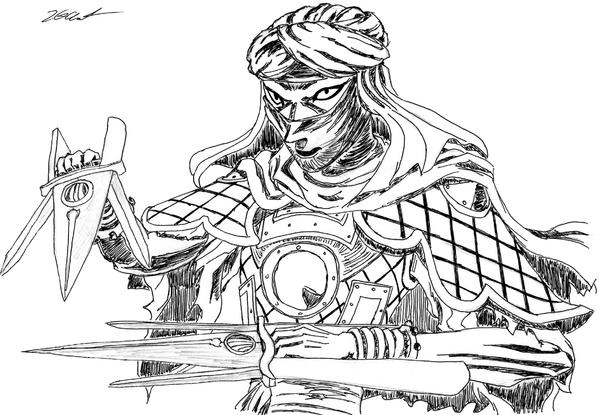
Sometimes such references pop up in odd locations. For example, the manga Berserk has several characters that take inspiration from the lands of India including one champion, Silat, that the main character, Guts, keeps running into. Over here on Deviant Art is a good likeness of Silat by 20AznHuskarl20.


Indian and Oriental Arms and Armour is a bit different than I thought it would be. I'm used to the Dover books being fairly inexpensive reproductions of material long since out of print. Which this is. But this is a bit more scholarly than I thought it would be.

For example, "The shield is deemed the only fit salver on which to present gifts, and accordingly, at a Rajput court, shawls, scarves, jewels, are always spread before a guest on bucklers." That's a neat little bit right there and "parallel between the Rajputs and the feudal races of Scandinavia and Germany. In feudal, as in Rajput communities, arms played a conspicuous part in all military pagents, as well as in all the business of life."

There is also a ton of black and white artwork. One of my favorite bits is a picture of different types of swords that includes at least two pata or gauntlet swords.

At 43 years old, I'm old enough to remember a fantasy movie called Willow.

One of the characters from Willow, is a heroic warrior with no peer known as Madmartigan. During a showdown with his opposite, the fierce General Kael, one of the weapons Madmartigan uses in a two sword fashion, is the pata. It's a fantastic scene.


Visually it's an interesting weapon. Different enough from a standard sword to stand out, but still with enough of the form and functionality to be identified quickly.

There are several such weapons throughout the region, several of which, thanks to media, have become well known, like Xena's chakram.

Having an exotic non-standard weapon like this gives characters a bit of difference. It makes them stand out among others who may only be using standard sword and shield.

And it's not necessarily just a visual difference. Where did they find the weapon? Who trained them? Do they know how to get back there? Are there other treasures and bits of information that can be fed into the campaign?

In the Black Company, a fantasy story about mercenaries and their vague origins, the later books, or Books of the South, allow Glen Cook to tell a story focusing on a completely different region with non-standard heroes and villains that still provide a powerful story.

While I'm still reading through Indian and Oriental Arms and Armour, it's so far proven both visually appealing and interesting reading. Its too short to go into much detail on all aspects, but does point out enough interesting bits that where I'm curious I can hit up other sources for further research.

If you want to dip a toe into the exotic world of weapons that go beyond long sword and broad sword, Indian and Oriental Arms and Armour is a solid start.

As a Game Master, have you ever added any such weapons to your own campaign? Back in 'the day', I had a bounty hunter that used to have a special ability to use any weapon he picked up and used that to justify a whole range of odd weapons. It wasn't something that I innately came up with though as I believe I based it off an old Ral Partha miniature, Nimrod the Hunter from their Warlords boxed set.


Nimrod was the one on the left with the shield that has a tri-dagger peaking out of it and the odd shaped sword and no pants.

Anyone use any monsters from these far away places? I was fortunate to be able to back Harwood Hobbies last miniature Kickstarter and one of the pieces you could get is an Avatar of Kali, but some of the assassins from the thugs cult also look great.


It's a wide world out there and having more options can allow for some variety in the stew.

Any other great books or references I'm blatantly missing? Throw a link in!

Tuesday, June 10, 2014

The Tigress of Forli by Elizabeth Lev


One of the characters that made an appearance in both versions of the Borgia series I've seen, was Caterina Sforza, a woman whose name on this book goes by Caterina Riario Sforza De'Medici. How's that for a mouthful.

Her Wiki entry has some of the nuts and bolts of her life. This book takes such nuts and bolts and expands them greatly. Elizabeth Lev does a nice job of making a book that's at once readable and one filled with notes from dozens if not hundreds of other resources which curious readers can go further on and read.

In terms of gaming, there is much to mine here.

1. Background. Caterina is raised to enjoy hunting and the military arts. The author notes that this was because unlike other nobles of the time, Caterina comes from a mercenary family that rose to prominence on the strength of their sword arm so raising all the children to fight was only normal and natural as opposed to segregating them into different roles.

2. People: Caterina has eight kids by three different husbands. Two of those husbands had powerful alliances to other families of the time. This doesn't count Caterina's own family and the rise and fall of status dependent upon not only your own abilities as a ruler or with diplomacy, but on the rise and fall of others that you may have no direct control over.

3. Rapid Reversal: There are several times throughout the scene that Elizabeth Lev sets, where one is assured that based on X, Y should happen. Nope. For example, when assassins kill her second husband, they think that they will be greeted with a hero's welcome. They are killed by the dozens instead. This happens a few times where people hear, "Oh, this is a problem is it? I shall solve it and all shall love me." only to find out that yeah, that was pretty much idle talk and acting on it was really stupid.

4. Different Perspectives: One of the other characters that made an appearance in both Borgia series was Savonarola, the initial inspiration for the bonfire of the vanity. Apparently he and Caterina had exchanged correspondence and it left an impact on Caterina that would follow her for the rest of her days. In this exchange, Savonarola doesn't' get much page time, but he does sound rather sane and reasonable unlike how he was portrayed in either series. For one person, an ally might seem saintly and full of vigor and vim and for another person, an adversary of devastating cunning and ability.

5. Disease: Since this is a book about the Renaissance and the various French invasions of Italy, we have to have some mention of 'The French Disease', along with Malaria, and the Bubonic Plague, all of which make their appearance in this historical. Indeed, is is no sword or poison that ends Caterina's life, but rather disease.

6. Social Combat: Initially there are many celebrations and honors given to Caterina upon her initial marriage as that was to a 'cousin' (some say illegitimate bastard) of the Pope of the time, Pope Sixtus IV. Thanks to that connection, Caterina has social advantage and ability that many in her time lacked and the parties that followed allowed for a lot of intermingling that could have consequences lasting well past the initial meetings.

7. Instability: When a pope dies in Rome, the citizens go a little crazy and form into unruly mobs. This can be a situation in a standard game as well when a well loved figure dies and there is a time of mourning as well as individuals using these situations to their advantage. Easier to send in the assassins while the city burns then attack the front gates.

8. Esoteric Hobbies: Among the many things that Caterina enjoy, hunting in the gaming grounds of the city Pavia, as well as breeding and riding horses, she was reknown for her herbalist skills and even had a book published on her findings. Some have even referred to her skills as 'alchemy'. In a fantasy campaign, it's easy to imagine Caterina having levels of Noble, Alchemists, and Fighter among others.


There are so many characters that Caterina interacts with or is there to see rising, that it gives the whole of the Renaissance itself a greater feel, like some massive tapestry that cannot be seen in one viewing and must be taken in from various angels.

Saturday, March 22, 2014

Pavia 1525: The Climax of the Italian Wars (Campaign)

So after watching the Borgias and the Borgia series on Netflix, I was still in the mood for more information on the various issues in Italy. Well, the area around which the series took place as Italy as a unified state didn't exist at that time and the whole area was rife with warfare from French and Spanish, as well as numerous Italian, French, and German mercenaries.

Pavia 1525, The Climax of the Italian Wars, is written by Angus Konstam, and outside of the numerous illustrations from historical sources, utilizes the modern day talents of Graham Turner to bring to life the battles in the Italian Wars the cumulated at Pavia in 1525. Note that the cover I used here is not the latest one, but rather, the cover of the edition I personally own that at its time of publishing, ran for $19.99, but not runs for $21.95.

There are a number of interesting factors at work when looking at history.

Never Ending War: When looking at the Italian Wars, such as over on the Wiki, http://en.wikipedia.org/wiki/Italian_campaign_of_1524%E2%80%9325, you'll see that there are various 'wars'. LIke the Italian War of 1521-1526. The sack of Rome happens in 1527. War is a part of the landscape.

Names: I sometimes laugh at some of the names I see in fantasy novels, my own characters, friend's characters or other media. Historically though, such names like 'the Bastard of Savoy' or Saint-Severin (Master of the King's Horse) among others, such as Bande nere, the Black Band mercenary group.

Weather: One of the things that happen with canons and hand canons, is that they are vulnerable for a wide range of weaknesses. For example, once the canons are in place, they don't move. Mobility is not a key factor. Another thing is fog. If you can't see the enemy, you can't shoot the enemy. Another problem is rain. Wet guns and wet gunpowder do not make for good weapons.

Reversals: The French lose the battle at Pavia. The Imperials though, don't have time to take advantage of it due to the quick thinking of the mother of the French King.

Mercenaires: The Italians were known for their mercenaries. The Germans, such as the Landsknechts, and the Swiss, are all employed here. The payment, or lack of payment for these forces, provide fooder in and of itself for how things could work.

Large Campaigns, Small Campaigns: Despite the book being titles Pavia, it covers many of the other events that happened, such as 'The Storming of Mirabello", where the Imperialist troops attacked the French at the hunting lodge. This hunting lodge is described as a small castle with its own drawbridge. This would be a perfect fortification to hold back a larger group. For example, a group of players fighting against larger numbers to slow them down. Another example is when a group of French soldiers fight a group of Spanish infantry outside the small town of Binasco.

Pavia is an interesting look at a small slice of a terrible time in history and has enough odd bits between its pages to provide readers with many bits for their own games.


Wednesday, November 27, 2013

The Whiskey Rebels by David Liss

I would not say with absolute certainty that The Whiskey Rebels is the best book I've read in 2013. After all, there is still another month to go and there is a lot of potential in that last month. Having said that, The Whiskey Rebels is the best book I've read in 2013. David Liss is always worth a read and this book, a done in one historical look at America right after the Revolutionary War, is a fascinating take on how to use historical fiction and fact to weave a fantastic story together.

There are so many things that make it useful to a person running a role playing game that it's an important reminder why people should regularly read outside of their genre, why they should stretch their mental muscle past its comfort zone.


I'll be discussing some specific things below from the book and how they might be useful in role
playing games.


Money. One of the biggest focuses of the book is in the accumulation of money. Anyone whose lived in America in the last, oh, say ten years, has seen the financial institutions take the economy to the brink and had to be saved from themselves only to eagerly go back to the very same behaviors that lead to the issues to begin with because they know that the government will back them up again should the need arise. This is something that doesn't necessarily get touched on often in role playing games because it can not only be boring, but can be more complex and less violent than a good old dungeon crawl.


In terms of money, no matter what the era, no matter when the time, there will be conflicts. there will be opportunities. There will be potential. As the book picks up right after the Revolutionary War, there are people attempting to control the new banks that are coming along. To fund them, or at least fund a specific one, there is a Whiskey Tax. This tax, on one side, seems harmless but to the people making the Whiskey?

Well, the whiskey in and of itself doesn't bring in funds. Instead, it's used as a bartering tool. An object of trade. There may be those who do make money off it, but those are not the people hurt by the tax.

Imagine Star Wars. The Emperor probably has those who are friends and allies and he could easily let slip that the Empire is going to build not one, but two death stars. Think of the manpower, the funding, the technology in terms of engineers and machines, needed to build that. Now we could go all, "Well, it's the Empire. No one is getting paid." Corruption pays off much better than tyranny. Look no further than China where it's not necessarily illegal to be bribed, merely illegal to be caught doing so eh?

Information is power. In a fantasy setting, if the players learn that a group of merchants is going to buy all of the land on the waterfront and sell it to the lords of the city in exchange for vast sums of wealth because they know that the lords of the city need that land for building defenses or something of that nature, what happens if the players decide to be the ones who buy the property? What happens if they already own it and are then put under 'scare' tactics? Hunting down such things would be an excellent use of the Gumshoe engine for example.

Character Change. Ethan Saunders starts the book as a near useless alcoholic. His talents in spying, in gathering information, are secondary to the notoriety he faces for rumors of him and his best friend Fleet, being British Spies who merely weren't brought up on charges because the war was ending and people had better things to do. Through the course of the novel, David builds the things that tore Ethan down into things that slowly build him up. Ethan missed out on so much of his life due to failed perceptions and not wanting to do anything to disgrace the memory of Fleet, because he secretly feared that Fleet was indeed a spy, that when the novel keeps bringing the 'truth' to the surface, Ethan has no choice but to change into something still flawed, but better than he was at the start of it.

The same is also true of Joan, who starts off wanting to be a writer, but whose apparent uncontested understanding of how the financial system works, makes her into a near unbeatable foe whose goal, the destruction of the government, seems almost within her power to be stopped by sleight of hand as opposed to straight out skill. The changes characters go through should influence the direction the game takes.

The Frontier. Joan starts off living in 'civilization' but poor. An opportunity comes up to seek out a new live on the Frontier in exchange for the script that shows the government owes her husband money. But after the Revolution the funds don't appear right away so are traded away for a 'better' life. This life is one of hardship. One where the simple comforts of the city, even the city of that era, are not present. Where one must be self sufficient to survive. Well, perhaps not entirely self sufficient for Joan's husband, despite his carpentry skills, and the skills he mastered in the war, isn't a full wilderness master like those already tricked, and already living there are. This brands them together being out in the wilderness against those who would further harm them. It makes them united against 'outsiders' even though Joan and her husband are still the 'new' people who must earn their way into the trust of the group.

Big Concepts: Joan and Ethan are both patriots. Ethan fought in the war to be free from English rule. Joan's husband did the same. Joan harbors thoughts on what a true free society is worth and what shape it must take while Ethan wouldn't see chaos and government failure run through the streets if he can help it. Some ideas can have multiple views that are both right but both must come across one another. When designing a setting, are there certain aspects of it that people might find distasteful but would rather have than absolute chaos? Are there some things that would make people change their minds about the country if only they knew?

The Unseen: Ethan has a slave, Leonidas. Ethan is able to use Leonidas status and his race as a useful tool for gathering information several times throughout the novel. In many settings, there are those who are looked down on. In modern societies, this could be as simple as the ignoring the cleaning people or the delivery people. In ancient societies, slaves were not often well thought of and things may have been spoken of freely in front of them. Another group in almost any setting could be children. Most settings have that 'underclass' that is always around and no one pays attention to. Using those resources can give characters and edge up against those who don't.

The Whoseitcalled. I was surprised to see reference to Jeffersonits. Those who followed Thomas Jefferson. And Hamiltonist. People who have followers will find those followers called by their specific name. While perhaps not in as much use today for personal names, Communist is a label still thrown about for example, but Putinists? Perhaps not so much. But in a setting where characters can be larger than life? Where you may have served, fought for, or directly assisted the person who liberated the whole of the country? Where those who take up stances against new methods and manners are on one side and those who take the opposing ideas on the other? Then indeed, it would seem nature that naming conventions might be s thing that use the giants of the era.

A Large Cast: When I was a younger and perhaps more apt game master, I had a huge three hold punch of characters. Whenever I added a character to the game, a throw away merchant, a named dragon, a hidden dungeon, or anything that had a name, I jotted it down into the book. I organized the book by region and was able to expand upon it and call upon it when characters where in a certain location. David Liss maintains a huge cast of characters here and it makes the world feel more alive. He mixes fictional and historical characters with the ease of a master juggler and the reader is never certain if who they are reading at the time is one or the other. Keep a list of potential names and descriptions for use at any time with the understanding that those names and characters may never be used, but that you have them if they are needed.

The Whiskey Rebels is a powerful historical novel that has a personal touch and focus and by having two viewpoints, brings the reader even deeper into the action.

Friday, April 8, 2011

H is For History

When reading C. J. Snasom's Soverign, one of the things that comes into question is how history is formed and perceived by the people living today. There are older books that cover events and laws that become... shall we say, inconveinent and are purged from the archieves. But this isn't a universal purge as a few places that are out of the way still have this knowledge.

But not only that, but there are still some older people who recall the actual events.

Imagine a setting though, where there are elves, dwarves, and other long lived, if not immortal creatures. This rewriting of history doesn't necessarily become impossible, but it becomes more tangled. After all, it's not like people don't lie, even to themselves of older events or aren't above trying to make themselves look good, as a certain mage in The First Law series of books showed.

But outside of trying to recapture the truth of the past, either for the sake of knowing the truth or because there is vital information that is needed, history can have tremendous weight. After all, H is also for Holiday and it's not like someone just wakes up one day and announces something is now going to be celebrated. That's not impossible after all as Sienfield and Festivus proved but for the most part, holidays are build or corrupted from older events and then tied into more modern events to align themselves more popularly with todays ideas.

History can also be found in the very buildings that a city is build of. The materials and stylings of the old town may be different than the new town which may be different than the noble ward which may be different than the merchant ward and so on. History can also be found in the different styles of painting, music, dress and even outward attitudes.

When looking at your fantasy city, think about what events have given the city weight. Which events has the city hidden? Which events have become wide spread and celebrated? Which events does the city vow will never happen again? Which events has the city at one time vowed would never happen again but vigilance has long since cooled?

Thursday, February 3, 2011

The Monks of War by Desmond Seward

Amazon had this puppy on sale a while ago and I picked it up. I'm not deep into it yet but some of the writing already strikes me as 'RPG' style.

"Those who stayed in Palestine were adventurers, mainly French, with nothing to go back to, and the state they created reflected the feudalism of their own land." (pg. 24).

"When the first king of Jerusalem, Baldwin I, died in 118 the land was still in wretched disorder, infested with criminals; with some justice Latin Syria has been compared to a medieval Botany Bay. Many Franks had been sent on the crusade as penance for atrocious offenses such as rape and murder, and they reverted to their unpleasant habitis." (pg 29)

"Huges de Payens was no mere adventuerer but lord of the castle of Martigny in Burgundy...Hugues arrived in Syria in 115, and by 118 had become a self-appointed protector of pilgrims...This ragged eccentric persuaded seven knights, also from northern France, to help him, all taking a solemn oath before the patriarch to protect pilgrims and observe poverty, chasity and obedience.... (pg 30).

Right here I see a few scenarios playing out as it may apply to RPGs.

The first is that adventurers in and of themselves may not be the most loved individuals in any setting. They are bringers of chaos where they go. After all, they are wanderers. They are roaming the land gods above knowing exactly what it is they seek. Several adventures, like Death Frost Doom, have dire consequences if the party fails at what their doing. In many home campaigns, I've used an ancient unearthed evil bit a time or two myself where the party has to put the genie back into the bottle.

Next, there are potentially two types of campaigns at the root here. The one is a glorious age of evil and neutral characters running around the countryside taking what they will and abusing the lands as their wont.

The second is a group of characters who take it upon themselves to cure this plague ridden land of these foul vermin that infest it. So that the common folk may move about more freely.

Depending on the group and the efforts involved and how into one scenario over the other the Game Master is in, either one could be entertaining.

With the bandit angle, the real problem is going to be the long term legs of things. In level based games, merely performing hit and run tactics on groups of peasants, the occassional knight errant, and fighting for living space with the other inhabitants of whatever bad lands the players inhabit, won't cut it at the higher levels of the campaign.

But if the players want to take root and possess power, it shouldn't. I'm not hard core old school or anything, but in older editions, hiting namel evel and constructing your castle gave players the things that adventurers tend not to have; roots. Now they have to go out and hunt bandits. Now they have to scourge the countryside just to protect their own men and loyal factions.

It's something that no matter how awesome and powerful latter foes in an epic campaign may be, is a failure of 3rd and 4th edition on some level.  It's not that you can't do these things in either edition. It's not even that there aren't ways of providing rules for it. It's just so not the focus of the game. I don't know if that makes sense but I'm sure with a good GM and a good group, it's not going to be a problem, even for a long term game that makes it to higher levels.

Perhaps being on the frontier, these adventurers new castle attracts all the worst sort of attention starting with giants and moving it's way up the food chain to dragons and demons? Maybe they built their castle right on something like the Hellmouth from Buffy the Vampire Slayer? While 3rd and 4th ed scale to various degrees upward, the problem to me is that they don't scale 'downward' in terms of what the players can do and what they're expected to do.

Anyway, Monks of War is written in an easy to read manner and brings out all sorts of campaign suggestions right ouf of the box.