Showing posts with label Player Characters. Show all posts

Sunday, October 23, 2011

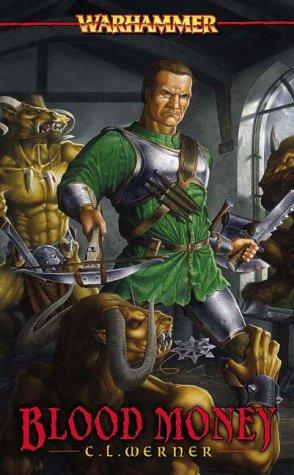
Brunner the Bounty Hunter by C. L. Werner


Brunner the Bounty Hunter is a collection of a trilogy of books; Blood & Steel, Blood Money and Blood of the Dragon. I'm not quite sure what the actual break down is in each book as most of the tales are short stores, framed by an author in the fantasy Warhammer setting who knows Brunner and sells tales that Brunner tells him.

C. L. Werner's work is solid here but may suffer a little from the length of the stories. With most of the contents being short, there isn't a lot of room for character development, and while the overall story continues to build and change and evolve and we see everything in previous tales move forward, it's a much different feel than reading a standard trilogy where there might be dozens of characters with their own goals and motivations.

On one hand, this allows C. L. Werner to put Brunner into a lot of situations and brings a lot of action to the reader. In many ways Brunner would be perfect for a weekly cliff hanger style show where Brunner continues to hunt down bounties and we continue to learn a little more about him.

On the other hand, there's not a lot of supporting cast and well, I can only read about how fierce Brunner looks a dozen times before yawning at his bad assery so to speak.

I think overall I enjoyed C. L. Werner's Witch Hunter series a little more but know that in many ways, Brunner is far more appropriate for gaming inspiration thanks to its shorter tales providing more material to a potential GM.

I've often mentioned that bounty hunters are my favorite type of character in games. They have a quick and easy hook that the GM can use to bait the campaign with a variety of bounties, rival hunters, and organizations that make use of such individuals. The ring of details that can be included varies from informants, bars to gather information in, and the law men who sit back and allow the hunters to do the leg work.

These law men may vary tremendously in terms of their authority and their need. In the standard, Brunner receives many of his 'quests' from a judge. On some of his travels while getting those bounties though, Brunner comes across situations that are tasked of him that come from a different authority. In one instance, he's invited by a noble to kill a were wolf. Normally a man of Brunner's status wouldn't even be allowed near the man, but due to the noble's need of seeing the creature captured or killed, Brunner is allowed into the inner circle.

A short job like this allow the character to brush up against society he might not normally be involved with. Unlike the manga Berserk, where initially Griffin is able to rise in rank and ascend to the highest political levels, the jobs Brunner does are so quick that he's not around long enough to necessarily rise or want to. Staying in one place limits the type of jobs he could take after all.

One of the things that Werner does well, is provides a larger backdrop to the setting. For example, when discussing Brunner. "It was said that the bounty hunter had spirited a buccaneer captain from the sanctuary of the pirate stronghold of Sartosa, that he had brought down a traitor to the King of Bretonnia in the court of an Arabyan sheik, and that he had pursued one notorious smuggler to the depths of Black Crag and returned with his prey from the bowels of the goblin fortress."

In that bit alone we get a brief flare of how large the setting is, and how fierce Brunner is. It's a nice bit of reputation and the GM should allow players to craft their own reputations and incorporate things they've down, as well as things that might sound like things they've done. Exaggeration is always a useful tool to have.

Another bit to consider when running characters who thirst for bounties, is that they will be spending a lot of their time in places knights, nobles, and other aristrocrat races, like elves, would probably avoid. They would need to do this in order to gather information, and it allows the GM to occasionally throw them a small bone in that they may recognize a bandit, a mugger, or a smuggler with a bounty on his head. Of course the players need to be secure in their own prowess least they fall prey to ambush or trap themselves...

When looking at where the enemy might flee to, try to incorporate already existing bits of the setting into it. For example, in one story, Brunner has to hunt down a man known as Bertolucci. Turns out their family, like many, owned villas in the country, but waves of beastmen and orcs drove the nobles out of those homes. But sometimes better the unknown then the sure death that waits if you stay... These little bits allow the players, especially those who are already familiar with a setting with a large fan base, such as Warhammer, Greyhawk, or the Forgotten Realms, a chance to enjoy it.


Collecting bounties may provide some challenges to characters. For one thing, if they are employed as more than just assassins, a lot of their victims may have to come back alive. This is something the GM can play on the characters with by providing bounties of various costs that may be worth less than half, or even a fourth dead. Keeping the characters on their toes, and actually providing them with a sound reason for keeping an enemy they've defeated alive.

Another benefit of having a setting like Warhammer, is that little things can be done to customize it further that incorporate the already existing elements. For example, "Farmers in Bretonnia would train hogs to hunt truffles and they held that the noses of their hogs were sharper than any hound. He was counting that the snouts of the Empire's swine were no less keen. If there was one thing a pig enjoyed eating more than a truffle it was a snotling."

Snotlings are a race of goblinoid in the Warhammer setting and by putting that little touch of character there, it provides just a touch more of being somewhere that isn't Earth in a dark ages setting.

Another benefit of running a bounty hunter style campaign, is that the players should be on the alert for the unusual. Brunner is often noted for having a great memory and always examining his surroundings. "I have both three-toe and the one with the clubbed foot here. There can't be two orcs with feet like that rampaging about in your father's domain.'.

A fine example of knowing what to look for and where to look for it.

In terms of these unique elements though, Werner doesn't pause when detailing out monsters, bandits, dragons, vampires, or others. His vivid imagery showcases an interesting bit though when compared to gaming. There are several enemies Brunner quickly bowls through thanks to the use of his crossbow pistols, his actual pistol, and other weapons he's mastered. But from a quick read, you might not know which foe was supposed to be which. Treat every enemy the players face as if it was the preordained winner in the fight when describing it. The players won't know who is a minion and who is the real deal.

Werner is also entertaining. The Warhammer setting is strange in its use of fire arms and dueling and knights and wizards. There are often unspoken honorable agreements about how such things are to be used. But he does manage to capture what I'd call an Indiana Jones moment here when a famous duelist challenges Brunner, the bounty hunter goes outside and shots the man. It's entertaining but also gets the point across that most often, unless restricted by some limitation, Brunner, like many players, will do what he needs to win.

Keep that in mind when coming up with adversaries and foe men. The players might not be bound by the same rules of honor. They might be so slipper on the morale chart that those around them keep a wide distance.

But at the same time, unless you've completely changed the fantasy setting you're running, this should have the occasional benefit allowing them to get the drop on a knight, on a noble, on an elf, or another variant whose honor is held in such high regard that they would never think the players would sink to some dastardly level.

At the same time, the players, engaged in bounty hunting, may be involved in locations that only the most vile murderers and scum may call home. For example, "Will you be needing more salt, master?' the boy asked, a tone of eagerness in his voice. Even at his tender age, he had witnessed death often enough, and heads of criminals adorning pikes set before the town's main gate were commonplace." Remember that no matter how shinny the armor of a knight, that knight is still probably ruling over peasants and dispensing harsh justice that may take the form of entertainment for the common folk. No television, no radio, and no form of instant communication with people around the world makes for some people who in their limited experience have already seen a lot of things that others would consider truly horrid but to them is mild entertainment.

There are some more bits I'll pull from Brunner, but I'll leave off with the recommendation to pick it up in trade paperback as the individual books run quite a bit higher.

Tuesday, September 6, 2011

Treasure Island by Robert Louis Stevenson

When I posted yesterday bout the old $1.00 Exalted book, I knew that sooner or later I'd mention another reason why I think ebooks are vastly overpriced.

The free ebooks. Now these aren't only books done by unknown authors or authors trying to get word out on the street. They are books whose age puts them into the public domain and well, are free to read if you have a reader and well, are classics such as, you guessed it, treasure Island by Robert Louis Stevenson. For a brand new author to come out with an ebook that cost $14.99 out the gate when readers have the choice of thousands of classic titles... well, that's just $14.99 I'm going to save.

Today's post was in part inspired by the webcomic, d20monkey, in particular, this strip.

http://www.d20monkey.com/2011/07/27/laying-claim/

In Treasure Island, one of the passages goes a little something like this;

"Captain," said I, "Trelawney is the dead shot. Give him your gun; his own is useless."

They exchanged guns, and Trelawney, silent and cool as he had been since the beginning of the bustle, hung a moment on his heel to see that all was fit for service. at the same time, observing Gray to be unarmed, I handed him my cutlass. It did all our hearts good to see him spit in his hand, knit his brows, and make the blade sing through the air. It was plain from every line of his body that our new hand was worth his salt."

When I read the above in Treasure Island, I instantly thought of the d20 Monkey comic because I've seen similar behavior and at times, as a GM, I'm a little stumped by it because it transcends editions and game systems and its a point of player behavior. As a GM do you just stomp on this player because he's being an ass or do you wait it out and see what the other players do? There are no easy or right answers because people are complex and what works for one group may not work for another group.

All too often advice for role playing games tends to focus on the Game Master. How to be a Yes Game Master. How to be a No Game Master. How to identify different play styles. How to accommodate said play styles.

What is really needed is more advice on how to get players to work together in the game. How to let players use that knowledge they have of the system to not lay claim to an item whose obvious use is better with another class. To use that meta knowledge to make a character that fits into the party.

In short, to be part of a group. Stop hiding behind "It's what my character would do." If you as a player can ask for healing because you're down 25 hit points, you as the player can stop and go, "Maybe I shouldn't sell this wand of magic missile for gold because the mage or the fighter-mage can use it." Don't hide behind your character on one hand and then profit from it on the other.

Oh, and speaking of free books...

http://www.gutenberg.org/
http://www.baen.com/library/

Don't believe the hype!

Sunday, July 3, 2011

Lords of the North by Bernard Cornwell


The Lords of the North is the third book in the Saxon Tales written by Bernard Cornwell detailing how King Alfred's kingdom is crafted during the Danish invasions.

Like previous books, this one is told in first person with the teller, Uthred, being a pagan who worships Thor among the Christian nation making him outcast yet a valuable outcast.

I'll be discussing some general and specific points of the book below but let me start by saying that if you want some inspiration for a viking or late English based game, one mired deep in the grim that the entire series of the Saxon Tales is well worth a look.

Anyway...

Character Motivation: Uthred is pretty simple at this point of the game. He want his ancestral home back and he wants to take revenge on those who've done his adopted family wrong and he wants reputation and gold and wealth and power. Sounds a lot like an adventurer. Note that he doesn't have a single motivation here and other elements to his personality will come back to haunt him throughout the book but by knowing what the character wants, the GM can have a better idea of what the player is looking to get out of that particular character.

This depends a lot on the player though. I've had players who have diverse characters in theory, yet they all play the same. Doesn't matter if they're playing an elf wizard or a dwarf cleric, they all play them the same in terms of how they role play them. Others can play the same class and race and you'd never know it was the actual same player due to the various differences the player gives the characters. As a GM, put the effort where it'll be most rewarding.

Non-Player Motivation: Often the Game Master doesn't have all day and night to paint how he wants the NPCs of the setting to be seen. But sometimes he is able to get the gist of it across quickly enough and once the motivation of a character is known, don't be surprised if the players work on that nerve to either get their way, annoy the character, or if the NPC is an antagonist, to work against them.

The News: One of the things that can be hard to remember, is that in the dark ages and in the times of non-electric news, that news has to be taken by hand, by horse, by word of mouth. Organizations that are large, like a monolithic church, may have an advantage over other organizations in that because of their size, indeed, spanning multiple countries, they may be able to get information prior than others.

In some ways, the exchange of news is in and of itself, an event. When strangers come to town, they might be given free drink and meal in exchange for news of the outside world. In some cultures, the exchange of news is part of the social events and worthy of small events.

Naming: Uthred has a name for his blades, Wasp Sting for the smaller sword and Serpent Breath for his longsword. But he also names his horses, such as the horse Witnere, which means Tormentor. Names can provide a lot of color to the game and if you've got a book of Baby Names or access to the internet, aren't that hard to come up with. Putting together a list ahead of time provides you with some quick ways to personalize things.

This doesn't count the potential for earned or given names that go beyond the birth name. The naming can be based on physical traits, such as Sven the One-Eyed, or on traits like Tormentor.

Continuity: When the series started, Uthred's father was killed by clever planning on the Dane's side. Here, he comes across an old foe who has his father's helmet. Of course it's not a magical helmet, this being a historical, but it does has great significance to him. The feel of a campaign can be influenced hugely by having small things crop up in latter sessions.

Distinctive Features: Uthred earned a limp in the last book, but it wasn't one that slows him down. It's merely a distinctive feature. When providing details such as this, remember the game system. If you're playing Hero or GURPS, you might have some game penalties and game benefits, but in playing games like Dungeons and Dragons where there really are no mechanics for it, the GM should not start imposing penalties on the players when they come up with distinctive features because one of the first things that players will do is seek to cure them and remove that unique aspect about their character.

Superstition and Ritual: Soldiers generally have many superstition and perform little rituals to reassure themselves.  But this isn't limited to just soldiers. Sailors have their own list of do's and don'ts aboard the ship and their own belief system about what must be done to appease the sea. When dealing with different social circles, each one probably has their own rituals and habits that go into the make up of their meetings, or starting a project, or of going to war. They add small touches to the game but also add depth.

Conflict is Good: Many of Bernard Cornwell's books are focused at times of war. This is good because conflict provides opportunity. Conflict acts as a catalyst. In times of peace, what is a sword master supposed to do outside of be a trainer? But during war? When armies need to be raised, homes defended, and enemies taken? When the landscape can potentially change in a single battle? These times are the times when character's can thrive.

Life Happens: Not everything involving the world needs to involve the characters fighting goblins and orcs

Misinformation: Even as news spreads and the continuity of a campaign grows, remember that people, or at least men, have short memories and events attributed to one race may change as time moves on and that people will want to ascribe their own deeds alongside the greatest of the great in history. That those who were great builders in the past may be attributed to have super human powers or physical status to have achieved their wonders and advancements. In his historicals, Bernard tends to ascribe an almost alien level of ability to the Romans as the 'modern' people living in those ruins can't compete with the stone work and road work and general skill of the Roman's.

Bandit Kings: Depending on the location in the campaign, anyone can declare themselves a king. After all, if a tree falls in a forest and no-one hears it, does it fall? In the same way, if you're in a winter wasteland or a highly contested land and no one can take it away, aren't you the king? This can lead to a land of a Thousand Kings or something similar. Many campaign settings, including the Forgotten Realms and the Warhammer FRPG, have areas that are meant to be Border Kingdoms.

Tradition and Ceremony: Weddings are often a huge part of a woman, or indeed, a man's life. These solemn events provide a cause for celebration. And yet, they often have a bigger hold in small ways than just the event itself. For example, Bernard Cornwell notes that women who have their hair free and not bound, are not married. In today's society, we have the wedding ring. Little things like that can provide a lot of depth to a setting.

Oaths and Oathbreakers: When a man's worth is only as good as his word, to be called an oathbreaker is not a good thing. In a land where they don't have digital cameras watching you try to sneak past the red light or electronic meters to time your parking, Kings had to rely on a man's word for his worth. Breaking such a thing though could be equal to committing career suicide as once broken, who would want you after that?

While much of Lords of the North repeats material found in earlier books, it is a repetition that moves the story forward. It is a story told quickly. It is a story that keeps the pages turning. Bernard Cornwell's take of 9th Century England moves quickly and provides a lot of color for those looking for dark age tales.

Saturday, March 12, 2011

This Crooked Way by James Enge


Since I already own the first three books by James Enge that feature his character Morlock, I figure I'd delve right into the next one; This Crooked Way.

Unlike the first book, this one isn't told from a single viewpoint by a single character. We get several first personal views of what Morlock is like, as wel las numerous interludes and a few of the standard third person chapters. Overall it works but doesn't work as well as I've seen in other places including Usagi Yojimbo.

Below I'll be pulling some quotes out of the book and there will probably be spoilers. Read no further if you'd care to avoid that sort of thing.

"My name is Vost. I was Lord Urdhven's right-hand man. His cloest friend. You killed him. Destroyed him. And now you come here." pg. 17

When players are fighting the good fight, their foes may be more than just the ones that are immediately in front of them. In a military based battle, there are numerous chains of command and if the players are focused on one level, the highest level, those below the military commanders the players slay, could one day seek vengance.

"They called it the winterwood. The trees stood on high rocky ground; it was cold there, even in summer. the trees there, of a kind that grew nowhere else, flowered in fall and faded in spring. They resembled dark oaks, except their leaves were a dim blue and their bark had a bluish cast." pg .54

Providing the local forest with some unique color goes a long way in establishing the players need to pay attention to things going on around them. Providing unique elements to the campaign severs to provide some unique game play options to the setting. The standard of classic fantasy are that way for a reason, but that very ample soil leaves plenty of room for customization.


"Yet you wander from place to place... like some kind of magical tinker, when you might command fear and respect the way a general commands an army."
Morlock shrugged irritably. "Why?" pg. 71

One of the things that's interesting about Morlock is that his ability as a maker allows him to manufacture a wide vareity of devices. If he so choose, he could set up shop in a major city and become a world reknown power. But those things doen't interest him. He's an adventurer you see.

When you have players who are interested in the actual adventuring process, of going forward for the experience itself as opposed to the gold and glory, you're able to throw a little more into the campaign. Gold and glory are great motivators in and of themselves and can be useful carrot and stick approaches, but when the players want to adventure on their own in the first place, this makes the GM's job easier.


"That's the one law the Riders carry with them through the lawless hours: bring the bodies out. For every body left in the woods after dark became the subject and sustenance of our enemy, the Boneless One, the Whisperer in the woods." pg 109

When possible, think about the long term effects of the magical and other unnatural elements of the campaign. For example, if there are undead in the campaign, either zombies or skeletons, those that can be crafted from the dead, or ghouls or those that feast on the dead, why are there corpses?


"The crowd's horror burst into panic. I wasn't the first person to rush for the door, but i wasn't thel ast one either." pg. 131

This one is a simple one. Not everyone in the setting is hard core ready to fight to the death and ready to kill for whoever tells them to. When things from beyond creep into the game, try to recall that the players are a step above most of those they encounter and that whats normal for them, may seem especially strange to the 'normal' people in the setting.


"A shape flew between Besk and me- a darkly luminous green bird whose form would not quite come into focus as if it were wrapped in a dark mist. It flew around Besk's head three times. With the first pass his eyes closed; with the second his head slumped; after the thrid he fell to the ground. The green bird flew back to where it came from: the door of the smith. Morlock, standing there, caught it in a glass bottle and closed the bottle with a stopper.
"What is that?" I asked.
"Sleep," Morlock said. Pg. 138

One of the things I like about 4th ed is that it's all about 'reskinning'. Its all about providing your own flavor and your own description to abilities. I've seen this done in the past as well where Dragon articles would encourage you to customize your character by describing special effects that your spells had about them. For example, elves using magic missles that were living wood or frost mages using frost missles. The problem happens when players try to take the extra step and throw in some other abilities that the core ability they're reskinning doesn't have. Allow description to run free but don't allow it to provide additional game mechanics unless you're doing some stunting like found in Exalted.


Morlock shook his head. "You go on," he said. "I have to find Tyrfing." pg. 153

A character with a unique signature weapon isn't going to leave it behind unless he absolutely has to. On the other hand, as Morlock revoers his weapon less than a page latter, he shouldn't have too do that too often. It's an abuse of the character concept and if the GM is dead set against that type of character with that type of weapon, he shouldn't allow it in the first place.

There are few thing more angry than a player told he can use X, Y, and Z and watching as X, Y, and Z are nerfed to whatever the GM prefers. Take the high road and just disallow it in the first place.

"May I offer you something, my boy? A glass of wine, or perhaps something stronger?" pg. 288

One of the thigns I haven't really touched on is that Morlock is the son of Merlin. And they're not really on good friendly terms with his father trying to kill him and all. Family can provide many a useful plot hook to the campaign and is of far greater use to the GM than some loner with no family and a mysterious past.

In this case though, the father is pushing the envelope by offering Morlock wine. One thing I may not have mentioned is that Morlock is an alcoholic. While it doesn't feature prominently in this book and didn't overall effect the previous book in the series, it's part of Morlock's character. Unless you're using a point system that has the characters roll to resist vices or be rewarded for falling into them, in games like Dungeons and Dragons and Rolemaster, this should be trapping or surface flavor.


"Morlock walled away quickly. He had the feeling that Trannon was intent on doing something that would wreck everything Morlock had done." pg. 352

One of the things about the real world is that you can't save everyone. Some people don't want to be saved. Depending on how the GM introduces such concepts to the game, this could involve alcohol like Morlock himself, drug use, or enuii. People may struggle to overcome their base instincts but cannot do so. In some instances, if the players are heroes higher than Morlock whose involvement is almost more of an honor thing, such as good friends of such a character down in the dark, they may be able to acheive a true intervention. But as Hollywood celeberties prove time and time again, having all the money, wealth, and adoration of millions might not be enough and the dark roads may be calling.

This Crooked Way continues the adventurers of Morlock with James Enge providing some solid humor and a stoic character that is at once heroic and self contained. His unique weapon and James take on the magic of that setting provide solid twist and turns along with a unique bestiary.

Those looking for fantasy entertainment that's not too high strung and isn't thousands of pages long with dozens of carefully created NPCs will enjoy it.

Tuesday, March 8, 2011

Blood Of Ambrose by James Enge

In between working like a slave for a company currently under sale, I also game, paint, and read numerous forums and blogs.

On one of ye old blogs, I stumbled across a book called This Crooked Way by James Enge.  Sounded right up my alley but didnt' sound like the first book in the series. After a trip to Half Priced books, as well as a visit to Borders with a 40% off coupon and Amazon, I was the proud owner of Blood of Ambrose, This Crooked Way and The Wolf Age by James Enge.

Good enough and time to start on the series.

Blood of Ambrose isn't as gritty as any of The First Law series or the books that come after it. It is not a ground breaking series like the Wheel of Time was thought at one point or A Game of Thrones currently is (thank you HBO).

However, that doesn't stop it from being a fun read. Taking some cues form Arthurian mythos and bits of fantasy, James Enge provides some interesting characters in interesting enough situations that Blood of Ambrose is well worth a read.

Below I'll be talking about some of the bits that I found interesting. If you wish to avoid spoilers, read no further.

"In all his life he had one friend, and now that friend was dead. What was an empire compared to that?" pg. 136.

Okay, a cheap start I know, but perhaps I'm reading too many blogs and forums where the basic question of why do characters fight and die for each other. It's not a question I gave much thought to when I first started gaming. My first role playing experiences were with Marvel Super Heroes. It was pretty much the standard that you'd rather die than abandon your friends in the middle of combat with the Red Skull or Thanos.

As I moved into fantasy games, that wasn't always the case. As I played with more and more people though, it seemed to fall into the category of 'dick players'. If everyone in the game but you dies, you're not a hero, you're a dick.

Sorry, but whose going to travel with you once its known that you've left other player's characters die, especially if the new characters are made by those same player's? Sure, you can say its the players being dicks in and of themselves, daring to use that foul meta-knowledge that your character values his own life so much that he'd abandoned them but hey, the other players are going to make their decisions based on what you've already done and meta-knowledge be damned.

I'm not saying that if you as a player had your character say, "Hey, this is crazy. We can't go in there and expect to live." and then stayed behind and didn't do everything in your power to help others out. But if you're the mage or other high level caster and your combat spells consist mainly of those which get you and you alone out of a tight situation? Yeah, good luck with that next group of adventurers wanting to travel with you.


"But no one knows him as well as I do. And I know not only that he's breakable, but that he's broken." pg. 145.

In making characters, one of the standards seems to be that everyone has feet of clay. Morlock ,one of the main characters of the novel, and the hero in many ways, has a lot of faults. But those days of being inactive and doing nothing are behind him. When players are designing their characters, I encourage the GM not only to point out the obvious faults with them, but to note how those might come back into the came to haunt her. If the player is dead set on making a drunk whose will is so weak that even in a game with no penalties for doing so, that they fall to alcoholism when drink is merely mentioned, they might be taking it too far. The clay should be something that the characters are working against as they start the game, not something that they are so rigidly defined by that any NPC with a roll of 15 or less on 3d6 knows that weakness.

"The sunkillers had taken an interest in our world and intended to conquer it." pg. 149

The whole thing here of another race deciding to take over the world is one that bears some mentioning not necessarily because you want to start the players off against such seemingly epic foes, but rather because it indicates that the width of the campaign is larger than the pond they're currently in. They should want to fight their own Sunkillers some day and to take their own steps "beyond their world" so to speak.


"When was the last time any of you guys heard any news from Invarna?" pg. 156

One of the hardest things for me to remember as a GM, and something I have to enforce with that same authority, is how little modern communications played in the settings we're often playing in. In order to enforce some of that feeling, it's good to have news come in from outside via caravans and other travelers. But sometimes, especially when the players are seeking to stir up trouble, they might ask, "Hey, when was the last time anyone heard anything about X." and because modern communication standards aren't in effect, they should get the benefit of the doubt. The opposite is also true of course...


"All that is left of that once was Urdhven is a slender thread of ego trapped inside that slab of meat." pg. 181.

The main villain at this point is the Protector to the king. He's a man obsessed with taking over the lands and ruling. He appears normal enough at first until his head is cut from his body and he still lives. When such things happen, well, there has to be something else behind it no? It's a good way to set up the otherness behind some of the villains in the campaign and to hint at things to come down the road.

In the same vein,

"He says there is a danger we aren't facing-"
"Yes, I know: the Protector's Shadow, Urdhven's magical patron." pg. 208.

When the players do manage to take out one villain, they may discover that he was just a puppet of a stronger villain. When you face cultist, their leader is a necromancer, who gains strength from demons, who gain strength from their patron Orcus, and in between the cultist and Orcus are numerous encounters and challenges ranging from champions and servants to unique monsters and environmental issues that require more than just brawn and power to overcome.


"...among the crystalline shards was one_ long, swordlike, and dark_ which fell into Morlock's outstretched hand. It was tyrfing, the accursed sword, its blade like dark basaltic glass glimmering in the fitful light of the stormy evening." pg. 182

Not every game models every genre or even every weapon within a particular genre well. The first thing I thought of when I read about the "veins of glowing white crystal within the dark blade" wasn't D&D, it was Rolemaster. The blade has more of a magical nature than a mere bonus and that made me think of an essence multiplier or addition to the power points a character would gain from holding it. Keep the game you're playing in mind as you read, but don't be afraid to let bits you read find their appropriate place among other game you might enjoy.


"this time I got there in time," pg. 190.

Players fail. It happens in almost every game and every genre. In fiction, the writer has the ability to give the characters a second chance at doing what they failed to do. When possible, take a nod from this and allow the players to enjoy success at something they failed at before.


"that satisfied some of the Protector's Men; others, who knew or had heard a truer version of the fight in the Great Market, quietly deserted." pg. 206.

You've got this awesome villain but he's such a scum bag that if people truly knew what a vile source of scum he is, they would quickly leave him but yet the players have found him out and proven his vileness! What to do. Depending on the nature of the outing, have some loss of power occur. If you don't you're taking away from the player's victory. Why bother exposing the villain if there's no effect of doing so?


"You don't sign peace treaties with your friends, Wyrth; you sing them with your enemies." pg. 212

Wow. What a piece of advice for a game that may have too many foes for a typical party to overcome. when dealing with things like war, as I mentioned in my ramblings of the Heroes, there may be too many foes for the players to overcome. In order to cut back on sheer bloodthirst and rampage, hinting that the players may want to capture enemies and resources so that they may barter with their foes for terms of peace may be a way around the death toil that could otherwise come around.


"It looks as if you're going to have to continue those lessons in the Sight." pg. 249

One of the things that always brings out my Internet fighting form, is talking about game design versus game play. I've seen Champions characters built with 350 points that look nothing like Champions characters that were played from 250 to that 350 point total. Game play in and of itself indicates a LOT of what will happen in the game. Worried that wizards and clerics and druids are just too damn powerful? Allow them in the campaign and see what happens through, you know, actual game play. Sure, they may want spell X, Y, and Z, but the campaign may call for them to use A, B, and C. The theory of game design and optimal choices may be vastly different that what's useful for your own campaign.

I'm not saying ignore advice and bits of wisdom you come across when seeing how people deal with a particular issue, but understand what your own campaign issues are prior to adapting someone else's solution. It may not be a problem in your campaign if Clerics are the most powerful class in your campaign and they don't need nerfing at all.


"Suppose that the magical adept is not, in fact, Urdhven's patron. Suppose that Urdhven is merely the dupe or pawn of this adept, who uses him to distract us from some under taking of the adept's own." pg. 250

There may be times when the foes of today's game are the allies of tomorrow's game. There may be times when the depth of the characters you've developed to interact with the players go beyond merely killing them. The motivations of some of the cast may clash against the motivations of others of the cast. In those times, allow the characters to grow through the actions of the player's characters and the world they inhabit.

There are a few others bits within Blood of Ambrose that are worth quoting and thinking about, but the Patron is flowing  strongly and it's well past the old sleepy time form me.

Friday, March 4, 2011

Jimmy the Hand by Raymond E. Feist and S.M. Stirling

Below I'll be talking about Jimmy the Hand, Legendso f the Riftware Book III. It's not going to include any quotes and is more of a review/rant with a few thoughts on gaming at the end of it, so beware of spoilers if you're not inclined to know more.

The book has a great villain. A noble whose motivation is to save the love of his life, his wife who 'died' during childbirth. There was a visitor to the noble that night though, a powerful wizard, who was able to keep the wife alive in a state between life and death and uses the life force energy of children to keep her in that state between life and death.

While the noble considers himself to have the most noble of intentions, it gets back to the motivation of things. When the players have an idea of what motivates the villains of the game, they may have a greater understanding and appreciation of them. In some instances, they may even be able to provide alternative solutions.

For players, there are a few things to ponder. For example, when Jimmy the Hand meets Coe, its obvious the two are on a different playing level than those around them. In looking at it game wise, they'd be the PCs. To keep things simple, thankfully the author has both of them expalin their motivations to each other quickly and the two become allies. In some instances, with the right GM and the right group, having all sorts of inter party conflict, secrets, alliances, backstabbing and other bits can be entertaining.

In others, when doing dungeon crawls are more casual game play, the players may want to focus on the killing of bad guys and not each other and coming out right up front and in character putting their motivations out there for all to see can work wonders for the moving of the game forward.

In terms of the book itself, its not my favorite of the series. When I read the old Raymond E. Feist books, I'm generally in the mood for what I call popcorn but of a certain flavor. To me, taking Jimmy the Hand out of Kronodor, while going into the details of his 14 year old sex life with various whores, is not getting what Jimmy the Hand is about. Especially when your not doing anything interesting with the character. As the title character, Jimmy doesn't actually DO much except explore Land's End, get sea sick, learn he doesn't ride horses well, and meets a few rubes.

This is something that may be tied into S.M. Stirling's hand. It's not that S.M. Stirling is a bad writer as I've blogged of several of that authors books. It's that when co-writing, there may be a difference of style that is perceptible to the reader.

In terms of multiple GMs running a campaign, in some instances, it just doesn't work. In my experience, I've seen it work best when GMs are running in the same setting and perhaps have some splashes of 'crossover' material. The power levels need to be similiar, the default styles need to be similiar. The default assumptions need to be similiar. For a good example, I look to comics; JLA/Avenger. Sure, the default styles of the core comic companies have similiariest but there are general differences as well but in the greater scheme of the setting, they're not that different. Hawkeye even jokes that the JLA is the Squadron Supreme which considering the Squadron's own origins as homage characters for the JLA, is entertaining.

When thinking of letting another GM run a game you've run, set the boundries at the start of the bit to avoid heartache later on down the road.

Friday, February 11, 2011

The Religion: The Player Side of Things

Below I'll be taking a few points that happen early in the book and discussing how it might be useful from the player's point of view. This will include some spoilers so if you're looking to avoid such details, read no further.


"Bors," he said, "you're my oldest and most steadfast companion. But we three contracted to become rich men together and such we are becoming and so we have done. Whether we rise or fall, it's battle of a different sort we're engaged in now. Remember the motto you coined for us, Usque ad finem. Until the End. Until the very end."

When the party is first being generated, there may be some concerns or issues with the variety of materials that are allowed in the campaign and the inherent opposing natures of some of the classes. If the players can agree to work with each other, then regardless of their core believes and alignments, outside of actual restrictions in game, such as older editions where paladin's couldn't associated with known evil individuals, then the game should be able to proceed with few difficulties.

The real meat of the above quote is that despite their different backgrounds, Bors, Tannhauser, and Sabato, are associates, allies, and more; to the end. Players need to realize, at the start of the campaign, that acting in character is one thing, but causing so much distruption with other players that it effects the game itself? That behavior, in my opinion, needs to be booted out.

I'm not saying all of the characters have to love each other. After all, Bors and Sabato are not 'friendly despite their alliance to one another. Verbal sparring and one upping another against their foes should be the pick of the day.

In terms of character motivation, sometimes when making a character, the motivation comes through deeds. Most fantasy role playing games are set in a time when if one has the will and ambition, the world is literally theirs for the taking. In such a world, just getting by, or even doing well in your own business, might not be the standard or enough.

"They will harrow Hell on that island- and you and I are not among them to test our mettle." He clenched a barrel-shaped fist in anguish. "It's a violation of the natural order."

Here, Bors, a man whose blunt actions and thirst for violence are crouched behind the Church and the desire to test himself, sound like it comes straight out of Dragonball Z or some other anime show where the very act of testing your strength against a worthy opponent is the point of conflict in the first place.

This isn't that strange though. Think of wandering ronin who would demand to test their blades against other wanderining samurai. Think of the fame or notority to be gained by testing your own skills against anothers. Think of putting those skills to use for the greater good of a larger body then yourself such as a church, a guild, or in the case of Bors, his comrades.

By having motivations that the Game Master can understand at the ready, the players help the Game Master not only get an idea of what makes the characters tick, but how to add those opportunities to the game itself.

The Religion has many a fine character moment and players looking for ideas to inspire them could do far worse then reading through it.

Wednesday, February 9, 2011

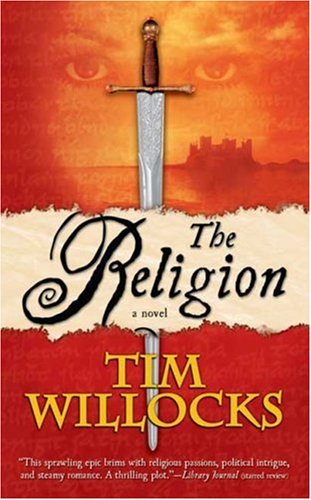
The Religion by Tim Willocks


Another novel recommended to me by fellow online players and readers of historical fiction, The Religion is a powerful novel that has a lot of elements going for it that would not only make a fantastic movie, but provide a ton of fodder for a role playing game.

Looking at the very begining for instance, in which young Mattias life is changed forever but has some historical basis.

"Thus, in the year of 1540, Mattias the blacksmith's son became a devshirme: a Christian boy gathered in the Gathering and drafted  for the Slaves of the Gate."

The young man in turn becomes a janissary, one of the elite soldiers. In and of themselves these might be minor things, but the weaving of the historical with the fiction with fine action sequences brings the book to life in its own way and provides a lot of depth that many settings are lacking.

On the other hand, the book doesn't focus extensively on this period of the main character's life. While those introduced here will play roles again, it doesn't go through each  and every year that he endured his initial training. When next we see him, he's a grown man with his own allies and enemies.

In its own way, this is espoused by many. Let the character develop through game play. In some instances I've seen, it's more like the novel here in that there are things hinted at in his background that eventually come to light in the book, but they are not needed at the start of the book and indeed, a new character may have a germ of an idea for his background, but unless it's going to directly effect how the campaign runs, don't be afraid to hold back some of the rare gems of events that happened prior to play and see if the GM can work them into the campaign.

Tim Willock's book is one with a lot of elements going for it and I'll be hitting it with a few more footnotes for at least a few more entries.

Monday, December 20, 2010

The Replacement Killers aka the New PCs

This one is directly inspired by the posting over at Comics in Crisis. See, I'm a big fan of Super Hero comics. I've read many and owned many and even started a little subscription to Marvel's online thing to see how it handles. I figure if WoTC could suck out some money for years before leaving me in the dust with their terrible online offering, I'd see how another online offering that wasn't game related went.

Before I drift too far off the point though, replacement characters in mid campaign can be somewhat problematic. How do you easily slide in new players with a minimum impact to the current game? Depending the style of game you run, it may be as simple as, "Bam, you're there. Let's get gaming." That works well for games where the actual gaming is the main thing everyone is there for. But for other games... Let me talk about some of the ways I've seen it done.

1. Prisoner: The cheap and easy way to add a member to a party that's in mid-dungeon crawl. I've done it myself and while I'd hate to say it is a classic method, it is one that I've seen used several times. The thing is though, and perhaps I'm just fortunate, that at no time did the other players mess with the prisoner. You've got this guy, supposedly about the same level as you, with no gear or equipment, and you've got him at your mercy. Most gamers will go, "Hey dude, we just lost X. Glad to have you above. Here's your gear." For those groups that may not though...

2. Survivor: This fellow isn't some down and out hero that needs rescuring. He's been exploring the dungeon as well but his whole group bit the bucket and he managed to escape. It is indeed a shame that the fireball or collapsing cavern destroyed all of the items of his team mates, but not only is he ready to go and in top spirits and form needing only some stout allies to assist him, he doesn't necessarily have to rely on the other players to 'save' him from his situation.

3. Enemy Mine: The new player is actually one of the enemy! In 3rd ed and 4th ed and other games, such as Hero or GURPS, the lure of playing something odd may be strong. In a situation that allows for it, such as when the players are fighting drow, lizard men, or other humanoid entities that can easily be swaped into the party, especially the half-breeds that may have something against their betters like the half-orcs, this can be an easy time to throw in a character that may or may not have the party's best interest at heart. Like with the escaped slave scenario though, it relies on the players not to abusre each other over such things. After all, the empire of monsters have more treasure than a single monster right?

4. NPC Promotion: In this case, the players have brought along with them a wide variety of henchmen and hirelings to take the brunt, I mean, explore from the front. These characters may with the GM's permission move from the low level rankings of NPCs to full fledged player character. Sure, the character may experience a power growth and may be slightly different, but unless it is really going to effect the game, what's the point of worrying about it?

When replacing a character in mid stream, try to work not only with the GM, but with the current situation to allow the fit to be one that's as seemless as possible and one that allows the dungeon exploration to continue.

Thursday, October 21, 2010

Gen's Story

One of the things I've mentioned before, is that in the Usagi setting, everyone has a backstory. We might not always get to see it but that backstory helps expalin who the characters are and what their motivations originate from.

Here, Usagi meets an old woman and her single retainer asking for a meal. Usagi obligies, recognizing the noble spirit in Lady Asano. Turns out that the Lady's house was betrayed and they have spent all of their money and time looking for the traitor.

Gen's father? A famous general who also sought out the traitor, even though it meant his family had to live like destitute beggars and the mother had to perform acts that perhaps bordered on prostituion although full details are never given.

In this light, Gen's character and shape come into sharp contrast. Events of the past, such as his reluctance to help the poor children or his self serving attitude, those come into a more reasaonable being.

But Gen is not a one dimensional character. When Usagi is in trouble, Gen helps him. When the chips are down, Gen is there for him. In some ways, Gen is even fooling himself. "Well, he does have all the money." It's important that characters in a campaign, even if they are not all friends, even if they don't all have the same motivations and the same purpose in adventuring, are all loyal to one another. It just makes the game run smoother. If the players have to come up for reasons why they'd help each other, like Gen, they need to fake it.

I know there are some games that thrive on inter party conflict or at least the promise of it, but in most standard games, especially those not necessarily design for 'clan' politics, it's best to keep all the players loyalties above the surface unless one is deliberately running a deeper game of espionage where trust itself is a treasure well worth having.

Bringing in Gen's background is a sort of 'round robin' technique that GMs can incorporate into their own games. If the players provide some background elements at the start of the game, and the GM isn't necessarily running adventurers out of modules (nothing wrong with that in my own opinion), he can use a round robin method of having someone's background crop up every other game or so to keep the character's past in the now and to use different characters to move the characters against different elements.

In terms of GM tricks though, Stan pulls out a great one. When Gen and Usagi are captured by the tratior to the house, Gen rummages through the weapon storage and grabs some new weapons. He even notes that he was never as attached to his weapons as Usagi is to his own specialty blades. After the fighting is all said and done, Gen notices that the swords are those of his father, the famous general, and takes a moment to reflect how they must have come into the traitor's hands.

Providing characters in a game with legacy items, not necessarily those of power, but those that have a connection to them, is a way to establish a powerful bond between the campaign history and the player's place in it.

Thursday, October 7, 2010

The Way Of the Samurai

Different cultures place different values on different actions. One way to showcase these changes to a default setting is to allow players to see the action prior to becoming involved with it.

For example, if the players are the 'strangers in a strange land', they may find it odd that an older samurai suffering from a disease is determined to die in combat. On the other hand, as default Dungeons and Dragons tend to have knights, who have their own brand of honor, the idea might not seem that strange to them.

Stan also is able to use the visual medium to showcase daily things that the samurai do. For example, when Usagi is speaking with General Oyaneko, the general is polishing his sword with great care and dedication to the blade which he refers to as his 'soul'.

These visual and verbal clues can be great aids to players new to role playing as it allows them to see and experience how others in the setting go about their daily business.

For more experienced players though, they may need a little more out of a meeting with a general. For Usagi, part of it is that the general has reknown. For players in the campaign, this can be copied a bit by either having the players meet famous NPCs of the setting, if they enjoy that vein of the game, or by having them meet their old characters or versions of their old characters, who have gone on to different things.

When the general engages Usagi in a duel, the two don't actually battle. In 4e, or with the right frame of mind and the right skills in play, 3e, this might be considered a skill challenge. Usagi uses old samurai wisdom to counter the codes of bushido that the general uses to justify his action. In a 4e situation, if Usagi failed to make his appointed number of rolls, then it would go from a skill challenge to actual combat. For players and

Game Masters more comfortable with role playing, if the players can provide an out for combat, especially against one they admire, they should role it out to the nines so to speak. Having game mechanics in place for something is not necessarily always the way to run the game if your group is comfrotable with other methods and it doesn't impact the group.

If that in and of itself isn't enough, there is always the set up for the next adventure. Here Usagi learns of a samurai who was framed and now seeks revenge. A samurai who travels with his son. A samurai commonly known as Lone Goat and Kid assassins.

Saturday, September 18, 2010

Usagi Yojimbo Book One: Homecoming

It would seem that one of Stan's favorite methods to get the action to his character Usagi, is to have him simply come upon it. In this instance, on a cold winter road on the way home to pay homage to his father's gravesite, Usagi comes across a gorup of travelers who decide he is a village who is not listening to their warnings.

The usual fight occurs and Usagi saves the hostage, a small child, that the ninja moles possessed. When the ninja retreat, he meets an old child hood sweet heart, Mariko, and we get a flashback of a tender moment between Marko and Usagi. During that flashback there is some banter, but also a quick showcase of Usagi as an artist, with Usagi himself noting that the brush is part of the samurai's discipline.

Usagi is a little shocked to learn that the child he saved is Marko's. Apparently she married Kenichi, Usagi's nemesis from when the two where children with another flashback.

The use of flashbacks here do a few things. They provide the character a reason to interact with his environment and they provide context for the action that takes place.

The use of an old rival married to his childhood sweetheart, could also have gone several ways. In some media, the old rival would look for any chance to dispose of Usagi in any way he could. Here however, the rival even winds up saving Usagi, with Usagi doing the same for him. This character who doesn't like Usagi is in some ways more interesting than someone whose just out to kill him.

How do players react to not being well liked? In the game I'm currently playing in, one of my friends makes a lot of characters because half the time he's in love with trying out different game mechanics and the other hanlf of the time he's trying to be a helpful player and fill a niche that the group is missing. His latest character is a sorcerer skill hound who comes from a noble background, Count Victor.

I kept referring to him as, "You." and when Count Victor pressed me on this matter, I explained that I'd already travelled with several other short stinted comrades and after a few weeks I might bother to remember his name. His response was to bribe me with an item we found later that night, asking my character, "What's my name." It was a funny moment at the table as his character was played the way the player wanted, with his desire to be well liked coming out even in simple things.

In terms of the background flashes, these additional flashes to do conflict with the earlier flashes in the book, but rather help to flesh out not only the characters but the setting. If a player has some idea for adding some elements to his background, before vetoing them, think about what those background elements actually mean to the game. Ask the player to define his relationships with others if he asks if he knows someone.

For exmaple, a member of a noble house may often have had guests and on the road may meet them. Ask the player how those interactions went and if it works with the campaigns themes and mood, run with it. Let the players do some of the campaign lifting when you can. It will allow you more time to come up with combat stategy and allow the players a better fit into the setting.

Wednesday, September 15, 2010

Usagi Yojimbo: Book One, Chapter One

Usagi Yojimbo is a hell of a comic. It's often described as "A masterful adaptation of samurai legend to sequental art."  The story is that of a masterless samurai named Miyamoto Usagi who often acts as Yojimbo or bodyguard.

I was introduced to Usagi many years ago but can't recall the specifics. Unlike the manga Berserk, published by Dark Horse also, I actually don't own all of the Usagi books yet. The series has been around for a long time and is still being printed and still being collected.

In this first chapter of the first book, our Samurai Rabbit approachs a house and asks for shelter and it is granted. The elderly woman inside relays that her husband was killed in a great battle, one that Usagi also took part in. 

Here Usagi's background comes out just a little. We learn that he served a lord and failed. The lord died but Usagi escaped with the Lord's Head to prevent it from being disgraced.  Usagi asks the old woman why she doesnt' fear the goblin of the region and she says it is not here karma to die by such a creature's hands.

During the night when the beast attacks, Usagi is ready and quickly dispatches it. He learns that it is his old mentor's betrayer and that he was once 'normal' like Usagi but guilt and rage drove him to become monstrous.

The part I'd like to touch on here is the background. It's brief but it presents a motivation for Usagi to wander. It's brief, but ties into the scene. It's brief, and it can be expanded.

In that I'd like to offer my own character Rus as a way of comparrision. One of my friends was running a Forgotten Realms 4e campaign. He is known by the group to be a pretty fair GM, one who gets into character's background and other bits. I didn't both putting down anything because I was more interesting in some light popcorn style playing and testing out some game mecahnics and more importantly, my friends and I were aware that despite his good habits as a GM, his worst habit is being a flake and quiting after running for a brief time.

So the inevitable happens. He stops running. But another player picks it up. He's interested in our backgrounds and would like more details. I resist the urge and put only the faintest bit of background into it so that I can keep gaming. It provides the other players, who are mostly new, with a lot of scenarios designed around them, but I still don't know the new GM so I hold off on it.

I do however, write out my character's take on how various adventurers go based on what happens to the game and throw some reference to the background ideas I have there. After a few months of this the GM wants some more information directly from me and I provide it in layered spades as at this time, I'm pretty sure the GM is going to be running for a while and is more than capable of taking things into the game from background.

The thing that I'll tie this into Usagi though, is that as the game has continued, I've added little bits of background to the game. In one instance, this was to form a tie or link with another new player. I thought it best if the new character had some ties to the campaign. The other time was when I was adding some details about the character's family. 

Neither instance effected the current campaign save to provide it with more opportunities.

This is more easily accomplished if you're not playing a wet behind the ears character. Sure, it may seem strange to flashback to your character being roughly as effective as he is at higher levels, but this is in part the nature of the game. If the Game Master is willing to let the players narrate their past histories with the setting and to include events in it, the Game Master can take those elements and add them to the campaign. This allows the world building to be done by the players and gives them more interest in the setting as they've now helped to develop it.

When thinking of background, it can effect current game play but most importantly, shouldn't get in the way of game play. 

Tuesday, August 24, 2010

Sheepfarmer's Daughter: The Military Setup

Sheepfarmer’s Daughter, Book One of the Deed of Paksenarrion, is in many ways a typical ‘farmer’ story. A character of humble origins goes out into the world and from a small point of knowledge, gains a greater understanding of how things work in the ‘real world’.


Note when I say famer, I don’t necessarily mean an actual farmer. For example, in the White Company, the scholarly monk of the series, despite having a plethora of book learning, discovers that the world outside his monastery walls isn’t quite the way it is depicted in the books.

Foreigners also fit into this category. While they may have a larger body of experience to draw on, their overall knowledge base of the current campaign is limited. One movie example of this would be Tom Cruise’s character in the film, the Last Samurai. He comes in with a body of knowledge. He is not ignorant to the ways of war. But in the ways of the Samurai?

This type of character is useful in a fantasy campaign for several reasons. The first is that it allows the Game Master to directly set the scene. If the player is one who has read sourcebooks and fictional material about the setting, all of that becomes “merely rumors.” After all, what does someone trapped on the farm truly know about how life on the outside is?

Outside of showcasing the growth of character, Sheepfarmer’s Daugher also has a great framing reference in the military mercenary company that Paks is a part of.

In many campaigns, there may be questions as to why all of the players are gathered. What links to they have to one another to keep loyal to each other? What method can the Game Master use to move the campaign forward.

A military campaign is an easy framing reference in that it allows the players to know each other right off the bat. It provides them with a common background. It gives them leadership and possibly other tangible benefits such as rivalries with other companies, that may be friendly or deadly series.

In Sheepfarmer’s Daughter, the companies tend to be broken up into the more honorable north companies and the more bandit like southern companies. A background element like this provides its own hook. In a fresh starting campaign with new players that are new to role playing, the Game Master can use an honorable company to provide mentors to explain how things work in the campaign.

Optionally, if only some of the players are new, the Game Master can allow those who are old hands to actually take the role of the mentors. Give them a few levels and abilities that the new recruits must train to match up with. But reduce their experience gained. In 3.5, this is self handled by the methodology of experience where lower level characters gain more than higher level characters.

The point isn’t to let the old hands lord over the new players, it is to allow the old hands an advantage in ability to showcase the world and setting and how the rules work, not to beat the newbies over the head with their power.

In addition, these mentors can act as a source of information for how things work in the ‘meta’ setting. For example, Sheepfarmer’s Daughter includes information on how the soldiers march, how they train, how they form rank and file, which weapons they use, and how they work in the world. Because the main character who is learning all of this is originally sheltered from such information, it allows the author to make large information ‘dumps’ to the reader without coming out on a sidebar or other aspect that can feel forced.

The other thing I’d like to mention about Sheepfarmer’s Daughter is that it is fairly internally consistent. The characters are aware that magic exists in the world. When they encounter it, they strive to overcome it. They don’t act like it’s the first time such magic has ever been used in the setting before. Some authors play with the readers in trying to keep magic mysterious by having things that would be obvious to characters who actually lived in the setting have no idea on how to react, or even about the existence of magic despite the fact that some of them may use it in the form of potions or magical weapons.

Lastly, in the novel, Pak’s is saved by ‘luck’ several times. This is an indication in the novel that there are higher powers looking out for the character. There are often numerous bits of advise for GMs in terms of ‘cheating’, allowing the characters to survive something that should have killed them. In many ways, this is one of the reasons why the GM screen is around. Not to cheat and punish the players. After all, the GM controls the whole of the world. It’s easier enough to throw an ancient red dragon at a group of first level characters.

Published in 1990, the DMGR1 Campaign Sourcebook and Catacomb Guide for AD&D 2nd edition notes on page 44, “Still, instead of killing the characters outright, he could throw something else at them, something equally deadly, but which will give them a chance to survive – if they’re clever.”

The real trick in doing this though is to never let the players know. If they feel that every time they are going to get into a potentially fatal situation the GM is going to save them, there is no fear of death and perhaps even a smugness about it. Always give the players the feeling that things could get much worse far too quickly for their liking.

Sheepfarmer’s Daughter can provide the reader with a good framing reference for a campaign but also allows the reader to see a bigger picture and this can be used as a tool to help move players outside of the military campaign once they’ve gotten the hang of it.

Sunday, August 22, 2010

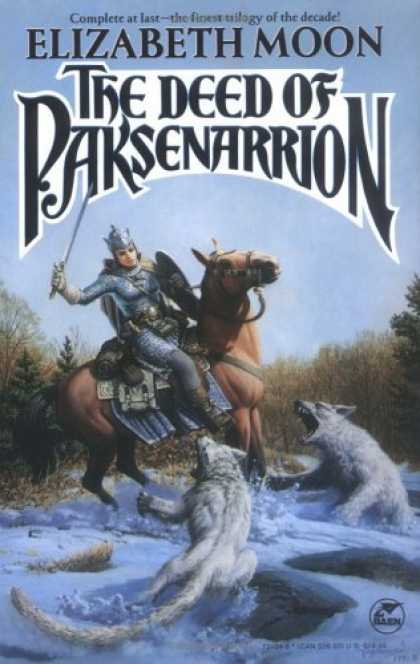
Sheepfarmer's Daughter by Elizabeth Moon

While I still own many a book I have not yet read, I still find myself wandering off to Half Priced books. Because of all the books though, I’ve decided that if I’m going to buy a book, it has got to be coming out of the one dollar spinners they have located throughout the store. So I pick up the Deed of Paksenarrion Book One through Three, written by Elizabeth Moon.


I’ve never read any Elizabeth Moon. I figure for a dollar each, if I don’t like them I can give them to a friend and not worry about it.

Her writing is crisp. It gets to the point. It is easy to read. These things alone insure that I will finish the series.

But what struck me in the first few pages that I wanted to share it with the readers of the blog? It is not necessarily that it moves quick in terms of action or events, but rather how it moves.

The main character, a tall woman Paksenarrion, Paks for short, does not want to do as her father wishes and marry the pig farmer down the road and wants to join the military and serve thanks to tales told to her by her cousin. It happens quickly. Her initial signing isn’t made a big deal of. Her leader and trainer in her unit is very much a mentor role without being interested in her as a woman.

This to me, after reading books like Best Served Cold and the First Law, was like a breath of fresh air. Sometimes when I’m reading writers, I get the feeling that they just keep adding text and text and text and problems and problems ot make things more interesting instead of getting the story done.

For example, while reading this, I thought for sure she wouldn’t get away from her father. I thought for sure that she’s have some dire encounter on the road to joining the military that would make her question her motivations. I thought for sure that she would initially be turned away from signing up, that her mentor would be some puke who only wanted to bed her and dispose of her. None of those things happened.

It is not that bad things do not happen to the character, but rather, it does not seem like the entire setting is out to cause her harm. When she does encounter difficulties, there are those who are neutral on the subject, but follow the chain of logic and evidence as well as those who stand against her. It makes a nice breath of fresh air.

When as a game master you are about building your story, communication with the players is a good thing to keep the game moving in a direction that makes everyone happy. For example, if there was a female player who wanted to play a warrior and was using running away from home as a background, would the GM throw those things above in her way or, like Elizabeth Moon does, just use that as a launching point and get to the military and move on?

I’m not advocating not throwing issues into the players way. But knowing which issues are worth the time to spend in game and to engage the player with is a vital tool of having the players enjoy the game. There are some players who look forward to expecting the inevitable betrayal, of expecting their employer to turn on them at any moment, that the kindly old white wizard is actually the balrog in disguise. Indulge them in that as it is what they enjoy. For those who have a stated goal and want to get to it, try not to make it so difficult that it alters the character concept and background.

Thursday, August 12, 2010

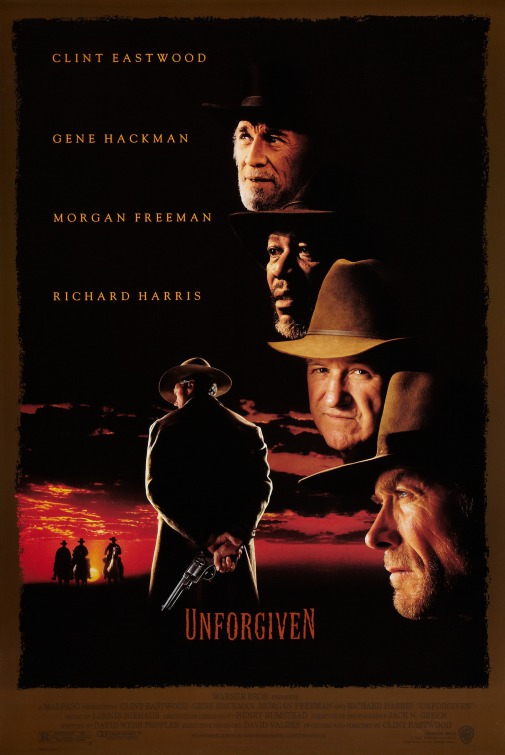
Unforgiven

Unforgiven is a classic Western movie. While the plot is fairly razor thin, it is one often used for adventures to begin with. “There is a bounty on this individual. Go collect it.”


The thing that makes Unforgiven however, is the atmosphere and the characters.

The atmosphere drifts in through names like the town, Big Whiskey and through little statements made here and there, like when someone mentions the billiards table was broken down for fire wood years ago. Or how technology isn’t there to solve every problem such as vision difficulties or simply having the hogs suffer flu.

But it is the background of the characters that helps the whole movie to gel. For example, the viewers are often introduced to characters not only through those characters actions, but by how the other individuals in the movie react to them.

When English Bob and his biographer are travelling along on the train and being taunted by one of the cowboys, another cowboy warns him that this fellow might indeed be English Bob and is not one to be trifled with. The audience is further granted a view of skills involved here with a pheasant shooting contest from the back of the moving train with Bob hitting eight and the cowboy hitting one.

But as in many setups, this is just a tease. You see, it’s a tease for the build up of Little Bill who is spoken of in near holy tones by his fellow law men. Was he scared? No. He’s a bad carpenter, but he ain’t scared. Indeed, Little Bill is so unafraid of English Bob that he gets the drop on him with a full posse and beats the crap out of him. This sets Little Bill up as a truly big bad.

One of the 4e DMGs has some advice on trying to showcase the strength of the big bad including allowing the players to take the role of the person going up against the big bad. This allows the players to first hand experience the gaming effect without the GM only having to rely on narration to showcase the strengths of the villain.

It is also the characters that move the story along. There is no dungeon to explore here. While there is a beautiful scenery all about, the vast empty plains are not there for exploration but to travel through. Rather, it’s the characters that move the story forward.

One man makes a bad decision. A lawman makes another decision. The mother figure of the person wronged is not pleased with the lawman’s decision and puts a bounty out on the men who have wronged her people. The lawman now has to deal with bounty hunters, assassins, and other vagrants moving about his peaceful town.

In helping to make the characters stand out, think of the five senses. Hearing is a good one because when the players hear the names of the characters, if the names are descriptive and appropriate, the characters will probably get it more. The Black Company and The First Law use a lot of names that make sense only in their context, like the doctor being called Croaker or the hunter with the good smell the Dogman. Here, it’s names like Skinny or Fatty that come across on even the normal people of the setting.

In terms of player character types though, the three killers, tend to fall into three separate camps.

The Kid: He comes across as tough. He has access to high quality gear. He claims a lot of deeds under his belt. But… he doesn’t seem to know things that he should. The things he does know, he learned from an older relative, a member of the old posse. He doesn’t seem as capable as he should. Those who’ve been in the field for a long time may even notice that the kid suffers from some sort of physical defect that may not be easy to notice at first. Say… being short sighted? Not a good thing for a gun fighter.

The Eternal Companion: When first introduced to Ned, he’s a friend of the Seasoned Killer. He’s okay with his past. He’s not only made peace with it, he’s moved on. He doesn’t talk about it with a lot of regret but merely as something that happened. But more importantly, he’s a keystone for the Seasoned Killer. He’s a true comrade who would face death rather than betray his friends. He may have his own specialties but he often acts as a bit of comedy relief and a mirror for the Seasoned Killer.

For example, when questioned by the Kid about facing down two marshals and coming out with only a scratch, after the Kid goes away, the Companion tells the Killer that, “I recall it was three marshals.” He’s not necessarily there to act as the conscious of the seasoned killer. Indeed, he may spur the killer on if he thinks that will get the group where they’re going, but he has limits and will not cross them, leaving his friends if in good hands, to wash the blood off his own.

The Seasoned Killer: In the movie, Munney as played by Clint Eastwood is at first a man seemingly at peace with himself. He acknowledges his foul ways. He knows that he’s done wrong. He’s pushed by circumstance to go into “one last job” but isn’t going to fall into his old ways again.

But that’s nonsense. It takes a lot for the Seasoned Killer to simmer to the top. Here, Munney endures being made a fool of by his horse. He takes it in stride for his “wickedness to animals when I was weak.” He suffers the harsh life of an outdoor travelling man in the fall season suffering rain and snow and wind. He suffers disease, his mind ravaged by fever dreams, dreaming of those he’s killed, those he knows are dead, and even his loved ones. He even suffers at the hands of Little Bill. But the encounter is too early and so, the Killer, weakened by the fever, is unable to fight at his peak and suffers a beating, worsening his condition.

And when the killer wakes up? When he throws off the beating and the fever days latter? At first he may even seem like the repentant killer. He looks about the landscape and marvels in being alive and in the beauty of a scared woman. But when it comes to the killing? No uncertainties now. Indeed, he turns out to be a better shot than his Eternal Comrade whose specialty was with that weapon. His blood turns to ice and its only on getting the job done.

Consequences? Those are for lesser men. The Seasoned Killer may be a ruthless killing machine with a cool hand, but he’s not mindless. He values his friends. When people turn on those friends, woe be unto them.

For example, here, when Munney sees his friend Ned in a coffin outside Skinny’s Bar, it’s all over for skinny. When Little Bill protest that he just shot an unarmed man, Munney replies, “He should’ve armed himself” and goes on for a second about anyone going to decorate their bar with his friend is a dead man.

This is in the midst of a room full of lawmen. This is in the middle of town. This is walking into the cave of the bear with the bear awake and pissed.

And he walks out of it with a threat to burn the town down if they don’t take care of his friend.

There are variants of the Seasoned Killer, such as Samurai X, where the character is so earnest in trying not to kill anymore, that they essentially strip themselves of the ability. But the struggle of self perception, of telling people, “I’m not like that anymore” against what the character falls back unto?

For a different example, in The First Law, the Bloody Nine noted that its difficult to change if you stay in the same place with the same people doing the same things. The old habits return and good intentions are useless.

The Seasoned Killer also has another problem that the Eternal Companion and the Kid may not. While the Companion is competent and the Kid a young blood who hasn’t made a name for himself yet, The Seasoned Killer, when identified, is a known quantity. He’s a wanted man. Those on the side of justice want him dead or behind bars and those looking for a dangerous man are willing to pay.

If you’re looking for a movie with a ton of character that has a slow built up with a great cast, Unforgiven is a solid Western.

Saturday, July 17, 2010

Big Guy and Rusty the Boy Robot

On ye old Hulu, under the animation section, I found an old favorite, Big Guy and Rusty the Boy Robot.

It makes a nice change of pace in many ways and it showcases some interesting rationals for some role playing options as well as mechanic options in a game.

In terms of role playing characters, the naive character makes a good source. In many instances, this character may have innate abilities that make him the equal of his more experienced comrades, but his experience with life is at a low point. It can be challenging for an old hand to play a naive character but it can also be fun.

These types of characters should approach everything with a fresh eye and with an air of optimism that may contrast with the rest of the party members.

The second type of character, is the character with a secret. In this case, the Big Guy is supposed to be an A.I. but is instead an exo-skeleton for a human pilot. This lends the character not an air of secrecy but a secret identity. This is old hat in games like Mutants and Masterminds and Champions but not quite so common in the sword swinging field although Zorro does come to mind as well as the old Scarlet Pimpernel.

The trick to pulling this off is as the quote from one of the episodes, "It's time like this that I wish the Big Guy's sSecret wasn't such a secret." If there is no effort or repercussions from failing to keep the secret then the secret is worthless. If the player has to work every minute of ever session to keep the secret, then the GM is trying to hard.

In terms of game mechanics, Big Guy and Rusty is a solid example of M.D.C. in action. For those who don't play Rifts or any of the high end games, that would be Mega Damage Capacity. In Big Guy and Rusty, the bad guys are always shrugging off the attacks of the normals of the setting and it isn't until Big Guy and Rusty come into the scene that we see anything getting done.

Now that might just be my love of big damage talking but on the other hand, it's a quick way of showcasing how the characters are not part of the normal setting and stand far apart from it.

Tuesday, July 6, 2010

The Make Up Of the Epic Party

Last time I mentioned that some games might be better off starting at a higher level.

But what types of characters can make up such a party?

Long Lived Races or Races that Reincarnate: Depending on what edition of the game you are running, the rules for aging on the dwarves and elves allow a very long life span. In the various books that make up the Last Mythal, the elves within are often over five hundred years of age.

Heroes from the past: One of the things that surprised me about the series is that one of the main characters is an elf hero from the original battle of Myth Drannor. Resurrection actually used in a gaming novel! Other possibilities include a hero trapped in ice or in status or in a different state of being such as a stone statue. In some instances, the hero may sleep away the ages such as the original Druid in the Shanarra series.

Legacy Heroes: This series boasts a couple of different types. First, we have an apprentice of one of the original character's friends showing up. Next we have a former student of the same character show up. the Druids of the Shanarra series work well here as well since when one falls, another often crops up to take his place.

Children: Similair to legacy heroes, but with a direct tie or link to the heroes that may have walked the land previously.

Experienced adventurers: If you look at Rand from the Wheel of Time at the start of the series and Rand at the latter books, it is a comparission of completely different power levels. This is true in books like Raymond Feist's Magician series as well as a host of others where the character initially starts off small but gains vast power. Running the campaign when the character is at this vast power level is by far the more challenging aspect of the game.

When making it epic, don't forget to bring a little something extra to the character creation process as well.

Monday, March 1, 2010

Dead or Alive.... You're Coming With Me

Robocop was ahead of its time in many ways. In looking at it today, as I did on good old Blue Ray, I found myself thinking of the use of catch phrases.
A good catchphrase can be a timeless identifier and are in common use in many types of media. For example, Marvel comics has at least two power hulks, the Hulk, "Hulk Smash", and the Thing, "It's Clobberin' Time." These battle cries are quick things to identify and reinforce character integrity.

These identifying marks can take a few forms.

1. Mannerisms: Despite Murphy's catch phrase in the movie, the whole Dead or Alive, there is another trick he has, a certain method of twirling his gun in immitation of his son's favorite television character. Bruce Lee occassionally would taste his blood and give his enemies a quick hand gesture to continue the battle. Others crack their knuckles. Give the character a physically identifying signature.

2. Methodology: The Mark of Zorro is called that for a reason. In video games (no, not the dreaded Video Game comparisson!), like Mortal Combat, the characters tend to have unique 'Finish Him' moves which share a similiar purpose. They look cool and identify the character to the audience.

3. Equipment. While perhaps not as personal as some of the other bits, when you see a 'batarang' hit the stage, you're pretty sure a member of the bat family has shown up. When you see Stormbringer sucking the soul of a dying man, you're probably safe betting that Elric is nearby.

4. Speech Patterns: Hard to pull off except with practice or the most dreaded of stereotypes, but love him or hate him, everyone knows Yoda. In the show Samurai Jack, the Scott's Man is another one easily identified. Exagerrating stereotypes and making them larger than life is a quick way of ingraining such a character onto the players. Don't overdo it though with too many characters of similiar nature or too many apperances of such characters.

Remember, when making your characters, as a player or a game master, the easier the catch phrase rolls off the tongue and the easier it is to remember, the quicker you'll be engaged in a familiar character and that's something that a famous commerical would say, "I'd buy that for a dollar."

Friday, December 18, 2009

Living Up To The Legacy


In addition to manga, Dark Horse has long been the comic care taker of the Star Wars property. One of those veins of gold they mine, is the Star Wars Legacy era, 125 years after Return of the Jedi. Over here is a summary and preview of the first collection of legacy comics.
As with all Star Wars comics, one of the first things a Game Master may take from it, for any game, system, or genre, is that apperance matters. When I was a kid, Darth Vader didn't stand out so much because of the high end special effects and fighting sequences, but rather, the visuals that came with him. The bounty hunters like Fett? Ditto.
Giving the main characters a distinctive look will go a long way in ingraining them to the players they must interact with.
In addition, because these are Star Wars comics, even though they are in a different time line, they share many of the same elements.
If your group is looking for a standard game of Dungeons and Dragons and they start off as breaking out of their shells as lizard men in some swamp that has no humans and is a pre historic world with dinosaurs and dragons as the masters, it may be an awesome setting, but it's not what they've signed up for. The elements of the familiar can help the players quickly get into the game. When people look at Dragon Age and claim it has no originality, that doesn't seem to stop it from selling or from people enjoying it immensely. When critics talk about Terry Brooks, Ryamond Feist, or a certain Dennis of being Tolkien copy cats to various degrees, they may be over looking the fact that many people like the 'comfort' food category that these elements fit into.
For players, Star Wars Lgecay has a few words about being a legacy character. "The point is-- I have a legacy, too. And I'm just as trapped by mine as you are by yours. Sometimes I wish I could just change my name-- make a new life...I envy you your freedom but I'm not walking away from my responsibilities."
When looking at a legacy character, is your character like Roy from the dreaded Order of the Stick? Willing to go the distance for the family honor and legacy but going against the wishes of the one who sent him on the path? Is he like Cade from this series? Possessing of the powers and abilities but seeking to surpress them in order to ignore that legacy? How a character interacts with the elements that make up the character's legacy will define the role that the character takes in the campaign.
Legacy characters can be a lot of fun. Like the new Batman, who started off as Robin and moved onto Nightwing, they can represent a logical growth and extension for the character. Like the various comic extensions of Marvel's 2099 line, they can be either inspired by the originals or perhaps even time displaced copies of the original who have a name and title to live up to. When using legacies in the campaign, as either a player or a game master, make it interesting enough so that its fun for the whole gorup without overshadowing eveyrone else.