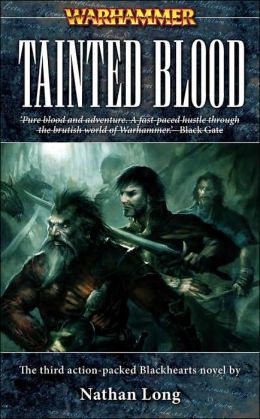
Nathan Long brings the conclusion to the Blackhearts trilogy with all the flavor you'd come to expect from a good popcorn read. We have dark elves, skaven, and other vile creatures doing their best to take out the anti-heroes known as the Blackhearts whose interest isn't necessarily in saving the Empire so much as in saving their own skin.
It has a good flow for the most part and is an easy read and brings the series to a nice conclusion while at the same time leaving it open for future volumes. This novel even has the appearance of a certain high elf mage from the pages of the Warhammer tabletop version which is always a nice touch. If you're a fan of the Warhammer setting, this will be a nice novel to read over while prepping to wipe out your players.
Onward to spoilers!
One of the things I've mentioned before, is that if you're using a specific setting that has its own things that are famous and familiar to those who enjoy the setting either through video games, board games, or table top games, is that you should check the waters and see if the players enjoy it when you bring in those iconic elements.
Tainted Blood not only has the character meet the Skaven again, but learn of their lust for the dreaded Warpstone and that they are willing to try and 'fix' things when it is to their advantage. We have multiple groups of chaos worshippers trying to trust one another but due to their intrinsic nature, are easy to manipulate into fighting one another. We have Telcis, one of the most powerful magic users of the setting here.
The good news is that since this isn't a book about Telcis, but rather, one about the Blackhearts, the author does what any good author should and takes that character out of the action immediately. This allows the Blackhearts to have to strive even harder because hey, if this guy could take out that guy, what's he going to do to us?
The solution is great though in that it's one the author set up earlier in the novel with one of the thieves/assassins talking about a set up he performed where it looked like he murdered his target, but rather just had the appearance of murder and not actual death. This comes back in later and allows the characters to have a friendly ace in the hole later on and works quite well. It goes back to my thing of if the players have a great idea, let them run with it. Let their inventiveness provide success when possible. It'll make them know that you're rewarding them for it.
The other big thing? The Blackhearts are freed of their service. This does have the odd thing of "what now" though as at the end, the character don't necessarily know what their going to do with their lives and wonder if they can go back to their old profession but without the coercion this time. It's an important thing to have an end game in mind if the characters are starting out with some type of limitation.
I'm not saying the campaign has to end or anything like that mind you. But if the whole campaign revolves around killing X, if the players kill X, what then? It can be as easy as kill Y or as complex as moving onto a new campaign with new characters and new genres. Try to have an end game in mind when you start if you're putting those things in place at the start of the campaign.
Blackhearts is a nice omnibus and I haven't mentioned the two short stories included in the book which augments it's value and provides more insights into the characters and the dire situation they find themselves in as agents of the Empire. If you want to run a Dirty Dozen or Inglorious Bastards style campaign, Blackhearts by Nathan Long provides a lot of fodder for the fire.
Showing posts with label Nathan Long. Show all posts
Saturday, October 26, 2013
Sunday, October 20, 2013
The Broken Lance by Nathan Long
The Blackhearts Omnibus by Nathan Long contains a few short stories as well as three full length novels. The second novel in the series is The Broken Lance. Here we see the Suicide Squad of the Warhammer setting given a new mission. With this new mission comes new comrades to replace those that have fallen as well as to keep an eye on the soldiers. After all, these Blackhearts are not the standard soldiers. They are bound by magic to their lord to do his bidding all in the name of the Empire mind you.
The Broken Lance features a lot of the setting bits. This can be important in keeping the reader entertained. If you're reading a book in the Warhammer setting, there are certain expectations. For instance, you'd want to see the forces of Chaos, as were present last book. You'd want to see the failings of humanity in the form of say, bandits, which while not ever present, are here and there though the series. You'd also want to feature one of the other more iconic creatures in the series, and that would be Skaven which Nathan Long brings us in droves in this volume.
In short, the Broken Lance brings good writing and an entertaining story to the reader that fans of the Warhammer world will especially enjoy.
But what about gaming purposes?
More specific spoilers follow so for those who don't want more than an overlook, read no further.
One of the things I find interesting about the whole idea of the Blackhearts, is that due to their nature, that of a Thunderbolts or Dirty Dozen group, that some of them will die. Some of them will try to betray the group. Some of these betrayals aren't even intended to be specific to the idea of treachery, just that the group is saddled with psychopaths who aren't necessarily interested in killing the group, it's just they have no self control.
On one hand, this could be an excellent way to test out new players. You have the group have a collection of characters that are used for such suicide runs. These characters aren't the main characters but rather, characters that get broken out when a new player joins the group. This way you can see how the new players interacts with the characters. If it's a good fit, the group that never could gets another mission done successfully.
If the player is a flake? If the player doesn't work well with the others? If it's a play style that is obviously going to cause friction within the group? The potential for a good game is there but the penalty of having long term characters and possibly entire campaigns thrown off the tracks is minimized.
Now mind you that only works if the longer term players understand that this secondary group of characters is there specifically for this reason and could get snuffed at any time. Heck, they might play in ways and manners that they don't normally do.
In addition, because characters are going to die by the nature of the set up, it allows the GM to set up some spectacular death scenes. For instance, there is a mercenary here who hates the Skaven. His parents and indeed, his village was devoured by them. This is hard to get across to men of the Empire who "know" that there are no Skaven. Mind you that whole concept is entirely stupid and hard to believe even in the slightest now due to their various interactions with numerous characters and events but anyway....
This character, Giano, sacrifices his life to set up an explosion. It kills a lot of the enemy and it makes sense for his character to do. In some game systems he may have had to do it if the restrictions or pulls on his character were strong enough. In a role playing session where say, you know player X is going to be leaving next week? Getting a new job or moving? It allows you to talk to the player before hand and find out how he would like his character to go. It allows you to set up a specific death scene that plays up the character's strengths and provide some resolution to that long running background element. In Giano's case, it's the desire to kill Skaven which he gets to fulfill.
If you can bring together the iconic elements of a campaign and do so in a manner that encourages the players to make bits and pieces of those elements part of their own background, you've got a magic formula for a solid game.
The Broken Lance features a lot of the setting bits. This can be important in keeping the reader entertained. If you're reading a book in the Warhammer setting, there are certain expectations. For instance, you'd want to see the forces of Chaos, as were present last book. You'd want to see the failings of humanity in the form of say, bandits, which while not ever present, are here and there though the series. You'd also want to feature one of the other more iconic creatures in the series, and that would be Skaven which Nathan Long brings us in droves in this volume.
In short, the Broken Lance brings good writing and an entertaining story to the reader that fans of the Warhammer world will especially enjoy.
But what about gaming purposes?
More specific spoilers follow so for those who don't want more than an overlook, read no further.
One of the things I find interesting about the whole idea of the Blackhearts, is that due to their nature, that of a Thunderbolts or Dirty Dozen group, that some of them will die. Some of them will try to betray the group. Some of these betrayals aren't even intended to be specific to the idea of treachery, just that the group is saddled with psychopaths who aren't necessarily interested in killing the group, it's just they have no self control.
On one hand, this could be an excellent way to test out new players. You have the group have a collection of characters that are used for such suicide runs. These characters aren't the main characters but rather, characters that get broken out when a new player joins the group. This way you can see how the new players interacts with the characters. If it's a good fit, the group that never could gets another mission done successfully.
If the player is a flake? If the player doesn't work well with the others? If it's a play style that is obviously going to cause friction within the group? The potential for a good game is there but the penalty of having long term characters and possibly entire campaigns thrown off the tracks is minimized.
Now mind you that only works if the longer term players understand that this secondary group of characters is there specifically for this reason and could get snuffed at any time. Heck, they might play in ways and manners that they don't normally do.
In addition, because characters are going to die by the nature of the set up, it allows the GM to set up some spectacular death scenes. For instance, there is a mercenary here who hates the Skaven. His parents and indeed, his village was devoured by them. This is hard to get across to men of the Empire who "know" that there are no Skaven. Mind you that whole concept is entirely stupid and hard to believe even in the slightest now due to their various interactions with numerous characters and events but anyway....
This character, Giano, sacrifices his life to set up an explosion. It kills a lot of the enemy and it makes sense for his character to do. In some game systems he may have had to do it if the restrictions or pulls on his character were strong enough. In a role playing session where say, you know player X is going to be leaving next week? Getting a new job or moving? It allows you to talk to the player before hand and find out how he would like his character to go. It allows you to set up a specific death scene that plays up the character's strengths and provide some resolution to that long running background element. In Giano's case, it's the desire to kill Skaven which he gets to fulfill.
If you can bring together the iconic elements of a campaign and do so in a manner that encourages the players to make bits and pieces of those elements part of their own background, you've got a magic formula for a solid game.
Labels:
Black Hearts,
Campaign Design,
Nathan Long,
Skaven,
Warhammer
Saturday, October 5, 2013
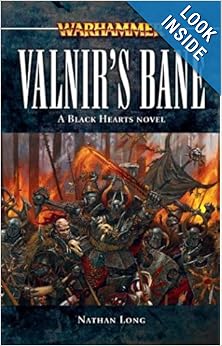
Valnir's Bane by Nathan Long
The idea of the people on the wrong side of the law doing good things because they're forced into it, is not a new concept. The group I'm most familiar with in this regard is the Suicide Squad.That group of super villains, often C listers or not very important characters, are used in death defying missions that allow the writers to occasionally kill off a member or two. The Thunderbolts by Marvel did something similar for a while although I'm not sure of their current status. My first encounter with such a concept though, goes way back into my child hood with the movie, The Dirty Dozen and other similar concepts have crept into modern cinema with say Quentin Tarantino doing the movie Inglorious Bastards.
Here the characters are a group of military men who for various reasons are sentenced to death and given a brand of 'The Hammer', a visual signifier to anyone in 'The Empire' that these are men sentenced to death. Most have their own story and in a short story included in the omnibus Blackhearts, Nathan Long provides a more detailed account of the leader, Reiner Hetzau's fall from grace.
Valnir's Bane could very easily be a standard adventure. It hits many bits and Nathan Long isn't short on the action. Because of the nature of the group, Nathan doesn't provide complete script immunity to the cast an author might in a more standard fantasy setting.
If you're looking for a good pulpy fantasy read, Valnir's Bane has you covered. Below I'll be discussing some specifics of the book, spoilers, and how I might snag something out of the novel for my own games.
In any game, why would convicted felons help out those who've damned them to die?
In war scenarios, it might be for patriotism. A thief or a murderer may still have a great deal of patriotism for their home country. They may not be able to stand the whole idea of another race, alien or monstrous, invading their country. This works pretty well in any setting that has multiple factions to it. Even Chaos may have its champions for a particular faction as opposed to unified.
Another problem may be loved ones held hostage to insure good behavior. This one only works if the players are going to work with you though. If the players are all 'lone wolf' types who care nothing for no one and no body, then this method is doomed to failure.
Branded. Depending on the level of technology, the characters may be branded and can't find social acceptance anywhere that civilization, or at least civilization that supports their home, is found. Only in certain confined spaces, perhaps with others of their ilk, can they enjoy all of the comforts of home.
They Like the new work. In some instances, it may simply be a matter that in their prior life, they were not putting their skills to the uses they would have enjoyed. A swordsman who starts brawls to collect money from another man for killing someone else may find that he enjoys the ability to cut lose on certain enemies of the stage.
An honest repentance. Even rarer, there may come a time when some characters decide that they've been doing the wrong thing prior to this point and that its time to turn over a new leaf. This one can be tied into other elements such as patriotism or love of someone else or just deciding to make the best of a terrible situation.
The honest spy. What if not everyone in the group is actually working under a death threat? What if one, or more of the individuals there, are there honestly and there to keep tabs on the others? In some cases this person may be known to everyone at the start. It could be a commanding leader who is well known and gives the characters some legitimacy among other factions.
The death trap. In high fantasy, super hero, cyber punk, or other advanced technology games, the characters are implanted or branded or geased or quested so that they must serve. There may be terms that allow them some freedom in terms of how they provide this service but overall? They must serve and do so again and again until the curse is broken.
The idea of running a Suicide Squad type of set up is one that can be applied to almost any genre depending on the set up and can provide some different assumptions about the characters. It can allow some odd 'evil' style characters to be played while still directing that style of game play against something other than the party.
Anyone ever run a game like that? How'd it go?
Here the characters are a group of military men who for various reasons are sentenced to death and given a brand of 'The Hammer', a visual signifier to anyone in 'The Empire' that these are men sentenced to death. Most have their own story and in a short story included in the omnibus Blackhearts, Nathan Long provides a more detailed account of the leader, Reiner Hetzau's fall from grace.
Valnir's Bane could very easily be a standard adventure. It hits many bits and Nathan Long isn't short on the action. Because of the nature of the group, Nathan doesn't provide complete script immunity to the cast an author might in a more standard fantasy setting.
If you're looking for a good pulpy fantasy read, Valnir's Bane has you covered. Below I'll be discussing some specifics of the book, spoilers, and how I might snag something out of the novel for my own games.
In any game, why would convicted felons help out those who've damned them to die?
In war scenarios, it might be for patriotism. A thief or a murderer may still have a great deal of patriotism for their home country. They may not be able to stand the whole idea of another race, alien or monstrous, invading their country. This works pretty well in any setting that has multiple factions to it. Even Chaos may have its champions for a particular faction as opposed to unified.
Another problem may be loved ones held hostage to insure good behavior. This one only works if the players are going to work with you though. If the players are all 'lone wolf' types who care nothing for no one and no body, then this method is doomed to failure.
Branded. Depending on the level of technology, the characters may be branded and can't find social acceptance anywhere that civilization, or at least civilization that supports their home, is found. Only in certain confined spaces, perhaps with others of their ilk, can they enjoy all of the comforts of home.
They Like the new work. In some instances, it may simply be a matter that in their prior life, they were not putting their skills to the uses they would have enjoyed. A swordsman who starts brawls to collect money from another man for killing someone else may find that he enjoys the ability to cut lose on certain enemies of the stage.
An honest repentance. Even rarer, there may come a time when some characters decide that they've been doing the wrong thing prior to this point and that its time to turn over a new leaf. This one can be tied into other elements such as patriotism or love of someone else or just deciding to make the best of a terrible situation.
The honest spy. What if not everyone in the group is actually working under a death threat? What if one, or more of the individuals there, are there honestly and there to keep tabs on the others? In some cases this person may be known to everyone at the start. It could be a commanding leader who is well known and gives the characters some legitimacy among other factions.
The death trap. In high fantasy, super hero, cyber punk, or other advanced technology games, the characters are implanted or branded or geased or quested so that they must serve. There may be terms that allow them some freedom in terms of how they provide this service but overall? They must serve and do so again and again until the curse is broken.
The idea of running a Suicide Squad type of set up is one that can be applied to almost any genre depending on the set up and can provide some different assumptions about the characters. It can allow some odd 'evil' style characters to be played while still directing that style of game play against something other than the party.
Anyone ever run a game like that? How'd it go?
Labels:
Black Hearts,
Nathan Long,
Suicide Squad,
Thunderbolts,
Valnir's Bane,
Warhammer
Subscribe to:
Posts (Atom)