Showing posts with label Forgotten Realms. Show all posts

Tuesday, May 30, 2017

Crossing the Streams: Civil War


When I talk about stealing ideas from any source, some may seem odder than others. How about Marvel Comic's Civil War for example?

If you look at the 5th Edition D&D Player's Handbook, you've got the following classes:

  • Barbarian
  • Bard
  • Cleric
  • Druid
  • Fighter
  • Monk
  • Paladin
  • Ranger
  • Rogue
  • Sorcerer
  • Warlock
  • Wizard


So how many of those classes cast spells or use some type of magic? How easy would it be to incorporate the idea of 'registration' for anyone who could cast magic? Even if it's just limited to a portion of the setting, it could create complications with most parties.

Imagine in Waterdeep you are automatically tagged and put into a school and have to work for the city.

Imagine in Cormyr you HAVE to be in the War Wizards.

In some ways, the settings often work something similar if at a reduced structure into their settings. But when you push things to an extreme level? They can take on different shades, different meanings.

It can also provide automatic breaks for the campaign. Imagine that it's not ALL magic using classes, just those that are arcane. All of the sudden you're sorcerer and warlock who didn't have to study for their magic, outside of the usual bits, now have to deal with witch hunters from all over the campaign setting. Now they have to deal with clerical spellcasters armed with dispel magic scrolls and a great knowledge of arcane magic.

Imagine the competition so fierce that warlock patrons are being killed off in the campaign by the deities of the setting, forcing people who still wish to be spellcasters to turn to deities for their power.

Pushing the ideas further, imagine groups that were once considered 'good' working on these terms. The 'Harpers' all of the sudden becomes a group that advocates for all mages to be registered and trained specifically so that they don't do any wrongs and that they have to be kept tabs on at all times. They point out the 'rogue' wizards of places like Zhentil Keep and Thay as a perfect reason why these laws must be passed and other countries, like Cormyr, fully agree, on the insistence that while in their country, these wizards work for both the Harpers and the country.

Still further, and you can see anti-magic zones like those created during the Time of Troubles becoming hot spots where the martial classes would gather to plot their works against the wizards of the world.

Still further and you can see countries using mage sniffing demons, hounds, or other entities that could sense and eat/countermagic.

This might lead to mages that don't rely 100% on their magic, mages that are multi-classed or are in hiding by claiming to be clerics or druids.

Comics can be a fun way to see how plot lines and ideas play out. Don't hesitate to steal from them.

Thursday, May 4, 2017

The Godborn by Paul S. Kemp


The Godborn
Written by Paul S. Kemp
The Sundering Book II
Dungeons & Dragons
Forgotten Realms

This book has more categories than it knows what to do with. It's Forgotten Realms, it's Dungeons and Dragons, it's the Sundering and it's the continuation of Paul S. Kemp's work of sun and shadow.

Hate to say it, but the initial chapters didn't win me over. It's not that Paul isn't a solid writer, but rather, that he's shackled by the setting. In this case, the 'Sundering'. See, it wasn't enough that the Forgotten Realms in Paul's last book was getting ready to undergo changes, and that oh, it's been about 100 years since the last book, well, 70 at the start, and you know, the whole 4th edition Spellplague and whatnot, but...

As I've gotten older, I've become less a fan of the dreaded 'women in refrigerators'. Paul does that to Vara, the mother of Vasen Cale. Some might argue that it's some weird necessary trial or tribulation but hey, he gets raised by a stepfather of sorts and that character dies off screen.

That's because by the time we're introduced to Vasen, he's thirty years old.

There was absolutely no reason why Vara couldn't have had the same kindly end. When something similar happens, later on, it's enough to get an eye roll from me.

I'm also not a fan of the whole time jump thing. In this book, in many ways,  it's even more obnoxious than in others.

Riven: One of the three who has the divine might of Mask in his shadowy blood. Waiting for Vasen to grow up. Oh, he's undergone many a change in the waiting time mind you and in that aspect, is probably one of the few who has.

Cale: Trapped under ice. In hell. So yeah, not a lot of character development for him eh?

Rivalen: He's one of the other three who has a shard of Mask's divinity. His name is also way too similar to Riven. He's one of Shar's Chosen and has sat for the last one hundred years looking at a tear in reality grow larger. Not a lot of development.

Magadon: The half devil literally spent the entire time in a bar waiting for something to happen. Anyone see a pattern here?

Mephistopheles: Been ducking a call from his boss for the last one hundred years until he could get some more divine energy.

Brennus: Brother of Rivalen, one of the Shadovar. A master of magic, a specialist in divination. He's spent the last one hundred years looking for a way to kill his brother Rivalen.

So all of the main characters from the previous series have been letting moss grow on them.

The new characters, or at least the main ones, keep things moving. Vasen Cale is a paladin, a dawnsword, a man whose spent his life in the shadows of Sembia. He's protected the Oracle his whole life. He's the one with the most seniority.

A strange being, Orsin, a deva, one whose lived many lives, befriends him. The duo makes a solid pairing. Paul has always had a solid grip on making characters move forward and take to the action.

And it's this ability of Paul's to move characters, even characters who've literally been sitting on their backside for one hundred years, to action, that makes this a solid read. One that I finished in a day.

When the pieces all line up, the action happens. There are those who, under the assumption that Mephistopheles is to be trusted in any shape, Zeeahad and Sayeed, two who have been cursed by the Spellplauge, are hunting the son of Cale. Mephisopheles believes that the son has the answers he needs.

In their hunting, we get to see what monstrous characters they are. They make a great evil duo to cast contrast against Orsin and Vasen.

We also have Paul's little nods to repetition that work well, especially when dealing with sayings that the faithful would have. For example, Rivalen notes on many occasions "Your bitterness is sweet to my lady." A great bit acknowledging Shar and her dark desires.

There's also the fact that for all the importance the Sundering is supposed to have, this story, this here very story, is in its own way, far more important. The hole in reality that Shar has started and that is growing, will eclipse all wars. Will eclipse all personal matters. Will devour the world itself and all those who are in it. Against this, the war of the Shades against the Dales, against The Forest Kingdom, those are all petty bit players in the grander scheme of things.

And Paul captures that epicness well.

Paul wraps up his chapter of the Sundering leaving the Forgotten Realms changed and a little more familiar. It allows those who hope to see Cale or who want to see more of his son in future adventures, to have that opportunity. Someday. Maybe. As you know, Wizards of the Coast may in some distant future decide to actually publish more fiction.

I know I've picked on Paul a bit for what I saw as weaknesses in the pulling together of the characters. But honestly, I don't know how much of that was on Paul. When you work in a shared setting, while it's great to have access to long known characters like Shar and Mask, the peril of having to work on 'event' bits like how the last series ended or the very necessity of this book itself, the 'Sundering', show that it has its own perils.

Glad to see that Paul's been doing his own work lately. with Egil and Nix. I've got the first book in my queue and it's just waiting for (more) free time to devour it.

Am I being too hard on the Forgotten Realms? Or the shared setting? Or the whole Spellplague and the whole Sundering? Or were these big events the death knell of the fiction line?


Tuesday, April 11, 2017

The Adversary by Erin M. Evans


The Adversary is the first book I've read by Erin M. Evans. I went in with no expectations. I knew the 'Sundering' was one of those mega-events in the Forgotten Realms like the Avatar series and others but wasn't sure how they all tied in together or what the overall themes and arcs were.

The book is packed with numerous characters and factions that lends a bit of depth to the setting that can be confusing for newcomers, but most things are explained succinctly enough that readers shouldn't be too lost, even if this is their first Forgotten Realms novel. Mind you, the 'attachment' that long term Forgotten Realms readers will have will be missing from such as the novel does make use of many familiar organizations ranging from the Harpers and the Red Wizards of Thay, to the Netherese wizards and more.

The Adversary is also volume three in the Brimstone Angel Series.

After reading the Adversary though, I'll probably wind up hunting down the other books.

We have interesting heroes like Havilar and Fariden, twin tieflings. Tielflings are descendants of evil outsiders. Outsiders in this case being devils.

The girls were orphans, raised by Clanless Mehen, a dragonborn. It was great to see a dragonborn as this race gets little play. Dragonborn are reptilian humanoids from far away lands in the Forgotten Realms and having one inhuman raising two more inhumans of a different species was an interesting twist on things.

In the cast and parade of characters, we have Fariden's patron, a cambion, a half devil, who provided her initial set of powers. That character has sisters who are not fond of him. They all serve various patrons of their own and have various alliances that must be followed.

There are things I was not a fan of mind you. Perhaps because it's in 'the Sundering', there was a time skip although only of a few years. Richard Baker's character suffered such to get him to the new Forgotten Realms timeline, Paul S. Kemp's character had a son who was 'pushed' into the future, and other bits have happened that seemed forced in the Forgotten Realms. This bit was one of them.

Because it wasn't a huge push forward in time though and it wasn't a gate popping open or a magical trap, the twins, Fariden and Havilar, wind up in a bit of an off situation. The world has moved on without them in its own way. Mehen, their father, is pleased to see them. Havilar's prince is pleased to see her, but he is also engaged to be married. Such events as this provide nice complications to the characters so that they don't just get to step back into their lives.

The second bit I didn't enjoy was the 'Chosen' factor. Now mind you, the book has Fariden herself as the chosen of Asmodeus. I'm fine with that. She's one of the main characters of the book. The main thrust of the story though is that Fariden is among the Netherese to find the Chosen so that their divine energies can be harvested. On one side, the Netherse do this for Shar, on the other, those allied with the Netherse do this for their patron, Asmodeus, so that the king of devils can secure his place among the divine pantheons.

Having so many Chosen reduces what it means to be a Chosen. If Elminster and the Seven Sisters are some of the better known Chosen of the Forgotten Realms, what does it mean when dozens or more are similar? It reduces the unique factor, it reduces the whole point of being Chosen.

Given the scope of the book and the setting it takes place in though, these are minor complaints. The Forgotten Realms, much like Marvel Comics or DC comics, goes through upheveals often enough that either you get on for the ride or you stop reading them or you shake a fist in the air going "Damn you publishers!"

While the main plot of the book is wrapped up, the end leaves the reader prepared for the next novel in the series. While there are many questions answered, there are other elements set up for future novels.

Erin M. Evans wasn't a name I was familiar with before, but it's one I'll seek out again.


Saturday, October 8, 2016

Back In The Saddle Again

With apologies to Aerosmith.

So one of my friends was running a Rolemaster Fantasy Game. That's the Rolemaster version after the Rolemaster Standard System. But he wanted some more time to get some ideas fleshed out and get some more world building done.

I volunteered to run either Pathfinder in the official setting or 3.5 in the Forgotten Realms.

A bit of debate and some sidebars and blah blah blah, and it went with 3.5 in the Forgotten Realms.

I generally know what I like when I put together my campaign ideas. So some of the first things discussed were starting level, 3rd, starting gold, official for 3rd level, hit points, max, no rolling, character creation, 32 point buy per the Dungeon Master's Guide.

With that out of the way, I started to organize my collection. I haven't run anything in any real capacity in years. My books are vastly out of place. Some of them in storage even. So while I'm organizing, I'm also brainstorming ideas.

I like the Sword Coast. I like the North. Not a big fan of the Dales, Cormyr, Thay, or the whole Amn region. I decide on the Sword Coast. Hey, turns out I bought Murder In Baldur's Gate many moons ago and never had a chance to run it or even open it.

Awesome screen. Two booklets, one adventure, one campaign setting information. Read over the adventure. For first level players. I throw some of the things that happened in the adventure into the background ideas I'm weaving together. The setting booklet I keep as a reference point for the good stuff like bars, churches, important characters, important bits like Little Calisham, etc...

During my clean up, I also run across the Solomen Guild. I really need to do a 'real' review of that one day because it's a fun little thieves guild product. While Baldur's Gate does have an "official" guild, who cares? I throw some of the ideas of what these thieves do into the city and plot to have the characters harassed as an early encounter.

I suspect that the players will not give the thieves a few gold to be left alone and rather, attack the guild members. This allows me to get the game rolling with some combat encounters as well as refresh my memory of how the game MOVES as opposed to how it reads. It's been years since I've run a game after all.

By the way, this worked perfectly. The party realized they were being observed, called out the thieves; thieves asked for a small donation from the newcomers to the city and glorious combat ensured. A few of the thieves escaped and now the players are 'wanted' men by the Solomen Guild.

Another thing I did while cleaning, organized my books by companies. One of those companies is Green Ronin. I used to buy pretty much everything Green Ronin put out in the day. Well, to be fair, a lot of that was review products when I was doing a ton of reviews. One of those items? The Secret College of Necromancy!

Baldur's Gate has a long association with Bhaal, one of the 'evil' gods of the setting. So why not a college of necromancy? Even better, one of the already existing NPC's is always on the lookout for adventurers to guard him/escort him while he does his research.

And one of the notes in Murder in Baldur's Gate? Some tombs have recently been unearthed on the cliff face! Instant scenario. A little exploration, a little fighting against some ghouls, a little exploration of the city, and bam, first game session done.

Several NPCs introduced to the party, several ideas put out, several future adventure options put out. Oh, and I also threw an evil sword from an old Role Aids supplement, Blood & Steel, into the mix to give the players a bit of punch and worry about what others are looking at when they look at the characters.

In between the organization and reading, I've also been painting up miniatures. By skipping the first few levels, I'm trying to move away from goblins, kobolds, giant rats, orcs, and other too familiar foes. I've got gnolls, bugbears, ogres, and minotaurs on the painting block along with some gargoyles, so I already have an idea of where I'm "pushing" the new few encounters.

Hope everyone else games are going well!


Sunday, June 29, 2014

Scourge of the Sword Coast: Some rambling thoughts

Properly titled, "Dreams of the Red Wizards: Scourge of the Sword Coast", is an adventure for 'Dungeons and Dragons next or 5th edition. This is a second level adventure set in the Forgotten Realms in it's current timeline, which is prone to change with the next edition of the Forgotten Realms. The adventure is very much a sandbox that has a lot of potential but does some things that hit my personal annoyance buttons.

First off, the price. This is an electronic product for $17.99. Ouch. This includes several files and the current existing rules for Dungeons and Dragons in many other separate files.

The 'core' book of the adventure is in total 85 pages but that doesn't count cover or credits page. On the other hand, I'm honestly surprised that there is no 'rear' cover as is so common for books that went from print to PDF. The file does have several bookmarks hitting the major breaks in the adventure to make navigation easier, and those major breaks often have further bookmarks to allow you quick access to those desired spots.

What's worse? It's not designed to be an electronic product. The pages and everything in it, are full color. I can see doing that for the cover maybe because covers sell. But the pages are full color themselves. I mean that they have full bleed backgrounds of 'scroll' like dark yellow parchment color. In addition, the page numbers are surrounded with big red and gold stars.

You will not be printing this puppy. There's also a minimal amount of art in something that has a premium price. There are, I think three, maybe four illustrations in the book. The art is solid mind you, but again, at this price point I'm expecting something of top shelf level illustrations with at least every NPC illustration if for nothing else, to hold up a tablet in game play and go, "This is what you see."

The maps are by +Mike Schley and he does a fantastic job with them. We have a map of Daggerford with a small overview of the region on the same map. The map comes with like 40 noted locations. There's also overview map of the Sword Coast region including Waterdeep, the Ardeep Forest and other locals. It's a fantastic full cramped map that will serve well outside of the adventure itself.

But again, it's in full color. If you have a laser printer, you're like, "Sucks to be you Joe." Yup.

Note there is a separate file with the maps included with them. I imagine that these would have been physical hand outs or elements outside the main book in a printed product.

The adventure is set up so that the players are assumed to be answering a call for 'heroes' or 'adventurers' if you will, by Sir Isteval. The town of Daggerford is well detailed with a lot of characters and locations to explore with a lot of plots for the GM to throw out for the characters to follow up. These NPCs may have a variety of reactions to the players depending on how the players act in initial and later encounters.

In many ways, Daggerford is the 'home' of the players for the follow up in their journeys here with Sir Isteval acting as a patron for the group and potential allies around the corner from other venues. This allows the players to have a 'stand by' place to recover and spend gold without having to worry about being eaten in the wilds.

The adventure has a very 'sandbox' feel which is good. In the adventure itself, it notes what level the players should be as they go through different aspects of the adventure. For an example of how many sessions you could get out of the game, consider the following:

The adventure in Julkoun should get the players to third level.

Firehammer Hold should get the characters to fourth level.

At the end of the adventure proper, they should be fifth.

I'm seeing an easy six sessions here.

Now in terms of utility, Wizards of the Coast could easily have made this more firendly.

How so Joe?

Well, for this PDF only premium price, consider the following:

1. Monsters in black and white. Yeah, with all of the things that are included in the rules as its own file in black and white, the monsters are in the adventure proper. In an electronic file, referencing monsters while you're on a separate part of the book isn't necessarily the easiest thing. Mind you, Wizards of the Coast could have made it easier with hyperlinks to the monster stats under their "Creature" section under each encounter, but HEY, that might require you to do some work.  It's easier just to print them out. But HEY, again, full color so murder that printer will pages that aren't even white but scroll colored.

2. Maps: There are a lot of nice encounter maps here. How hard would it have been to include black and white versions to print out in full scale with miniature use? Again, I know that Dungeons and Dragons in its new edition has made some noise about "it's not a board game" but some of us like miniatures. Really, we do.

3. Tokens: There are a ton of pregenerated characters in this sucker. This is fantastic. There are numerous monsters in the adventure. Again, great stuff. One of the problems that previous editions have had is that you need specific miniatures for various encounters. If you're making an electronic only file, you might want to consider putting some tokens in that represent the pregenerated characters and the monsters to go with those maps. But again, that's just me talking like someone is actually using an electronic file in its most efficient manner as opposed to you know, making it for print and then not printing it.

Now in addition to the adventure itself, the download comes with the Dungeons and Dragons rules. Mind you, these aren't the final rules and are subject to change, but they have a lot of interesting bits to them. If you really wanted to see what the future edition is going to look like or is heavily influenced by, this is the way to go. Not getting into the details of it here as the download, which is huge and broken up into different sections but hey, at least it's in black and white so you won't murder your printer with it.

I know it sounds like I'm bagging on the product, and to a certain extent, I am. If you're the biggest publisher in the gaming community and you can't be bothered to print the product for people to run YOUR game, because this is one of those adventures that was supposed to be run at stores, and then you can't be bothered to make it easy to use, what does that say about you as a company? Nothing good.

The adventure though? I think it has a lot of potential. If nothing else, Daggerford can easily be reused outside of this adventure with minimum tweaks. The maps and encounters can easily be snagged and moved around for any adventure for the appropriate level characters. It's one of the things I used to love about Dungeon back in the day. "While I have no intention of running this as written, I shall surely steal this encounter for Y and this for Z."

Some may be saying, "Well Joe, why did you get this?" Honestly, I was going to run it for my group, but if you've been reading the blog for a while, you'll notice for the past say three months, I've been playing in a Warhammer FRPG and it doesn't look like it's going to end anytime soon so while I'd have loved to have written a actual play review, this grousing will have to do. If anyone has run it, please leave some links to actual play in the comments section. I'm sure people want to see how it runs as opposed to what one fat man says.

If you have a burning desire to see how the rules for Dungeons and Dragons are coming along before the big reveal in the next few months, this can provide a good look at it. If you want the adventure... well, money is relative. To me, it's overpriced for what it is and isn't anywhere near as electronic friendly as it needs to be to justify that price.

Thursday, April 18, 2013

Prince of Ravens by Richard Baker

I mentioned, some time ago, Amazon having a few Forgotten Realms novels for sale for $2.99. Prince of Ravens by Richard Baker was one of them. The same book in the same format is now $6.15. I wonder where Amazon comes up with these prices eh?

I finally managed to get around to reading it. It's not a bad yarn but I have some 'issues' with it if you will. Let me say that there will be spoilers.

In designing your campaign, there are many options. In resuming a campaign, there are many options. Prince of Ravens takes one of the heroes of the Forgotten Realms and puts him in the 'new' setting of the Forgotten Realms some one hundred years after his own timeline. The immense problems in terms of suspension of disbelief hit hard and fast for me.

For one thing, if I read a book by say Mark Twain or Harold Lamb, or something from an even older time, the language is different. Oh sure, it's still English but the way words are used, indeed, the very words used, are massively different in style and tone.

If I go to an old neighborhood, the buildings are different. The very designs are different. In some areas, the buildings may be so worn down and dilapidated that its a safety hazard even to be near them.

Food changes. The types of food popular now are not in any way, shape or form the foods that people even fifty years ago were eating.

Jack, the main hero who is time lost, basically comes into Ravensbluff going, "Man, it sucks that everything and everyone I ever loved is dead, but hey, some style changes to clothing and I'm good to go again man. Awesome."

The problem with a generic setting like the Forgotten Realms is fully showcased here in that it remains a generic setting for this tale as Jack is able to easily fit into the modern world with such little difficulty that its evident the more things change, the more they stay the same.

So what's my point? In a fantasy setting, all of this can be explained with a wave of the hand. Yeah, pretty much. But I guess my point is, in designing your campaign, you still wind up using all the static elements that were used so predominatnly before without bringing in the things that were supposed to make the setting what it is now, like Swordmages, like Dragonborn, like Spellplague, and other bits, that Richard has used in other novels, don't change the setting.  It may be strange to think it, but companies can still write stories about their characters in those 'olden' times. How many Batman, Spiderman, and even Conan origins have we been subject to? Learn from the properties some of your more fantastic elements seek to emulate.

One thing that Richard does well here, which is a tremendous paint in many role playing games that are detail intensive, is multiple parties of adventurers with the unexpected popping up. For example, Jack is looking for a book. They encounter some villains and battle. As they move forward, they encounter another group of adventurers. Plus some more villains and their leader! While not breaking out into a three way brawl, the battle in a role playing game, like Rolemaster or 4th edition Dungeons and Dragons, could be a huge time sink as you now have multiple groups of characters to run as the GM and interact with the players.

There are also cases of characters 'breaking' the rules. One of the characters is the 'warlord' who is immune to all magic, both good and bad. At the end of the novel, Jack loses his own spellcasting ability and the 'warlord' gains access to magic. In a point based game like Hero or GURPS, that might be considered a 'radiation' accident via the old Marvel Super Heroes where there were in game reasons for why your character changed.

If players want to change their characters, see if you can build it into the game itself as opposed to bringing in a whole new character but only do so if it fits the feel and mood of the campaign proper. You don't want Spellplagues and Wildmagic and other nonsense popping up every other session because someone wants to play the latest and greatest class race combo.

Prince of Ravens is a very character driven story and provides a quick look as to how an out of time character might interact with the new setting and finds it same as it ever was.

Tuesday, January 8, 2013

Forgotten Realms Kindle Books $2.99 Sale?

Elaine Cunningham, author of several Forgotten Realms novels, twitted that while organizing links to her material, that Evermet was $2.99 in Kindle Format. For those who know me, $2.99 is my 'sweet spot' as a purchaser. I have a few used book stores around me and while I can't always select what they have, there are enough books on the dollar spinner racks to keep me busy, well, forever. These are all 'luxury' purchases if you will.

So I went to check it out. While I've read several of Elaine's books, that one I had never gotten to. Sure enough, $2.99. I also picked up some others.

Prince of Ravens: I like Richard Baker's work. Not too crazy about taking a character from one era of the Forgotten Realms to another, but I'll give it a try. Odd how that happens eh? Drizzt, Elminster and Jack too? Wonder if maybe they shouldn't have split their reader base? Ah, what do I know.

The Masked Witches: Alright, I liked the book description. I figure for the price I'll give it a shot.

Charon's Claw: I think the last R A Salvatore book I read was The Orc King and I read it at Borders while waiting for my girlfriend. I suppose I could go to the library for some of this material but again for the price...

Shadowbane: Eye of Justice: Magic swords and vigilante killers? Okay, I'll try it out.

Mind you, they had more than these but I figured that was enough for me. Good hunting!   

Thursday, September 27, 2012

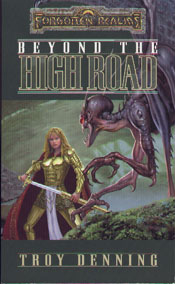
Beyond The High Road by Troy Denning


Because I have several Half-Price Bookstores within driving distance, I’m rarely at a loss for reading material. Time on the other hand… but reading material? Inexpensive reading material? The Half Price store on Touhy has a nice dollar spinner rack and I buy a book or ten from it every now and again. It’s one of the reasons I have a hard time paying some of the prices that Kindle books are marked at when not on the Daily Deal or the monthly deal.

In this case, Troy Denning brings us Beyond the High Road, a Forgotten Realms novel set in the Forest Kingdom known as Cormyr. This is one of those that I believe is set firmly during the 3rd edition era and while it has a lot of bells and whistles and some efforts at political materials, is really a good quick popcorn read. I finished it in a few hours and enjoyed it for what it was.

When I look over at Amazon, it is available as a Kindle Book , http://www.amazon.com/Beyond-High-Road-Cormyr-ebook/dp/B0060B6GRY/ref=sr_1_2?ie=UTF8&qid=1348787446&sr=8-2&keywords=beyond+the+high+roadfor a little over $5 bones. Not a bad price but I’m more happy with the $1 paid from the ole rack.

The novel does bring up a few interesting threads that can be fun when throwing them into a campaign.

1.       The Old Evil. Yeah, overplayed extremely but if it’s a well known old evil, that usually works out better in my opinion that some whack job monster that is some ancient evil that no one has heard of or bothered with before. In those cases I wish the author would just go to a “NEW” thing. “Yes, I have brought about never before seen enemies and powers to deal with you. Forget Orcus. You’re my bitch now.” Or something along those lines.

2.       Politics. While the book is certainly no Game Of Thrones, Troy does bring in the problems of having a Royal Church, one approved by the royal family, when the setting is home not to one faith, but home to many deities, some of which have actually walked in the country before. It adds a nice touch when the idea of having a royal church is first introduced and then the feedback, both from other religious organizations wondering when they can get their official royal church and from organizations already well established that quickly seek to hold onto their current power by shutting out any competition.

3.       Old Friends: While Cat and her man Grigori aren’t the main stars or even really anything other than a cameo here, it’s always nice to see a character well known in another series in the same setting make a pop up here and there without taking over the story. If you have some NPCs that the party knows are in the area, don’t go out of your way to hide or not-use them but make it clear that those individuals are not there for the story, just there to keep the continuity of the setting alive.

4.       Magic Items. If you’re playing in a high magic game, use it. There are several individuals here who use the Cormyr armory to armor themselves in magic. It makes sense in the context of the story because the Forgotten Realms is a high magic setting and the Forest Kingdom is known for its war wizards.

5.       Slap Magic Down. On the other hand, when magic becomes too easy, there are often things in the game that are designed to get around those limitations. Sometimes it’s a well placed Dispel Magic spell or an Anti-Magic Shell or a monster with immunities to various common spells or a monster that has a high magical resistance or a mirror like ability to reflect attacks. In this instance, the monsters can absorb magic. It’s a good trick that doesn’t make them exactly completely immune and doesn’t take place instantly but does bring up the limits of magic.

6.       Magic Commonality: One of the problems with magic follows the old saying if all you have is a hammer, all of your problems become nails. In this instance, the head war wizard finds himself, while not helpless, at least far less able then he should be given the resources at his disposal. In a society where magic has replaced technology, imagine what happens when it fails. It’s a similar theme we see in modern takes when electricity or physics fail and man is forced to a more primitive life style. Whatever is making you too comfortable then becomes a crutch you must endure all to save.

7.       It’s a Dangerous World Out There. One of the things that draws the characters out, is blighted farms. Initially its thought that the orcs, often a dark and cave dwelling race, have brought some type of fungus based blight to the lands they raid due to the various locals they inhabit. In other venues, the characters come under attack by goblins. Most Dungeons and Dragons settings are not for the faint of heart and a good reminder of that every now and again with ‘random violence!’ is a good way to remind the characters.

Troy Denning made Beyond the High Road a quick read and while the Royal Family does come across as a bit spoiled and out of their element in a market where A Game of Thrones and other novels try to emulate a deeper and richer complexity, the magic and relationships of the characters in the book to each other make it worth a read.

Friday, April 20, 2012

Temple Hill by Drew Karpyshyn


Another standalone book in the Forgotten Realms series, The Cities. I managed to pick up this book from the Half Price book store for the princely sum of $1! Cheaper then most e-books I'll tell you. Speaking of e-books, a quick search of Amazon shows that nope, no ebook version over there. Anyway, Temple Hill does a lot of things that I felt the other book I read in the series failed to do.

First off, most of the action actually takes place in, below, and around the city. This involves throwing several organizations in there including organized religion, some of the famous factions of the setting like the Harpers, the Cult of the Dragon, and an guild of protectors that falls and rises again within these pages.

Next off, a lot of the material makes more sense in the context of the story here. While there are some moments where I wonder how things are justified in terms of how the action rolls off, those are the 'gamer dice' rolling in my head and don't interfere with my enjoyment of the story. The characters here are competent and knowledgeable, they 'fit' into their setting. More impressive is that Drew takes a female and male pair and doesn't have them fall in love at the end of the novel! Applause to you Drew Karpyshyn!


In terms of gaming, the male hero of the tales, Corin, has a patron in the form of the gnome that raised his half elf employer, Lhasha Moonsilver. This allows him access to goods that he might not normally be able to have access to. This also works out well in a city based campaign because many of the enemies a player may have to face in a city based campaign are human or humanoid and those huge cash reserves that players may be used to stumbling over in a dungeon probably won't be found here.

This isn't to say that precious gems, jewelry, objects of art, and other valuable bits like magic items, can't be found but if the party has a patron who can supply them with 'loot drops' at appropriate times, it can help to curb some of the more outrageous bits that may pop up and more importantly, it allows the party members some access to a 'small' magic shop that the GM controls with a pretty sturdy hand if he so chooses.

Drew makes sure to throw in a lot of elements that make Dungeons and Dragons what it is. This includes evil life draining swords, a strange fierce enemy for Corin to battle, several groups that have their own unique leaders, one with a powerful mage, another with a Beholder, and the use of another magical creature, in this case, a Medusa, almost as a weapon of mass destruction. The utility of these setting bits, not setting bits to the Forgotten Realms, but to Dungeons and Dragons, gives the book a homely feel. If you can bring the elements that mean Dungeons and Dragons to your group, and those will vary from group to group, then you're doing your job right.


Monday, April 2, 2012

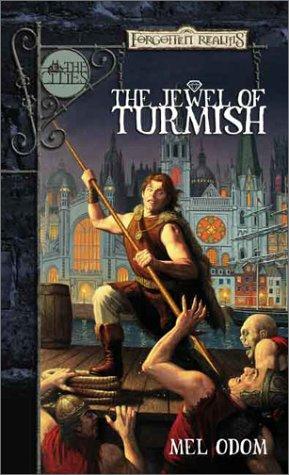
The Jewel of Turmish by Mel Odom

I've recently mentioned the perils of shared settings. That sometimes the setting can work against the author and that I try not to take such books as more than popcorn reading. Even with that in mind, Mel Odom's The Jewel of Turmish, unless you find it in the bargain bin for $1 like I did, is probably better off skipped.

In terms of things I didn't like as a book, some of those may work in a game as a prelude or a highlight of an upcoming menance.

For example, we are introduced to a group of young thieves and given a run down of their various hardships and how they stick together. They are horribly murdered. We are introduced to a group of priests where their leader is granted a vision by his goddess. These priests are horribly murdered. In killing off such groups well after numerous little bits have been introduced, the author was in my opinion, wasting time. In terms of a role playing game though, where you as the Game Master want to showcase a powerful villain, giving the players some premade characters and having them struggle against some unknown horror can bring out some anticipation for the players.

Another bit is misdirecting the audience. Don't label your campaign as a heroic high end super hero campaign and then have the players run into Wolverine, the Punisher, and other gun totting murderous villains and heroes whose only goal is to increase their body count. Don't talk about running a high magic and epic campaign and then force players to keep meticulous track of their rations and arrows and copper pieces. In that vein, this book called the Jewel of Turmish and part of a series called The Cities, failed, to me at least, to bring to light anything about the city itself.

Another aspect is beware of overusing old cliches that you've already used. In Mel's previous work that I've read in the Forgotten Realms, the one about the old sea monster coming back after many years of imprisonment, why is Mel's next book bringing out a villain who is coming back after many years of imprisonment? It's a common enough theme but don't be the same author bringing the same plot where gods themselves couldn't kill the villain but some dumb kid can.

Another bit is know where your action lies. If you know that the main thrust of the campaign is going to involve demons and undead and betrayal by once loyal allies, don't bog the players down in long drawn out fights against such mundane foes as man eating wolves and the difficult decesions they must make in terms of balancing the right and wrong of their actions.

Mel can do better than this and I've say this book is actually worse then Revan which makes it, the worst book I've read in 2012. Here's hoping the next one brings up the averages a little.

Tuesday, February 14, 2012

The Last Mythal by Richard Baker

So over here Amazon has the Last Mythal omnibus edition in Kindle format for $9.99. It's not as great as 99 cents or $1.99 but it is exactly the type of behavior I want to see Wizards of the Coast taking so I'm supporting it by buying it again, even though I have the original trilogy in the box set.

By offering the books individually, it allows the user to 'sample' the series. I've seen some initiatives where the first book is either free or at a greatly reduced price. The thing with Wizards of the Coast though, and I'm not saying this for one hundred percent truth, is that they generally do not offer their ebooks in collected editions.

By offering their collected editions in ebooks at an affordable price, if they at least have an author you like, such as Richard Baker or Mel Odom or Richard Lee Bryers, you can get some great deals. But only if they continue to offer these types of collection.

If you want to see this type of behavior continue, make a purchase and then let WotC know that you purchased it because the price and format was right.

Saturday, January 7, 2012

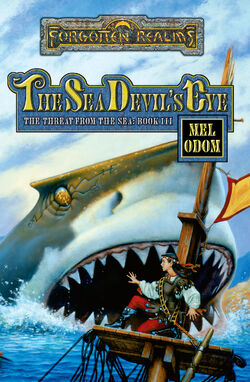
The Sea Devil's Eye by Mel Odom

The third and final book in the Threat From the Sea series brings a close to the adventures of angst and ancient evil. I'll be discussing some of the things in the book that I didn't like and how I would try to avoid them.

The first thing is over use of the gods. The malanti that starts us off on this journey turns against her master and is protected thanks to the god.

The emo hero of the piece has been directed and guided by a god. He was knocked out a few times early in the series including once where he was shot by a crossbow and lived because he had to serve.

The bard hero of the piece is also directed by a god.

While the use of deities is not necessarily a bad thing, especially in a setting like the Forgotten Realms where the gods are very real, after a while you have to wonder, where the hell are the evil gods while the rest of these deities are planting their very firm hand on the setting? Mind you, the villain of the piece of old enough and powerful enough to perhaps qualify as some sort of demi-power, but you figure that some of the evil forces out there would be aligned on his side right?

So when running your game, try to be aware of the powers that be and that their overuse might have an adverse effect on the game.

For one, the players can become spoiled if they expect to have their fat pulled out of the fire by the gods when the going gets tough. If you bust them out of death's door once, why only that time? They can also get jaded in that they'll wonder why they are playing if the gods are going to solve all their problems to begin with. It's a fine line and once that can be crossed easier when you are familiar with the preferences of your group.

The next bit has to do with the villain of the piece. Iakhovas is an ancient entity native to the Forgotten Realms. He enjoyed the love of the Bitch Queen when the lands were young and he was one of the first creatures upon it. But he failed to keep that love and was punished.

Thousands, if not tens of thousands of years later, he comes back and seeks out all the old items that made him into such a power back in the day.

Okay, this is like the Emperor rebuilding the Death Star in the third Star Wars movie. Yeah, it was awesome when we first saw it, but do we need to see it again? Is that 'ultimate power' that got is ass whipped the first time around really the solution?

If in the day he could not achieve his goals with the items he had, why would he search out those exact items again? Did something change where now they are more powerful then ever? This falls into the trap of "the old stuff is better". It would have been more interesting if the author took that old standard and had the heroes going around securing all of Iakhovas old goods while he went and either made new ones himself or had new ones crafted for him.

The other problem I had with Iakhovas, is that he's shown as being a great leader. He's shown that he is a tactical genius. At the end, he stays to fight to the death against someone who has a superior weapon. This reminded me of the Transformers movie with the Fallen going on and on about how only a Prime can defeat him and hey, there's Optimus Prime renewed and invigorated and yeah, let's fight him!

What's worse, is at the point of his death, Iakhovas has a magic eye which when hit with a magical sword, blows his head off. How stupid of an entity do you have to be to put something that can take your head off into your head? "I think this grenade really sets off my features." Stupid.

Now the things that I thought worked, included bits that were set up for future follow up. This includes some glimpses into the future where the hero sees himself fighting his father. I thought this would've happened prior to the fight against Iakhovas as a sort of redemption piece but by leaving it for later, the author saves some space for future conflicts that perhaps may not be as epic, but are still personal to the hero.

The mentor of the young hero mentions his fallen sister, a necromancer, and her alliance with the Zhents. Another field where we get no resolution.

The destruction of the Sharksbane Wall. This was used to keep the old beasties away from the rest of the population in the Sea of Fallen Stars. It is a very real thing that leads the setting into more dangerous tides.

And on that last note, I have to wonder, again, how badly 4e screwed the Forgotten Realms pooch.

Prior to 4e, and not necessarily all at once, but all having long term effects, you have the following:

The elves retake Myth Drannor.

The Shades take over Sembia.

The Sharksbane Wall is destroyed and naval powers have suffered some crippling defeats.

The Dragons have gone mad and destroyed a lot of the standards and standbys.

And then instead of having to help fight back the hordes of undead dragons created during this time, or sail in peril across the Sword Coast or across the Sea of Fallen stars, or fight against the Shades in Sembia, or help rebuild the city of elves, we get a hundred year skip where all of the interesting stuff is someone done by still relevant?

M'eh.

One thing I thought interesting, when discussing the gods though, is that it provides a good example of how some of the deities, in this case, Sekolah, the god of the sahuagin, are multi-natural in order and would allow the villain of the piece to rise to prominence. The villain makes a note early on that the Shark God swims through many worlds, a nod to the huge connected nature of the planar settings that the Dungeons and Dragons rules utilized back in the day.

Threat From The Sea has a lot of action and keeps things moving, even when I'm not down with all of the pieces and bits that are used to tell the story.

Thursday, January 5, 2012

Under Fallen Stars by Mel Odom


One of the interesting things about how the previous book, Rising Tide ended, was the heroe's quest to get to Baldur's Gate. This is a fairly famous city in the Forgotten Realms for several reasons ranging from its initial launch point in the gray boxed set back in the day with the mercenary group the Flaming Fist, to its importance in a video game called... yes, Baldur's Gate.

At the end of the previous novel, the hero discovers that he needs to be at Baldur's Gate and so, he goes on an overland journey. Due to the raids and attacks, the pirates in alliance with the various horrors of the depths, the goods going north must now do so through land. But here Mel pulls out another set of sharpened stakes and notes that even overland journeys are more dangerous because everyone is doing it so the orcs, goblins and other land based monsters, are essentially having a field day. This is a good example of showcasing how one change in one part of the setting can effect other parts of the setting. Sure, soldiers and sailors are in more demand than ever, but that doesn't guarantee victory!

At the start of this novel though, the journey is finished. There is no daily recap of the heroic quest to reach the city. They made it. When running your own game, how important is each and every potential conflict? In some games I've played in, the GM insisted on careful calculations of every gold piece spent and earned, of every item of clothing and possession written down. Depending on the GM and the players, this can be fun and serve some distinction between games. In other groups and GMs, it can be tedious to a level that makes the players simply not want to play.

This gets back to another old adage around this blog; know your players. If your players are highly detail oriented and enjoy noting their possessions and are always on the lookout for the strange bits, then indulge them in it. If they don't, have some common ground where the players understand X amount of wealth will be lost on housing and supplies and in exchange you want bring the ban hammer down on them when they make assumptions that might be... presumptious in another style of game.

Now the big bad of the series, his attack on Baldur's Gate is meant to shatter it. To cast the city to the four winds. Well, at least according to this book and the 4th edition version of Baldur's Gate, that didn't quite happen. Which makes sense. Previous novels and material have established Baldur's Gate as well, not invincible, but something that would require such a major upheaval that having it taken down by some fish men might prove problematic to those readers heavily involved with the series.

And here's another old adage; kill your babies. If you, as the GM, are running some epic material and want to do the old styling of showcasing just how powerful and vile the enemy is, destroy a few major cities, kill some major NPCs, and create havoc on the shipping lanes. This lets the players know that the stakes are very high and that they need to be at the top of their game if they are to thrive.

The only potential problem in such cases though, is that if you are running multiple campaigns in the same setting and want things to not be so smashed or if you're running a group with other GMs in the same setting. You can either let the other Game Masters know ahead of time or you can decide that the epic nature of the story requires you to bring the setting to a different level than the players have assumed and this in and of itself will let the players know that something big is happening here.

As a GM though, unlike an author, you have to be ready to follow what the players do after the attack. In the previous novel, Waterdeep took a beating. In this one, it's Baldur's Gate. What if you're players are like true old school players, not like the 3rd and 4th ed ones, but characters who have build their towers, created their castles and have their thief guilds? Chances are good that they may want to rebuild their schools, recreate their schools, and renew their alliances prior to moving on to attack the ones who attacked them.

You can either push them onto the 'adventure' that is waiting, or you can craft material out of their rebuilding efforts. If supplies are limited, then there will be struggles over those supplies. If the players have not made firm alliances with the local politicians, then they will have even greater struggles. At the end of the day, depending on the previous actions of the players and their current activities, they may have to actually pack up and leave the city. If they are ready though, and they do have supplies, then let them reap those rewards. Perhaps they have foodstuffs that the city needs or access to magic that allows them to quickly clean and rebuild the city. Perhaps the fighter is in alliance with the thief and they keep the rougher rogues of the city in check allowing people to come into the city and make new opportunities for themselves until they learn that the beneficial players perhaps have a few 'taxes' of their own that they are going to lay down.

Another factor that comes into play here is a massive gate that allows the villain of the piece to move from the Sword Coast to the Sea of Fallen Stars. There are also nods to Spelljammer with a Helm, used tospelljamming helm on a ship or want that much magic in the setting, if it's not overly abused and isn't a sign of the campaign tone and focus shifting, and just an nod to those other elements, even the most jaded player may get a gidding feeling about knowing what a helm is and how the ship is going to meet up with others in the Sea of Fallen Stars from a river that ends long before it gets there.

Use the setting and the rules are bones to build the structure of your game and if those tools don't let you do what you want, smash them and make some new ones.

Tuesday, January 3, 2012

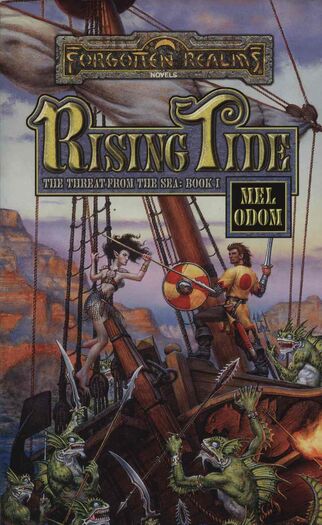
Rising Tide by Mel Odom

The first book in the Threat From the Sea series set in the Forgotten Realms setting introduces a number of new characters while utilizing existing monsters from the D&D mythology. For those who don't want a spoiler review, suffice it to say that I enjoyed the whole series despite thinking that the main character would win in an Emo off with Drizzt.

Onward to more specifics that may include some spoilers.

When looking at campaign design, there are many routes a Game Master can take. There are many groupings that may crop up. The trick is, do you use them or spread them out? Adventure paths often face this issue. If everything focuses too much on the main plot or event, it can feel very forced. If not, it can feel very random. For the traditional dungeon crawl, that random thing is part of the lure of the game. For those who want a little more focus out of things, it is something to be avoided.

When I read the year of Rogue Dragons series, I noted that by grouping things into a dragon category catch all, it allowed the authors to dig out all sorts of under utilized dragons like planar dragons, as well as various templates and other game bit lore from the 3.5 game engine.

Mel is able to do the same thing here with the Threat From The Sea. It's not just about the sauhagin, it's not just about the sea elves, it's not just about tritons. We have various giant marine predators, morkoth, kraken, and other water related monsters working their way through the series. And hey, look over there, pirates! This allows the author to mix up naval combat, underwater combat, and other entertaining bits that all fit logically together.

Speaking of underwater combat, this brings up another potential problem that the heroes have to face. Man versus the environment is a classic bit and in the Year of Rogue Dragons, when fighting enemies that can all fly, the air is an issue. Here, it's the water. There are several things that complicate the issue in both cases. There are a lot of native monsters to those environments whose mastery of them should be better than outsiders. Combat is now in all dimensions instead of just forward and back. Underwater fighting also involves a lot of things that may not be obvious on the surface like, oh, breathing. Vision also suffers the further down you get from the sun.

The real question is how much do you want those things to matter. Do you want to gloss it over or look for expanded rules and details? In the 3.5 era, there were a lot of aquatic based source books, some better than others. For most though, the core rules should do just fine.

Another element the book handles is weaving an epic story, that of an invasion of Waterdeep by the return of an ancient evil and its minions, with a deeply interpersonal story of a man searching for his purpose. While I absolutely detest the emo nature of the main character, his search for meaning is one that a lot of people can relate to. Regardless though, the fact that the author is able to bring the personal elements of one character to the forefront of a series where danger is all about is important. Never forget that while the action and scenery can help move a game along, if its all action shots and explosions, you get the Transformers which can be entertaining to watch, but lacks any depth or substance.

Mel Odom does a nice job of bringing various elements and areas together and showcases an epic story with a series of heroes that have a long way to go prior to meeting the evil that threatens them all.

Sunday, July 11, 2010

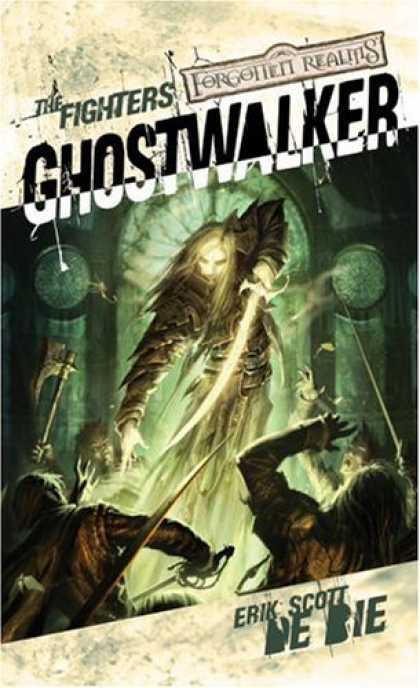
Ghostwalker by Erik Scott de Bie

Ghostwalker is a fantasy take on one of the old classics; the wronged man out for revenge.

The comic the Crow lead to a movie, novels, more comics, and a whole host of other media tie ins. A dead man whose been wronged comes back for revenge.

Sound familiar? How about in a western like Hang 'Em High?

The wronged man is a strong theme. Everyone wants to take some revenge when they feel wronged. If anyone has cut you off in traffic, ignored a traffic signal, cut in front of you at the store or other mundane matters, you might have a quick revenge fantasy but it goes out the window quickly. These minor things aren't worth the trouble they'd bring about.

But in a fantasy setting? One in which the character you're playing is wronged in a massive way up to an including death? Yeah, things can get messy.

The real trick in such a character though, is he has to work with the group. Ghost Rider, a Marvel Comic character is known as the Spirit of Vengance and he is generally a solo worker. The character in this novel, Walker, is usually a solo styled fighter. In a group focused activity like role playing, or most role playing games default assumptions, you might have to broaden the scope of the wrongs done to the character so that it includes the other party members or is something that all of the characters are in agreement on. It could be a personalized reason why the character adventurers in the first place.

When wathcing movies or televsion and the plots seem familiar, don't be surprised. Rather, think of how you can use it in your own campaign. After all, the trappings may be different, but if the action and the reactions from the players are those of enjoyement and go get 'em, the everything is working.

Monday, July 5, 2010

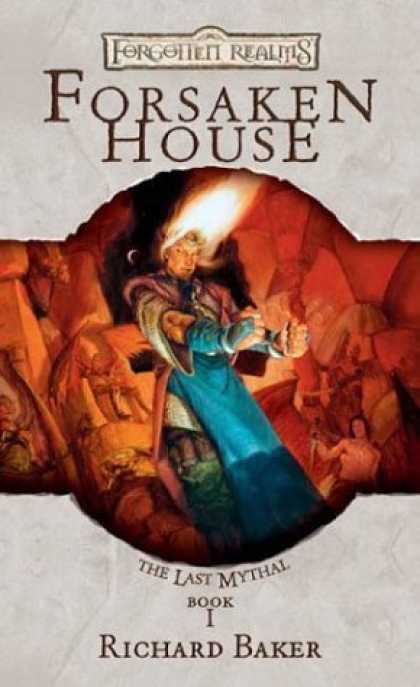
Forsaken House by Rich Baker

So now that the end of the second quarter and the month of June is behind me, I can stop working 60+ hours a week and read a book. The Forgotten Realms line often has what I call 'popcorn' books that are quick to read and often entertaining. Since I usually run a FR game, I also take a few odd ends and notes here and there.

Rich Baker's book has many a good idea for inspriation in gaming. The scopes of this series are epic and high involving the return of many of the elves to the mainland of the Forgotten Realms campaign. Almost an anti-retreat as it were.

The first thing I'd note, is that the main character is tossing spells like prismatic spray and disintegrate about as main spells and not as some last minute hoarded magic. With that in mind, if you haven't run a game in a while and have a definitive campaign arc, start your next game off at the cust of epic level. Use those often unusued books and get some milage out of them. The old basic sets even had rules for immortals.

The second thing is that there is a huge swathe of history in the Forgotten Realms. Does it make sense all the time? Probably not. But much like say, the Green Lantern series from DC comics, it does allow the GM to literally pull things from out of the backside and say, "Yeah, it's been here all along its just that you didn't know it." and often when such events happen, it's because a higher power was supposed to be keeping track of things. In this case, it's the demonfay, a group of elves that have given in to the temptation of demon alliances.

The third thing, is hit them at home. In the Goodman Game adventure, Dragora's Dungeon, the players start the adventure off under assault at their own home. In this book, as the main character enjoys the scenic beauty of his home, it comes under assault. Few things will get a body as motivated as possible as getting an attack in their own house.

Note this can be grossly abused though and shouldn't be taken out all that often. If you punish the players by continuously assaulting them in their own house, even if they make real efforts to safe guard their home, this might be seen in some circles as 'dick DMing'. The point isn't to punish the players but to get the game moving with some action.

Fourth thing, the magic items! Here we have a series of gems that have a wide range of uses. In 4e, this wouldn't necessarily be possible and indeed, in many editions, weapons and magic items often have powers that just run outside the game. As long as the GM is controlling when access to those abilities is possible, it shouldn't be a campaign breaker. Sure, the item can do Y, but it only does it when the GM wants. Now on the other hand, if the players come to rely on that ability, then the GM is either allowing that ability to manifest too often, building that ability into his campaign to be used too often, or the players are trying to abuse the in-house system the GM has set up.

Fith thing, epic scope. The elves returning to the mainland is an epic thing. Are there similiar efforts in your own campaign that could be made by the players? Can they restore one of the fallen empires? Can they bring forth a new age? Can they create a demi-plane where the dragonborn's ancient empire lives again?

Sixth thing, keep the variety up. While the main thrust of the book deals with the elves and their corrupted cousins, there are other elements afoot. For example, demons and devils and mercenary outer planar fiends. Past those though, the adventurers still encounter a few random beasts on the road. Past that even, the enemey armies they face often have vile mercenary races working with them that fall into the standard forces of evil; orcs, ogres, trolls. By allowing a center enemy to take stage, the GM shouldn't forget all of the other wonders that the system has within it.

Indeed, in a game like 4e that doesn't necessarily rely on the players fighting one big bad at a time as was often the case in the previous editions, it almost encourages the GM to come up with reasons why a wide vareity of forces such as this would be gathered together. Strong leadership, bribes, alliances and outright enslavement of the others is as good a cause as any in this case.

Seven thing, end clean but leave plenty of room for further adventurers. I've read a few books that end on a cliffhanger. I hate that. I much rather prefer an ending where the book is finished, the reader knows that there are other elements that will be coming down the line, and other conflicts that will be taken up and the reader has more to look forward to then "how the hell is the main character getting out of this."

Rich Baker is a solid writer and his books have many ideas perfect for stealing for that high level campaign you've always wanted to try out.

Tuesday, May 25, 2010

Fringe Versus the Forgotten Realms

Fringe has toyed with the idea of another universe, a parallel reality in season one and takes it to the next step in season two, especially the ending. As I've viewed the end of Fringe not on TV but rather, off the old Fox site itself, there will be some spoilers below about Fringe and how I was thinking of tweaking something like it for a Forgotten Realms campaign.

So spoiler space.
.
.
.

In Fringe, the alternate universe has many duplicates of the core characters but there are exceptions. Many of these characters are not necessarily the same as they are in some areas, but in others, have the same core personalities and strengths.

But what does that have to do with the Forgotten Realms?

If you have some long term players or some new players who've read a lot of the fiction line, you could do a Fringe that doesn't use alternative universes, but alternative time lines.

For example, imagine the players are starting off well before the Time of Troubles, but events from the time of Troubles cause rifts in time, similiar to the BBC show Primeval, but instead of millions of years, it's just from that era. But to complicate matters, the Spellplague also cuts through time and creates more potential paradox. This would be an excellent bit for characters who are playing long lived races and the GM isn't quite using the reduced life spans of the 4e rules.

What would characters from 4e want in the distant past though? Let's take the Spellscarred. Perhaps they've heard of Spellfire. This ability, the ability to absorb magic, might be in high need to take care of many of the various problems in the 4e default setting as well as possibly curing those who suffer from the scars.

But where does that leave the Time of Troubles characters? Perhaps during her first death, Mystara sees a flash of her next and final death. and has agents of Magic scattered in time and space to try and stop the events that lead to her untimely death. This might not go unopposed by other deities, such as Helm, who once again would find himself on the opposite side of her again, even though in the future he himself is not where he'd like to be.

In such a situation, the agents through time are not going through in terms of conquest even though their goals may be huge. Rather, they are using personal goals and motivations to interact with the players. The GM can have fun making old pre 4e-magic items into the new system as well as spells and other monsters that might have been more popular.

The important thing is to take the characters the players are running and make it personal to them. At the last episode when Olivia approaches Peter, she says she has many reasons that Peter some come back to the other side but it boils down to her saying that he belongs with her. A personal matter that crosses universes.

Friday, February 12, 2010

The City of Ravens by Richard Baker


I'll be discussing the City of Ravens, written by long term Forgotten Realms author Richard Baker. Any page references used will be from the paperback.
"How do you intend to divide five gems, Jack? Four or six present no problem, of course, but five are difficult to split between two partners." (pg. 5)
One of the things that may not always be thought of before the group actually hits the road, is how to split the money. In most of the groups I've run and those that I've been a player in, for the most part, it wasn't a big issue. All coins were split evenly. Gems and jewelry or other art objects were sold. Magic items were given to the person who could use them best, or sold and the funds evenly split.
There were a few tense times when multiple people wanted an item that anyone could use. I'm sure those groups I was involved in during those terse times aren't alone. Having some sort of plan ahead of time might have smoothed out even those transactions.
"The Game of Masks?" Jack tried not to wince. The Game was a noble diversion, an ongoing series of play acting events wherein the participants took on various roles and tried to solve puzzles, stumble through a plot or play at great deeds." (pg. 38)
One of the reasons I tend to favor city based adventurers isn't that it's an escape from the dungeon. After all, there are often dungeons in the castle. The sewers under the streets can be considered dungeons. The maze like alley ways of the dock wards are another dungeon.
No, I tend to enjoy cities because there is often more to do for those whose interest do not rest soley on testing their powers in new and interesting ways against monsters of various caliber. In a city, you can do wine tasting contests, engagements of skill, and even things like the old Game of Masks.
"In the name of all the gods, why should I know who that was? He was your identical twin! Are you telling me that you have no idea why someone who looks exactly like you showed up at my doorstep, ushered me into the coach, and started pawning at me like a lovesick orc?" (p.148)
Individuals who make a name of themselves also make a face for themselves. Others might decide to put that face and reputation to their own use. In a gmae like Dungeons and Dragons, there are spells, monsters, magic items, and other methods of capturing an individual's likeness and then using that reptuation to perform various acts, all of which might not be what the original would have done. It can be quite a challenge to overcome a perception problem where everyone who believed the character to be one way, now have to ponder if the character was every truly that way.
"I... I think I'm all right," the mouse piped. "Oh thank you, Master! Thank _" And that was all, for at that moment the wheel of a passing cart rolled right over mouse and wizard's hand both, crushing each beyond hope of repair. (pg 98)
The hand of fate is often fickle. Try to make sure that the fickle nature of reality is helping the players as much as it is hindering them. There's no shame in allowing a few entertaining moments to happen and help the players out of a jam, especially if it's one that they couldn't avoid or one brought on soley by poor dice rolls. If it's organic and follows the rest of the campaign, the player's probably won't mind being saved in suc ha fashion.
The City of Ravens is another of what I call my 'popcorn' books. It's not a deep read, but it's a fun one and Richard Baker does a solid character whose a well intentioned rogue with a dash of magical ability. The Forgotten Realms setting, especially the city of Ravensbluff itself, gets some well deserved attention here and provides the reader with much to draw on ranging form the city's vast history, to various liquors, to the material I've quoted above.

Saturday, July 4, 2009

Shadowrealm: The Twilight War Book III by Paul S. Kemp

Below I'll be discussing some things I'll try to remember and apply when I'm running my Forgotten Realms 4e set in 3e campaign. It's going to be a quote and spoiler filled discussion so if you're not hunting for any spoilers for Paul S. Kemp's Shadowrealm, read no further.


"Rivalen recalled his own fight with the green dragon outside the walls of Selgaunt. He'd learned a lesson in that combat, one he intended to teach to Kesson." (p.274)

While the comic, Order of the Stick, did what Rivalen is speaking of, it could be any stragety that the players themselves did not think of. When breaking out the big guns or unusual methods when having the monsters battle the characters, remember that the characters could be impressed enough by these actions to take them as their own. Then as a Game Master you've got to figure out a way to make sure it doesn't become the default strategy. Few things are more boring than having every fight go the exact same way. This may involve using more opponents, it may involve using enemies who have a completely different specialty. It may involve a shift in the campaign focus while you try to figure out how to get the game moving again.

"A sculpture of glistening black stone dominated the courtyard. It depicted a tall, faceless woman in flowing robes. A circle of tarnished silver, ringed in amethysts, adorned her breast. Before her in a fighting crouch stood a shorter male figure, a man clad in a long cloak. Leather armor peaked from under the cloak and he held a slim blade in each ahnd. A black disc adorned his chest." (p. 200)

Shake things up. If all of the players know that certain deities act a certain way and have certain relationship with other deities, don't be afraid to take what's in the settings history and flip it on its head. Prior to the books of the Twilight War, Shar and Mask have little interaction in most Forgotten Realms products. One of the last books on the gods of the setting noted that Shar had taken an interest in claiming Mask's portfolio. Some may find it works too much against the history and not appreciate it.

However, from the players point of view, from the characters point of view, what they've experienced and encounterd in your own campaign should count for more than antying written in a supplement that they may or may not have read.

"Furlinastis," Cale called into the shadows." (p.231)

When a player does something with no expectation of a reward, the Game Master can take those times and provide one. In this case, Cale is calling on a shadow dragon that he brought back from the dead because the creature had been ill used by a former chosen of Mask. Without asking for anything, the creature agreed to perform one service for Cale in the future. There is no reward system like this in most role playing games. This requires the Game Master to roll up his sleeves and decide if something like this is warranted. It's a reward that has no gold piece value. It's a treasure that can't be spent easily.

Note that unlike previous books in the series, this one includes an epilogue. If the campaign has reached it's organic end and the players and Game Master know what the future of the campaign is going to hold, an epilogue may be appropriate. Give the players a taste of what's to come. Let them know what happened to all of the friends and enemies they made. Let them know what happened to the cities they walked through and the treasures they once had. Allow them to share in it even by allowing them to describe how they imagine their own characters, those that survived it at least, enjoy retirement.

Shadowrealm takes a lot of high powered action to a level where chosen and dragons must ally themselves with former enemies to have a hope of fighting stronger evils. Lot artifacts must be recovered and friendships taken to the ultimate level of sacrifice. Game Masters should be able to pilfer themes, elements, and scope of elements that a campaign can enjoy

Friday, July 3, 2009

Shadowstorm: The Twilight War Book II by Paul S. Kemp

Below are some ideas dregged up from my ole brain by reading Shadowstorm and how they might apply to your own role playing game. As usual I'll be using quotes from the book with a page indicator so spoilers will be here. Reader beware.

"A bargain, devil." (p. 12)

There are times when the players will get themselves into events far beyond their ability to control. In such instances, if the players have anything of value, even if that is information, if possible, nudge the players into that direction if you wish to avoid what is commonly referred to as a Total Party Kill (TPK). In some instances, the party may be setting up their own future adventurers and will have a chance to come back to the situation that lead them to the bargain in the first place.

Dawn's light, as pink as a rose, radiated through the slats of the closed shutters. Abelar rushed to them and threw them open. Rose-colored light bathed the room. Its touch warmed Abelar, calmned him. The light washed over the entire village, casting it all in a pastel glow." (p.114).

Sometimes the actions of a deity do not take form of a massive column of flame enguling the enemy. It's not a parted sea rushing together to crush the foe. Sometimes it's something that will be of help to the party that is not of direct combat. It could be the saving of resources for latter. It could be the temporary boost of power that a group needs in order to be somewhere else.

In many cases, the divine favor should be used sparingly. The players should never come to rely on divine intervention nor come to expect it. Players that do so are going to be let down when the Game Master does not provide that extra assistance.

"He and the Maskarrans learned only what you wished, Divine One. They destroyed your simulacrum and think you dead." (p. 229)

Everyone loves a good villain. An enemy that is harder to kill than originally thought. A villain that keeps coming back for more. If the Game Master has a villain that the players enjoy fighting and thrwarting, there are numerous ways to keep such a villain in the game. In the case above, the heroes of the novel weren't even fighting what they suspected they were but rather a duplicate. In fantasy role playing games, such an event can be common ranging from an actual clone to a dupe dressed as the villain. Marvel Comics was notorious for using robots for Thanos and Dr. Doom to explain their numerous losses to what would be considered 'C' listers.

"Love is a lie. Only hate endures. Light is blinding..." "All is fleeting." (p.79)
"The Light is in you, my friend. It shines brightly." (p.112)
"May Lathander watch over you and the dawn bring you hope." (p. 113)

In terms of players having a patron deity, if the GM has a list of catch phrases that is common to the faith, it can help the players to bring more to the table in terms of potential for role playing. A character with strong faith may have have an outlook that is colored by the faith. If the rest of the party members share the faith, it can provide some common bonds for them. If they do not, it can create friction. In many fantasy settings, including the Forgotten Realms, generally only classes that directly rely on divine power have a single patron deity with others praying to whatever deity is in charge of the current issue. For example, the 'Bitch Queen' is the patron of storms and sailors often pray to her to spare their ships as they sail across the waves.

Look for ways to bring details to the game that will give each campaign setting its own flavor and the players will look for that flavor. Some will pick up on it and bring their own ideas that can be incorporated, making the game as much theirs as yours.