Yesterday it was time for another game of Warhammer FRPG. I think this is like session ten or something of that nature? Has the GM got his money's worth out of the Thousand Thrones campaign yet? Hard to say but my physical book of the Warhammer FRPG 2nd edition hasn't seen this much use in years. Despite the portability and ease of use of PDFs, people like flipping through books and I'm on that list too.
Anyway, that Hornitos Black Label next to the book? A very interesting tequila. As Arnold would say while playing Conan, "I have no words" or something to that effect of providing a 'technical' description of drinking it, but for tequila brewed in whiskey barrels? Very nice. I would buy again. Mind you, I'm not putting it ahead of say, my 'standards' or 'go to' tequilas which include: Patron, Don Julio, Avion, Three Generations, or Corzo, but it has a very rich blend of flavors to it.
For an actual technical review? Go here.
Even better though, one of my friends brought some Nego Medlo and another some hard apple cider and some of those crazy margarita beers. Much drinking to be had.
Anyway, back to Warhammer FRPG.
We had a nice battle at the end of last session and we started this one off in various states of being wounded. Fortunately none of us were badly injured so restoration was pretty quick. Three of us are playing non-humans. I'm a dwarf, another is a wood elf, and a third a halfling. The human 'adventurer', a hedge wizard whose never cast magic around us, has the healing skill and made it only on the other human in the party so we ribbed her about being a species racist.
After that, it was time for more investigation. Part of that was a book dealer who had possession of questionable content. As we went to visit him, the place was burning down. The dealer was taken to the church of the healing goddess while I stuck around and tried to stop the fire from spreading.
Up show the witch hunters and demand we let that building burn but allow us to prevent the fire from spreading.
Meanwhile in the church, two of the four who went are able to get in with some quick thinking with my other friends are just spouting the stupid. I'm sitting there thinking, "Man, the GM is being awful kind to you guys to start with." Ah, the perils of alcohol at the game.
Nonetheless, they find out that under the book shop is an entrance to a secured location with various books and a list of buyers and other goods. As they come out and meet up with me though, the witch hunters are all like, "You must come with us!"
One of the players is an actual empire wizard and doesn't want any trouble so we decide, yeah, okay, we'll go with you.
Then the witch hunters are attacked by an angry mob. The cries of the mob indicate that they are people who lost their homes due to the witch hunters interference, but since I stayed behind, the GM tells me I don't recognize any of them and that they seem to be of a different type of rabble altogether. The halfling gets ready to take off, but as I'm a troll slayer, I'm all up and about the "death!" parts as we didn't attack the witch hunters.
Many of the crowd start taking off when the elf and halfling begin raining death on them and the troll slayer stalks their midsts like a wolf among lambs. The wizard tries to draw official city attention to us with some noise and the 'adventurer' aka hedge wizard flays about with a long sword and takes a few hits in return.
After the battle, the seven witch hunters are reduced to four. I ask the GM what type of equipment they have. Most of the other party members have this image of them being heavily armed and armored and the GM's like "blah blah blah" which meant leather armor and crossbows instead of say, plate armor and guns.
I turn my back on them and they're like, "Nope, you ain't going anywhere." Seeing as how most of the party is for once not injured, we turn on the witch hunters and make quick work of them. The GM laughs about it because he said the book assumed we would flee the scene when the witch hunters came under attack in the first place but he quickly picked up the pace and in the ensuing melee, we are victorious again!
After that, some more exploration. A few of the characters fall through the weakened floor into the basement and it is there that we find the hidden door, buried under a ton of hot rubble and take a few wounds from heat related damage but eventually get it open. Some more exploration of the sewers and some good subtle smacks from the GM lead us to the books which have already been ransacked.
We find out that several of the people on the list have been killed by Zorro, I mean, the Vengeance of Sigmar. This is a black masked, black garbed vigilante that goes about killing high and low born who deal with chaos including a wizard who we jab our own Bright Wizard college student about. We do some more training and hunting down for clues and information before the GM calls it a night.
It's been nice hitting up the old Warhammer FRPG. Player deaths have been fairly minimal, but I suspect that has more to do with the lack of combat and the great opportunities for investigation as opposed to how powerful we are as characters. Fate points have been spent mind you, but I think it's the Fortune points that are keeping us alive.
Most of the players are hitting up their second careers. This has lead to the whole, "No, those advancements are not cumulative. If it's +10% in one career and +10% in another, you can't buy it up to +20%." leading to protests of outrage.
Kind of annoying to me really. I mean, like I said, it's week ten and people are still looking at like the basics of advancing a character? Sheesh people. Some of them were thinking of changing what they were looking at in terms of advancing their careers. Me? Because the Troll Slayer basic career has so many advancements, and for whatever reason, I'm the type who buys out all my advancements, I still need a few more hundred xp to make it to Giant Slayer.
The GM has also told me that I don't have to kill a giant per say, just something powerful enough to represent a equal threat so that I'd then become whatever that 'slayer' type is. Which is cool and I can see why he'd do it that way. Minimizes the fuss he has to make in order to allow advancement of the character while still providing the 'flavor' and purpose of the whole thing.
I think the GM said we're on something like chapter four now and a few more to go. Probably take us to August.
Anyone else picking up old games and 'classic' adventurers to catch up on things once missed? I'm reading through the Wizards of the Coast Red Wizards PDF only adventure about the Red Wizards. Some nice descriptions on some of the Forgotten Realms locals and a very 'playbox' feel to it. I might run that, but heck, Dungeons and Dragons 5th edition proper may be out by the time we finish this so it's hard to say what's next.
Well, thanks for reading and good gaming everyone!
Showing posts with label Campaigns. Show all posts
Saturday, June 21, 2014
Sunday, November 6, 2011
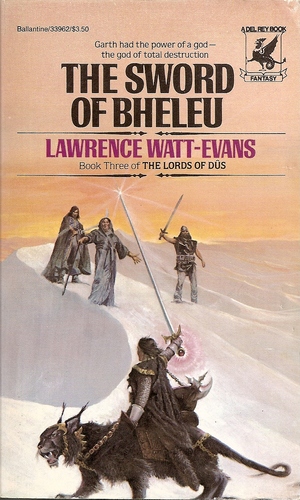
The Sword of Bheleu by Lawrence Watt-Evans
Written by Lawrence Watt-Evans, the Sword of Bheleu is apparently the third in a series. This is another one of those novels that I picked up for $1.00 at Half Priced books. Hell, maybe I had a coupon and picked it up for eighty cents or something.
The interesting thing is that at the time of its printing, it was $2.50. Yeah, inflation in a specific field gone wild again eh? More interesting to me, is that at Amazon, you can buy it in ebook format for $5.59 which to me is a little overpriced considering the original cover price but not horrible.
Knowing nothing of the series, the author, or what happens after, as I'm still reading it, but I'm going to hit some spoilers below.
First off, the book is sword and sorcerer. Magic is fairly rare but those who have it tend to be powerful. Magic items are also fairly rare, and in this case, while we have a few of the standards, like the crystal ball, the Sword of Bheleu itself turns out to be a major artifact, effectively making the user a avatar of the god of destruction. This isn't a one way ticket though. Indeed, the sword often compels its user to destroy, to attack, to kill. this is often indicated by the massive ruby on the hilt of this two-handed bad boy glowing with an inner fire. A great visual cue but if you're playing the prototypical dumb fighter, all the visual cues in the world aren't going to help.
The sword is also a bit of old school in that it seems it can do many things. For example, when the wielder, Garth, is spied upon with a crystal ball, his connection to the got of destruction travels back on that feed and destroys the crystal ball. Garth can also use the weapon to set fire to buildings, to burn through stone itself. This doesn't count that others don't seem to be able to use the weapon without suffering massive burns and wind up dropping it.
By not pinning everything the sword does, the author provides himself some space in which to use the sword for different elements. One of the terrible things that third edition started, and fourth edition fully embraced and has been struggling to get back ever since, is removed the magic from magic items. I haven't played a lot of 4e lately and I know that some others, like the Fourthcore group, have also tried to bring some of the magic back to the magic so to speak. Damn shame that it ever got that far to begin with.
Anyway...
Another interesting aspect of the book is that Garth isn't human, he's what's called an overman, humanoid but physically better than a human. The problem is that the overmen lost the Racial Wars that happened some odd three hundred years ago. Turns out that like orcs and some other humanoids, while they may be great independent fighters, they are terrible fighters when it comes to war as they are not great social creatures, each too headstrong and independent to do any group warfare that doesn't involve a numerous commanders involved with many levels of the soldiers. Their home life structure isn't that great either, they essentially borrow the idea of marriage to provide some stability to their lives.
I like this factor because it provides the overmen some character and showcases why they are where they are when I read this book. It's not some nine hundred page beast that I feel compelled to read because it's trying to teach me history. Rather, it's a quick sword and sorcery romp that showcases bad things happen and sometimes, more bad things happen. Heck, I think Rolemaster old versions may even have something similar to this guy. I know that they had High Men, which were essentially homages to Strider's people, but I think they had something even bigger and stronger and with even fewer background points in one of their series of companions.
In addition, it gives me some ideas as to why elves and dwarves and other long lived races don't rule the world. They're just not able to compete with humanity. It's not that elves aren't the best archers, rangers, or masters of magic. It's just that they're so tied up in their own thing they never think, "Man, these humans are going to take it all over." For the dwarves, they might have so much going on in their various book of grudges, that they don't necessarily care that humans are taking over until those humans get into the book of grudges themselves, and because humanity at least if often allied to dwarves, the dwarves are only worried about specific humans to hunt down. The decline of their race isn't something directly attributed to humans often, but rather to their many numerous other enemies ranging, at least in say, Warhammer, to goblins, trolls, orcs and Skaven, to even chaos dwarves. Humans may provide worthy foes, a few may even go into the book, but for the most part, allies and trade partners.
Speaking of those bad things, in that war three hundred years ago, when the overmen lost, they got some bad terms. But interestingly enough, the garrison, the town, the fortress that provided them? Well, as Garth notes, humans have short memories and yesterday's heroes are today's useless dregs of society. The town that has its borders with the overmen is poor and feeble and easily overcome. Mind you this isn't necessarily a good thing because as I read its indicated that yeah, this was a wasting outpost but its just a part of a larger entity. Still, showcasing how decay can ease up onto these elements of society, especially those that might have been considered the most important at one part of a setting's history, are important.
The overmen have another advantage here in that they have warbeasts. These are essentially large, black massive hunting cats that, like like worgs, wargs, or dire wolves, are actually more dangerous than the overmen themselves. This makes fighting overmen even worse when they come prepared. Worse still, the beasts aren't too concerned with what they eat as at one point Garth is worried about the warbeast eating patrolling soldiers if they're not feed soon. Scary but entertaining stuff.
A third interesting factor, is the use of the King in Yellow. Now I'm not saying it's the exact character from the Mythos, but when you read a little on the author's page about the series, yeah, it's pretty much him. He comes off as a tragic character with a terrible destiny but also a little like the dude of Many Eyes and the Faceless mentors of the Twain from Fritz Lieber's various Swords Against series. Good stuff.
So, still reading, and may/may not get the ebook versions, but they're out there, the paperbacks are still out there, and there's even an omnibus edition. It's old school with a bit of a twist and well worth reading for those looking for a non-human hero with a kick ass magic weapon.
and come on, how can you not lover a cover where the guy in the middle of these enemies isn't looking like he's going, "What, you wanna piece of this?"
The interesting thing is that at the time of its printing, it was $2.50. Yeah, inflation in a specific field gone wild again eh? More interesting to me, is that at Amazon, you can buy it in ebook format for $5.59 which to me is a little overpriced considering the original cover price but not horrible.
Knowing nothing of the series, the author, or what happens after, as I'm still reading it, but I'm going to hit some spoilers below.
First off, the book is sword and sorcerer. Magic is fairly rare but those who have it tend to be powerful. Magic items are also fairly rare, and in this case, while we have a few of the standards, like the crystal ball, the Sword of Bheleu itself turns out to be a major artifact, effectively making the user a avatar of the god of destruction. This isn't a one way ticket though. Indeed, the sword often compels its user to destroy, to attack, to kill. this is often indicated by the massive ruby on the hilt of this two-handed bad boy glowing with an inner fire. A great visual cue but if you're playing the prototypical dumb fighter, all the visual cues in the world aren't going to help.
The sword is also a bit of old school in that it seems it can do many things. For example, when the wielder, Garth, is spied upon with a crystal ball, his connection to the got of destruction travels back on that feed and destroys the crystal ball. Garth can also use the weapon to set fire to buildings, to burn through stone itself. This doesn't count that others don't seem to be able to use the weapon without suffering massive burns and wind up dropping it.
By not pinning everything the sword does, the author provides himself some space in which to use the sword for different elements. One of the terrible things that third edition started, and fourth edition fully embraced and has been struggling to get back ever since, is removed the magic from magic items. I haven't played a lot of 4e lately and I know that some others, like the Fourthcore group, have also tried to bring some of the magic back to the magic so to speak. Damn shame that it ever got that far to begin with.
Anyway...
Another interesting aspect of the book is that Garth isn't human, he's what's called an overman, humanoid but physically better than a human. The problem is that the overmen lost the Racial Wars that happened some odd three hundred years ago. Turns out that like orcs and some other humanoids, while they may be great independent fighters, they are terrible fighters when it comes to war as they are not great social creatures, each too headstrong and independent to do any group warfare that doesn't involve a numerous commanders involved with many levels of the soldiers. Their home life structure isn't that great either, they essentially borrow the idea of marriage to provide some stability to their lives.
I like this factor because it provides the overmen some character and showcases why they are where they are when I read this book. It's not some nine hundred page beast that I feel compelled to read because it's trying to teach me history. Rather, it's a quick sword and sorcery romp that showcases bad things happen and sometimes, more bad things happen. Heck, I think Rolemaster old versions may even have something similar to this guy. I know that they had High Men, which were essentially homages to Strider's people, but I think they had something even bigger and stronger and with even fewer background points in one of their series of companions.
In addition, it gives me some ideas as to why elves and dwarves and other long lived races don't rule the world. They're just not able to compete with humanity. It's not that elves aren't the best archers, rangers, or masters of magic. It's just that they're so tied up in their own thing they never think, "Man, these humans are going to take it all over." For the dwarves, they might have so much going on in their various book of grudges, that they don't necessarily care that humans are taking over until those humans get into the book of grudges themselves, and because humanity at least if often allied to dwarves, the dwarves are only worried about specific humans to hunt down. The decline of their race isn't something directly attributed to humans often, but rather to their many numerous other enemies ranging, at least in say, Warhammer, to goblins, trolls, orcs and Skaven, to even chaos dwarves. Humans may provide worthy foes, a few may even go into the book, but for the most part, allies and trade partners.
Speaking of those bad things, in that war three hundred years ago, when the overmen lost, they got some bad terms. But interestingly enough, the garrison, the town, the fortress that provided them? Well, as Garth notes, humans have short memories and yesterday's heroes are today's useless dregs of society. The town that has its borders with the overmen is poor and feeble and easily overcome. Mind you this isn't necessarily a good thing because as I read its indicated that yeah, this was a wasting outpost but its just a part of a larger entity. Still, showcasing how decay can ease up onto these elements of society, especially those that might have been considered the most important at one part of a setting's history, are important.
The overmen have another advantage here in that they have warbeasts. These are essentially large, black massive hunting cats that, like like worgs, wargs, or dire wolves, are actually more dangerous than the overmen themselves. This makes fighting overmen even worse when they come prepared. Worse still, the beasts aren't too concerned with what they eat as at one point Garth is worried about the warbeast eating patrolling soldiers if they're not feed soon. Scary but entertaining stuff.
A third interesting factor, is the use of the King in Yellow. Now I'm not saying it's the exact character from the Mythos, but when you read a little on the author's page about the series, yeah, it's pretty much him. He comes off as a tragic character with a terrible destiny but also a little like the dude of Many Eyes and the Faceless mentors of the Twain from Fritz Lieber's various Swords Against series. Good stuff.
So, still reading, and may/may not get the ebook versions, but they're out there, the paperbacks are still out there, and there's even an omnibus edition. It's old school with a bit of a twist and well worth reading for those looking for a non-human hero with a kick ass magic weapon.
and come on, how can you not lover a cover where the guy in the middle of these enemies isn't looking like he's going, "What, you wanna piece of this?"
Thursday, October 6, 2011
Prince of Thorns by Mark Lawrence
I love the cover of this book. It's a simple piece that would work fantastic as a miniature with a character in apparently some type of light armor with a nice fancy hilted sword with a hooded cloak where the cap is moving. Dynamic but static.
In terms of the book, it's got a lot of grit going for it but I'm a little undecided if I like it or not. the main character is a little too competent either through blind stupid luck or through bad assery that makes me think this kid could bitch slap Elminster and while that would be amusing, it just rubs me wrong in some ways.
In terms of spoilers, they'll be coming below because I'm going to talk about intangibles as they relate to setting the tone of a campaign.
Prince of Thorns isn't heroic. It's not even friendly. the character isn't even an anti-hero. But how could you do this in a role playing game? How could you model having 'brothers', a group of murderous bandits, working with the Prince, a player, and showcase the tone you're trying to set?
First off, let's discuss the brothers. By being part of a bandit group, Mark Lawrence has provided the main character with a group of characters he can easily kill off and most people aren't going to care or blink an eye. This almost harkens back to older editions of Dungeons and Dragons with hirelings. "You there peasant, take this mighty one silver and take up arms against yon ogre for a further single piece of gold!" Of course morale was a game factor too in the day eh?
But in terms of showcasing a setting, you can crib the following without having to resort to game mechanics.
1. Life is worthless. The main character is almost assassinated by an enemy from one of the Hundred Kindgoms that make up the setting and his father, instead of taking vengeance against the murderer or his wife and his youngest son, makes peace through concessions from the enemy king.
2. Life is worthless. Kill some of the 'brothers' or bandits, or hirelings in standard tasks or fights. For example, in the book, while the characters are climbing a mountain, one of them falls to his death. Another character suffers a cut from a farming implement and dies as a result of infection.
3. Life is worthless. Introduce a whole new race of creatures and entities that the players interact with a bit and have a few of those new found humanoids join the player characters. Then destroy the rest of the race while the players continue their trials and journeys.
4. Life is worthless. Have the players use every means at this disposal to win, even if that win results in mass overkill and the destruction of hundreds of people. Some may argue that the method used in the book needs rules when Jorg, the Prince of Thorns, destroys another kingdom. They may note that it is science that destroys it! Humbug. In Eberon and the Forgotten Realms we've got numerous scars and blisters on the land that are the direct result of magical armagedon. Rules only matter when destroying a kingdom if you want them to matter.
5. Life is worthless: In having the players use every means at this disposal, push them against the boundaries of the standard fantasy tropes. This is done twice in the novel. The first time, Jorg kills a man so skilled with the blade that this knight is able to out fence Jorg's champion, who himself is a master duelist. Jorg however has no problem provoking the knight, running into a guard, snatching a crossbow and putting one through the blademan's skull. This is allowable because Jorg is the King's son and the king is impressed with this show of ruthlessness. In another venue, Jorg is in a knightly tournament and goes for the kill on numerous knights. Because Jorg not only survives in that arena but takes out the king of that realm, he is able to avoid repercussions from it.
6. Life is worthless. Have the 'brothers', the brigands that you've been so eager to kill off in the most minor of fashions to showcase how fragile life is, ready to turn on the players if they're not always at the peak of the game. It's not just that life is worthless for them, it's worthless for the players if those slip and showcase mercy or weakness. Have some of the 'named' brothers challenge the players after a particularly tough battle or when a loved one dies as an opportunity for the player to man up or be put down.
By focusing on the things you want the campaign to convey, regardless of the game you're running, you can do a far better job than if you sat around making up rules for diseases that lice may be carrying or what the chances of players catching infections from having sex with villager's unwilling daughters. Focus on the mood. Focus on the atmosphere. Focus on the tone.
Saturday, September 17, 2011
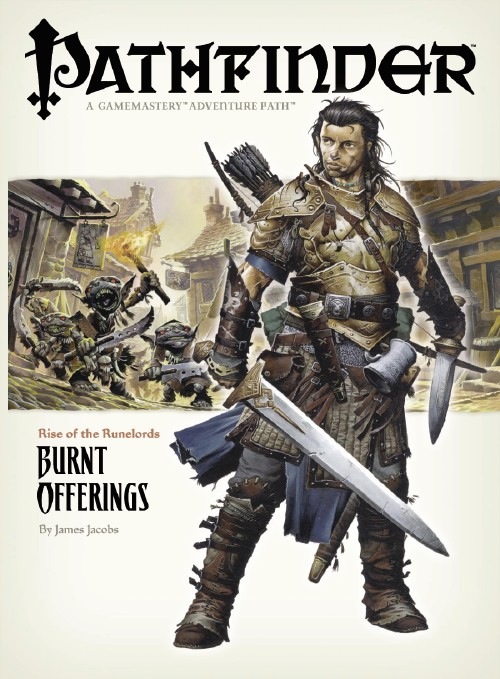
Rise of the Runelords: Burnt Offerings
My new 3.5 game started the other day. My skills are a bit rusty but things went fairly well. We had a bit of page turning as many of us were used to 4th edition. The look of horror on players faces when they realized they didn't have the cushion in terms of dying that 4th ed allowed was pretty priceless.
I already put in a few minor mods which don't necessarily work in the players favor. For one, I'm not confirming criticals or fumbles and I am using the decks that Paizo makes for each. Its good stuff as I got to use both of them. For another, point buy and fixed hit points. I hate to say it but I am a bit of a control freak and that was one of the things that 4e had that does appeal to me.
For the initial combat, my main problem was that there were many players; from my left to the right were Ryan playing a sorcerer, Sergio playing a halberd wielding fighter, Angel playing a druid specializing in shape changing, Tom, our host, playing a warlock, Erik playing a cleric, and Ana, playing a halfling rogue. I needed to add some most monsters to the three encounters but failed to do so, still getting my feet back under me.
On the other hand, the players didn't get as much experience as they might have otherwise. And ugh, the 3rd edition experience point system is still an ugly dog. Of all the things Monte cribbed from Rolemaster, that was one of the worst. Challenge rating against character level is good in theory to prevent players from gaining experience from slaughtering things many levels beneath them but its also another layer of complexity in the game that doesn't need it.
In terms of what works, Paizo does a great job of providing information on the locations and the locals. This allows you to add in a lot of minor flourishes that might otherwise be missed. For example, in the Iron Dragon tavern/inn, I explained to the players the different garb that the barbarians and tinkers were wearing and drew a few interested eyes in terms of the sword-shield the barbarians have.
The real winner of the game, and the one that gets the inspiration going here, is the reimagining of the goblins. In addition to a catchy little goblin tune, the players also get to meet a skilled ranger whose battled the goblins numerous times, and she can act as an information dump allow you to humorously highlight the strange behaviors of the goblins of this setting.
In terms of providing details though, Paizo offers a free player's guide, that provides some minor game mechanic information (3.5 at this point) as well as role playing details on the region. Because this is a free download, I'd recommend anyone who wants to see what the praise being passed along on the setting is about, download the guide. Paizo has continued to offer free guides for each of their adventure paths so they allow the players and Game Masters a chance to see if there might be some hooks for them.
The only flawed thing I find in Paizo's logic here is that with the print books being out of print, and the whole first series, Rise of the Runelords, getting revised latter, that they should drop the price of the original six books by a substantial amount to generate more interest and allow those that may not have purchased the adventure paths when first brought out, into the fold.
Labels:
Burnt Offerings,
Campaigns,
Paizo,
Rise of the Runelords,
Third Edition
Monday, August 15, 2011
Dungeon Siege III
I don't play a lot of video games. Between work, the g/f, my vast reading pile, and the occasional movie, it's rare that I'm willing to sacrifice a huge time chunk to a full fledged video game.
Dungeon Siege III is probably the first new game I've bought in quite a while. The last one probably being Assassin's Creed years after it was out.
Dungeon Siege III is far more character based and in some ways, limited than previous entries. You have a choice of four different characters to select. The interesting thing is that the characters all play different in terms of appearance, style, and abilities. They can be highly customized with various attributes that rise as you gain levels, allowing a user to play through the game multiple ways with the same character. I'll be mentioning some specifics below so if you want to avoid spoilers, read no further.
That reminds me of one of the strengths of D&D. As a whole, it's generally good to have a well rounded party. While 4th edition may have given these roles terms like striker, defender, controller and leader, in many ways, they've been a part of the game since thief, fighter, magic user, and cleric. Perhaps not always in exactly the same role, and perhaps some customization could change how classes worked in the game, such as multi-classing demi-humans in the OSR realms, but for the most part...
The game hits on a lot of high points I've mentioned in the past.
Religion plays a huge role. The main villain of the series is called the Living Saint and has a massive following in the East where the church is strong.
Family relations play another big role. The villain is after the heroes because they murdered her father. The villain is also related to the current queen and has a legitimate claim to the crown. Two of the selectable characters are related to each other. One of the characters is a direct descendant of one of the most powerful spellcasters in the history of the setting. These things have an influence on how people see each other, they provide illumination into motivations and provide insight into what someone might do.
The game isn't that open in some aspects, but it does allow a few variations including redeeming foes, sparing foes, and taking different paths that wind up crossing the paths not taken. The writing isn't bad and there are probably a few ideas that could easily be yanked for your own campaign.
The side quests aren't always fighting either, even if they may have an ultimate effect of providing some damage to the enemy. For example, while the Queen's forces are under siege, you can set up a cannon and prevent the enemy from entering the cave complex where the Queen is holding up. There are a few examples of this combat handy but not actual combat skill tests throughout the game. When setting up challenges for the players, see what options you can provide them that don't necessarily rely straight up on dealing damage.
Dungeon Siege III is probably the first new game I've bought in quite a while. The last one probably being Assassin's Creed years after it was out.
Dungeon Siege III is far more character based and in some ways, limited than previous entries. You have a choice of four different characters to select. The interesting thing is that the characters all play different in terms of appearance, style, and abilities. They can be highly customized with various attributes that rise as you gain levels, allowing a user to play through the game multiple ways with the same character. I'll be mentioning some specifics below so if you want to avoid spoilers, read no further.
That reminds me of one of the strengths of D&D. As a whole, it's generally good to have a well rounded party. While 4th edition may have given these roles terms like striker, defender, controller and leader, in many ways, they've been a part of the game since thief, fighter, magic user, and cleric. Perhaps not always in exactly the same role, and perhaps some customization could change how classes worked in the game, such as multi-classing demi-humans in the OSR realms, but for the most part...
The game hits on a lot of high points I've mentioned in the past.
Religion plays a huge role. The main villain of the series is called the Living Saint and has a massive following in the East where the church is strong.
Family relations play another big role. The villain is after the heroes because they murdered her father. The villain is also related to the current queen and has a legitimate claim to the crown. Two of the selectable characters are related to each other. One of the characters is a direct descendant of one of the most powerful spellcasters in the history of the setting. These things have an influence on how people see each other, they provide illumination into motivations and provide insight into what someone might do.
The game isn't that open in some aspects, but it does allow a few variations including redeeming foes, sparing foes, and taking different paths that wind up crossing the paths not taken. The writing isn't bad and there are probably a few ideas that could easily be yanked for your own campaign.
The side quests aren't always fighting either, even if they may have an ultimate effect of providing some damage to the enemy. For example, while the Queen's forces are under siege, you can set up a cannon and prevent the enemy from entering the cave complex where the Queen is holding up. There are a few examples of this combat handy but not actual combat skill tests throughout the game. When setting up challenges for the players, see what options you can provide them that don't necessarily rely straight up on dealing damage.
Saturday, August 13, 2011
Captain America: The First Avenger
Just saw Captain America, The First Avenger. It was a solid movie and I enjoyed it. I actually thought it was too short, which is a rarity for a me to think such of a movie. The actors did a good job with their characters. The little differences between the comic and movies, actually worked in the movies favor this time around. For example,I wouldn't mind seeing the origin of the Red Skull as done in the movie makes a lot of sense and makes the Red Skull and Captain America more alike in some ways.
Now I'll be talking about specifics in the movie and how they bounce around the old brain and how I might relate some of that to a role playing game.
In terms of structure, Captain America is a soldier. Prior to that, he is a patriot. He wants to serve his country. One of the reasons I like games that follow some type of military structure, either mercenary or military, is that they provide a fairly clear structure that allows the game to flow in a manner that the GM has a little bit more leeway in controlling. As shown in the film however, not every soldier always does as he's told and even in those situations, they work out to be action filled scenarios that have the soldier 'officially' in the wrong, but doing such a good job of crippling the enemy, that it still works out to every one's advantage and any actual punishments are wink winked away.
For equipment, Captain America uses a specialized mesh for his uniform to protect him from small arms fire as well as from bayonets. His shield however, is a unique weapon of defense that is painted over and over again in the colors of his home country. With his augmented strength and agility, the shield becomes both defensive and offensive weapon. It is also iconic. Few fans of Marvel Comics wouldn't recognize the red, white, and blue of Captain America's shield.
Supporting cast includes fellow officers and agents who are allied with America. Another reason why I enjoy the military structure, there are opportunities to surround the players with interesting people who may not have the same type of plot protection that the players have. Will an explosion kill a friend? Will a sniper take out an important ally?
The nemesis... I've mentioned the Red Skull already. In this version, he too benefits from the super serum that turns a man into a super soldier. It ties him and Captain America together. the actor playing the Red Skull does a great job of bringing a level of arrogance to the Skull that works well. For example, when first introduced, he is warned away from an item of great power by an old guardian who tells him, "It's not meant for normal men to look upon", or something of that nature. The Red Skull agrees with him! Other opportunities for the Red Skull to shine include his first physical encounter with Captain America, which is cut short by the destruction of the building around them.
This destruction is a good method of keeping the final fight from happening. It allows the audience to get a taste of the Red Skull's physical prowess and reveals his madness as he claims to embrace his greater than human nature, by showcase his well, red skull visage.
In many situations where there is a need for a nemesis, having that nemesis have a similar origin to the players can provide insight into the abilities, methods, and motivations of the nemesis. It also serves to set up the nemesis as someone who is just as capable as the players. a good villain needs a good introduction. He needs a good theme.
The Red Skull also benefits in that he has a lot of neat toys. His car for example, is a slick piece of machinery while his soldiers, Hydra, are all armed with high powered energy weapons with their own signature look. These touches work well for the movie in that they allow viewers to quickly identify who the good guys and bad guys are.
Captain America is also packed with high energy. It keeps moving. There are times I wanted it to slow down as it actually uses a montage of Cap taking down various Hydra bases instead of showcasing specific missions. Keeping things moving is also vital to a role playing game. It helps keep things moving. It provides the players reasons to pay attention, to keep their hands close to the dice.
While many of the ideas are immediately of use to a super hero based campaign, they are also grounds for any campaign that requires the GM to have a military structure with a villain who shares a common point of origin with the players. Good stuff all around.
Now I'll be talking about specifics in the movie and how they bounce around the old brain and how I might relate some of that to a role playing game.
In terms of structure, Captain America is a soldier. Prior to that, he is a patriot. He wants to serve his country. One of the reasons I like games that follow some type of military structure, either mercenary or military, is that they provide a fairly clear structure that allows the game to flow in a manner that the GM has a little bit more leeway in controlling. As shown in the film however, not every soldier always does as he's told and even in those situations, they work out to be action filled scenarios that have the soldier 'officially' in the wrong, but doing such a good job of crippling the enemy, that it still works out to every one's advantage and any actual punishments are wink winked away.
For equipment, Captain America uses a specialized mesh for his uniform to protect him from small arms fire as well as from bayonets. His shield however, is a unique weapon of defense that is painted over and over again in the colors of his home country. With his augmented strength and agility, the shield becomes both defensive and offensive weapon. It is also iconic. Few fans of Marvel Comics wouldn't recognize the red, white, and blue of Captain America's shield.
Supporting cast includes fellow officers and agents who are allied with America. Another reason why I enjoy the military structure, there are opportunities to surround the players with interesting people who may not have the same type of plot protection that the players have. Will an explosion kill a friend? Will a sniper take out an important ally?
The nemesis... I've mentioned the Red Skull already. In this version, he too benefits from the super serum that turns a man into a super soldier. It ties him and Captain America together. the actor playing the Red Skull does a great job of bringing a level of arrogance to the Skull that works well. For example, when first introduced, he is warned away from an item of great power by an old guardian who tells him, "It's not meant for normal men to look upon", or something of that nature. The Red Skull agrees with him! Other opportunities for the Red Skull to shine include his first physical encounter with Captain America, which is cut short by the destruction of the building around them.
This destruction is a good method of keeping the final fight from happening. It allows the audience to get a taste of the Red Skull's physical prowess and reveals his madness as he claims to embrace his greater than human nature, by showcase his well, red skull visage.
In many situations where there is a need for a nemesis, having that nemesis have a similar origin to the players can provide insight into the abilities, methods, and motivations of the nemesis. It also serves to set up the nemesis as someone who is just as capable as the players. a good villain needs a good introduction. He needs a good theme.
The Red Skull also benefits in that he has a lot of neat toys. His car for example, is a slick piece of machinery while his soldiers, Hydra, are all armed with high powered energy weapons with their own signature look. These touches work well for the movie in that they allow viewers to quickly identify who the good guys and bad guys are.
Captain America is also packed with high energy. It keeps moving. There are times I wanted it to slow down as it actually uses a montage of Cap taking down various Hydra bases instead of showcasing specific missions. Keeping things moving is also vital to a role playing game. It helps keep things moving. It provides the players reasons to pay attention, to keep their hands close to the dice.
While many of the ideas are immediately of use to a super hero based campaign, they are also grounds for any campaign that requires the GM to have a military structure with a villain who shares a common point of origin with the players. Good stuff all around.
Sunday, July 17, 2011
Sharpe's Fury by Bernard Cornwell
Sharpe's Fury continues the trend of Bernard Cornwell to throw Sharpe into all of the interesting parts of history that occur during this time. That in and of itself says a lot about characters and how they get to where they are going.
Looking at some settings like the Forgotten Realms and Greyhawk, one might wonder how they can use all of the coolest elements of the setting while keeping it consistent. It only has to be consistent to the characters. If the GM wants to run a certain part of the campaign world and then move on to another, it's up to the GM to get the characters moving, not expect the characters to decide on their own where they're going.
The GM can do this through a few methods, depending on what type of campaign the players are enjoying. In a campaign that focuses on dungeons, the easiest way to move the party, is to inform them of a famous dungeon or a ancient dungeon just found where people are either being killed in mass droves as they descend downwards, or are coming out with vast treasure and vast losses making it a combination of meat grinder and Monty haul. Of course what's actually going on may be far different than what people are talking about. Rumors after all, need to be validated.
In campaigns that take the form of the players having a patron, this one's pretty easy. The patron needs the players to leave their regular unit or army and move onto a different location for a different McMuffin of the week.
In games that are player drive, using elements of the character's own previous adventurers or backgrounds, the GM should be able to devise something that ties into the new local he wants to use and something that's in the character's history. For example, if there are undead hunters in the group, rumor of an outbreak of zombies or ghouls, or perhaps hints of a weapon that destroys such entities, can be thrown into the campaign. Those players seeking lost relatives, can hear tales of slavers and other similar themes that lead them to the new local.
Another interesting point in the book though, is night fighting. I know that I'm a child of the city and man, I've been out all hours of the night and because of all the so called night pollution, barely realize that it's night. On the other hand, I've got relatives in Indiana and when I drive out that way, the night driving is a thing of terror resembling something out of Stephen King's The Mist where the only way you know you're still on the road is the splat of massive bugs against the windshield and the occasional dip in the road.
RPG's can negate this somewhat by having races that see in the dark or having torches, magical light and other options, but its up to the GM to note the unusual aspects of night fighting. In some games, if all of the party has night vision, the GM show showcase that potential terror by having them stumble across enemies that don't have it. The benefits of fighting opponents who are effectively blind should be massive and should give the players a leg up.
Also in terms of giving players a leg up, is having them be on an 'inside joke'. Here, one of the wealthy officers, who doesn't like Sharpe, mainly because Sharpe's humble origins, falls for what is essentially a gold digger high class prostitute who passes herself off as a high end woman suffering from the times due to the war. While Sharpe and others know who she is, the officer doesn't. It's a good laugh for the players and a potential piece of information that Sharpe can use at a latter date.
In terms of player ingenuity, doesn't punish them when they use the tools they have at this disposal. Shapre is asked to help another man deliver funds for the blackmail. Shapre takes the imitative and goes to the drop point well ahead of time to scout it out and make plans in case there is a double cross since the last person who went there wound up dead. Its a good tactic. Encourage the players to be smart. Allow them to get the drop of the villains when appropriate.
Another nice touch Cornwell brings, is the city of Cadiz itself in the first few paragraphs talking about the stink of sewage and the direction the wind blows. If you can introduce a city with a few words and enforce that imagery later, the players, even if they only spent a short time there, will come away with memories of that place and a method of distinguishing it.
One of the things that I enjoyed about the book, is outside the war, there are various missions that Sharpe needs to be involved with. One of them involves blackmail as well as the messy business of unfinished business. When NPC's take actions against the characters and those actions are hidden by happenstance, dont' be afraid to let the player's find out later, even if it's years later in the campaign, what has happened. Friendships can grown between those who've been wronged and finding out latter that a man you've trusted with your live has killed a woman you loved or a man you respected can cast new light on such an individual.
In terms of religion, Cornwell shows little mercy to any faction. Here, we have divisions between Protestants and Catholic, using that difference as reason why, for a religious man, it's okay to commit the bloodiest of murders and the breaking of one's word. In most fantasy campaigns, pantheons are used so the opportunity to use a division within a church isn't always available, but that doesn't mean the GM can't use such a schism or break. The Forgotten Realms used one in the Church of Lathander for example.
Despite the year, 1811, the medical field is still way behind current times. For example, Sharpe suffers a glancing blow to his skull and is told in no uncertain terms that "We know almost nothing about head wounds." In most fantasy games, healing is built into the system through magical means. Those few that don't however, often have some harsh penalties. When looking at trying to make a game realistic or grim and gritty, don't forget that players will only put up with so much of that before they make a new character.
Sharpe's Fury, despite having nothing to do with fantasy warfare, provides a wealth of inspiration ranging from character focus and intrigue, to revenge and utility. Well worth a look.
Saturday, July 16, 2011
Jade Man's Skin by Daniel Fox
Back in the days of first edition of Advanced Dungeon's and Dragons, I loved the idea of Oriental Adventures. The lure of the far east, of martial arts, of exotic looking armor, of weapons that were non-standard was a big influence on me.
But I was always stuck for ideas on how to run the thing. When Legend of the Five Rings came out, it provided a hell of a background and methodology for running such a setting but at the cost of being so heavily involved with the setting, that my attention soon wandered off as events and timeline advancements took it well past where I was comfortable with.
That's not a bash against such events. I'm not too fond of them when they happen to say the Forgotten Realms, and hated Greyhawk Wars, but in those settings, I was so at ease with that style of adventure, that it didn't take much effort on my part to ignore this, or change that. I was never quite so comfortable with L5R to do that without worrying about the 'purist', which I freely ignored for my FR games.
But one thing that would have helped me enjoy making such changes and making the setting fully my own, would be books like Jade Man's Skin by Daniel Fox, the sequel to Dragon in Chains. I'll be discussing some of my thoughts on the book but a quick summary for those who don't want spoilers? It's a fun filled romp in fantasy ancient China that's well worth a read.
Now onwards!
The book has one thing in common though with L5R right off the bat. The importance of Jade. In this setting, Jade is something that long term exposure to, can make you superhuman. Indeed, Jade is the source of the Emperor's longevity. It's also being used so much here, that you get tired of seeing it. The cover is an powerful illustration of an animal encountered in the book, a jade tiger. In the book its described as massive. There is also a set of jade armor made. Its so heavy that only someone who is already super human can use it because of its weight. While its a great idea and a great visual, the use of jade after jade after jade, apparently all of it the same color, is well, boring. There is nothing that can make the exotic and the far away as boring as overdoing it.
Having said that though, the book provides a reason for things like jade armor, not being used before. The sheet weight of it. Does that strike anyone as familiar? As anyone who played older editions and had to deal with having a very high strength to use certain weapons? And why certain magical items like Gauntlets of Ogre Power and Girdle's of Giant Strength were so highly sought after?
The nice thing though, is that like some of the old artifacts in the game, there is a potential price to pay. In this case, the jade armor turns the emperor green, unto like jade itself. It is also difficult to remove. This reminds me of those quaint and weird little bits that some of the artifacts in the old edition could have in that you could gain vast power but it might cost you say, your humanity. There might be other costs, worse cost associated with it but that was part of the charm. I hate to bash 4e for this, but that game is so focused on the balance of magic items that most efforts at making quirky magic items or items with personality seem pale shadows of earlier editions.
When making unique items for your own campaign, try to give them something different. Try to give them something that's not standard. Try to give them something that works, perhaps better than promised, but has its own draw backs to it. If the draw backs are too high, the item goes unused. If the drawbacks aren't really drawbacks, then there's no point in including them. Some of the point build games used to be very specific in this, "A disadvantage that is not a disadvantage is not a disadvantage and worth no points." or something along those lines.
In terms of working themes into a game, one of the things that book starts off with is corruption. While a messenger is running along, he notes that several soldiers are abusing their position by taking items away from various merchants and family on the road in the name of the emperor. This is not an isolated problem to the realms or fiction, nor to the past. Corruption is an every day occurrence in the modern world and the weight can be costly.
Can you rely on the police if they're under the influence of drug cartels? Mexico seems to be having a lot of problems in that vein and the American movie industry has no shortage of corrupt cop movies. When corruption is present, trust is far and away. People forget things they saw. In some of these movies though, the people are more prone to work with outsiders and are more prone to possibly trusting them and allowing the outsiders to make real changes that couldnt' be made by internal forces. This is an opportunity for players who enjoy the role playing aspect, the challenge of convincing people who are scared for their lives, scared for their families, and scared for their own businesses, that they should trust the heroes.
Another aspect brought up is picking where you fight. One of the few things I think 4th edition tried to do well, that at least brought light to the subject, is making the environment more a part of the game. In previous editions, there might be a small bonus for holding the higher ground (+1 to hit!) but it rarely went beyond that.
Entertainment is far different in this old eras than modern entertainment. In one of the C. J. Sansom books, the author noted bear baiting. Here, Fox brings out fighting crickets. The differences in entertainment are as much a choice of the limits of technology as they are availability of resources. When not fighting for daily survival, what do people do to fill the time? For some like farmers that may be a foolish question as there is no spare time save perhaps to go to church and prepare for the better world that awaits in the next life. For those in the city and those who have the funding, what do they do?
And for those who have power, those who have responsibility, how do they react to it? Bernard Cornwell made no secret that some of the joy that the raiders took, including a Christian Priest, was that there was a savage joy in having no responsibilities to anyone other than yourself. Do such characters run away from their responsibilities when time allows? Do they seek to indulge themselves in their own past times?
And in terms of resources, how does an economy deal with dwindling supplies? Is there an acknowledgement that there is a problem? Is it covered up? Do those in charge send out seekers of new resources and supplies? Does the government prepare itself for when those supplies will run out? Or do they ignore it, pretend that its not a problem and that somehow, and someway, things will work themselves out on their own?
Fox also brings more of the setting's religion into the forefront this time around. A mother and her daughters were told to seek sanctuary at an old temple and now have taken to the temple as their own. And the goddess of that temple speaks through the mute, speaks through the damaged, speaks through those who would not speak on their own, including infants. How do the gods of the setting make contact with the world?
For those who are of noble blood or royalty or prestige, how do they declare it? Here, the Emperor's color is yellow, but a very specific, very pure yellow. Purple seems to be the color of royalty in the standard fantasy settings. The wearing of these colors, especially by those not empowered to do so, can be severer ranging from death and banishment to maiming. It is an obvious sign of challenge to wear the colors that are prohibited to any but the royal family.
On the other hand, it does make for a great method of impersonating members or even soldiers of such a family. After all, if the consequence for doing so is death, who would dare do it?
In terms of the creatures of the setting, what do they think about? How do they think? One part of running a campaign that can be hard to handle, is making non-humans different than humans. In this book, one of the character is tied into a dragon's mind. The view point of the dragon is so vast and different than whenever the link is active, the character feels threatened with drowning and being lost inside that mind. If you can provide a different mind set to the monsters and provide them with reasons for that difference, you'll provide some interesting times to the players.
When creating NPCs, try to look past the surface. In the story here, the mother of the Emperor notes that she has been trying to poison a general who is advising the emperor falsely to no avail because the man is too well protected in court. It comes off like a not important remark, but it puts the older woman in a whole new light. It showcases a level of ruthlessness that a reader would never find otherwise despite her tough as nails demeanor.
If you're looking for ideas on your next Oriental Adventure's campaign, Jade Man's Skin is well worth al ook.
Labels:
Campaigns,
Daniel Fox,
Jade Man's Skin,
Oriental Adventures
Saturday, May 14, 2011
Zatoichi The Blind Swordsman
Every now and again, I'll break out the old DVDs and watch some of Zatoichi, the Blind Swordsman. For those who are unfamiliar with him, there's a fairly decent article on the old Wiki.
In terms of pacing, at least during the first four movies, it has a lot of similarities to other movies where a showdown is coming. The first act introduces the major players. The second act sheds some light on their motivations. The third act brings in the glorious combat.
Like many other forms of media, even though it is older, Zatoichi continues to use some of the formulas that should be familiar to any fan of say, Dragonball Z. An introduction to the main character. He may be taken for helpless. He may have people who know his skills. An introduction to the villain. In many cases, some type of battle occurs to display just how powerful and dangerous this villain is. Then, some type of set up where the hero and villain must battle it out.
In my viewings of the first four movies, the continuity between the first two is strong, and while lighter in the third and fourth, still has elements that viewers can relate to.
For those who enjoy games build more around character and character interaction, Zatoichi provides a lot of opportunities.
For off, due to his Yakuza background, Ichi isn't quite a shining virtue of good deeds. His creed tends to be something similar to say, a player character in that he is loyal to those who are loyal to him. Class and creed mean something to him only when the people are living up to the ideals of that class.
For example, in the first movie, Ichi befriends a samurai. In this time period, samurai have a lot of status and for the most part, if any of them cross Ichi, he has no problems returning the favor. However, as this samurai is also of the humble nature, perhaps due to himself being an alcoholic or dying of consumption, the two get along and share a few drinks and discuss some philosophy.
However, they later duel to the death. This is a good study in character motivation. One of the most difficult things to arrange in some instances, is having two individuals who would normally be on the same side fight. Part of this may be due to alignment issues in games like Dungeons and Dragons. Ichi moves above this by having the samurai's motivation be simple, yet having some depth to it.
For one, he knows he's dying. His desire not to die at the hands of an unskilled yakuza thug is powerful. For another, he realizes Ichi's skill with a sword. Fighting the blind swordsman would be a duel worthy of him even were he not dying. Three, his own code, the 'honorable' thing, pushes him to it. See, the yakuza boss figures that the easiest way to take care of the blind swordsman is with a rifle. To the dying samurai, this goes against the principle of swordsmanship, so to save Ichi, he must fight Ichi.
Ichi's battles with others in the series sometimes have similar deeper connections. For example, in the second movie, he battles his brother, who initially appears to be a one armed samurai. As the movie progresses, we learn that no, like Ichi, he is not on the side of angles and is a thug with a wide array of crimes on his head. He hates Ichi for cutting his arm off while Ichi hates him for stealing his woman. When they fight, even though Ichi wounds his brother to death, Ichi allows no others near him, fighting off those coming for the bounty on his brother's head. This 'hands off' approach has been used in other media, like the anime Gun Grave. There, the main character fights to kill his best friend and when he finally has the chance, his best friend is himself on the lamb and the two join forces again.
In the third movie, Ichi is taken under wing by his mentor. But the depth of the characters here, generally mean that the mentor isn't what he seems. He's fallen on hard times and is a murderous fiend intent on advancing his clan. The sister of said mentor though wants a simple life and approaches Zatoichi about it and he agrees to leave his past life behind him.
The thing that is striking here, is that the continuity of the films, brings us a yakuza who wishes Ichi dead but upon seeing the blind swordman's love for this woman and his willingness to give up the life he lead, including an arm even, the Yakuza leaves him alone. Here we see a flip of the standards where a villain performs a good deed.
This allows the world to have more depth. If the players are not sure of the full consequences of their actions, they may pause and hesitate before killing those in places of power. They may need to ask for mercy from those they have wronged in the past. And if the GM wants the world to be more than just a hack fest, he should allow it.
Zatoichi and his mentor eventually come to blows due to his mentor's murderous ways and perhaps just as importantly, his mentor's attitude towards Zatoichi. Being a caste system, Ichi is impressive in his bladework, but what does that really mean? He can perform feats of sword skill, but that in and of itself isn't enough to change his status. When the opportunity is there for him to marry into Samurai, his mentor shuts him down. Not only is he a criminal, but he is blind. The swordskill he has is no insurance of raising status.
Zatoichi in the same rank as many adventurers. In the first movie, he notes that he learned his swordskills to showcase his strength to fellow Yakuza. For players, their abilities and powers, if they don't have the proper connections and ranking, may just make them more useful pawns to be moved about, regardless of what 'level' they are. Sure, they can lay independent siege to a castle and the king will be forever grateful, but hey, now that that's done, would you mind moving on?
On one hand, this allows the Game Master to keep pushing the players from place to place as they look for a place to settle down. On another, if it's a level based game where power increases occur over a short period of time, the players, depending on their mood and style of campaign being run, may soon wonder why they are NOT running the place.
The fourth movie pits Zatoichi against another samurai. This time, the samurai is the current love interest of one of Zato's old flames from the previous movies. The line of continuity allows the viewer to follow along if he's seen previous episodes and doesn't hinder the story greatly if you haven't. The interesting thing here, is that the samurai, like others in the series we've seen, is interested in the money. For you see, Zato has a bounty placed on his head.
The film starts with a bounty of like ten 'gold' pieces. A fair amount I supposed but by the end, due to treachery and manipulations of the Yakuza around him, the price is three hundred ryo. That's almost as much as Lone Wolf and Cub command per assassination.
The interesting thing in this episode, is how the Yakuza maneuver one of Zatoichi's allies into betraying him. With the start of the movie, the Yakuza would be assassin that Ichi kills is a member of the man Zato is allied with later. Because of the death of the Yakuza, by not taking action against the killer, Zatoichi, it proves that the leader is not worthy of having his territories. But going against Zato is in and of itself death. Hence, the three hundred ryo bounty on Zatoichi's head, placed there by a man whose life he saved several times.
This, the altering of circumstance, is another instance in where those who might otherwise be allies, become enemies. Sure, you and the Duke get along well, but hey, you remember those bandits you killed last week? Yeah, turns out they were nephews of the duke who were 'in disguise' as bandits to hunt down the real bandits and by killing them, you've made a laughing stock of the Duke. Yeah, you can help him, but it just makes him look weaker and all his political allies are moving away from a man who relies on outsides so much.
In addition to the characters, the land has its own personality. For example, there are times when Zatoichi complains about how hot it is. Others complain about how dirty he is and demand that he bath before seeing the important people. The land itself almost has a gritty feel to it. In some of the scenes, either through providence or careful planning, the cups and plates used have cracks and flaws in them. It's an imperfect, harsh world where only a man's sword arm can provide any measure of safety.
Those looking for thieves to build in off beat cities, or for motivations for heroes fighting heroes, need look no further than Zatoichi, the Blind Swordsman
In terms of pacing, at least during the first four movies, it has a lot of similarities to other movies where a showdown is coming. The first act introduces the major players. The second act sheds some light on their motivations. The third act brings in the glorious combat.
Like many other forms of media, even though it is older, Zatoichi continues to use some of the formulas that should be familiar to any fan of say, Dragonball Z. An introduction to the main character. He may be taken for helpless. He may have people who know his skills. An introduction to the villain. In many cases, some type of battle occurs to display just how powerful and dangerous this villain is. Then, some type of set up where the hero and villain must battle it out.
In my viewings of the first four movies, the continuity between the first two is strong, and while lighter in the third and fourth, still has elements that viewers can relate to.
For those who enjoy games build more around character and character interaction, Zatoichi provides a lot of opportunities.
For off, due to his Yakuza background, Ichi isn't quite a shining virtue of good deeds. His creed tends to be something similar to say, a player character in that he is loyal to those who are loyal to him. Class and creed mean something to him only when the people are living up to the ideals of that class.
For example, in the first movie, Ichi befriends a samurai. In this time period, samurai have a lot of status and for the most part, if any of them cross Ichi, he has no problems returning the favor. However, as this samurai is also of the humble nature, perhaps due to himself being an alcoholic or dying of consumption, the two get along and share a few drinks and discuss some philosophy.
However, they later duel to the death. This is a good study in character motivation. One of the most difficult things to arrange in some instances, is having two individuals who would normally be on the same side fight. Part of this may be due to alignment issues in games like Dungeons and Dragons. Ichi moves above this by having the samurai's motivation be simple, yet having some depth to it.
For one, he knows he's dying. His desire not to die at the hands of an unskilled yakuza thug is powerful. For another, he realizes Ichi's skill with a sword. Fighting the blind swordsman would be a duel worthy of him even were he not dying. Three, his own code, the 'honorable' thing, pushes him to it. See, the yakuza boss figures that the easiest way to take care of the blind swordsman is with a rifle. To the dying samurai, this goes against the principle of swordsmanship, so to save Ichi, he must fight Ichi.
Ichi's battles with others in the series sometimes have similar deeper connections. For example, in the second movie, he battles his brother, who initially appears to be a one armed samurai. As the movie progresses, we learn that no, like Ichi, he is not on the side of angles and is a thug with a wide array of crimes on his head. He hates Ichi for cutting his arm off while Ichi hates him for stealing his woman. When they fight, even though Ichi wounds his brother to death, Ichi allows no others near him, fighting off those coming for the bounty on his brother's head. This 'hands off' approach has been used in other media, like the anime Gun Grave. There, the main character fights to kill his best friend and when he finally has the chance, his best friend is himself on the lamb and the two join forces again.
In the third movie, Ichi is taken under wing by his mentor. But the depth of the characters here, generally mean that the mentor isn't what he seems. He's fallen on hard times and is a murderous fiend intent on advancing his clan. The sister of said mentor though wants a simple life and approaches Zatoichi about it and he agrees to leave his past life behind him.
The thing that is striking here, is that the continuity of the films, brings us a yakuza who wishes Ichi dead but upon seeing the blind swordman's love for this woman and his willingness to give up the life he lead, including an arm even, the Yakuza leaves him alone. Here we see a flip of the standards where a villain performs a good deed.
This allows the world to have more depth. If the players are not sure of the full consequences of their actions, they may pause and hesitate before killing those in places of power. They may need to ask for mercy from those they have wronged in the past. And if the GM wants the world to be more than just a hack fest, he should allow it.
Zatoichi and his mentor eventually come to blows due to his mentor's murderous ways and perhaps just as importantly, his mentor's attitude towards Zatoichi. Being a caste system, Ichi is impressive in his bladework, but what does that really mean? He can perform feats of sword skill, but that in and of itself isn't enough to change his status. When the opportunity is there for him to marry into Samurai, his mentor shuts him down. Not only is he a criminal, but he is blind. The swordskill he has is no insurance of raising status.
Zatoichi in the same rank as many adventurers. In the first movie, he notes that he learned his swordskills to showcase his strength to fellow Yakuza. For players, their abilities and powers, if they don't have the proper connections and ranking, may just make them more useful pawns to be moved about, regardless of what 'level' they are. Sure, they can lay independent siege to a castle and the king will be forever grateful, but hey, now that that's done, would you mind moving on?
On one hand, this allows the Game Master to keep pushing the players from place to place as they look for a place to settle down. On another, if it's a level based game where power increases occur over a short period of time, the players, depending on their mood and style of campaign being run, may soon wonder why they are NOT running the place.
The fourth movie pits Zatoichi against another samurai. This time, the samurai is the current love interest of one of Zato's old flames from the previous movies. The line of continuity allows the viewer to follow along if he's seen previous episodes and doesn't hinder the story greatly if you haven't. The interesting thing here, is that the samurai, like others in the series we've seen, is interested in the money. For you see, Zato has a bounty placed on his head.
The film starts with a bounty of like ten 'gold' pieces. A fair amount I supposed but by the end, due to treachery and manipulations of the Yakuza around him, the price is three hundred ryo. That's almost as much as Lone Wolf and Cub command per assassination.
The interesting thing in this episode, is how the Yakuza maneuver one of Zatoichi's allies into betraying him. With the start of the movie, the Yakuza would be assassin that Ichi kills is a member of the man Zato is allied with later. Because of the death of the Yakuza, by not taking action against the killer, Zatoichi, it proves that the leader is not worthy of having his territories. But going against Zato is in and of itself death. Hence, the three hundred ryo bounty on Zatoichi's head, placed there by a man whose life he saved several times.
This, the altering of circumstance, is another instance in where those who might otherwise be allies, become enemies. Sure, you and the Duke get along well, but hey, you remember those bandits you killed last week? Yeah, turns out they were nephews of the duke who were 'in disguise' as bandits to hunt down the real bandits and by killing them, you've made a laughing stock of the Duke. Yeah, you can help him, but it just makes him look weaker and all his political allies are moving away from a man who relies on outsides so much.
In addition to the characters, the land has its own personality. For example, there are times when Zatoichi complains about how hot it is. Others complain about how dirty he is and demand that he bath before seeing the important people. The land itself almost has a gritty feel to it. In some of the scenes, either through providence or careful planning, the cups and plates used have cracks and flaws in them. It's an imperfect, harsh world where only a man's sword arm can provide any measure of safety.
Those looking for thieves to build in off beat cities, or for motivations for heroes fighting heroes, need look no further than Zatoichi, the Blind Swordsman
Saturday, March 5, 2011
The Heroes by Joe abercrombie
I've read the previous books written by Joe Abercrombie with much enjoyment. There is a lot of character building going on with a lot of emphasis on people as people as opposed to heroes or high morals. In some ways, much like the Black Company in its gritty take of standard high fantasy elements.
I'll be discussing some of the material below, so if you want to avoid spoilers, read no further.
Names: One of the characters in the book has a weapon called the Father of All Swords. Now this isn't the first time Joe's come up with some great naming conventions. His term for Death? The Great Leveller. I snagged that right away from my old character's fullblade as it fit him. Weapons don't have to be magical or unique one of a kind for it to have a name.
In addition, when you see the name of the book, The Heroes, it makes you think that its going to be about heroes right? Well, that's another nice trick. The name is the reference point for the actual circle/ring of stones that is called The Heroes because its supposed to have famous heroes buried under it. Another great use of the 'gotcha' by Joe.
History: The Father of All Swords had several names before it was the Father of all Swords. While the history isn't a significant part of the book nor does it take up much space in telling, the same is true for role playing games. Giving weapons a history gives them depth. Even if it's just another NPC telling the player that he heard of the Dreaded Black Wand of Agnash when it was called simply the Death Kiss of Korrus, before the dread lich Agnash had it.
Hoarding Resources: One of the things that gets a lot of talk on the internet is the '15 minute adventuring day' that is supposed to have been I guess, an everyday thing in older editions of Dungeons and Dragons. You know, go into the first few fights while expending all of your spells and abilities and some how finding your way back to territory safe enough that you can just rest and recover your abilities while the bad guys sit around wondering who just broke into their home and killed uncle Bob?
Since the Heroes is set during war time, there's no such thing really as 'break off' the engagement. You beat the first wave of soldiers? The next wave is up. You have a paladin in the party with super high AC? The archers are targeting dexterity. You have that great fire and poison resistance? Its force damage. The point being not that war is a great excuse to punish your players for their hoarding of resorces, but to get them to engage the system, to push them to the limits, to give them the Die-Hard experience.
It also helps break up the standard if that's what your players are actually like. Perhaps its just a reduction of wandering monsters in later editions. Perhaps its the GM not being forceful enough with the players to get more done in the alloted time. Perhaps its the diseased thinking that D&D is a online game where you can just retreat to the town at any time.
But its easy to break players out of the habbit by forcing them to actually fight beyond what they think they can handle. Minions and specialized forces in 4e with roles appropriate to test those defenses the party is lacking in can push the party. Forces that have a lot of hit points and ability to soak up damage to keep the party pinned up until the party finds that their enemies have reinforcements.
But this is only useful advice if you're not out to murder the characters. Don't get me wrong. My expectation as a GM is that if your character does something stupid, that's not a kid glove, it's a boxing glove with a horseshoe that I'm going to punch your character in the jaw with and as Drago said in Rock IV, "If he dies, he dies."
Part of this, for me, goes into building a world that's bigger than the character. If the party of first level adventurers thinks they can take out a family of hill giants and their cave bears because I mention the hills are thick with such monsters, then the party needs to adjust their thinking and try to focus on what their characters can and more importantly, cannot do with innate abilities. Some clever thinking, hiring of mass groups of henchemen, and control of the land could make it possible for a low level group to perhaps survive such an encounter, but the thinking that just because its there means its level appropriate? Out the window with that thinking.
The internet is full of great builds. Its full of useful advice for Max-Min play. It is sadly lacking in talking common sense as that seems to often fall under the umbrella "The GM's job is to take it." so to speak. To allow the players utter freedom to act without consequence. Perhaps I'm too old school in my GMing mentallity but if you charge a group of orcs thinking that they're all minions because if they were anything else they'd be too powerful, well, it's a good think that the DDI has a great online character generator cause chances are you'll need it.
Well, I seemed to have wandered off the deep end there away from the idea of using war as a method of mixing what players expect a standard encounter and resource measurement to be to a rant against some modern thinking in D&D I've seen.
Hang in for next post where I'll talk some more about the actual book!
Friday, March 4, 2011
Legion: The End is The Begining of the Begining of the End?
Spoilers abound so if you don't want to know anything about the post-apocalyptic movie Legion, read no further.
So you want to put together a one shot campaign that ends the world? Legion covers it. God is tired of man and decides that its time to send the angels on down to take care of business again. Pretty simple right? In this instance, its like a zombie plague for the most part. Those of 'weak will' are taken over by angels are go after the stronger willed individuals. And hey, just like with zombies, if you're resolve weakens, you can now be taken over.
But what about a longer term campaign?
The first step, is determine what you want to do with this set up and where you want it to go.
Are the players low level individuals that may be making up some of the militia? Are they the epic level heroes that will lead the resistance into the future with the promised ones show up?
If its the end of the campaign, and you're playing a game where there are users of magic, of almost all sorts, you need to determine, how boned are these individuals? In the movie Legion, the main 'hero' if you will, not only has his superior physical abilities of being an angel himself, but has a hell of a lot of firepower. In older editions of Dungeons and Dragons specifically, clerics and mages tend to suffer a little at lower levels because their spell power at higher levels makes them very potent and powerful against a wide range of characters and obstacles.
But if the astral plane is sealed, and essence dries up, and the gods no longer hear the pleas of mortals... well, that pretty much takes care of psionic power, arcane power, and divine power. It leaves those lowly fighters and rogues at the forefront of things.
But in my experience, high level characters tend to have a lot of magic items as well. What if this new alignment of the planes or this new passing of an era, takes care of those too?
Mind you, these are huge and drastic steps that will have massive impacts on the campaign and the ability of the characters. In older editions of Dungeons and Dragons for example, its often impossible to effect certain monsters without magic items and a high level wizard without his magic is well, a sorry sack of some odd thirty hit points. But if your going for an end of the universe style campaign...
To counter that, perhaps there are some items that not only work, but they allow the cast to draw upon his own pools of inner energy or allow others to provide some type of siphon for him to draw on his power. It could almost be like how Middle Earth Role Playing handled Magic in that it attracts all the wrong sorts of attention to the user. In games like GURPS and Hero, this isn't necessarily the end all be all it is in games like Rolemaster or D&D so remember those long term ramifications.
In addition to providing huge changes to the world, if its more than a one shot, think of the larger consequences. In a setting lik the Forgotten Realms, its been through so much that even the death of the goddess of magic and massive spell plagues didn't do that much to change its overall nature and scope. As a matter of fact, the setting had more magic with Sword Mages introduced along the way. Think not only of the negative, but also the positive.
In the movie Legion for example, while the world is in a new 'Terminator' state, there is still hope and there is still resistance. If the players have absolutely no chance to effect real change or provide that hope themselves, break out the old Call of Cthulhu game and tell them you're running a very special episode of "In The Mouth of Madness."
Thursday, February 3, 2011
The Monks of War by Desmond Seward
Amazon had this puppy on sale a while ago and I picked it up. I'm not deep into it yet but some of the writing already strikes me as 'RPG' style.
"Those who stayed in Palestine were adventurers, mainly French, with nothing to go back to, and the state they created reflected the feudalism of their own land." (pg. 24).
"When the first king of Jerusalem, Baldwin I, died in 118 the land was still in wretched disorder, infested with criminals; with some justice Latin Syria has been compared to a medieval Botany Bay. Many Franks had been sent on the crusade as penance for atrocious offenses such as rape and murder, and they reverted to their unpleasant habitis." (pg 29)
"Huges de Payens was no mere adventuerer but lord of the castle of Martigny in Burgundy...Hugues arrived in Syria in 115, and by 118 had become a self-appointed protector of pilgrims...This ragged eccentric persuaded seven knights, also from northern France, to help him, all taking a solemn oath before the patriarch to protect pilgrims and observe poverty, chasity and obedience.... (pg 30).
Right here I see a few scenarios playing out as it may apply to RPGs.
The first is that adventurers in and of themselves may not be the most loved individuals in any setting. They are bringers of chaos where they go. After all, they are wanderers. They are roaming the land gods above knowing exactly what it is they seek. Several adventures, like Death Frost Doom, have dire consequences if the party fails at what their doing. In many home campaigns, I've used an ancient unearthed evil bit a time or two myself where the party has to put the genie back into the bottle.
Next, there are potentially two types of campaigns at the root here. The one is a glorious age of evil and neutral characters running around the countryside taking what they will and abusing the lands as their wont.
The second is a group of characters who take it upon themselves to cure this plague ridden land of these foul vermin that infest it. So that the common folk may move about more freely.
Depending on the group and the efforts involved and how into one scenario over the other the Game Master is in, either one could be entertaining.
With the bandit angle, the real problem is going to be the long term legs of things. In level based games, merely performing hit and run tactics on groups of peasants, the occassional knight errant, and fighting for living space with the other inhabitants of whatever bad lands the players inhabit, won't cut it at the higher levels of the campaign.
But if the players want to take root and possess power, it shouldn't. I'm not hard core old school or anything, but in older editions, hiting namel evel and constructing your castle gave players the things that adventurers tend not to have; roots. Now they have to go out and hunt bandits. Now they have to scourge the countryside just to protect their own men and loyal factions.
It's something that no matter how awesome and powerful latter foes in an epic campaign may be, is a failure of 3rd and 4th edition on some level. It's not that you can't do these things in either edition. It's not even that there aren't ways of providing rules for it. It's just so not the focus of the game. I don't know if that makes sense but I'm sure with a good GM and a good group, it's not going to be a problem, even for a long term game that makes it to higher levels.
Perhaps being on the frontier, these adventurers new castle attracts all the worst sort of attention starting with giants and moving it's way up the food chain to dragons and demons? Maybe they built their castle right on something like the Hellmouth from Buffy the Vampire Slayer? While 3rd and 4th ed scale to various degrees upward, the problem to me is that they don't scale 'downward' in terms of what the players can do and what they're expected to do.
Anyway, Monks of War is written in an easy to read manner and brings out all sorts of campaign suggestions right ouf of the box.
"Those who stayed in Palestine were adventurers, mainly French, with nothing to go back to, and the state they created reflected the feudalism of their own land." (pg. 24).
"When the first king of Jerusalem, Baldwin I, died in 118 the land was still in wretched disorder, infested with criminals; with some justice Latin Syria has been compared to a medieval Botany Bay. Many Franks had been sent on the crusade as penance for atrocious offenses such as rape and murder, and they reverted to their unpleasant habitis." (pg 29)
"Huges de Payens was no mere adventuerer but lord of the castle of Martigny in Burgundy...Hugues arrived in Syria in 115, and by 118 had become a self-appointed protector of pilgrims...This ragged eccentric persuaded seven knights, also from northern France, to help him, all taking a solemn oath before the patriarch to protect pilgrims and observe poverty, chasity and obedience.... (pg 30).
Right here I see a few scenarios playing out as it may apply to RPGs.
The first is that adventurers in and of themselves may not be the most loved individuals in any setting. They are bringers of chaos where they go. After all, they are wanderers. They are roaming the land gods above knowing exactly what it is they seek. Several adventures, like Death Frost Doom, have dire consequences if the party fails at what their doing. In many home campaigns, I've used an ancient unearthed evil bit a time or two myself where the party has to put the genie back into the bottle.
Next, there are potentially two types of campaigns at the root here. The one is a glorious age of evil and neutral characters running around the countryside taking what they will and abusing the lands as their wont.
The second is a group of characters who take it upon themselves to cure this plague ridden land of these foul vermin that infest it. So that the common folk may move about more freely.
Depending on the group and the efforts involved and how into one scenario over the other the Game Master is in, either one could be entertaining.
With the bandit angle, the real problem is going to be the long term legs of things. In level based games, merely performing hit and run tactics on groups of peasants, the occassional knight errant, and fighting for living space with the other inhabitants of whatever bad lands the players inhabit, won't cut it at the higher levels of the campaign.
But if the players want to take root and possess power, it shouldn't. I'm not hard core old school or anything, but in older editions, hiting namel evel and constructing your castle gave players the things that adventurers tend not to have; roots. Now they have to go out and hunt bandits. Now they have to scourge the countryside just to protect their own men and loyal factions.
It's something that no matter how awesome and powerful latter foes in an epic campaign may be, is a failure of 3rd and 4th edition on some level. It's not that you can't do these things in either edition. It's not even that there aren't ways of providing rules for it. It's just so not the focus of the game. I don't know if that makes sense but I'm sure with a good GM and a good group, it's not going to be a problem, even for a long term game that makes it to higher levels.
Perhaps being on the frontier, these adventurers new castle attracts all the worst sort of attention starting with giants and moving it's way up the food chain to dragons and demons? Maybe they built their castle right on something like the Hellmouth from Buffy the Vampire Slayer? While 3rd and 4th ed scale to various degrees upward, the problem to me is that they don't scale 'downward' in terms of what the players can do and what they're expected to do.
Anyway, Monks of War is written in an easy to read manner and brings out all sorts of campaign suggestions right ouf of the box.
Labels:
Campaigns,
Character Design,
Desmond Seward,
History,
Monks of War
Sunday, January 23, 2011
Agincourt: Nicholas Hook
Hook held few things dear beyond his brother and whatever affection he felt for whichever girl was in his arms, yet archers were special. Archers were Hook's heroes. England, for Hook, was not protected by men in shining armor, mounted on trapper-decked horses, but by archers.
He had been warned not to walk the streets by himself, but the people of Soissons left him alone, perhaps scared of his height and size, or perhaps because they knew he was the one archer who prayed regularly and so tolerated him.
Remind me why you were outlawed, Hook?
"Because I hit a priest, sir John," Hook admitted.
"that priest?" Sir John asked, jerking a thumb toward the retreating horsemen.
"Yes, Sir John."
Sir John shook his head. "You did wrong, Hook, you did very wrong. You shouldn't have hit him."
"No, Sir John," Hook said humbly.
"You should have slit the goddamn bastard's putrid bowels open and ripped his heart out through his stinking arse," Sir John said, looking at Father christopher as if hoping his words might offten the priest, but Father christopher merely smiled.
I've picked a few quotes out of Agincourt to point out some of the bits about Nicholas Hook.
He is an archer.
He prays.
He is an outlaw in his home.
He has friends and allies as well as enemies and rivals.
These things keep him an interesting character and make him a good focal point for the novel.
While he starts off as a groundskeeper for one lord, one whose job is to eliminate poachers on his lords land, his failed attempted to assassinate an ancient family rival, as well as his direct assault against a murderous priest, make him an outlaw in his own land and he joins the military where his woodsmen skills and impressive physical strength allow him fairly quick advancement.
His character has different takes such as hearing voices ranging from the lord above to various saints. He hears two saints in particular, the of Soissons. This makes him seem a little strange to others, but the advice given to him is generaly sound and he manages to thrive with it.
In terms of hearing the saints, one interesting thing that can be used for role playing games, is that it allows the GM to throw in some 'common' sense for players that may be new to the game and not sure how exactly things may play out. Without having a 'pet' NPC around, the GM can provide some standard advice that would be useless to more experienced characters.
His love interest, a nun who also survived the sack of Soissons, has a French father who is a leader of the enemy. This foeman even takes a finger from the archer, but leaves him with enough fingers to use the bow in order to keep his daughter safe.
Despite that foeman though, his true enemies are the family rivals he has. In keeping with themes of family rivals, his own brother is well liked by many, but becomes involved in the difficulties with the families.
In the book Hook manages to wind through the setting and more importantly, grow. In some role playing games, the different encounters and dungeons may not require actual character growth. In many different dungeon crawls, there isn't really a need for characters to change or to note how their environments effect them. In a full fledged setting where cities and travel and other bits that involve actual characters as opposed to traps and monsters, the characters have opportunity to take in new data points and either use them to reinforce their current behaviors or to actually take into account this new information and change.
Nicholas Hook, while starting off as a fairly skilled character, nontheless, manages to grow in both his travels and experiences, as well as his expectations of how the world works. Those looking to model a new Warhammer character in say 2nd edition may wish to look at him for ideas on how a former road warden may have left his old life behind.
He had been warned not to walk the streets by himself, but the people of Soissons left him alone, perhaps scared of his height and size, or perhaps because they knew he was the one archer who prayed regularly and so tolerated him.
Remind me why you were outlawed, Hook?
"Because I hit a priest, sir John," Hook admitted.
"that priest?" Sir John asked, jerking a thumb toward the retreating horsemen.
"Yes, Sir John."
Sir John shook his head. "You did wrong, Hook, you did very wrong. You shouldn't have hit him."
"No, Sir John," Hook said humbly.
"You should have slit the goddamn bastard's putrid bowels open and ripped his heart out through his stinking arse," Sir John said, looking at Father christopher as if hoping his words might offten the priest, but Father christopher merely smiled.
I've picked a few quotes out of Agincourt to point out some of the bits about Nicholas Hook.
He is an archer.
He prays.
He is an outlaw in his home.
He has friends and allies as well as enemies and rivals.
These things keep him an interesting character and make him a good focal point for the novel.
While he starts off as a groundskeeper for one lord, one whose job is to eliminate poachers on his lords land, his failed attempted to assassinate an ancient family rival, as well as his direct assault against a murderous priest, make him an outlaw in his own land and he joins the military where his woodsmen skills and impressive physical strength allow him fairly quick advancement.
His character has different takes such as hearing voices ranging from the lord above to various saints. He hears two saints in particular, the of Soissons. This makes him seem a little strange to others, but the advice given to him is generaly sound and he manages to thrive with it.
In terms of hearing the saints, one interesting thing that can be used for role playing games, is that it allows the GM to throw in some 'common' sense for players that may be new to the game and not sure how exactly things may play out. Without having a 'pet' NPC around, the GM can provide some standard advice that would be useless to more experienced characters.
His love interest, a nun who also survived the sack of Soissons, has a French father who is a leader of the enemy. This foeman even takes a finger from the archer, but leaves him with enough fingers to use the bow in order to keep his daughter safe.
Despite that foeman though, his true enemies are the family rivals he has. In keeping with themes of family rivals, his own brother is well liked by many, but becomes involved in the difficulties with the families.
In the book Hook manages to wind through the setting and more importantly, grow. In some role playing games, the different encounters and dungeons may not require actual character growth. In many different dungeon crawls, there isn't really a need for characters to change or to note how their environments effect them. In a full fledged setting where cities and travel and other bits that involve actual characters as opposed to traps and monsters, the characters have opportunity to take in new data points and either use them to reinforce their current behaviors or to actually take into account this new information and change.
Nicholas Hook, while starting off as a fairly skilled character, nontheless, manages to grow in both his travels and experiences, as well as his expectations of how the world works. Those looking to model a new Warhammer character in say 2nd edition may wish to look at him for ideas on how a former road warden may have left his old life behind.
Labels:
Agincourt,
Campaigns,
Nicholas Hook,
Warhammer
Monday, December 6, 2010
Stonehenge by Bernard Cornwell
One of the comments in the old blog mentioned a trilogy of books by Bernard Cornwell that I would be well advised to seek out. Alas, Half Price books did not possess this Arthurian trilogy, but they did have a few other books by the author. I'm always out to see how different authors handle different things so I was eager to see how Bernard Cornwell wrote, even if it wasn't the choosen titles recommended to me.
Stonehenge as is, would be a great source of material for any game master that was going to add a 'lost world' style elements to his campaign. The author does a good job of making the reader feel the lack of technology, even 'Dark Ages' technology where weapons of bronze and enginnering tasks are vastly more difficult than they'd be today.
In addition, there is a whole pantheon of deities, war, solar, moon, and others, that the GM can easily add to the game.
In terms of broad themes, the use of family is powerful here. The main 'cast' of characters involves three brothers and their father and the relationship between them and how things change as each goes his own way and how these brothers and their influence over others works between not only each other, but the various tribes in the setting.
Superstition and prophecy are also used to good effect. Even when some of the propehcy is specific, it tends to come true, even when its influenced by those actually making the propehcy. The importance of superstition on the other hand, allows one man, even when he is not the epitome of physical perfection, even when he is not the best hunter, superiority over those who would kill him.
Parts of this superstition come in through the reading of omens. Of looking about at the world around and interpeting the events, often trying to do so in a method that's favorable to the omen reader. The fall of a leave, the flight of a bird, the degree in which winter falls. All of these things can possibly be considered signs. For a really heavy handed version of this, watch the movie Signs. Everything can possibly be fitted into a pattern if you have a big enough net.
Nemesis: One of the brothers, Lengar, creates a nemesis out of his younger brother's wife. The next brother, Camaban, continues that nemesis theme, making of Saban's wife a further nemesis. But what does that mean for a role playing game? When 'named' characters are given the shaft without killing them, there are consequences. In a super hero game, this may result in the creation of a new super villain. In a fantasy game, the results can be all over the place.
Is the slighted NPC one that has allies and friends in other places? Are those allies powerful? Even without going to war, those allies of the enemy can make things difficult for the players. This could result in a loss of trade, restrictions from those of the player's allies going through that territory, to outright war against the players and their allies. The theme of actions have consqeuences is powerful here and most of those within the novel get what they deserve.
On the other hand, Saban, the 'hero' if you will, is not a good role model for most player characters, or at least the situations he finds himself in, are not situations that players would endure in his manner. You see, while Saban has a few moments of brilliance, especially when bluffing his mad brother in terms of Saban's skill set, most players would go straight for the throat.
This gets back to knowing the players. In the novel, years pass. This is because of the low levels of technology and the sheer time needed to move stone, smooth stone, and arrange stone. Most players in 3rd and 4th edition, aren't going to want to wait for such events. I mention those editions specifically because older editions tended to have rules and a focus on higher level players having land and construction was often slow, even when assisted by magic items.
Still, the point, know your players and what they want out of the game, is important. If they are anxious and eager to fight and join battle with the primordials and as a GM you keep having them sit around for years running a kingdom, well, there is a clash of taste here. GM's shouldn't give up what they want to run, but if the player's arent' into it, then how long will the GM have players at all?
I have two more books by Bernard Cornwell to go through and while Half Price did not have the Arthurian trilogy, they did have a few more, especially in the Sharpe's series....
Stonehenge as is, would be a great source of material for any game master that was going to add a 'lost world' style elements to his campaign. The author does a good job of making the reader feel the lack of technology, even 'Dark Ages' technology where weapons of bronze and enginnering tasks are vastly more difficult than they'd be today.
In addition, there is a whole pantheon of deities, war, solar, moon, and others, that the GM can easily add to the game.
In terms of broad themes, the use of family is powerful here. The main 'cast' of characters involves three brothers and their father and the relationship between them and how things change as each goes his own way and how these brothers and their influence over others works between not only each other, but the various tribes in the setting.
Superstition and prophecy are also used to good effect. Even when some of the propehcy is specific, it tends to come true, even when its influenced by those actually making the propehcy. The importance of superstition on the other hand, allows one man, even when he is not the epitome of physical perfection, even when he is not the best hunter, superiority over those who would kill him.
Parts of this superstition come in through the reading of omens. Of looking about at the world around and interpeting the events, often trying to do so in a method that's favorable to the omen reader. The fall of a leave, the flight of a bird, the degree in which winter falls. All of these things can possibly be considered signs. For a really heavy handed version of this, watch the movie Signs. Everything can possibly be fitted into a pattern if you have a big enough net.
Nemesis: One of the brothers, Lengar, creates a nemesis out of his younger brother's wife. The next brother, Camaban, continues that nemesis theme, making of Saban's wife a further nemesis. But what does that mean for a role playing game? When 'named' characters are given the shaft without killing them, there are consequences. In a super hero game, this may result in the creation of a new super villain. In a fantasy game, the results can be all over the place.
Is the slighted NPC one that has allies and friends in other places? Are those allies powerful? Even without going to war, those allies of the enemy can make things difficult for the players. This could result in a loss of trade, restrictions from those of the player's allies going through that territory, to outright war against the players and their allies. The theme of actions have consqeuences is powerful here and most of those within the novel get what they deserve.
On the other hand, Saban, the 'hero' if you will, is not a good role model for most player characters, or at least the situations he finds himself in, are not situations that players would endure in his manner. You see, while Saban has a few moments of brilliance, especially when bluffing his mad brother in terms of Saban's skill set, most players would go straight for the throat.
This gets back to knowing the players. In the novel, years pass. This is because of the low levels of technology and the sheer time needed to move stone, smooth stone, and arrange stone. Most players in 3rd and 4th edition, aren't going to want to wait for such events. I mention those editions specifically because older editions tended to have rules and a focus on higher level players having land and construction was often slow, even when assisted by magic items.
Still, the point, know your players and what they want out of the game, is important. If they are anxious and eager to fight and join battle with the primordials and as a GM you keep having them sit around for years running a kingdom, well, there is a clash of taste here. GM's shouldn't give up what they want to run, but if the player's arent' into it, then how long will the GM have players at all?
I have two more books by Bernard Cornwell to go through and while Half Price did not have the Arthurian trilogy, they did have a few more, especially in the Sharpe's series....
Labels:
Bernard Cornwell,
Campaigns,
Historicals,
Stonehenge
Thursday, December 2, 2010
Algrim Durarr: An Essentials Cleric
Well, the standard game I'm in on Friday's has wound down ast he GM has found himself a job! Congrats on him in that field.
This left our group puzzled for a few moments. The two... dare I say it, 'good' GMs, not counting the current one, are working fifty plus hours a week and while we can make it to play, GMing is a whole different thing. So our 'standard' GM picks up the pace. This guy also works, and he GMs a fair even game, but he sometimes lacks the pizzaz that others bring.
But when it comes to running the game like clock work? He's on top of it so I'll take the old slow and steady versus spectacular burn out.
However, this left me in a bit of a pickle. Wizards of the Coast decided that too many people were stealing the old Character Builder and decided to just charge people for the beta online version they have. As a long time customer, I personally felt lied to about the updates and had a few days to play with the online version and yeah, it's a beta. So I dropped my subscription. Perhaps I'll pick it up again in the future when things are ironed out and its no longer beta.
In the meanwhile, that meant I had to... gasp... read my book. I like dwarves. One of my old friends, GM, and player at times, Mike Quon, ran a hell of a game and dwarves were a huge feature in it. He had several named characters, various clans, famous artifacts and other goods. Besides, the other players were already running heavy on the strikers and defenders so I figured I'm either going to run with the cleric or run with the wizazrd.
I went with the dwarf clerci.
Let me tell you old timers, those playing 4e today don't realize how good they have it. Your primary stat as a cleric, Wisdom, is used for all sorts of things. It's not like 1st, 2nd, or 3rd edition D&D where it's always better to have several high scores. Don't get me wrong, it doesn't hurt in 4e either, but your primary attacks are almost all based off of that one stat. You don't have to worry about having a high strength to hit, or a high con for those hit points.
Mind you, the bonuses in 3rd and 4th come a lot sooner than the did in previous editions anyway, and they're equal across the board. No more having that high strength and constitution but it being useless because you were not a fighter class.
Anyway, I already have a figure picked out, but not yet painted for this storm cleric who I've named Algrim Durarr;
This left our group puzzled for a few moments. The two... dare I say it, 'good' GMs, not counting the current one, are working fifty plus hours a week and while we can make it to play, GMing is a whole different thing. So our 'standard' GM picks up the pace. This guy also works, and he GMs a fair even game, but he sometimes lacks the pizzaz that others bring.
But when it comes to running the game like clock work? He's on top of it so I'll take the old slow and steady versus spectacular burn out.
However, this left me in a bit of a pickle. Wizards of the Coast decided that too many people were stealing the old Character Builder and decided to just charge people for the beta online version they have. As a long time customer, I personally felt lied to about the updates and had a few days to play with the online version and yeah, it's a beta. So I dropped my subscription. Perhaps I'll pick it up again in the future when things are ironed out and its no longer beta.
In the meanwhile, that meant I had to... gasp... read my book. I like dwarves. One of my old friends, GM, and player at times, Mike Quon, ran a hell of a game and dwarves were a huge feature in it. He had several named characters, various clans, famous artifacts and other goods. Besides, the other players were already running heavy on the strikers and defenders so I figured I'm either going to run with the cleric or run with the wizazrd.
I went with the dwarf clerci.
Let me tell you old timers, those playing 4e today don't realize how good they have it. Your primary stat as a cleric, Wisdom, is used for all sorts of things. It's not like 1st, 2nd, or 3rd edition D&D where it's always better to have several high scores. Don't get me wrong, it doesn't hurt in 4e either, but your primary attacks are almost all based off of that one stat. You don't have to worry about having a high strength to hit, or a high con for those hit points.
Mind you, the bonuses in 3rd and 4th come a lot sooner than the did in previous editions anyway, and they're equal across the board. No more having that high strength and constitution but it being useless because you were not a fighter class.
Anyway, I already have a figure picked out, but not yet painted for this storm cleric who I've named Algrim Durarr;
Saturday, November 20, 2010
The Chronicles of Rus (A tale of my D&D character!)
This is just my weekly recap of the game. I'll throw some 'meta' comments in there as well. For those who find it boring, let me know. For those who find it interesting, let me know. I always encourage the players to take notes when I run a game. It makes for some interesting observations seeing how people write things down according to their own perceptions. Unfortunately, while everyone comes up with some great background in the group I play with, I'm the only one whose has a chronicle so to speak.
We play every Friday, or almost every Friday, at Black Sun Games. The game moved from one GM to another. My initial character didn't have background or much to him because the first GM was a more or less 'popcorn' style guy who I knew wouldn't run long and the game probably wouldn't be very serious. In his kuddos though, he did keep a much better Obsidian Portal account then our new GM.
Anyone looking for more background on my character can hit out the messages boards or the game store or go here for my background.
The initial style of the character was based on my appreciation for the dreaded 'two handed sword' aka in 3rd and 4th ed, the greatsword. that probably started with Elric, but characters like Guts from Berserk and various Manga probably didn't hurt either.
Our GM tends to have us fight small groups or solos so most of my abilities tend to focus on dishing out as much damage as possible. He's also not real tight with magic items or wealth, but getting to find a place where one can get magic items or spend the wealth is another subject.
I'm 12th level now. I've been playing him since 4th level.. I've been playing this character in some form or another since 4th ed started. One guy ran a few sessions of Keep on the Shadwofell when 4e first game out, stopped. Another guy started a homebrew, stopped... so I've run the same concept through again. Of course with the various options and abilities out now, it's not like it's exaclty the same character, but it is the same concept; a guy with a big sword who chops things up.
Our group is currently trapped in Ravenloft. I know several GMs who love its atmosphere and other bits. Never been a huge fan of it myself, but I do get the appeal. We were sent on a mission to kill a hag in order to speak the language of the land. We're in Sithicus, the domain of Lord Soth, which is being run by a badger lycanthrope whose already robbed us. This is what happens after we get back to the Vishanti, Ravenloft Gypsy take, after killing the hag...
After hours of celebration, I decide its time to retire. For the first time since we’ve been here, in this strange and dark land, I feel almost at ease. In the morning, I feel the pain of drinking too much. I go outside and try to ease my muscles up in the morning with some quick katas.
As I get used to the sun, which doesn’t shine here as it does even in murky Mulmaster, I decide that it’s time to payback some of the hospitality I’ve enjoyed here. I prepare to offer my services to the camp, cutting firewood or gathering logs or other such activities.
But a scream cuts through the silence.
Grabbing the Great Leveler,I rush towards the sound. In one of the wagons, the hacked and pale remains of the war priest, Torque, the dog brother remain. No blood either. I suspect the vampire blade. It too left no blood for its wounds. On the other hand, as someone who has dealt death and been on the receiving end more than once, these wounds don’t look like that. They look too crude in nature, as if dealt with by a hand axe in some hacking fashion.
The Avenger and remaining dog brother, Tor, does not take the news well. We gather the bits and pieces of Torque and proceed to burn them. There are far too many undead in this land for me to not take this precaution.
The dead war priest was one of the other party members who seems to insist on making a new character every time something catches his eye. His first one was a swordmage, which he thought too weak. His next one was the war priest, who crossed over a little with our current priest. His fourth one was a bard whose skill sets made him an asset, but whose combat ability... and well, then it was back to the war priest. But recently the Hex Blade, in 4e, a 'build' for the warlock came out and well, his Character Attention Deficiancy picked up again and so he allowed his character to die to build suspense and prepare the way for his new character. Out of character the game I even said, "Oh, X must be making a new character." which meet with many guffs.
After this grueling work and enduring the stench of the dog brother’s burning flesh and organs and bones, I decide its time to eat. All of this manual labor has built up an appetite. Tor heads off to seek some answers. I wish him luck on that quest.
That night, the gypsies throw a celebration for Torque. It’s loud and obnoxious and wild. Tor is the center of attention that night. The ladies console him, the men wish him good cheer. The tales are told of the deceased dog brother, some of them so bawdy they would make a bard blush. Even Pela the bard and Brother Johnathon drink to honor him. Tor moves the celebration more into the realm of Tempus with a wrestling matches. I do as well but hold back. I'm not here to break bones or set us against these people.
The gypsies bid us farewell the next day. The paladin still bemoans the lack of magical might. Her old sword was formidable but cursed. Her new one, an oatblade, has a minor enchantment so its better than nothing. Tor seeks a map of the lands and more information but is only given general directions as to where we need to go. Some elf city, one of the few cities and one of the few elf settlements of all.
We hit the road. Once again, almost as soon as we’re out of sight of the gypsy camp, the rain and frost and fog come. Lousy weather seems to be nothing new here. At our lunch break, we are meet by Dorian, the deva evoker, who travels the land in the form of a large raven. He speaks briefly of the elves, a race unlike those from where we come from. He tells us that they reflect the land and that this is a dire land indeed. As if to prove his point, the rain increases its tempo with the storm sending down sheets of water and hail against us.
The paladin leads us uphill. She hopes that the greater elevation will enable us to keep an eye out for any potential problems. I dread having to take a night watch. I’ll have to use the stone. The stone which requires me to kill least it become angered with me. I clench my fists wondering about the eventual consequences of using such an item. It’s not that I mind the murder, it’s that I mind the potential betrayal of the jet black stone.
I clean off the mithril scale armor, and insure that the blade is firm in the scarlet scabbard.
I wake up to Dorian shaking me. “The dog brother is in trouble.” I blink out the sleep and can make out Tor fighting some woman covered in wooden spikes that she’s using to impale him. “How lovely” I mutter under my breath as I reach for the Great Leveler. No time for armor but then again, between my stance and the blade, even the finest armor doesn't tend to do me much good anyway.
We charge forward. She manages to knock out, or possibly dead. She cackles madly and throws a small forest at the priest of the moon and the paladin. They don’t take it well. I charge past that and using the flat of my blade, smash her face, knocking her to the ground. She doesn’t look pleased. The paladin and priest struggle with the forest.
She rises hissing at me. She essentially throws the forest at me and the red haired rogue. I struggle to break free but the woods hold me tight, piercing my flesh. She doesn’t bother to try and finish me off. Rather she moves closer to the paladin and the priest and begins rending them with wooden spikes and razor sharp talons.
Dorian decides to make an appearance and casts flames upon the woods pinning my comrades. The stench of burning hair and flesh is never a pleasant experience but I’m thankful that its not me. Then more surprises. Torque shows up in a haze of grey and green ghostly translucent magnificence and waves at her and she seems in write in pain.
She moves forward to attack the ghost and as she does so, I feel necromantic energies seeping into me. She continues to wreak havoc on the group as they struggle free from the burning branches. Dorian decides to return the favor for me as well and I also burn. The burns also handle the vines.
I move forward and bring down the Great Leveler but miss. I move around her and swing again. The blow is a glancing one, but my first strike set her up for the second and she staggers under the onslaught.
She moves away from us and I slash into her again. She grabs our local red head and leaps into the trees, appearing somewhere else and they both look alike. I charge both and with an overhead strike hit both of them. The hag decides to drop the disguise and punctures red with more vines and prepares to move away. I slash at her again and she’s not expecting it and moves away from me back to the rest of the group.
I reach on down and roll out the bandages. The group is so used to magical healing that I almost forget the basics of banding the wounds. My own blow against red wasn’t too bad, a fairly shallow but long cut. The burning and other wounds she’s suffered though…
I turn back to see the group engaged and notice that somehow the dog brother is in the midst of combat again. I didn’t even realize he was still alive. I suppose that yell of Tempus didn’t come from my lips this time.
I move back into the fray. The blade runes begin to flare and I grind my feet into the ground to get a better grip on my handle and increase the force of my blows. Her necromantic aura clashes against the ruins flaring on the blade and I laugh and laugh and laugh even as I’m bringing the blade down upon her and pinning her to the floor as she writhes underneath it. The others, the ants, the fleas, those with no heart, begin moving around trying to live through the necromantic aura.
We joke at the table that when I use my stance and my daily berserk ability from the sword that I go 'Super Sayian'. With the power attack and other bonuses, I'm probably doing as much damage as a strikerer every round. In addition, because I use a fullblade and I managed to crit her twice, even though it was on opportunity attacks, she wound up taking most of the damage in this fight from me.
This dry tree lady doesn’t appreciate the fleas running from her and raises a hand, exploding more vines laced with dark necromantic energies from Pela. Poor paladin. Ever since she gave up her dark long sword that drank blood, she just hasn’t been the same. But in doing so, she’s opened herself up to attack by not only myself, but by the dog brother and Dorian. Our attacks hack away the withered gray bark surrounding her.
Because our games tend to have only a fight or two in them, I always wind up using my dailies. No point in not doing so. Ditto for the action point. I have an ability called Bone Crusher that provides a vulernability 10 to weapons so I use that and then do an action point and make another attack. Very potent bit there.
Well, there's a taste of my character at the 4e game I'm playing in. I'll leave off with my stats from the old, downloaded Character Builder that I paid for during many years of service and if I start hearing good things about the online one, despite Black Sun not having wi-fi, may have to pick up again. I iz lazy!
====== Created Using Wizards of the Coast D&D Character Builder ======
Rus Connor Norach, level 12
Human, Fighter, Kensei
Build: Great Weapon Fighter
Fighter: Combat Agility
Fighter Talents: Two-handed Weapon Talent
Kensei Focus: Kensei Focus Fullblade
Human Power Selection: Bonus At-Will Power
Background: Occupation - Military
FINAL ABILITY SCORES
Str 23, Con 17, Dex 11, Int 11, Wis 12, Cha 9.
STARTING ABILITY SCORES
Str 18, Con 14, Dex 10, Int 10, Wis 11, Cha 8.
AC: 30 Fort: 28 Reflex: 20 Will: 21
HP: 108 Surges: 12 Surge Value: 27
TRAINED SKILLS
Endurance +14, Streetwise +10, Intimidate +10, Heal +12
UNTRAINED SKILLS
Acrobatics +6, Arcana +6, Bluff +5, Diplomacy +5, Dungeoneering +7, History +6, Insight +7, Nature +7, Perception +7, Religion +6, Stealth +6, Thievery +6, Athletics +14
FEATS
Human: Toughness
Level 1: Fighter Weapon Specialization
Level 2: Weapon Proficiency (Fullblade)
Level 4: Weapon Focus (Heavy Blade)
Level 6: Power Attack
Level 8: Powerful Charge
Level 10: Weapon Expertise (Heavy Blade)
Level 11: Blood Thirst
Level 12: Marked Scourge
POWERS
Bonus At-Will Power: Wicked Strike
Fighter at-will 1: Sure Strike
Fighter at-will 1: Knockdown Assault
Fighter encounter 1: Steel Serpent Strike
Fighter daily 1: Savage Advance
Fighter utility 2: Battle Fury Stance
Fighter encounter 3: Dance of Steel
Fighter daily 5: Nimble Bladestorm
Fighter utility 6: Unbreakable
Fighter encounter 7: Reckless Strike
Fighter daily 9: Bone Crusher
Fighter utility 10: Mighty Surge
ITEMS
Adventurer's Kit, Javelin, Climber's Kit, Journeybreads (10), Longbow, Potion of Vitality (paragon tier) (2), Jet Black Ioun Stone, Berserker Fullblade +4, Tattoo of Bloodied Chains (paragon tier), Mithral Scale Armor +4, Belt of Giant Strength (paragon tier), Amulet of Life +3, Sapphire Scabbard (paragon tier)
====== Copy to Clipboard and Press the Import Button on the Summary Tab ======
We play every Friday, or almost every Friday, at Black Sun Games. The game moved from one GM to another. My initial character didn't have background or much to him because the first GM was a more or less 'popcorn' style guy who I knew wouldn't run long and the game probably wouldn't be very serious. In his kuddos though, he did keep a much better Obsidian Portal account then our new GM.
Anyone looking for more background on my character can hit out the messages boards or the game store or go here for my background.
The initial style of the character was based on my appreciation for the dreaded 'two handed sword' aka in 3rd and 4th ed, the greatsword. that probably started with Elric, but characters like Guts from Berserk and various Manga probably didn't hurt either.
Our GM tends to have us fight small groups or solos so most of my abilities tend to focus on dishing out as much damage as possible. He's also not real tight with magic items or wealth, but getting to find a place where one can get magic items or spend the wealth is another subject.
I'm 12th level now. I've been playing him since 4th level.. I've been playing this character in some form or another since 4th ed started. One guy ran a few sessions of Keep on the Shadwofell when 4e first game out, stopped. Another guy started a homebrew, stopped... so I've run the same concept through again. Of course with the various options and abilities out now, it's not like it's exaclty the same character, but it is the same concept; a guy with a big sword who chops things up.
Our group is currently trapped in Ravenloft. I know several GMs who love its atmosphere and other bits. Never been a huge fan of it myself, but I do get the appeal. We were sent on a mission to kill a hag in order to speak the language of the land. We're in Sithicus, the domain of Lord Soth, which is being run by a badger lycanthrope whose already robbed us. This is what happens after we get back to the Vishanti, Ravenloft Gypsy take, after killing the hag...
After hours of celebration, I decide its time to retire. For the first time since we’ve been here, in this strange and dark land, I feel almost at ease. In the morning, I feel the pain of drinking too much. I go outside and try to ease my muscles up in the morning with some quick katas.
As I get used to the sun, which doesn’t shine here as it does even in murky Mulmaster, I decide that it’s time to payback some of the hospitality I’ve enjoyed here. I prepare to offer my services to the camp, cutting firewood or gathering logs or other such activities.
But a scream cuts through the silence.
Grabbing the Great Leveler,I rush towards the sound. In one of the wagons, the hacked and pale remains of the war priest, Torque, the dog brother remain. No blood either. I suspect the vampire blade. It too left no blood for its wounds. On the other hand, as someone who has dealt death and been on the receiving end more than once, these wounds don’t look like that. They look too crude in nature, as if dealt with by a hand axe in some hacking fashion.
The Avenger and remaining dog brother, Tor, does not take the news well. We gather the bits and pieces of Torque and proceed to burn them. There are far too many undead in this land for me to not take this precaution.
The dead war priest was one of the other party members who seems to insist on making a new character every time something catches his eye. His first one was a swordmage, which he thought too weak. His next one was the war priest, who crossed over a little with our current priest. His fourth one was a bard whose skill sets made him an asset, but whose combat ability... and well, then it was back to the war priest. But recently the Hex Blade, in 4e, a 'build' for the warlock came out and well, his Character Attention Deficiancy picked up again and so he allowed his character to die to build suspense and prepare the way for his new character. Out of character the game I even said, "Oh, X must be making a new character." which meet with many guffs.
After this grueling work and enduring the stench of the dog brother’s burning flesh and organs and bones, I decide its time to eat. All of this manual labor has built up an appetite. Tor heads off to seek some answers. I wish him luck on that quest.
That night, the gypsies throw a celebration for Torque. It’s loud and obnoxious and wild. Tor is the center of attention that night. The ladies console him, the men wish him good cheer. The tales are told of the deceased dog brother, some of them so bawdy they would make a bard blush. Even Pela the bard and Brother Johnathon drink to honor him. Tor moves the celebration more into the realm of Tempus with a wrestling matches. I do as well but hold back. I'm not here to break bones or set us against these people.
The gypsies bid us farewell the next day. The paladin still bemoans the lack of magical might. Her old sword was formidable but cursed. Her new one, an oatblade, has a minor enchantment so its better than nothing. Tor seeks a map of the lands and more information but is only given general directions as to where we need to go. Some elf city, one of the few cities and one of the few elf settlements of all.
We hit the road. Once again, almost as soon as we’re out of sight of the gypsy camp, the rain and frost and fog come. Lousy weather seems to be nothing new here. At our lunch break, we are meet by Dorian, the deva evoker, who travels the land in the form of a large raven. He speaks briefly of the elves, a race unlike those from where we come from. He tells us that they reflect the land and that this is a dire land indeed. As if to prove his point, the rain increases its tempo with the storm sending down sheets of water and hail against us.
The paladin leads us uphill. She hopes that the greater elevation will enable us to keep an eye out for any potential problems. I dread having to take a night watch. I’ll have to use the stone. The stone which requires me to kill least it become angered with me. I clench my fists wondering about the eventual consequences of using such an item. It’s not that I mind the murder, it’s that I mind the potential betrayal of the jet black stone.
I clean off the mithril scale armor, and insure that the blade is firm in the scarlet scabbard.
I wake up to Dorian shaking me. “The dog brother is in trouble.” I blink out the sleep and can make out Tor fighting some woman covered in wooden spikes that she’s using to impale him. “How lovely” I mutter under my breath as I reach for the Great Leveler. No time for armor but then again, between my stance and the blade, even the finest armor doesn't tend to do me much good anyway.
We charge forward. She manages to knock out, or possibly dead. She cackles madly and throws a small forest at the priest of the moon and the paladin. They don’t take it well. I charge past that and using the flat of my blade, smash her face, knocking her to the ground. She doesn’t look pleased. The paladin and priest struggle with the forest.
She rises hissing at me. She essentially throws the forest at me and the red haired rogue. I struggle to break free but the woods hold me tight, piercing my flesh. She doesn’t bother to try and finish me off. Rather she moves closer to the paladin and the priest and begins rending them with wooden spikes and razor sharp talons.
Dorian decides to make an appearance and casts flames upon the woods pinning my comrades. The stench of burning hair and flesh is never a pleasant experience but I’m thankful that its not me. Then more surprises. Torque shows up in a haze of grey and green ghostly translucent magnificence and waves at her and she seems in write in pain.
She moves forward to attack the ghost and as she does so, I feel necromantic energies seeping into me. She continues to wreak havoc on the group as they struggle free from the burning branches. Dorian decides to return the favor for me as well and I also burn. The burns also handle the vines.
I move forward and bring down the Great Leveler but miss. I move around her and swing again. The blow is a glancing one, but my first strike set her up for the second and she staggers under the onslaught.
She moves away from us and I slash into her again. She grabs our local red head and leaps into the trees, appearing somewhere else and they both look alike. I charge both and with an overhead strike hit both of them. The hag decides to drop the disguise and punctures red with more vines and prepares to move away. I slash at her again and she’s not expecting it and moves away from me back to the rest of the group.
I reach on down and roll out the bandages. The group is so used to magical healing that I almost forget the basics of banding the wounds. My own blow against red wasn’t too bad, a fairly shallow but long cut. The burning and other wounds she’s suffered though…
I turn back to see the group engaged and notice that somehow the dog brother is in the midst of combat again. I didn’t even realize he was still alive. I suppose that yell of Tempus didn’t come from my lips this time.
I move back into the fray. The blade runes begin to flare and I grind my feet into the ground to get a better grip on my handle and increase the force of my blows. Her necromantic aura clashes against the ruins flaring on the blade and I laugh and laugh and laugh even as I’m bringing the blade down upon her and pinning her to the floor as she writhes underneath it. The others, the ants, the fleas, those with no heart, begin moving around trying to live through the necromantic aura.
We joke at the table that when I use my stance and my daily berserk ability from the sword that I go 'Super Sayian'. With the power attack and other bonuses, I'm probably doing as much damage as a strikerer every round. In addition, because I use a fullblade and I managed to crit her twice, even though it was on opportunity attacks, she wound up taking most of the damage in this fight from me.
This dry tree lady doesn’t appreciate the fleas running from her and raises a hand, exploding more vines laced with dark necromantic energies from Pela. Poor paladin. Ever since she gave up her dark long sword that drank blood, she just hasn’t been the same. But in doing so, she’s opened herself up to attack by not only myself, but by the dog brother and Dorian. Our attacks hack away the withered gray bark surrounding her.
Because our games tend to have only a fight or two in them, I always wind up using my dailies. No point in not doing so. Ditto for the action point. I have an ability called Bone Crusher that provides a vulernability 10 to weapons so I use that and then do an action point and make another attack. Very potent bit there.
Well, there's a taste of my character at the 4e game I'm playing in. I'll leave off with my stats from the old, downloaded Character Builder that I paid for during many years of service and if I start hearing good things about the online one, despite Black Sun not having wi-fi, may have to pick up again. I iz lazy!
====== Created Using Wizards of the Coast D&D Character Builder ======
Rus Connor Norach, level 12
Human, Fighter, Kensei
Build: Great Weapon Fighter
Fighter: Combat Agility
Fighter Talents: Two-handed Weapon Talent
Kensei Focus: Kensei Focus Fullblade
Human Power Selection: Bonus At-Will Power
Background: Occupation - Military
FINAL ABILITY SCORES
Str 23, Con 17, Dex 11, Int 11, Wis 12, Cha 9.
STARTING ABILITY SCORES
Str 18, Con 14, Dex 10, Int 10, Wis 11, Cha 8.
AC: 30 Fort: 28 Reflex: 20 Will: 21
HP: 108 Surges: 12 Surge Value: 27
TRAINED SKILLS
Endurance +14, Streetwise +10, Intimidate +10, Heal +12
UNTRAINED SKILLS
Acrobatics +6, Arcana +6, Bluff +5, Diplomacy +5, Dungeoneering +7, History +6, Insight +7, Nature +7, Perception +7, Religion +6, Stealth +6, Thievery +6, Athletics +14
FEATS
Human: Toughness
Level 1: Fighter Weapon Specialization
Level 2: Weapon Proficiency (Fullblade)
Level 4: Weapon Focus (Heavy Blade)
Level 6: Power Attack
Level 8: Powerful Charge
Level 10: Weapon Expertise (Heavy Blade)
Level 11: Blood Thirst
Level 12: Marked Scourge
POWERS
Bonus At-Will Power: Wicked Strike
Fighter at-will 1: Sure Strike
Fighter at-will 1: Knockdown Assault
Fighter encounter 1: Steel Serpent Strike
Fighter daily 1: Savage Advance
Fighter utility 2: Battle Fury Stance
Fighter encounter 3: Dance of Steel
Fighter daily 5: Nimble Bladestorm
Fighter utility 6: Unbreakable
Fighter encounter 7: Reckless Strike
Fighter daily 9: Bone Crusher
Fighter utility 10: Mighty Surge
ITEMS
Adventurer's Kit, Javelin, Climber's Kit, Journeybreads (10), Longbow, Potion of Vitality (paragon tier) (2), Jet Black Ioun Stone, Berserker Fullblade +4, Tattoo of Bloodied Chains (paragon tier), Mithral Scale Armor +4, Belt of Giant Strength (paragon tier), Amulet of Life +3, Sapphire Scabbard (paragon tier)
====== Copy to Clipboard and Press the Import Button on the Summary Tab ======
Labels:
4e,
Campaigns,
character,
Dungeons and Dragons,
Ravenloft
Wednesday, November 3, 2010
The Scandinavian Baltic Crusades 1100-1500
There is so much history out there and the world is so large, that sometimes when you see a word, like Crusade, associate with a different location than you're used to, it perks your interest. Hell, sometimes seeing a favorite artist involved with a project, like Angus McBride, perks your interest.
While I haven't delved very far into the book, a few things struck me as important world building bits from this Northern Crusades material.
One, religion is a huge motivating tool in a society. The author argues that many went on Crusade because it was the 'right' thing to do, not because the royalty and religious powers wanted all of the 'rough' men out of the country during times of peace. There were rewards to be sure, such as having all previous sins, and all those committed on the trail, forgiven, but it was done because it was a 'good' thing.
Two, the use of waterways is so vital that it can help establish not only cultural similarities due to bleed, but is essential in the spread of news. This allows those individuals who are notable and noteworthy to have much greater and more reliable methods of finding out what is going on in the world. In a campaign setting like the Forgotten Realms, news in the Moonsea region, despite the hostility many of those independent city states hold towards one another, probably travels much quicker than it would merely up and down the Sword Coast, which is a huge stretch of coastline.
Three, religious pilgrimage. It's a common enough event for these times but one frought with danger. For example, King eric I 'Ever Good' of Denmark maded an armed pilgrimage to Palestine but did not make it back home.
Four, crusade is often used, at least in the times I've heard it referenced, almost in exclusive contact with the Holy Land. Here, the text makes the distrinction that it's against any religious hersey, even when its against members of the same faith who practice it a different way. Looking at the Forgotten Realms again, the Twilight War by Paul Kemp put this to good use with the sun god unergoing his change at the time and the new face of the faith taking place. The victor of the battles will determine what is the actual heresy. In some fantasy settings, perhaps the followers turn away from their god if the god does physically make new decrees and laws that those of his faith simply do not wish to follow.
Fifth, the environment plays a vital part in any military matters. While it was mentioned in the old mercenary book how one of the commanders used superior tactics involving the surrounding country side through use of scouting and planning, that idea is hammered home again here where the rugged landscape here isn't necessarily one that is suitible for the standard mounted men with the infantry taking a larger and more important role.
When looking at your gaming maps, try to keep in mind what type of armies can realistically funtion there. Now the rough terrain may not be an issue for those who ride griffons or giant eagles. It may not be an issue for those who use flying ships and fortressess. But for those who are using a more earthly campaign or more rooted in standards of reality, when the mountainous terrain and the badlands become too common, the use of horsemen is out.
The Baltic Crusades brings a lot to mind without even getting into the specifics of it. When reading material, try to keep the mind open. Try to think what can be applied to your own campaign. Try to think how you might be able to use the material. Keeping such things in mind as you read may open the campaign in ways you never initially thought about.
While I haven't delved very far into the book, a few things struck me as important world building bits from this Northern Crusades material.
One, religion is a huge motivating tool in a society. The author argues that many went on Crusade because it was the 'right' thing to do, not because the royalty and religious powers wanted all of the 'rough' men out of the country during times of peace. There were rewards to be sure, such as having all previous sins, and all those committed on the trail, forgiven, but it was done because it was a 'good' thing.
Two, the use of waterways is so vital that it can help establish not only cultural similarities due to bleed, but is essential in the spread of news. This allows those individuals who are notable and noteworthy to have much greater and more reliable methods of finding out what is going on in the world. In a campaign setting like the Forgotten Realms, news in the Moonsea region, despite the hostility many of those independent city states hold towards one another, probably travels much quicker than it would merely up and down the Sword Coast, which is a huge stretch of coastline.
Three, religious pilgrimage. It's a common enough event for these times but one frought with danger. For example, King eric I 'Ever Good' of Denmark maded an armed pilgrimage to Palestine but did not make it back home.
Four, crusade is often used, at least in the times I've heard it referenced, almost in exclusive contact with the Holy Land. Here, the text makes the distrinction that it's against any religious hersey, even when its against members of the same faith who practice it a different way. Looking at the Forgotten Realms again, the Twilight War by Paul Kemp put this to good use with the sun god unergoing his change at the time and the new face of the faith taking place. The victor of the battles will determine what is the actual heresy. In some fantasy settings, perhaps the followers turn away from their god if the god does physically make new decrees and laws that those of his faith simply do not wish to follow.
Fifth, the environment plays a vital part in any military matters. While it was mentioned in the old mercenary book how one of the commanders used superior tactics involving the surrounding country side through use of scouting and planning, that idea is hammered home again here where the rugged landscape here isn't necessarily one that is suitible for the standard mounted men with the infantry taking a larger and more important role.
When looking at your gaming maps, try to keep in mind what type of armies can realistically funtion there. Now the rough terrain may not be an issue for those who ride griffons or giant eagles. It may not be an issue for those who use flying ships and fortressess. But for those who are using a more earthly campaign or more rooted in standards of reality, when the mountainous terrain and the badlands become too common, the use of horsemen is out.
The Baltic Crusades brings a lot to mind without even getting into the specifics of it. When reading material, try to keep the mind open. Try to think what can be applied to your own campaign. Try to think how you might be able to use the material. Keeping such things in mind as you read may open the campaign in ways you never initially thought about.
Subscribe to:
Posts (Atom)