Sunday, February 1, 2015

Marada The She-Wolf by Chris Claremont and John Bolton

Marada the She-Wolf
Written by Chris Claremont
Illustrated by John Bolton
$24.99 ($16.99 from Amazon)
8.9 by 11.9

The cover for Marada the She-Wolf is a piece that looks like it could come from any classic sword and sorcery tale with a feisty antagonist battling against some otherworldly tendrils while an ally looks on helplessly from the background.

This book is from foreign shores (England I believe) as evidenced by the odd product dimensions. In a way, that's a good thing as it's taller than many standard products and the painted full color art only benefits from the increase in standard size.

I grew up on Chris Claremont comics in the 80s by the name of the X-Men. I also remember John Bolton's art from a comic called the Black Dragon. It was a fantastic adult take on Arthurian mythos and did a nice job of things. I had not heard of Marada the She-Wolf before but it sounded intriguing. Somewhat of a sword and sorcery take of things.

As I get older though, I find myself changing in how I look at the way things are worded. For example, "the she-wolf". Perhaps meant to provide some kinship from a word play to a certain she-devil with a sword.

But if you looked at Marada, would you be like, "Man, it's a she-wolf!" Would you have to add the "she" part? I know it was written many moons ago but it just strikes me as amusing these days. The character's concept is so tied into its being a woman that it HAD to be identified as such. "CONAN the He-Wolf." Sounds like nonsense right?

The other problem I have is that there's all these introductions in the book that talk about how independent and powerful and raw and primal Marada is. Does that prove itself in the actual story?

Starts off with Marada being a docile creature freed from slavery after she's been physically and mentally raped by demons. ESSENTIAL to any story of a She-Wolf right? I mean without the rape how would we know that she is raw and primal?

Yeah...

Another story has her 'die' to fool some demons but it's okay because the person who did it really loves her and is protecting her from those bad people.

Um...

There are only a handful of completely adventurers here as it was something that was always meant to get back to. In those stories Marada is captured several times but the good news is that she escapes and manages.

It's a product of it's time I.

I have much the same feeling of Jirel of Joriy. I remember being a young man and thinking, "Wow. So here's where a female Conan/Elric/Fafrd is eh?" and reading it and was like, "Uh... no. She does little under her own agency." Don't mistake me, Jirel is important more as a historical book in breaking a lot of barriers, but I bet there could be an anthology of short stories down on Jirel today that would actually make Jirel an action character who doesn't rely on weird things happening around her or other people's power to get done the things that need done.

The good news about Marada the She-Wolf?

The art of John Bolton.

There's a full page of Marada in the swamp with bow held at the ready. It's a fantastic piece and wouldn't be out of place in any fantasy game or as art in and of itself.


The book is filled with such pieces. Each one fit to provide inspiration for the imagination of any fan of sword and sorcery style illustrations. The vistas range from Arabic stylings to African hunting plains and Bolton does a fantastic job of capturing each landscape as though he had been there.

The writing and the story telling are the old archetypes of the 80s but the art is timeless and for the price, well worth the having.

Saturday, January 31, 2015

Return to the Mines

It's been a while since I ran my 5th edition Lost Mine of Phandelver mixed with the King Maker adventure path. The last two weeks though have seen a return to form of sorts.

Part of the problem? After being away from the game for so long, most of the players had no clue where we last left off. Not only that, but the continuity or knowing the NPCs, the locations, and the other minutia were lost on them. This is a real world penalty for taking a month + long break from the game. We'll either get over it or we'll work through it.

Another problem? I've got seven players at the table. Most of them are good solid players who know the system and  can answer any rules questions brought up quickly. But when combat happens, it's still seven players and a simple equal combat can take up a good chunk of the night, even though 5th edition runs much quicker than 4th did.

I also have been playing with my gaming style. Because I mixed King Maker and Phandelver, the characters are fifth level in a section of Phandelver that is for like second level characters. I narrated one of the fights because, well, I didn't have an hour and a half to have them go room to room killing bandits.

Has anyone else ever done that? In my mind, I know I have options.

1. Beef up the opposition: Again, 5th edition is good in that because of the low numbers, you can throw more grunts into the mix and it makes a real difference in terms of resources consumed. Problem is that it is adding more time to the combat.

2. Customize the opposition: Instead of bandits, it's bandit chiefs or some substandard in the middle.  This is the ideal road I should take but I'm using prewritten adventurers because of time constraints and I should really make MORE time to run the adventure as opposed to just winging things like that off the cuff.

But maybe my group is humoring me because they didn't seem to mind the "this is what happens" bit. I guess when you can do it for trips that have no random encounters on them, you can do it for fights in which the likelihood of death is minimal.

The good news is that the party is no onto the last branch of the Lost Mine section and should be finishing that one up soon. I've already done some legwork in possible additions/changes to the last end boss which will vary depending on the number of players that show up as the usual is anywhere from five to seven.

So far, because Wizards of the Coast hasn't released any additional adventurers and hasn't put out an official OGL or anything, the offerings remain scant and if you're looking to get into 5th edition and have an adventure out of the box, I'd still recommend Mines over the Tiamat based hardcovers.

Other opinions out there? People playing the Goodman Games unofficial adventurers? Recommendations?

Sunday, January 25, 2015

The Art of Ian Miller


US $34.95 ($25.24 at Amazon)
160 pages

The Art of Ian Miller is a collection of Ian Miller's artwork stretching over a long period of time and includes over 300 pieces. It includes both color and black and white artwork. A quick way to get a glimpse of what's inside, is to do a google search like this one.

I can't tell you when I first encountered the art of Ian Miller. I know that it was either through the books of Steve Jackson's Sorcery, the tabletop game Warhammer, or reprints of H. P. Lovecraft's work that I found in used book stores. In my mind, I associate Ian Miller with imagery of 80s Warhammer and the chaos gods in particular.

The book starts off with an introduction by Brian Sibley before getting into the work itself. Broken up into different sections, some much smaller than others, it includes the following:

Maelstrom: A collection of images inspired by Edgar Allan Poe's story, "A Descent into the Maelstrom." This section is black and white.

Dragons: Ah, Ian Miller doing dragons. Some of these are images that hail from the Tolkein Bestiary. I found that fascinating as I don't associate Ian Miller with Tolkein, as opposed to say, Games Workshop. This includes black and white, as well as pen work in red and other colors.  The double page spread of what appears to be a phoenix surrounded by dragons is in full rich color and rewards multiple viewings with its numerous intricate details. 

Men, Monsters & Machines: A collection of a variety of pieces, many of them that look like they came straight from Warhammer. I say this because of the odd faces, leering and snarling on shields and helms.  There are a variety of styles here ranging from pen and ink to full color, including more work for the Lord of the Rings animation. 

Castles & Kingdoms: One of Ian's favorites is apparently the old Gormenghast Novels and he has several works of his take on the castles, as well as Arkham, the fictional city in Massachusetts. Another bit that comes through, is work he did for an animated feature by Ralph Bakshi called Wizards. Another bit that intrigued me as I knew nothing of Ian's involvement with Ralp or Wizards up to this point.

Dreams & Nightmares: To be honest, I'm a little confused as to what makes a piece fall into Dreams & Nightmares as opposed to Men, Monsters & Machines. Is it more of a dream like state? More of a "Well...", a gut feeling if you well? 

One of the problems is that for the double page spreads, the art doesn't handle it well because of the immense detail that Ian brings to his work. For example, the double page spread of Cthulhu on page 48-49? There's quite a bit not necessarily lost, but the flow is immensely interrupted.

Another problem? Despite the size of the book at 9.3 x 12.5, it's too small. This is because Ian is relentless in his use of lines for detail. You could easily have this book at twice the size and still spend hours studying one picture. His use of repetition and patterns is everywhere. 

For under $30, under $26 if you use the Amazon link, the art of Ian Miller can be yours to study.

For those already familiar with Ian, do you have a particular favorite? For those who already own it, any illustrations that are you quintessential Ian that are missing?


Saturday, January 24, 2015

Indian and Oriental Arms and Armour by Lord Egerton of Tatton


First of all, thanks to those readers of the blog, twitter, and other interactions on social media. This book is a direct result of sales through the Amazon Associate link so I appreciate it!

Second, if you've been reading this blog for a while, you'll know I'm a sucker for books on weapons. Indian weapons don't necessarily get a lot of recognition. They don't have the 'Katana' that is so popular among the second part of this book's title, "Oriental Arms and Armour."

Even in role playing games, there isn't that much in Indian settings. While there are notable exceptions, especially now with an OSR game, Arrows of Idra or the Pathfinder city book Parsantium , the majority of games either focus on pseudo European or pseudo Japan.

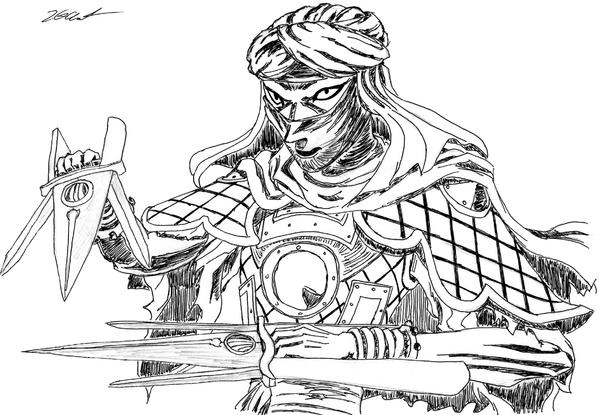
Sometimes such references pop up in odd locations. For example, the manga Berserk has several characters that take inspiration from the lands of India including one champion, Silat, that the main character, Guts, keeps running into. Over here on Deviant Art is a good likeness of Silat by 20AznHuskarl20.


Indian and Oriental Arms and Armour is a bit different than I thought it would be. I'm used to the Dover books being fairly inexpensive reproductions of material long since out of print. Which this is. But this is a bit more scholarly than I thought it would be.

For example, "The shield is deemed the only fit salver on which to present gifts, and accordingly, at a Rajput court, shawls, scarves, jewels, are always spread before a guest on bucklers." That's a neat little bit right there and "parallel between the Rajputs and the feudal races of Scandinavia and Germany. In feudal, as in Rajput communities, arms played a conspicuous part in all military pagents, as well as in all the business of life."

There is also a ton of black and white artwork. One of my favorite bits is a picture of different types of swords that includes at least two pata or gauntlet swords.

At 43 years old, I'm old enough to remember a fantasy movie called Willow.

One of the characters from Willow, is a heroic warrior with no peer known as Madmartigan. During a showdown with his opposite, the fierce General Kael, one of the weapons Madmartigan uses in a two sword fashion, is the pata. It's a fantastic scene.


Visually it's an interesting weapon. Different enough from a standard sword to stand out, but still with enough of the form and functionality to be identified quickly.

There are several such weapons throughout the region, several of which, thanks to media, have become well known, like Xena's chakram.

Having an exotic non-standard weapon like this gives characters a bit of difference. It makes them stand out among others who may only be using standard sword and shield.

And it's not necessarily just a visual difference. Where did they find the weapon? Who trained them? Do they know how to get back there? Are there other treasures and bits of information that can be fed into the campaign?

In the Black Company, a fantasy story about mercenaries and their vague origins, the later books, or Books of the South, allow Glen Cook to tell a story focusing on a completely different region with non-standard heroes and villains that still provide a powerful story.

While I'm still reading through Indian and Oriental Arms and Armour, it's so far proven both visually appealing and interesting reading. Its too short to go into much detail on all aspects, but does point out enough interesting bits that where I'm curious I can hit up other sources for further research.

If you want to dip a toe into the exotic world of weapons that go beyond long sword and broad sword, Indian and Oriental Arms and Armour is a solid start.

As a Game Master, have you ever added any such weapons to your own campaign? Back in 'the day', I had a bounty hunter that used to have a special ability to use any weapon he picked up and used that to justify a whole range of odd weapons. It wasn't something that I innately came up with though as I believe I based it off an old Ral Partha miniature, Nimrod the Hunter from their Warlords boxed set.


Nimrod was the one on the left with the shield that has a tri-dagger peaking out of it and the odd shaped sword and no pants.

Anyone use any monsters from these far away places? I was fortunate to be able to back Harwood Hobbies last miniature Kickstarter and one of the pieces you could get is an Avatar of Kali, but some of the assassins from the thugs cult also look great.


It's a wide world out there and having more options can allow for some variety in the stew.

Any other great books or references I'm blatantly missing? Throw a link in!

Thursday, January 22, 2015

Dungeon Master's Screen Review

Looking over the Dungeon Master's Screen for 5th edition.

The outside art is top notch. One of the best fantasy pieces I've seen in a long time. Over at the blog Shadowcore, you can see the artist other work: http://shadowcoreillustration.blogspot.com/

Bad news? It's kinda m'eh. It's why I put a picture of the Savage Worlds screen below it with some inserts. If you need more game information than you do pictures and graphic design, the Dungeon Master's Screen is going to leave you cold.

The good news?

It's pretty cheap at Amazon. The blank Savage Worlds screen from Amazon is $22.25. The Dungeon Master's Screen is $9.22

I'm a little disappointed that with so many editions to review and gather examples from, even from other game systems, that the designers decided pretty was more important than useful but hey, maybe other people LOVE the art and design and would rather have MORE items like this?

It has given me a better appreciation for the custom screen that Gale Force 9 did for the campaign Tyranny of Dragons though. That had some very specific information that made it easier to run. Bad news is that one is twice as expensive as the generic one.

Can't win!

Let me know what you think of the new screen and how you'll be using it.


Wednesday, January 21, 2015

Steppe by Piers Anthony

While it doesn't seem that long ago, 2009, Steppe by Piers Anthony, was brought back to print by #Paizo Publishing, the makers of the Pathfinder role playing game.

It fell under their Planet Stories. This line didn't do well despite it bringing some of the classics of the science-fiction/fantasy line back into print. Paizo didn't quickly give up mind you though as they tried different formats to save it but eventually give it up.

Mind you in the modern era, they might have been able to do more with it as they didn't have rights for the e-books when they were publishing these novels.

I haven't read all of them. I have read many of them though. I don't consider it my 'duty' or anything of that nature to read 'classic' or older science fiction or fantasy books, but I do try to stretch my wings and read a variety of authors and pieces when possible. It helps provide a grounding effect for books I'm reading now, or even how far society and technology has come.

Many people are probably familiar with South Park. Last year, 2014, they did an episode about Youtube Stars.

In Steppe, which looks to have been first published in 1976, Alp, the main character of the book, is an early example of a star made by passive viewers.


You see Alp was taken from his time, hundreds of years ago, into the future, so that his knowledge of that time may be useful to those playing a game that to modern readers would seem to combine elements of the Matrix, in that it's not real, but also elements of MMO's in that the characters are in different times and eras.

And it was in 1976.

So through passive viewing, Alp at the end of his adventurers, becomes an 'internet' celebrity years before such a thing could even be possible.

I know people point to shows like Star Trek and other popular science fiction bits and look around at our current technology and go, "Ah Ha!" but don't underestimate the unexpected places you may find those predictions of the future coming true.

Piers Anthony hits it out of the ball park in quite a few fields in Steppe. For example, invasion of privacy in terms of when a person voluntarily subjects themselves to being view, such as say through modern Youtube, and involuntary, such as brought to our attention by Edward Snowden.

If you want a quick read of a man out of time, a genre for which Planet Stories was known, Steppe is a great yarn. If you want to see how far Piers Anthony could see the future from before 2000, Steppe takes on a deeper view of technology and man's use of it.

Sunday, January 18, 2015

Nagash: 5 Reasons to Use Nagash in your Fantasy Role Playing Game

I'm a big fan of Nagash from way back in the day. Hunt threw some of my ideas to revitalize the Warhammer line and you'll see me talking about a "Summer of Nagash" where the big undead returns and gets to use a variety of unique models as well as those from Vampire Counts and Tomb Kings.

Well boy did that come to pass eh? For those who don't know, Nagash is an undead sorcer from the Warhammer Fantasy setting. At the end of 2014, Games Workshop started the 'End Times' and did a lot of different things to the Warhammer Fantasy setting. The first book of that was with Nagash.

But why is Nagash so awesome? I'm approaching him not only from a miniature appreciation, but because it's Warhammer and I've been a player of the Warhammer setting for years, also as a role playing character.

1. The God That Walks: Dungeons and Dragons has a fat bloated goat headed demon lord known as Orcus. Nagash is a man who pulled himself up into a god like status and fought Sigmar, another former man, now god, in hand to hand combat. Fat goat demon versus man who pulled himself into the higher reaches of possible power?

2. Nagash has magic items. The Books of Nagash or the Liber Mortis, are potent necromantic artifacts in and of themselves that drive others to search them out. These artifacts can make little games in and of themselves as players, if good, must prevent others from finding them, and if evil, take them and master them before others do. His name is also associated with other artifacts of her time like the Black Pyramid of Nagash. This lending of his name to various things, without he himself being there, lends his character power. Take the fat bloated goat headed demon again. What's his wand called? Yup, Wand of Orcus.

3. The First: Nagash has a lot of things attributed directly to him or about him ranging from necromancy and vampires to lichdom. And if not him creating them directly, him being involved either as a counter against his power or early experimentation. This is one of the few times where a setting has a definitive answer. "Where did vampires come from? Where did liches come from? Where did necromancy come from?"

4. Potent Characters: How can you not love Nagash when he has a follower like Arkhan The Black? I have the original model of this character and he's a lich on a skeleton chariot. His never version is even more impressive. When you need a high priest for the undead? Having someone who might be a match for Vecna when Vecan was a lich as opposed to the deity he became? And how about those on the edges of Nagash lore like Krell, a former Chaos Champion who was raised by Nagash and wound up serving Heinrich Kemmler, the Lichemaster? Those names in and of themselves were of powerful entities and they're just entities on the chain of Nagash's influence.

5. Backstory: Because he wasn't overused, Nagash remained a potent character despite having a terrible model in the older edition of the game. This allowed the writers of the Warhammer Fantasy setting to fire with both barrels and deliver a ton of new models, new characters, new scenarios, and new events that could fit in with what we know of Nagash. In Spartacus, there is rumors of "The Shadow of Death" before Spartacus fights the gladiator. Putting bits and pieces of lore about Nagash well before the characters ever meet him? Classic!

When you want to build a monster of your own for your campaign, you could do far worse than look at how Games Workshop handled Nagash.