In the Warhammer setting, there are many deities that are followed. The general ones or the popular ones, would probably be Sigmar, the patron of the Empire, the White Wolf 'cult' in the north, and the Ruinous Powers of Chaos.
While Brunner himself is not given over to active worship, or at least, does not appear to acknowledge it, he does have several incidents or encounters with religion and those who are religious, or at least pay lip service to it that span a bit differently than the standard gods of the Warhammer setting.
Shallya: While Brunner does wind up crossing blades with a worshipper of Uncle Nurgle, the interesting thing was the prespective it puts on that worship. Tear down hospitals not because the help the injured, but because they cure the sick. This in and of itself could easily become a mini-campaign with one faction trying to wipe the other one's forces out. Brunner appreciates the healing but doesn't feel he owes anyone here anything because he earns his keep.
Solkan: I remember when I first bought my Warhammer FRPG book. It wasn't the hardcover first edition, but it was a great edition by Hogshead. Nonetheless, one of the interesting things I remember reading about in those early days, was deities of law. Not as known or as active in the world as those of Chaos, nonetheless, they were there. One of my friends ran a campaign where we were trying to free one of the trapped gods, the Lady of Law or something like that.
In one of the stories, Brunner is visiting a city state where Solkan is ascendant and his worshippers, while not the only faction, do have a lot of leeway in how they deal with sinners. The unfortunate thing is that they essentially come off like flagellants or other heavy handed worshippers of Sigmar so with a little name change, I wasn't seeing a lot of difference.
Ranald: The patron god of thieves and someone one of Brunner's bounties gives lip service to often.
When using a setting that has a lot of deities, try to focus on some that may not be receiving a lot of attention. It may force the players to pay a little more attention. If in a game where there are special toys different deities provide their worshippers, or different methods of worship are known, use them. Make the game a little different in aspects so that you can get away from the whole Ruinous Powers and Sigmar association that tie up so much of the Warhammer setting.
Keep it fresh and keep the players guessing.
Wednesday, October 26, 2011


Sunday, October 23, 2011
Brunner the Bounty Hunter by C. L. Werner
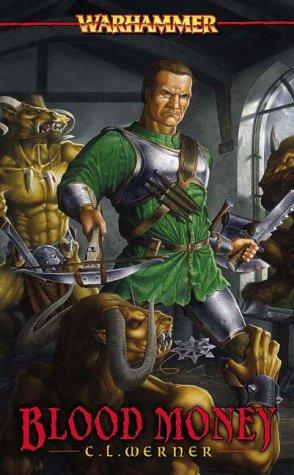
Brunner the Bounty Hunter is a collection of a trilogy of books; Blood & Steel, Blood Money and Blood of the Dragon. I'm not quite sure what the actual break down is in each book as most of the tales are short stores, framed by an author in the fantasy Warhammer setting who knows Brunner and sells tales that Brunner tells him.
C. L. Werner's work is solid here but may suffer a little from the length of the stories. With most of the contents being short, there isn't a lot of room for character development, and while the overall story continues to build and change and evolve and we see everything in previous tales move forward, it's a much different feel than reading a standard trilogy where there might be dozens of characters with their own goals and motivations.
On one hand, this allows C. L. Werner to put Brunner into a lot of situations and brings a lot of action to the reader. In many ways Brunner would be perfect for a weekly cliff hanger style show where Brunner continues to hunt down bounties and we continue to learn a little more about him.
On the other hand, there's not a lot of supporting cast and well, I can only read about how fierce Brunner looks a dozen times before yawning at his bad assery so to speak.
I think overall I enjoyed C. L. Werner's Witch Hunter series a little more but know that in many ways, Brunner is far more appropriate for gaming inspiration thanks to its shorter tales providing more material to a potential GM.
I've often mentioned that bounty hunters are my favorite type of character in games. They have a quick and easy hook that the GM can use to bait the campaign with a variety of bounties, rival hunters, and organizations that make use of such individuals. The ring of details that can be included varies from informants, bars to gather information in, and the law men who sit back and allow the hunters to do the leg work.
These law men may vary tremendously in terms of their authority and their need. In the standard, Brunner receives many of his 'quests' from a judge. On some of his travels while getting those bounties though, Brunner comes across situations that are tasked of him that come from a different authority. In one instance, he's invited by a noble to kill a were wolf. Normally a man of Brunner's status wouldn't even be allowed near the man, but due to the noble's need of seeing the creature captured or killed, Brunner is allowed into the inner circle.
A short job like this allow the character to brush up against society he might not normally be involved with. Unlike the manga Berserk, where initially Griffin is able to rise in rank and ascend to the highest political levels, the jobs Brunner does are so quick that he's not around long enough to necessarily rise or want to. Staying in one place limits the type of jobs he could take after all.
One of the things that Werner does well, is provides a larger backdrop to the setting. For example, when discussing Brunner. "It was said that the bounty hunter had spirited a buccaneer captain from the sanctuary of the pirate stronghold of Sartosa, that he had brought down a traitor to the King of Bretonnia in the court of an Arabyan sheik, and that he had pursued one notorious smuggler to the depths of Black Crag and returned with his prey from the bowels of the goblin fortress."
In that bit alone we get a brief flare of how large the setting is, and how fierce Brunner is. It's a nice bit of reputation and the GM should allow players to craft their own reputations and incorporate things they've down, as well as things that might sound like things they've done. Exaggeration is always a useful tool to have.
Another bit to consider when running characters who thirst for bounties, is that they will be spending a lot of their time in places knights, nobles, and other aristrocrat races, like elves, would probably avoid. They would need to do this in order to gather information, and it allows the GM to occasionally throw them a small bone in that they may recognize a bandit, a mugger, or a smuggler with a bounty on his head. Of course the players need to be secure in their own prowess least they fall prey to ambush or trap themselves...
When looking at where the enemy might flee to, try to incorporate already existing bits of the setting into it. For example, in one story, Brunner has to hunt down a man known as Bertolucci. Turns out their family, like many, owned villas in the country, but waves of beastmen and orcs drove the nobles out of those homes. But sometimes better the unknown then the sure death that waits if you stay... These little bits allow the players, especially those who are already familiar with a setting with a large fan base, such as Warhammer, Greyhawk, or the Forgotten Realms, a chance to enjoy it.
Collecting bounties may provide some challenges to characters. For one thing, if they are employed as more than just assassins, a lot of their victims may have to come back alive. This is something the GM can play on the characters with by providing bounties of various costs that may be worth less than half, or even a fourth dead. Keeping the characters on their toes, and actually providing them with a sound reason for keeping an enemy they've defeated alive.
Another benefit of having a setting like Warhammer, is that little things can be done to customize it further that incorporate the already existing elements. For example, "Farmers in Bretonnia would train hogs to hunt truffles and they held that the noses of their hogs were sharper than any hound. He was counting that the snouts of the Empire's swine were no less keen. If there was one thing a pig enjoyed eating more than a truffle it was a snotling."
Snotlings are a race of goblinoid in the Warhammer setting and by putting that little touch of character there, it provides just a touch more of being somewhere that isn't Earth in a dark ages setting.
Another benefit of running a bounty hunter style campaign, is that the players should be on the alert for the unusual. Brunner is often noted for having a great memory and always examining his surroundings. "I have both three-toe and the one with the clubbed foot here. There can't be two orcs with feet like that rampaging about in your father's domain.'.
A fine example of knowing what to look for and where to look for it.
In terms of these unique elements though, Werner doesn't pause when detailing out monsters, bandits, dragons, vampires, or others. His vivid imagery showcases an interesting bit though when compared to gaming. There are several enemies Brunner quickly bowls through thanks to the use of his crossbow pistols, his actual pistol, and other weapons he's mastered. But from a quick read, you might not know which foe was supposed to be which. Treat every enemy the players face as if it was the preordained winner in the fight when describing it. The players won't know who is a minion and who is the real deal.
Werner is also entertaining. The Warhammer setting is strange in its use of fire arms and dueling and knights and wizards. There are often unspoken honorable agreements about how such things are to be used. But he does manage to capture what I'd call an Indiana Jones moment here when a famous duelist challenges Brunner, the bounty hunter goes outside and shots the man. It's entertaining but also gets the point across that most often, unless restricted by some limitation, Brunner, like many players, will do what he needs to win.
Keep that in mind when coming up with adversaries and foe men. The players might not be bound by the same rules of honor. They might be so slipper on the morale chart that those around them keep a wide distance.
But at the same time, unless you've completely changed the fantasy setting you're running, this should have the occasional benefit allowing them to get the drop on a knight, on a noble, on an elf, or another variant whose honor is held in such high regard that they would never think the players would sink to some dastardly level.
At the same time, the players, engaged in bounty hunting, may be involved in locations that only the most vile murderers and scum may call home. For example, "Will you be needing more salt, master?' the boy asked, a tone of eagerness in his voice. Even at his tender age, he had witnessed death often enough, and heads of criminals adorning pikes set before the town's main gate were commonplace." Remember that no matter how shinny the armor of a knight, that knight is still probably ruling over peasants and dispensing harsh justice that may take the form of entertainment for the common folk. No television, no radio, and no form of instant communication with people around the world makes for some people who in their limited experience have already seen a lot of things that others would consider truly horrid but to them is mild entertainment.
There are some more bits I'll pull from Brunner, but I'll leave off with the recommendation to pick it up in trade paperback as the individual books run quite a bit higher.
Saturday, October 22, 2011
The Problem With Brunner
As I'm getting ready to finish off Brunner, a collection of short stories set in the Warhammer Fantasy setting that features Brunner, a bounty hunter of no small prowess, I decided to do a quick snoop around the Black Library site to see if this was offered as an ebook.
No such luck.
I did however, look around at another series by the same author, the one about the Witch Hunter. Now when I read the series, I read it in a collected format that I bought either at Amazon.com for something like $11 or at Half-Price for something like $7.50 plus tax. So how does the Black Library decide to sell the series?
In individual book form only for $7.99.
So... buy all three books and pay more than you would if you bought the print collection at a brand new price with zero discount, or, well don't.
I think publishers still have a long way to go in terms of figuring out where they want to be, what they think the customer will pay, and how the customers behavior will influence them.
For myself, I would never buy an ebook for more than the price of the printed book, and this includes collected editions. If as a publisher you've already made enough money from the series that you decide to get another round of dollars from it by collecting the books into a collection and don't sell that in the same format as an ebook, you, as a publisher, are effectively telling your fans to buy the print version.
There is nothing wrong with that, but considering unless its a direct sale that most of the profits from sales of print books go to the various middlemen there as opposed to the ebook, that might not be the best way to make the money.
Ah well, let me finish off Brunner here and post some actual inspiration material as opposed to yet another ebook price rant.
No such luck.
I did however, look around at another series by the same author, the one about the Witch Hunter. Now when I read the series, I read it in a collected format that I bought either at Amazon.com for something like $11 or at Half-Price for something like $7.50 plus tax. So how does the Black Library decide to sell the series?
In individual book form only for $7.99.
So... buy all three books and pay more than you would if you bought the print collection at a brand new price with zero discount, or, well don't.
I think publishers still have a long way to go in terms of figuring out where they want to be, what they think the customer will pay, and how the customers behavior will influence them.
For myself, I would never buy an ebook for more than the price of the printed book, and this includes collected editions. If as a publisher you've already made enough money from the series that you decide to get another round of dollars from it by collecting the books into a collection and don't sell that in the same format as an ebook, you, as a publisher, are effectively telling your fans to buy the print version.
There is nothing wrong with that, but considering unless its a direct sale that most of the profits from sales of print books go to the various middlemen there as opposed to the ebook, that might not be the best way to make the money.
Ah well, let me finish off Brunner here and post some actual inspiration material as opposed to yet another ebook price rant.
Tuesday, October 18, 2011
Return of the Living Dead
With the Halloween season on a full run, I decided to watch Return of the Living Dead. I saw movie in the theater when it first came out with some friends and my dad. He was, shall we say, unimpressed with the need for the undead to eat brains to cull the pain of being dead.
Return of the Living Dead is a sequel in a different vein than Dawn of the Dead of the movies that follow that director's vision of the undead as social commentary.
Indeed, Return of the Living Dead has many differences in its adaptation of the zombies to the big screen.
1. The zombies in the Return series can still speak. They are far more mobile than those in the standard zombie films with the remake Dawn of the Dead being a clear exception to that rule.
2. The zombies have thinking process. Now mind you, this isn't always the best and they have no sense of self preservation, but since they're incredibly difficult to destroy, that's isn't a problem. Indeed, it leads to some entertaining moments. The point of their intelligence though, comes through when they're using emergency radios to call for more paramedics and send more cops and other such classic lines.
3. The zombies don't have a single point of weakness. This isn't to indicate that they are super strong or that they can accomplish feats of physical prowess beyond humanly possible. They just ignore all injury. A blow to the skull does nothing more than annoy them. They require complete physical destruction. This might be a challenge to rule so in a game.
4. The zombies haven't taken over the world yet.
That latter part might or might not be important because the zombie in say, the Walking Dead, are an omnipresent threat that are everywhere. In Return of the Living Dead, they are a localized one. They might make for an interesting threat in a location that was somehow cut off from the rest of a setting. An island, warded cemetery, or even a demi-plane where something the characters need is trapped with these difficult to destroy undead.
Another part that is tied into the isolation factor, is that everyone who comes into the area, is killed. Paramedics, police, and friends of the employee working at the cemetery, all meet an untimely death at the hands of the zombies. This can work it's way into a setting as well and provide another reason why characters all called on. Everyone else that the kingdom has sent into this location with the super zombies, has already died and the players are the last hope before the entrance way is sealed forever.
Return of the Living Dead is goofy but it does provide some differences in zombie action to those looking for more than just shamblers that aimlessly get shot, bashed, or stabbed in the brain.
Return of the Living Dead is a sequel in a different vein than Dawn of the Dead of the movies that follow that director's vision of the undead as social commentary.
Indeed, Return of the Living Dead has many differences in its adaptation of the zombies to the big screen.
1. The zombies in the Return series can still speak. They are far more mobile than those in the standard zombie films with the remake Dawn of the Dead being a clear exception to that rule.
2. The zombies have thinking process. Now mind you, this isn't always the best and they have no sense of self preservation, but since they're incredibly difficult to destroy, that's isn't a problem. Indeed, it leads to some entertaining moments. The point of their intelligence though, comes through when they're using emergency radios to call for more paramedics and send more cops and other such classic lines.
3. The zombies don't have a single point of weakness. This isn't to indicate that they are super strong or that they can accomplish feats of physical prowess beyond humanly possible. They just ignore all injury. A blow to the skull does nothing more than annoy them. They require complete physical destruction. This might be a challenge to rule so in a game.
4. The zombies haven't taken over the world yet.
That latter part might or might not be important because the zombie in say, the Walking Dead, are an omnipresent threat that are everywhere. In Return of the Living Dead, they are a localized one. They might make for an interesting threat in a location that was somehow cut off from the rest of a setting. An island, warded cemetery, or even a demi-plane where something the characters need is trapped with these difficult to destroy undead.
Another part that is tied into the isolation factor, is that everyone who comes into the area, is killed. Paramedics, police, and friends of the employee working at the cemetery, all meet an untimely death at the hands of the zombies. This can work it's way into a setting as well and provide another reason why characters all called on. Everyone else that the kingdom has sent into this location with the super zombies, has already died and the players are the last hope before the entrance way is sealed forever.
Return of the Living Dead is goofy but it does provide some differences in zombie action to those looking for more than just shamblers that aimlessly get shot, bashed, or stabbed in the brain.
Monday, October 17, 2011
Mordenheim by Chet Williamson
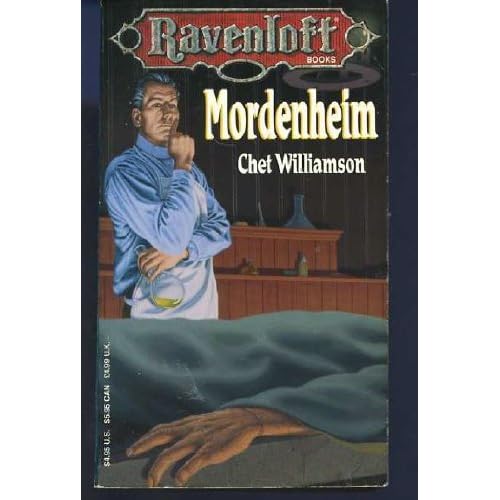
Mordenheim is one of the books in the Ravenloft series. This series brought a touch of gothic horror to the Advanced Dungeons and Dragons setting initially through a single module and then through a meta-setting that could reach any other setting and was heavily inspired by many a tale of the classics.
Mordenheim is in many ways the answer to Mary Shelly's Frankenstein. The interesting thing, to me, is how the author plays off the differences inherent in such a take. Mordenheim, the name of the doctor, lives in a setting where magic is real. Being a true man of 'science' however, he has long discounted magic and relied only on those things that he himself can bring to the table.
This makes him an interesting stand out from other villains. He seeks a deeper understanding of the world through the physical attributes that he can disect. This started off with animals and worked its way up to humans, including the associated grave robbing inherent in such a task. But his goal, of extending life, of curing disease, or making man immortal and invicible, well, to him, and to many throughout history, the ends justify the means.
And that makes him a dangerous villain and makes for a great nemesis motivation. If the GM can play such a villain correctly, if he can choose his words and examples with great care and catered to the players, he may even be able to lure some of them to the villain's side. But it has to be a compelling arguement. It has to be something grand.
And more importantly, there has to be some evidence that the villain is capable of doing what he wants. In this case, Mordenheim is no idle scientist, he has created Adam, which in Dungeons and Dragons, amounts to a unique, advanced Flesh Golem with its own will and mind and its own desires. But to Mordenheim, it is a truimpth of science. And to anyone who sees it, physical proof that Mordenheim is capable of showing his theories in the flesh.
Keep the motivation of the villain out front where the players cna see the strength of it and either take up arms in rebellion against those ideas which tye consider foul or pause and wonder if indeed, the ends do justify the means.
And for one more furthe price rant, the cover price of this book was $4.95 in 1994 and most paperbacks these days cost $9.95. So... 100% inflation in less than twenty years... but surely everyone is making double what they made back then right? The minimum wage has doubled since then right? Righ? Ugh. And the Kindle Price? No such animal. Ugh again.
Sunday, October 16, 2011
Another e-book Pricing Rant
I've mentioned before that my sweet spot for e-publications is around the $2.99 point. Amazon has various daily deals that meet my standard in addition to hundreds, if not thousands of free books. Hell, I'm reading the invisible man now that was free. Tor has some steambooks on sale for the $2.99 and took some of their biggest fantasy franchises to the $2.99 price point for the first book in the series. I've seen a few others, like a recent steampunk fantasy anthology for $2.99 as well as others, that makes me ponder that my 'mythical' price point isn't that far out of line.
What does that have to do with anything?
On RPG.net, someone start a WIR, short for where I read, and the book in question was Black Company, by Glen Cook. Go over to Amazon and hey, no Kindle copies at all, regardless of the cost. But the new stuff? Yeah, it's there. This is another case of author not taking control of his e-rights and insuring that his existing material is creating another revenue stream for him.
But then on an art blog, I see this fantastic drawing of Death Dealer, a Frank Fazetta character. It inspires me to look up one of my favorite authors of sword and sorcery fiction or semi-modern times, David Gemell. All of his books cost around $7.99 in kindle format.
Uh... listen estate of Dave, if you didn't make the money necessary to earn profit on those books while he was alive, then it might be a little late now and because the author is dead, it might be easier to spread information about him and his works at a much lower price point since as I started off, there are thousands of e-books out there for free.
I dread looking up what something like the Amber series would cost.
And one reason for that, is at the end of the series, sometime well after it, there was a nice trade paperback collection of the whole series. And Glen Cook's Black Company is also in collection edition. So how would the e books go in that instance? $7.99 per each of the original Black Company or Amber books or one reasonable price for a collection? While many of Bernard Cornwell's e books are around paperback price, the trilogy covering Bernard's version of King Arthur, the Warlord Chronicles, covers all three books and runs $5.14 for The Winter King, Enemy of God, and Excalibur under one file.
Once again, this tells me that my preferred price point isn't out of whack with reality and that if living authors like Bernard can do it with collections of their work, that someone needs to step up to the black and first make sure we have e books that take the existing work already out there and two, make it affordable to the masses.
What does that have to do with anything?
On RPG.net, someone start a WIR, short for where I read, and the book in question was Black Company, by Glen Cook. Go over to Amazon and hey, no Kindle copies at all, regardless of the cost. But the new stuff? Yeah, it's there. This is another case of author not taking control of his e-rights and insuring that his existing material is creating another revenue stream for him.
But then on an art blog, I see this fantastic drawing of Death Dealer, a Frank Fazetta character. It inspires me to look up one of my favorite authors of sword and sorcery fiction or semi-modern times, David Gemell. All of his books cost around $7.99 in kindle format.
Uh... listen estate of Dave, if you didn't make the money necessary to earn profit on those books while he was alive, then it might be a little late now and because the author is dead, it might be easier to spread information about him and his works at a much lower price point since as I started off, there are thousands of e-books out there for free.
I dread looking up what something like the Amber series would cost.
And one reason for that, is at the end of the series, sometime well after it, there was a nice trade paperback collection of the whole series. And Glen Cook's Black Company is also in collection edition. So how would the e books go in that instance? $7.99 per each of the original Black Company or Amber books or one reasonable price for a collection? While many of Bernard Cornwell's e books are around paperback price, the trilogy covering Bernard's version of King Arthur, the Warlord Chronicles, covers all three books and runs $5.14 for The Winter King, Enemy of God, and Excalibur under one file.
Once again, this tells me that my preferred price point isn't out of whack with reality and that if living authors like Bernard can do it with collections of their work, that someone needs to step up to the black and first make sure we have e books that take the existing work already out there and two, make it affordable to the masses.
Wednesday, October 12, 2011
The Lincon Park Zoo
One of the nice things about living in Chicago, outside of having one of the most expensive set of taxes, parking tickets, public transportation, gas, and electricity, is there is a lot of free stuff to do and a lot of it is cool if you're willing to either take public transportation there or be gouged on 'public' parking.
I went with the later option knowing that I was going to be doing some further driving down the road and went to the Lincon Park Zoo. Turns out that after thirty years the zoo is going to be, in theory, temporarily removing the penguins due to the age of the machines in the park. They are some odd thirty years old.
Bad news? A few of the beasts were no where to be found. A lot of the cafes were closed. The price for a bottle of water or soda was $3.00. My girl friend smoked me in terms of walking. Sure, I've got a broken toe, but when we hit the gym I'm usually able to do the cardio far longer then her. The reality of walking up and down and moving in the outdoors came into play here. Embarrassing! I'm sure there are a few other petty annoyances I could think of but...
The good was that it was a fantastic day in Chicago. The crowd's weren't too bad. There were plenty of places to sit so that when my girlfriend was leaving me in the dust, I was able to gather my wits. My camera actually lasted most of the trip so I had opportunity to take a lot of pictures, or at least, my girlfriend did after I showed her how to work the thing and she stopped worrying about dropping it.
But why post this type of stuff here on Appendix N? What about it brought out any gaming inspiration?
Lots of things.
For one, despite it being a public and free zoo, it has a lot of variety there. Sure, you're typical fantasy campaign setting may not be appropriate to throw all of the animals that you can see gathered in one spot at a zoo, but it does allow you to get an idea of just how diverse animal life can be.
Differences in animals of the same type and the same breed can be vast. This one should be a no brainer. I'm six and a half feet tall and a fat bastich. I tower over a lot of my co workers and outweigh many of them. You'd think some of them were from pygmy tribes if you didn't know we were all human.
The same is true of animals but even more so. For example, one set of birds I saw had different lengths and colors of beaks. The sizes between male and female can be vast, and not always in the male's favor. The coloration of animals can vary by age. In one exhibit on fish, the smallest of the fist started off as yellow with blue stripes and grew to be blue as they grew larger. And the smallest of these fish were perhaps in the two to three inch range while the largest were over a foot in length and almost as wide.
Adding little details like that can either be boring or fascinating for your group, depending on the preference of the players. For example, knowing that an ape should be approximately so many pounds and knowing that whatever they're following appears to be an ape, but one much larger, is mostly background noise leading to a confrontation with a giant ape, but what if the nature sense people can tell that even at the giant size, it's still a young ape? Now you're setting up foreshadowing.
Animals also have their own needs and cares. One of the bears had surgery on its mouth so that its tongue slightly protruded. The animal would have died without it but thanks to modern science it was saved. These distinguishing marks can be the sign of a druid or other animal lover in the region or noticing issues with the animals in the first place, could be the start of a separate campaign dealing with plague.
The movie reviewer, Ebert, noted that the Hunted, wasn't some tricky fighting movie but that its characters looked like they had weight and that they felt ever blow and cut between each thrust and attack. When looking at some of the animals here, especially some of the lions or the rhino, its important to think about how weight can be an issue. A charging rhino may not have all that jazz of a demon or undead, but the sheer weight of it should be enough to ensure that all but the most heavily armed and armored character strive to remove themselves.
The important thing though, is that with all of the things animals can have going for them, in terms of superior senses, using the environment, pack tactics, and a host of other bits, that if the GM goes out of his way to make them 'realistic' and the players are feeling like they're in a slash fic remake of The Ghost and the Darkness, then what happens when the GM starts using supernatural elements like demons and devils or animals that are well, greater animals such as dire or legendary?
I'm not saying ditch all the cool elements that an animal can bring to the game, but don't become so bogged down in how much more dangerous hippos are than crocodiles that you make them tougher than stone giants. Respect the animals but in most fantasy games, know their place.
I went with the later option knowing that I was going to be doing some further driving down the road and went to the Lincon Park Zoo. Turns out that after thirty years the zoo is going to be, in theory, temporarily removing the penguins due to the age of the machines in the park. They are some odd thirty years old.
Bad news? A few of the beasts were no where to be found. A lot of the cafes were closed. The price for a bottle of water or soda was $3.00. My girl friend smoked me in terms of walking. Sure, I've got a broken toe, but when we hit the gym I'm usually able to do the cardio far longer then her. The reality of walking up and down and moving in the outdoors came into play here. Embarrassing! I'm sure there are a few other petty annoyances I could think of but...
The good was that it was a fantastic day in Chicago. The crowd's weren't too bad. There were plenty of places to sit so that when my girlfriend was leaving me in the dust, I was able to gather my wits. My camera actually lasted most of the trip so I had opportunity to take a lot of pictures, or at least, my girlfriend did after I showed her how to work the thing and she stopped worrying about dropping it.
But why post this type of stuff here on Appendix N? What about it brought out any gaming inspiration?
Lots of things.
For one, despite it being a public and free zoo, it has a lot of variety there. Sure, you're typical fantasy campaign setting may not be appropriate to throw all of the animals that you can see gathered in one spot at a zoo, but it does allow you to get an idea of just how diverse animal life can be.
Differences in animals of the same type and the same breed can be vast. This one should be a no brainer. I'm six and a half feet tall and a fat bastich. I tower over a lot of my co workers and outweigh many of them. You'd think some of them were from pygmy tribes if you didn't know we were all human.
The same is true of animals but even more so. For example, one set of birds I saw had different lengths and colors of beaks. The sizes between male and female can be vast, and not always in the male's favor. The coloration of animals can vary by age. In one exhibit on fish, the smallest of the fist started off as yellow with blue stripes and grew to be blue as they grew larger. And the smallest of these fish were perhaps in the two to three inch range while the largest were over a foot in length and almost as wide.
Adding little details like that can either be boring or fascinating for your group, depending on the preference of the players. For example, knowing that an ape should be approximately so many pounds and knowing that whatever they're following appears to be an ape, but one much larger, is mostly background noise leading to a confrontation with a giant ape, but what if the nature sense people can tell that even at the giant size, it's still a young ape? Now you're setting up foreshadowing.
Animals also have their own needs and cares. One of the bears had surgery on its mouth so that its tongue slightly protruded. The animal would have died without it but thanks to modern science it was saved. These distinguishing marks can be the sign of a druid or other animal lover in the region or noticing issues with the animals in the first place, could be the start of a separate campaign dealing with plague.
The movie reviewer, Ebert, noted that the Hunted, wasn't some tricky fighting movie but that its characters looked like they had weight and that they felt ever blow and cut between each thrust and attack. When looking at some of the animals here, especially some of the lions or the rhino, its important to think about how weight can be an issue. A charging rhino may not have all that jazz of a demon or undead, but the sheer weight of it should be enough to ensure that all but the most heavily armed and armored character strive to remove themselves.
The important thing though, is that with all of the things animals can have going for them, in terms of superior senses, using the environment, pack tactics, and a host of other bits, that if the GM goes out of his way to make them 'realistic' and the players are feeling like they're in a slash fic remake of The Ghost and the Darkness, then what happens when the GM starts using supernatural elements like demons and devils or animals that are well, greater animals such as dire or legendary?
I'm not saying ditch all the cool elements that an animal can bring to the game, but don't become so bogged down in how much more dangerous hippos are than crocodiles that you make them tougher than stone giants. Respect the animals but in most fantasy games, know their place.
Subscribe to:
Posts (Atom)


