One of the things I tell people is that they have to support the things they like with money. I can't always do it and my priorities aren't always where they should be, especially on luxury purchases. But when I look at the Tome of Horrors Complete, I see both failure and success.
Failure is on the path of WoTC. Their restrictive licensing, instead of embracing the OGL, put this puppy right into the hands of a third party instead of killing it. Oh sure, it was dead for a while but the potential for it to be released under the OGL under Pathfinder was always there. For 4th ed? No using that license and not apparently by anyone who just wanted to run a book of 4e monsters out there using this material under a heading of "For the world's most popular role playing game" as I've seen some try to avoid the license WoTC is currently offering.
And it's a damn shame and yet a good thing. If such a book had come out at the start of 4e's lifespan, it would be using the 'wrong' math. Yeah, while we haven't got a 4.5 edition (ha!) the game plays differently now in combat and other aspects (rituals anyone) than it initially did.
The sad thing is its not like WoTC couldn't have used more monster support, especially up in the higher levels of things. Perhaps when they were talking about keeping core monsters like the Frost Giant out of the original Monster Manual to insure higher sales for the 2nd Monster Manual, they should have been working on some more epic material?
Anyway, for WoTC, the publication of this book is failure. On their part.
For Paizo, and for Frog God Games, it's a success. Even without cracking it open and talking about what I'm sure needs to be errata'd, the book sold out of its initial Pathfinder print run and went back for a second print. To me, this indicates that the Pathfinder market is healthier than the end run of 3.5. I'm not saying this is AWESOME news or anything but Necromancers games kept things close to the vest in order to avoid over printing at the end of times and well, we didnt' get a lot of reprints. The fact that this book is being reprinted? Good news.
In terms of errata, I'm disillusioned of it. WoTC has put out so much errata for their games that when I see another company or book with errata, I can't really muster a lot of energy to go, "sonofabitch" as opposed to 'm'eh'. Now if it's really game changing errata or just plain damn errors, like missing pages, yeah, the nerd fires get stoked there.
Better news in that if you were a fan of the old books, or a fan of 1st edition monsters and wanted to see them in Pathfinder, well, you've got them. there's a ton of inspiration to be found here. Hell, the book itself is like some primitive printed monolith waiting to be placed on the shelf.
WoTC, I hope that when 5th ed rolls around you realize you're not the producers of D&D being sold in Toys R Us and open up to the OGL again and Paizo, I tip my hat off to you and Frog God for this success.
Thursday, September 29, 2011


Sunday, September 18, 2011
Dai-San: Missing in Action?
One of the things I generally fail to understand about ebooks, is how authors with a larger backlog of books don't put their books to work for them. In some cases, the book might be so old that there is no electronic file of it to modify and upload. When doing research on various bits though, I see that you can have this done with $1 a page.
The catalog of an author can do many important things for the reader. If you find an author you enjoy, especially later in the author's writing career, or through some media coverage on the author, such as the author writing a licensed book in a genre you enjoy (Star Wars, Star Trek, Forgotten Realms, etc...), then it is handy when you can puruse and purchase at your leisure.
I suspect part of the lack of Dai-San and other books by Eric Van Lustbader, is that the new properties he is working on, from what I See, the Bourne material, takes presidence. Or it could be that like many things in the past, the rights of the electronic material are in shaky waters. Will it be a priority for Fawcette to make an ebook or do they have their own new properties that they have to promote?
From things I'm reading about ebooks, when the author needs to take control of such a situation, as putting their catalog online, they can't rely on the publisher to make that a priority. In addition, doing so for the author makes the author into a jack of all trades. The author now has to increase his skill set and knowledge pool to learn how to handle the various aspects of which digital rights he owns, what is the most efficient way to publish his backcatalog, and how can he get word out once that is done, that books released 25 years ago now have new life?
Some may feel that it's not the authors place to take control of their work like that. That they don't have to know or shouldn't need to know these things. In general labor terms, people whose skill sets aren't expanded, especially in modern America where cheap labor is found through illegal use of migrant works, minimum wage payment of migrant workers, or just offshored to another country, everyone has to step their game up.
It's like its okay for a computer to be four times as powerful and new technologies to continue to emerge, but to have people whose finances depend on those take charge of those technologies and move forward on their own? The days of the writer who only writes, if they haven't already done so, are coming dangerously close to the end.
And that's not necessarily a bad thing.
Saturday, September 17, 2011
Rise of the Runelords: Burnt Offerings
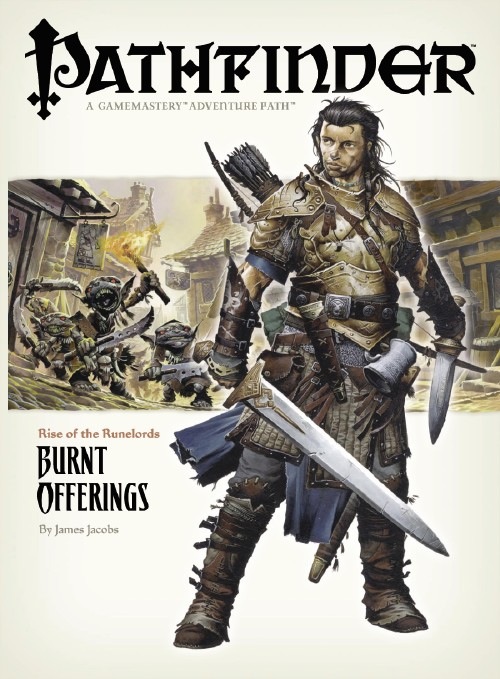
My new 3.5 game started the other day. My skills are a bit rusty but things went fairly well. We had a bit of page turning as many of us were used to 4th edition. The look of horror on players faces when they realized they didn't have the cushion in terms of dying that 4th ed allowed was pretty priceless.
I already put in a few minor mods which don't necessarily work in the players favor. For one, I'm not confirming criticals or fumbles and I am using the decks that Paizo makes for each. Its good stuff as I got to use both of them. For another, point buy and fixed hit points. I hate to say it but I am a bit of a control freak and that was one of the things that 4e had that does appeal to me.
For the initial combat, my main problem was that there were many players; from my left to the right were Ryan playing a sorcerer, Sergio playing a halberd wielding fighter, Angel playing a druid specializing in shape changing, Tom, our host, playing a warlock, Erik playing a cleric, and Ana, playing a halfling rogue. I needed to add some most monsters to the three encounters but failed to do so, still getting my feet back under me.
On the other hand, the players didn't get as much experience as they might have otherwise. And ugh, the 3rd edition experience point system is still an ugly dog. Of all the things Monte cribbed from Rolemaster, that was one of the worst. Challenge rating against character level is good in theory to prevent players from gaining experience from slaughtering things many levels beneath them but its also another layer of complexity in the game that doesn't need it.
In terms of what works, Paizo does a great job of providing information on the locations and the locals. This allows you to add in a lot of minor flourishes that might otherwise be missed. For example, in the Iron Dragon tavern/inn, I explained to the players the different garb that the barbarians and tinkers were wearing and drew a few interested eyes in terms of the sword-shield the barbarians have.
The real winner of the game, and the one that gets the inspiration going here, is the reimagining of the goblins. In addition to a catchy little goblin tune, the players also get to meet a skilled ranger whose battled the goblins numerous times, and she can act as an information dump allow you to humorously highlight the strange behaviors of the goblins of this setting.
In terms of providing details though, Paizo offers a free player's guide, that provides some minor game mechanic information (3.5 at this point) as well as role playing details on the region. Because this is a free download, I'd recommend anyone who wants to see what the praise being passed along on the setting is about, download the guide. Paizo has continued to offer free guides for each of their adventure paths so they allow the players and Game Masters a chance to see if there might be some hooks for them.
The only flawed thing I find in Paizo's logic here is that with the print books being out of print, and the whole first series, Rise of the Runelords, getting revised latter, that they should drop the price of the original six books by a substantial amount to generate more interest and allow those that may not have purchased the adventure paths when first brought out, into the fold.
Saturday, September 10, 2011
Okko The Cycle of Air by Hub

To me, in terms of direct gaming inspiration, this one is probably the weakest. It's not that there aren't some great battles. It's not that there aren't some great turn arounds. It's not that we don't get to see a little more of the setting and how those in higher positions are probably more tighhtly bound by society than those who are wanderers and ronin like Okko.
Rather, it's that the action takes place because of an individual demon hunter that has come for Okko's giant friend. This brings the action straight to the characters and for once, the characters are completely outmatched. They only win through a bit of luck thanks to their youngest member.
While as a GM you may be tempted to 'ass kick' the players every now and again to put them in their place, there better be a hell of a good reason or story behind it. At almost every level, as the GM, you can always flatten the characters. Going out of the way to do so is pointless. And because this is book three of a five book series, we only get vague hints as to why Okko and his friend were hunted in the first place so it feels very incomplete.
Art, overall story, theme, and background details that pop out all make it worth having in terms of reading the series for itself, but in terms of developing some action around the activities, the previous two volumes probably fill that role better.
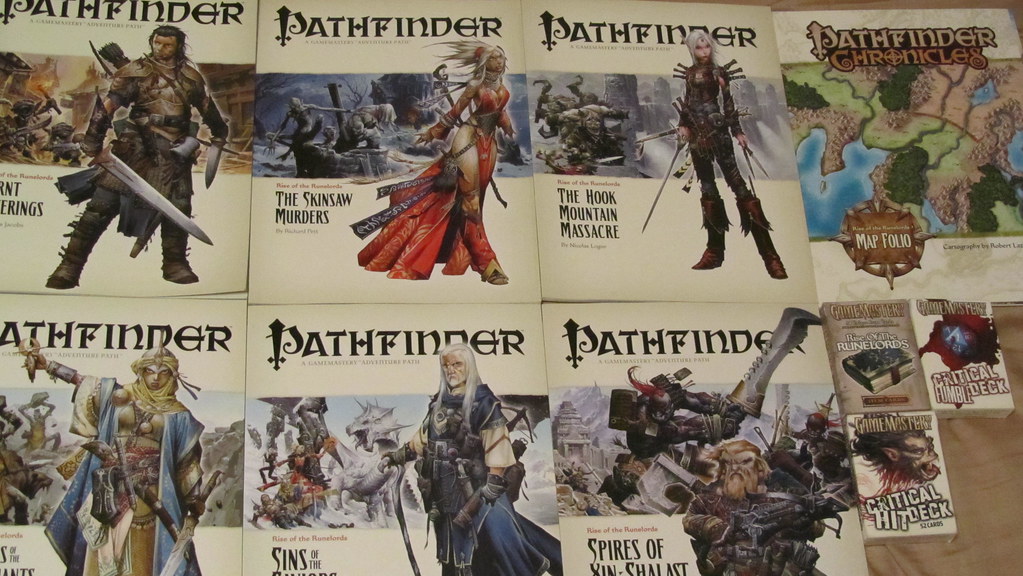
Rise of the Runelords from Paizo
I used to subscribe to Dragon and Dungeon when they were print magazines. When 4th edition was announced, there were problems for third party supporters. The OGL was being dropped in favor of a different license. In addition, although I don't think it was an issue at that time, WoTC own digital offering, for character generation especially, I think put a big block on any 3rd party player resources that might have come down the line.
Anyway, Paizo was starting their own stuff, in this case, Pathfinder. This is still using the 3.5 rule set as it was well before Pathfinder as an RPG was out.
I had left over issues from my subscriptions and allowed that to fall into the Pathfinder adventure path.
In the real world...
I've been working many hours of overtime but that was recently rewarded with a week off with no pay so that the company can post larger profits. Made me evaluate what's important to me and while I'm not putting running Dungeons and Dragons ahead of working, I'm not going to take work so serious from now on. This gives me opportunities to indulge my game master side.
Still, I will be working most Saturdays. It's not like the company said screw you and I decided I don't need that overtime, especially after having a week off, and decided to cut my nose off to spite my face.
So I find I'm able to work with a pregenerated adventure, especially if it's a pregenerated adventure path. I've already read the books multiple times so I'm pretty sure I'll have no problems running it. I also still have all my WoTC 3.5 books, so that'll be no problem either.
But why 3.5? I'm not some fanatic that thinks one edition is better than the other and that all other editions must be cast into the first.
For one, I like the fact that Paizo is supporting the setting. For me, WoTC dropped the ball here. Sure, we just got Neverwinter as a hardcover (way to screw that one up WoTC) and it's not a bad book but... it's a heroic campaign and it's set in a Forgotten Realms I don't like. That is a personal preference. I don't like what they did. To me, as a reader of the fiction line, right before 4th ed, they had done a lot of setup that would have made the Forgotten Realms an exciting place to adventure in.
Sembia falling under control of the Shades?
The Elf Kingdom starting to rise?
Thay becoming an undead nightmare land?
Dragons on a rampage that destroyed or damaged many towns or lands?
Now some might want to have some influence in those areas, and I agree, that would be great. But these are campaign changers that have made the world more unsteady. For the new setting, they took even bigger steps and allowed the players to partake in none of that . The fans of Eberron dodged a bullet here.
So on one hand, I like how Paizo is treating the campaign setting. Hell, in the new adventure path, they use material that was introduced in the first adventure path.
Next, Paizo did some fun stuff with goblins and ogres. The Paizo goblins have a standard all of their own and their use of ogres, making them into inbreeds that resemble something out of the hills have eyes, works perfectly.
In terms of adventure structure, add in the 'missing' Revenge of the Giants stone giant adventure, and we have a nice call back to earlier editions. It's such a neat call back that WoTC has decided to do something similar. Only about three years behind the curb here.
Next, well, I already own it. I'm familiar with 3.5. Sure, it can be a nightmare system when doing everything off the cuff or doing everything by hand, but I still own a ton of 3rd party material, all the official books, and the adventure path itself. I don't think I have to worry too much about my personal time being bogged down.
What about miniatures? While there is not a metal miniature for every encounter in Rise of the Runelords, I'm pretty sure we have more miniatures for this adventure path than we do for any WoTC adventure path. For me, this is baffling. When you run your own miniature division, how can you not tie the miniature production to the actual campaign material being written? I know that the miniatures have a long lead way, but it would not be impossible to provide details of what's coming on down the line. But to be fair, how can I expect WoTC to support the adventurers when they couldn’t' even support the core races in the Player's Handbook? "Dragonborn are hard to design!" Uh... you didn't know that they were going to be a core race and decided to put more elves, halflings, and dwarves as random figures in the set? Go WoTC! Ugh.
Last, and this is again, a matter of opinion, WoTC adventure writing lacks too much. For one, both the completed adventure paths they have, such as the printed one that started with the Keep on the Shadowfell or something, and ends with a brawl against Orcus, is using 'the old math'. Yeah, while there has been no .5 edition of 4e (which again I disagree with), the math of the monsters has dramatically changed and many other features have changed. Only post Essentials plays differently then only pre Essentials. The e-adventure, Scales of War, also lacked something. On one hand, I didn't want to print all that information out. On the other, it seemed more haphazard than any previous Adventure Path.
I was willing to forgive that because really, it was WoTC second effort at doing an adventure path after the printed one.
But... they're not doing any more.
WoTC has fallen into a pattern of not quite exclusive, but heavily focused Heroic tier support. This makes little sense as the platform of 4e was to include epic. Paizo at least acknowledges that high level play can be beyond any prewritten adventure and bows out at about 15th-17th level. WoTC decided to add another ten levels to the core and then promptly decided not to support said levels.
The recent campaign book, Neverwinter, is heroic. The recent boxed set Madness, is heroic. The Dungeon Master's Guide 3, which was supposed to cover epic, cancelled. The latest monster book, no epic foes.
Now this might not be an issue if characters gained levels in a manner similar to how they did in 1st and 2nd edition. It could take a damn long time, dozens of adventurers and many many gold pieces and magic items. In 3rd and 4th edition? A few adventurers will prop the characters right up there in levels. I guess after every three adventurers you're supposed to trash your campaign and absorb what WoTC is sellinng.
Now for those who have more free time than I do, this might not be a problem. 4th edition, to me, harkens back a bit to 2nd and 1st edition in that monsters are easier to craft. Encounters are easier to craft. Magic items, while sucking mightily in 4th edition, are almost optional and allow the players to focus on being the star and not the magic item.
And I'm not against 4e in terms of what was done with the system. I've played it and I've run it. I ran it when it first came out. I've run it at Game Day events. I've run it for different groups. I've played it numerous times.
Hell, maybe at the end of the day, I just miss a well-supported campaign setting that takes the old and standard and makes them new and exciting. Anyway, that's my thoughts for today. If anyone's interested in how the campaign goes, let me know and I'll see if I can post some post even plays here.
Friday, September 9, 2011
Okko the Cycle of Earth by Hub

The second book in the Okko graphic novel series, Okko, the Cycle Of Earth, continues the travels of the demon hunter Okko and his motley band of allies. The illustrations are strong, crisp whil still having tons of detail. The setting comes alive under the artist here and the feel of the setting is made clear through careful placement of little details.
The story line here works fantastic for a RPG and could be lifted whole cloth. In short, I highly recommend anyone running Oriental Adventurers, Legends of the Five Rings, or other manner of games where a little Samurai Sunday attitude is called for, look it over. This isn't to say that a standard fantasy game of Dungeons and Dragons couldn't swipe the plot by changing a few things.
The book starts off with an introduction to a city. The youngest of their group, Tikku, acts as our outsider. Because he is not well versed or travelled, his mentor must inform him, and through him, the audience of the importance of places and events going on around them.
For example, in the city they are at, it's a celebration for the first day of winter. Floats are carried on the streets, dragons manned by multiple people dance around, masks are worn and "every kind of outlandishness is allowed." We discover that Bakuyaku's nicnmake is "Black Poweder City" because the seven monastery range has a lot of despotis of the stuff around them.
Okko himself becomes involved in greater events by having a man seek him out and die in front of him from an assassin's attack. His ally, Noburo, seeks to hunt down the assassin, but during the celebration, the tightly wound city with all of its masked inhabitants makes this a difficult task.
In looking at such a set up for your own campaigns, this is one of the reasons its good to have a calendar of the holidays and what those holidays mean. If people are all out celebrating in the streets and the streets are crowded with floats and other obsticales, it can make for a more challenging race against individuals that are seeking to escape. It also makes things more colorful and takes away some of the 'generic' that some settings can suffer from as they all seem so similiar.
Now on the hunt for the assassins and for the person that was identified by the slain courier, Okko begins wandering the Seven Monstary Range looking for the Raven Mon. This allows the characters to learn about the setting and details of background even as they suffer some random encounters. It also provides some background on the senior monk as he used to be a student at one of the monastaries.
This is another useful trick when a player has information in his background about where he came from and what he did. Some players put it there for active use, some to just have a grounding part of their characters. the players will generally give you a good idea of what they'd like done with that information and pulling a little of it into the game when appropriate is never a back idea.
One of the things the monks encounter is an oracle who provides information, but that information relates to what they are seeking only on the very edges of that mission. This is a fairly standard method of providing some information, to not hand out the exact answers that are sought, but to provide perhaps more details to the overall scheme of what the players may be involved in.
Inthis instance, no search could be complete without visiting all seven monastary's, and only at the end, learning that "An eight exists, perched atop the roof of the world. There dwells an order of illuminators in their hands ap riceless collection of books! nly the powerful and the prvileged few have access to this immense source of knowledge... or even know of its existence..."
That bit right there does a few things. It takes the knowledge that is commonly known, that there are seven schools, and expands it. It then names the location, the location of which, is known to their guide as "oneo f the highest mountaints known to man! I know none fool enough to dare is heights. And I do not know the path." This bit of player knowledge is like having a player talk about a demon inhabited realm or a blasted wasteland. It may add a little more inherent danger in the trip, but overall, it's not going to stop the players from going there.
Here though, the author provides some hope in the form of the Sanctuary of the 47 Geysers. By placing these unlikely found but named locations throughout the book, the author is cementing the setting. By allowing the players to visit these locations that are few and out of the way, he is providing color and character to the landscape. This is a useful trick for any game master and not every encounter has to end in a fight. The wonder of the setting should also strike the characters as much as the monsters.
When Okko does meet the samurai that the courier died trying to name, the meeting is like oil and water. Okko, being considered a ronin and an outsider of the standard civilization of his time, is not necessarily respected in the manner that other Samurai are. This happens in role playing games all the time as adventurers are generally not land owners and only have themselves to be responsible to. This allows them to do and say things that might get say, a farmer a trip to the gallows but to which an adventurer might reply, "Do you really want me to kill the garrison and leave you vulnerable to the giants in the area?"
When the whole group comes under attack, the monk is taken out in the first volley of the assault. This is something to remember for the Game Master when playing monsters that have intelligence or tactics. In pre-4th edition games, the wisdom is go for the spellcasters. Nothing like a group of fire balls or turning efforts on the undead to quickly undermine a horde of minions and monsters. To counter this, don't act like the monsters are stupid. If a lich, an undead spellcaster, is among the villains, he's going to know exactly how powerful an opposing spell caster is and want that creature dead.
Eventually, when they do find the forbidden libraries, they discover that they are there too late. The library has been ransacked and its men killed. What they learn though, is that their enemies started off as healers but seeing the land plunged into such deep war, decided that they should be the ones to rule as they could, using their forbidden studies, control the dead of all the clans. With the land in such a constant state of warefare, they are not left wanting for raw supplies.
This is part of the appeal of running a campaign during a time of trouble. If everything is normal and the characters are merely looters, then their overall impact on the setting, as great as it may be, is one of the outsider. If on the other hand, the setting is alive and thriving with its own series of conflicts, things that no one adventurer will be able to solve, then it allows them to gather into different places and impact the setting in different ways. They are not necessarily merely dungeon crawling, but choosing sides in a multi-angled war. If they choose to do so. After all, with so many dying on the battlefield, that just means more empty castles for looting right?
The whole thing comes to a conclussion as Okko and his allies hold down an old fort against the legions of undead and their spellcasting masters. It has very much the feel of a Seven Samurai, a group of skilled individuals against a horde of nameless enemies. Okko and his allies are only able to claim victory though the use of a surgecial strike against the leaders of the undead.
Which is something that the Game Master has to look out for. Unless you're dealing with a group of brand new players, the characters will often go after the puppeter, not the puppets. You have to be ready with appropriate challenging counters if the villains are clver enough to have them. If your bad guys aren't expecting a scrying, teleportation, assassination attack, then you're not playing at mid-high levels of D&D with thinking villains. Prepare and defend appropriately, but don't provide everyone the exact same type of defense. Vary things up. Provide differences.
Okko the Cycle of Earth provides investigation, strained alliances, exploration, and combat against dark masters insistant that their rule would be better for the land then those currently ruling.
Wednesday, September 7, 2011
Character Archetypes Inspired by Blue Gender
On ye old Netflix, I'm watching the 'classic' anime, Blue Gender. In honor of this watching, I've decided to give some half assed thoughts to what I see as two archetypes that I've seen in a few different situations and genres. Let me know if this is something a reader would like to see more of, or perhaps more random babbling from the various viewings and readings.
The Out of Time Character:
In many different genres, a character can become locked in time. In many instances, this character can be a default 'standard' viewpoint character. In Thundar the Barbarian for example, there are instances of people from pre-Cataclysm Earth that Thundar runs into. In Blue Gender, Eugene is another such character. He suffers from a disease and is placed into a sleep that allows him to bypass the Blue invasion. In other settings, such as those written by David Gemmell, a whole race of warriors is set in stone so that they may be called forth when needed to fight an invasion by an old foe.
Such a viewpoint character often fits the standard of where they come from or what the rules and or time of the genre may be. For example, in a setting taking place in an Oriental Adventure setting, the character may be a Westerner whose outlook and equipment is familiar to those who read Knightly tales or standard fantasy. In a Vampire or other setting where the characters are monstrous, the character in question may be new. The path of the character is to discover what they are in relation to the setting about them.
They judge others around them by the manner in which they used to. It may take them some time, if ever, to accumulate to the new setting and or situation that they find themselves in. Such an archetype is useful for new characters or new players who may not be familiar with the current setting or game system. A potential problem such individuals may have, is adapting to the current weapons and armor of the setting. For example, while a sword may just be a sword, a blade like the Sunsword in Thundar might be quite different than one a standard character is used to. In some instances, such a time displaced characters may not have any weapon skills to call upon.
When such a character is offered the chance to return to the womb, or to return to the simpler times, they often pass on it. They've already lived that life, already done those deeds. This is a new life and a new time and even though it is challenging, they accept where they are.
The Doomed Soldier:
A professional by trade, the Doomed Soldier is a stoic individual that doesn't complain. They are often highly skilled in their field and while not necessarily boastful of it, they have no problem demonstrating their skills to others. They have little use for those who don't follow orders, because in their experience, those who do not follow orders tend to die and often times, wind up taking other members of the crew with them. In terms of respecting those they work with, they often only have a great degree of respect for those in a similar outlook to themselves, especially if they are part of the same organization.
The Doomed Soldier doesn't necessarily have a problem making allies, but making real friends on the other hand, is difficult. In their experience and history, it just isn't worth the time. They know that most people they associate with and ally themselves with, will in time, through circumstance or situation, perish.
They do not hold themselves above such a situation happening to them, but worry that due to some failure of their own, they may cause others to die. This is something that the Doomed Soldier struggles against with every fiber of their being. Others perishing because of their own inability to follow the rules and existing structure is bound to happen but under their watch and under their control? Never.
Despite their outlook of death being perhaps inevitable, or perhaps because of it, they have no problem enjoying the sensations that the world offers. This could be as simple as a fine meal, or satisfying other physical needs. Their theory is that because they could die at any point, weeks, days, or minutes from now, they should take advantage of life when they can. This pleasure seeking however, never interferes with the mission.
Doomed Soldiers may not necessarily start off with such a pessimistic attitude but may gain one through game play and suffering through difficult times that tend to stretch on for years at a time.
Subscribe to:
Posts (Atom)


