Friday, November 4, 2016

Stagecoach (1939)

Continuing my Criterion Collection viewing before they leave +Hulu , next up was Stagecoach. It's not a movie I would have picked originally as while I do enjoy westerns, my enjoyment of the Criterion Collection is usually through their Samurai films.

But I'd heard rave reviews for years about Stagecoach and decided to pop it in.

What a rewarding experience.

First, if you're a young person, you should occasionally throw on an old movie, and I don't mean from the 80s, I mean from the 50s, 40s 30s or earlier. You should do this just to see what life was like in the days and times. The vernacular, the clothing, the attitudes, no matter what the people on stage are trying to portray, are the elements of the time the films were made.

Stagecoach provides the viewer with a brief meeting with nine individuals and their travels aboard a stagecoach. Each one with their own motivations for being on it. Each time they board it, they are in a dangerous territory and the resources protecting them grow fainter and fainter until they are all alone.

There is a lot going on and most of the characters get several moments to shine.

Much of it would still be relevant in today's society. For example, When Doc Boone tells Peacock that he served as a doctor in the Union Army during the "War of the Rebellion," Hatfield quickly uses a Southern term, the "War for the Southern Confederacy." The "wounds" of the war were still relatively fresh when this movie was made. You look around today and it seems nothing has changed.

The banker, Henry Gatewood, tells everyone how everything should be done. Loud and boisterous in demeanor acting as if his words were the words of the people. Until it's revealed that he's a thief, and unlike modern bankers, goes to jail. Well, I suppose modern bankers who, like he did, steal from the bank, would still go to jail... It's a huge flag of the hypocrisy of "I'm better than  you." even though, you know, he's not.

Another citizen, Dallas, is a prostitute who's been driven out of the city by a collection of righteous women under the organization "Law and Order League". So smug and satisfied with themselves that they can't wait for her to leave. 

The culture clashes abound as Dallas finds some sympathy with Ringo, played by a very young John Wayne here. As an escaped outlaw, Ringo's use for social classes is negligible. He treats everyone like people, responding to aggression with aggression for example.

And there are other bits. For example, Geronimo. His name holds sway over the entire trip like a powerful harbinger of terror. His mere name alone enough to cause men to tremble.

The variety of nationalities is present too, as when in one town, a Mexican is married to a Native American and notes that it's safer for him than for the others as he's already in the "family". Doesn't work out too well for him when his wife leaves and takes his possessions, including his prized horse who, it turns out, he loves and values more than his wife!

With the tricks of the trade in filming today, Stagecoach is ripe for a modern day remake. A full-color version that could capture the rocky plains, that could capture the rocky buttes , the isolation between towns and that last seat clenching battle as the Apaches and the Stagecoach riders fight tooth and nail against one another for survival.

Stagecoach has a variety of great characters that make great models. It has a variety of great scenery that can be inspiring. It has cultures clashing and numerous viewpoints coming together and falling apart in waves with no clear resolution.

Catch it before it leaves Hulu or on Blu-ray.


Thursday, November 3, 2016

Cronos (1993)

With the Criterion Collection leaving +Hulu soon, I'm catching up on movies I haven't seen in years or haven't seen at all.

Cronos, a film by Guillermo del Toro, better known for Hellboy and other "weirdness", was next on that list.

Short review? Set in the modern era, an old man, Jesus Gris, in charge of a shop buys an old statue that contains an odd device. The device belonged to an ancient alchemist who'd crafted the device to grant eternal life. Unfortunately for the alchemist, that didn't include being crushed and vital organs pierced! Hence the alchemist items wind up for sale and this statue winds up in the old man's shop.

The story follows what happens when someone else seeks out the item and what happens when you play with ancient secrets without the instructions. It's not Guillermo's strongest work but it's a solid film and is worth viewing.

For role playing games, it brought to mind two bits.

1) Jane Stop This Crazy Thing! Jesus initial exposure to the device was accidental. Future exposures were deliberate. He does this without knowing what exactly he's doing and he suffers quite a bit for it. In post-apocalyptic settings or fantasy settings with their share of weird technology, don't be afraid to throw negative side effects into the game when players don't' bother trying to learn how to use an item.

2)Origin of the Species: The villain of the piece, the recluse and wealthy De La Guardia, notes how wonderful insects are. How versatile they are. He compares the miracles of Jesus to those of insects. But the device itself? The one crafted by the alchemist? Well, it grants you immortality, aging wise at least, by forcing the immortal to drink human blood.

It's a wonderful play off of the vampire origin and could be a fantastic way to do things in a role playing game. Forget getting bit by a vampire. Forget necromancers and their rites. It's a bug. A huge weird bug that lives in symbiosis with the user.

Keep an open mind when you're watching movies, reading books, looking at comics, and listening to others. Inspiration for thing different strikes when you least expect it.

For those readers with Hulu, any recommendations on the Criterion Collection? Any favorites? Any to avoid at all costs?


Wednesday, November 2, 2016

The Seventh Seal (1957)

The Criterion Collection is leaving +Hulu . The Halloween season is upon us.

So The Seventh Seal seemed an appropriate movie.

For those who've never seen it, you should. Highly recommended.

It's one of Ingmar Berman's masterpieces. A crusader, Antonius Block, returning home from 10 years of war in the Crusades, during the time of the Black Death, is weary of spirit and sees a personification of Death who has come for him. Here we see perhaps the first use of Death playing a game to delay the inevitable.

This methodology was put to great comedic effect in Bill & Ted's Bogus Journey. I'd forgotten when I saw Bill & Ted's Bogus Journey, that they cribbed even the look of Death from The Seventh Seal.


As a personification, Death here is, well, mild. He knows he has all the time in the world. He plays with Antonius and is in turned "played" by the crusader, but the viewer never knows if those plays by Antonius are successful or just Death allowing them to appear such.

As a personification, it could be "higher" than the Gods in a standard fantasy campaign. It doesn't need to be malicious like Bhaal or other Death Gods tend to be in the Forgotten Realms and Greyhawk. It's just something that happens.

Antonius Block is an interesting character if one were to look for inspiration for role-playing traits and motivations.

The later leads into the former.

Antonius is tired of NOT hearing God. He's always questioning. He's always seeking that big truth. He seeks it from Death, who remains silent on the matter. He seeks it from the Church, which provides no answers. He seeks it from fellow pilgrims and travelers. He is always questioning the overall purpose and arc of life itself, of his life itself. This questioning provides a tragic frame to Antonius, much like Warlock from Marvel Comics or Elric, seeking to fight his nature but being trapped in the world, must eventually yield to it.

His squire, Jons, is a man of the real world. He knows what life is and it's not happy. Described as a nihilist, he nonetheless isn't evil. He saves a woman from being raped and killed for example. He sees evil being done and would rise against it to another woman condemned to die as a witch. He merely sees things the way he thinks they are and is frank about it. This stoic nature makes him a great contrast to his seeking master.

There's also the setting. The Black Plague is everywhere. People die from it frequently. It's referenced as the end of the world. It sets the stage for a death that cannot be reasoned with. Cannot be bargained with. A death that strikes noble knight and lowly leper with equal ease.

Then there's the background of where the knight's coming from, the Crusades and 10 years of war. During the trip back to the knight's manor, Jon finds the priest who convinced his master to go to the Crusades in the middle of stealing from the dead and about to rape and murder a servant girl. Jon is not happy. His master's demeanor changed by the horrors of war and he lets the fallen priest know, should they meet again, Jon will mark the priest so others know what a liar and fiend he is.

These huge events, the Black Plague, and the Crusade, showcase how vast and uncaring the world is. There can be several things going on in your campaign at the same time and they should all have an impact to those that must experience them.

There is no raising one's hands and begging enough. There is no exception for already having suffered from one calamity. There is just life and the events that must be endured.

This is a movie I could watch again and again. The black and white filming, the nature of the questor and his stoic squire, the background characters, the threat of plague, the damnation of a man spent 10 years in war... it's all powerful stuff and well told.


Saturday, October 29, 2016

Scanners (1981)


I found out that the Criterion Collection. is leaving +Hulu.

It's also almost Halloween.

That means time to watch some appropriate holiday movies.

One of my favorites, one I saw in the theaters as a preteen at 10, was Scanners.

Scanners offer a lot to both Game Masters and Players.

For Game Masters


1. Plot Twists: Some of these are cliche, but they are cliche for a reason. That reason? Sometimes they work. For example, imagine having a mentor for your character that turns out is his father? Imagine an arch enemy that is your brother! What a shocker!

2. Organizations: The bit in the movie that quickly gets overlooked, is that the "Scanner" program was designed as a weapon program and during it's initial viewing many high-end buyers, six individuals killed, one quite spectacularly.


In almost any modern day setting, that would cause quite a stir. In the modern Marvel Universe setting, or any role playing super hero game using the modern setting, there would be a quick search into the matter.

How did this happen? What's the origin point? Are there more of them?

For Players

1. Character Outlook: When first found, the protagonist is living in the street. Unable to fend for himself. His powers are too strong and they cannot be shut off. Typical telepathic problem. But there are other "Scanners" and one of them, after trying to kill his family, has been "rehabilitated by art".

The art this scanner creates is dark and disturbing, often dealing with multiple entities around the skull or with thoughts exploding out of the brain.

What is the mind status of a non-normal character? If you're in a Dungeons and Dragons setting and are a psion, how do you perceive the world about you? Even if you're a lowly fighter, is it more of a Jason Bourne thing where as soon as you enter the room you've objectified everything into ways on escape or ways to kill?

2. Limitations: When first introduced, the protagonist HAS to have a drug to suppress his powers. This leaves him vulnerable. In some game systems like Champions and GURPS, you would buy advantages and disadvantages to represent this about your character. In other games, it becomes a GM ruling. What about limitations makes characters more interesting? It makes them vulnerable.

Even Superman has weaknesses after all.

Scanners isn't high art but as one of David Cronenberg's early films, 1981, it is worth watching.

3. Unlikley Powers: There's a scene in the movie where the hero of the movie connects his brain to the
"nervous system" of a computer. Well before hacking was a thing. But how would ESP or
telepathy in the normal sense of the word allow that to work? The Game Master or Player could
easily rationalize it that the powers Scanners have isn't based on telepathy. It's based on control
of reality and that their true limitations are that they only do what they do, because that is the
traditional use of their powers. Only when pushed or when something out of the range becomes
needed, do those powers actually come to a head. The old marvel character, Phoenix, after all,
could control reality with her powers.

For others looking at the Criterion Collection leaving, what movies do you recommend? I've
got the Samurai films on lockdown but am fortunate enough to own most in DVD/Blu-Ray format.

Thursday, October 27, 2016

Monster of Frankenstein


Marvel Comics has done more than super heroes for decades. The Monster of Frankenstein takes the old legendary monster and his creator's tale and brings it into the Marvel Universe. This collection includes issues #1-#18 of Monster of Frankenstein, Giant Sized Werewolf by Night #2, the Frankenstein portions of Monsters Unleashed #2, #4-#10, Legion of Monsters #1, and even Marvel Team Up #36-#37.

That's a lot of Monster.

At first, this is done in an independent fashion. The tale starts with a search for the Monster. As the search is conducted, the leader is telling the "original" tale from the novels with a few tweaks here and there.

But this being a monstrous tale, it's also a tale of tragedy and death follows where the monster walks leaving him the only one of the original issues alive.

At the end of that, the Monster is alive and aware but is still out of time. During that period, he fights Dracula, among others, and encounters hatred in many forms. His appearance causes those about him to be frightened.

Interestingly enough, this take of the Monster is intelligent. He can initially speak, but after battling a vampire minion of Dracula and loses his voice for several issues. Probably an homage to the old movies.

In many ways, it's very much a Silver Surfer tale if the Surfer was prone to bursts of murderous rage that was actually carried out. When John Buscema takes over some of the penciling, it's even more mirrored.

This collection includes all of the comics, several of the horror magazines with fantastic black and white artwork. It is during the black and white period, that Frankenstein is pulled into the "modern" era.

Much like Captain America, the Monster goes into a state of suspended animation and can bypass decades at a time.

And the art? On those magazines? No one can say they're not getting their money worth when they can see those pencils and ink work of John.


Most of those told tales, though are self-contained. They don't "hit" the Marvel Universe properly until we get an encounter with "Werewolf By Night"


That's an old take of a classic where the traditional "monsters" wind up meeting and fighting each other.


But that was still a 'corner' of the Marvel Universe, it's not until we get a few issues of Marvel Team Up, an old title from Marvel where Spider-Man would monthly meet different heroes, that we see the Monster in full in the setting, done up by Sal Buscema no less.


Marvel and DC have both had their use of the Monster and while I think lately DC has done a better job with the character, this collection, at least now, was a very reasonable $3.99 and for me, the black and white artwork alone was enough reason to put down the money.

In this Halloween season, The Monster of Frankenstein makes for appropriate reading.

Monday, October 24, 2016

Mad Shadows: The Weird Tales of Dorgo the Dowser by Joe Bonadonna


Mad Shadows, The Weird Tales of Dorgo the Dowser, is a collection of short stories, told in chronogical order, of the adventurer Dorgo. He is known as a Dowser for the stick he carries.

In short, if you're looking for a mix of "old school" fantasy writing with a dash of noir thrown in, Mad Shadows is a great fit for you. While I was reading through it, I kept thinking how sword and sorcery it was, without being a Conan pastiche.

After I had finished, looking over the afterword, it was cinched. The author is a fan of other authors like Raymond Chandler and David C Smith. The latter might be unknown to audiences of 2016, but when I was growing up, he wrote blood-soaked tales of barbarians. Sadly, Oron and other tales are not available in Kindle format (yet) so I'll have to hunt down some works next time I'm at the half-priced books.

The author describes his style of writing as gothic noir. Fits well enough in a fantasy world where magic is a thing but isn't magic of the high or epic nature you'd see in say, The Wheel of Time or a Forgotten Realms novel.

The world Dorgo inhabits is a bit of Thieves World in that his city is "the city" in a way. It's a corrupt place where officers try to guard the inhabitants against bad things, but there are so many bad things that they are often forced to seek specialized help, such as Dorgo himself.

The people of Dorgo's world range from a variety of human ethnic nationalities to minotaurs, cyclops, fauns and others, but no elves who are seen as mystical. Now that later part may just be language as just because we haven't seen any elves in this volume, there are no elves in the setting at all.

Dorgo is a bit of a hard luck loser regarding his character. It's not that he's incompetent but unlike many modern heroes, he lacks the ultra competency in one field that allows them to dominate. He's a former mercenary in an army, and while he can hold his own with a sword, he's not a devastating swordsman.

He's not a magician or priest, but his dowser rod allows him to identify things of a magical or mystical nature. His upbringing in a church-sponsored orphanage gives him knowledge of the religious realm.

In terms of this being "old school", In The Vale of the Black Diamond could be a Conan tale.

There is a quest for a fantastic item.

The item is in a lost or forgotten part of the world.

The flora and fauna of this type of the world are alien and otherworldly.

The item is a power source for an ancient alien race beyond human keen.

The alien race is monstrous and has breed it's own slave race, one which rebels against its master.

Almost all of those who go on the expedition perish horribly.

Now Dorgo himself isn't Conan and suffers many a beat down in the tale. In a true Conan tale, EVERYONE but Conan would die. In some instances, the alien race would've been beaten down by cruel humans whose stolen their magics for their own. But you get the picture. The nuts and bolts of a Robert E Howard story are there just with different lens and it works fantastically.

This volume collects six short tales. If you've picked it up and enjoyed it, which was your favorite tale? Hit me up with a comment.

If you're a fan of that older school of writing and want to see some new tales, or at least some old tales with new characters and settings, Mad Shadows should be on your list.


Sunday, October 23, 2016

Thor: The Goddess of Thunder


Thor: The Goddess of Thunder, collects the first five issues of the new female Thor. I'm one of those readers who tends to buy comics electronically when they're on sale. This volume was on sale recently for $3.99. I've heard a lot of the grumbling about it and figured for that price it was worth a look.

Depending on how long you've been a reader, how old you are, and a host of other things, you may hate the whole concept or sit back and enjoy the ride. I'm a tiny bit of the former and a lot of the later.

The whole thing starts off from a few years ago with the forgettable Original Sin. That was where Nick Fury had all the secrets of the Watcher and he acted as "The Man on the Wall" to protect Earth from aliens. A huge retcon.

But Whatever...

During that time, Nick said something to Thor that made him unworthy to hold his hammer. Some time later, the new series, The Goddess of Thunder, kicks up with Thor being unable to lift his hammer. Leaving it on the Moon where it last was.

The author sets up the return of Odin who immediately is portrayed in a negative fashion in several ways. His general rudeness, his hostility towards his wife, and his bringing of the fold of his previously unknown brother, the Serpent, into the ranks of power, make him instantly unlikeable.

Remember, the Serpent is from another older storyline, Fear Itself,  where this previously unknown brother actually KILLED Thor. So yeah, the whole bit there stinks. I kept expecting the Guardians from Green Lantern to show up and be like, "Damn Odin, you make us look good!"

Seriously, Odin is just unlikable here. The only good thing? When he talks to the birds. "I should have baked you into a pie" he pipes at them in one scene.

So Odin is angered that Thor can't lift the hammer and decides to show his son how it's done. In theory, this should work perfectly.

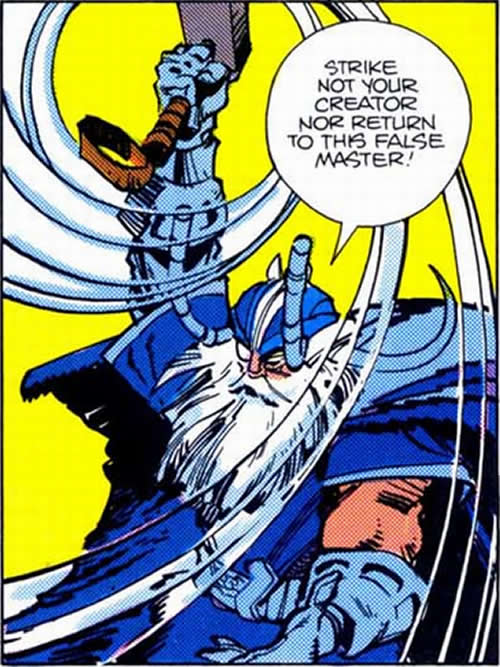
At 44, I've been reading Thor since the late 70s when comics were like a quarter. As I grew older, we got to see Odin do all sorts of things. One of those bits was in the famous Walter Simonson run. Beta Ray Bill has taken the hammer of Thor and been transported to Asgard. Beta Ray Bill is unphased by this and attacks the All-Father with the hammer!

The All-Father catches it.


But hey, it's comics, right? The enchantment could have changed. After all, Thor bound some of his life  force into it with Doctor Strange's help at one point no?


 So what happens when Odin goes to pick up this "new" hammer? Not much.


In terms of the new hero being called Thor?

I see it more of a title at this point than anything else. She wouldn't be the first person called Thor that wasn't the Odinson, she won't be the last person called Thor. After all, we've seen a Thor from the future who wields the hammer.

But not everyone sees it that way. The Absorbing Man probably speaks for more than one person when he battles against the new Thor.


I think the authors enjoyed 'baiting' what they considered trolls but I get the issue. Even with the new star of Iron Man, she's not called Iron Man. But again, it's best to think of "Thor" as a title.

One of the things that may annoy some? The hammer shows itself to have better grace, finesses and well, power under the new Thor than under the Odinson!


Some may see this as nonsense!

But it's actually part of a long established bit to showcase how powerful a character is.

Happens all the time.

If you've read anime or manga, check out Dragonball. Remember when Demon King Piccolo was a top tier villain? Then when it was Piccolo that was a top tier villain? Then it was Vegeta? And every time a new enemy shows up, they usually wind up putting the beat down on one of those old top tier characters.

Marvel used to do this by taking out someone like the Wrecking Crew of the U-Foes and showing how dangerous some new character was. God, they need people to develop some new enemies for the heroes to fight.

Anyway, some people don't like the hammer showing more power for the new Thor, but to me, it's a device well worn and used in many forms of media.

I'm actually more upset by Thor losing his arm. Not being able to wield his favorite hammer, Thor picks up his Celestial killing battle ax (introduced in Uncanny Avengers first run!) and the first thing he does is get his arm cut off.

Odin has the dwarves forge him an arm out of black uru.

This bugs me for a number of reasons.

First, you don't have the luxury of saying, "Well, it's Marvel Earth, but it's still Earth, they can't just regrow his arm!"

It's Asgard! Super science would regrow that, or Odin could just sigh and do it.

But instead, we have to get this stupid thing.

Hey, Odin, why not Tell Thor, "Hey, remember when after your whole Disassembled thing you came back and were smart enough to wear armor? Yeah, since you don't have the hammer, maybe you do that again? Or did you like it so much when Hela gave you that curse and you were forced into sending your soul into the Destroyer that we eventually go that route again?" Mind you we got some cool designs out of it in terms of Thor's armor but man...

How about, "Thor, I love thee, but thou are as smart as a jack ass. I have had this armor of black uru forged to protect thy remaining limbs."

In terms of the new Thor's action sequences, her integrity, her dedication to the cause? The 'readability' of it?

Thumbs up.

Her battling against the Ice Giants, her vocabulary, which is cribbed from Thor's old methodology of speaking, her working with Frigga? Her fight against the Odinson?

All thumbs up.

In terms of Odin, Thor, and the whole "men evil" vibe, or at least "men stupid" vibe? I'm hoping it's lazy writing and Marvel comics is like, "Oh man, it was the Serpent controlling Odin all this time!"

If the other volumes go on sale I'll gladly check them out but as currently, I'm just a poor boy from a poor family, I'll be reading other comics that hit the sales rack.

How about everyone else? Like it? Hate it? Want to see something else? Looking forward to seeing the Odinson in his own split off title where he hunts down the Ultimate Thor's hammer?