Wednesday, January 22, 2014

The Kindle Strikes Again

Not that long ago, Amazon.com had a nice sale on their kindle books. It includes some books on history and computer programming that I was quite to buy. If funds were permissible, I would have bought more.

Turns out Amazon.com must have enjoyed the sale as well because they're doing it again. I was disappointed thought that the pickings didn't seem quite so good this time, although I did find a few books that weren't in the sale that were also inexpensive so I'm throwing some links to them as well.

The Last Kingdom Bernard Cornwell : I enjoy a lot of Bernard Cornwell's historical materials. This is one of his 'Saxon' tales and it's running for $2.99 on the kindle format.

The Burning Land Bernard Cornwell: Another book in the Saxon tales, and this one for only $1.99. That's a good deal.

The Winter King Bernard Cornwell: This is Bernard covering King Arthur in a historical style and context. I blogged about it and enjoyed the trilogy.  $2.99 in kindle format.

The Books of Blood - Volume 1 Clive Barker wrote some great short stories here and I've owned a few versions in paperback. I skipped out on this one though because I have a Kindle and you can borrow it. Otherwise, in kindle format it's $2.99.

The Greek Myths Robin Waterfield looks to be another solid book on Greek mythology. I haven't read this one yet. Listed at $1.99.

After Tamerlane John Darwin a book focusing on empire building after 1405. I keep meaning to get back to it as I've had it 'forever' it seems. Currently going for $1.99

There are several other books that look interesting, but I'm afraid I haven't gotten halfway through the books from Amazon.com last sale.

Did anyone pick up anything from either sale particularly worth reading? Good stuff? Overpriced even at $2.99?

Tuesday, January 21, 2014

City of Sorcery by Marion Zimmer Bradley

Rare is the time when I’ve read a book with more titles and subtitles. I think this is just ‘City of Sorcery’, written by Marion Zimmer Bradely, but it’s also got the Darkover trade dress and under that The Renunciates (Free Amazons).
This copy is from 1984 and comes in at $5.99. I’m sure most paperbacks these days easily hit the $9.99 mark. I bought it from Half-Priced books, off of the dollar spinner racks. It was well worth the dollar. Looking over Amazon, it’s only available from third party sellers at this time, with no Kindle version. Now that’s a shame as one of the things I’d love to see e-books used for, is the restoration of so much of the ‘lost’ fantasy books that fail to stay in print.             
If you’re looking for a fantasy book with some science fiction elements, the Darkover book should hold your attention. If you’re looking for a fantasy book with a lot of strong female characters, City ofSorcery again has you covered.
I haven’t read any of the Darkover books in easily twenty years. I was never a huge fan to begin with but do remember reading a few of them and just never getting into it or keeping up with it. For its time I assume it was successful due to the sheer number of books in the series.
The majority of the novel tackles exploration of the ‘Hellers’, an unexplored region of Darkover. This exploration takes the form of fighting the elements, fighting against fatigue, fighting against altitude, fighting against a village where strangers are welcomed, and then drugged to make the murder of them easier.
Depending on the game system you’re playing, this could be a fun thing or a terrible thing. One of the things I loved about 3rd edition, and the OLG, is that it allowed settings like Midnight from FFG, to flourish. There were a lot of fantastic elements in the dark fantasy game, and fighting against the elements just for survival was high on the list.
But that was my least favorite aspect of the game. I didn’t want to take subdual damage or have to keep track of it or have to keep making saving throws or customize my character just to survive the wilds.
On the other hand, games like The One Ring, do a fantastic job of providing some penalties for failure to make a ‘travel’ skill check. It uses a few roles that have to be filled and these checks can be complicated by failure or rolling the ‘eye’ on the d12. The results of failure vary but can include losing health to encountering monsters to added travel time.
This matches well with the movies where the journey is often one of the more dangerous aspects of the characters trails. In City of Sorcery, there is a ‘big bad’ at the end, but her powers and abilities rely on having those around her to carry out her will in addition to her own knowledge base and powers. While she’s a danger to the characters, she’s not necessarily as terrible as the trials that got the characters to the location to begin with.
I find that 4th edition Dungeons and Dragons, with its skill check system, also allows a great deal of ability to customize the travel times as well as the meetings between characters and leaders of towns.  This is another strength of The One Ring where important meetings between the characters and NPCs to gather information is easy to play out.
 City of Sorcery is not heavy on action, is not heavy on sword and sorcery, but is heavy on character and exploration.

Monday, January 20, 2014

Look what's shipping: Premium Original Dungeons & Dragons Fantasy Roleplaying Game (D&D Boxed Game)

As a certain Professor would say, "Good news everybody."


In this case, my Amazon order for the Premium Original Dungeons & Dragons Fantasy Roleplaying Game (D&D Boxed Game) reprint of the original, or at least some of the original Dungeons and Dragons material, has shipped.


I know a lot of people put in orders to Amazon for this product and were annoyed, at best, with the numerous delays.


For me, I had the opportunity to cancel. I know a few people over on RPG.net did so and ordered it from Barnes & Nobles online and have already had it for a week or more.


But since my playing schedule is erratic at best, I didn't see any need to make a big deal of it. If it shipped, great. If it didn't, I could always save the money.


For those who don't know what's in this reprint, taken from the Amazon page itself:


A premium, deluxe edition of the Original D&D® "White Box"!
It's the original Dungeons & Dragons game, packed with more content than ever before.

The original Dungeons & Dragons boxed set was published by TSR, Inc. in 1974 and was the very first roleplaying game, introducing concepts that have persisted throughout later editions. It included three small rules booklets in a white box.

This deluxe, premium reprint of the original "White Box" features new packaging and includes the following seven booklets:

 Volume 1: Men & Magic
 Volume 2: Monsters & Treasure
 Volume 3: Underworld & Wilderness Adventures
 Supplement I: Greyhawk
 Supplement II: Blackmoor
 Supplement III: Eldritch Wizardry
 Supplement IV: Gods, Demi-Gods & Heroes

Each booklet features new cover art, while the interior retains nostalgic original art. Booklets are packaged in an engraved illustrated wooden storage case.


So for those who kept their orders at Amazon, have you got a shipping notice yet? Are you looking forward to having it as a bit of nostalgia or are you going to play with the rules? For me, it's definatly nostalgia. My limited time and my friends bouncing from system to system makes it difficult for me to schedule something like this in when they're chomping at the bit to run Numera and other new games.

Sunday, January 19, 2014

From Ashes to Ashes to Diamonds

I enjoy reading a variety of things ranging from discovering underwater cities in the modern era, to discovery of mass graveyards due to drug wars and other bits that might be considered either morbid or useless.


I do this because they are fuel for the imagination. You either have precedent for something happening, or you have new information coming to light.


Among the resources I follow, is good old NPR.


Their latest article discusses turning human remains and ashes into diamonds using a process similar to that used by the earth itself.


I can't imagine any roleplaying game that doesn't automatically have potential for such a thing.


In modern and post modern games, like all remains of loved ones, the objects become objects of worth not necessarily based on their monetary gain, but their sentimental gain. Depending on the wealth of the individual making the stone, there could be real value involved with it.


Players in a Cyberpunk 2020 game could be hired to retrieve such a diamond or steal one.


In a fantasy game, it should be obvious that there are a ton of possibilities for such a use.


For example, what if this was an old preservation process? Imagine a ten thousand year old diamond found that contains the remains of a powerful sorcerer or warrior whose techniques made him invincible on the field. Perhaps the forging of people's ashes into this type of diamond negates the aging process for things like raise dead or resurrection spells.


There are other potential uses such as ioun stones. Perhaps ioun stones are actually made in this method using different types of creature's ashes.


Other magic items could be applicable as well. Anything that is a gem could be forged in this manner.


Cursed items? What if a lich uses such a stone as his hiding place? What if a gem is haunted by a ghost or some other type of malign intelligence?


Diamonds just went from being 'only' a rare piece of jewelry to potential magic.

Saturday, January 18, 2014

English Longbowman 1330-1515

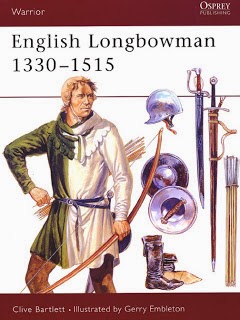
English Longbowman 1330-1515, written by Clive Bartlett and illustrated by Gerry Embleton, is one of the Osprey Publishing Warrior series that has seen print on and off through the years. Strangely, the book is currently out of print and I didn't see a Kindle version available from Amazon.

I tend to enjoy this smaller book by Osprey because they tend to have great artist, and the writers tend to put a lot of diverse information, not all of it necessarily with laser like focus on the actual subject but of the time period itself.

The front cover is a combination of pieces from the interior with the left side archer being one of two archers in the actual picture in the book, and the equipment on the right being roughly half a page worth of equipment from a two-page spread of archer equipment in the interior. If you enjoy the cover, you'll appreciate the interior. Gerry Embleton has a nice 'realistic' style.

Gerry does several internal illustrations that bring to life the subject matter in a wide variety of scenes. In one, the archers are practicing their craft. In another, English Longbowmen are fighting their German allies. According to the plate information, this happened from time to time because the German forces wouldn't listen to anyone else.

In another one, soldiers catch a bowyer making bows after dark. And this is forbidden because quality may suffer. In the dark ages before modern electricity, working in the dark was not conducive to quality materials and goods. As these were weapons made for war, it was vital that they be at their highest quality.

The other nice thing is that Gerry also does several internal black and white illustrations. These help further provide details on what archers wore, such as different hats and boots. It provides the reader with an idea of the variety to be found in even these old times.

In terms of roleplaying games, there are often things that spring to mind when reading these books that I try to make a note of to add to my rpgs.

For example, a big part of the potential pay for any English Longbowman, is in plunder and prisoners. Of the plunder, a certain percent is supposed to be kicked up the chain of command, and then higher until it gets to the king. Of the prisoners, depending on that status, the soldier may ransom them back, or they may have to give them to the higher ranking officers for a flat reward.

That part there had adventurers written all over it. I can easily see a group of adventurers capturing a high placed noble. A person of such rank and prestige that they should give him over to their superiors but in many games I've witnessed, player's greed tends to make them take chances that might not always be the wisest. There are all sorts of possibilities in terms of what can they do with such a person, how do they keep him under lock and key? How do they keep him safe? How do they keep others from discovering him?

This doesn't count just regular plunder. One of the notes in the book is that one of the greatest achievements during the wars with France was the movement of so much French wealth back to England. It notes that most wives and households of soldiers had some part of France's wealth decorating it ranging from fur coats and tables to plates and of course, jewelry.

For other role playing bits, there is good old superstition always at work. Soldiers and their commanders would carry certain tokens around with them in order to guarantee victory or survival. One English commander is reputed to have "carried a good-luck token for the whole army in the shape of the banner of St. Cuthbert." Nothing like seeing historical characters and those that have been incorporated into the game's founding meet like that. The Banner of St. Cuthbert might even be a real magic item.

Another interest facet of archers, is that they didn't have a lot of quivers doing on. They often kept the arrows pushed through their belt or in a sack. Gives different opportunities for belts to have abilities that they might not normally be associated with.

One of the problems though when looking at books like this, is they tend to focus on the type of soldier as part of an army. In most role playing games, the players are usually controlling one character at a time. But it does provide you with some ideas if you're running a war. For example, the archers, while not as heavily armed or armored as other soldiers, often found behind staked ground. This prevented knights from charging them. Little details like that can go a long way.

If you're playing an archer like character, from his own experience, he might know to make use of terrain so that the enemy has a harder time getting to him.

Even when it comes to naming conventions, the 'longbow' is called a warbow because they were constructed in mass quantities for wartime and used in wars. It might not change the equipment in the Player's Handbook for example, but if the players start talking about the qualities of their warbows as opposed to longbows, it gives them a more personalized touch.

One thing the book notes, is the importance of having a 'higher' allegiance. It mentions this not as die hard fanatics or anything of that nature, but the willingness to stand and die down to a man for a cause. It assumes a chain of loyalty ranging from the common soldier to his commander, from his commander up the chain of command to the king, and then even to the land itself, to England. This patriotism could be a trait for characters or loyalty to their allies and friends or to the king. Providing characters hooks to the setting can be easy if they are willing to have their characters invest in something outside of themselves.

Monday, January 13, 2014

47 Ronin by Mike Richardson Stan Sakai


Dark Horse comics publishes a lot of non-superhero comics that I enjoy. Last year during the old 'Black Friday' bit, they have their annual half-off sale. I picked up the 47 Ronin in digital comic format. Written by Mike Richardson and illustrated by Stan Sakai, I wasn't quite sure what to expect.

Mind you, that's not true in the art department. I've written about Stan Sakai and his long eared wandering ronin Usagi Yojimbo many times before. But Mike RIchardson wasn't as familiar to me. Still, it's a fairly well known historical tale, and Dark Horse's website is generally nice in that they often have a multiple page preview for all the digital comics they sell. Looking through those previews, I felt pretty secure that it would be a 'safe buy'.

And it was.

47 Ronin provides a much more grounded and historical version of events that Keanu Reeves recently brought back to theaters in a semi-fantasy, semi-westernized style.

Here there is no magic needed for the assault. Here there is no need for a half-breed of magical nature to assist in the taking of vengeance. Here there is no love story. Or at least no love story between a princess and her servant.

Instead we see 47 loyal ronin, loyal beyond all sense of the word, who are determined to avenge what they see as a wrongdoing to their lord regardless of the personal cost. This cost comes in many forms ranging from their personal honor, to their status that they could have had even as ronin. As they know this is a death sentence, it also costs those who decided to have families that opportunity to live outside their lord.

It's well told and takes its time. We see the general plan and the specifics that each character goes through. We see the fall from grace, we see the rise of a force capable of laying siege to a powerful merchant. We see the end result which is almost universally the same.

Mike Richardson did a fantastic job in the telling of 47 Ronin and I'll be keeping an eye out for anything else he does of this nature even as I wait for the next graphic novel of Usagi Yojimbo by Stan Sakai, which according to Amazon, is a while in coming and is title, Usagi Yojimbo Volume 28: Red Scorpion.

All good and well said, but what does that have to do with role playing?

1. Lead by Example: One of the things I unfortunately see often as both a player and a GM, is that the GM has expectation X and the players have expectation Y. Sometimes this happens even after they talk about the concepts of the game. This generally happens a lot with superhero settings. Older readers often think that the games are going to reflect the comics where characters are generally law-abiding heroes who don't kill. Younger ones who grew up with Image in the 90's, or heck, even with movies, don't necessarily see anything wrong with massive property damage, lose of civilian life, or killing your enemies en mass. By providng material, either in movies or in other media, such as comics, the players and game master can have a clearer understanding of what they are expecting the game to actually play as. If someone said, "I want to play 47 Ronin" and meant the latest movie as opposed to someone who read the historical based comic, there would be some issues.

2. Lawful Villains have allies: Sometimes you just want to take your katana and strike a merchant dog down in the presence of the shogun. Well, that's not necessarily a good idea because that villain has a son married into a very powerful family and hey, even if he deserved to be struck down from behind like a dog, those other people aren't going to have their name, and their honor dragged through the mud. Their not going ot take the chance that someone will be sympathetic to the poor good guy's tale of woe and suffering. No, their going to buy that guy with every force at their disposal as quickly and inhumanely as possible. When designing your villains, don't forget their network.

This network may not even be one that they sought out. For example, a rogue elf may have a half elf son who feels determined to protect his father regardless of the cost and that half elf is married into a very powerful merchant family who can hire the most dangerous defenders and mercenaries in the land. In a fantasy RPG, that might even include assassins to hunt the players down before they get their bearings.

At that point, what would characters do? The source of their enemy's power isn't actually the enemy, but perhaps a non-evil individual who simply doesn't want to see his relative killed.

3. Suicide Mission: Sometimes you have to take one for the team. Sometimes the team has to take one for the boss. If there is absolutely no chance of winning, or at least living and winning, this should be something that is clear to the players at the start of the campaign. If the GM has poisoned the characters and they only have X amount of hours to live, a popular plot device, or that if the players going on with their course of action because that's what they're meant to do, such as say Rosach from the Watchmen, they should know ahead of time that it's death to do so.

This doesn't mean a bad role playing session though. It might be best for a one shot or a limited campaign, but there can be powerful action scenes, there can be allies gained and lost, there can be vast treasures gambled and earned. It's just your going to die.

Knowing that ahead of time may make some players bold. It may give them role playing opportunities that they've never engaged in before.

47 Ronin by Mike Richardson and Stan Sakai has a lot going for it and is well worth a read.

47 Ronin is available at Dark Horse over here in electronic format with the individual issues running about $3.99 each, each one with a preview, and is available from Amazon.com over here in hardcover format for $14.99, a $5.00 savings form the cover price.

For those who've read the Dark Horse comic, do you have a particular scene that stands out? A particular bit that you'd like to bring to your RPG?

For those who've read other accounts of the 47 Ronin, is there a particular version you'd recommend? I picked up two of them immediately after seeing the movie in kindle format, and have an old hardcover with other stories in it, as well an Osprey book I want to get to.

The 47 Ronin is a tale with a lot of elements to it that historically bears retelling in one form or another.

Sunday, January 12, 2014

Blood of Elves by Andrzej Sapkowski


Fantasy Novel Review


When I initially read, novel, The Last Wish by Andrzej Sapkowski, I wasn't overly impressed. I don't know if it was the translation, the short story format, or just the writer getting to the introduction parts of his world and characters but it struck me as rather mediocre. Unfortunately for me, I had already purchased the Blood of Elves in kindle format when it was on sale. I figured I'd already read the first book, might as well plow through the second.

It was the right call. Blood of Elves is a much better book than the Last Wish. I don't know what the author Andrzej Sapkowski did between the books, or if the company found a better translator or what, but it is head and shoulders above the previous book.

The book's title, Blood of Elves, is a bit of a play on words. I initially thought it would be something about the sacrifice of elves in that the world had passed them by and it was their time to move on. And in part, that element is there. But more than that, it's the bloodline of elves. In the Witcher's setting, many individuals have the blood of elves in their heritage. Many can claim lineage to the elves.

It uses a lot of the material set up in The Last Wish, but isn't overly reliant on the reader having read that book. Instead it does a lot of subtle world building by allowing various factions and personalities from different regions and races to air out their world points which provides the reader with a lot of background and detail as to what the current state of the world is.

In doing so, it provides the reader with clearer understandings of the various characters including Geralt, the Witcher, an albino who was raised from an orphan, as are all witchers, to be a slayer of monsters. There are other cast members we are introduced to, including Ciri, who is a 'Surprise Child' which has a faerie tale quality to it. A Surprise Child is one conceived of when a favor is granted and payment is allowed to be anything. Very similar to King Arthur's own tale in the movie Excalibur. 

Many members of the cast make appearances here including Dandelion, a poet, bard, performer who acts as part time spy for his country, as well as being a friend to the Witcher himself. In some ways, he reminds me of a 'Companion' style character popular in Michael Moorcock's Eternal Champion series. He's useful, but can't compare to the main cast so to speak.

The only problem with the book, is that it knows it's part of a series. While you wouldn't have to read any books previous to it to enjoy it, it ends on an obvious cliffhanger. This isn't something I'm fond of because there have been books by Ryamond Feist that just ended when things were 'getting good' and I was furious because at that time, I was reading them as they were coming out.

For those interested in the works of Andrzej Sapkowski, we have the following:

Blood of Elves in Paperback for under $8.00.

Blood of Elves in kindle format for under $7.00. 

Below I'll be discussing some of the specifics of fantasy novel Blood of Elves and how it might work in your own games.

Witcher

Geralt is a Witcher. We find out more about these characters here. They were originally orphans taken in and trained at a citadel. They were subject to magic, training, and specific diet to augment their abilities. Some of this training is physical and martial related. Some of it is magical and spell related. All of it on the focus of destroying monsters.

Initially I thought that such a concept might be a prestige or paragon path, but after seeing that the changes are permanent and that the effects include things like reduced aging and augment physical abilites from the schooling, it would seem to be more of a core class or at least a rational for why a core class might have such abilities. Depending on the campaign, for example, in an OSR style game and designing your own classes, something done a bit in the Player's Companion to Adventurer Conqueror King, you might try to restrict players from taking a 'powerful' class by having very high requirements to get in. This in short was the method that the official Advanced Dungeons and Dragons game used to limit say the number of Paladins in a game.

The thing that shines through in the Witcher though, is that a specific class has specific elements to it. In this case, the witcher's training ground and home has been destroyed prior to the start of the novel. This limits any new witchers from being fully changed as those that were not there and did survive, do not have the knowledge base on how to craft the alchemical drugs needed to physically transform any students they do have. 

Despite their foundation being destroyed though, most of them shown here are loyal to the cause and the idea. They do not hold with the idea of working for a specific country or place. Geralt even talks about the world failing and in the ruins of that new world, fighting and killing monsters until one of them kills him. It's good character depth and motivation.

World Building

At the start of the novel, a group of various individuals ranging from merchants and wizards to kings and advisors, are listening to an entertainer. After the tale of the entertainer, they begin to speak about the things in the tale and assigning specific names to things only hinted at by the speaker.

In the modern era, there may be a certain assumption of knowledge. You can know what's happening in your town, your city, you state, your country, your hemisphere. Knowledge is deep and detailed. Things can be verified and cross checked. The request for information are instant.

In most fantasy settings, even those with wizards and other methods of circumventing the perils of long term travel, this is not true. The people on the next horizon might be completely unknown. Historically groups like the Mongols seemed to arise from nothing and nowhere because no one had really investigated and more importantly, made that knowledge widely known.

Throw red herrings into the campaign when you can because chances of everyone knowing everything? Slight to non-existent in those times characters find themselves part of. 

Character Knowledge

On the other hand, don't be afraid to give the players specific knowledge that is not common. Allow them to know things that even the so called professionals are wrong on. In the novel, Geralt is amused by a scholar who is speaking to him of certain types of creatures and how something Geralt is talking about, simply cannot exist. Of course when Geralt is proven correct, the scholar quickly changes his mind.

Giving players specific knowledge based on their profession or actual personal experiences gives them a reward beyond magic and gold. It is information that they might be able to trade with others of their profession or use to get into guilds or companies.

Miscellania

There are numerous other bits that show up in the Blood of Elves that make for some potential good gaming.

For example, on rivers, borders might be a bit difficult to detect and enforce. When certain trade goods are taxed or banned outright, will characters claim the law on their side if on a watery surface and claim the tariffs were unfairly enforced?

Factions within Factions: The 'wild' demihumans believe that they are fighting for their freedom. They have been roused to action by outside agencies. Those agencies aren't too concerned for their welfare. This leads the 'wild' races of elf, dwarf, and gnome, to fight against those living within and working within the human kingdoms, leading some of the human kingdoms to closely question, and set up tests of loyalty for those races. A situation in which there can be no clear winners. 

Blood of Elves is a strong fantasy novel and far ahead of The Last Wish. After I finish wadding through some of my other back log of books, I'll be sure to return to the next novel in the series. Hell, I might even pick up the computer game by that time.

If you enjoyed my ramblings, please +1, share, and ask questions or comments on your own enjoyment/dislike of the book.