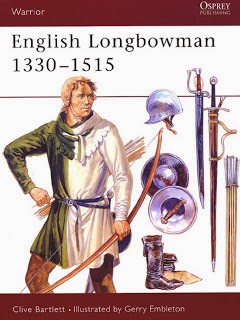
English Longbowman 1330-1515, written by Clive Bartlett and illustrated by Gerry Embleton, is one of the Osprey Publishing Warrior series that has seen print on and off through the years. Strangely, the book is currently out of print and I didn't see a Kindle version available from Amazon.
I tend to enjoy this smaller book by Osprey because they tend to have great artist, and the writers tend to put a lot of diverse information, not all of it necessarily with laser like focus on the actual subject but of the time period itself.
The front cover is a combination of pieces from the interior with the left side archer being one of two archers in the actual picture in the book, and the equipment on the right being roughly half a page worth of equipment from a two-page spread of archer equipment in the interior. If you enjoy the cover, you'll appreciate the interior. Gerry Embleton has a nice 'realistic' style.
Gerry does several internal illustrations that bring to life the subject matter in a wide variety of scenes. In one, the archers are practicing their craft. In another, English Longbowmen are fighting their German allies. According to the plate information, this happened from time to time because the German forces wouldn't listen to anyone else.
In another one, soldiers catch a bowyer making bows after dark. And this is forbidden because quality may suffer. In the dark ages before modern electricity, working in the dark was not conducive to quality materials and goods. As these were weapons made for war, it was vital that they be at their highest quality.
The other nice thing is that Gerry also does several internal black and white illustrations. These help further provide details on what archers wore, such as different hats and boots. It provides the reader with an idea of the variety to be found in even these old times.
In terms of roleplaying games, there are often things that spring to mind when reading these books that I try to make a note of to add to my rpgs.
For example, a big part of the potential pay for any English Longbowman, is in plunder and prisoners. Of the plunder, a certain percent is supposed to be kicked up the chain of command, and then higher until it gets to the king. Of the prisoners, depending on that status, the soldier may ransom them back, or they may have to give them to the higher ranking officers for a flat reward.
That part there had adventurers written all over it. I can easily see a group of adventurers capturing a high placed noble. A person of such rank and prestige that they should give him over to their superiors but in many games I've witnessed, player's greed tends to make them take chances that might not always be the wisest. There are all sorts of possibilities in terms of what can they do with such a person, how do they keep him under lock and key? How do they keep him safe? How do they keep others from discovering him?
This doesn't count just regular plunder. One of the notes in the book is that one of the greatest achievements during the wars with France was the movement of so much French wealth back to England. It notes that most wives and households of soldiers had some part of France's wealth decorating it ranging from fur coats and tables to plates and of course, jewelry.
For other role playing bits, there is good old superstition always at work. Soldiers and their commanders would carry certain tokens around with them in order to guarantee victory or survival. One English commander is reputed to have "carried a good-luck token for the whole army in the shape of the banner of St. Cuthbert." Nothing like seeing historical characters and those that have been incorporated into the game's founding meet like that. The Banner of St. Cuthbert might even be a real magic item.
Another interest facet of archers, is that they didn't have a lot of quivers doing on. They often kept the arrows pushed through their belt or in a sack. Gives different opportunities for belts to have abilities that they might not normally be associated with.
One of the problems though when looking at books like this, is they tend to focus on the type of soldier as part of an army. In most role playing games, the players are usually controlling one character at a time. But it does provide you with some ideas if you're running a war. For example, the archers, while not as heavily armed or armored as other soldiers, often found behind staked ground. This prevented knights from charging them. Little details like that can go a long way.
If you're playing an archer like character, from his own experience, he might know to make use of terrain so that the enemy has a harder time getting to him.
Even when it comes to naming conventions, the 'longbow' is called a warbow because they were constructed in mass quantities for wartime and used in wars. It might not change the equipment in the Player's Handbook for example, but if the players start talking about the qualities of their warbows as opposed to longbows, it gives them a more personalized touch.
One thing the book notes, is the importance of having a 'higher' allegiance. It mentions this not as die hard fanatics or anything of that nature, but the willingness to stand and die down to a man for a cause. It assumes a chain of loyalty ranging from the common soldier to his commander, from his commander up the chain of command to the king, and then even to the land itself, to England. This patriotism could be a trait for characters or loyalty to their allies and friends or to the king. Providing characters hooks to the setting can be easy if they are willing to have their characters invest in something outside of themselves.
Saturday, January 18, 2014
Monday, January 13, 2014
47 Ronin by Mike Richardson Stan Sakai
Dark Horse comics publishes a lot of non-superhero comics that I enjoy. Last year during the old 'Black Friday' bit, they have their annual half-off sale. I picked up the 47 Ronin in digital comic format. Written by Mike Richardson and illustrated by Stan Sakai, I wasn't quite sure what to expect.
Mind you, that's not true in the art department. I've written about Stan Sakai and his long eared wandering ronin Usagi Yojimbo many times before. But Mike RIchardson wasn't as familiar to me. Still, it's a fairly well known historical tale, and Dark Horse's website is generally nice in that they often have a multiple page preview for all the digital comics they sell. Looking through those previews, I felt pretty secure that it would be a 'safe buy'.
And it was.
47 Ronin provides a much more grounded and historical version of events that Keanu Reeves recently brought back to theaters in a semi-fantasy, semi-westernized style.
Here there is no magic needed for the assault. Here there is no need for a half-breed of magical nature to assist in the taking of vengeance. Here there is no love story. Or at least no love story between a princess and her servant.
Instead we see 47 loyal ronin, loyal beyond all sense of the word, who are determined to avenge what they see as a wrongdoing to their lord regardless of the personal cost. This cost comes in many forms ranging from their personal honor, to their status that they could have had even as ronin. As they know this is a death sentence, it also costs those who decided to have families that opportunity to live outside their lord.
It's well told and takes its time. We see the general plan and the specifics that each character goes through. We see the fall from grace, we see the rise of a force capable of laying siege to a powerful merchant. We see the end result which is almost universally the same.
Mike Richardson did a fantastic job in the telling of 47 Ronin and I'll be keeping an eye out for anything else he does of this nature even as I wait for the next graphic novel of Usagi Yojimbo by Stan Sakai, which according to Amazon, is a while in coming and is title, Usagi Yojimbo Volume 28: Red Scorpion.
All good and well said, but what does that have to do with role playing?
1. Lead by Example: One of the things I unfortunately see often as both a player and a GM, is that the GM has expectation X and the players have expectation Y. Sometimes this happens even after they talk about the concepts of the game. This generally happens a lot with superhero settings. Older readers often think that the games are going to reflect the comics where characters are generally law-abiding heroes who don't kill. Younger ones who grew up with Image in the 90's, or heck, even with movies, don't necessarily see anything wrong with massive property damage, lose of civilian life, or killing your enemies en mass. By providng material, either in movies or in other media, such as comics, the players and game master can have a clearer understanding of what they are expecting the game to actually play as. If someone said, "I want to play 47 Ronin" and meant the latest movie as opposed to someone who read the historical based comic, there would be some issues.
2. Lawful Villains have allies: Sometimes you just want to take your katana and strike a merchant dog down in the presence of the shogun. Well, that's not necessarily a good idea because that villain has a son married into a very powerful family and hey, even if he deserved to be struck down from behind like a dog, those other people aren't going to have their name, and their honor dragged through the mud. Their not going ot take the chance that someone will be sympathetic to the poor good guy's tale of woe and suffering. No, their going to buy that guy with every force at their disposal as quickly and inhumanely as possible. When designing your villains, don't forget their network.
This network may not even be one that they sought out. For example, a rogue elf may have a half elf son who feels determined to protect his father regardless of the cost and that half elf is married into a very powerful merchant family who can hire the most dangerous defenders and mercenaries in the land. In a fantasy RPG, that might even include assassins to hunt the players down before they get their bearings.
At that point, what would characters do? The source of their enemy's power isn't actually the enemy, but perhaps a non-evil individual who simply doesn't want to see his relative killed.
3. Suicide Mission: Sometimes you have to take one for the team. Sometimes the team has to take one for the boss. If there is absolutely no chance of winning, or at least living and winning, this should be something that is clear to the players at the start of the campaign. If the GM has poisoned the characters and they only have X amount of hours to live, a popular plot device, or that if the players going on with their course of action because that's what they're meant to do, such as say Rosach from the Watchmen, they should know ahead of time that it's death to do so.
This doesn't mean a bad role playing session though. It might be best for a one shot or a limited campaign, but there can be powerful action scenes, there can be allies gained and lost, there can be vast treasures gambled and earned. It's just your going to die.
Knowing that ahead of time may make some players bold. It may give them role playing opportunities that they've never engaged in before.
47 Ronin by Mike Richardson and Stan Sakai has a lot going for it and is well worth a read.
47 Ronin is available at Dark Horse over here in electronic format with the individual issues running about $3.99 each, each one with a preview, and is available from Amazon.com over here in hardcover format for $14.99, a $5.00 savings form the cover price.
For those who've read the Dark Horse comic, do you have a particular scene that stands out? A particular bit that you'd like to bring to your RPG?
For those who've read other accounts of the 47 Ronin, is there a particular version you'd recommend? I picked up two of them immediately after seeing the movie in kindle format, and have an old hardcover with other stories in it, as well an Osprey book I want to get to.
The 47 Ronin is a tale with a lot of elements to it that historically bears retelling in one form or another.
Sunday, January 12, 2014
Blood of Elves by Andrzej Sapkowski
Fantasy Novel Review
When I initially read, novel, The Last Wish by Andrzej Sapkowski, I wasn't overly impressed. I don't know if it was the translation, the short story format, or just the writer getting to the introduction parts of his world and characters but it struck me as rather mediocre. Unfortunately for me, I had already purchased the Blood of Elves in kindle format when it was on sale. I figured I'd already read the first book, might as well plow through the second.
It was the right call. Blood of Elves is a much better book than the Last Wish. I don't know what the author Andrzej Sapkowski did between the books, or if the company found a better translator or what, but it is head and shoulders above the previous book.
The book's title, Blood of Elves, is a bit of a play on words. I initially thought it would be something about the sacrifice of elves in that the world had passed them by and it was their time to move on. And in part, that element is there. But more than that, it's the bloodline of elves. In the Witcher's setting, many individuals have the blood of elves in their heritage. Many can claim lineage to the elves.
It uses a lot of the material set up in The Last Wish, but isn't overly reliant on the reader having read that book. Instead it does a lot of subtle world building by allowing various factions and personalities from different regions and races to air out their world points which provides the reader with a lot of background and detail as to what the current state of the world is.
In doing so, it provides the reader with clearer understandings of the various characters including Geralt, the Witcher, an albino who was raised from an orphan, as are all witchers, to be a slayer of monsters. There are other cast members we are introduced to, including Ciri, who is a 'Surprise Child' which has a faerie tale quality to it. A Surprise Child is one conceived of when a favor is granted and payment is allowed to be anything. Very similar to King Arthur's own tale in the movie Excalibur.
Many members of the cast make appearances here including Dandelion, a poet, bard, performer who acts as part time spy for his country, as well as being a friend to the Witcher himself. In some ways, he reminds me of a 'Companion' style character popular in Michael Moorcock's Eternal Champion series. He's useful, but can't compare to the main cast so to speak.
The only problem with the book, is that it knows it's part of a series. While you wouldn't have to read any books previous to it to enjoy it, it ends on an obvious cliffhanger. This isn't something I'm fond of because there have been books by Ryamond Feist that just ended when things were 'getting good' and I was furious because at that time, I was reading them as they were coming out.
For those interested in the works of Andrzej Sapkowski, we have the following:
Blood of Elves in Paperback for under $8.00.
Blood of Elves in kindle format for under $7.00.
Below I'll be discussing some of the specifics of fantasy novel Blood of Elves and how it might work in your own games.
Witcher
Geralt is a Witcher. We find out more about these characters here. They were originally orphans taken in and trained at a citadel. They were subject to magic, training, and specific diet to augment their abilities. Some of this training is physical and martial related. Some of it is magical and spell related. All of it on the focus of destroying monsters.Initially I thought that such a concept might be a prestige or paragon path, but after seeing that the changes are permanent and that the effects include things like reduced aging and augment physical abilites from the schooling, it would seem to be more of a core class or at least a rational for why a core class might have such abilities. Depending on the campaign, for example, in an OSR style game and designing your own classes, something done a bit in the Player's Companion to Adventurer Conqueror King, you might try to restrict players from taking a 'powerful' class by having very high requirements to get in. This in short was the method that the official Advanced Dungeons and Dragons game used to limit say the number of Paladins in a game.
The thing that shines through in the Witcher though, is that a specific class has specific elements to it. In this case, the witcher's training ground and home has been destroyed prior to the start of the novel. This limits any new witchers from being fully changed as those that were not there and did survive, do not have the knowledge base on how to craft the alchemical drugs needed to physically transform any students they do have.
Despite their foundation being destroyed though, most of them shown here are loyal to the cause and the idea. They do not hold with the idea of working for a specific country or place. Geralt even talks about the world failing and in the ruins of that new world, fighting and killing monsters until one of them kills him. It's good character depth and motivation.
World Building
At the start of the novel, a group of various individuals ranging from merchants and wizards to kings and advisors, are listening to an entertainer. After the tale of the entertainer, they begin to speak about the things in the tale and assigning specific names to things only hinted at by the speaker.
In the modern era, there may be a certain assumption of knowledge. You can know what's happening in your town, your city, you state, your country, your hemisphere. Knowledge is deep and detailed. Things can be verified and cross checked. The request for information are instant.
In most fantasy settings, even those with wizards and other methods of circumventing the perils of long term travel, this is not true. The people on the next horizon might be completely unknown. Historically groups like the Mongols seemed to arise from nothing and nowhere because no one had really investigated and more importantly, made that knowledge widely known.
Throw red herrings into the campaign when you can because chances of everyone knowing everything? Slight to non-existent in those times characters find themselves part of.
Character Knowledge
On the other hand, don't be afraid to give the players specific knowledge that is not common. Allow them to know things that even the so called professionals are wrong on. In the novel, Geralt is amused by a scholar who is speaking to him of certain types of creatures and how something Geralt is talking about, simply cannot exist. Of course when Geralt is proven correct, the scholar quickly changes his mind.
Giving players specific knowledge based on their profession or actual personal experiences gives them a reward beyond magic and gold. It is information that they might be able to trade with others of their profession or use to get into guilds or companies.
Miscellania
There are numerous other bits that show up in the Blood of Elves that make for some potential good gaming.
For example, on rivers, borders might be a bit difficult to detect and enforce. When certain trade goods are taxed or banned outright, will characters claim the law on their side if on a watery surface and claim the tariffs were unfairly enforced?
Factions within Factions: The 'wild' demihumans believe that they are fighting for their freedom. They have been roused to action by outside agencies. Those agencies aren't too concerned for their welfare. This leads the 'wild' races of elf, dwarf, and gnome, to fight against those living within and working within the human kingdoms, leading some of the human kingdoms to closely question, and set up tests of loyalty for those races. A situation in which there can be no clear winners.
Blood of Elves is a strong fantasy novel and far ahead of The Last Wish. After I finish wadding through some of my other back log of books, I'll be sure to return to the next novel in the series. Hell, I might even pick up the computer game by that time.
If you enjoyed my ramblings, please +1, share, and ask questions or comments on your own enjoyment/dislike of the book.
Saturday, January 11, 2014
Stands A Shadow: The Heart of the World Book Two by Col Buchanan
After finishing the first book in the series, The Heart of the World, Farlander, I looked at Amazon and saw that in hardcover, the second book was ten dollars. Bam! Ordered and now read. The bad thing? This one came out in 2011, or at least is copy right 2011 and Col Buchanan's website, which is both cool and infuriating, has no information on the next one.
Stands a Shadow continues several threads from the previous book and introduces new ones. It stands in stark contrast to a lot of the 'rules' of writing when talking about introducing a gun in scene one to use it in scene ten because it moves the cast around a lot. In that venue, it actually reminds me of A Game of Thrones in that you may think, "Ah, here's the main character." and then, nope, sorry, that was not the protagonist you were looking for.
I don't know if that's everyone's thing but it makes a nice change of style. It breaks the rules. I think writers like George and Col Buchanan can get away with it though, because first and foremost, they are good writers.
In Stands A Shadow, we have the assassin Ash seeking revenge for the death of his pupil, Nico in the first volume. His order though, is forbidden from doing this as it makes the chances of the guild, the Roshun, being hired again lessened as it tarnishes the image of their professionalism. At this point, as he's an older man, I think the book quotes sixty, Ash is okay with this making him a piraha among his own people.
The author uses a few techniques to bring out more of Ash's backstory including dreams, delirum, and Ash speaking with a monk about the troubles he finds himself in. These work well to bring out different aspects of the character as each method reveals something in a way that the others don't. The dreams are more akin to memories, while the delirum brings forth unwanted and guilt laden memories.
But despite the heavy focus on characters in the novel, there is more going on. The empire of Mann, where the only virtue is strength, is seeking to end the resistance of the so called Free Ports. This invasion brings armies into clashes and brings a lot of action and new characters to the scenario like Bull, a man released from jail, an extremely dangerous man who killed a hero of the war and is now offered a pardon and the opportunity to engage his anger at the enemy of his people. He takes it with both hands.
Other characters from the previous book, like Che, also are featured here and find their loyalties tested in many ways that they might never have expected.
Stands A Shadow is fairly self contained. While the end does offer the potential for another book, it is more the potential of hope itself that it offers, of the journey not being over, thing things can get better. Still, when Col Buchanan does get that next book out, I'll be down for the next copy.
Stands A Shadow is available in hardcover from at least one vendor using Amazon Prime for under $8.00 here on in kindle format for $6.83 here. If you have not read the first book in the series, Farlander, I would highly recommend getting it in hardcover because Amazon has it for $2.92, under three dollars, in hardcover, and shipped from Amazon Prime, here.
Having said all of that, how might this be useful for role playing games like Dungeons and Dragons or Rolemaster? Below I'll be discussing several specific bits from the book so there will be spoilers aplenty. Read no further if you wish to avoid them.
When I was reading this book, I kept thinking of Wizards of the Coast, Heroes of Battle. I kept thinking how that book would be a good resource to delve into after reading Stands A Shadow because of the war which has a large focus on the unexpected actions of characters and the armies that follow them, as opposed to just long grinds.
1.The Best Laid Plans of Mice and Men: The army of Mann uses ships to transport its soldiers. In even the best of circumstances, crossing the world over a hostile terrain even in the largest ships, is a dangerous and challenging prospect. If you've seen Frank Miller's 300, there is a scene where the invading army loses ships to a storm. Something similar happens here. Despite the greater strength of numbers that the army of Mann brings with them, they still cannot control the weather or the elements. Remember random events in the campaign and how they may impact the overall campaign itself.
When looking at these elements, you should determine how big an impact they will have. Will they effect the whole army? For example, this book would have been pretty short had the entire army of Mann washed up on the shores dead and broken. Instead they lost a lot of their high powered weapons and their mounts and several people suffered injury including the Holy Matriarch suffering a broken arm.
2. Camp Followers: Where they are soldiers, there are those who will serve them. The book has Ash befriend a group of prostitutes after the ship's crash as he is seeking the warmth of their fire and scares off a group of soldiers who had intended not to pay. These camp followers are not the only ones though. There are also food sellers, carpenters, leather workers, and a whole host of other professionals whose survival comes from following the army. In some games like Games Workshop's Warhammer, at least in some editions, the players may even start off as a camp follower! Not ever character need be a camp follower though. For example, the young woman Curl is a battle doctor. Well, not quite, more like a nurse who stitches up the wounded and provides them with water and drugs to get them either back into the fight or out of it.
The camp followers can have many roles in the game. When the camp is not actively engaged in war, the soldiers need to do something. They will seek out different forms of entertainment and food and alcohol. This makes the camp itself like a moving city with all of the challenges of such a city.
For example, what if one of the food vendors is using the dead to supply his special brand of meat? This is a fairly common theme for a game like Warhammer for example.
What if the entertainers keep certain types of characters behind when the rest of the troop leave and devour them?
What if one of the prostitutes is a serial killer and picks out targets that won't be missed for weeks if ever as they were prime targets for desertion in the first place?
What if the players infiltrate the enemy camp and use the resources there to hinder the opposing force, or use it as cover to try and assassinate the enemy leadership or destroy key resources?
3. Characters change the game. Che is a 'diplomat' which is another code word for assassin. His doctrine into the religion of Mann is one that required him to undergo a change of personality to be trained as the Roshun assassin and then betray them. But it also requires him to be kept wide read and learn of the world. These elements make him a poor honest worshipper of the ways of Mann and while he does part of his duty, he also abandons the empire of Mann and saves the life of Ash while doing so. His actions bring further conflict to the empire of Mann, as well as resulting in more 'diplomats' being sent after him for his ways.
The world can be as big and vast as you want it, but the events around the players should be influenced and influence the characters in them. If the players take the fight to the enemy in the dead of night in a strategic movie to deprive the enemy of their leadership, can it work? If the enemy then decides to do the exact same thing against the players, will they be prepared?
4. Strong character opposition. While the army of Mann itself is powerful, I again find the head enemy, the Holy Matriarch of Mann, a physically weak character who while having a few moments more than she did in the previous book, still getting taken out almost as an after thought. This in turn leads to a huge event, civil war in the empire of Mann as multiple factions vie for the supreme rulership of the empire. The empire? Still a big bad overarching theme of do as thou will but the actual agents of this empire? So far both the Matriarch and her son have not proven to be that impressive. Mind you this goes in contradiction to how I feel about the heroes where I'm not necessarily expecting each one to be so skilled in dealing death as long as they have some character to bring to the story, but if the heroes are motivated to overcome these villains, if they have no problem doing so once they meet in the flesh, it feels a little demotivating.
5. Survival: On the other hand, if the game master doesn't provide some logical reason why the enemy isn't overwhelming the character, when appropriate, it can make the game seem off key. If the players are faced with overwhelming force, there needs to be a solid reason why the players haven't been overwhelmed. In the case of the book, part of this boils down to how the empire of Mann operates. The heroes of the Free Ports get a break when civil war breaks out in the empire, and this is something that's happened at least one time before as one of the generals notes it happened fifteen years ago. If you put up unbeatable opposition against the players, make sure they have an out.
6. New Characters: War brings out need. In this case, the need for bodies to press into the grinder of war. In so doing, new characters are introduced from dubious sources such as the mad house, the prisons, and the hospitals. If they can walk, they can fight. If in the course of the game the players lose a character or two, having a reliable way to introduce new characters is useful. This can range from a character from the opposition seeing the light, to someone seeking justice against the same foes the players are currently fighting against.
Stands A Shadow is a strong sequel to Farlander and well worth a read.
Stands a Shadow continues several threads from the previous book and introduces new ones. It stands in stark contrast to a lot of the 'rules' of writing when talking about introducing a gun in scene one to use it in scene ten because it moves the cast around a lot. In that venue, it actually reminds me of A Game of Thrones in that you may think, "Ah, here's the main character." and then, nope, sorry, that was not the protagonist you were looking for.
I don't know if that's everyone's thing but it makes a nice change of style. It breaks the rules. I think writers like George and Col Buchanan can get away with it though, because first and foremost, they are good writers.
In Stands A Shadow, we have the assassin Ash seeking revenge for the death of his pupil, Nico in the first volume. His order though, is forbidden from doing this as it makes the chances of the guild, the Roshun, being hired again lessened as it tarnishes the image of their professionalism. At this point, as he's an older man, I think the book quotes sixty, Ash is okay with this making him a piraha among his own people.
The author uses a few techniques to bring out more of Ash's backstory including dreams, delirum, and Ash speaking with a monk about the troubles he finds himself in. These work well to bring out different aspects of the character as each method reveals something in a way that the others don't. The dreams are more akin to memories, while the delirum brings forth unwanted and guilt laden memories.
But despite the heavy focus on characters in the novel, there is more going on. The empire of Mann, where the only virtue is strength, is seeking to end the resistance of the so called Free Ports. This invasion brings armies into clashes and brings a lot of action and new characters to the scenario like Bull, a man released from jail, an extremely dangerous man who killed a hero of the war and is now offered a pardon and the opportunity to engage his anger at the enemy of his people. He takes it with both hands.
Other characters from the previous book, like Che, also are featured here and find their loyalties tested in many ways that they might never have expected.
Stands A Shadow is fairly self contained. While the end does offer the potential for another book, it is more the potential of hope itself that it offers, of the journey not being over, thing things can get better. Still, when Col Buchanan does get that next book out, I'll be down for the next copy.
Stands A Shadow is available in hardcover from at least one vendor using Amazon Prime for under $8.00 here on in kindle format for $6.83 here. If you have not read the first book in the series, Farlander, I would highly recommend getting it in hardcover because Amazon has it for $2.92, under three dollars, in hardcover, and shipped from Amazon Prime, here.
Having said all of that, how might this be useful for role playing games like Dungeons and Dragons or Rolemaster? Below I'll be discussing several specific bits from the book so there will be spoilers aplenty. Read no further if you wish to avoid them.
When I was reading this book, I kept thinking of Wizards of the Coast, Heroes of Battle. I kept thinking how that book would be a good resource to delve into after reading Stands A Shadow because of the war which has a large focus on the unexpected actions of characters and the armies that follow them, as opposed to just long grinds.
1.The Best Laid Plans of Mice and Men: The army of Mann uses ships to transport its soldiers. In even the best of circumstances, crossing the world over a hostile terrain even in the largest ships, is a dangerous and challenging prospect. If you've seen Frank Miller's 300, there is a scene where the invading army loses ships to a storm. Something similar happens here. Despite the greater strength of numbers that the army of Mann brings with them, they still cannot control the weather or the elements. Remember random events in the campaign and how they may impact the overall campaign itself.
When looking at these elements, you should determine how big an impact they will have. Will they effect the whole army? For example, this book would have been pretty short had the entire army of Mann washed up on the shores dead and broken. Instead they lost a lot of their high powered weapons and their mounts and several people suffered injury including the Holy Matriarch suffering a broken arm.
2. Camp Followers: Where they are soldiers, there are those who will serve them. The book has Ash befriend a group of prostitutes after the ship's crash as he is seeking the warmth of their fire and scares off a group of soldiers who had intended not to pay. These camp followers are not the only ones though. There are also food sellers, carpenters, leather workers, and a whole host of other professionals whose survival comes from following the army. In some games like Games Workshop's Warhammer, at least in some editions, the players may even start off as a camp follower! Not ever character need be a camp follower though. For example, the young woman Curl is a battle doctor. Well, not quite, more like a nurse who stitches up the wounded and provides them with water and drugs to get them either back into the fight or out of it.
The camp followers can have many roles in the game. When the camp is not actively engaged in war, the soldiers need to do something. They will seek out different forms of entertainment and food and alcohol. This makes the camp itself like a moving city with all of the challenges of such a city.
For example, what if one of the food vendors is using the dead to supply his special brand of meat? This is a fairly common theme for a game like Warhammer for example.
What if the entertainers keep certain types of characters behind when the rest of the troop leave and devour them?
What if one of the prostitutes is a serial killer and picks out targets that won't be missed for weeks if ever as they were prime targets for desertion in the first place?
What if the players infiltrate the enemy camp and use the resources there to hinder the opposing force, or use it as cover to try and assassinate the enemy leadership or destroy key resources?
3. Characters change the game. Che is a 'diplomat' which is another code word for assassin. His doctrine into the religion of Mann is one that required him to undergo a change of personality to be trained as the Roshun assassin and then betray them. But it also requires him to be kept wide read and learn of the world. These elements make him a poor honest worshipper of the ways of Mann and while he does part of his duty, he also abandons the empire of Mann and saves the life of Ash while doing so. His actions bring further conflict to the empire of Mann, as well as resulting in more 'diplomats' being sent after him for his ways.
The world can be as big and vast as you want it, but the events around the players should be influenced and influence the characters in them. If the players take the fight to the enemy in the dead of night in a strategic movie to deprive the enemy of their leadership, can it work? If the enemy then decides to do the exact same thing against the players, will they be prepared?
4. Strong character opposition. While the army of Mann itself is powerful, I again find the head enemy, the Holy Matriarch of Mann, a physically weak character who while having a few moments more than she did in the previous book, still getting taken out almost as an after thought. This in turn leads to a huge event, civil war in the empire of Mann as multiple factions vie for the supreme rulership of the empire. The empire? Still a big bad overarching theme of do as thou will but the actual agents of this empire? So far both the Matriarch and her son have not proven to be that impressive. Mind you this goes in contradiction to how I feel about the heroes where I'm not necessarily expecting each one to be so skilled in dealing death as long as they have some character to bring to the story, but if the heroes are motivated to overcome these villains, if they have no problem doing so once they meet in the flesh, it feels a little demotivating.
5. Survival: On the other hand, if the game master doesn't provide some logical reason why the enemy isn't overwhelming the character, when appropriate, it can make the game seem off key. If the players are faced with overwhelming force, there needs to be a solid reason why the players haven't been overwhelmed. In the case of the book, part of this boils down to how the empire of Mann operates. The heroes of the Free Ports get a break when civil war breaks out in the empire, and this is something that's happened at least one time before as one of the generals notes it happened fifteen years ago. If you put up unbeatable opposition against the players, make sure they have an out.
6. New Characters: War brings out need. In this case, the need for bodies to press into the grinder of war. In so doing, new characters are introduced from dubious sources such as the mad house, the prisons, and the hospitals. If they can walk, they can fight. If in the course of the game the players lose a character or two, having a reliable way to introduce new characters is useful. This can range from a character from the opposition seeing the light, to someone seeking justice against the same foes the players are currently fighting against.
Stands A Shadow is a strong sequel to Farlander and well worth a read.
Labels:
Assassinations,
Col Buchanan,
Military,
Stands A Shadow,
War
Friday, January 10, 2014
Kindle Daily Deals: Any takers for the big sale?
I try to keep tabs on the Kindle Daily deals for stuff that I might be interested in terms of role playing games and that feeble effort I take at actually doing some work at my job or keeping my personal interest up to date, or vaguely up to date.
Imagine my surprise today when I saw that there were a ton of things on the daily deal that I bought even though some of the prices did not say daily deal to me. I think there's something like 500+ books, not counting the regular four sections of the daily deal, one of which I also bought.
The Oxford Handbook of Late Antiquity (Oxford Handbooks) while the e-book version is still like $25 bones or something along those lines, it covers a pretty generous scope of history and it is now mine.
Data Science for Business: What you need to know about data mining and data-analytic thinking over at work I work with a lot of charts, a lot of Excel, a lot of Access, some SQL and reams of data. I'm better at asking questions of processes and how decisions are made, in my opinion mind you, so everytime I see something about what goes into making hard data decisions I buy it. This one is just under $7.50 so it's still a good deal higher than I like to see for a 'daily deal' but...
Imagine my surprise today when I saw that there were a ton of things on the daily deal that I bought even though some of the prices did not say daily deal to me. I think there's something like 500+ books, not counting the regular four sections of the daily deal, one of which I also bought.
The Oxford Handbook of Late Antiquity (Oxford Handbooks) while the e-book version is still like $25 bones or something along those lines, it covers a pretty generous scope of history and it is now mine.
Data Science for Business: What you need to know about data mining and data-analytic thinking over at work I work with a lot of charts, a lot of Excel, a lot of Access, some SQL and reams of data. I'm better at asking questions of processes and how decisions are made, in my opinion mind you, so everytime I see something about what goes into making hard data decisions I buy it. This one is just under $7.50 so it's still a good deal higher than I like to see for a 'daily deal' but...
Creative Workshop: 80 Challenges to Sharpen Your Design Skills something like $3.50 and I'm always interested in these types of books just for the 'creative' side of things.
Windows PowerShell Cookbook: The Complete Guide to Scripting Microsoft's Command Shell again, while I'm not a programmer by any means, I'm not afraid to mess with the internals of a PC and well, I've learned a few skills here and there that have been helpful in say, boot time.
There were a couple of other programming books I bought, but those were more for reference. I find that if you have an actual programming problem that the internet is full of some very smart people willing to help you work through the problems and that the computer books themselves are more like, "here's a sandbox of what can be done but we're going to tell you how to do it in ways people actually working would never do." But that's just my personal experience with those types of books.
In terms of my game? Shot down today. I live in Chicago. My mom's doctor for her foot is way out in like the edges of Skokie near Mount Prospect. It's raining like hell. Her appointment was over an hour, which was very good in terms of time taken. Usually it's two to three. Barely gave me any time to work on COl Buchanan's second book ,Stands A Shadow.
But on the way back and since, it's been raining nonstop. Several almost accidents along the way so now that I'm home, the chances of me leaving the house again? Especially when I haven't eaten dinner? Especially when the GM called ahead to let us know that another player was bailing already? Yeah, not the first out and the GM already has a backup plan.
For me, I think I'm going to cook one of those over saturated with sodium Jewel pizza's and read some more of Stands A Shadow and wait for that Oxford book to download.
Hope everyone else has some happy gaming!
Let me know if you found anything worth while on the deal. I was surprised by how many things I wanted purely for reference and had to reign myself in before I spent a whole check on stuff I'm only going to use vaguely.
Thursday, January 9, 2014
The Last Wish by Andrzej Sapkowski
When I first heard of Geralt, a Witcher, a professional who hunts down supernatural horrors, it was not in a positive context. Over on Michael Moorcock's website, some of the fanbase essentially noted that the Witcher was a direct rip off of Elric, an aspect of the Eternal Champion created by Michael Moorcock. And what's more, the character or at least the world and setting, is apparently part of a best selling series of computer games.
That didn't necessarily strike me as a bad thing mind you. Conan, despite the dozens if not hundreds of stories written about him, has relatively few by the actual original author, Robert E. Howard. Most of these stories have been written decades after his death.
So when the opportunity came to pick up The Last Wish by Andrzej Sapkowski, at a decent price on the old Kindle format, I snatched it up. It appears to be a series of short stories broken up by an over arching rest point where Geralt is preparing himself for future travels after taking an injury in a case.
In terms of 'being a rip off' Elric, at least in this book, I can see where the comparison comes from, but Geralt is no Elric.
But let's start with the similarities. They are both albino characters. They are both spellcasters and master swordsmen. They both use drugs and elixirs. Note that in Geralt's case, the dependency, at least in this novel, seems like a new thing as opposed to Elric's ongoing need for them due to his chronic weakness. The other thing that would be annoying if I was Michael Moorcock would be having had a character like Elric whose bylines include The White Wolf, which at least one person calls Geralt here.
However, Geralt doesn't have a rune blade that drinks souls or has sword his own soul or alliance to the forces of Chaos and their worlds are vastly different. This bit is important because even in the first Elric book, the albino of that series is going to other worlds and planes and eventually times and manifestations of himself.
In terms of weapons, Geralt uses two different types of swords, one made of cold iron and the other of silver. Each suited for fighting a specific type of creature. Their outlooks, again, at least as far as this book is concerned, are also different although there are some similarities in terms of themes of fate and destiny.
In terms of the novel itself, it was worth a thought in terms of how certain types of characters fit into the wider world. In Geralt's case, he is a Witcher. Being a Witcher means hunting down supernatural entities. But it notes that even during Geralt's time, that the need for his services has become less and less and that 'honest Witcher' work is harder and harder to find.
The whole idea of the Witcher would fit in well with specific roles in a fantasy game. Such roles have long been a part of Dungeons and Dragons, being put into more game related mechanics in the various Complete books with kits that provided game benefits and often role playing penalties or guidelines. It was made more concrete in 3rd edition with prestige classes that characters couldn't start as, but could advance into, and then part of the overall core mechanics in the Player's Handbook in 4th edition with paragon classes.
It showcases how such designs could go in a variety of methods. The abilities that Geralt has, are particularly suited for many dangerous things, not just fighting against monsters. In one short story, he has to note that he is not an assassin and those who seek to use him as such meet poor results. Geralt though, is not a player character. In a situation where characters are down on their luck, will they use their special and specific abilities to go outside those boundaries?
Another interesting bit that Andrzej uses is that of folk tales. He plugs several events from a variety of sources into the setting of Geralt with no problem or even attempts to make it subtle. This has been done for other settings like the Forgotten Realms with some success by plugging in deities from other campaign settings or eras. When something works, it works.
A third thing apparent, is the changing of an age. In one of the short stories, a fey creature is 'stealing' secrets of farming from humans and providing them to the elves. Geralt notes that the elves only chance of survival is to trade and work directly with the humans or they'll die out of starvation and only have a last ride out against humanity and then fade into legend. Given that the title of the next book I have by the author is The Blood of Elves, perhaps that vision comes true already.
In the Forgotten Realms, in some time lines at least, the elves, much like they are in Middle Earth, are a fading power. As are the dwarves. This is a common theme when humanity and technology and civilization are on the rise. The only thing that doesn't become too clear in The Last Wish, is how this interacts with the ideas of magic. Geralt has the ability to cast spells, as do many others he encounters and few of the human spellcasters seem to have any issue with civilization as opposed to the things in the wild that might be considered mythical which are being hunted to extinction.
The Last Wish isn't the strongest book I've read in the genre and my purchase of future volumes of the Witcher will be heavily influenced by how much I enjoy Blood of Elves, and of course, any future sales I may find that feature the books at the prices I like.
For those who've played the Witcher game, is it worth picking up for a person who doesn't play a lot of games on the computer?
For those who've read all the novels, is there one in particular that stands out from the crowd?
Tuesday, January 7, 2014
The passing of a Kung Fu Icon Run Run Shaw
Blogger apparently ate my post so this is a report. Or a prepost? Anyway...
As reported by New York times, NPR, and other sources, the 106 year old media master, Run Run Shaw, has passed.
I'm not a film scholar. I grew up one of those dumb kids who was 'reached' by the 'Kung Fu' that Run Run Shaw brought over many times in many movies.
Some of my favorites are below. Things to remember though. One, is these were often done on a low budget. Two, they have a different perspective than most Westernized films. At least most of them. Three, they're from a different time and period.
Fists of Fury: I could just go, "Bruce Lee" and that would make it one of my favorite movies. But that's nonsense. As old as I am, I was born in 1971 so I was maybe 1 year old when this first came out. There are a ton of m'eh versions of this movie out in terms of transfer but I hear this one isn't too bad but if you're looking for a definitive version, I hear searching Amazon.UK is your better bet.
Fists of Fury is one of those simple movies where Bruce's character is told, "Honor your promise and don't fight" but hey, he discovers that his working environment is not what is seems and so must break his promise! This movie is over forty years old and it still brings the Wushu.
Five Fingers of Death: Also known as King Boxer. Another one from 1972. One of the 'fun' things about this movie is it's one of the first ones I remember with a 'secret' technique aka the Iron Fist or Iron Palm, depending on your translation. It's got a LOT of fighting and well, if Kung Fu is your thing...
Looking up his movies, I think I may be running into some directed by the sons but were ones that I enjoyed so I'm springing them up here.
The 36th Chamber of Shaolin: Thinking that the Shaolin Monks and the mystic elements associated with them? This is one of the movies that would make a good starting point to see where all of that came from 1978! Here we have some kindly wise old masters and the outsider who wishes to learn their secrets to take the fight back against corruption! Heck, this one is even on blu ray.
There are a lot more but again, no scholar, just someone who enjoyed a lot of these films, but saw them when he was a younger man and honestly can't remember most of them. They turn into a blur of kung fu with angry students, wise old masters, and the deadly arts of hand to hand combat!
But there is one that he is an unaccredited producer of...
Blade Runner: Yup, this one has all sorts of editions including a four disk edition and a blu ray. I myself had one of those ultimate edition things that was sadly destroyed in a move. Verily that sucketh!
With my buddies getting ready to run more Legends of the Five Rings, or L5R, I think that instead of the next Samurai I was going to do, a crab who actually tried to be sociable, it's time to review the Dragon and see if I can monkey up a monk for Friday.
What about the rest of wushu fans out there? Any particular favorites jump to the forefront? Any particular stories about Shaw that you think people should know about? Share the
As reported by New York times, NPR, and other sources, the 106 year old media master, Run Run Shaw, has passed.
I'm not a film scholar. I grew up one of those dumb kids who was 'reached' by the 'Kung Fu' that Run Run Shaw brought over many times in many movies.
Some of my favorites are below. Things to remember though. One, is these were often done on a low budget. Two, they have a different perspective than most Westernized films. At least most of them. Three, they're from a different time and period.
Fists of Fury: I could just go, "Bruce Lee" and that would make it one of my favorite movies. But that's nonsense. As old as I am, I was born in 1971 so I was maybe 1 year old when this first came out. There are a ton of m'eh versions of this movie out in terms of transfer but I hear this one isn't too bad but if you're looking for a definitive version, I hear searching Amazon.UK is your better bet.
Fists of Fury is one of those simple movies where Bruce's character is told, "Honor your promise and don't fight" but hey, he discovers that his working environment is not what is seems and so must break his promise! This movie is over forty years old and it still brings the Wushu.
Five Fingers of Death: Also known as King Boxer. Another one from 1972. One of the 'fun' things about this movie is it's one of the first ones I remember with a 'secret' technique aka the Iron Fist or Iron Palm, depending on your translation. It's got a LOT of fighting and well, if Kung Fu is your thing...
Looking up his movies, I think I may be running into some directed by the sons but were ones that I enjoyed so I'm springing them up here.
The 36th Chamber of Shaolin: Thinking that the Shaolin Monks and the mystic elements associated with them? This is one of the movies that would make a good starting point to see where all of that came from 1978! Here we have some kindly wise old masters and the outsider who wishes to learn their secrets to take the fight back against corruption! Heck, this one is even on blu ray.
There are a lot more but again, no scholar, just someone who enjoyed a lot of these films, but saw them when he was a younger man and honestly can't remember most of them. They turn into a blur of kung fu with angry students, wise old masters, and the deadly arts of hand to hand combat!
But there is one that he is an unaccredited producer of...
Blade Runner: Yup, this one has all sorts of editions including a four disk edition and a blu ray. I myself had one of those ultimate edition things that was sadly destroyed in a move. Verily that sucketh!
With my buddies getting ready to run more Legends of the Five Rings, or L5R, I think that instead of the next Samurai I was going to do, a crab who actually tried to be sociable, it's time to review the Dragon and see if I can monkey up a monk for Friday.
What about the rest of wushu fans out there? Any particular favorites jump to the forefront? Any particular stories about Shaw that you think people should know about? Share the
Labels:
Bruce Le,
Kung Fu,
Legend of the Five Rings,
Movies,
Run Run Shaw,
Wushu
Subscribe to:
Posts (Atom)


