In America, Black Friday is when retailers pop up massive discounts to get bodies into the stores. It was added by Cyber Monday when online shops decided to get into the action. Now? Now it's pretty much all week, if not all month.
But that's also good new for gamers as there tend to be a lot of sales around this holiday season now anyway.
Miniature Market has a ton of stuff on sale. I placed an order there for some various Warmachine stuff and if funds were no problem, would have ordered a lot more. They have numerous board games for great prices too. The service is usually very good, and if you order more than $99 worth of stuff, the shipping is free.
Fantization does numerous sales throughout the year. In this instance, they're 15% off everything, and 20% off if you spend more than $250. I've used them many times before and they have a wide selection of materials. It's one of the few places for example, you can get Scale75 paint.
Michigan Toy Soldier is a true hobby store with paints from companies I just don't see at other vendors including Life Color. Their doing 20% off if you're a preferred vendor. Shipping is relatively fast and the selection can't be beat, especially if you're trying to get hold of say, Andrea paints or figures.
CoolMinorNot is having a 15% off. Perhaps not the highest discount but they have a wide range of miniatures that you're not going to find in a lot of places.
The War Store, another place I've done business with on several occasions that delivers fairly fast and doesn't have crazy shipping prices, is also doing their sale. Some heavy discounts on a lot of different things.
There are numerous others out there. Goodman Games is doing a sale for example, where you can get the PDF at a discount or even some physical copies of the variant covers. Catalyst games is having some. Litko if you're ooking for dice towers. Military books more your think, Osprey has a ton of stuff in their online shop for 25% off.
I hit my $$$ limit pretty eary between Miniature Market and the War Store picking up a bunch of Convergance stuff for Warmachine that I don't even play, but at those prices figures I could start too.
Anyone have any particular deals they found too good to pass up?
Saturday, November 30, 2013


Wednesday, November 27, 2013
The Whiskey Rebels by David Liss

There are so many things that make it useful to a person running a role playing game that it's an important reminder why people should regularly read outside of their genre, why they should stretch their mental muscle past its comfort zone.
I'll be discussing some specific things below from the book and how they might be useful in role
playing games.
Money. One of the biggest focuses of the book is in the accumulation of money. Anyone whose lived in America in the last, oh, say ten years, has seen the financial institutions take the economy to the brink and had to be saved from themselves only to eagerly go back to the very same behaviors that lead to the issues to begin with because they know that the government will back them up again should the need arise. This is something that doesn't necessarily get touched on often in role playing games because it can not only be boring, but can be more complex and less violent than a good old dungeon crawl.
In terms of money, no matter what the era, no matter when the time, there will be conflicts. there will be opportunities. There will be potential. As the book picks up right after the Revolutionary War, there are people attempting to control the new banks that are coming along. To fund them, or at least fund a specific one, there is a Whiskey Tax. This tax, on one side, seems harmless but to the people making the Whiskey?
Well, the whiskey in and of itself doesn't bring in funds. Instead, it's used as a bartering tool. An object of trade. There may be those who do make money off it, but those are not the people hurt by the tax.
Imagine Star Wars. The Emperor probably has those who are friends and allies and he could easily let slip that the Empire is going to build not one, but two death stars. Think of the manpower, the funding, the technology in terms of engineers and machines, needed to build that. Now we could go all, "Well, it's the Empire. No one is getting paid." Corruption pays off much better than tyranny. Look no further than China where it's not necessarily illegal to be bribed, merely illegal to be caught doing so eh?
Information is power. In a fantasy setting, if the players learn that a group of merchants is going to buy all of the land on the waterfront and sell it to the lords of the city in exchange for vast sums of wealth because they know that the lords of the city need that land for building defenses or something of that nature, what happens if the players decide to be the ones who buy the property? What happens if they already own it and are then put under 'scare' tactics? Hunting down such things would be an excellent use of the Gumshoe engine for example.
Character Change. Ethan Saunders starts the book as a near useless alcoholic. His talents in spying, in gathering information, are secondary to the notoriety he faces for rumors of him and his best friend Fleet, being British Spies who merely weren't brought up on charges because the war was ending and people had better things to do. Through the course of the novel, David builds the things that tore Ethan down into things that slowly build him up. Ethan missed out on so much of his life due to failed perceptions and not wanting to do anything to disgrace the memory of Fleet, because he secretly feared that Fleet was indeed a spy, that when the novel keeps bringing the 'truth' to the surface, Ethan has no choice but to change into something still flawed, but better than he was at the start of it.
The same is also true of Joan, who starts off wanting to be a writer, but whose apparent uncontested understanding of how the financial system works, makes her into a near unbeatable foe whose goal, the destruction of the government, seems almost within her power to be stopped by sleight of hand as opposed to straight out skill. The changes characters go through should influence the direction the game takes.
The Frontier. Joan starts off living in 'civilization' but poor. An opportunity comes up to seek out a new live on the Frontier in exchange for the script that shows the government owes her husband money. But after the Revolution the funds don't appear right away so are traded away for a 'better' life. This life is one of hardship. One where the simple comforts of the city, even the city of that era, are not present. Where one must be self sufficient to survive. Well, perhaps not entirely self sufficient for Joan's husband, despite his carpentry skills, and the skills he mastered in the war, isn't a full wilderness master like those already tricked, and already living there are. This brands them together being out in the wilderness against those who would further harm them. It makes them united against 'outsiders' even though Joan and her husband are still the 'new' people who must earn their way into the trust of the group.
Big Concepts: Joan and Ethan are both patriots. Ethan fought in the war to be free from English rule. Joan's husband did the same. Joan harbors thoughts on what a true free society is worth and what shape it must take while Ethan wouldn't see chaos and government failure run through the streets if he can help it. Some ideas can have multiple views that are both right but both must come across one another. When designing a setting, are there certain aspects of it that people might find distasteful but would rather have than absolute chaos? Are there some things that would make people change their minds about the country if only they knew?
The Unseen: Ethan has a slave, Leonidas. Ethan is able to use Leonidas status and his race as a useful tool for gathering information several times throughout the novel. In many settings, there are those who are looked down on. In modern societies, this could be as simple as the ignoring the cleaning people or the delivery people. In ancient societies, slaves were not often well thought of and things may have been spoken of freely in front of them. Another group in almost any setting could be children. Most settings have that 'underclass' that is always around and no one pays attention to. Using those resources can give characters and edge up against those who don't.
The Whoseitcalled. I was surprised to see reference to Jeffersonits. Those who followed Thomas Jefferson. And Hamiltonist. People who have followers will find those followers called by their specific name. While perhaps not in as much use today for personal names, Communist is a label still thrown about for example, but Putinists? Perhaps not so much. But in a setting where characters can be larger than life? Where you may have served, fought for, or directly assisted the person who liberated the whole of the country? Where those who take up stances against new methods and manners are on one side and those who take the opposing ideas on the other? Then indeed, it would seem nature that naming conventions might be s thing that use the giants of the era.
A Large Cast: When I was a younger and perhaps more apt game master, I had a huge three hold punch of characters. Whenever I added a character to the game, a throw away merchant, a named dragon, a hidden dungeon, or anything that had a name, I jotted it down into the book. I organized the book by region and was able to expand upon it and call upon it when characters where in a certain location. David Liss maintains a huge cast of characters here and it makes the world feel more alive. He mixes fictional and historical characters with the ease of a master juggler and the reader is never certain if who they are reading at the time is one or the other. Keep a list of potential names and descriptions for use at any time with the understanding that those names and characters may never be used, but that you have them if they are needed.
The Whiskey Rebels is a powerful historical novel that has a personal touch and focus and by having two viewpoints, brings the reader even deeper into the action.
Sunday, November 24, 2013
Berserk 37 by Kentaro Miura
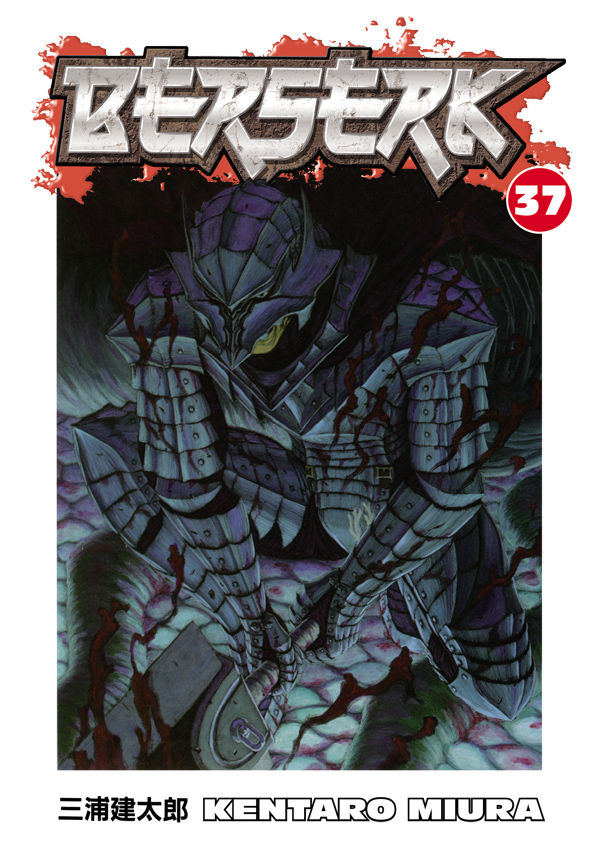
This volume concludes the 'Sea God' story and brings in more magic and more visibility to the changes that have rocked the world since "the Wind" event where a strange wind blew through the land and heralded the age of magic and monsters returning to the world.
The art is up to Kentaro Miura's usual high standards. He, George Pereze and John Buscema all have a great timeless talent and I hope that if Berserk is on hold for a while that we'll be seeing his work in some other forms. Perhaps even an art book or something.
In terms of gaming?
1. Judge not by size. When Guts is 'fighting' the Sea God, he's fighting an island. Like several other similar situations where the character's size is of such insignificance, Guts is able to deal damage based on a weak point of the creature, in this case, it's heart. Designing such an opponent is like designing a dungeon. There are 'anti-bodies', various monsters that make their home there, there are parasites, there are creatures too small for the entity to notice. There are also natural hazards like stomach acid, drowning in blood and other unpleasant bits.
2. Red herrings: Guts is aided in this volume by Merrow and by a magical child. It's strongly been hinted, or at least argued online, that the child is Guts and Caska's child that is only able to reach the mortal world during the period of the full moon. This volume throws a wrench into that theory though as we're given two other options. The first is that the character seeking the elves to restore Caska, have been given a guide. The other is that the boy is a manifestation of King Hanafubuku. I'm sticking with it being Gut's and Caska's child.
3. Blow up the Outside World: Because Guts is at sea on a voyage, he doesn't know what's happened to the mainland. With all of the magic and monsters roaming freely through the land, man has retreated to shelter under Griffith's new country. Growing from outside the country are huge arcs of crystal called "Wing Stones" due to their appearance like wings. These keep out the 'wild' monsters and keep the humans and the Apostles, demonic creatures that serve Griffith, 'safe'. The real question is are the humans safe from the Apostles long term?
In addition to these Wing Stones, there is also the World Spiral Tree, an object so huge that it casts its branches over mountains and its visible against the moon when it first rises.
Lastly, we have the newly raised, in whole through magic and ritual, city of Falconia, a city where harvest season never ends, allowing people to continue to survive as well, people. Food and shelter are now not issues and they can continue to bring in outsiders.
These elements are a far cry from where the series has been prior to the Wind incident. In the past there were elements of ancient India and the Dark Ages of Europe. All that is potentially washed away but what it's replaced with is not certain. Only by effecting HUGE change can this be done.
Now I can hear some people saying, "I could swear that you didn't like it when WoTC blew up the Forgotten Realms." and yes, that is true but that's because of the manner in which it happened. There was no opportunity for the players to experience the events as they happened but rather, they get to play in the aftermath of that, and in many cases, the setting, at least in the novels I read, read much the same with a few nods to the vast changes. And when I say nods, that's what I mean. For example, Dragonborn? Not in the novels I read. Real effects to magic and the Spellplague? Again, nods to it, but effectively no. The whole point of putting the setting in that far reach having little impact on the characters.
Putting the characters IN the middle of that action however? Completely different beast.
Berserk 37 may be a temporary close to the story of Guts, but it's visual impact remains long after the last page is turned.
Wednesday, November 20, 2013
Percival and the Presence of God by Jim Hunter
I can't remember when, where, or for how much I bought Percival and the presence of God, but I know I bought several of the Arthurian novels at that time. I had never read anything written by Jim Hunter prior to this. It was a well written short first-person novel that took me an afternoon to finish off.
In many ways the novel is timeless. Well that's not quite true. But it doesn't seem to be set in a specific time frame outside of being in a dark age or a middle-age or a medieval style setting .The author is free with a lot of description in terms of what the character is feeling but not necessarily and say what the characters wearing, what style armor the character has, what manner of sword the characters using or other bits and pieces that some modern authors drown the reader with.
In short if you're looking for a quick read about Percival you could do worse then this book by Jim Hunter.
In terms of gaming because the novel is short and combat is secondary, not even secondary maybe fourth or fifth six place in the scheme of things there are still some bits that can be yanked for your home campaigns .
For example that many people take Percival's quest to be a worthy and in and of itself.. There is the question of leaving not just one home but many homes in the pursuit of something that may not come to fruition but it is that characters drive . in looking at characters drive it's important that the player and GM understand it but not necessarily important that the other characters or the NPCs agree with it.
Another thing to consider is the lack of light. in the wintertime for example there is not much time to be on the road. indoors there is not much light to do anything without candles or torches or lanterns and many of these things produce smoke and heat and fire.
Lastly there is the presence of ruin. Percival thinks he sees King Arthur's castle from afar. As he draws closer to it though, it is merely a ruin that he almost gets himself killed in. IN so doing, he learns deep despair. Ruins are full of potential 'traps' from rotting ceilings and stairwells to support beams and floors that can all fail when a character puts weight on them.
Percival and the Presence of God is not filled with combat and clashes but is an interesting character look at a knight's wanderings as they take him further and further form home.
Monday, November 18, 2013
Barnes & Noble Criterion Collection Sale
Barnes & Noble is having a 50% off their Criterion Collection of movies. Sadly, this often doesn't amount to 'huge' savings, but there are a few exceptions to that.
For example, there's a certain Blind Swordsman for $112.49 on the B&N site which compared to the $199 .99 they want for it say at Amazon, is a FANTASTIC deal.
There are a few other bits here and there you can hunt down, like the Samurai trilogy but the savings aren't as great. When you start getting to the single disk, the savings are still there when comparing B&N with Amazon, but not in the same level.
I know what I'm preordering myself for X-mas.
Good shopping!
Sunday, November 17, 2013
The Wolf's Hour by Robert R. McCammon
After reading Swan Song and asking about opinions for further reading by Robert R. McCammon, one novel that came up in a few posts was The Wolf's Hour.
The short review? Thumbs up.
Take one part James Bond, in high action mode, and add a dash of werewolf and you've got the basis of the story. Oh, it's also set during World War 2 and involves a vital plan to save the allies during D-Day.
The writing engaged me. Robert's use of flashbacks to break up the sections of the book worked well ranging from how young Russian Michael Gallatin first suffers the 'curse' and how he grows with it and eventually joins the 'civilized' world.
Some of the things that stood out to me, is that despite Michael's potent abilities, heightened sense of smell for example, great physical abilities, and apparently like catnip to the ladies, is that he rarely 'walks' through any conflict and suffers several set backs. Some of these set backs take time to overcome and recover from. Some of them have deeper costs.
There is also a lot of internal turmoil the character endures as he seeks to divine what exactly he is and what his role in society is.
In terms of gaming? Yeah, there were several bits that would be useful. Spoilers for the novel will follow. If you'd rather not be spoiled on some odd twenty + year old book, read no further.
1. Not everyone is a bad guy. One of the strengths of characters like Elric and Drizzt is that they play against the archetype of a member typical of their race. Here, just as in the Captain America movie recently, the author reminds the reader that not every German is a Nazi with the introduction of a character named Mouse.
2. The surreal. There are a few points in the novel where due to the excess of the Reich, that things that would be vastly out of place in the 'real' world are seen as normal. One example of this is a train that a big game hunter has set up as a death trap that keeps circling the city of Berlin while he hunts the people within it. Another is a exclusive Nazi club where atrocities are on display and excess is the standard.
3. Delayed combat. Robert has at least three villainous characters who get their comeuppance at a later date than their initial vile acts would lead the reader to hope for.
4. Mystery. A part of the story that takes a good chunk of time is the unraveling of the "Iron Fist" bit where Michael has to discover what a local German artist and an undercover spy have in common with stopping D-Day from happening. Pathfinder has a few supplements that can handle such additions to them like Lorefinder a bolt of the Gumshoe system straight onto the Pathfinder engine.
5. The exotic with the mundane. World War II has a TON of supernatural crossoever elements to it. Usually those elements though, are in putting the players against some type of horror from beyond. Cubicle 7 for example, recently did World War Cthulhu and one of the settings is World War II. But what if the players are the monsters? Imagine the monster of Frankenstein. "What did you say your name was again? Adam? What happened to you? You look horrible. What were you in some type of accident?" The monster's rictus grin was unnerving. "An accident? Yes. An accident of birth you might say..." There are many opportunities to take the standard super hero types from say the Invaders and put a little Mythos twist on it. Sub Mariner an American patriot first and foremost and a spawn of the deep ones secondary? Lots of potential there.
Monday, November 11, 2013
Swan Song by Robert R. McCammon
Amazon did one of their various author spotlight sales for the kindle e-books on Robert R. McCammon, a horror author. I'd heard of the author from friends over twenty years ago in high school when people who had read Swan Song complained to me of how terrible it was that Stephen King's novel, The Stand, seemed to be the only thing fans of the genre were talking about. My mother, a voracious reader of many genres, was also a big fan of Robert and of Swan Song in particular.
When I saw the sale, I figured at worse, mom would be able to refresh her recollection of the books. It had been quite a while since she had read them and well, the old gray mare ain't what she used to be.
Strangely enough then, months, if not years later, I wound up reading Swan Song. I think it was because after reading the Shining and Doctor Sleep, both by Stephen King, I wanted to read something that had been compared to King's works, but not by the author proper if that makes sense.
Swansong has a lot of great moments to it in terms of how it flows. It's also a very dated book. People think I'm cynical and pessimistic and well, a bit of a downer. I read this book and I see a lot of that still goes back to the 80's and the fear, the very real fear a lot of people had of the nukes flying at any time.
I know things todays are more strained it feels like, but I'm honestly not worried about Russia declaring nuclear war on us. One crazy holy roller taking out a city on the other hand? Yeah, real thing. Getting killed at random when seeing a movie on opening night by some nut job? Real thing. Being nuked back to the stone age? Not so much anymore.
Anyway, I've drifted off the topic. Swan Song is a good post apocalyptic novel in the ruins of earth after a nuclear war. Like many tales with a touch of the supernatural in it, there are no explanations for the 'weird' bits in it. Why is there a supernatural creature? Why is there a magical crown? Why is there a prodigy of the land that can cause vegetation to grow when it's dead. But if you have to have those things, you're reading the wrong book. I won't mind some more internal acknowledgement of it, some questioning of it by scientists, but that gets into that hard science and well, I'm a big fan of not pushing the genre.
By that I mean don't take something into a place it's not meant to go. A good example of that would be "The Deal", a fan made Batman and Joker end all scenario. It's not that it's bad or I don't think it's good, but it's something that anyone could write if they want to break the standards. For example, it'd be easy to have Spider Man die with a few well placed grenades but it doesn't happen because that's against the genre. Ditto for most of the X-Men. Heck, most super heroes who actually aren't bullet proof. It's why Fury doesn't have a clone eye or a cybernetic eye or take that stupid amulet from Doctor Strange and put it in his skull. The genre works, and it doesn't even necessarily have to have internal consistency with itself, much less 'how' things might work out.
The same thing is true here. There are enough bits that make it a good read that you want to see what happens. Robert does a good job of planting story seeds early that have eventual payoffs even if those payoffs may be visible in their final revelation. For example, the whole 'Jacob's Mask' bit? That was pretty clear to people who were paying attention to the writing and tone of certain character voices aka foreshadowing at the time.
Swan Song is a good story for those looking for a post apocalyptic horror story. It's good in that unlike some stories, it's ending is open enough that Robert could write a sequel to it that would be able to pick up many of the threads and see where they go from that point.
But what about in gaming? Is there anything worth looking at there? I'll be hitting some specific spoilers next so if you'd rather avoid them, read no further.
Jacob's Mask: What starts off as a series of warts, apparently caused by radiation poisoning, forms into a harden bark like mask over the user's face that eventually cracks off revealing the person's inner character for the world to see. While this works great for people like Sister and Swan and Josh, those who haven't been so kind? Well, monster city. In a fantasy environment, such a disease could be caused by a variety of things ranging from strange spoors and fungus, to curses and hexes. In a fantasy game, instead of changing your face, it could change your race, perhaps your entire identity. It would be a quick way of adding new races to the campaign.
Sunlight: After the nuclear war, there's a long nuclear winter. No sunlight. In Chicago, when the winter hits, we have little sunlight, some days are gray. It's an oppressive feeling at time. If you can capture the long term effects of that, you've got at the very least, a campaign element to hit the players with every not and again.
Civilization's Fall: Robert does a fair job of showing how quickly everything goes to hell in a hand basket without the toys. Given the limits of technology at the time of the book's writing and when the war occurred, it'd be even worse given how interconnected things are today. The collapse might be quicker and harder as people long used to shopping at three or six grocery stores discover that variety doesn't mean anything without the means to produce and transport said goods. Even in fantasy settings that try to put the 'grim' into the setting, one of the ways this is done is with the destruction of the highways and byways of the land. Without roads, trade becomes a very dangerous and treacherous thing. Without fuel, vehicles become scenery. Without maintenance, buildings become deathtraps. Without upkeep, bridges collapse and cities burn.
Time Skip: While I'm not always fond of a time skip, especially one like between Forgotten Realms 3rd edition to Forgotten Realms 4th edition, some odd 100 years I believe, when doing smaller ones, like the 2 year skip in Girl Genius or the nearly ten year skip done here, it allows the author to keep a lot of the old toys intact while still keeping the majority of the setting in tune with what has gone before.
New Artifacts: One thing I've harped on time and time again is how boring it is for the 'old ways' to just completely dominate the new. Don't get me wrong, in my own fantasy writing I've done I've fallen into that trap in terms of ancient swords but Robert doesn't. He crafts a crown of class and gems and melted precious metals that has a unique power whose full extent is never showcased in the novel. Messing with a setting allows new things to come to the fore front as well as showcase old things failing.
Swan Song provides a lot of fuel for the imagination's fire.
In terms of other Robert R McCammon books, anyone have any recommendations? I have quite a few of them but the one I heard the most buzz outside of Swan Song was probably Boy's Life although I have Stinger and a few others as well. Recommend away!
Subscribe to:
Posts (Atom)


