Wednesday, October 14, 2009

A last look at Robert E. Howard's Almuric


Almuric is a rather short book by today's standards of mega multi-volume epics but it gets it done in one while leaving the setting open enough that further adventurers could have been written in the vein. Like a good campaign ending at that.
But now for some specifics and what I thought of in regards to role playing as I read this tome. Page references are from the Paizo edition.
"On the remnants of flesh were the marks of fangs, and some of the bones had been broken, apparently to get the marrow." (p.83)
The characters are not the only inhabitants of the world. They should see signs of other live on the setting all around them. On the road there should be shrines and way markers with richer countries having way stations and havens for travellers. In dungeons there should be evidence that the things that live there, unless undead or animated objects, are eating and doing their business. Make the players realize that they are moving through a world and not a passive setting.
"By Thak, it is he! Do you not remember me, Tharn Swordswinger, whose life you saved in the Hills?" (p.133)
4th edition, perhaps more so than any other edition, does not have a huge implicit love for the good factors of the game. Unaligned, not neutral or chaotic neutral or some other hinged alignment, is fairly sellf expalanatory. However, this should't necessarily be license for the players to run wild.
When they do deeds for no reward, when they help those who can't at the time help themselves, insure that these strangers mark the players as potential allies and possibly even potential friends. Have the players hear of those they've helped. Have the players develop a reputation. In a typical fantasy setting, it'll take time for players to have a reputation that goes far and wide, but make sure it's one they've earned. If played with a little heart, they'll have allies and friends in many corners of the setting as well as the enemies they've earned by helping those who could not help themselves.
"Runners were sent to the cities, to give word of what went forward. Southward we marched, four thousand men of Koth, five thousand of Khor. We moved in separate columns, for I deemed it wise to keep the tribes apart until the sigh of their oppressors should again drown tribal feelings." (p.139)
The old saying is the enemy of my enemy is my friend. I've seen this used in various pieces from the animated series Robotech with threat of alien attack to the same plot in the Watchmen graphic novel. If you have an enemy but at least know that enemy, it's better to ally with that enemy against the unknown enemy who overpowers all of you individually. In some ways it's even a good motivation to keep a party together. The members are not friendly towards one another but because of the recent changes in the campaign, they've been thrown together and have to make the best of it least they all fall.
Almuric is a quick moving book and Game Masters who want to learn from Robert E. Howard need to keep their own campaigns moving foward.

Monday, October 12, 2009

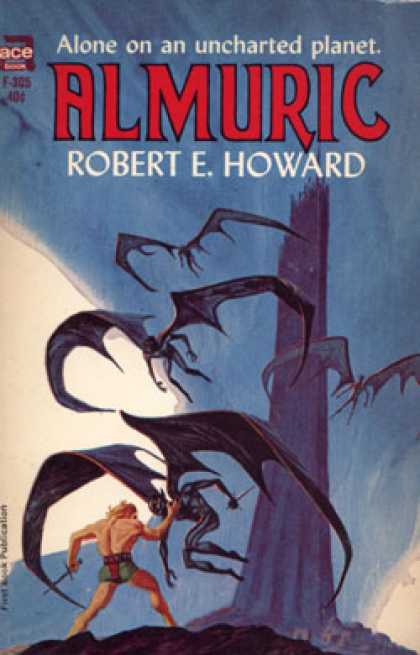
Robert E. Howard's Almuric


One of the things I love about Paizo's Planet Stories line is that it brings back a lot of material that is often hard to find in today's modern shelves of the latest fads. One of those books is Almuric, Robert E. Howard's take on the whole Planetary Romance inspired by a certain hero who went to Mars...


Below will be some quotes with some ideas of how they'd fit into one of my games and how I try to keep some things in mind when I'm gaming. Page numbers come from the 1st printing Paizo edition. Spoilers may follow so beware!


"It was chance led him there, the blind instinct of the hunted thing to find a den wherein to turn at bay." (p.15)


Often, when one door closes, another opens. If the party finds themselves overmatched, the Game Master must have a plan outside of the party runs for their lives. In some instances, whole campaigns can be built in this fashion. For example, back in the day, Orcus or Necromancer Games mentioned how he'd like to start an "Iron Tower" adventure path with the characters battling gnolls in treacherous terrain that plunges both character and monster into new venues.


Having an out that is a lead in for future adventurers provides the Game Master an opportunity that he may not need, but always has ready.


"Boss Blaine could not understand that he was dealing with a man to whom his power and wealth meant nothing." (p. 17)


This one's a little close in page numbers to the previous one and also hits on a theme I've mentioned before.


Players tend to run their characters unlike how people of those times would act. They're not real living breathing characters save to the most dedicated role player and the players are often willing to take chances with a character that any normal person would find insane. The Game Master needs to be careful that when dealing plot lines and making NPCs that none of them so motivate the players to action, that the action the players take is straight out murder that thrusts the entire party into a situation that requires either a whole new group of characters of a quick change of setting.


"The tangible and material can never be as grisly as the unknown, however perilous." (p. 22)


One of the great things about H. P. Lovecraft's work is the whole theme of the unknown. That there are things man isn't meant to know. That man is at his best, ignorant of the lowly position he has in the universe.


One of the great things about older Ravenloft material is how it would remind the Game Master to use description and details but not labels. Speak of an ogre's massive height and powerful frame, the low gleam of intelligence in it's eyes, the size of it's mammoth fists and the cruel edges to it's teeth, but do not actually call it an ogre. Players love to label things because they gain an accuracy of the enemy's strength.


By providing description without naming something though, while the Game Master is giving the players something solid and tangible to face, they still have the potential fear of the unknown. 3rd edition and 4th edition Dungeons and Dragons take this a long way too. Not only could an ogre be an ogre, it could be an ogre with some type of template or an ogre that is no mere soldier, but an elite brute.


"I made out only a dim gigantic shape, which somehow seemed infinitely longer than it was broad- out of natural proportions, somehow. It passed away up the vallye, and with its going, it was as if the night audibly expelled a gusty sight of relief." (pg. 32-33)


In addition to describing things that are tangible threats, the Game Master should be sure to include those that are simply beyond the ability of the characters at the moment. In the Stephen King novel and movie the Mist, there is a scene where the group witnessess a massive creature whose size makes the term behemoth seem too little. Showcase the awe of the setting, showcase the scope of the campaign. Allow players to note the hights and the lows even when they are not directly interferring with them.


Robert E. Howard wrote with an energy that was almost tangible to the reader. Make the players your readers and entrance them with description, but make sure that description not only leads to action, but leads to opportunity.

Sunday, October 11, 2009

A Meeting At Corvallis or A Little of This and A Little of That

One problem with reading a series of books by the same author is that sometimes the author is so intent on getting his message across that he's going to pound it into your eyes again and again. This seems particularly true of S. M. Stirling as he continues to hammer home the difference between those who were adults at the time of the Change and those that were children or weren't alive at that time.

This can be something that you may need to bring to your own game if there has been a huge campaign change and the characters are playing in a time line that goes beyond merely entering into dungeons and spending the loot at the local town. What differences did the change make to the campaign? In Dungeons and Dragons, with edition changes, the Forgotten Realms took a hammer to the head in both the 2nd and 4th edition turnovers. The very setting changed in order to accomidate the rule changes.

If you're going to be going for such changes, contrasting how things are done now as opposed to how they were rumored to be done is always something to keep at the back of your mind. In some cases though, it's part of the lure of fantasy settings in the first place. In most generic fantasy campaigns, magic used to be more powerful. Warriors used to be the sons and daughters of demi-gods if not outright gods themselves. Everything was better and anyone who has a hint of talent in the new setting must have some deep relationship to those passed ancients.


As far as A Meeting At Corvallis, below I'll be pointing out some specific quotes and how they may get your own brain juices working. All quotes are to the paperback version so spoilers will be found below.

Ever have non-player characters that you'd like to have the players encounter more than once? It can be tricky. Most abilities that characters have are geared to do one thing and that's kill the opposition. In many games, it's actually harder to take an enemy alive with a penalty to 'pull' your attack or to only do subdual damage.

This doesn't count what happens if the players don't kill the enemy but do take them prisoner. Now they have to worry about the prisoner trying to make an escape and being a general pain all around. Probably better to just kill them right?

What if you can make it worth the player's time though?

"We'll turn him over when his steward sends us five years' yield, " the Lady of the Dunedain replied curtly. "In cash of equivalents in cloth, horses, tools, and provisions of types and quantities to be agreed. We won't release him until the ransom is paid in full." (p.154)

Having the NPC tell the players outright when they're about to deliver that final blow that he's worth something alive is a quick way of possibly adding the character to the campaign latter on.

Other options would be to have the character know someone who knows something that the players need to know. The character himself is useless save for that one bit of knowledge.

Another option is that the character, due to race or class or training or heritage, has the ability to do something that none of the other players can and they need to keep him alive.

Note though that this can be good for a few chuckles if the players are smarter than the Game Master. For example, in the Dark Blade comic, there is a wizard who puts a map on his own skin thinking that will keep him alive. The dark elf cuts the skin off the wizard and kills him. If you've seen Minority Report, you'll note that some security is tied to other body parts.

If using this technique, make sure that it's a live heritage that's needed and not merely a body part unless the NPC is with a group of paladins or other nobel characters or you want to see how bloody the party is willing to get.

Thursday, October 8, 2009

Warring With Words


First off, beware the spoilers. I'll be starting with a little broader base than a direct quote to set the tone so that the quote make sense.


In S. M. Stirling's The Protector's War, the second book of the Change, there are numerous organizations. Some of them friendly towards one another and others that take various minor actions of war against one each other.


Two of the allied groups, the Bearkillers and the Clan Mackenzieare bound together not only by a common enemy, the Protector, but by Rudi, the child of Mike and Juniper, the leaders of each group. The child came about through a chance meeting before Mike would marry his queen.


In a down time setting, a magnificent horse is brought forth. The beast is everything a warrior would want save one thing. It's soiled. It's not fit for riding people. It's a mankiller.


"I could ride her! Like an ealge on the wind!"

"Kid, if you can convince your mother to buy that horse, go ahead!" he called again, his voice warm and friendly. "I'll go halves on the price for a cold of hers, if Juney can magic her into not being crazy-mean."


Signe Havel's voice was coolly neutral as she called: "I'll pay the man's price myself and give her to you if you can ride her, Rudi!"


Signe is essentially trying to get Rudi to kill himself through the boy's own lack of knowledge.


I've seen this happen in the game and it's usually not among the characters but rather the players. It's when one player users superior knowledge of how the game works to screw another player's character over and usually for a small benefit. Usually to get another character to take a cursed item for a chuckle or to set off a trap so that they don't have to endure it.


This behavior might not be fatal to a gaming group but what impression does it leave on the guy who isn't sure about the rules? Instead of encouraging the new player or trying to show the best of gaming, it showcases the worst attributes and it doesn't do it in any sense that is 'illegal' or against the rules, but nontheless, is wrong. Hazing is something you usually think of when you hear about frat houses or sports and should be left far and away from a group of people trying to entertain themselves through the use of a gaming system where people are taking on imaginary roles.


But in the game itself, ah, there's potential.


If the Game Master showcases the enemy to be brash, bold, and prone to acting before thinking, then players should be using not only sword arms and other combat based skills to take the action to them, but also using other abilities so that their enemies are taking risks that they don't necessarily have to take.


The same is also true for the game master. If the players are supremely sure of themselves and their abilities, there are fewer things more enjoyable then giving them the "okay" signal and having them have to work through the results of their potential folly.


Roleplaying games should stretch to move beyond combat not because combat is bad, but because combat should not be the only resource of the players or the game master.

Monday, October 5, 2009

A group effort

In 4th edtion, characters can't do it all by themselves. They have a buikt in need for each other. Is that realalistic or organic... lets look at a piece of fiction that han nothing to do with dungeons and dragons or old stle dark age fantasy. In the Protectors War, S. M. Stirling's second book of the Change, on page 62, it notes, "rangers or no they cant come back across the valley alone."

This is a reference to two characters whose skills are tried and tested and are at some of the highest levels of competenece.

And they still cannot go alone.

Travel is dangerous. Now mind you, if you don't encounter anything, if you're on well paved roads with numerous patrols and guards, then sure, everything is fine.

But 4e defaults to a points of light setting where travelling is not encouraged, or at least not encouraged to go by yourself.

This is all the more reason why characters should be joining into mercenary units or adventuring parties. It's not a full organic bit as there is still not a lot of trust inherent in joining others you may not know, or may not know well, but the motivation to travel and journey not by yourself, should be strong in such a setting.

Saturday, October 3, 2009

Gaming The News

The news is a never ending fountain of information that can be distilled to gaming in many ways.

For example, currently the news about Rio being the home of the 2016 Olympics is making all of the rounds. In your campaign, is there anything similiar to it? Are there games where the players can particiapte? Are there politics that the players can work at to negotiate where the sporting event is to be held?

In Raymond Feist's series, one around the time of the Talon of the Silver Hawk or so, one of the main characters is trained to be a part of society and in his training, he undergoes swordfighting with the best of them and wins the award. Such an award carries with it not only fame, but a target on the character's head. Now all of the young pups who want to prove how skilled they are will seek out the character either for trianing or to test their mettle against.

Also in the news are various horror stories on natural events like mudslides, earthquakes, flooding, and the world's reaction to those events. I've mentioned before that natural events can be massive in scope and effects can be far ranging but what happens if the players themselves aren't in any of these areas when it happens? What if instead they hear about it? What do they then do?

In a modern campaign, especially one where the players are in a super hero campaign, they may wish to lend their aid immediately but then have to deal with red tape. For example, what if the game master uses a cave in on a mine in China with trapper miners? Do the players have the authority to go to China and pit their powers to work or do they have to go through red tape and wait as people die?

Such an event can also be a good time to introduce new characters to a campaign. For example, say the plaeyrs are going to help but when they get there, they discover that one of the reasons China didn't want their help wasn't because it wouldn't have been useful, but rather because they have their own super heroes and no longer need wait on others to do the job for them.

In several cases, such characters are often carbon copies and are granted their power through something like power armor such as the Red Rockets from DC comics that originally appeared in the good old Green Lantern series when the Russians were 'bad'.

But what about personal problems? Take late night talk show host David Letterman. What if an event like this happens with one of the rulers in a campaign setting? What if the king all of the players have served for so long and so loyaly, has habits that some of the players aren't fond of? What happens if the game is a little darker and while the players may not care about the lusts of their ruler, this ruler, instead of making a public announcement, takes the players aside and informs them that someone is trying to hold the king's past indiscrecions against him and he would like the players to take care of the problem?

What of kidnap victims? In a fantasy game that includes the fey, there are many options that don't necessarily have to include the horrifics of an actual kidnapping. Perhaps when the eladrin kidnapped some lass, they did it because they were protecting her but now those hunting her have discovered the eladrin's home and while they would love to fight for her, they are not strong enough so hey, can you player characters take over this guardianship duty and by the way, her royal family is probably enormously pissed that she was kidnapped in the first place and is probably coming for you even now.

The news is vast and broad enough to provide thousands of campaign seeds if the game master is willing to tailor the news to his own campaign.

Friday, October 2, 2009

Dies the Fire by S. M. Stirling


S. M. Stirling's Dies the Fire is a novel where certain chemical reactions stop working and this pits the world back into a dark time. I read it because my mother and I don't share a lot of reading material so I thought it'd be fun. I know she's read the Stand and Swanswong so thought she'd enjoy these books. She's already read the first three and I'm way behind here.
In addition though, I thought, "Hell, it's not almost a thousand pages like Kate's books were." Lastly, I was in the mood for something a little different. While many of the main characters note that a lot of the themes and living styles of the old ways are coming back, they are still 'modern' people and know a lot more than their ancestors ever did. Something by an author I'd never read before on a series that looked interested and well supported? Sign me up.
Below I'll be taking a couple of direct quotes out of the paperback version so if you'd like to avoid spoilers, beware below.
"Well, what was it, then?" her mother said.
"I don't have fucking one clue about what it was," Dennis said. "But I've got this horrible feeling about what whatever-it-was did." (p.17)
To me, one of the worst things about the 4th edition Dungeons and Dragons version of the Forgotten Realms was, is that they took several massive events and put them in the past and spelled out how they all happened. Sometimes in novels, other times directly in the campaign guide. This doesn't leave a lot of mystery.
When something big happens, the players may have no clue as to what it all means. However, they'll quickly learn what it will mean to them in the future. For example, if you're running a campaign that uses various forms of magic, such as arcane, divine, psionic, what happens if one of those power types stops working?
If you're running a more modern campaign, such as Champions or Mutants and Masterminds, what happens if you follow the ideas in Dies the Fire? Instead of individuals running around trying to rework their own little worlds, you could have super heroes in a post apocalypse setting. Some of those heroes own abilities and powers may be vastly effected. For example, in a setting where high technology shuts down, what happens to characters like Iron Man and the Punisher? No more guns for mister skull face.
"These weren't bad peoplpe; probably none of them had so much as hit anyone since junior high. But they were desperate." (p.85)
One of the nice things about Dungeons and Dragons is that an orc is evil. Now sure, we could all hunt down and find examples of those noble orcs who aren't but for the most part, the black knight is evil, the goblins are evil, and all of those evil things are around to be killed.
But what happens when the enemy isn't so clearly evil? What happens if the enemy is your brother or sister? What happens if it's your fellow country men and they are merely reacting to disaster themselves? How do you handle the outcome?
"It's Yersinia pestis. The Plague. The Black Death. Those camps were filthy and swarming with rats, and plague's a speceis-jumper endemic among ground squirrels here in the West." (p. 337)
I've mentioned this a few times before, but finding things other than monsters to challenge the players can provide a lot of opportunity to grow the campaign in manners the stretch pass a dungeon crawl. Indeed, most dungeons are often depicted as damp and dirty anyway. What better place to pick up diesease? In 4th edition, if you want to challenge the players in this manner, there's a supplement for it.
"I never thought there would be any child but Eilir, she thought. But it seems You had other ideas..." (p.362)
When one of the characters discover that she's pregnant by, well, not a 'random' encounter, but by a short encounter, it leads to a life long complication. Characters in many fantasy games are often seen about the taverns seducing the wenches. If the campaign is a long plotted out one, what are the effects on such a character's reputation as a sire of many bastards? Does he take them in? Does he train them? Deny them?
On the female side of the table, I'd be very careful about making any female player's character pregnant. First off, it potentially takes the character out of an active adventuring life. Second off, it may be something that the female character is very uncomfortable with. In such cases, it never hurts to ask.
If done properly and the players are all for it, it can be something that creates family lines in the game. Some fantasy games, like Green Ronin's A Game of Thrones, are based off of novels where these details are very important.
"We didn't plan it that way, not at first, but it turned out that about all we've done since the Change is fight, train to fight, and work on our gear." (p. 492).
If that's not an explanation of what happens in games with defined goals like level advancement, I'm not sure what would. Game Masters who hate such games, should probably stay away from them. Whle they can be worked on and turned into other types of games with careful game mastery and with a group of willing players, why not find a game that suits the style of the game you want to play better? If it's all about killing things and levelling up, and that's what the players are there for, give it to them or get out of the way.