In Chicago, we're lucky to have the Lincoln Park Zoo. It's a free zoo to enter and has a wide variety of offerings that are always changings. For example, right now they just celebrated the birth of a baby gorilla, red panda, and tiger among many other additions.
In fiction, games, and other forms of media, the zoo can play an important role.
First, it's a location that has a lot of people in it. This could be useful if you need to have a setting where there are lots of people.
Those people mind you, are usually all about minding their own business because they are often there with children. Lots of noisy loud children.
Second it's a location that has a lot of potential trouble to it. The new movie coming out, Jurassic World is what goes wrong in a zoo of the future. In comics, there have been incidences where the characters use the animals around as assistants.
For example, in a Punisher arc, Frank shoots the glass out of a shark tank and the shark does the job of finishing off a criminal.
Third, it's a location that has a lot of potential activities to it. Characters could be looking for things to do and going to the zoo and watching ice sculptures being cut with chainsaws beats standing around in the cold doing nothing.
Other more likely scenarios include housing some unique animal or having events proclaiming the birth of a newcomer to the world.
Fourth, for a true turn of events, the characters can be from the zoo. They can be the animals that live there. The graphic novel Pride of Baghdad, written by Brian K Vaughan, features a group of lions that 'escape' the zoo when the country comes under attack. A powerful story with great art,
In a fantasy setting, such a place can be even more important. First off, it may have to be stocked. Where do such creatures come from in the first place? Sounds like a job for the characters.
When such creatures escape, as they are wont to do, who is there to put them back?
Showing posts with label A to Z Challenge. Show all posts
Showing posts with label A to Z Challenge. Show all posts
Thursday, April 30, 2015


Tuesday, April 28, 2015
Y is for Youth
All too often you can hear critics of the younger people. It's become such a standard accusation, there's a meme for it. Telling them to "Get off my lawn."
Depending on which side of the fence you're on, you'll probably thrill to movies like Grand Torino where a grizzled war veteran played by Clint Eastwood has to teach these young pups a lesson. This is similar to another Clint Eastwood movie, the western Unforgiven, where what appears to be a docile old man is in reality, the fiercest killer of them all.
If you're on the other side of the fence, you may see the youth of fiction such as Harry Potter and his 'wild ways' being a specific type of hero to handle specific foes. That the world weighs on his young shoulders but he is able to bear that burden responsibly.
Traditionally, America is a youth oriented consumer driven culture. In most older tales, the 'heroic journey' starts with a youth who has to learn and be doing so, learn and become wiser.
As America continues to gray, that focus is starting to shift. While such actors as Clint, and other aging power houses, continue to showcase that there is an audience for movies like the Expendables, Red, and others, its started to hit other venues like fiction.
Take for example, Druss the Legend. David Gemmell, long before it was cool, used both young foolish heroes, and battle hardened vets in his tales. He even took Druss, whose first appearance is a grizzled aged warrior, and went to the well many times with him.
Other authors like Joe Abercrombie, have taken a page from fantasy and westerns and crafted new stories like Red Country.
I've rambled between youth and old age. I've even pointed out several instances in which the older, wiser, more world weary character is called on to save the world.
But the future belongs to the youth. After all, sooner or later the old people will be dead no?
For those who are starting to gray like me, what's the youth of your region like? Are we looking at an upcoming golden age or are we going to have to rely on old war horses coming out of retirement to save us one last time?
X is For X-23

X-23: Target X was another book featured by both Amazon and Google Play recently as part of their 'girl power' sale on superheroes.
X-23 is a clone of the Marvel Comics mutant hero Wolverine. At this point, with numerous solo movies and being a part of a team, X-Men, with multiple movies, I'm not going to go into who Wolverine is. X-23 retains three claws, but only two of them per hand, and that third claw is in the foot. This gives her a bit of a surprise factor when fighting people used to battling Wolverine.
X-23 shares similarities to Firestar and Harley Quinn in that she was initially a character that appeared in cartons before her appearance in the comics. Since her initial appearance, X-23 has been in many solo series, team books, and limited series.
One of the strengths of Target X, is it puts X-23 firmly into the Marvel Universe. In her initial training, X-23 was trained to go into berserk rampages when hit with a 'trigger' scent. This is an odd 'weakness' but it has come into play several times.
But its important to note, some characters have a 'trigger' weakness that has nothing to do with going into a killing frenzy.

Here Captain America has come across a 'survivor' of a massacre. Too late as Cap puts her into an ambulance, does he realize that this 'survivor' is none other than the killer. Cap's desire to help has costs other people their lives even though he himself did not take them. Cap's need, his demand for acting the hero, was triggered.
X-23 also has her own nemesis here. the strange thing about the nemesis, is that in almost every encounter, even when X-23 gets the upper hand, this nemesis trounces X-23. So here's my question. Why make it a 'huge' deal to make clones of Wolverine when you can make an individual so powerful that they can trounce that clone?

That lady pounding on a young X-23 there? That's Kimura. She's indestructible. It's almost like one of those old poems where neither blade nor bullet nor whatever else you got punk is going to do anything to her. Kimura is also malicious and takes great joy in bringing pain to others, especially X-23.

X-23 grows in the volume in that her previous training and abilities as an assassin do come into play, but are also countered by her efforts at normalcy. Her time in high school gets her sent to the principal's office on numerous occasions as she has an almost Data or Spock like logic in answering questions posed to her, and with her wide body of knowledge, accumulated for the purpose of murdering people, her answers tend to fall on the rather shocking side.
For me, the volume was a hit on several areas. The art was good. The story was well paced. It took a former loner character and firmly put her into the Marvel Universe without overwhelming her with it. That is often a problem with a comic has a firm direction, like the original Runaways or Young Avengers, and it's so mashed into the greater setting, that the characters are overwhelmed.
The writers captured not only the things that make Captain America tick, but also Daredevil and Wolverine providing X-23 a great set of characters to compare and contrast to.
In the end, we're left with an X-23 whose on her own and has allies and perhaps even friends.
For myself, while I'm not a huge collector of comics, I've enjoyed her appearances in Avengers Arena as well as her stint in X-Force. The former a direct homage to Battle Royal and the later a tribute to the old New Mutants comic that evolved into X-Force, now come full circle to a hidden branch of the X-Men specializing in assassination.
Are there any particular story arcs others would recommend featuring X-23? Any particular dogs to avoid?
Monday, April 27, 2015
W is for Women Warlords
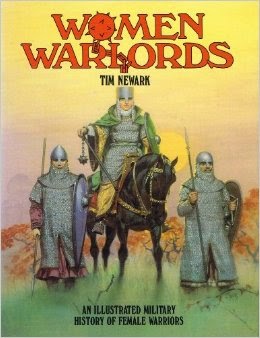
I don't remember where or when I picked up Women Warlord by Tim Newark. It's another case of a subject, women who don't follow the standards, that I said, "I'll read that sooner of later." The cover is of Matilda, the Countess of Tuscany with her warriors and is painted by Angus McBride. The book is published by Blandford, but the size, 144 black and white pages, and style, photos of ancient weapons, armor, and art, remind me of Osprey Publishing.
Written by Tim Newark, the book is broken into the following chapters:
The True Amazons:
When talking about the Amazons that the Greeks battled, Tim makes a case for them being an actual historical group.Sometimes these 'Amazons' are attributed a different name. For example, "There is a Scythian race,' wrote Hippocrates, 'dwelling around Lake Maeotis [the Sea of Azov] which differs from other races. Their name is Sauromate [Greek for Sarmatians]. Their women ride, shoot, and throw javelins when mounted. They remain virgins until they have killed three of their enemies and only then may they marry once they have performed the traditional sacred rites." (pg 12)
As I read a variety of material, I look at the supposed meeting between Thalestris, Queen of the Amazons and Alexander the Great. The two supposedly lay together for 13 days after which she left. Her sole purpose? To get a child of Alexander. I can see either a super hero comic or a modern thriller where the descendants of those two strive to live up to that legacy. Perhaps without knowing it, good old Doc Savage could be one of their children.
Amazons of the Jungle:
Brazil and Dahomey. When searching for the lost city of gold El Dorado, beware the amazons lead by Conori. The 'problem' is that even thought this is happening around 1545, confirmation is still not easy to come by. First, it's across the ocean. The failures of the Spanish initially might have needed a little... 'boost' to explain that it was not normal failure and that victory was just around the corner.Now that takes care of Brazil. In West Africa? Warrior women were not unknown. "A further four (women) stood behind him, carrying flintlock muskets on their shoulders. They were naked from the waist upwards, wearing gold rings around their arms and beads around their neck and in their hair. They were members of the king's elite bodyguard, composed completely of women. And this is during the 1850 era of slave trade.
There's some interesting quotes here. One of them reminds me of how mercenaries treat war. "War is our great friend,' said one. 'Without is there is no cloth, no armlets. Let us to war, conquer or die.' (pg 44)
The author of Imaro, Charles Saunders, had done enough research in his creation of Imaro to have enough material to create Dossouye, a warrior woman based off of West Africa body guards of kings, similar to the above.
Historically, it appears that ehre were four kinds of warriors as follows:
The Agbaraya or blunderbuseers: Veterans of the army and called into action only when urgently needed. The biggest and strongest warriors of the force, each accompanied by an attendant carrying ammunition.
The Gbeto, or elephant huntresses: The bravest warriors that carried out dangerous hunting expeditions and bore feocious scars of close encounters with wounded elephants.
The Nyekplehhentoh, or razor women. They carried a hinged sword about 18 inches long that shut into its scabbard like a razor. The blade was used for decapitation.
The Gulonentoh or musketeers, the majority of the armed warriors. (pg. 48)
Braver Than Her Husband:
Artemisia and Zenobia.
Artemisia, Queen of Halicarnassus, goes back in time. From the time of the West African Amazons, the author takes us to the time of Xerxes in 480 B. C. Those who've been to the movies might recognize the name Xerxes as he's the villain in Frank Miller's novel and movie, 300. Turns out Artemisia was a skilled strategist who might have turned a few of the failures of Xerxes to victory had he but listened to her.
Zenobia was wife and advisor to Odaenathus, ruler of Palmyra. Here we have a scenario that sounds like it played out of George R. R. Martin's Game of Thrones. Zenobia and her husband did much together. She was well respected. She was known to the soldiers. She was 'reputed' to be a descendant of Cleopatra.
But her husband was going to leave the kingdom to his son Herodes, and this son was from a previous marriage and well, wasn't too useful. Listed as worthless and spoilt.
So apparently Zenobia has Maeonius, the ruler's cousin, kill him. The cousin is in turn killed by Zenobia's soldiers. Herodes disappears after his father's death.
Zenobia rules as regent for her son, Vaballathus. She was not a modest regent either. She took a troop of some odd 70,000 soldiers into Egypt and defeated the Roman-Egyptian forces there. Mind you, those forces had their own problems with Goth Pirates from the Black Sea. Timing is everything eh?
Unfortunately for Zenobia, Rome came under new leadership, Aurelian, Roman Emperor between 270 and 275. And to all things that rise, they must fall. Despite some daring stopping maneuvers, Aurelian won the conflict.
Celtic Queens:
Medb, Cartimandua, and Boudica are included here. While I'm familiar with Medb and Boudica, I'm no scholar on either of them and it's good to see information on all three in one spot.
The author starts off with a brief telling of The Tain Bo Cuailnge. Medb having a confrontation with her husband about who was better off before they married the other. The husband has a slight advantage that Medb seeks to immediately redress by in her way the warrior known as Cuchulainn. She soon learns why they call him 'the Warped One' as when she seeks to trap him, he turns into a super human mass of muscle and power and tears through those setting the trap like tissue.
Lots of people turn up dying in this instance for one bull. Hundreds if not thousands. Heroes inflicting mass carnage and spilling gore of hundreds upon the land.
Cartimandua lives in the first century AD. She was the leader of the Brigantes, a confederation of tribes and was made richer by Roman governor Plautius who made her a client ruler.
Unfortunately, a falling out with her husband Venutius, winds up with Venutius leading Celts against Cartimandua who tries to rely on the strength of Rome to hold her position.
This indirectly leads to the rise of Boudica a few years later. When Boudica protest her treatment at Roman hands, she is whipped and her two royal daughters cornered and raped by Roman soldiers.
In exchange, Boudica gathered forces, spoken encouragement, waited while the Romans fought against the strength of the Druids in north Wales, and when the time was right, burned the colonial settlement at Colchester to the ground including all the men, women, and children.
When the legion IX Hispana was sent to bring order, only their leader, Petillius Cerealis and a few cavalry escape with their life.
Boudica continues her vengeance with some reports of deaths of Romans rising as high as 70,000.
It took several legions and one mass battle to decide the fate of Boudica and history at this time casts Rome as the winner. That 70,000 number of Romans supposedly killed is matched in horrific manner as "no less than 80,000 Britons died".
Women of Christ:
Included here are Aethelflaed, Matilda of Tuscany, and Eleanor of Aquitaine.
Aethelflaed of Mercia is well known to me not necessarily because of any actual effort I've put into reading history. Rather the writer Bernard Cornwell's Saxon Tales gave the eldest daughter of Alfred the Great quite a starting role in several of the books.
Aethelflaed, after her husband's death, works with her younger brother, Edward, to make England more united than it had been previously, and in so doing, make it a stronger England able to withstand the Viking invasions.
She was a political creature at heart. She didn't name herself queen, but rather, Myrcna hlaefdige (Lady of the Mercians). An official title that doesn't put her at odds with her brother, King Edward.
Despite the threat of the vikings, the people of Mercia were under attack from numerous forces including Irish, Norwegian, and Welsh. Aethelflaed responded by building more burhs and fortifications and sending armies against those who would do her people harm.
Matilda, Countess of Tuscany, doesn't have the same historical problem that Aethelflaed did. For the Lady of Mercia, her brother had to be seen as the guiding power, the crafty hand, the sole mover of events.
Matilda did not have the issue. Rather as the sole remaining child of Boniface of Canossa, who was assassinated in 1052 through the plotting of Emperor Henry III, Matilda was trained to excel.
She did so through not only courtly learning, but that of arms.
And while Matilda had no love for the German emperors, she did however, have loyalty to the papcy of Rome.
Her own private life was not easy. Married to Godfrey the Hunchback, she suffered the loss of a child who died in infancy. She separated from her husband who'd been rumored to attempt an assassination on the Pope. In 1076, Godfrey was murdered.
At this point, Matilda's loyalty to the pope is tested as Henry IV sought to depose of the pope, rising an 'antipope'. But the threat of excommunication gave Henry IV pause not necessarily because of what he thought, but of how his enemies could use that event against him. Matilda allowed the Pope to stay at the castle of Canossa and humbled the German emperor but it was a temporary humbling at best as in three short years, Henry IV elected an antipope.
Henry's initial forays worked well and Matilda suffers greatly during this period. The only thing preventing a total victory by Henry is the weather as the summer forces the soldiers to retreat north to Tuscany.
The pope secures the assistance of Robert Guiscard and his Norman warriors. Claiming other business, Henry retreats to the north.
Not one to waste such an event, Matilda uses the confusion to lead a small force of soldiers including horsemen and foot-soldiers and using a classic night ambush, dispatches several of her foes.
When times passes and Henry lays siege to her again, she proves a worthy warrior and leads her elite men out of a secret entrance of her castle and using a dense fog as cover, panics the forces of Henry who retreat rapidly.
Closing out this section, Eleanor of Aquitaine inherited a vast estate in 1137 at the age of 15 upon the death of her father. Due to this amount of wealth she controlled, the Capetian dynasty made her the Queen of France. As she grew older, she grew more involved with the politics of day to day. She traveled with Louis when in 1146 he 'took the cross', travelling the Holy Land.
Things didn't go well for Louis. Eleanor perhaps not taking the trip seriously, dressed in armor and carried weapons, as did her maids. Eleanor's favorite vassal, Geoffrey of Rancon, moved too far out of the other warriors and Turks ambushed them killing many. Geoffrey was held accountable and sent back to France.
Worse for Louis when in Antioch they meet Raymond, the prince of the city and Eleanor's uncle. Supposedly the two had something greater than he being her uncle between them. Conflict between Louis and her spread from that point until their marriage was annulled in 1152.
But she would be alone only a short time. So vast her wealth, she quickly took another husband, Henry Plantagenet, who might be more familiar as Henry II King of England.
But that relationship also went sour. She have five sons and three daughters by Henry. Richard I and John, the last born, would also become Kings of England. With some suspicion of her being the 'ringleader' of a rebellion against him, Henry brought Eleanor home and had her imprisoned for some odd 15 years and it wasn't till his death that she was freed.
She didn't let age slow her down though and remained very active, including gathering the random for Richard I release from the Duke of Austria as well as supporting John when he became king.
Hundred Years War Women:
While I'm reading for the new information, such as Jeanne of Montfort and Christine de Pisan, I did know Joan of Arc.
Jeanne is literally a leader. When he town is under siege, she dons armor, rides through the streets, encourages the people to fight. To take stones from the buildings and throw them at the enemy.
She leads a group of 300 horseman into the enemy's deserted encampment and sets it aflame.
When she escapes the French, she returns with reinforcements!
Because of her efforts, her town holds out long enough for the English army sent by King Edward to arrive.
That wasn't the only bit of action Jeanne had. She later wound up assembling 1,000 men-at-arms and 8,000 foot-soldiers to La Roche Derrien to fight against the encroaching French.
Further on timewise, Christine de Pisan was a writer who wrote Treasure of the City of Ladies in 1405. Her writings are a call to arms or rights if you will, for those women to take what is rightfully theirs and to seek "to protect her rights boldly by law and reason'. Another book mentioned here is Feats of Arms and Chivalry and compiles material from ancient military authors as well as modern ones.
Christine de Pisan died around 1429 and right before then, around 1428, Joan of Arc at the age of 16, is instructed to help the King of France. In 1431, after a brief and brilliant time as a symbol of France, Joan is burnt at the stake.
Because its covering such a wide swath of history, if you wanted more details on any of the subjects and individuals brought up, further research is recommended. Thankfully Tim includes a great bibliography and there are many new resources these days as well as more information comes to light and research becomes easier and more expanded.
Sunday, April 26, 2015
V is For Viking
I've long collected the various series by Osprey Military that include the Warriors Series and the Men-At-Arm series. With the +HISTORY channel just finishing airing Vikings Season Three, I decided to delve into my Warrior Series Volume 3, Viking Hersir 793-1066 AD: Weapons>Armor.Tactics. Note the cover below is not the current cover, but is is the one I have.

Vikings are a popular. Part of this is the warrior heritage. They are individual who 'do' things. It's easier to involve characters into stories when they are active in that story.
They are also not restricted to their own time. Marvel Comics for some odd forty years has been getting good mileage out of reimagining the adventures of Thor, one of the gods of the Vikings. This has included numerous versions of Thor in both the past and far future, as well as individuals with the power of Thor, thanks to an enchantment placed on Thor's hammer.
Even DC, which has mainly stayed with the Olympian Pantheon via Wonder Woman, has gotten mileage out of names such as Wotan, a mystical super villain who battled Dr. Fate.
In terms of writing, there are numerous tales of the Vikings which come to us, often hundreds of years after the events take place such as the saga of Vinland that I recently blogged about.
But for more modern audiences, writers like Bernard Cornwell are getting their milage out of the era. Bernard currently has eight books in his Saxon Tales, the latest being the Empty Throne, a first person narration and while I'm behind one book in the series, it's another look at the vikings that I've enjoyed.
The viking presence is also felt in role playing games. While I don't have the specific issue of Dragon Magazine in front of me, Dungeons and Dragons has taken it's own look at some of the berserkers from Viking lore.
Later on, during the 2nd edition era of Advanced Dungeons and Dragons, TSR started doing 'historical' books. The first one they did was HR 1 Vikings Campaign Sourcebook. This was a green faux leather cover book and while no longer available in print, DriveThruRPG is selling it in PDF format for $9.99.
This doesn't count other companies like I.C.E. who had their own historical line that brought different eras to Rolemaster. Their own book Vikings was another look at how to implement the mundane and fantastic mythological elements into MERP and Rolemaster. Makes perfect sense since at the time, I.C.E. was also doing Middle Earth Roleplaying, the aftermentioned MERP, and there are quite a few nods to the Norsemen in Middle Earth.
In short, Vikings were, and still are, a popular subject, especially to write about.
Part of this is their mythology. They have a full cycle. They know what is supposed to happen at the end of the world. They know that if they fight and die, they will go to join the king of the gods Odin.
Part of it is the unique elements they possess. For example, naming weapons and armor. Good weapons and armor will go down in history. Those who do legendary deeds, will do the same.
One thing that Viking Hersir pointed out that I did not know before, was that with the fragility of weapons versus time, especially over an era covering almost three hundred years, that if a sword broke, but it was a good quality sword, it would be reforged into a spearhead. The good metal too important to let sit rusting somewhere.
Other bits that Viking Hersir point out, that perhaps should be obvious, are that that scabbards do not survive. They often becomes melded through time into the weapons themselves. In fantasy campaigns, having a shealth that survived the tides of time would be a sure indicator that there was something not normal about sword and scabbard.
I admit one of the reasons I like the Warrior Series by Osprey, is the art. This volume is no exception. Gerry Embleton. He's a fantastic artist whose work can be found here. Gerry brings us twelve different full color plates.
As someone who also paints miniatures, one of the things I enjoyed was a full page of shields. While there are several 'normal' shields, there are also several patterned shields. While some cultures may have very elaborate and impossible to design by hand shields in 28mm, that's not true of the Vikings who often had one to three bright colors and simple designs.
Outside of Gerry's art, there are numerous photographs of actual items from the era ranging from swords and axe heads to helmets and scans of ancient art that has survived into the modern era. Makes for a great immersion even though the book is relatively short.
If you're a fan of the Vikings show and want to dip your toe into something that's going to provide a little more information and is written easily enough to follow with a ton of material referenced at the end, Viking Hersir is perfect.
Saturday, April 25, 2015
U is For Unique
In comics, books, and roleplaying games, there are often new characters, villains, and technology introduced with great frequency.
Sometimes these things are merely copies or built upon ideas formerly launched in the past. The recent run of Spider Man with it's whole Spider Universe for example, brought in numerous variants of Spider Man including some of whom have gone on to get their own series like Spider Gwen and Silk.
On the other hand, often there are new characters or monsters introduced that are unique.
Look at fantasy role playing games. New magic items, new spells, new classes, new variants to generate that 'unique' feel people want.
One of the original things people looked at when reading Elric for example, is that he was the opposite of Conan. He was not a barbarian. He was not a brawny thief. He was a spellcaster who worshiped a chaos god and used a magical sword. Not just any magical sword but a soul drinker. Perhaps not the first of its kind but quickly imitated in mass from that in games like Warhammer Fantasy and others.
Games like Dungeons and Dragons don't come out with numerous Monster Manuals and Fiend Folio's and have 3rd party supplements because people want the same old same old.
People want the unique. They want the unusual. They want the different encounters.
Sometimes this will be a hit. The original Fiend Folio from Advanced Dungeons and Dragons for example, has the race of Gith, the Elemental Evil Princes, Death Knights and other entities that stand the test of time for the last twenty years. On the other hand, some like the Flumph, while enjoyed by some, have not stood out quite so well. Pathfinder by Paizo even did a book to 'redeem' a lot of those monsters.
But don't be afraid to take risks. People may get a chuckle out of a failed unique encounter, but when it hits the right bars and that magic comes together to create a great encounter, you've got a home run.
Friday, April 24, 2015
T is For Trouble
When I say T is For Trouble, I'm not exactly talking about Big Trouble in Little China.
But I could be!
No, T is for Trouble in that your hero, your protagonist, could be minding their own business. They could be going about their daily chores. They could be, for all intents and purposes, dead to the world.
The world will not return the favor.
I've blogged about Usagi Yojimbo before. Published currently by +Dark Horse Comics , one of the hooks Stan Sakai uses to get Usagi into the action, is having his ronin rabbit stumble unto trouble as it's occurring.
Which is why I mentioned that I could be talking about Big Trouble in Little China. When it comes to an everyman whose bringing the audience into the action, you can't get much better than Jack Burton. Not only is he an entertaining SOB, he's got a few traits of survivability.
He's such a normal guy, he drives 'The Pork Chop Express', a semi.
But his friends? They know some weird people.
And when Jack goes with his friend to pick up said friend's girlfriend? Well, it leads into all sorts of interesting supernatural situations. What turned into the horrific real world enslavement of another person, becomes something more fantastic as Jack has to pit his wits, what few he has, against the ancient evil that has endured all that China's gods can throw at it.
Trouble comes in all shapes and all sizes. Trouble may look like it wants intervention but may not. One horrific thing that happens with much more frequency than it should, is when someone is being physically and verbally beaten and if someone goes to interfere, instead of being grateful, the person who is being beaten is outraged that an outsider would dare bring themselves into this private thing. "He doesn't mean it!" may be heard by any helpful outsider.
In such a situation, what is the hero to do? Taking on more responsibility as such a point may actually be irresponsible unless the character is willing to become fully enmeshed in the activity that drew his attention. How much time, how many resources, is the character willing to spend on what to all intents and purposes is some off change encounter?
Trouble has a way of showing up when you least expect it. Below are some examples:
Disease: Without warning, a disease that no one is prepared for exploded unto the scene.
Mugging: The characters have taken a short cut and in doing so, are witnessed to a mugging or worse.
Mistaken Identity: When the characters are entering the city, they are mistaken for another group of characters. This could range in circumstance. For example, one of the character could look exactly like another character or the characters as a whole could meet the metaphysical description of a group that is supposed to save the city, country, planet, universe, or something even grander like the multiverse.
Challenged: While minding their own business, perhaps even shopping, the characters are challenged. If one of the characters is a renowned swordsman, another swordsman has come to test that claim.
One in a lifetime opportunity: While out and about, the character discovers something that they never knew before which changes everything. This could be an opportunity to study in another country, or a deal on something they've wanted for a long time, but the "deal" is still so expensive that they have to sell everything else they own.
Trouble is always around the corner and it's the quickest way to get the characters moving when they appear to only want to stay home and bake peach pie.
Wednesday, April 22, 2015
S is For Supergirl
+Amazon.com and +Google Play both recently had numerous comics featuring leading ladies on sale. I managed to pick up quote a few deals at $2.99 per volume. Supergirl was another character that received a reboot in the new 52 with the first volume being Supergirl Volume 1: Last Daughter of Krypton.


Weighing in at 160 full color pages, this reintroduction to Supergirl is a win for me on several levels. About the only place it's not a win? The costume.
I'm not talking necessarily about design or anything but there's a lot of skin on the legs exposed yes?
So when reading the actual comic and it puts some information in perspective, you have to wonder, WTF?
For those who can't read it, "It's not clothing, it's armor!"
So you send your daughter through space and time with no armor on her legs or head? Now mind you, when I think about it, I have to wonder why the big S doesn't have a mask of the same material. Were the super advanced people of Krypton that vain? "Let us shield our soldiers and people but not the face!"
One of the bonus features of this volume was a sketchbook showing numerous designs. One of my favorites is probably the all white version. Mind you I could go for it in the traditional colors but the coverage, especially for armor, seems more appropriate.
I'm not going to get into the history of Supergirl. I'm not necessarily the best scholar of such. She's gone through a lot of changes and in most of her incarnations, has had some good writers and some bad runs. The DC staff mandate has changed from Superman is the only Kryptonian to "Hey, we put Zod back in the movies so let's not waste this opportunity!" although to be fair they've been using Zod in various ways in various incarnations for a while now.
The good news is that this is a strong introduction to the character. One of the problems I've often though female leads have is that they lack strong enemies. This Supergirl does not have that problem. Not only does she have a scientist trying to determine who and what she is (as if the Big Red S isn't a huge clue eh?) but she has foes directly tied into her Kryptonian heritage. Enemies that are as strong, if not stronger than her.
The variety in enemies, from characters that are soldiers in power armor, to generically engineered creatures on Earth, to those created from Kryptpton, as well as the solid designs on them, allow Supergirl to finally stand away from Superman in that she has a bit of her own mythos, her own reason, he own motivation. She's not just Clark but with legs.
If you're a fan of superhero comics and the opportunity to pick up at least the first volume in the New 52 happens your way, you won't be disappointed with this volume.
Tuesday, April 21, 2015
R is For Roland

The King of France is the grandson of King Charlemagne. Worthy of his own entry, suffice it to say King Charlemagne was reknown for many attributes and deeds that his children would strive to live up to and often come up short. But of those who served under King Charlemagne, it is Roland who has his own tales, told most famously in the book The Song of Roland.
Outside of the Song of Roland, this Paladin also features in the Matter of France or the Carolingian Cycle.
Personally, I remember Roland best not for his foolhardiness displayed in the book, but rather, for his appearance in Dragon Magazine and it's regular feature, Lords and Legends, issue 127 . This was a feature that often took characters from history or myth, and provided gaming stats for them.
In some ways, it was nice. You could see what a professional thought such and such would be in an actual game of Dungeons and Dragons. On the other, often because of the historical nature or at best 'legends' of the character, these heroes were woefully under equipped for Dungeons and Dragons having few magic items.
Roland is a part of France's history and his sword a part of what many could consider the first Holy Avengers in terms of its legend.
But those magic items they did have... For whatever reason, the author of that article, made Roland's sword, a named blade called Durandal, a +7 long sword holy avenger with other abilities like automatically hitting anyone with non-magic armor. As a power gamer even back in the day, I was impressed with it.
But I was also impressed because I had read the Elric saga when I was younger. These books are ancient so beware the spoilers ahead. In the later volume, Elric seeks out a Horn. It's Roland's Horn he seeks out and the Elric and Roland duel with Elric being the victor. In my youth, I had visions of Stormbringer, stats pulled forth from the original Deities and Demigods, and Durandal.
But the reason that fascinated me, was I had read the Song of Roland. I knew who Roland was. If you're reading a book and it throws an odd character in there whom you've never read about before or know anything about, the result probably isn't going to be the same.
That's why I always urge people to expand their horizons. Don't stick with just the popular current stuff. Dig into the older material not only so that you can see where the foundations of the modern authors often lie, but so that you have a broader appreciation of the genre as a whole.
Monday, April 20, 2015
Q is for Quote
Who has been in a game of Dungeons and Dragons and the cleric turns towards you and says "I find your lack of faith disturbing?"
How about Rifts and getting ready to raid a hideout of Xenos? "It is all about that base."
Quotes bring a lot of entertainment to a game.
They help everyone share the current pop culture, as well as showcase the group's personal preference for older material.
I know that in my group, the original movie Predator has many lines taken from it. The dreaded "If it bleeds we can kill it." is by far the favorite. It's even been made into a meme with "If it has stats we can kill it."
Quotes can also take on a life of their own. A Game of Thrones has a line, "You know nothing John Snow." One of the players accused the DM of not knowing anything. So that because "You know nothing Tom Snow." And we've used it many a time.
What are some of the favorite quotes that get thrown around at your gaming table?
Saturday, April 18, 2015
N is for Necromancer
Necromancy has come a long way from it's humble origins.
In a historical context, it's about communicating with the dead. I won't say that's it, but yeah, pretty much, that's it.
In those terms, the old Martha Wells novel, Death of The Necromancer, plays with its original function as well as what it's later become.
While it's long out of print, the Kindle version is only $2.99 so it makes an interesting read and Martha is a hell of a writer.
In role playing terms, especially in the grand father of RPGs, Dungeons and Dragons and it's sibling, Advanced Dungeons and Dragons, Necromancy is a school of magic. It's also, depending on the edition, a sphere of priestly studies. The effects tend to go well beyond merely speaking with the dead.
But not only necromancy as a school, but as a character archetype. So fascinating is the subject, that even 'back in the day', TSR was able to get a DMR (Dungeon Master Reference) out of it with The Complete Book of Necromancers. This was a fun little book with its own island setting making it useful for almost any standard setting that TSR was publishing back in the day.
The book isn't available in print anymore but you can buy it at DriveThruRPG.com nowadays for $9.99. If you want Necromancers that are more than game stats, it's a solid book. Don't misunderstand me, it includes a lot of gaming information for AD&D 2nd edition but unless you're playing that edition, the game mechanics might be a little dated.
When thinking about Necromancers, there are a lot of subjects to think about.
What happens to dead people? This isn't a question of people rising as zombies after death but rather, a question on what happens to a person's corpse. In a fantasy setting that is known to have magic that can raise the dead, what purpose would not burning the bodies or at the very least, binding the bodies have? "Well, I know that necromancers are real and that the undead can be created through their magic, but hell, let's not actually do a single thing to prevent that."
Is Necromancy Inherently Evil? Necromancers are often portrayed as evil individuals from their dealings with all of the negative energy they handle. The Complete Necromancer's Handbook plays against type with some options, and Kobold Press has a book, New Paths Compendium, with a White Necromancer. Nat Russo has his own take on it in his series starting with the Necromancer Awakening.
Thinking about the role of necromancer in the setting can have a huge impact on how the entire setting works. Are there famous necromancers? Some that are 'fated' to return?
One of my favorites in that region was Nagash in the Warhammer Old World. There was something appealing in a 'normal' person who creates the whole concept of Necromancy. Who creates the first vampires. Who undergoes a physical change to such a point that his own body becomes engorged with the power and he becomes a giant.
If you've followed me on Twitter or over on RPG.net, you'll note that I've wanted Nagash to return to Warhammer for a long time. When Games Workshop was doing their yearly story lines, I had hoped for a 'Summer of Nagash' where they would release new sculpts of old figures with new stats and have one of those campaigns where the players would determine the fate of the world!
Mind you Games Workshops efforts in this endeavor had failed to a certain extend in previous years thanks to the ham fisted writing of the Games Workshop staff who seemed unable to accept that Chaos was stomped into the ground so soundly when they should have been posed for victory...
But Games Workshop in an effort to invigorate the Old World, went a step further. Nagash was the first to have his 'End Times' book published and it literally was the start of the end for the Old World of Warhammer.
But other companies, like En World Publishing, have their own versions of a powerful necromancer. In this case, it was a book called Necromancer's Legacy, Gar'Udok's Necromantic Arts. A book designed under the OGL and d20 license for 3rd edition of Dungeons and Dragons. It was filled with monsters, prestige classes, spells, and magic items with it's own story of Gar'Udok. Good stuff for those looking for a name less famous than Nagash.
Necromancers have long been a staple of fantasy games as the villains. How have you used Necromancers in your own campaign? One shot use? Campaign villain? Individuals who have challenged the likes of Orcus for their throne?
Friday, April 17, 2015
M is For Master
One of the things I enjoyed about Fullmetal Alchemist was the different villains that it showcased. There always was another villain behind the current one. It allowed the heroes to progress in power, ability, and knowledge, while still providing them a challenge.
When we are first introduced to the minor character Cornello, he is a false priest stirring up revolution. His claim to fame is the ability to craft 'miracles' based on his faith.
When Ed and Al defeat him, Father Cornello is then confronted by Lust and Gluttony. Another bit higher up the chain. That encounter does not end well for the poor father.
We then encounter further 'Sins' up the ladder such as Envy and Wrath. Sometime later 'Father' and the first of the 'Sins' Pride.
By having multiple villains of various power level and various abilities, the characters have to learn and adapt. For example, when fighting the Sin known as Greed, Ed learns that Greed's Ultimate Shield is carbon based and manages to weaken it using his alchemy.
While it's good to have a chain of villains related to one another, in this case Cornello working for Lust, Lust working for 'Father' and the various other circles that happen due to 'Father's influence, such as the Crimson Alchemist working for Pride who in turn works for 'Father', it's also important to have characters and opposition that is not necessarily related directly to those foes.
Fullmetal does that with their antihero Scar. Originally from the war torn country of Ishval, he hunts down the State Alchemists who he feels are responsible for so much pain and suffering in his home country. He almost manages to kill both Ed and Al in their first encounter and only through strange circumstances do Ed and Scar wind up as allies against the Sins.
The Pathfinder Adventure Paths by Paizo follow a similar pattern. The first few books may often involve some lowly creature, like say a horned bandit king in Kingmaker, while five books down the road, the power behind the throne awaits. Because it's a huge setting, Paizo also throws a few other bits in there to insure that it's not just all minions of the big boss all the time.
And often there are opportunities to bring foes over to your side. This allows former enemies to become allies. In Kingmarker there are several such opportunities and in other Adventure Paths, similar circumstances allow players, through clever role playing or mercenary individuals who see opportunity when the player's come calling, to switch sides.
When designing your own villains, don't forget, there's always somebody smarter than yourself.
Thursday, April 16, 2015
L is For Leadership
When it comes to role playing games, there aren't necessarily a break down of the group into leaders and followers.
So what am I talking about when I say L is for Leadership?
Be the type of player you want to play with.
Do you show up late to the games and hate it when other people are later then you? Think about it and make the effort to show up on time.
Have you ever blown off your group and not called to let them know you weren't making it?
Have you ever been at the game and had the GM waiting to find out what's going on with that one guy?
Think about it and make the small effort to call and let the group know you're not going to be there. The earlier the better because if other people cancel, and some of them don't call? The game itself may be cancelled.
This type of 'leadership' can go into everything that happens at the game.
Do your games get bogged down in rules questions? Learn the system better. You're not doing it to showboat your knowledge of the game, but rather, to get the game moving forward again.
Does your group use miniatures? Can you provide your own?
Are you going to someone else's house to play? Bring the host refreshments. I've been to games that have run where no one outside of a few select people bring soda and chips and you have to look at the other guys like "Really? You'll sit here and eat the food and drink the soda and never bring any yourself?" Don't be that guy.
Here's another tip. If the place you're playing isn't owned outright by the host, bring something for the actual owners. Order them a pizza. Role players can be loud and obnoxious at times without ever meaning to. I know there has been more than one shout of "Nat 20!" in games I've played and if anything, I'm positive my group is not alone in that.
I know that for some people, there is a financial costs here that even when moderate when compared to other things (what is it, $4 for a Starbucks coffee) that you may not be able to afford it.
That's when you need to do the non-costing things. Get there early. Offer to help set up. Offer to hep clean up. Offer to take out the garbage if enough has accumulated during game time. There are things that don't cost any money that are appreciated.
Be the gamer you want to play with.
Are there any other positive attributes we gamers should be bringing to the table? Throw a comment down below!.
Wednesday, April 15, 2015
K is For Knowledge
For many people in the so called 'industrialized' world, we live in an age of almost instant knowledge. Want to know stats of your favorite baseball team? What to know when a war started or ended? Google and other resources are handily available.
Our ability to know things is tremendous.
Our capacity to double that knowledge is ever increasing as the world becomes more networked. What took hundreds of years to double the body of human knowledge is now a fraction of that time.
The problem is that people are involved in such information.
For example, you look at a web site like "You Are Not So Smart" and it point out how terribly stupid people are.
Some of my favorites:
The Science of Misremembering. You can't trust your own memories. How horrible is that? As you age and your opinions change and your ideas evolve, hey, guess what? You tend to think you always thought that way. This could be one of the big reasons why politicians are always caught flip flopping on issues. It's not that they honestly don't remember holding another position, it's that their own brains have rewired their memories so that they've always thought, that what they currently think, is what they've always thought.
There's also the Black Swan effect. When things happen that no one thought would happen, people look on it and then invent whole scenarios and stories about why we didn't stop it. Why we didn't plan for it. All along the ability to actually plan for something of similar scope happening again? Ignored.
A great blog post by Post-Mortems, talks about the Whys of things. One of the things it points out, is that we honestly think we're going to be smarter in the future then we are today. For some reason, we've convinced ourselves that if we have a problem today, that if we have the exact same problem or a similar one in the future, because hey man, we make progress around here, it'll be easier to handle.
Big can of Nope there! If the effort isn't put in to advance the knowledge of how to prevent, fix, document, ad etcetera the problem to begin with, whoever comes after you is going to run into similar problems and have to start at ground zero in fixing them.
There's also the problem in that numbers mean what you want them to mean. You have to have a huge amount of context when dealing with numbers, including knowing what the other person's point and goal is.
For example, there are more white people on public aid then there are black people.
Counter, there is a higher ratio of black people on public aid than white people.
In both instances it's terrible that we need public aid to support people as opposed to having excellent job training, public college to assist in that training, and public health care to you know, not bankrupt anyone whose ever had medical issues, but each number tells you something and depending on who you're talking to, you'll be able to quickly see where they stand on a number of social issues.
K is for Knowledge but it's not something we should be proud of. When thinking about who you are, write it down. Come back to it in a month, in a year. Are you still the same person. When looking at a problem you've had in the past, write it down. Develop your method for dealing with it in the future. Did it happen again? Did it help?
Knowledge isn't just the regurgitation of information. It's the application.
Thursday, April 9, 2015
F is For Full Metal Alchemist

Full Metal Alchemist is a story about two brothers trying to reclaim their lost humanity. Along the way they make numerous friends and enemies and wind up in a much larger scale of events than they had ever anticipated.
The series has proven very popular. There are two separate animes on it. While this is not unusual (see Gundam), the fact that they came out so close together is a little unusual. There is also a lengthy manga. I stopped reading a while ago as I had caught up to the series and after watching the new anime, will have to go back and catch up on it all over again.
One of the things that's great about Fullmetal Alchemist, is the world building. By making the characters Edward and Alphone, into specialist in a field of specialist, the viewers are able to have numerous favorites. There are different named characters like the 'Crimson Alchemist' or the 'Flame Alchemist'. Some very impressive sounding names.
These named characters also have named maneuvers and abilities. This puts them into a category that is above the standard soldier. In many ways, this makes them perfect classes with each type of class having a different specialization.
Because they work for the government, they also automatically have a patron. This prevents the Game Master from having to work too hard in order to get the characters involved with the adventure.
When a setting gives you an "in" like this, it can make running the campaign easier. In the classic game, Legend of the Five Rings, one of the suggestions is to make the characters Emerald Magistrates. This allows the game to get moving without the dreaded "You all meet in a bar" standard. In newer games, Spears of the Dawn has a similar option in that the title, Spears of the Dawn, is an actual title of those who fought against monsters and are well respected.
Ed and Al have their own motivations though. In this case, it is to get their bodies back. To do this, they need to do research. This involves them going to different research faculties and studying. While that could be boring, the writer showcases several small bits that are anything but ranging from a burned down library, to a random encounter with a former state alchemist who knows more than he's telling.
By having both options, player driven quests, and the ability to introduce patron level quests, the Game Master has the best of both worlds. Indeed, if the characters are having too easy a time of getting their own deeds, the Game Master can add complications through the patron. They may have to do some standard guard duty instead of hunting down that serial killer.
Of course players will seek to work around such restrictions but that's the point. The conflict of trying to do what they want against what others want them to do, is how the game creates a sense of tension.
The setting that Fullmetal takes place in, is one that has a variety of creatures that themselves can be different than one another. For example, Alphonse does not have a body, but rather, his soul is bonded to a suit of armor. During the series, we discover that there are others like this.
There are also combinations of men and animal known as chimeria. Each one potentially different than the others.
Then there are the Seven Sins. Some of these are 'standard' like Lust and Gluttony while others are a bit more friendly than you'd think.
The setting is large enough to weave numerous threats that the characters can't overcome just with punching or kicking.
Despite the grim overtones the series carries, the writer is able to weave quite a bit of humor into it. This should be something that a Game Master keeps in mind when prepping his own work. Even as plagues and zombies take over the land, there needs to be some genuinely funny things. Perhaps someone has a favorite cup that he dropped and is always talking about it. "My favorite cup!"
The humor helps break down the gruesome elements and gives the viewer a break and allows the reader to recharge her batteries.
Another element to note, is that there are changing alliances. One of the most popular characters here is Scar, named (originally!) after his scarred face. He's a tough loner who hates the heroes! This type of anti-hero is fairly common and the anime/manga Dragon Ball Z is littered with characters who once fought against Goku but now work alongside him.
When designing your NPCs, are there 'hooks' that the characters can use to turn them from enemies to friends? Are there deeds that the characters can perform to show these foes that the players are not the true enemies?
Have any other gamers used Fullmetal Alchemist as inspiration for their games? If so, how did it go? I have friends who are enamored of the art style in the series and love the animated suits of armor as well as some of the villains the characters face.
Friday, April 29, 2011
Z Is for Zoo
In a fantasy city, where would all of the wondrous animals, monsters, and other unique entities be found? Why, in the zoo of course.
On one hand, in a fantasy city setting, zoos may seem incredibly dangerous. After all, some of the inhabitants there are bound to get out and cause all sorts of trouble. Well, that depends on the nature of the creatures released and how often it happens.
In C J Sansom's Soverign, while Matthew is out and about, someone opns up a bear cage in an effort to get the bear to finish him off. In a D&D campaign, perhaps someone lets out some creatures in order to take advantage of the chaos the situation brings, an indirect method of murder, or because they feel a social injustice is being done to the monster.
In some settings, the zoo may be huge. For example, in basic D&D, the Hollow Earth, is essentially one big perserve with people among its many wonders. In some ways, its whole purpose is to shelter civilizations that simply couldn't make it on the surface world.
Players may find themselves tossed up as oddities on an alien world if your game runs a little closer to the Planetary Romance that has a lot of influence on earlier editions of the game. Whole cities may be captured and put on display, such as the alien Brianic does with different civilizations to study and perseve them.
The more fantastic the setting, the more high end such zoos can be. In one campaign I ran, there were a series of islands run by mages with the entry point "Mage's Port", holding a wide variety of animals that were not native to the mainland, so that new travellers could quickly learn some of the flora and fauna about the place. In addition, the guilds offered high fees for animals brought back alive for further study, and lesser funds for those brought back dead but intact for museum pieces.
In additilon, if you just want another showpiece of how far the cilization has come, a well tended, well run zoo can be a sign of many things, and power is one of them. Who has the funds to take care of these animals? To feed them? To shelter them? To treat them when sick? To provide habitats that they can thrive in? Even in today's soceity, not all zoos are equal and not all zoos can quality as something where animals are taken care of and are not under a death sentence. You can tell a lot about a ciliziation by the way the treat their less fortunate people and their animals in captivity.
Y Is For Youth
Usagi Yojimbo has meet individuals who have children before, such as the spoof of Lone Wolf and Cub, Lone Goat and Cub. His own indiscretions have also gifted him with his own son, Jotaro. Their relationship is complicated because Jotaro has been raised by his rival, as Usagi was first serving with his lord, and unaware of Jotaro and then latter, Usagi was wandering, still unaware of him.
As the series has progressed though, Jotaro became a known entity in Usagi's life. A glimpse at the road not taken. In the series, it seems that many people know that Jotaro is Usagi's son. The mother, Usagi's mentor, Usagi, Jotaro, and well, its often remarked how they resemble each other like father and son by whoever seems them.
But Usagi and Jotaro themselves do not know that each of the other knows. It makes for some interesting moments.
Stan is able to capitalize on these relationships in Duel At Kitanoji, Travels with Jotaro, and Fathers and Sons. Here we directly see how Usagi's actions, and those of others around him, directly influence the youth of today, who will be the inheritors of tomorrow.
As Jotaro is but one of Katsuichi's students, we see how other members of the young are doing. His other pupil Shunji is far more... traditional in his thinking. For example, his fighting style and potential doesn't match Katsuichi's own teachings. In one instance, when a peasant is wounded, Shunji questions why the peasant is allowed to rest on a cart while the Samurai walk, whereas Jotaro takes the more common sense answer of not expecting a man wounded like that to walk.
The idea of the young though, isn't limited to just Usagi and his trails. Super Hero comics are fairly famous for trying to bring a generational theme to bear as they continue to evolve. Sometimes this may have started off as origin points for the main characters, other times a direct result of advancing the timeline and using an alternative time line.
For example, Spider Girl. Based off of a What If issue, the series had a good run as the direct daughter of Spider Man wove her way through a future that included the Fantastic Five, Avengers Next, and a host of other changes in the M2 universe. Several characters in that timeline were direct descendants of modern characters such as J2, Juggernaught's Son, Giant Girl, whose actually become part of standard Marvel Fare, Thunderstrike, another one whose become part of standard Marvel Fare, Wild Thing, Wolverine and Electra's daughter, and others.
When looking at the campaign and the setting, think of what effect the upcoming generation will have on it. The things that the younger people will find of intrest, will understand more inherently, will move to more quickly. These elements may be something that older characters may be wise to observe or if stuck in their own ways, fade to black.
Wednesday, April 27, 2011
X is For Xenophobia
Xenophobia is a very powerful thing. The infamous drow ranger, Drizzt, suffers from it most of his early adventurers. Most, if not all of the surface world, suffers Xenophobia when dealing with the drow. This is part of the 'charm of the character if you will. He must strive against the stereotypes that have grown up about his race while maintaining his own code of honor and goodness.
Others that suffer from this treatment, like Elric, a creation of Michael Moorcock, don't necessarily have to deal with the issues of a morale compass that put them in conflict with the forces aligned against them, but must suffer the quick judgements of those who are afraid of Elric's race or simply wish them dead.
This is not something limited to older fiction though. Oh how I shudder when I think of labelling Drizzit as older fiction, but hey, if I remember reading it in high school and I'm closing in on 40... Anyway, Sarath, a cambion in Rich Baker's Swords of the Moonsea trilogy, worries about his own appearance because he wears his heritage on his face being a cambion that resembles something between a devil and a human. In the third book of the series, Avenger, while imprisoned, he worries that someone with his appearance will not receive a fair trail, if a trail at all, due to his appearance from the elves of Myth Drannor.
Now that last part is something to keep in mind when designing your fantasy cities. The fantastic elf city, our demonic friend Sarath worries, suffers some xenophobia. He has good reason to. In many bits of fantasy fiction, the older races of dwarves and elves, are generally convinced that their ancient abilities, their old homes, their lost structures and ruins, are means of such masterpiece, that today's efforts hardly scratch the surface of what they are capable of, but nonetheless, they are still superior to the works of man.
Keep in mind the potential advanced age, or long life of the races in question. Elves could live to see generations of humans come and go. Perhaps they are correct in that all things elf are greater than what man or dwarf could craft. In Privateer Press, the elves of that game system have unique forces at their disposal and are more than willing to engage the Retribution of Scyrah with the most modern and telling of Warmachine factions.
When looking at your fantasy cities, what is the outlook of the locals? Are they striving to learn from, and improve upon the past, or are they inherently satisfied with the deeds of the ancients? Are they positive that their own ways are superior to all others, or are they open to judging an individual by his own deeds? As the game has progressed and changed, Dungeons and Dragons has went from race as a class, to race as a choice, to race being almost anything in the game system, including, as Heroes of Shadow, the latest 4e supplement would allow, vampires, as a core race.
Would the people of the city look upon vampires as a resource? Would they look upon them as something to be hounded and hunted off the bat? The Noble Dead series by Barb Handee had different answers depending on who you asked ranging from death on sight to vampires don't exist, and the answer may be different for vampires than it is tielflings, as different settings play with different histories and assumptions.
Xenophobia is something that is already inherent in many fantasy defaults and is something that game masters can have a lot of fun with. Imagine that the old dwarf and elf animosity has long since faded, replaced by dragonborn and tiefling hatred as that is now the core setting and you may even be able to run different assumptions within the party.
Tuesday, April 26, 2011
W Is For Waterway
I've always liked the idea of a city where the waterways are the main mode of transportation. A place where small boats are the norm and people move about to and fro on them. Where the water, for the most part, is just another obstacle, but still has its secrets and mysteries. After all, in a fantasy game, who knows what monsters may lurk underneath the surface, depending on how deep the waterways are and how far they travel out.
Waterways provide a means of transportation.
Waterways provide a means of trade.
Waterways provide a different look and potentially feel for a city.
In a standard D&Dish campaign, a waterway ridden city could have a number of different origins. While D&D has traditionally used sea elves for such things, what if the people who founded the city were of a little more malicious nature, like pirates and bandits, and didn't have quite the reservations about working with the Deep Ones, or one of D&D's many takes on them such as the Kuo-Toa? Here the riverways are still mostly safe, but sacrifices are made in exchange for that safety. Perhaps the deep ones inform the pirates of ships in the nearby region. Perhaps they all make sacrifices to Dagon together? Perhaps there is a breeding program or eons old pact that keeps the people of the city tied to the people of the depths?
When looking at some unique or rarely used factors a city can have, waterways, such as those found here, are different enough to stand out in players minds.
Monday, April 25, 2011
V is For Victim
One of the things I've noted about Usagi Yojimbo, is that he tends to stumble onto those in need of his help. In a game where the players are in a heroic mode, or at least concerned enough about their fellows to stop and help them out, the idea of using victims to set up the game is right in line with how things often run for the long eared samurai.
For instance, in Usagi Yojimbo The Shrouded Moon, Stan has Usagi seeing a beating in an alley as four thugs beat on one victim. Becoming involved, Usagi learns that the person being attacked isn't quite a lowly innocent. This is a pattern that often happens to Usagi as he assist someone who is not necessarily as helpless as their initial situation seems.
Game Masters can take it a step further. In older adventurers, it was almost a sight gag that if there was an attractive woman being held prisoner by the villains, that she herself was a vampire, succubus, doppelganger, or other obvious trap. This was much the same as when seeing a highly valuable treasure out in the open with no apparent guards or traps. If it was too good to be true, it was.
The only problem with handling things like this too often though, is most players get their cues from the Game Master. If the GM insist that it is a game of high fantasy and heroism and keeps slitting the player's throats through the use of victims who are actually monsters, then pretty soon, if not immediately, the players will stop helping the victims. They may not become so madden that they attack and kill everyone they meet who may be a victim, but that easy in to the game of throwing the players into a situation where they can help someone, will be gone.
When thinking about using a victim, you need to decide how the character in question has been wronged. Is the victim someone that has been murdered and needs avenging? Is the character someone who has been bested unfairly and needs justice? Is it someone that's been robbed and will suffer dire consequences if the funds are not returned, or another source of funds used to replace them?
Victims come in all shapes and sizes. The rewards for helping different individuals should be different. When helping a noble regain lost honor or a prized possession, a monetary award should suffice. When helping a peasant or harlot whose been attacked and perhaps even killed or scarred or sold into slavery, a XP story award based reward should suffice to keep the players motivated. Remember, that despite some people's enjoyment of the game and the role playing elements they can bring to it, to others it is just a game and without some type of compensation, either in gold or in intangible xp, they may not go for it.
Victims are a useful tool in the Game Master's bag and should be used when appropriate.
Subscribe to:
Posts (Atom)


