Showing posts with label Michael Moorcock. Show all posts

Saturday, July 6, 2024

Corum and the art of killing Gods


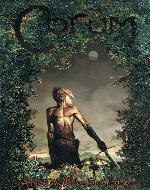
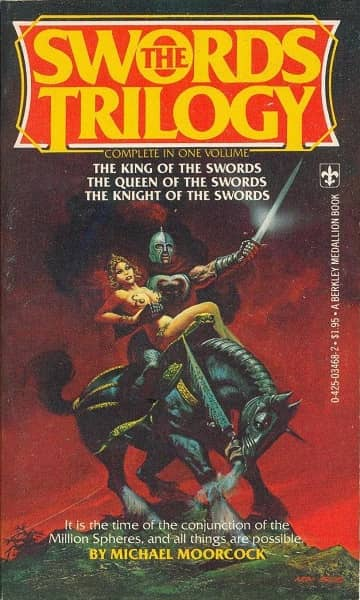
In Michael Moorcock's first Corum Series, the Swords trilogy, Corum must save his 15 planes from the powers of Chaos.

These powers are represented by the Kight, Queen, and King of the Swords.  For those who are more familiar with Michael Moorcock's Elric series, the Knight of the swords should be very familiar as it's Arioch, Elric's patron demon god.

Over the course of three novels, Corum dos manages to banish these gods.

Depending on the edition of Dungeons and Dragons you've run or played in, this might not seem that odd. Early editions of the god featured stats that, while powerful, were not so out of line that a group of players couldn't kill them.

Third party companies like Wizards of the Coast, when they were producing TRPG content, even made a series of books to augment gods with Primal forces which cut through mortal defenses. That was The Primal order series of books. Fun stuff. Find it if you can. Greatart.

But back to Corum.

Corum, at this point, has two artifacts, the Hand of Kwll and the Eye of Rhynn. They are described in detail. The hand is physically powerful and Kwll, unknown to Corum, controls the hand directly in several cases to save Corum's life.

So how does one go about killing the gods?

The Knight of Swords notes that Gods have to keep their heart separate from themselves so that the other rules know their whereabouts. Corum has to destroy it. Arioch leads him around, and Corum deduces where it is.

But it was a game because Arioch was unable to remove his own heart and Corum, taking it from it's chambers, has done Arioch a service.

Oh no!

So Corum's hand does the logical thing and crushes it. This banishes Arioch.

So no actual fight. No big battle. No clash of swords. 

The Queen of Swords is enraged at her brother's banishment. But she cannot go to Corum's five planes. There are rules of balance after all. The Eternal Balance must be maintained.

But Corum angers the Goddess so much she decides she is more powerful than the balance itself! She enters Corum's plane and... the Cosmic Balance Banishes her.

The King of Swords gets to meet the lost god Kwll directly. Corum, after finding Tanelorn, the city of refuge, the city of peace, a city with as many incarnations as there are champions, discovers that this Tanelorn is being used to imprison Kwll.

Kwll wants his hand back. Corum asks him to fight Chaos. Some back and forth and we get Kwll kind of agreeing but not really.

But then when it comes time to fight, Corum is shocked at the raw forces of chaos arrayed against them and tells Kwll to retreat and not honor the bargain.

Kwll gives a great line. "I made no bargain." And proceeds to destroy all the gods of chaos reamining.

Oh, and all the gods of law.

I don't point these out to indicate that it's lame or a cop-out. But to indicate that sometimes the way characters win, especially in older tales where the heroes have no direct manner of winning, no sword strength or sorcery powerful enough to win, there are often other ways to win.

Many of Corum's adventurers could be done with skill checks and investigation. Rare is it when Corum solely wins through strength of arms, and many times when he does, it is in a situation where he did not wish to do so, but Kwll controlled the hand and forced him to violence.

Think about how things can be accomplished in your own games that don't involve swinging a sword. Are there multiple paths that will get the players to the same place? Some are easier than others. Some provide a greater reward with risk than others.

Corum is an interesting read in that when Gods die, they don't die but are merely banished and have a host of early ideas that others have built upon. Go check them out.


Thursday, July 4, 2024

Corum by Michael Moorcock


As a preteen, I read a lot. My father lived by Diversy and where Clark and Broadway merged. There were several bookstores and used bookstores in the area.  Mind you, this was before Barnes and Noble and even Borders. We had Crown, Waldenbooks, Barbarba's Books, and the bookstores that were used, among others.

So I was always buying books and back in those days at least, reading them.

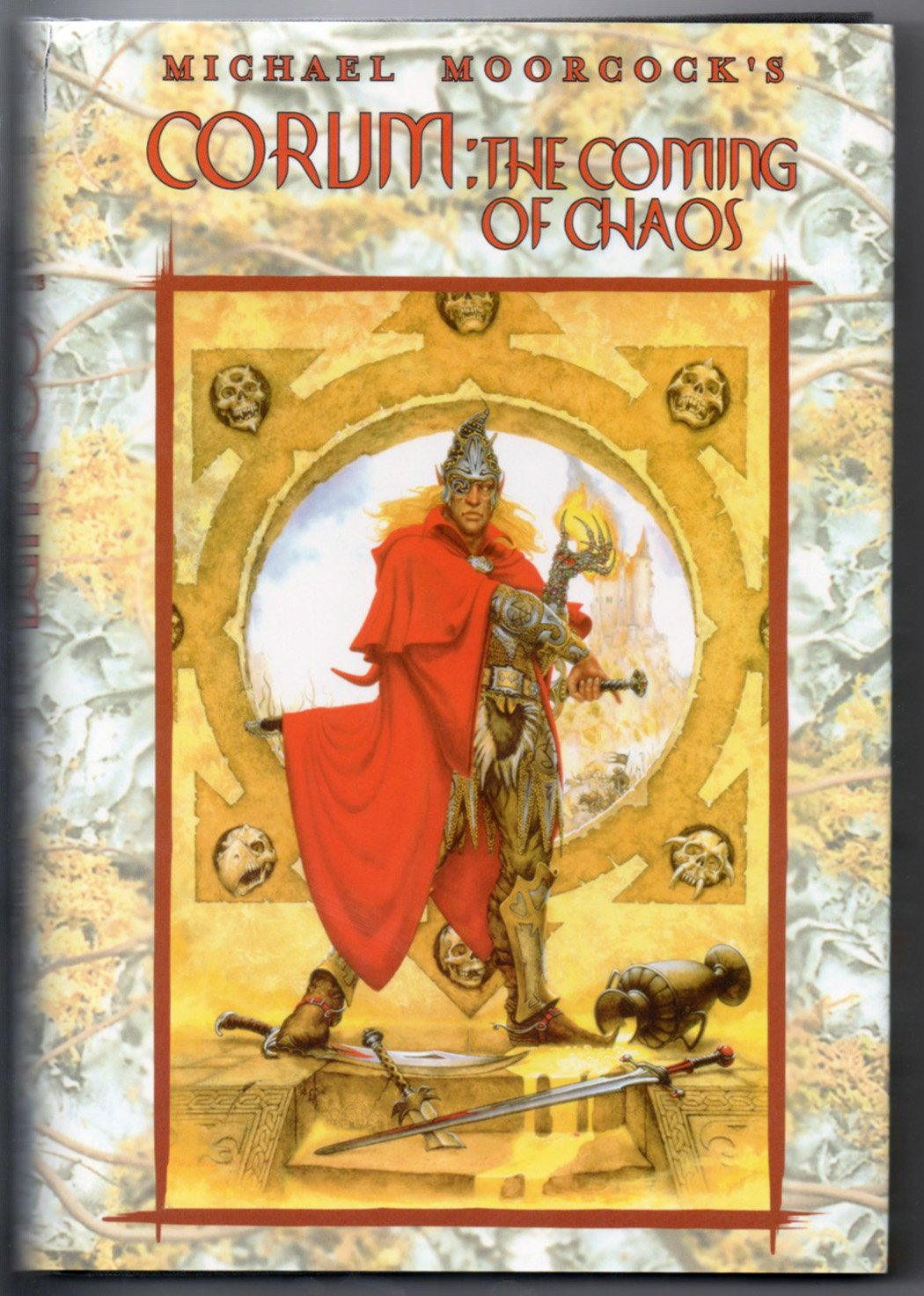
The above picture is the one I picked up for Corum. I was a fan of Michael Moorcoc, via Elric like many before me.

Corum, though, is a bit different. 

I've reread the original a few times and read the First Comics adaptation, now available via Titan in the Michael Moorcock library. We readers didn't know how lucky we were to have Mike Mignola, famous for his creation Hellboy, on hand for those earlier volumes.

I'm lucky enough to have an hour lunch and I've been listening to audio books so I figured it was a good time to revisit Corum.

What's the old saying?

No man steps in the same river twice for the river has changed and so has he?

Some themes were far more obvious to me this time around, and I was just scratching my head at how dumb Corum appeared to be. 

The writing is evocative and I recommend anyone interested in the history of fantasy read it as it was written in 1971 so in and of itself stands as a historical artifact. It's also not by an American author and while we can argue a man of England isn't that far off, the author has always brought his own viewpoint to things.

As a youth, when I first started in TRPGs, when playing Advanced Dungeons and Dragons 1st ed, one of the things that was fascinating about Corum, was the hand and eye he bore in the first trilogy. In AD&D, we had the hand and eye of Vecna. Clearly Gary had been reading Moorcock as well eh?

Corum even had a one book TRPG products that was licensed from Chaosium who had the rights at the time. I do not recall it with any fondness as I remember reading it and it didn't have details on the  Eye of Rhynn and the six-fingered Hand of Kwll. It would be like buying the Stormbringer TRPG and it not having states on Stormbringer. 


Like some of the works of Robert E Howard, the author famous for Conan, but also the creator of Kull, Solomon Kane, and others, these books fall in and out of publications with some frequency.

The last hardcover I have is of the White Wolf edition when they were doing a 'library' collection, and they did Moorcock's worst as well as Fritz Leiber, known for his tales of 'the Twain'.


Corum has a new collection out, though, with a cover that's cropped from an older cover. I love the design on the original cover. It reminds me of the Ace versions of the Elric paperbacks I had, with the design and art style. Strangely enough, there's no e-version so if you read things in e-version like I do these days, to say on space mostly, you're out of luck.


I'll try to return to some actual gaming throughs on Corum. Having listened to all six of the novels recently and back to back, a lot of things really stand out in terms of how the author handles quests and whats expected of the hero. Some of it might be useful for gaming both in terms of what not to do and what to take inspiration from.

Wednesday, June 29, 2016

Stormbringer

Elric: Stormbringer
Blondel*Cano*Telo*Recht*Poli
Graphic Novel
64 Pages
Titan Publisher
$14.99
$9.74 at Amazon http://amzn.to/29429Xf

I read the reimagining of Michael Moorcock’s Elric novel, The Ruby Throne a while ago and looked forward to the follow up, Stormbringer.

Little baffled by the decisions made here.

Elric is far more bloodthirsty and well, useless than he’s been in different incarnations. This ranges from his crippling obsession with Cymoril to his callousness in wiping out a village.

It’s not that these things aren’t “acceptable” or aren’t suitable for Elric. It’s just such a different exaggerated take of him that I’m not sure I like it.

There are other liberties the series takes. For example, the rune swords Stormbringer and Mournblade are gifted to Elric and his cousin and are the Prince of Sword’s “Daughters” as opposed to being what they originally are.

In the context of the story, it works. In the greater whole? If they ever decided to go on? There would either have to be more liberties taken or it would have to continue to diverge more and more.

On one hand, watching A Game of Thrones, I can easily see this version being adapted for a HBO style 4 part series/movie or something.

On the other? Still digesting it.

The good news though, is that art is fantastic. The visuals are stunning. Much of the setting, especially on Elric's home island, could be straight from a Clive Barker Hellraiser book.

The layout and wording and coloring all work to move the story forward. It’s well done and visually appealing. These version of Elric and his people will stand out in the mind as the modern interpretations.

Further good news? It’s inexpensive. Under $10 for either the digital version or the print version is a good deal for quality art like this.

If you’re a fan of sword and sorcery and want to see what a modern version of Elric is like that doesn’t cleave to the story as rigidly as previous comic adaptions have, this one is for you.


Friday, October 24, 2014

Elric The Ruby Throne


Huge fan of Michael Moorcock's creation Elric over here. I've read the old comics when they were published by First and Dark Horse. I had read the books long before that.

This volume, which is a slim hardcover that goes for $10.01 on Amazon, slipped by me until another fantasy fan showed his own copy arriving. Didn't take long and I had ordered my own.

This volume covers the point we're introduced to Elric till the time he summons Arioch. I'd say what, a third of the book?

The story is familiar since I've read the novel and the old comics, but it's different as well. I don't know if that's because the author and artist took some liberties with the material or I'm senile. The good new though, is that even the material I don't remember being here, fits in well with the overall theme and arc of the character of Elric.

Now one of the things I like about this version? It really puts a new spin on things for me. The artists, Robin Recht and Didier Poli are fantastic. While I'm not sold on all of the character designs, the overall graphic design and choices made in the book are fantastic and powerful.

For example, let's start with the Ruby Throne. I'm probably not alone when I say I've always thought of the Ruby Throne as being, well, a throne made of one solid ruby or something of that nature. Here, the artist creates a massive throne of which the chair portion is the smallest. The throne is the type that could not physically be moved so large is it. I can see a question to break off a part of the throne for use in a spell component or ritual but actually stealing the whole thing?

At the end, when Elric summons Arioch, who appears in this instances as a child, he does so with numerous blades surrounding him. This gives Arioch a 'anima flare' if you will that fits in well with the character and his name as the Prince of Swords.

There's also the common cruelty of live in the empire. For example, Doctor Jest here looks like he could be from a certain mercenary faction in Warmachine with his artificial limbs that are dissecting prisoners. Elric's fiance feeds him blood and souls in order to empower him, because he is a sickly creature. It's far more graphic then I recall but it fits with the theme of a demon worshipping society.

There are other little bits that don't match my memory. For example, when Elric leads his kinsmen against a raiding party, when some seek to escape, Elric summons the demonic depths of the sea to handle them. This leaves him weakened at which point he is dragged by one of the raiders over the ship and his evil cousin has opportunity to save him. I recall it being his cousin who pushed him.

Minor things and they don't effect the story at all.

This book is perfect for any fantasy fan who wants to have some fantastic art work. The story is short enough that it leaves you wanting the second book, which is also available for pre-order. Hope I remember that one!

Thursday, January 9, 2014

The Last Wish by Andrzej Sapkowski


When I first heard of Geralt, a Witcher, a professional who hunts down supernatural horrors, it was not in a positive context. Over on Michael Moorcock's website, some of the fanbase essentially noted that the Witcher was a direct rip off of Elric, an aspect of the Eternal Champion created by Michael Moorcock. And what's more, the character or at least the world and setting, is apparently part of a best selling series of computer games.

That didn't necessarily strike me as a bad thing mind you. Conan, despite the dozens if not hundreds of stories written about him, has relatively few by the actual original author, Robert E. Howard. Most of these stories have been written decades after his death. 

So when the opportunity came to pick up The Last Wish by  Andrzej Sapkowski, at a decent price on the old Kindle format, I snatched it up. It appears to be a series of short stories broken up by an over arching rest point where Geralt is preparing himself for future travels after taking an injury in a case.

In terms of 'being a rip off' Elric, at least in this book, I can see where the comparison comes from, but Geralt is no Elric.

But let's start with the similarities. They are both albino characters. They are both spellcasters and master swordsmen. They both use drugs and elixirs. Note that in Geralt's case, the dependency, at least in this novel, seems like a new thing as opposed to Elric's ongoing need for them due to his chronic weakness. The other thing that would be annoying if I was Michael Moorcock would be having had a character like Elric whose bylines include The White Wolf, which at least one person calls Geralt here.

However, Geralt doesn't have a rune blade that drinks souls or has sword his own soul or alliance to the forces of Chaos and their worlds are vastly different. This bit is important because even in the first Elric book, the albino of that series is going to other worlds and planes and eventually times and manifestations of himself.

In terms of weapons, Geralt uses two different types of swords, one made of cold iron and the other of silver. Each suited for fighting a specific type of creature. Their outlooks, again, at least as far as this book is concerned, are also different although there are some similarities in terms of themes of fate and destiny.

In terms of the novel itself, it was worth a thought in terms of how certain types of characters fit into the wider world. In Geralt's case, he is a Witcher.  Being a Witcher means hunting down supernatural entities. But it notes that even during Geralt's time, that the need for his services has become less and less and that 'honest Witcher' work is harder and harder to find.

The whole idea of the Witcher would fit in well with specific roles in a fantasy game. Such roles have long been a part of Dungeons and Dragons, being put into more game related mechanics in the various Complete books with kits that provided game benefits and often role playing penalties or guidelines. It was made more concrete in 3rd edition with prestige classes that characters couldn't start as, but could advance into, and then part of the overall core mechanics in the Player's Handbook in 4th edition with paragon classes.

It showcases how such designs could go in a variety of methods. The abilities that Geralt has, are particularly suited for many dangerous things, not just fighting against monsters. In one short story, he has to note that he is not an assassin and those who seek to use him as such meet poor results. Geralt though, is not a player character. In a situation where characters are down on their luck, will they use their special and specific abilities to go outside those boundaries?

Another interesting bit that Andrzej uses is that of folk tales. He plugs several events from a variety of sources into the setting of Geralt with no problem or even attempts to make it subtle. This has been done for other settings like the Forgotten Realms with some success by plugging in deities from other campaign settings or eras. When something works, it works.

A third thing apparent, is the changing of an age. In one of the short stories, a fey creature is 'stealing' secrets of farming from humans and providing them to the elves. Geralt notes that the elves only chance of survival is to trade and work directly with the humans or they'll die out of starvation and only have a last ride out against humanity and then fade into legend. Given that the title of the next book I have by the author is The Blood of Elves, perhaps that vision comes true already.

In the Forgotten Realms, in some time lines at least, the elves, much like they are in Middle Earth, are a fading power. As are the dwarves. This is a common theme when humanity and technology and civilization are on the rise. The only thing that doesn't become too clear in The Last Wish, is how this interacts with the ideas of magic. Geralt has the ability to cast spells, as do many others he encounters and few of the human spellcasters seem to have any issue with civilization as opposed to the things in the wild that might be considered mythical which are being hunted to extinction.

The Last Wish isn't the strongest book I've read in the genre and my purchase of future volumes of the Witcher will be heavily influenced by how much I enjoy Blood of Elves, and of course, any future sales I may find that feature the books at the prices I like.

For those who've played the Witcher game, is it worth picking up for a person who doesn't play a lot of games on the computer?

For those who've read all the novels, is there one in particular that stands out from the crowd?


Sunday, February 12, 2012

Elric The Balance Lost by Roberson-Biagini-Downer


FIrst off, let me talk about two things I don't like in the marketing of this book. The first is the dreaded "Michael Moorcock's" bit here. I love Michael's work and owe a huge nod of thanks to White Wolf when they reprinted a ton of his work many years ago. Having said that, this is NOT written by Michale Moorock but is just kind of noting that you know, Elric is Michael Moorcock's character. Don't want to put the actual author on the cover or anything you know because who the hell is that guy?

The other thing is the 'Afterword by Neil Gaiman." Uh... no. That is not an afterword. That is a lie. That bit by Neil is from a book published in 2008 and reprinted here talking about how awesome Michael Moorcock is.

I get the need for marketing but people aren't blatantly stupid and that marketing is. It's just bad and pisses people off.

On the other hand, the company Boom made a free issue for free comic book day so that's not all bad.

But what about this trade draws inspiration? For one, the book collects the covers of the series and they are awesome. Some great talent here. Art is not always an inspiration for me, but when it strikes, it can motivation me in ways that text alone cannot. It's one of the reasons I'm always puzzled by people who would rather have RPGs with minimal design and no art in exchange for a lower price. I live visual candy. It's one of the reasons I still watch those Walking With X series. (Just finished the Walking With Monsters, only three episodes but hey, giant scorpions with two sets of claws!).

Another thing I thought interesting though, was that as more characters are introduced and some die, the idea that the 'Eternal Champion' doesn't always win, and that whole worlds if not universes are destroyed thanks to these failures, that if the players fail to do something in your own campaign, you should allow that failure to stand. I've seen some Dungeon Master's who are so concerned with their setting that they won't allow anything big to happen to it that derail's their 'story'.

While I can understand that thinking process and lord knows, when I was much younger, was probably in that boat myself as I tended to use the same campaign setting with the events of previous campaigns evident upon it, as I get older and game less constantly in one campaign, I'm more willing to see where things go. To see what happens when characters fail.

Such options for failure are also great when running a one shot that's high powered. If the player's are given individuals who have rune drinking swords, can summon demon gods, and have alliances with higher powersl eft and right, allowing them to fail and letting them know that such failure will cause the end, can put some extra motivation on the players.

This volume of the Balance Lost is well illustrated if somewhat slow going and I'm curious to see where it winds up. If the e-versions came in a collected edition or were less expensive, I might go that route but as long as I can get the trades for cheaper than buying the individual issues and I continue to churn through my own collection to make space... well, those e-versions will just have to wait.