One of the nice things about Bison Books publishing efforts with the works of Harold Lamb is that they've brought back a lot of material that hasn't seen print for years. This volume in particular, Swords From The East, has a nice focus that escapes most of the standards of 'European' style historical adventure stories.
One of the things I enjoy is some of the characters that get historical footnotes. Take this one in particular from page 427.
The Rajputs were the most warlike of the races of India. They were chivalrous warriors, and experienced, if impeuous soldiers. Rana Sanga was old in years and wisdom, with fifty sword and lance scars on his body, blind in one eye, with am arm cut off and one leg crippled. Seven Rajas and a hundred chieftains, eighty thousand horse, and five hundred elephants were at his back. He was in all things a foeman to delight Babar.
Now that's a foeman with some character there. If you can make the enemies of the players as interest as those history is litered with, you're on the right path.
Showing posts with label Harold Lamb. Show all posts
Showing posts with label Harold Lamb. Show all posts
Wednesday, February 2, 2011


Sunday, January 24, 2010
Wolf of the Steppes: Vocabulary Building
Over here on good old Google books is a preview of Wolf of the Steppes by Harold Lamb. Here are some various words that I was like... must look that up.
Atamans: General officer of the Cossack.
Bogatyr: Similiar to a knight errant.
Hetman: Title of the second highest commander from 15th-18th century in Poland and the highest in the Cossack military.
Zaporogian Siech: The Cossacks of the sixteenth and seventeenth century called their isolated war encampment.
Kurens: Barracks
Nankeen Breeches: Cotton cloth
Sequin: Coins used in the Mediterranean. Also used to make jewelry like viels of Sequin.
Versts: Equal to 3500 feet.
There was a wide variety of language in the book that piqued my interest and made me look up terminology. In today's era it's pretty easy with the internet to act as a guide and much of it being found at good old Wikipedia. Still, the fact that so much of it is unfamiliar to me, gives me an idea of how, when I run games, if I want players to know that they're no longer in a standard dark ages generic fantasy, can use language and vocabulary to build on the differences of the cultures. Language is an excellent tool for communicating the familiar and for showcasing difference.s
Atamans: General officer of the Cossack.
Bogatyr: Similiar to a knight errant.
Hetman: Title of the second highest commander from 15th-18th century in Poland and the highest in the Cossack military.
Zaporogian Siech: The Cossacks of the sixteenth and seventeenth century called their isolated war encampment.
Kurens: Barracks
Nankeen Breeches: Cotton cloth
Sequin: Coins used in the Mediterranean. Also used to make jewelry like viels of Sequin.
Versts: Equal to 3500 feet.
There was a wide variety of language in the book that piqued my interest and made me look up terminology. In today's era it's pretty easy with the internet to act as a guide and much of it being found at good old Wikipedia. Still, the fact that so much of it is unfamiliar to me, gives me an idea of how, when I run games, if I want players to know that they're no longer in a standard dark ages generic fantasy, can use language and vocabulary to build on the differences of the cultures. Language is an excellent tool for communicating the familiar and for showcasing difference.s
Wednesday, January 20, 2010
Age is Not Just A Number
When creating characters, either as Game Master and breathing life into NPCs or as a player, think about the age of the character. What does it say about the character?
While reading Harold Lamb's Wolf of the Steppes, the age of the main character, Khilt the Cossack, made me ponder the value of age. In this case, Khilt is not quite the Old Man of the Mountaint, but is an older man. In some of the tales, he notes that these days, he survives more than the use of tactical genius rather than sheer brawn.
Those who encounter him often have one or two thoughts. One, he's an old Cossack and that makes him dangerous. Warriors don't live to a ripe old age on the steppes. Two, he's old. He's no longer a threat.
In a fantasy game, that might be a little more difficult to acheive because there are so many options in terms of what a character can do. However, if playing something like Dungeons and Dragons 4th edition, making the character a martial class whose primary ability isn't in fighting, such as say a Warlord, may allow the character to speak openly and mour about his lost fighting prowess but at the same time inspire the youth of the next generation to take up arms.
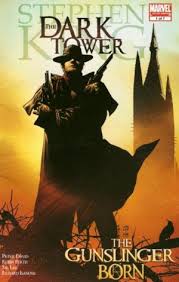
On the opposite end of the specturm, we have Marvel Comic's graphic novel, The Gunslinger Born, in their line of The Dark Tower series. Here, Roland is a pup. Few take him seriously. While he manages to excel at his tasks, while his skill with the gun is not rivaled, his youth makes him brash and perhaps foolish. It allows other to prompt him to take action instead of thinking.
Roland manages to break records and strives to "remember the face of his father" but thanks to his youth, manages to fall victim to things an older individual, like Khilt, may have avoided.
In any game system, it's often easier to role play the brash youth. The trick thought is eventually showcasing some grwoth in the character based on events that happen to him.
Tuesday, January 12, 2010
New To Me: Harold Lamb
I had several goals in mind when thinking about books I wanted to read for Appendix N.
1. Books I already own. I have some serious collector issues going on. I own more books than I've actually read. In Chicago, there is a wide variety of methods of getting books for very little cash thanks to an over abundance of book fairs and other events. Mind you, I haven't gone to any of these in quite some time, but Half Priced books, library sales, Science Fiction Club blow outs and other things keep the books coming in at a pace greater than I've read. I've tried to curb this, no, I've tried to stop this completely as I live in a small apartment and it's overflowing with paper but so far no complete luck. It's how I wound up reading the Crown of Stars series by Kate Elliot. The Sci-Fi club had a booksale on one of her series in a bundle and I snagged it where it sat on the shelf for many years.
2. Books of the New: This isn't quite accurate. For example, Steven Brust. I've read some of his material. His work isn't quite as old as say, Robert E. Howard or Michael Moorcock. I've heard good things about it. Karen Miller, Brent Weeks, and Joe Abercrombie are also authors I've heard positive reviews of and they are on the list.
3. Books of the Old: Part of this was inspired by seeing Paizo reprint Planet Stories, as well as other reprints, like Doc Savage, coming back into vogue again. Part of it was seeing authors like Charles Saunders with an older book, Imaro, with a different menu than typical sword and sorcery. In that vein, I picked up Harold Lamb's Wolf of the Steppes, volume one of the Complete Coassack Adventures. To me, these older books act as a lense through which one can view some of the ground work of the role playing games origin point. These books have far less to do with a lot of how games are designed these days that are not deliberate 'retro clones', for example, Exalted, but they do showcase how a genre came into being from myth and legend and historical action adventure tales to its own thing.
Harold Lamb's book is good stuff. While there are no overt elements of the supernatural in it, and it does suffer a bit from the time in which it was written, Harold Lamb does a great job of providing life to an era not often explored in the venues I normally read. I'll be posting more about Wolf of the Steppes but thought that for those looking for 'old school', to see some of the authors that influenced Robert E. Howard and others of his time, you can't go wrong looking at Harold Lamb.
1. Books I already own. I have some serious collector issues going on. I own more books than I've actually read. In Chicago, there is a wide variety of methods of getting books for very little cash thanks to an over abundance of book fairs and other events. Mind you, I haven't gone to any of these in quite some time, but Half Priced books, library sales, Science Fiction Club blow outs and other things keep the books coming in at a pace greater than I've read. I've tried to curb this, no, I've tried to stop this completely as I live in a small apartment and it's overflowing with paper but so far no complete luck. It's how I wound up reading the Crown of Stars series by Kate Elliot. The Sci-Fi club had a booksale on one of her series in a bundle and I snagged it where it sat on the shelf for many years.
2. Books of the New: This isn't quite accurate. For example, Steven Brust. I've read some of his material. His work isn't quite as old as say, Robert E. Howard or Michael Moorcock. I've heard good things about it. Karen Miller, Brent Weeks, and Joe Abercrombie are also authors I've heard positive reviews of and they are on the list.
3. Books of the Old: Part of this was inspired by seeing Paizo reprint Planet Stories, as well as other reprints, like Doc Savage, coming back into vogue again. Part of it was seeing authors like Charles Saunders with an older book, Imaro, with a different menu than typical sword and sorcery. In that vein, I picked up Harold Lamb's Wolf of the Steppes, volume one of the Complete Coassack Adventures. To me, these older books act as a lense through which one can view some of the ground work of the role playing games origin point. These books have far less to do with a lot of how games are designed these days that are not deliberate 'retro clones', for example, Exalted, but they do showcase how a genre came into being from myth and legend and historical action adventure tales to its own thing.
Harold Lamb's book is good stuff. While there are no overt elements of the supernatural in it, and it does suffer a bit from the time in which it was written, Harold Lamb does a great job of providing life to an era not often explored in the venues I normally read. I'll be posting more about Wolf of the Steppes but thought that for those looking for 'old school', to see some of the authors that influenced Robert E. Howard and others of his time, you can't go wrong looking at Harold Lamb.
Subscribe to:
Posts (Atom)