Friday, September 21, 2012
Heartstone by C. J. Sansom
Heartstone is the fifth book in the Shardlake lawyer series set in the 1500s. This one involves Shardlake going to unravel a mystery that involves many a party interested in him not finding out the root cause of the problem against the backdrop of war. I'll be discussing the book in full below so if you're eager to avoid any spoilers read no further. A quick review would be that C. J. Sansom is a solid writer and if you want to bring something like mystery to your games, you could do worse then read some of the Shardlake series for inspiration.
War is often written in fantasy genres as something that the main characters are themselves involved in. That they are at the forefront of. But sometimes the material fails to bring home some of the common practices of war preparation. For example, England has a rich history of archery. I've spoken of archery in the past and some of the battles England was involved with that were turned by the skilled English longbow man thanks to another writer of historical material, Bernard Cornwell, but there are still some differences.
For example, in Bernard Cornwell's archery books, the main characters are consummately skilled archers. They are at the forefront of things. Here not so much. Shardlake's servant, Barak, is almost recruited to the war effort because of his backtalk to a recruiter. Well, recruit is too kind a word. Drafted is more accurate.
And these soldiers are supposed to keep their own gear and weaponry. Many people didn't have them. So of the fees they earn, they have to pay back the crown. And those who are supposed to provide those equipment? Well, if you can charge a premium price for something and provide something old that's already paid for? You can pocket quite a penny in the process.
Another venue of war, is how much it takes. I'm not just talking about the manpower fighting in the war, but the manpower not fighting in the war. Depending on the length and duration of the war, the farming back home may not go well. Farming in these times is heavily labor dependant. In addition, the manpower recruited for the war may not be all that useful if it's made up of individuals not suited for such a life. Mind you it can be fun to have a campaign staring a 'Dirty Dozen' type of individual but that's not necessarily on a large scale such as portrayed here.
A third venue of war is the scope. On a huge ship with some odd five hundred people, Shardlake almost drowns when the ship sinks. The root cause of the ship's issue's aren't made known but could include incompetence. In the anima and manga series Berserk, one of the reasons Griffith, a charismatic and effective commander is able to rise so rapidly, is that most of the people at the top are grossly incompetent. Being wealthy and a noble does not provide some magical and mythical ability to rule wisely not command smartly. Too many people in this battle on both sides prove to be useless in terms of winning.
The size of the ship, with five hundred people, may not be that impressive if you think of something like the Death Star that had to have thousands and thousands of people on it, or indeed of the first planet destroyed by the Death Star where millions of people were. Imagine players being in those situations where something like a flying citadel is under attack and is going down regardless of what the player's do. It can provide them with an experience that actually repelling the attack may not.
Another bit about war and the resources it consumes, is how much money it all consumes and what it does to the economy. In his time here, the King has literally debased the money to pay for the war effort. Currency takes on a new name. Funds take on new values. People can tell the difference based not only on the look, but the feel of the coins. Players may come across silver and gold coins that aren't what they are supposed to be. Will people in the town accept them? Will they have to accept a lesser amount for them? Are they worthless? In the modern edition, coins like electrum and brass pieces have been given the boot to keep things simple. It's a worthy goal.
But in a long term campaign that isn't dependent on gold coins to be some type of magic fuel, it can be fun to throw a wrench into the works. "No lads, I'm sorry, these are Mulgin Silver. The darker red color means there's a lot of copper mixed in there. Takes three Mulgin to make a standard." Or something along those lines.
Of course the opposite can also be true. In most games. the age of the coins isn't a deciding factor but when talking about the purity of the coins, the older coins may be more pure or have more face value due to people having better ideas about what those coins are actually made of. All of the sudden a few hundred silver might be worth a few thousand silver.
For characters, both in terms of character development and the sign of the times, the notion of a woman's empowerment during these times is a theme that crops up at the end. Some find that its easier to pretend to be a man during these times and take advantage of the strengths that men have, not in terms of physical power, but in terms of social movement.
Mind you, in most fantasy games, there is a passing effort to make such issues moot to begin with but when actually looking at the setting, if you're not seeing stripper ninjas or what not, the social structure upon anything resembling a closer inspection tends to be based on the same old same old. This can be fun to play against if its something the group wants to explore.
For character growth, having a family will change a body. Barak for instance, has gone from a street smart agent of Cromwell to a husband and in this book, to a father. He is not quite so quick to put his life on the line. In a role playing game, that can be a difficult role to get a player to embrace and some Game Masters abuse the whole thing by giving the players contacts only to have them brutally taken away and then putting the min the position of vengeance seeker.
In terms of gaming inspiration, there is a investigative book out for Pathfinder called Lorefinder. It's a well done short book but in my experience, running a game as a mystery can be a little harder than just throwing some monsters into the balance. C. J. Sansom does a good job of providing a lot of characters, which is what makes a good mystery, into a very detailed setting, which helps cement where the mystery is taking place. If you're looking for something to add details to your campaign in the little things, this is a good book to read about the various events in a setting that could easily be a fantasy one.
Sunday, August 14, 2011
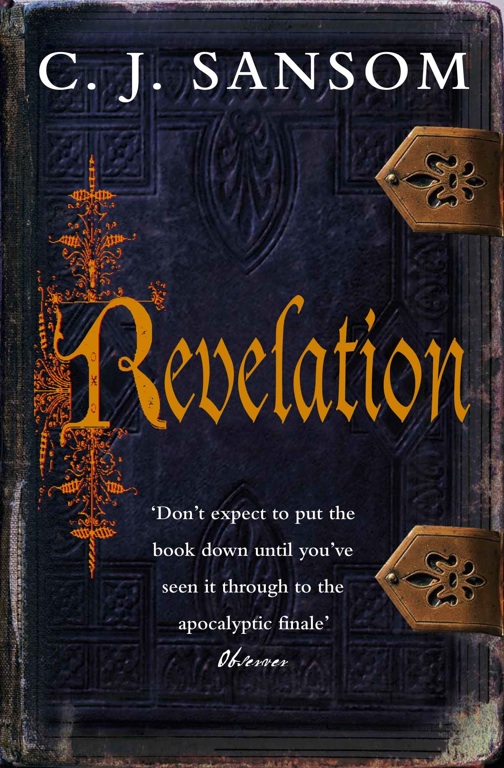
Revelation by C. J. Sansom
The first, is a wide cast of characters. Sansom isn't afraid to throw characters into the mix and then murder them off. I've heard it said before that GM's must be ready to murder their children. This is a truism that needs to be followed. While some of the characters you create may have some untold stories, keep those stories in mind and transfer them over and let the characters wonder what's going on as some of their favorites die off.
The next thing, is keep the plot moving. If the character run up against some walls or issues or, well, let's be honest, just stink at investigating, throw them a bone or two. Perhaps the villain isn't as clever as he though and leaves some evidence out to torture the players with just how smart he thinks he is? Perhaps someone the players have helped in the past has seen something and wishes to provide some assistance in compensation for the player's aid in the past?
Another factor to keep in mind, is bodies rot. In the novel, the villain leaves the windows open during winter so that the cold air will slow down the rot. In a game where blasts of ice might not be that hard to summon up, or even where magical means of completely destroying a body might be applicable, players may not discover murder has been done in a timely fashion or at all unless they use their own divination magics.
For the old school gamers, remember poisons are bad. In most old school games, if you fail a saving throw versus poison, you're dead. On the other hand, an interesting thing used here, is a poison that provide not death, but a pleasant feeling so that when the corpses are found, they seem to be in a state of bliss. Poisons and drugs can do more than kill, then can alter perception, alter reality, and without some type of anti-venom or cure-all, there isn't much that can be done outside of making a save and noting that the poison didn't enter the old blood stream.
Another aspect of the book that takes place is omens and con men. A few big fish wash up on shore from the Thames and people claim that they are Leviathan. Of course as soon as some religious significance is attached to the fish, the snake oil sellers are out selling various unguents, oils, and potions that they claim are made from the fish with various abilities to heal, cure, and do other things. Small incidents can help showcase the reality of the setting so to speak, and provide players with some interaction with the background that isn't necessarily of the violent nature. GMs feeling generous might even allow the players to make some knowledge or skill checks to see if any of the snake oil is real or might have properties that the seller's are unaware of. Its okay to let the players occasionally cheat a con man out of something he doesn't know he has.
For campaign seeds, it can be difficult to provide advice that means anything unless its specific to a campaign. For example, one of the characters here, Guy, is a doctor. He is reading a book that focuses on medicine in a whole new way. A manner that proves older books, books that have been used for decades if not longer, are false. While the same fervor is not attached to them as might be a religious text, old ideas can be hard to change. But if none of the people in the group are interested in medicine, its a moot point. It's a possible background element you might be able to introduce.
The same is true of false teeth. Here doctors are buying people's teeth for the creation of false teeth, apparently a fad that was popular in France during this time that made its way among the English. Little elements that provide a touch of, in this case, strangeness.
Having said all of that though, when you're running a game, it's not the same thing as reading a book at all. The players may simply be smarter then you or may get lucky. In a novel, the author can keep the audience and the hero guessing for quite a while. In a role playing game, the players may just stumble onto the main villain in the first act.
Go with it. Few things are more annoying than having the players do this as it's happened to me. It happens in written modules all the time. While I love the concept of the Witch Fire trilogy for the Iron Kingdoms Game, originally just for fantasy d20 in many ways, I don't think I ever saw a group have a hard time figuring out what was going on in the mystery portion of the game. Just run with it. Keep the rest of the stuff, characters, encounters, details, and other important bits, for another game or another sesson.
C. J. Sansom provides a wide cast of characters and events to keep the story going and someone looking for how an investigation might have happened during this darker days should pick up a copy of Revelation today.
Wednesday, April 20, 2011
R is For Rumor
I love rumors. What I remember as a young Dungeon Master, and this could be my crappy memory striking again, is that before you had skills like those in 3rd edition, you had various tables to roll on. The tables consisted on various things about the adventure, wither it was the location, the fabulous treasure, or some of those who lived about the land, and it had either a T for True or a F for false. The Gm was encouraged to add to the tables and to change things around so that someone playing through the adventure multiple times would not always come away with the same, or even the correct information.
Rumors fit a city based campaign for a number of reasons.
First off, people are always talking. Look at the Republican Party in America. This band of the so-called GOP, has insisted at times, that our current President is not naturally born. The rumor mill churns in the world of politics. The important thing though, is that even if its not true, it can generate its own air, its own power, its own field of negativity where things can be thrown into doubt for those whose faith or information isn't solid to begin with. The world of entertainment also swirls and churns with rumors ranging from dating, sexual preferences in the present, conquests of the past, and accusations of talent theft to other, even less kind things.
In a fantasy city, there are multitudes of options to work from.
1. Famous Buildings. Mage towers, guild halls, taverns, red lantern districts, and of course, sewers are all ripe targets for rumors. These can range from hauntings, to the origins of those hauntings to who is zooming who.
2. Historical Events. Much like how history can be remade by the winners, the modern history of a city may quickly fall sway to rumor and hearsay. For example, if the players saved a noble from assassination, the noble may spread around town that it was only his own exceptional skill at arms that saved a blundering party from assassination and that he felt so bad for them, that he provided them with riches so that they may improve their paltry skill set.
3. Individuals: Much like Sovereign, rumors are always swirling about the rich, famous, and powerful. Of course such rumors might not always be wise to find. In older editions of Dungeons and Dragons, powerful entities like Demon Lords and Devil Princes could hear their names mentioned as well as the words that followed it. Such entities would hardly take to rumors of their weaknesses, strengths, hidden strong holds, or allies. In the Forgotten Realms city, Waterdeep, the ruling council were masked and unknown so rumors were always flying over who the actual rulers were with only one of them, The Open Lord of Waterdeep, of course a paladin, known to the public.
4. Magic Items. In older editions of the game, things were not so static. 3rd and 4th put magic items into a 'math' function so that a character of X or Y level was doing A or B damage. Earlier editions wouldn't necessarily give you a super powerful magic item at low levels, but the opportunities were often there. For example, I've run White Plume Mountain and had a player character with Black Razor. I've run a PC that had Black Razor. I've run The City Beyond the Gates and had a player with the Mace of St. Cuthbert. There was no 'cheating' going on there, just honest to goodness module running and the players earned those powerful artifacts.
In the book I'm currently reading, Barb Hendee's Through Stone and Sea, Wynn, a sage, is seeking information on the Thirteen, the original vampires, and has to work through the rumors of a secretive sect of dwarfs in order to discover what she seeks. The author is turning her quest for information using only rumor and hearsay into a full fledged quest.
When preparing your cities, prepare some rumors that the players might stumble into. When preparing some encounter areas, prepare some rumors that the players might seek out. When providing information from the rolling dice, prepare two sets of answers depending on how high the player rolled or how well they role played out the scene and how much gold they dropped.
Rumors can add dimensions to the game that might otherwise be unexplored.
Monday, April 18, 2011
P Is For Prostitue
However, Gary is far from the only one to hit up such a random table for game play. After all, Runequest Cities has one as well, Prostitute Encounter Table 17 with a roll of 1d20 with five different possible results.
Now outside of a nod to the actual history of the game, what roles would these harlots play n a standard role playing game? Well, hitting up the old C. J. Sansom's Sovereign again, one of Matthew's friends has a vice where he enjoys a good beating with a leather belt every now and again and not wanting the misses to soil herself so, has a professional do it. This in turn puts him under another's power because these ladies performing these services have higher patrons whom they report to.
In addition, one of my favorite movies, The Brotherhood of the Wolf, used those in the sex trade as gatherers of information and even as royal spies and assassins.
While as a youngster we used to joke about the various potential for diseases from the lower quarters, the threat of assassination or having one's secrets spilled, or perhaps merely drugged and robbed, are probably more dangerous and potential things that an adventurer has to worry about.
Note that even if the adventurers themselves aren't seeking out the red lantern district for their own pleasures, they may be in search of information themselves. They may be seeking out information of a favorite patron or other tid bits that would generally not fall into the public hands.
Friday, April 8, 2011
H is For History
But not only that, but there are still some older people who recall the actual events.
Imagine a setting though, where there are elves, dwarves, and other long lived, if not immortal creatures. This rewriting of history doesn't necessarily become impossible, but it becomes more tangled. After all, it's not like people don't lie, even to themselves of older events or aren't above trying to make themselves look good, as a certain mage in The First Law series of books showed.
But outside of trying to recapture the truth of the past, either for the sake of knowing the truth or because there is vital information that is needed, history can have tremendous weight. After all, H is also for Holiday and it's not like someone just wakes up one day and announces something is now going to be celebrated. That's not impossible after all as Sienfield and Festivus proved but for the most part, holidays are build or corrupted from older events and then tied into more modern events to align themselves more popularly with todays ideas.
History can also be found in the very buildings that a city is build of. The materials and stylings of the old town may be different than the new town which may be different than the noble ward which may be different than the merchant ward and so on. History can also be found in the different styles of painting, music, dress and even outward attitudes.
When looking at your fantasy city, think about what events have given the city weight. Which events has the city hidden? Which events have become wide spread and celebrated? Which events does the city vow will never happen again? Which events has the city at one time vowed would never happen again but vigilance has long since cooled?
Tuesday, April 5, 2011
E is For Entertainment
In C J Sansom's Sovereign, book three of the Shardlake series, there is a need for entertainment. After all, the king is coming to Kent. One of the events arranged is bear baiting where a bear is pitted against hounds. While barbaric and cruel of animals, these 'sporting' events are not limited to the dark ages of history as even light hearted shows like Seinfeld have an episode where chicken fighting is the theme and of course, who could forget football superstar spending time in jail for pitbull fighting?
Outside of such animal cruelty though, cities have other various forms of entertainment. The Clone Wars carton series for example, often features the characters going into various bars in order to discover some information of a more seedy nature. Outside of the information exchange, there is often gambling, dancing, and of course, drinking.
In Chicago, not only do we have an enormous amount of bars and eateries, we also have various museums. The players could discover that some of the clues they're looking for are of such age or such rarity, that all available copies are only to be found in some obscure or expensive or exclusive museum.
But what about music? Chicago also has its share of outdoor shows. Such a show, where the center of the city is occupied and people are milling about, drinking, eating, dancing, and having a good time, could easily be the center of a chase scene or an assassination attempt. Imagine the chaos if the threat is perceived by the crowd or imagine the difficulty the characters will have communicating if it is not! The music, masses, and general horde of people will present their own difficulty.
Plays and operas may be another way to showcase various background elements in the campaign. Propping up an old play that showcases how the current king game to power, ala Hamlet, or providing a hiding place for the characters, or even a job source for the characters, can always be entertaining. After all, some would say the the Spider Man musical has certainly had its share of adventure worthy issues.
When designing a city, don't forget the things that make it more than run, don't forget the things that make it fun.
Monday, April 4, 2011
D is For Disease
In keeping the material in line with books I'm working on or just finished off, disease plays a minor role in C. J. Sansom's third novel of Shardlake, Sovereign. Several of the characters, while not suffering the direct effects of the Black Plague or other plagues, note that the cities tend to breed the plagues and that they are a periodical problem.
Even in the times we live in now, diseases can run rampant if given the right breeding grounds and opportunity. Various things happen, even when the disease is under control, that the GM should take into account.
1. Quarantine. No one gets in or out until its all said and done.
2. Specialist. The doctors of the olden times with their hook beaked masks filled with various incense and herbs to prevent the spreading of disease have a unique look all their own and this look has been used in various fields ranging from movies to comics.
3. Overkill: One of the reasons families may have been large is that disease could come along and wipe out everyone. In Sovereign, one of the characters notes that his own family has died of the plague but he managed to avoid it. What type of mentality does it set up if every dozen years or so a disease cuts through the locals and its a matter of hit or miss?
4. Magic: Dungeons and Dragons has a huge array of races, magic items, locations, planes, and other bits that can be used to spice up the normal disease. In a recent book I just finished, The Wolf Age, Ambrose suffered from a 'ghosting' disease that worked its way from his hand trembling to going insubstantial and that ghost like effect working its way toward his heart. Diseases don't necessarily all have to be about the standard bile and pus.
5. The gods. This goes both ways. While there are gods that help to cure the diseases, such as Lathandar in the Twilight War series, there are gods whose whole specialty is the spreading of diseases, such as Nurgle, one of the four Ruinous powers behind the Warhammer setting and whose creatures plague the witch hunter in that series.
6. A Weapon: Disease can be used as a weapon. In an old movie I recall, I believe, Flesh and Blood, disease is used in the water as a biological weapon.
When using disease, like many other large scale elements though, the GM has to decide what the role of the disease is. It's it a manufactured disease like the Blue Shadow from the Clone Wars that the players have to actively avoid, or is it a background element that for all intents and purposes, the players have plot immunity from unless they do something really stupid?
Is it something already in play or something that is coming? Is it a plot point that the players can stop, and if so, what happens if they fail to stop it? The Years of Rice and Salt provide one answer, but you'll have to decide if that's the answer you want for your own campaign.
Sunday, February 28, 2010
Dissolution: More historical mystery
Quotes will be taken from that version.
In the book, one of the most important aspects of the historical setting of England is religion. This takes all manner of aspects in the book. This ranges from the personal, introspection of the main character Shardlake, a man who once wished to be a member of the clergy and was denied due to his hunchback, to churches owning land, trying to pass laws, selling beer, and having vast sums of treasure that make them a target for others.
“The skull of St. Barbara,” Cromwell said, slapping the casket with his palm. ‘A young virgin murdered by her pagan father in Roman times. Form the Cluniac Priority of Leeds . A most holy relic. ‘ He bent over and picked up a silver casket set with what looked like opals. “And here- the skull of St. Barbara., from Boxgrove nunnery in Lancashie.’ He gave a harsh laugh. ‘They say there are two-headed dragons in the Indies. Well we have two headed saints.’
Human remains of the famous and the holy were often assumed to have power that could be granted to those that would go and see them. Fakery of such objects were not uncommon during the Dark Ages and in other eras. The Game Master could easily give such items minor powers for a campaign that only work for those who are of the same religion or could easily send the characters on a hunt for ‘true’ relics as opposed to those that are fake.
The real trick would be to discover which ones are real and which ones are fake. Depending on how robust the skill system is, for example, 3rd edition had a few skills that might work with some different skill checks. 4e might make it into a skill challenge or even a minor ritual, “Divine the Relic” or something of that nature. Other editions can be hit or miss, but the fun in those cases is in having the players hunt down the information when they can’t solve things with just a skill roll.
In terms of the main character’s lack of acceptance by the church, his deformity is noted as a restriction. If all men are made in God’s Image, having one who is not a whole specimen stands against that theory and none who suffer any physical deformity were allowed into that church where Shardlake studied.
“To the left , against the far wall, stood the usual outbuildings- stables, mason’s workshop, brewery.” Pg 40
A church, especially a monastery that may not be inside of a city, is not necessarily one building nor it is necessarily only occupied with those of the church. In this example, the church actually sells beer by exclusive contract to the town. They have more employees than actual church members. These little touches can add a lot to a campaign when dealing with the role of religion.
For example, a fighter may not actually be a member of the church, but may still believe. A rogue may have done work for a church in past, selling their liquors and perhaps developing a taste for their special brand of liquor.
Like the sequel Dark Fire, I strongly suspect that Dissolution will contain more strong writing invocative of the era.
Tuesday, February 23, 2010
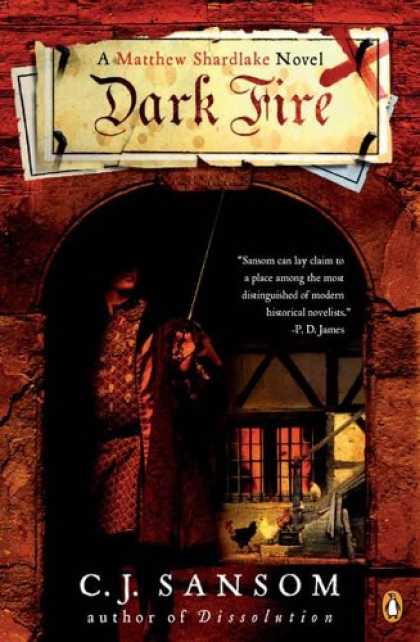
Dark Fire: A Historical with Punch!

But how does that help a person running a RPG? Below I’ll be discussing Dark Fire, using quotes from the trade paper back by Penguin books.
“There was a pleasant breeze; we were too far from the City walls here for London smells to penetrate.” pg. 31
When describing the background, remember that there are five senses. Smell can be a powerful one. Sight is the standard. Hearing can be used to point out some unusual elements or some very standard ones when trying to reinforce how a particular place is. For example, the lull of the waves against the shore. Taste is one not often used because it’s often only thought of during eating. However, a thick mist that taste of sea salt… not so different but still telling.
“His face hardened. ‘And because you care too much for the fate of the Wentworth girl and, finally, you are too afraid of me to dare cross me.’ Pg. 63
“What’s that in your pocketA?” Barak asked as we rode up Bishopsgate.” (pg. 75
One of the ways to get to players that they are in a place that matters, that what they are doing matters, that where they are going matters, is to put effort into it by providing names to locations, events, and people. It definitely takes more time as a game master and can be frustrating when the player’s don’t bite, but at the very least, at least you’ll have those names if the players come around that way again. This is most often useful for places that the players will be again and again. It allows the players to get an idea of the size of their home, the types of people that live there, and what is currently going on.
Shardlake’s patron is none other than Cromwell who has charged him with finding an ancient formula for Greek Fire, also known as Dark Fire. The important thing though, is this isn’t a simple “here’s 50 gold to do the mission.” This is a patron of many passions whose good to his friends, but always a hard man. If the players have a leader that is a Non-Player Character, why do they work for him? What does he do? How well connected is he? Is he a man with a reputation that insist one should not cross him? With the alignments in 4e simplified, it’s probably a little easier to handle a patron like that then in previous editions where players were often assumed to be working for the ‘good’.
“You’ve killed Sam?’ Toky’s voice was a horrified croak. “You’ve killed Sam!” pg. 446
Toky and Sam are two mercenaries who have been a plague on Shardlake and his comrades, getting into the spots they need to long before them, killing those they need to talk to, and seeking to end the life of Shardlake and his comrade.
However, they do not come across as nameless brutes or thugs. While doing research on whose attempting to get in their way, the backgrounds of Toky and Sam and brushed up and they’re given a little more character.
When you can give the bad guys flavor and flair, don’t be afraid to do so. It’s far more interesting to fight Toky the former mercenary with the plague ravaged face than another level 6 brute.
“He took a shuddering breath. ‘Lord Cromwell has fallen!’ Pg. 482
One of the continuous criticisms of the Forgotten Realms, is the wide plethora of powerful characters. Here, the author takes a real world figure, one of great power, perhaps only second to the king, and show cases that even when the players are successful in their own mission, that it may not always be enough. With their patron fallen, Shardlake and his comrade have new venues to explore and new adversaries and allies to discover. If the campaign is getting stagnant, don’t be afraid to kill the NPC’s and leave the players to their own devices. They might surprise you.
“She shook her head. ‘Class is everything. I am a Vaughan. Once I would have been happy to know you, you are one of those fit to be raised up, as my husband was. But not now, given your past loyalties and who the new powers are in the land. And I will not be lowered to your status Matthew.” She shook her head again.” Pg. 489
For a game based, in theory, on a certain time period of history, it does a bad job in many aspects of capturing those elements. One of those, is in class status and social levels. Perhaps back in the day when Unearthed Arcana first rose as one of those original hard cover supplements and its random tables allowed you to roll on them, did the core game concern itself with those elements.
And in those elements, there are a lot of potential role playing opportunities. Class in and of itself, is often seen as a divine right. It’s often seen as a right of arms. It’s seen as a right of inheritance. It’s seen as a right of the noble blood.
The benefit of using class in this manner, is that most characters are completely unconcerned with class. Now mind you, if your game is heavily focused on social class and status and you’ve been running such games for a long time, you already know this. But it’s a potential gold mine of role playing for characters because when they don’t care about who you are, but rather, as most players do, what you can do, it upsets the existing standards greatly.
This can be a useful tool for launching various aspects of the campaign. It can also be one for showcasing personal failings. For example, despite Shardlake’s kind spirit, he has failed to notice that one of his own workers is half blind and that is the cause of the numerous failings we find the lawyer yelling about in terms of quality. Even Shardlake, the hero of the story, has his own flaws as he merely thought his man incompetent and lazy, not suffering.
Dark Fire is full of great descriptions and it comes through by using a wide cast of characters and having numerous plot lines in the air. It provides descriptions that often come to light latter and provides a twist at its ending that doesn’t cheat the reader. If you’re looking for something to inspire, C. J. Sansom’s Dark Fire might have what you need.