"A Norman-French law dated 1393 delineates the reasons for establishing the sex neighborhood, the isolation of the sex trade to assigned areas, and the penalties for craftswomen who violate the rules. "Whereas many diverse frays, broils, and dissentions have arisen in times past and many men have been slain and murdered by reason of the frequent resort to and consorting with common harlots at taverns, brew houses of hucksters, and other places of ill fame within the city. And more especially through Flemish women who profess to such shameful, dolorous life. We forbid that any such women should move about or lodge in the city or its suburbs, by night or by day. But they are to keep themselves to the assigned places, the Stewes and Cokkeslane." page 105.
Many men have been slain? Think about what that implies here. Think about what it could possibly imply in a fantasy setting where half-orcs and drow may be among the more exotics of the nighthawks that are popular among the client? When fantasy poisons, spells, and all manner of dark and dangerous methods can be used to kill, and more importantly, where fantasy eco-systems are made specifically to clean up such a mess, think of how difficult it might be to even have prove of death.
In such a town, the lords and ladies running the dark houses of ill repute may have gleatinous cubes at the very least to clean up their mess. They may feed the occassional stranger to the ghouls in the sewers in exchange for the assistance of the undead in times of need.
Magic and mayhem can easily be combined when struck with such words as many men have been slain here.
Showing posts with label Women Medieval Europe. Show all posts
Showing posts with label Women Medieval Europe. Show all posts
Friday, November 12, 2010


Wednesday, November 10, 2010
The Action Is Happening At The Court
As I continue to read about Women At Work In Medieval Europe, the next section I'm on discusses the lady 'bosses' of the time. One of the things it speaks of is the vast size and scope of running a castle and the various duties that accompany it.
On page 54, there is an illustration and the text describing it brings forth a wide variety of individuals; "Elegantly clothed and seated at the high table, the hostess, beneath a richly decorated baldachin canopy, greets the entertainers who regale the guests with music and mummery. sword-carrying musicians play a variety of fifes, flutes, recorders, shawms, drums, and stringed instruments. Bird-masked, armed entertainers mine and act a play. Most mumming preserved ancient fertility rites including beheadings and resurrections, as in Morris Dances. The lead mummer carries a baton or torch, and faces the ermine-collared Surveyor of Ceremonies who directs the feast, alternating courses with entertainments."
A lot of things going on in that picture. But the courts also have wide arrangements and functions. There is a lot of detail on the use and nature of medieval hunting, including the various birds and animals used for sport. There are the good deeds that these people in power are supposed to be committed to, the givings of alms to the needy. The going to the hospitals to look after the sick.
There is the arrangement of the court itself. It doesn't 'just happen' to so speak.
And in some instances, there is war, and that war requires someone to take charge. One of the examples listed in the book is the countess of Buchan defending Burwick Castle against attack by King Edward I.
These activities provide an 'in' if you will, to the life of the courts. Does one of the players have a known skill? He's summoned to the court to show it off. Want to make more of it than a simple skill showing? Have it become a competition.
Want to run it in a dark vein? The players are hired to act as assassins but normaly people aren't allowed weapons in the noble's feasts and courtyard. Only those entertainers have them. Time to do some undercover work.
With the many branches that can interweave themselves in the high life of the court, it makes a tempting local to introduce the characters.
Friday, November 5, 2010
women At Work In Medieval Europe
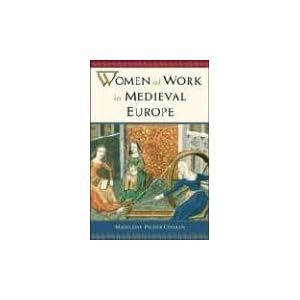
And one of those areas of interest is what were women doing. Not because when I GM I don't allow female paladins or anything like that. Rather, I'm curious as to what the actual socieites were like and what jobs they had.
While I've only just skimmed the book thus far, it's alays proven worth the price. Marie De France is a 12th century poet and one of the examples of her work is showcasing a woman using her mind to outsmart her husband who catches her cheating. She tells him that the man can't trust his eyes. After all, if he looks into a barrel of water and sees his reflection, he's not actually in the barrel. His eyes are lying to him! There's some other clever bits here too.
Ironically, before I got into the book, the preface mentions Dr. Barbara of Wissenkirchen, a battlefield truma surgeon in 14th-century Germany. That right there is a perfect NPC. While the gaming mechanics and whatnot would have to be worked out, the fact of a battlfield trauma suregon is awesome in and of itself.
When looking around at your table, if you have players whose characters roles and abilities you arent' certain would fit into your campaign, don't be afraid to do a little research and challenge your perceptions. Even if such characters are the rareities and exceptions, they can make good examples of 'true grit' so to speak.
Subscribe to:
Posts (Atom)


