Showing posts with label Cary Nord. Show all posts

Tuesday, November 13, 2012

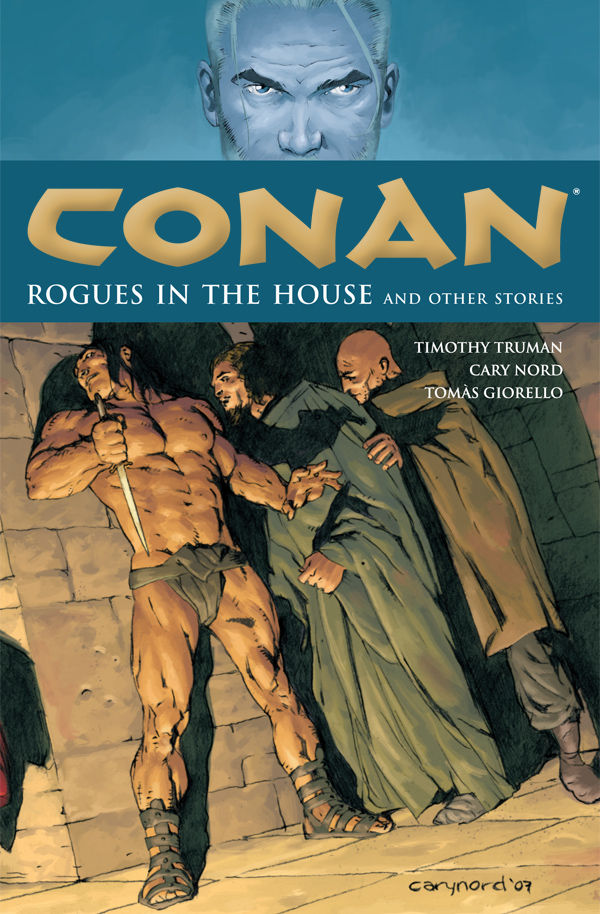
Conan: Rogues in the House by Timothy Truman, Cary Nord and Tomas Giorello

Conan's adventures by Dark Horse comics continue in this, volume 5 of the collected single issues of the series. Written by Timothy Truman this time around with art chores still handled, at least in part by Cary Nord, who does the cover, the series continues to provide a quick sword and sorcery fix for those who prefer a visual run of their material.

In looking at what elements bring conflict and potential adventure, there are a number of elements to put into a check box.

1. Relationships. Conan's ladylove Jiara is a bit tired of the low life living and when a suitor of apparent means and manners comes to woo her, she quickly throws her former comrades to them in exchange for a life of comfort. Of course nothing ever goes as planned but this brings into focus the need to keep characters around the players that can involve them in future adventures.

2. Failure is not the end. Through the series, in both the originals and in various forms of media, Conan is often captured. This in and of itself is something that players often don't like due to the lose of control of their character. However, it can be used to launch new adventures. In this volume, Conan is released from jail in order to hunt down 'The Red Priest'. In other series, such as in the Theft of Swords, when the main characters there are captured, they are put on a new mission in exchange for their freedom and their lives. By putting the game back into play from failure, the GM can keep the continuity of the campaign going while allowing the events to have played out.

In the Shackled City campaign I'm playing in right now, the group recently lost a fight. No one died in the actual fight itself but we were all down and unconscious. The GM decided that one of the players that wasn't there in person that night came in and saved us at the last minute. At first I was a little annoyed at that 'break' in the game but the more I thought about it, the more I thought, "You know, it's probably for the best." A few of the other players had been suffering from some numerous character deaths and didn't want to make another character, a few others were okay with it either way it went, and in the end, the game wasn't hurt by the incident and it fits well into the old movies "fade into black" followed by "to be continued!".

3. Gonzo. By this I mean having a variety of weird elements. In the case of Conan mind you, Robert E. Howard tried a bit to throw in some pseudo science into the game where a lot of the 'elder' beings were aliens who'd fallen into decadence. In this book, the Red Priest's home is host to numerous traps that can be activated through various manners and some of them are almost science-fiction in nature. If it's good enough for Robert, it's good enough for you. Don't be afraid to throw some odd elements into the campaign from time to time.

4.Apes! Gorillas! Monster Men! I've read a bit of Conan through the years. I don't know if it was Howard's initial intent or what but between the old Conan #100 where his lady love there is killed by a carnivorous winged ape, also of a decadent race mind you, or Thak, the monstrous semi-man ape here, as well as others I'm sure I missed, it seems there are a lot of ape potential in the series. This might be more of the 'near' man bit but unfortunately, it's a niche well filled in most fantasy games. Bringing to light the savage and the civilized, the morale and the unfit into contrast is not always an easy thing, especially in traditional D&D games where there are alignments with monsters hard coded to fit those elements but bringing those characteristics to the game can provide more than combat to the game.

Rogues in the House is well told and provides the reader some great visuals and while the classic confrontation between Conan and Thak isn't necessarily up with the iconic image from Fazetta, it gets the job done.


Sunday, November 11, 2012

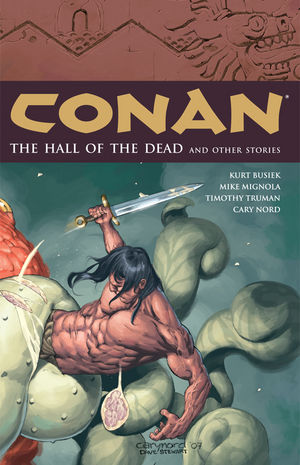
Conan: The Hall of the Dead and Other Stories by Kurt Busiek


One of the interesting things about cleaning up is that you often find things not as you left them. For example, this is volume 4. I can't find my volume 3 anywhere. I shall have to continue the search and hope that it eventually springs up.

In the meanwhile though, Kurt Busiek continues to work his talents on the barbarian and is joined this time around by Mike Mignola, Timothy Truman and the ongoing efforts of Cary Nord, who did the cover in this case.

I'll be discussing some specific spoilers below so if you want to avoid any of those, read no further.

Relationships can be a source of almost infinite adventuring seed generators in and of themselves. The book starts off with Conan wooing a magistrate's wife as he plunders her treasures. This in turn angers his current lover who then goes and has her own affair and in the process, does some more selling out of her own. The back and forth between the two in this instance directly sets Conan against the law and against other rogues.

The 'problem' if you will in such instances though, is that the Game Master has to have a world to hang these characters on. Conan's relationship with Jiara is not necessarily that of true love so while they are both out with others, then those others have to be created and then the people who deal with those others, such as the magister or the nobles, have to be fleshed out. It can be effort, especially for those that are only going to have a few appearances but keeping a set of generic game stats around for such characters can cut down the preparation time considerably.

In terms of good deeds, its often the motto, "No good deed goes unpunished." While that may come around true eventually, allowing the players good deeds to have, at the very least, some good karma, is not necessarily a bad thing either. Kiresh, a young woman who is practicing magic and at such a low level of the social strata that she is thieving her dinner when caught and Conan saves her, then works, behind the scenes mind you, to check on Conan. This allows the GM to return NPCs to the field when they work in the background and provide a reason for them to do so.

For foes, one of the creatures Conan fights here is a gigantic demon toad. When Conan hides from it, his presence is given away by another toad that bellows his presence to his master. Having themed monsters can make for memorable encounters. For example, a gigantic spider, such as the one from the Lord of the Rings, who has smaller spiders talk out her prey.

While Conan encounters his share of soldiers, he also encounters those that include would be bandits. The twist of a 'hero' like Conan though, is that even when killing bandits, he's not necessarily doing so out of a pure motive. Turns out that he winds ups stealing for those who were already being robbed. Mind you he doesn't kill or rape the people he's stealing from and even this robbery comes back to haunt him but having characters that are neutral in a campaign means the GM has to be prepared for more 'work' in terms of what the players will do. They aren't necessarily going to always follow a 'good' script and always be predictable in that fashion.

In terms of bringing old troupes to fantasy gaming, the old horror movies The Hills Have Eyes has been a source of inspiration in Pathfinder with their Ogres, but also in Conan as he encounters a clan of inbreed brigands whose intentions are as monstrous as their mutations. Despite that though, they still have contacts with the outside world including people who bring them fresh victims in exchange for getting the use of their muscles against specific enemies of their own.

In terms of overcoming foes, sometimes you can provide methods to the players that don't necessarily just involve battering the enemy until they die. When Conan battles the demon toad, it's not his sword that kills it, but rather, he drops a massive statue on it. He he's fighting against the hill folk, while his sword does indeed do a lot of killing, knocking out the support for a carved cave and then cutting a rope bridge does an excellent job of bringing that death total up even more.  Provide your players options to do things a little... easier and see if they talk them. These cinematic events can work against the players too mind you if they're not all up to the challenge of navigating the new terrain.

For example, if there is a monk, a barbarian, and an armored knight crossing that bridge and it gets cut, do all three make it across? Does the knight have to tie himself to the bridge to avoid falling to his death? The lightly armored characters, especially in this example, already benefit from a faster movement rate, both because of the lack of armor and the innate abilities. Try to provide situations that doesn't always favor one type of character over another in these instances.

Volume four of Conan from Dark Horse continues to bring the fantasy to a medium that could certainly use more variety and if your looking for some well illustrated tales with some interesting background bits on Robert E. Howard, this graphic novel has you covered.

Saturday, October 20, 2012

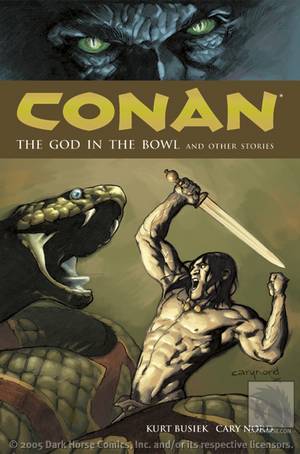
Conan: The God In The Bowl by Kurt Busiek and Cary Nord


Continuing to go through the old collection as I'm trying to organize things. Not easy as I tend to get distracted a bit too easily but nonetheless ongoing.

Conan continues his adventures in this collection of the single issues. Cary Nord does a fantastic job of illustrating the series and the colors are fantastic to view. This volume again presents stunning visuals if nothing else for any sword and sorcery campaign. Kurt provides some interesting interpretations of old stories and introduces new characters to the setting.

I'll be discussing specific spoilers below so if you'd rather not have any of that, read no further.

In terms of characters, the Bone Woman and her servant, Janissa are probably the 'big news' here. The Bone Woman was retroactively introduced in the zero volume and in many ways would be a GMNPC where the character is too powerful and can do no wrong. Thankfully her actual use is minimal here.

Janissa is... I don't want to say a poor substitution for Red Sonja, but... she's a red head warrior (and not in every illustration mind you, in some its brown hair) woman whose origin is tied into rape. More elements of the supernatural here? Yes. Similar enough to be a substitution? I'll let people more learned in the whole Conan mythos argue that one.

The thing I thought would fit with most campaigns though, is that the Bone Woman offers her services to those who seek her out. However she does make those who take her services work for her. This makes her a perfect patron for those campaigns that use an employer model. This can be anything from "Go kill this guy" to "retrieve this artifact." What do the players get out of it? Training, unique skill sets, magic items, spells, or other trinkets? Depends on the nature of the campaign.

Part of Conan's tales this volume involve a trip to Hanumar, "once a stronghold of learning and still a place of ancient power." It's necessary to go there because of the Eye of Tik-Pulonga, "Dark and tainted beyond measure." See, one of the few places that Eye can be destroyed is in Hanumar so off Conan and his new patron and allies go.

In standard campaigns, there is often little need to consider how to destroy magic items. Rather the opposite is often sough. But in looking to destroy magic items, it presents something of a different challenge not only in getting to the destination, but in keeping the item from those who would abuse its powers.

Are there items in the campaign that in the right hands would do vast harm and must be destroyed? Are there ancient powers out there that seek to use those powers for their own gain? A patron allows you to add those things in relatively simply.

For example, in older editions of AD&D, there were tables that broke spells down into their rarity. The more rare the spell, the harder to find, and the more to purchase, it cost. Having a patron allows you to sprinkle those things into the game with a ration for it.

In newer editions of the game, magic items became baked into the math that characters required to have. However, their accumulation then felt artificial since they HAD to have them. This mean you had to sprinkle them through the adventurers by 'chance' or allow magic shops on every corner. The patron is a somewhat mix of the two in that there is a source of magic but isn't one that the characters can necessarily just 'buy' things from.

There are other elements in The God In The Bowl worth reviewing but the main story itself is more about the build up of suspense. Its something that I've rarely been good at unless I'm 'on' so to speak. The building of good terror can be accomplished in a lot of ways, the peeling of the onion so to speak, but for most games these days, unless that is the genre you're playing in, such as Call of Cthulhu, which is excellent for this type of scenario, the pay off may take too long. There may be too much investigation. There may be too much questioning.

At the end of the day, Conan the God In The Bowl provides more fantastic visuals and some interesting monsters in the tales of Conan the barbarian.


Friday, October 19, 2012

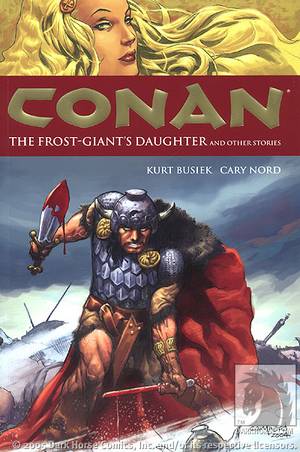
Conan: THe Frost-Giant's Daughter by Kurt Busiek and Cary Nord

As I continue to go through my various graphic novels and other bits, I find myself looking at my Conan collection one more time before putting them into storage to free up room for various other projects around the apartment.

This volume, the first collection of the monthlies by Dark Horse comics, brought Conan back screaming into the comics field. While no small part of that is thanks to the writing chops of Kurt Busiek, let me be honest and say its Cary Nord's powerful artwork and the amazing coloring job they did on these first issues that brought fans of the genre flowing towards the comic.

I'll be discussing some of the specifics below so if you would avoid spoilers, read no further.

Kurt uses an old method of starting in the middle of the action. Conan comes across a woman just about to suffer some unspeakable horror from raiders when he decides to interfere. By doing this, it puts him firmly into the conflict. This is something that has happened to Usagi Yojimbo many a time. In a role playing game, if your players are even slightly motivated by stopping atrocities, this is an easy method to use.

They are leaving the bar in the middle of the night and hear a scream. Being the poor part of town they would be the only ones to react. What do they do? They are travelling between towns and come across a group of merchants suffering a goblin raid. What do they do. By starting where action is, you firmly put the ball into the player's lap. They have to do something. This is something used in written adventurers as well. The first book in the adventure path by Paizo has the players in a city that comes under attack by goblins. What do they do?

This being Conan though... well, the villagers he saves are grateful but the menfolk who return as Conan's done are a little suspicious of him. After all, he is a Cimmerian. What the hell is he doing so far away from his own people? Most games downplay the differences between cultures and have universal languages. This isn't necessarily a bad thing and playing the differences up too much can lead to its own problems. Having some cultural animosity that can be overcome by actions isn't necessarily a bad thing.

The other part about this being Conan though, is best to lock up the ladies! Conan quickly works his way into one of the village lass's.... er... hearts, but of course she already has a man. Jealous is a powerful motivational tool. When looking at the motivations of those that could be enemies in the campaign and looking for the why of it, jealous is a quick villain motivation.

Another part that follows here, is Conan's lack of experience in the world. He wants to see the Hyperboreans who his grand father described as being something akin to the elves of other fantasy games but turn out to be more like Melnibonians from Michael Moorcock's Elric series. His grand father never ran into them personally but had heard about them and passed that information down. This second hand information allows the Dungeon Master to put out some feelers and if the players don't bother to gather more information then whatever befalls them next is firmly on their shoulders.

In terms of the Hyperboreans themselves though, Kurt does a good job of bringing this ultra-high fantasy race into the otherwise grim and gritty sword and sorcery world of Conan. They are a race of near immortals powering their decadent society with the souls of the dead and using individuals like Conan, whose captured thanks to betrayal, into the arena to fight for their entertainment. Others are turned into monstrous albino hulks that are used to in turn capture further people.

The interesting thing about this volume though, and perhaps its because its the first one, is that Conan doesn't actually 'win' if you look at the big picture. While in many tales his wealth is lost in order to motivate him to keep adventuring, here his big 'win' if you will, is merely his escaping the Hyperboreans.

In some campaigns, the assumption is that if the players go there, they should win through. In some cases though, it should be clear that is not a real possibility and the best they can hope to do is emerge with some new knowledge and know to never go that way again.

Kurt's early work on Conan stands the test of time although the high magic within it may not be to every one's favor and the artwork of Cary Nord is brimming with violence and power. The visuals alone should be able to provide some inspiration if the whole trip of Hyperborean fails to do so.