The first thing is over use of the gods. The malanti that starts us off on this journey turns against her master and is protected thanks to the god.
The emo hero of the piece has been directed and guided by a god. He was knocked out a few times early in the series including once where he was shot by a crossbow and lived because he had to serve.
The bard hero of the piece is also directed by a god.
While the use of deities is not necessarily a bad thing, especially in a setting like the Forgotten Realms where the gods are very real, after a while you have to wonder, where the hell are the evil gods while the rest of these deities are planting their very firm hand on the setting? Mind you, the villain of the piece of old enough and powerful enough to perhaps qualify as some sort of demi-power, but you figure that some of the evil forces out there would be aligned on his side right?
So when running your game, try to be aware of the powers that be and that their overuse might have an adverse effect on the game.
For one, the players can become spoiled if they expect to have their fat pulled out of the fire by the gods when the going gets tough. If you bust them out of death's door once, why only that time? They can also get jaded in that they'll wonder why they are playing if the gods are going to solve all their problems to begin with. It's a fine line and once that can be crossed easier when you are familiar with the preferences of your group.
The next bit has to do with the villain of the piece. Iakhovas is an ancient entity native to the Forgotten Realms. He enjoyed the love of the Bitch Queen when the lands were young and he was one of the first creatures upon it. But he failed to keep that love and was punished.
Thousands, if not tens of thousands of years later, he comes back and seeks out all the old items that made him into such a power back in the day.
Okay, this is like the Emperor rebuilding the Death Star in the third Star Wars movie. Yeah, it was awesome when we first saw it, but do we need to see it again? Is that 'ultimate power' that got is ass whipped the first time around really the solution?
If in the day he could not achieve his goals with the items he had, why would he search out those exact items again? Did something change where now they are more powerful then ever? This falls into the trap of "the old stuff is better". It would have been more interesting if the author took that old standard and had the heroes going around securing all of Iakhovas old goods while he went and either made new ones himself or had new ones crafted for him.
The other problem I had with Iakhovas, is that he's shown as being a great leader. He's shown that he is a tactical genius. At the end, he stays to fight to the death against someone who has a superior weapon. This reminded me of the Transformers movie with the Fallen going on and on about how only a Prime can defeat him and hey, there's Optimus Prime renewed and invigorated and yeah, let's fight him!
What's worse, is at the point of his death, Iakhovas has a magic eye which when hit with a magical sword, blows his head off. How stupid of an entity do you have to be to put something that can take your head off into your head? "I think this grenade really sets off my features." Stupid.
Now the things that I thought worked, included bits that were set up for future follow up. This includes some glimpses into the future where the hero sees himself fighting his father. I thought this would've happened prior to the fight against Iakhovas as a sort of redemption piece but by leaving it for later, the author saves some space for future conflicts that perhaps may not be as epic, but are still personal to the hero.
The mentor of the young hero mentions his fallen sister, a necromancer, and her alliance with the Zhents. Another field where we get no resolution.
The destruction of the Sharksbane Wall. This was used to keep the old beasties away from the rest of the population in the Sea of Fallen Stars. It is a very real thing that leads the setting into more dangerous tides.
And on that last note, I have to wonder, again, how badly 4e screwed the Forgotten Realms pooch.
Prior to 4e, and not necessarily all at once, but all having long term effects, you have the following:
The elves retake Myth Drannor.
The Shades take over Sembia.
The Sharksbane Wall is destroyed and naval powers have suffered some crippling defeats.
The Dragons have gone mad and destroyed a lot of the standards and standbys.
And then instead of having to help fight back the hordes of undead dragons created during this time, or sail in peril across the Sword Coast or across the Sea of Fallen stars, or fight against the Shades in Sembia, or help rebuild the city of elves, we get a hundred year skip where all of the interesting stuff is someone done by still relevant?
M'eh.
One thing I thought interesting, when discussing the gods though, is that it provides a good example of how some of the deities, in this case, Sekolah, the god of the sahuagin, are multi-natural in order and would allow the villain of the piece to rise to prominence. The villain makes a note early on that the Shark God swims through many worlds, a nod to the huge connected nature of the planar settings that the Dungeons and Dragons rules utilized back in the day.
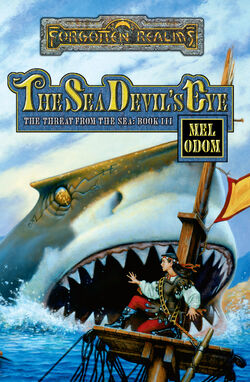
Threat From The Sea has a lot of action and keeps things moving, even when I'm not down with all of the pieces and bits that are used to tell the story.