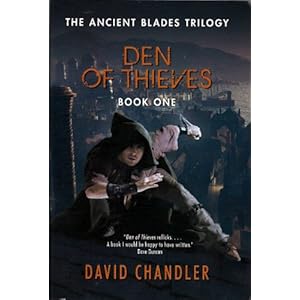
David Chandler wraps up the Ancient Blade trilogy with Honor Among Thieves. I have to say, I'm no art critic but this is a terrible cover. The whole angle of the main character is way off for some reason. Colors aren't doing it any favors either. The dark nature of the previous covers were solid in contrast to the colors. This to me, is muted and awkward.
Writing wise, the book continues to follow the previous established pattern. If you enjoyed the first two books, this one follows through in that manner. The material continues to expand the setting, has large scale conflicts, and some 'fantasy revolutions' in technology and portents for future material set in this series.
Again, perhaps because I read it prior to this one, I find myself doing some contrast to Riyria Revelations by Michael J. Sullivan. In the third book of that series, the elves have their time and quickly wipe out most of the resistance. In Honor Amongst Thieves, the barbarians have free access to the lands and quickly decimate most of the opposition leaving only one city, the Free City of Ness, left to resist.
One of the problems with some campaigns is that they become like glass. You want to look at them and admire them. To insure that they're is a continuous flow of one thing to another. Authors know better. Smash the setting. Unleash the hounds of war. If you don't like the way it goes down, next campaign do another variation of the campaign. Mind you, that's easier to do with a new group as the old group, at least in my experience, is often interested in seeing how things 'went down'.
Another interesting aspect is the rise and fall of characters. Malden, who started off as a simple free lance rogue, gained membership, and in this volume, not only becomes the guild master, but then the 'mayor' of the free city. Mind you, at the end of the volume, he's back to being a freelance rogue but the shifting nature of power, especially social power, is made clear here.
Sir Croy, whose been fairly boring in some instances, by design I suspect, has his chance to shine through. He rises from being an exiled knight to becoming the regent of the kingdom. It's not what he wants mind you and his interest in it is slim compared to the longings of his heart, but he is a duty bound man who does not run from his responsibilities. At the end of the novel, while he has indeed lost his heart's goal, his political position and social status are higher than they were at the first novel save for one important thing that I'll mention later.
Cythera on the other hand, whose initial role was a ward against poisons and curses, comes into her own as much more than the rival love of the main male characters. Her mother, who laid the protections against curses on her, now trains her to be a witch. However, as her father was the most powerful of sorcerers, she's inherited that talent as well and winds us using a bit of that. Now in this setting, sorcerers are demon bound and their use of such magics mark them. In this instance, she gains some gray hair.
Open Ended. While the bulk of the story is resolved, there are many parts that are not. This is a good thing as it evolves organically from the story. The barbarian invasion force splits due to differences between brother and sister. This leaves the main invading force of barbarians defeated, but a goodly sized portion still in control of several fallen cities. This leaves the series open for future investigation as to what will happen with the mingling of different cultures there. This doesn't count the pass open from the destroyed mountain either. More barbarians could wander forth. More trade could be established.
More interestingly to me at least, is the fate of the ancient blades. The barbarian war chief, Morget, found some very potent dwarven weapons last volume. One of these, an axe, is apparently able to smash through the ancient blades themselves. This is fascinating. I'm always advocating that new methods and new techniques should be able to overcome things of the past. If the modern world ran like most fantasy stories, someone would unearth a copy of MS-DOS and destroy the modern Internet with it's ancient and archaic powers. On the other hand, those ancient blades were craft with magic for a specific purpose. With only one left at the end of the series, wielded by a rogue who doesn't know how to fight even, the author sets up a return of demons and sorcery for future volumes and the creation of new blades even.
Mind you, not all the loose ends are so interesting. Elves were introduced to the setting, or reintroduced to the setting, and not a peep out of them. Some of the elements, like the introduction of a canon by the dwarf Slag, may seem awesome at first and indeed, worthy of a player character doing, but with the nature of the setting showcasing so much that appears to take place in several different eras in terms of how it might be first introduced, still feels somewhat forced. Minor things for me but others might be more irate about it.
Honor Among Thieves is a good source of inspiration for role playing games like Dungeons and Dragons or Rolemaster where the character is the star of the story and not necessarily just the mechanics of the character.
Showing posts with label David Chandler. Show all posts
Thursday, December 27, 2012
Monday, December 24, 2012
Thief in the Night by David Chandler
Thief in the Night is the second book in the Ancient Blade Trilogy by David Chandler. I see over on David's website that when I found the first book for $2.99, that was a temporary sale. Man, dude needs to update that blog some more or have some links to his more modern work or more complete work. Last updated on 2011? And I thought I was bad.
Anyway, Thief in the Night continues the tale of Malden and Croy and the woman who they both love as well as dwarfs, dungeon ruin exploration, barbarian introductions and all manner of other interesting bits that would feel right at home in most role playing games. I'll be talking about specific spoilers below so if you would rather avoid that, read no further.
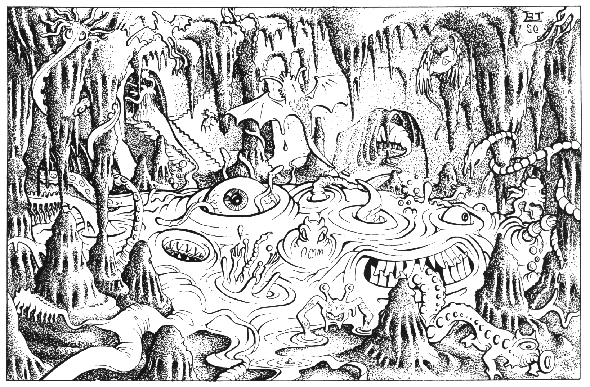
1. Racial Changes: I've mentioned before that in various settings, one way to make things stand out a bit is to change the 'core' fantasy races around. In the Riyria series by Michael J. Sullivan, the elves were vastly powerful and held at bay only through honorable agreements with their ancient pacts. Here, the elves were wiped out. Well, apparently not all wiped out as Malden and his friends discover in this novel as the elves have changed to more suit an underground civilization. This includes breeding large beetles for meat, fungus farms, and using the 'ancient's, which appears to be a thing that resembles an old Shoggoth by a Erol Otus from the old Deities and Demigods book.
Yeah, all eyes, and teeth, and hands, and strange bits to it.
When the elves die, they 'feed' themselves to it and their knowledge is then absorbed by it. This allows the elves to draw forth on knowledge that is ancient and rare and powerful. And in the case here, to survive their imprisonment in these ancient dwarven halls.
The dwarfs continue to be fleshed out a piece at a time. Slag showcases his vulgarity with vast amounts of swearing. It's entertaining to a point mind you. He also illustrates how dwarfs have changed. They have taken to some human vices such as gambling and this has lead some, like Slag himself, to do things that lead to exile. Their numbers are also on the decline. So some of the same old same old and some new.
2. Historical Nonsense. Again, the Riyria series covered similar ground. The humans have told themselves some pretty lies about how the war against the elves went but as Malden and his comrades explore the ancient ruins, which no dwarf in modern times could ever recreate, they learn that the elves weren't beaten by the humans, but betrayed by their allies, the dwarfs at a time when they didn't necessarily want to even fight anymore in the first place. This taking huge chunks of history and reworking them can also work in a RPG but care needs to be taken so that it actually works. Here, Croy and Malden are young enough that they wouldn't know the truth. In RPGs some long lived races, like elves, or even some immortal races, would know would actually happened. Not necessarily a problem for all games, but as Dungeons and Dragons tries to throw more and more material against the wall to see what sticks, its not entirely unusual to see such a player character pop up.
3. Expanding Setting. The first volume dealt mainly with the free city of Ness. This volume, by its nature of exploration of a ruined dwarf city outside Ness, expands upon that some. We see for example, Morget, a barbarian from the opposite side of the mountains, is seeking out Croy because his destiny is to kill a demon that looks like a strange slithering thing of arms, eyes and teeth. Morget is also a wielder of one of the ancient blades, one that explodes with light. This light is painful to undead and would make a good substitute for a Mace of Disruption with an area effect were the GM wanting to incorporate something like it into their own game.
In many ways, this is a natural in role playing games. You first dungeon leads to your second dungeon. Your first exploration in the sandbox leads to the second exploration in the sandbox. Your first departure from Sigil or the Rock of Bral leads to further exploration. Don't try to cram the whole campaign into one setting. Let it develop from the actions of the players.
4. Big Changes. One of the things I've been guilty of myself, is trying to keep things, to a certain point, at a status quo. To not have any huge effects happen to the setting. David doesn't have that problem. By the end of the novel, the characters have collapsed the mountain on the elves. This leaves a pass open from Morget's people, barbarians who have a lot in common with say, vikings and crossbreed with Mongolians. So that opens up a whole new vista for them to say attack the kingdom.
5. Character Optimization: One of the things that role playing games tend to suffer from, especially when they get pregnant with rules, is that there are 'builds' and abilities that almost become mandatory to take. Malden, while perhaps one of the best 'thieves' in the setting, one of the most agile, one of the most able, is still a terrible fighter. In 3rd edition and 4th edition of Dungeons and Dragons, its almost impossible to play such a character as so much of the setting focuses on their tremendous back stab damage and 4th ed kicking that up even more of a notch with special abilities that put them right into the fighter's arena.
The Game Master and player should have an understanding of what type of campaign is happening and the players should try to work with the Game Master to build characters that will thrive within it. In Malden, we have a character that is charismatic, works well with a party, and is a master thief. If the campaign requires only martial powered characters that can dish out damage, Malden would be useless. Check with the GM and hope you have one that's willing to work your abilities into the campaign.
Friday, December 21, 2012
Den of Thieves: The Ancient Blades Trilogy I
When I ordered the Riyria Revelations from the Science Fiction Book Club, I also ordered the Ancient Blades Trilogy. Or at least two of the three books. See, when I first looked around, the ebook from Amazon was less expensive then the physical hardcover so I bought that from Amazon. It's since gone up in price but still probably less expensive then the hardcover unless you get a good deal, which the Science Fiction Book Club has more than it's fair share.
Anyway, Den of Thieves is Book One of the Ancient Blades Trilogy by David Chandler. It touches on a few points I enjoy. A 'free' city in a medieval style setting. Dwarves on the decline, but still in high demand for their high quality. Thieves. Knights. Magic swords with unique backgrounds. Broad over arching themes that tie into the current story. It does fall into my 'popcorn' reading bucket mind you, but I don't have a problem with such material.
I'll be discussing spoilers from the book below so if you have no interest in such, read no further. Know that Den of Thieves is a fun ride but not the 'serious' stuff of Wheel of Time or A Game of Thrones. Anyway...
In terms of city setting, much of the book takes place in the Free City of Ness, a place that while part of the 'dark ages' styling so common to fantasy, has its own freedoms. The city has a bit of personality tied into magic. In the long ago past, a powerful sorcerer used his magic to take the mind of one of the rulers and put it in a crown. This intelligent crown then takes control of the heirs and essentially makes them imbeciles who couldn't run the city without it. The idea of an eternal ruler passed down from heir to heir, each one becoming more and more stupid and less capable is an interesting one and could easily by yanked for a campaign.
The city also has it's own thieves guild run by one Cutbill. It is he who first brings in one of the heroes, Malden, and puts a heavy burden on the young man. The thieves guild doesn't get a lot of attention in terms of its characters, and I'm sure if A Gallery of Rogues gets funded and gets actually completed, it will be more useful in terms of gaming, but there are several thieves that come out named with their own personalities and traits. There is also an interesting use of children as beggar lookouts. Children as lookouts I'm used to but beggar children ready to swarm their enemies is a bit different.
For magic items, the series title itself, Ancient Blades, comes home. There are seven magic swords that are crafted to destroy demons. Turns out that many moons ago, sorcerers would summon a lot of demons. In some ways, it evokes imagery of how I'd imagine the price to be paid for sorcery in Dungeon Crawl Classics might work. Powerful stuff but not good for the caster. Regardless, these seven swords have long histories, are passed down, and each do a specific thing. In that aspect, they reminded me of Fed Saberhagen's Book of Swords. I remember reading those as a teenager and thinking, "Damn, some of these are awesome." Ditto here although these swords aren't as powerful.
Den of Thieves also features a lot of traps, both mundane and magical. Reading through it should give any GM a few ideas on things that can be added to dungeons including illusions and floor traps among others.
In the end, the strongest thing I can say about Den of Thieves, in terms of gaming, is that David Chandler wrote a game that features characters in scenarios with items that wouldn't seem that out of place in an OSR game.
Labels:
Ancient Blades Trilogy,
David Chandler,
Magic Items,
Thief Guilds,
Thieves,
Traps
Subscribe to:
Posts (Atom)