Showing posts with label Warhammer 40K. Show all posts

Friday, February 21, 2014

Descent of Angels by Mitchel Scanlon


Descent of Angels is another volume in the long running 'The Horus Heresy" taking place in the early years of the Warhammer 40K setting. The book to me, for about 90% of it, feels very complete and very done in one. Mitchel Scanlon does a solid job of bringing the various cast and characters to life by having a focus on one of the youths of the setting who sees his world transformed and then his own life transformed.

The military chapter that comes into play here, The Dark Angels, are lead by Lion El'Jonson but this is a tale from before he actually lead them. Rather, it starts off on Caliban, a so called 'death world' where survival is difficult. I found the writing good enough to drag me into a sense of wonder where the characters are part of a near medieval system but are using ancient technology such as old school bolters and swords and unaware, for certain at least, if there is actually a Terra.

The main character, Zahariel , is growing up in this world and is not alone. His cousin, so close they are like brothers, Nemiel, are in a state of constant one ups man ship. Almost a mirror for the activities of the Lion and his second in command, Luther. The constant state of competition, of almost being equals, shows its strain many times but the problem in this book, is it never comes to a head.

The book ends in a sort of "and then stuff happened" which leaves that aspect of it unsatisfying. For me at least, the rest of the book was well written. There is a lot of action and the nods to what is going to happen as part are told in a historical fashion as opposed to the character moments.

I'll be discussion some specifics of the book below so if you'd rather not have any more specific spoilers, read no further.

1. Rivals: One of the things that's supposed to be 'tragic' about the whole of the Horus Heresy is how Horus turned against the Emperor and how brother fought brother. Here we see just a taste of that between the Lion and Luther and Zahariel and his cousin Nemiel. Having characters in the setting that the players don't directly fight against provides them ties to the setting that don't necessarily have to do with killing something. But how can you bring such a rivalry out?

1a. Games of Skill outside combat: Zahariel and Nemiel train against each other many times. While you could have the characters actually fight, don't forget there are other forms of competition. For example, in shooting or throwing weapons, the characters probably aren't going to be doing such against each other, but against targets.

1b. Kill Count: Just because the characters are all in the same setting, doesn't mean that the player's character goes out on the same missions as the NPC. For example, the player may hear what a great job his rival did and how many spawns of chaos were put down under his rival's sword.

1c. Advantage: Rivals may seek out an advantage over each other. In this case, Zahariel has an innate advance in that he has 'terror vision' or something of that nature and is a potential psyker which is a powerful ability in the Warhammer 40K setting.

2. Embrace Change: In Shadow World, a setting for use with the Rolemaster system, the Shadow World setting itself is merely one planet in the grand scope of the much larger Space Master setting. While there were several times I was tempted to drag the players into Space Master and more specifically Dark Space, I held off on it, but I could have done it and it would have fit the setting. Here, the characters go from an almost backwater planet to fighting among the stars. Roll with the changes when they make sense.

3. Have an Endpoint: One of the things that Mitchel Scalon didn't do well in my opinion, is have a good stopping point. If possible, have a number of end games in mind so that if something happens and the campaign can't continue to run or players drop or you need to switch games, that you can do so at an 'organic' place in the campaign where it feels logical to do so.

Descent of Angels is available from Amazon in paperback for $8.09 in paperback and is prime eligible. As with many of the Black Library books, there is no kindle version available but an electronic version is available from the Black Library directly.

Sunday, May 13, 2012

Duty Calls by Sandy Mitchell


Duty Calls by Sandy Mitchell is yet another book from the mighty dollar spinner rack at Half Price Books. Fortunately for me, its another winner. Like several books I've bought from the spinner rack though, this one takes place in the middle of a larger series. Unlike some series though, I didn't feel at a loss or that I was missing vital background or details.

Duty Calls uses first person for most of its tale through the viewpoint of Ciaphas Cain, a commissar with quite an interesting outlook for the grim future of 40K. There are a few breaks between chapters that help fill in the blanks though as these are told almost in a memoir style. Overall it works very effectively in providing a broader view of the setting and the events that take place there.

The book is well written in that it flows quickly, was easy to read, and easy to enjoy. It ends in a logical spot even though there are vast potential other bits that could be tackled and probably have been in the series. At this point though there was no Kindle version and the Black Library  ebooks tend to be higher than I enjoy paying for so I'll keep looking at the Half Price Books and its mighty dollar spinner rack.

In terms of gaming though, there were some things that nudged their way into my brain. Note, there will be specific spoilers for some parts of the book so if those aren't up your alley, read no further.

1. The five senses. Cain is a man whose aide is a man of intensely odorous smells and manners. This repetition helps enforce it. In doing so, the author brings up a great use of smell. The description for how the Tyranids move and how it sounds is another good example of the senses. When describing enemies or the landscape or the locals, don't forget that while the sights are important, the other senses can be just as useful in conveying mood and tone.  Is the floor even? Does the room stink of old meat? Is there the buzzing of insects? In terms of smell, sometimes it can be so powerful that people can taste it.

2. Repetition. Sandy Mitchell makes excellent use of variance in repetition on several factors including the smell of Cain's aide, as noted above. When trying to enforce something, the Dungeon Master's tools include repetition. It also serves as as reminder of the familiar when the reposition brings home the things the players enjoy.

3. Reputation. One of the most interesting things about Cain is that he's not quite the typical hero of such a story. He knows his weak points. He knows his issues. He does not claim to be brave or a leader, but because his history has placed him with a reputation, he has to maintain it in order to keep the benefits that it brings him including troops morale, trust, and cooperation. Everyone wants to keep on the good side of a competent and dangerous Commissar.

4. Allies. One of the interesting things that Sandy does here, is weaves the Inquisition of 40K into the more militant guard duty and makes it all fit. Cain's ally, or boss, or part time comrade or however you want to look at it, opens up different venues that Cain has to follow. This prevents all of the tale from being only about hunting down the bugs and makes it part investigative as well. In Role Playing Games, there are often organizations, factions, guilds, and other elements, that specialize in a venue of the setting that the players may not normally be involved in. Having some cross over with those organizations allow the Dungeon Master to pull the players in directions that they may not normally have went into. This is particularly useful if the game tends to have a narrow focus and you don't want the players to grow too bored or comfortable in their familiar environments.

5. Multi-Layered Issues: While Cain is doing his work for the Inquisition on one side, others in that faction are trying to assassinate him. While that is going on, the planet he is stationed on is under attack by Tyranids. While that is going on, the local population has to be watched because that are agents of Chaos within it and oh yeah, the Tyranids have GeneStealers and other methods of infiltrating the planet. Sandy brings all of these elements together in a manner that makes sense at the end with a villain whose presence has been felt, but not revealed until the end.  As a Game Master, trying to keep track of multiple elements can be challenging, but tools like Flow Charts can be helpful in determining which route the players take and what may happen if they take another path.

6. Bio-Mass: One of the things interesting to me about the Warhammer 40K setting is how they do the Tyranids. While they are a biological murder machine, they need bio-mass to keep creating more monsters to keep accumulating more bio-mass to.... yeah, it's pretty circular. One of the things about taking all that matter though, is that means there are generally no corpses left behind from such an attack. In a fantasy campaign, while I'm sure it wouldn't be hard to create fantasy equals of these monsters, if you already have something like the Undead, would you need to? When remote forts, towns, villages, and throps start winding up empty, the Undead would be an easy hook to explain it. All those who are killed become part of the enemy. The consequences of the battle don't necessarily stop with the cleaning of the weapons.

I enjoyed Duty Calls and hope that I can keep finding the gems in the old Half Price dollar rack as I work my way through the library.


Sunday, April 8, 2012

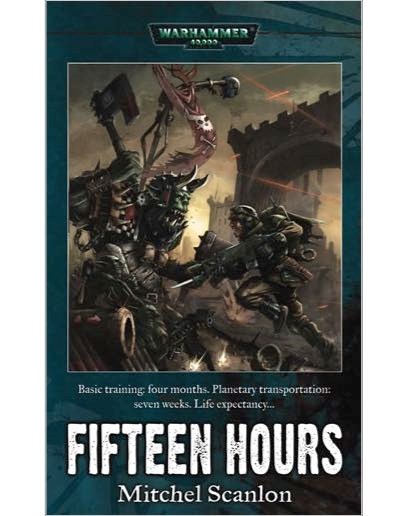
Fifteen Hours by Mitchel Scanlon


Another victory for the dollar spinner from Half Price Books. Did a quick check on Amazon and see no ebook there but no dice. On the other hand, the Black Library has a ton of stuff but their organization is crazy and most of the ebooks there go for $7.99 which is well outside my comfort range for most ebooks.

Anyway, Fifteen Hours isn't in a genre that I often read but let's be honest here, Warhammer 40K is about as far away from hard science fiction as you can get and still be sci-fi. It probably has more in common with Star Wars than Star Trek with it's prayers to machines, orks, and other assorted oddness.

Mitchel does a good job of bringing the setting to life with a hero who is indeed a farm boy but unlike so many of his fantasy counter parts, isn't actually the son of a god of a chosen one. Just some poor bastard who learns that war is hell. It's a solid novel and if you like the setting, it's another selling point. I'll be hitting some spoilers below so if you'd rather not know about the actual events in the book and how things shake out, read no further.

First off, the book uses a lottery of sorts to drawn and draft people into the Imperial Guard. This is a classic way of raising troops and with all of the brain washing that goes on in the Empire, it's often not problematic when those being called up for duty don't know any better due to their limited education. You see, despite being in a far future setting, most of the people have little technical knowledge.

Mind you, today we aren't much better off. Sure, many of us can drive a car or turn on a computer, but actual working knowledge of how these things do what they do and how to fix them? Well, much like the main character, Arvin Larn  we might be praying to the machine spirits to start. I know in horror movies we see it all the time. "Come on you stupid car, don't fail now of all times!" and such other great sayings.

Anyway, the book's real strength is in showcasing how damning bureaucracy can be on all levels. As a person who works in a factory that at one time had over a thousand people, as an inhabitant of Chicago, as a person who has had to deal with phone customer support, yeah, we all know this one.

But when you're in the military? And that bumbling sets you off into a war zone that you were never supposed to be? And when the supplies and news and all information is FUBAR because of this poor management? Well, the fifteen hours of the book title is exactly how long new soldiers to this planet are supposed to last.

While some of the material here is mundane, and isn't appropriate for all campaigns in terms of tone and feel, some fantasy campaigns like Midnight, the OGL and d20 versions, got a lot of mileage out of the standard things in the setting. How are you set for supplies? How are you set for healings? How are you set for general knowledge? How dangerous is the world around you?

In a setting like Star Wars, you can easily see the Empire falling into this type of decadence. Poor training, unmotivated employees and a host of other problems effect many corporations in the day to day activities that go on around every day. How much worse when they happen in the military? Wars have almost been started due to false information or a lack of proper communication. Allies can quickly turn into enemies and live soldiers into dead heroes.

When looking at your own campaign, don't forget the bumbling bureaucrats. They can add layers of complexity that the players won't appreciate but will remind them of the real world for sure.