Showing posts with label Angus Mcbride. Show all posts

Monday, April 27, 2015

W is for Women Warlords


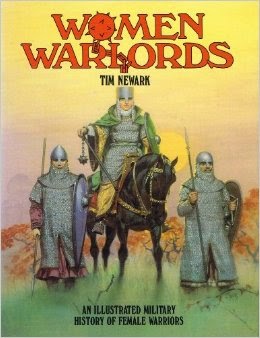
I don't remember where or when I picked up Women Warlord by Tim Newark. It's another case of a subject, women who don't follow the standards, that I said, "I'll read that sooner of later." The cover is of Matilda, the Countess of Tuscany with her warriors and is painted by Angus McBride. The book is published by Blandford, but the size, 144 black and white pages, and style, photos of ancient weapons, armor, and art, remind me of Osprey Publishing.

Written by Tim Newark, the book is broken into the following chapters:

The True Amazons: 

When talking about the Amazons that the Greeks battled, Tim makes a case for them being an actual historical group.

Sometimes these 'Amazons' are attributed a different name. For example, "There is a Scythian race,' wrote Hippocrates, 'dwelling around Lake Maeotis [the Sea of Azov] which differs from other races. Their name is Sauromate [Greek for Sarmatians]. Their women ride, shoot, and throw javelins when mounted. They remain virgins until they have killed three of their enemies and only then may they marry once they have performed the traditional sacred rites." (pg 12)

As I read a variety of material, I look at the supposed meeting between Thalestris, Queen of the Amazons and Alexander the Great. The two supposedly lay together for 13 days after which she left. Her sole purpose? To get a child of Alexander. I can see either a super hero comic or a modern thriller where the descendants of those two strive to live up to that legacy. Perhaps without knowing it, good old Doc Savage could be one of their children.

Amazons of the Jungle: 

Brazil and Dahomey. When searching for the lost city of gold El Dorado, beware the amazons lead by Conori. The 'problem' is that even thought this is happening around 1545, confirmation is still not easy to come by. First, it's across the ocean. The failures of the Spanish initially might have needed a little... 'boost' to explain that it was not normal failure and that victory was just around the corner.

Now that takes care of Brazil. In West Africa? Warrior women were not unknown. "A further four (women) stood behind him, carrying flintlock muskets on their shoulders. They were naked from the waist upwards, wearing gold rings around their arms and beads around their neck and in their hair. They were members of the king's elite bodyguard, composed completely of women. And this is during the 1850 era of slave trade.

There's some interesting quotes here. One of them reminds me of how mercenaries treat war. "War is our great friend,' said one. 'Without is there is no cloth, no armlets. Let us to war, conquer or die.' (pg 44)

The author of Imaro, Charles Saunders, had done enough research in his creation of Imaro to have enough material to create Dossouye, a warrior woman based off of West Africa body guards of kings, similar to the above.

Historically, it appears that ehre were four kinds of warriors as follows:

The Agbaraya or blunderbuseers: Veterans of the army and called into action only when urgently needed. The biggest and strongest warriors of the force, each accompanied by an attendant carrying ammunition.

The Gbeto, or elephant huntresses: The bravest warriors that carried out dangerous hunting expeditions and bore feocious scars of close encounters with wounded elephants.

The Nyekplehhentoh, or razor women. They carried a hinged sword about 18 inches long that shut into its scabbard like a razor. The blade was used for decapitation.

The Gulonentoh or musketeers, the majority of the armed warriors. (pg. 48)

Braver Than Her Husband: 


Artemisia and Zenobia.

Artemisia, Queen of Halicarnassus, goes back in time. From the time of the West African Amazons, the author takes us to the time of Xerxes in 480 B. C. Those who've been to the movies might recognize the name Xerxes as he's the villain in Frank Miller's novel and movie, 300. Turns out Artemisia was a skilled strategist who might have turned a few of the failures of Xerxes to victory had he but listened to her.

Zenobia was wife and advisor to Odaenathus, ruler of Palmyra. Here we have a scenario that sounds like it played out of George R. R. Martin's Game of Thrones. Zenobia and her husband did much together. She was well respected. She was known to the soldiers. She was 'reputed' to be a descendant of Cleopatra.

But her husband was going to leave the kingdom to his son Herodes, and this son was from a previous marriage and well, wasn't too useful. Listed as worthless and spoilt.

So apparently Zenobia has Maeonius, the ruler's cousin, kill him. The cousin is in turn killed by Zenobia's soldiers. Herodes disappears after his father's death.

Zenobia rules as regent for her son, Vaballathus. She was not a modest regent either. She took a troop of some odd 70,000 soldiers into Egypt and defeated the Roman-Egyptian forces there. Mind you, those forces had their own problems with Goth Pirates from the Black Sea. Timing is everything eh?

Unfortunately for Zenobia, Rome came under new leadership, Aurelian, Roman Emperor between 270 and 275. And to all things that rise, they must fall. Despite some daring stopping maneuvers, Aurelian won the conflict.

Celtic Queens: 


Medb, Cartimandua, and Boudica are included here. While I'm familiar with Medb and Boudica, I'm no scholar on either of them and it's good to see information on all three in one spot.

The author starts off with a brief telling of The Tain Bo Cuailnge. Medb having a confrontation with her husband about who was better off before they married the other. The husband has a slight advantage that Medb seeks to immediately redress by in her way the warrior known as Cuchulainn. She soon learns why they call him 'the Warped One' as when she seeks to trap him, he turns into a super human mass of muscle and power and tears through those setting the trap like tissue.

Lots of people turn up dying in this instance for one bull. Hundreds if not thousands. Heroes inflicting mass carnage and spilling gore of hundreds upon the land.

Cartimandua lives in the first century AD. She was the leader of the Brigantes, a confederation of tribes and was made richer by Roman governor Plautius who made her a client ruler.

Unfortunately, a falling out with her husband Venutius, winds up with Venutius leading Celts against Cartimandua who tries to rely on the strength of Rome to hold her position.

This indirectly leads to the rise of Boudica a few years later. When Boudica protest her treatment at Roman hands, she is whipped and her two royal daughters cornered and raped by Roman soldiers.

In exchange, Boudica gathered forces, spoken encouragement, waited while the Romans fought against the strength of the Druids in north Wales, and when the time was right, burned the colonial settlement at Colchester to the ground including all the men, women, and children.

When the legion IX Hispana was sent to bring order, only their leader, Petillius Cerealis and a few cavalry escape with their life.

Boudica continues her vengeance with some reports of deaths of Romans rising as high as 70,000.

It took several legions and one mass battle to decide the fate of Boudica and history at this time casts Rome as the winner.  That 70,000 number of Romans supposedly killed is matched in horrific manner as "no less than 80,000 Britons died".

Women of Christ: 


Included here are Aethelflaed, Matilda of Tuscany, and Eleanor of Aquitaine.

Aethelflaed of Mercia is well known to me not necessarily because of any actual effort I've put into reading history. Rather the writer Bernard Cornwell's Saxon Tales gave the eldest daughter of Alfred the Great quite a starting role in several of the books.

Aethelflaed, after her husband's death, works with her younger brother, Edward, to make England more united than it had been previously, and in so doing, make it a stronger England able to withstand the Viking invasions.

She was a political creature at heart. She didn't name herself queen, but rather, Myrcna hlaefdige (Lady of the Mercians). An official title that doesn't put her at odds with her brother, King Edward.

Despite the threat of the vikings, the people of Mercia were under attack from numerous forces including Irish, Norwegian, and Welsh. Aethelflaed responded by building more burhs and fortifications and sending armies against those who would do her people harm.

Matilda, Countess of Tuscany, doesn't have the same historical problem that Aethelflaed did. For the Lady of Mercia, her brother had to be seen as the guiding power, the crafty hand, the sole mover of events.

Matilda did not have the issue. Rather as the sole remaining child of Boniface of Canossa, who was assassinated in 1052 through the plotting of Emperor Henry III, Matilda was trained to excel.

She did so through not only courtly learning, but that of arms.

And while Matilda had no love for the German emperors, she did however, have loyalty to the papcy of Rome.

Her own private life was not easy. Married to Godfrey the Hunchback, she suffered the loss of a child who died in infancy. She separated from her husband who'd been rumored to attempt an assassination on the Pope. In 1076, Godfrey was murdered.

At this point, Matilda's loyalty to the pope is tested as Henry IV sought to depose of the pope, rising an 'antipope'. But the threat of excommunication gave Henry IV pause not necessarily because of what he thought, but of how his enemies could use that event against him. Matilda allowed the Pope to stay at the castle of Canossa and humbled the German emperor but it was a temporary humbling at best as in three short years, Henry IV elected an antipope.

Henry's initial forays worked well and Matilda suffers greatly during this period. The only thing preventing a total victory by Henry is the weather as the summer forces the soldiers to retreat north to Tuscany.

The pope secures the assistance of Robert Guiscard and his Norman warriors. Claiming other business, Henry retreats to the north.

Not one to waste such an event, Matilda uses the confusion to lead a small force of soldiers including horsemen and foot-soldiers and using a classic night ambush, dispatches several of her foes.

When times passes and Henry lays siege to her again, she proves a worthy warrior and leads her elite men out of a secret entrance of her castle and using a dense fog as cover, panics the forces of Henry who retreat rapidly.

Closing out this section, Eleanor of Aquitaine inherited a vast estate in 1137 at the age of 15 upon the death of her father.  Due to this amount of wealth she controlled, the Capetian dynasty made her the Queen of France. As she grew older, she grew more involved with the politics of day to day. She traveled with Louis when in 1146 he 'took the cross', travelling the Holy Land.

Things didn't go well for Louis. Eleanor perhaps not taking the trip seriously, dressed in armor and carried weapons, as did her maids. Eleanor's favorite vassal, Geoffrey of Rancon, moved too far out of the other warriors and Turks ambushed them killing many. Geoffrey was held accountable and sent back to France.

Worse for Louis when in Antioch they meet Raymond, the prince of the city and Eleanor's uncle. Supposedly the two had something greater than he being her uncle between them. Conflict between Louis and her spread from that point until their marriage was annulled in 1152.

But she would be alone only a short time. So vast her wealth, she quickly took another husband, Henry Plantagenet, who might be more familiar as Henry II King of England.

But that relationship also went sour. She  have five sons and three daughters by Henry. Richard I and John, the last born, would also become Kings of England. With some suspicion of her being the 'ringleader' of a rebellion against him, Henry brought Eleanor home and had her imprisoned for some odd 15 years and it wasn't till his death that she was freed.

She didn't let age slow her down though and remained very active, including gathering the random for Richard I release from the Duke of Austria as well as supporting John when he became king.

Hundred Years War Women: 


While I'm reading for the new information, such as Jeanne of Montfort and Christine de Pisan, I did know Joan of Arc.

Jeanne is literally a leader. When he town is under siege, she dons armor, rides through the streets, encourages the people to fight. To take stones from the buildings and throw them at the enemy.

She leads a group of 300 horseman into the enemy's deserted encampment and sets it aflame.

When she escapes the French, she returns with reinforcements!

Because of her efforts, her town holds out long enough for the English army sent by King Edward to arrive.

That wasn't the only bit of action Jeanne had. She later wound up assembling 1,000 men-at-arms and 8,000 foot-soldiers to La Roche Derrien to fight against the encroaching French.

Further on timewise, Christine de Pisan was a writer who wrote Treasure of the City of Ladies in 1405. Her writings are a call to arms or rights if you will, for those women to take what is rightfully theirs and to seek "to protect her rights boldly by law and reason'. Another book mentioned here is Feats of Arms and Chivalry and compiles material from ancient military authors as well as modern ones.

Christine de Pisan died around 1429 and right before then, around 1428, Joan of Arc at the age of 16, is instructed to help the King of France.  In 1431, after a brief and brilliant time as a symbol of France, Joan is burnt at the stake.

Because its covering such a wide swath of history, if you wanted more details on any of the subjects and individuals brought up, further research is recommended. Thankfully Tim includes a great bibliography and there are many new resources these days as well as more information comes to light and research becomes easier and more expanded.


Sunday, September 15, 2013

The Mongols by Stephen Turnbull Illustrated by Angus McBride


From my brief observations of the various Osprey titles, Stephen Turnbull is the main scholar of the east. From my years of enjoying Iron Crown Enterprise Rolemaster and Middle Earth role playing games, Angus McBride is an artist whose skill set is still sorely missed in all artistic fields.

I picked this puppy up at the Skokie Half Priced Books.  I've learned over there that if there is a book you see and you want it, waiting for a sale may sale you a few dollars but may save you more than a few because the item you want has long since been bought by someone else.

After reading the Kalka River 1223 Campaign book, and owning the Warrior Mongol Warrior 1200-1350, also by Stephen Turnbull, but that one illustrated by a modern artist who also does role playing products, Wayne Reynolds, I was eager to read the Mongols and see what else I could glean of them.

Hard to say. I couldn't honestly tell you how much of the generalized knowledge here I knew in some form or another before hand but I can tell you that it's well put together in terms of a quick summary of how dangerous the Mongols were to their enemies and the vast changes their brought to the world.

If you can find it, it's worth a read. I believe that the more 'modern' book by Osprey on the subject is the Mongol Warrior 1200-1350 in their Warrior series.

In terms of how dangerous the Mongol army was? I'm always amused that fantasy settings have to go to the final full tilt doomsday device when rebooting their settings like the Forgotten Realms and the Sundering. Historically, empires rose and fell with great frequency. The problem many people have isn't necessarily with their favorite group of NPCs being killed, it's how it's done. Forwarding the setting, further invaliding past purchases, isn't the way in my opinion.  Having a competent group of adversaries that the players can actually fight against, if the campaign is the thing as opposed to the dungeon crawl, requires there be, you know, actual competent foes.

You don't have to throw gods, demons, devils, and the kitchen sink into the setting to showcase how devastating the real world historically was.

Anyway...

The illustrations by Angus McBride for the series include eight separate paintings including the one on the cover. In that instance, I believe that's some poor Russian bastard whose been taken down by the archery skill of the Mongolian warrior retrieving his arrow.

Another shows Mongols in winter coats with pack camels. Another shows Mongolian heavy cavalryman battling against what could be Crusaders.  another the Mongolian commander and his 'naccara' drummer. Another the Mongol camp with children and small animals. Another of the Mongol camp shows a horseman with his hunting bird and a host of unfortunate animals strapped to his horse while in the background some dogs look on hungrily and behind them women tend to a fire.  Another shows a Mongol heavy cavalry officer in a siege of a city in China.  The last is a Japanese samurai fighting against Korean auxiliaries. 

The illustrations may be a little dated in today's brighter, louder, more action world, but for illustrating the Mongols? For showing some slices of life? They're perfect and can easily serve as templates to springboard visual inspired tales.

The book includes numerous real world paintings taken from around the globe. One of the interesting bits here, as I've mentioned in the past, is that the artist generally tend to make the subjects wear the clothing and armor of the time, as opposed to when the painting was supposed to take place. This could be a nice 'red herring' for a game where the characters are puzzle solvers if they failed to take that tendency into account.

One of the things that book notes in terms of difficulty, is how quickly things erode and rot. Whenever I see those shows and movies that are supposed to take place in the distant future and they have twentieth century buildings and vehicles still around is man, that would not last a year or two after man fell from grace. Right now people are being killed by failing infrastructure. Imagine it for a year or two without a full fledge fire department to handle vast blazes. Imagine it if an earthquake hits. Imagine it if a tidal wave hits. We're very industrious in how much we rebuild and as anyone whose paying attention to the news in America at least these days, knows that natural disasters require immense support to overcome. Without that ability to draw on massive funds and manpower? Yeah, it's all going away in a very short time.

In terms of the Mongols themselves, they are amazing for numerous reasons. Their reach encompassed a lot of what gamers traditionally associated with Oriental Adventures, including unifying all of China. They also devastated Russia so bad that the book on the Kalka River says it put Russia back a century or two in terms of development. They also used allies and defeated foes to attack other foes like when they tried to take over Japan on two separate occasions.


The book provides a lot of details on what the typical Mongol drank on the march, as well as what he ate. These details, as well as clothing and various other bits, can provide depth to a GM looking to add those elements to his own campaign.

They were also a multi-ethnical army with both Muslim and Chinese siege engineers among them. This facet of the Mongol war machine would work well in a fantasy campaign where the players wanted to play something exotic. They could be part of an invading or formerly invading army that was defeated and now have nowhere left to turn except well, either bandit or adventurer. Their use of Chinese and Muslim engineers also allowed the introduction of siege weapons that were unlike those already in use by their foes in the West.

When looking at the strengths of the Mongols, there are numerous advantages in their corner. Not only did they have great mobility, but they were able to bring with them their entire way of life with mobile yurts for example. They also made sure to scout out the areas they were heading into. They would seek out information on the various internal conflicts and try to use those to separate their enemies into smaller groups to more easily destroy them. The Mongols also did things few others would dare, like attack Russia in winter.

If you're looking for inspiration for your L5R game, Oriental Adventurers, or just want to see how devastating the Mongol war hosts were, this book should provide you a quick door into the death and destruction that a army with a few unique hooks in it's arsenal could unleash.


Sunday, December 5, 2010

Angus McBride's Art of Byzantine Armies

Angus Mcbride has a huge swath of material to work for here. Not only does this book cover a large period of time, but as I've posted previously, the Byzantine armies are often made up not of natives, but of mercenaries that range far and wide.

The cover, the first color plate on the interior, is of a cavalryma, a man-at-arms, and an infantryman. The cover however, loses the awesome background which has stone spires reaching up behind the figures, giving them a very real sense of presence and exploration.

The next one, shows three mercenaries, almughavar, Cuman, and Alan, in some thin woods having brought down a bird with some solid bowmanship.

The next one showsBuzamtome sp;doers beomg waoted pm bu a servamt in front of a castle.

The fifrth one shows a Cuman mercenary on horse, in a stream, next to an Albanian mercenary who rests a spear on a shoulder with one foot in the stream and the other on a rock outcropping and an Italian mercenary creeping along the rocks out of the river. This picture could almost be a group of adventurers exploring as the Albanian mercenary, with one hand raised and his spear which almost resembles a staff, could easily pass for a wizard with his rounded cap.

There are other illustrations, but I consider those 'pose' shots, solid artwork that is the characters essentially standing around so that McBride can showcase what these various individuals might have looked like. The ones I picked out have more going on wither its exploring, hunting, or day to day activities.

Angus McBride's art is solid and could easly make for some quick visual referens in any role playing game.

Saturday, December 4, 2010

Byzantine Armies AD 1118-1461

When talking about this book previously, I mentioned the high cost of mercenaries. The book, when speaking about the armies, further list out the nationalities of the soldiers that were often in these mercenary armies.

In using these forces, the empire found it easier to control them in small waves. It also made it easier to pay them. The soldiers were often paid once every three months, but that payment was also late in coming. For some forces, the promise of land and ownership was enough. For others, even though there was no pay, they were allowed to keep what they plundered. For some, there was no actual use by the Byzantine empire, but rather, much pillage in that time under those colors.

For example, in 1354, we have some 10-20 thousand soldiers sieze Gallipoli for their own plunder. Pretty good numbers and a sizable take for themselves.

I'm going to list out some of those that fought for the Byzantine here. It's surprising from where they come from. This is more interesting to me as a fan of the historical information simply because even in today's society of easy to get around places, people don't tend to move around a lot with notable exceptions. Anyway, onto the list;

Alans or Massagetoi: Christian Turks from the Caucasus, Albanians, Armenians, Bulgarians, Burgundians,
Catalans, Cretans, Cumans, Englishmen, Georgians, Hungarians, Latains: Italians, Germans, Spaniards and the majoirty being Frenchmen., Mongols, Patzinaks or Turkic Pechenegs, Russians, Scandinavians, Serbs,
Turks, Uzes, Vlachs

Seriously, is there anyone there no covered? Of course the times nad terms of service for these different nationalities differed and some of these nationalities fought among themselves, further weakning the empire itself, but overall, this list represents an amazing reach and an amazing potential.

For role playing games that is. It is often wondered, how do adventurers meet? Well, if you're working for the Byzantine armies, apparently, it doesn't matter if you from England or from Russia, chances are you'll wind up working together or at least having the potential to work together. Having a large empire like this, even one in decline, like Byzantine is, allows the GM to have a very open and 'real' reason for characters of different races and professions to join together if only as a starting point.

Monday, November 29, 2010

Byzantine Armies AD 1118-1461

Written by Ian Heath and illustrated by Angus Mcbride, Byzantine Armies represents the downfall of an empire. While I haven't finished the whole book yet, considering my appreciation for mercenaries, I found the introduction to be somewhat ironic.

Believing that the army's weakness resulted from its heavy dependence on foreign mercenaries, he concentrated the best of the remaining native troops in Constantinople and reduced the pay and privileges of its foreign mercenaires, declaring his intention c 1255 'to build an army not of Turks, Italians or Serbs, but of Greeks.'

Of course right after Theodore II, Michael VIII, the former commander of the army's Latin mercenaries, goes right back to the employemenet of large numbers of foreign troops. This eventually leads to the economic collapse of Byzantine wealth and other associated bad things like the fall of Contantinople in 1453 by the Ottomans.

Here, the mercenaries are a damned if you do, damned if you don't. Pay them and well, the finances just weren't there. The need to spend on military has apparently crushed more than one super power. Don't pay them and well, they'll just find another employer who might use them again you.

Mercenaries... gotta love 'em.

Monday, November 15, 2010

The Hussite Wars: Final Thoughts

I've mentioned the importance of individuals both in starting wars and in fighting wars.

I've mentioned naming conventions and how things are named after people. The Orebites, after Zizka's death, labelled themselves 'The Orpahns', because of the loss they had suffered. People have historically had names that might sound odd even at a gaming table. For example, the successors to Jan Zikka, Prokop the Great and Prokop the lesser. The Great and the Lesser? I know which one I'm going after first.

Don't know if I'm mentioned the use of heraldry or how important it could be. The Hussites used a few symbols. These went on their shields, surcoats, and horse barding usually. Symbols include the chalice and a goose. Some illustrations combine the two. I can't imagine a player today using a goose as his herald symbol but there it is in history.

Women: Don't know if I mentioned it before, but women fought in the Hussite armies. Yeah, Women At Work In Medieval Europe points out women doctors on the field of battle and the Hussite armies bring the peasant women with them into the actual field of combat.

Historical importance: The events of the time may leave their mark on the landscape for centuries to come. Jan has several statues dedicated to him. Some of the ideas and issues of the initial Hussite Heresy come to the foreground in the Reformation. In a fantasy game, it would probably go a lot further.

For example, magic items.  The Mace of Zizka could be a high powered Rod of Lordly Might. When he died he supposedly ordered his men make a drum out of his skin and beat it at the front of the Hussite Army. Drum of Zizka? Oh yeah. Anything a hero uses could be said to be of his power and by taking those names and events into the campaign, the GM can turn even a +1 item into something a bit more.

Now mind you this won't work in a magic item heavy campagin because the players will still turn in that Mace of Zizka if it's just a +1 mace and it's easier to get a +2 mace, but if the mace is used to improve moral, build troops, and other non-combat activities, even if it's not as powerful, it has greater appeal.


Artwork: The material by Angus is up to his usual standards.  Several powerful illustrations of the movers and shakers of the time as well as an excellent illustration of a war wagon.

The Hussite Wars showcase how one event can lead to others and to decades of warfare and in doing so, sparks the imagination with wonder and awe at the strength of the principle characters brought to the foreground in its wake.

Saturday, November 13, 2010

The Hussite Wars 1419-36 Part One

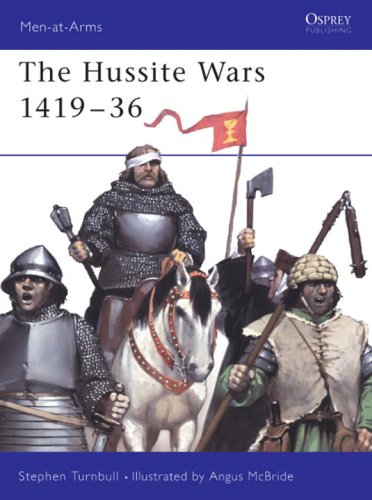
I've mentioned before that the art work of Angus McBride has a powerful pull on my imagination. This cover is no exception. In the Warhammer Fantasy Battle Game and the RPG version, clerics of the Empire are mace and hammer wielding fanatics. Seeing the center character here with one eye bandaged and a mace in hand, I was drawn to the book.

And it is another interesting read, well worthy of a look. I had no knowledge, or at least, direction knowledge, of The Hussite Wars before hand, but I am curious to learn more about them now.

One of the things that stands out to me as a reader and a Dungeon Master, is the enormous effect that individuals of character and charisma and skill have had on the world. The Hussite Wars themselves, take their name from Jan Huss. This is something that happens time and time again in the real world history and it's something I often forget about when looking at designing historical battles for any backgrounds I'm working on.

Not all wars can be the War of the Roses with such symbolism crashing through, but named individuals whose actions and fates, can inspire decades of warfare.

In addition to Jan Huss, the man in the centerpiece here, Jan Žižka, is a military genius of his time, revolutionizing the way battles were fought in his home and winning battle after battle despite only having one eye. Even more determination and grit is shown when he losses the other eye years latter and leads his army for another five years. This is something that in a fantasy book, people might laugh at and go, "Yeah right." But here it has apparently happened with no magic involved. Or course history revisionism is another topic...

But another point of interest about Jan Žižka is his death. He doesn't die on the battlefield. Rather, like several great warrior leaders before him, his death doesn't necessarily involve his profession; he dies of the plague in 1424.

The Hussite Wars bring some interesting bits together and showcase historical weight that will continue to roll down in history. When designing your own settings, if things happen at point X, do those actions have further repercussions down the road? Do people look at the leaders of a bygone era and say, "Yes, they were right and we will continue those works."

Lastly, once again, the strength and importance of religion is hammered home. These Hussite Wars are also Crusades with the Hussites being on the receiving end. Mind you they win these battles but the strength of faith is what starts off wars. Thousands of people killed for the methods of worship. This in turn reminds me of the great job Kate Elliot did with her series, Crown of Stars, and how strong the power of belief, without necessarily clerical magic or any magic for that point, can be.

In many fantasy campaigns, these wars of faith can be somewhat difficult. Some settings like the Forgotten Realms and even Greyhawk, are so brimming with deities that the idea of holy war or heresy on a large scale seems completely against the context of those settings. The best one might be able to do with them, is set up rival deities that can have various smaller rivalries and battles.

In these more intimate battles, the actions of single individuals, like the player characters, come more into focus. Do you want to be one man in an army of thousands, or one hero in a handful that knows of the plots of Shar against Sune?

On the other hand, as King of the North proved, althought briefly, the only thing more impressive than a war of faith is a war of gods. One of the fun things about Palladium Books and their Rift setting is that essentially everything is possible. There are gods, there are fake gods, there are ancient elder entities that had the same roles as some of the other gods and all manners of interesting bits and pieces that some how or another make a near whole. But, if you're looking for religious war fare on a grand and cosmic scale, then a war of Pantheons, where entire countries are moved by gods that are real and do take part of the battles, can be the route to go.

Thursday, November 4, 2010

The Limits of Specifics

As I continue to read through the Baltic Crusades, too much of it focuses on the weapons. On the knowledge side, it's interesting no doubt. I like seeing how one handed axes and pole arms come together to form big old halbreds. I like seeing that cheap and effective, such as the spear and the 'kettle' helmet continue to work their way through the ages.

But as a role playing piece of information? Unless I'm setting out to historically model a part of the campaign after it, useless. Most fantasy games have this weird pseudo era they take place in where you have all of the latest innovations in armor up to plate mail, but on the weapons side? Well, crossbows are about it. Even though in this book, it notes that guns and cannons started coming in much earlier than most people would normally think of when they think of guns and the middle ages. "It was during the 14th century that gunpowder reached Scandinavia and the Baltic, the Teutonic Knights and Danish armies being relatively earlier than Sweden and Norway in the use of this new technology."

I'm one of those weirdo's who likes guns in his fantasy. Star Wars is space opera. Light sabres and guns and all sorts of great stuff. Thundar the Barbarian isn't some post apocalyptic fantasy, it's fantasy. Sure, you can run into some weird bits when you try to model the accuracy, firing speed, and damage potential of all of the technology, but it doesn't stop fantasy game designers from throwing dozens of variants of swords, maces, and axes in there alongside of armor from cloth and leather to plate armor.

If the guns aren't made too extensive and too overwhelming in their use, their impact on the campaign should be minimal.

This is something everyone needs to determine for themselves of course but it's always been a no-brainer for me. Knights and dueling pistols are a long part of games like Warhammer Fantasy, and even Dungeons and Dragons 2nd edition toyed with them.

I guess part of it for me, is that it's just part of technological evolution. I have a hard time seeing an elf using some compsoite bow after being alive for ten thousand years. Sure, there is magic and it has a huge place, but unless the setting has suffered one massive dark ages apocalypse after another, something that the elves shouldn't have lived through in the first place, their inability to move past the woods is simply annoying.

It's one of the reasons why when I see Privateer Press and the old Rackham elves using what amounts to high technology and magic methodology, that I clap. Those ancient races should be the baddest of the bad. Even if, like Warhammer 40K they're not making newer technologies, their mastery of the old world material should render them like unto gods.

In 2nd edition, outside of the Forgotten Realms and it's brief flitartion with guns, we had Spelljammer. During the various wars between elf and orc, the pace of weapon mastery should have been staggering. While a few prizes of that nature do show up, it's often indicated in the "yeah, that was once long ago." and never seen again.

Eberron takes an interesting approach in that things seem to almost be at an industrial age level but it has come about through magic instead of technology.

Anyway, I'm rambling. While I like some of the ideas in the earlier part of the book, when it starts talking about the sepcifics, they become less useful to me. That may not be true for everyone, but unless you've got a weapons hunger that needs specifics, there's a big chunk of this book you can pass over.

In terms of art, Angus knocks it out of the ballpark. His use of color doesn't overwhelm the eyes. There is one picture in particular, where a group of soldiers is leading their horses through the swamp and the look upon their faces is great.  The illustration on the next page looks like it was ripped out of one of his Middle Earth books illustrating a Rider of Rohan speaking to fellows at a castle. Suffice it to say if you enjoy the cover, the interior is more of the same.

Inspiration can come from anywhere but be aware that in some instances, the specifics of a thing will render those parts useless for the specifics of what you want inspiration for.

Wednesday, November 3, 2010

The Scandinavian Baltic Crusades 1100-1500

There is so much history out there and the world is so large, that sometimes when you see a word, like Crusade, associate with a different location than you're used to, it perks your interest. Hell, sometimes seeing a favorite artist involved with a project, like Angus McBride, perks your interest.

While I haven't delved very far into the book, a few things struck me as important world building bits from this Northern Crusades material.

One, religion is a huge motivating tool in a society. The author argues that many went on Crusade because it was the 'right' thing to do, not because the royalty and religious powers wanted all of the 'rough' men out of the country during times of peace. There were rewards to be sure, such as having all previous sins, and all those committed on the trail, forgiven, but it was done because it was a 'good' thing.

Two, the use of waterways is so vital that it can help establish not only cultural similarities due to bleed, but is essential in the spread of news. This allows those individuals who are notable and noteworthy to have much greater and more reliable methods of finding out what is going on in the world. In a campaign setting like the Forgotten Realms, news in the Moonsea region, despite the hostility many of those independent city states hold towards one another, probably travels much quicker than it would merely up and down the Sword Coast, which is a huge stretch of coastline.

Three, religious pilgrimage. It's a common enough event for these times but one frought with danger. For example, King eric I 'Ever Good' of Denmark maded an armed pilgrimage to Palestine but did not make it back home.

Four, crusade is often used, at least in the times I've heard it referenced, almost in exclusive contact with the Holy Land. Here, the text makes the distrinction that it's against any religious hersey, even when its against members of the same faith who practice it a different way. Looking at the Forgotten Realms again, the Twilight War by Paul Kemp put this to good use with the sun god unergoing his change at the time and the new face of the faith taking place. The victor of the battles will determine what is the actual heresy. In some fantasy settings, perhaps the followers turn away from their god if the god does physically make new decrees and laws that those of his faith simply do not wish to follow.

Fifth, the environment plays a vital part in any military matters. While it was mentioned in the old mercenary book how one of the commanders used superior tactics involving the surrounding country side through use of scouting and planning, that idea is hammered home again here where the rugged landscape here isn't necessarily one that is suitible for the standard mounted men with the infantry taking a larger and more important role.

When looking at your gaming maps, try to keep in mind what type of armies can realistically funtion there. Now the rough terrain may not be an issue for those who ride griffons or giant eagles. It may not be an issue for those who use flying ships and fortressess. But for those who are using a more earthly campaign or more rooted in standards of reality, when the mountainous terrain and the badlands become too common, the use of horsemen is out.

The Baltic Crusades brings a lot to mind without even getting into the specifics of it. When reading material, try to keep the mind open. Try to think what can be applied to your own campaign. Try to think how you might be able to use the material. Keeping such things in mind as you read may open the campaign  in ways you never initially thought about.

Wednesday, October 27, 2010

Warriors & Warlords: The Art of Angus Mcbride

Art has always been a powerful motivator for me in terms of creative thinking. It has served as a shared medium among friends when I use an illustration to show something instead of explaining what something looks like.

Among those artists whose skills I find to tweak my particular taste, Angus McBride is right up there. I probably first saw his work, as many fantasy role players might have, in I.C.E.'s old Middle Earth line. Angus seemed to do a lot of work for I.C.E. back in the day, even covering their Rolemaster line with a series of great illustrations using the same characters for each cover.

The strength of the art, for me, is that it looks 'real'. While some artist like Wayne Reynolds are popular today, and they do pieces I enjoy, don't mistake that, I find that sometimes the art is so far from the subject matter that it makes it actually harder to relate to the art and the subject as opposed to easier.

When Angus illustrates two miles, the Latin term for warrior, and shows two French miles with mail hauberks and large Norman shield with spear and sword, he also includes a peasant on the side with an axe whose son is arming a hunting crossbow. In the background a bird flies easily while out at sea, gulls swarm around a boat. Some might find it too mundane, too earthly. However, perhaps due to some of my own roots as a fan of older sword and sorcery material, ranging from Conan and Fafrd, I'm okay with not every illustration being some crazy horned woman whose body couldn't exist in the real world due to the exaggerated pose.

The art of Angus is well worth a look, especially if you can find his fantasy based material. The only problem you might have though is that it appears some of it goes in and out of print. The Warriors and Warlords book for example? It's out of print. While it's not deep on details, it does have enough to speak the imagination as well. When players come up with terrible sounding names, a quick look through the historical section shows that we have such naming conventions as Alexander the Great, El Cid, Sala al Din Yusif ibn Ayyub known as The Victorious,  pr Sa;adom.  'Arthurian Age', the ship names Long Serpent or Iron Beard... these are real names. If they can exist, how silly is Rus the Red or something along those lines?

Anyway, if you're looking for inspiration or how things might have been and how they might have looked, The Art of Angus Mcbride should be right up there on your reading list.