Showing posts with label Usagi Yojimbo. Show all posts

Monday, August 28, 2017

Usagi Yojimbo: The Hell Screen by Stan Sakai


Usagi Yojimbo Vol 31
The Hell Screen
Written and Illustrated by Stan Sakai
208 b & w pages
$17.99/$12.16 at Amazon

It'd been so long since I'd checked in on the rabbit ronin that two volumes had come out! Thankfully Amazon had both in stock and both discounted so with a few clicks they were mine.

Stan Sakai has been writing and drawing Usagi for decades at this point, and he has the character and the setting well in hand.

This volume brings us the following:

The River Rising: Usagi is unlike many of the more traditional samurais. As the tale starts, he is knee deep in mud and rock enforcing a man made wall as rain bring torrential floods. As Usagi helps out the peasants who weep about their miserable fate, about the loss of so many of their men during the last war, the farmers suffer further.

Bandits make off with their food stores.

Usagi leaves the villagers to handle the reinforcement of the wall as he hunts down the thieves. Only the bandits aren't bandits. They are homeless rabble who are starving. They are thin, poorly garbed, possess no weapons and no training.

Usagi quickly gets them back to the village where they help the village survive the rains. But after the rains, Usagi himself is nowhere to be found. Which leave the villagers with the question of what to do with the bandits.

It's not quite up to the scene in the Batman movie with the Joker and his two boat plan, but seeing these people understand that the 'bandits' are just regular folk and offer them a place in the village is a touching scene that reminds us that the world isn't necessarily filled with villains as much as people who need help and a place to fit in.

Kyuri: So what happened to Usagi? It's important to note that Usagi's Japan is more fantasy than just the humans being animals. There are things like Kappa there as well. Usagi is no stranger to the Kappa having fought them in previous volumes.

Usagi sees one of the villagers being taken by a Kappa and follows it. Usagi is too late to save the villager but manages to follow the Kappa to its cave system where it escapes in the darkness. Descending further into the cave, Usagi finds a young Kappa and its mother, who swear that they are not allied with the savage or 'hairy' Kappa.

It's interesting that villagers who get seconds of screen time are given names, but the Kappa do not. The author throws a curveball at the audience as Usagi suffers a career injuring wound to his arm as the 'Hairy' Kappa uses its might to bring a stone against Usagi's sword arm and shatter the bone.

But this being Usagi's comic, he's saved from that f ate by the female Kappa who uses the healing arts that the Kappa is known for to save his arm. However, it does leave his sword arm weaker, and she warns him of this.

Kazehime: Stan has introduced many characters through his run of Usagi Yojimbo. Some of them make numerous appearances while others are introduced and are killed to showcase that the world Usagi lives in is not a pleasant one. In this case, the ninja Kazehime falls into the latter category. It's a poignant tale and it's one that Stan has hit on before and will hit on again. The Ronin who outlives those around him.

The Secret of the Hell Screen (Three Parts): This is the meat of this collection. Usagi comes across a temple where his old friend the Inspector Ishida. Like many of his longer tales, especially those involving Inspector Ishida, there are numerous elements at play here. There are several possible suspects, there are rumors of treasure, there are fallen samurai who've become monks, there is the terrible Hell Screen itself, a masterful piece of demonic art that shows the punishment of Emma's Hells. There are political forces at work trying to claim the land for hunting grounds as well as trying to fight against those claims.

In the three parts, Stan throws a few red herrings at the reader including the nature of the wounds suffered by those murdered but in the end, it takes more the simple deception for Inspector Ishida to be thrown.

The Fate of the Elders: Another reminder of what a harsh world Usagi lives in. In his standard method of encountering people on the road, Usagi comes across a son and mother. The mother is going to visit her husband. Only when Usagi gets to the mountain with the mother does he realize that she is going to stay and die there so make room in the village for her grand child. It's another sober moment in the Usagi setting and serves as a reminder that life is fragile.

The Hell Screen is another solid collection of ronin tales. If you've never read a volume before, check out the previews from Dark Horse Comics.

Tuesday, August 22, 2017

Usagi Yojimbo: Thieves and Spies


Usagi Yojimbo: Thieves and Spies
Book 30
Written by Stan Sakai
Published by Dark Horse Publishing
184 b & w pages
$17.99 ($12.10 at Amazon)

There are few comics I buy in physical media anymore. Storing comics is not an easy thing when you've been collecting for years. Usagi Yojimbo is one of those I still do buy. I've been bad at keeping up however and I missed both this and Vol 31, The Hell Screen. A few quick clicks from Amazon though and they quickly arrived and were quickly read.

Stan Sakai has written over one hundred and fifty issues of Usagi, not counting his side trips and alternative takes like Space Usagi. Unlike most traditional super hero comics from the big two, Stan takes the 'long' approach. Usagi ages. He meets people who sometimes perish immediately, and others he sees years later. It gives the series some depth that can sometimes be lacking in one of the Big Two's series when you have to wonder what universal change is going to negate a meeting, marriage or even character existence

We get the following tales in this collection:

The Thief and the Kunoichi: While this is a fantasy Japan filled with animals instead of people, Stan still slips in little bits of terminology such as 'The Hour of the Ox'.  Usagi himself though? He's still wandering and still running into people in trouble. In this case, it's Kitsune, the rogue, who in the middle of a heist, runs into Chizu, a ninja.

Usagi knows both of these women and is the peace maker between the two of them as Chizu is far more fatalistic in her approach to thieving whereas Kitsune and her prodigy, are more about the money.

Stan gives the readers a little taste of espionage as Chizu reveals behind a painting and hidden by a heat activated chemical, an agreement between merchants and lords to monopolize ginseng is afoot. Yes, that's right, ginseng!

I love that Stan uses mundane and standard items as a means of showcasing corruption and alliances on all levels. In the past, we've seen tales involving soy sauce for example. While Stan doesn't delve deeply into ginseng, the root and its healing properties have been used for other fantasy tales.


The One-Armed Swordsman: The One-Armed Swordsman is a popular trope of martial art films and stories. Stan has brought readers other honorary versions of such characters before, such as a 'Blind Swordspig' to stand in for a certain Blind Swordsman. In this tale, Usagi meets Mizuna Takashi, a warrior who lost his hand to a cruel samurai whose infamy spreads from his habit of cutting off the hands of those who raise their blades against him.

The Distant Mountain: Another look at a bit of Japanese lore. This time Stan gives us suiseki, the art of stone appreciation. Usagi helps a samurai guard a Toyama Ishi, a distant mountain stone. It takes its usual twists and turns and Usagi's sometimes grim humor comes out the winner in this one.

Death of a Tea Master: A swashbuckling foreigner in the courts of Japan wishes to see the art of Sepukku. The one called up for this duty is a tea master that Usagi knows. When the foreigner wants to see it again, Usagi steps in.

The Bride: Many tales of Samurai involve the loss of freedom to love who one wishes. This is true of the merchant class as well. In this instance, Usagi helps the daughter of a sake brewer escape death. Stan uses a few twists in the storytelling here as well showcasing that not everyone is as pleased to follow duty when other options are available.

For those who've never seen the art in a Usagi Yojimbo book, Dark Horse provides previews of most of their books. Thieves and Spies can be previewed here: https://www.darkhorse.com/Books/30-060/Usagi-Yojimbo-Volume-30-Thieves-and-Spies-TPB

Thieves and Spies provides a quick glimpse into a fantasy Japan that never was. It provides a peak into the lives of heroes and the everyday people they meet. Stan's writing suffers a bit from the episodic manner in which the tales are told, as often Usagi just happens to be at the right place at the right time as opposed to actually seeking out purpose, but that's the nature of the beast. It's a character showcase when we get to see Usagi meet old friends and make new ones.

Thieves and Spies continues a tradition that has taken Stan over one hundred and fifty issue and here's looking forward to another one hundred and fifty.

Monday, April 11, 2016

Usagi Yojimbo: Two Hundred Jizo


Two Hundred Jizo brings the Ronin Rabbit Usagi Yojimbo to his 29th collection of adventures by writer and artist Stan Sakai.

This volume includes the usual assortment of heroics and villains with those who live in this version of Feudal Japan trying their best to get by.

If you haven't read any Usagi Yojimbo in the past, the good news is this volume, like many, is relatively self contained and doesn't rely on following any long standing plot lines or resolutions. While not necessarily "done in one", many of the stores are quickly told.

In some aspects, that is very much like the old Marvel Comics "Conan" where the barbarian would wander from one adventure to the next with the whole issue of continuity becoming more embraced when years later Dark Horse would take over.

The black and white artwork of Stan Sakai is solid. His ability to use minimal amounts of line work does not hold back the flow of action on the page. And let me try to clarify, when I say minimal amount of line work, I'm noting that on the characters, not necessarily on the designs. Some of the clothing he draws has intense amount of detail to it.

If you want to read about samurai fighting bandits and playing detective, this collection has you covered. If your curious but want to know more, Dark Horse Comics has a multi-page preview over here: https://www.darkhorse.com/Books/28-442/Usagi-Yojimbo-Volume-29-Two-Hundred-Jizo-TPB

But what if you're hear for some Appendix N musings?

The Artist: This collection starts off with Usagi meeting  Yoshi, a young man who has had teachings of art styles outside of Japan. Because Japan is very traditional at this time, the artist's own father has decided to have his son killed as opposed to allowing those teachings to spread.

This 'clash of cultures' is not one that occurs with guns and bombs. It is not an exchange of arrows and swords. It is a divergence of styles, teachings, and culture. Perhaps something far more insidious in it's reach.

How far would people go to keep things separate? Sometimes this is used by marketers as a ploy to push merchandise. I can't be the only one who remembers "Freedom Fries".

Other times it can be used to justify murder.

Buntori: Despite the focus on historical accuracy, Stan Sakai has used elements of the supernatural many times. In this instance, Usagi falls asleep outside and has a dream of two samurai fighting, one falling and suffering an unkind fate. When Usagi awakens, he takes care of that business. Stan's use of dreams to convey information is solid.

This isn't just a small time independent publisher thing though. The recent movie Batman v Superman uses several dream sequences to suggest things and to push the characters. Dreams allow the game access to locations that the characters may not physically have access too.

Murder At The Inn: Inspector Ishida makes a pleasant return visit here, fighting against bandits and is assisted by Usagi, who he meets by chance! The two take shelter in an Inn with the bandit leader their prisoner. After exchanging some pleasantries with some of the customers of the Inn, murder happens overnight!

I recently played in a game of Legend of the Five Rings with a similar incident, murder with a group of suspects.

When dealing with multiple non-player characters, it's vital to draw those characters clearly in the player's mind. Just having a name isn't necessarily going to be enough unless there has been some extensive role playing done to determine the nature of the NPC's character.

Cheat sheets of portrait cards can be vital here. Find an image from the vast horde of the Internet and print it out on some nice paper and use it to represent those characters. The visual cues will be a lot more memorable than some hastily done verbal description.

Two Hundred Jizo: Feudal Japan is a land with its own religion and its own mythology. That of Jizo is no exception to the rule. This time period of Japan also seems to be teeming over with bandits.

Despite the vitriol that it received, one of the things 4th edition did well was the "fallen" kingdoms, the "points of light" idea where society as a whole was not empire spanning but rather small clusters of civilization which easily lends itself to having a setting overrun with bandits.

If your setting has a lot of bandits, why? Are they a culture whose homeland is destroyed? Has the warrior class being displaced through peace? Has some calamity befallen a part of the setting creating waves of mass migration?

Ice Runners: Usagi becomes involved in situations by accident. He is often wandering onto a scene of some ongoing action.

In this case, some runners are bringing ice as a tribute to a lord to showcase how great their own lord is. These runners are under attack by "bandits" who are suspected of being hired by another lord who wishes to see the first lord fail and lose honor.

When showcasing the abilities of an organization, there are often those who seek to take the glory away from such an effort and cover themselves with it. When designing an adventure seed, keep in mind those that may not want characters to succeed if it casts themselves in a better light.

Shoyu:  Sometimes you read something that makes you want to share that knowledge. Sometimes you want to incorporate this cool thing you've learned. Stan does this often with his writing. In this case, it's the creation of soy sauce and a feud between two crafters of the seasoning. Stan does so in a way that's organic and grows out of the situation and it works well.

A good way to 'feed' such information into a game is to have an NPC whose passionate about the subject matter and eager to show it off. They want to talk about the thing they love. They want to share that knowledge.

If you're running a Legend of the Five Rings game or an older game like the original Oriental Adventurers, Usagi Yojimbo continues to provide entertainment and inspiration.


Thursday, May 26, 2011

Usagi Yojimbo Volume 21: The Mother of Mountains


Usagi Yojimbo continues to advance the characters in directions they already travel even as it reveals more of their background, as well as the background of the setting.

In terms of setting, gold comes to the front again as a peasant finds a gromwell, a bush that has absorbed some of the gold mineral deposit below it. Gold is always a useful tool for rulers. It brings power with it. Its also something worth killing over. Anyone see the anime Ninja Scroll? The first one, the movie, not the series? Yeah, gold has a lot of power.

Those who seek the gold appear to be mere bandits but they are lead by Noriko, the cousin of Tomoe. Tomoe, being an ally of Usagi, has made others into her allies, such as young Motokazu.

In their dealings here, Tomoe is sent to investigate rumors of a plague. Much like in Ninja Scroll, it's a cover for the discovery of gold. This mission is being lead by Noriko known as the Blood Princess due to her ruthlessness. In flashbacks, we see training and sparring between Tomoe and Noriko with Noriko always gaining the upper hand. These flashbacks provide foreshadowing of a future duel and the difficulty that the hero will have in overcoming her nemesis.

But there are complications that Stan throws in. Turns out that the two's relationship is not that of cousins, as Tomoe believes it to be, but of sisters. Noriko and Tomoe share the same father and it turns out that due to an arranged marriage that Norkio wound up in a loveless family. So in typical villain fashion she poisons her false father and seeks acknowledgement from her true father. When if fails to arrive, she kills him too. When she explains this to Tomoe, it fills in the answer of who murdered Tomoe's father and brings them both reason to hate each other more. Noriko, right or wrong, feels that Tomoe had the life she should have had and Tomoe father's death is all the reason she needs.

This tying of character into character, of trying motivation into the scenes, is a powerful tool that can make adventuring more than merely dungeon crawling. There has to be logical reasons for linking characters and events though. Just randomly throwing some information out probably won't make for a better game, but if the players have relatives that work for a castle with a known dungeon or have relatives who have gone ahead of them into a famous dungeon and were never heard of again...

Usagi, despite being the star of the book, is in many ways just another character in the saga here. His sword skills continue to perform, his ability to joke in dark times under dire circumstances, such as when unarmed he takes out the eye of a mercenary and tells him, "Now you'll be known as the one-eyed orphan maker", continue to support the character he has shown in previous volumes.

This brings a nice level of consistency to the character. One of the issues that other types of media can suffer, is a change of staff or writers. In speaking with friends and reading various online sites, I'm not the only one who found later seasons of Heroes to suffer horribly due to quick personality changes and character goals switching every few episodes. Continuity and consistency can provide your game with a stable footing for the players. If things change rapidly, this should be a big clue to the players that something is seriously wrong and in need of investigation.

For the big duel between Tomoe and the Blood Princess, it doesn't end in anything other than a stalemate but in an interesting way. In the past, Stan has proven capable of 'killing' a character by having them have some thing befall them which prevents the body from being found, often using this 'trick' with Jei, the demonic spear fighter. Here, The Blood Princess runs into a mine that explodes and collapses. While Tomoe has a vivid dream of how her cousin could have escaped, we, the readers, don't know what actually happened to her. By providing the villain with an out, Stan is able to bring her back in the future without diminishing her potency and in fact, providing more reason why she would want to battle Tomoe again.

On other fronts though, Tomoe's lord is slowly coming under influences that are not goodfor her. They do not come out and accuse of incompetence, at least not in anything other than trying to use past events to paint her in an unflattering way, but the seeds planted in earlier novels continue to move forward, perhaps foreshadowing Tomoe's fate?

Stan continues to provide characters that don't need to be dark and gloomy with histories rebooted time and again in order to provide entertainment that brings a lot of ideas to any game and especially to an Oriental Adventurers based game.

Wednesday, May 11, 2011

Usagi Yojimbo: Glimpses of Death by Stan Sakai

While the previous graphic novel collections of Usagi, Travels With Jotaro and Fathers and Sons, builds on the continuity of the series, Glimpses of Death builds on what I'd call 'interlude' moments.

While Usagi does have a few brief adventurers here, much of the book also comes into play with other elements. For example, Jei and his unwilling victim remain in a state of contest for the body. This is another showcase of things that will continue to play out as the series progresses.

Another example of this is the hunt of Gen on Jei, who discovers that Stray Dog, another mercenary and bounty hunter, is also on the case. While the two don't find their quarry this trade, it sets up the events that will occur further down the road. Another 'glimpse' of what is to come in the future. Another interlude.

Usagi's old inspector friend meets a new nemesis; a robin hood style thief. Stan isn't afraid to borrow from the rich history of Japan and if Stan can do it, GMs everywhere should do it. Don't let a good idea for an NPC, building, monster, or magic item fall by the wayside because its already been done. Toss it into the game and see what happens. Trust me, if it sucks, your players will be more than happy to let you know.

Lady Tomoe suffers some politician setbacks when a new lord comes into contact with her master. Her Stan uses a mist to provide Tomoe with a flashback of what happened in an event that the political rival spins to make it look as if it were her family's fault that a critical battle was lost, even though Tomoe lives out the battle in the mist and knows the truth. These little glimpses into the past can be useful if you're playing in a political heavy campaign. The real trick in such situations, is how to prove the accusations false and bring the reality to light with naught but a spirit quest vision to do so from?

In some instances, people may wonder, what good are these interludes? What benefit do they bring to the game? Why should GM's or players want them in the campaign.

Depth.

They add depth to character motivation while providing further details of how the setting itself works.

This isn't to say they are for every game. If you're heavy into dungeon crawls and see little use for the city or town outside of a potential place to spend loot, then having interludes where your characters learn that some outside religion is being persecuted, or that one lord is lying to another or that a skilled thief is on the lose, then no, those things would have no point.

But if in the course of the campaign you do learn of those things and they do match with what your groups interest is, then roll out the interludes.

Friday, April 29, 2011

Y Is For Youth

Usagi Yojimbo has meet individuals who have children before, such as the spoof of Lone Wolf and Cub, Lone Goat and Cub. His own indiscretions have also gifted him with his own son, Jotaro. Their relationship is complicated because Jotaro has been raised by his rival, as Usagi was first serving with his lord, and unaware of Jotaro and then latter, Usagi was wandering, still unaware of him.

As the series has progressed though, Jotaro became a known entity in Usagi's life. A glimpse at the road not taken. In the series, it seems that many people know that Jotaro is Usagi's son. The mother, Usagi's mentor, Usagi, Jotaro, and well, its often remarked how they resemble each other like father and son by whoever seems them.

But Usagi and Jotaro themselves do not know that each of the other knows. It makes for some interesting moments.

Stan is able to capitalize on these relationships in Duel At Kitanoji, Travels with Jotaro, and Fathers and Sons. Here we directly see how Usagi's actions, and those of others around him, directly influence the youth of today, who will be the inheritors of tomorrow.

As Jotaro is but one of Katsuichi's students, we see how other members of the young are doing. His other pupil Shunji is far more... traditional in his thinking. For example, his fighting style and potential doesn't match Katsuichi's own teachings. In one instance, when a peasant is wounded, Shunji questions why the peasant is allowed to rest on a cart while the Samurai walk, whereas Jotaro takes the more common sense answer of not expecting a man wounded like that to walk.

The idea of the young though, isn't limited to just Usagi and his trails. Super Hero comics are fairly famous for trying to bring a generational theme to bear as they continue to evolve. Sometimes this may have started off as origin points for the main characters, other times a direct result of advancing the timeline and using an alternative time line.

For example, Spider Girl. Based off of a What If issue, the series had a good run as the direct daughter of Spider Man wove her way through a future that included the Fantastic Five, Avengers Next, and a host of other changes in the M2 universe. Several characters in that timeline were direct descendants of modern characters such as J2, Juggernaught's Son, Giant Girl, whose actually become part of standard Marvel Fare, Thunderstrike, another one whose become part of standard Marvel Fare, Wild Thing, Wolverine and Electra's daughter, and others.

When looking at the campaign and the setting, think of what effect the upcoming generation will have on it. The things that the younger people will find of intrest, will understand more inherently, will move to more quickly. These elements may be something that older characters may be wise to observe or if stuck in their own ways, fade to black.

Wednesday, April 6, 2011

F is for Food

While it may seem a little silly to be talking about food, it has many important parts to consider.

In Futurama, when they're spoofing good old Chef Emeril and Bender decides to become a chef, the very art of food preparation becomes an adventure.

In the 'old days', in one of the different perfect bound adventure books (either the Book of Lairs I or II or one of the others in that line), the adventurers find out the meats that a famous place prepares include such cuisine as purple worm.

In Warhammer, it's almost a running gag that you don't eat the sausage as there are various times when the sausage is more than it appears or worse, is tainted with Chaos!

Food can also become an important commodity in and of itself. In the Clone Wars, they pay homage to the classic film, Seven Samurai. In that film, the Samurai are hired to protect rice farmers.

In Usagi Yojimbo, in the graphic novel 17, on the way to the duel with Usagi's master, there is another homage or sorts as a small cadre of samurai fight against a group of bandits intent on wiping out the village and using their food to survive the winter.

In sieges, food also becomes an enormous issue. In fantasy games where clerics or magic items can summon food, its probably a good bet that the besiegers have specialists to assassinate or destroy such items.

Food can also be a cause for celebration in and of itself. Being a native of Chicago, we have many food events and some of them go back to E for Entertainment, in that they include music and other goods to enjoy while eating a variety of foods.

Wither it's working for one chief that's a rival to another, protecting a city that's under siege, or fighting off yet another band of bandits intent on making off with this year's crops, food has a vital role to play in any game.

Thursday, March 24, 2011

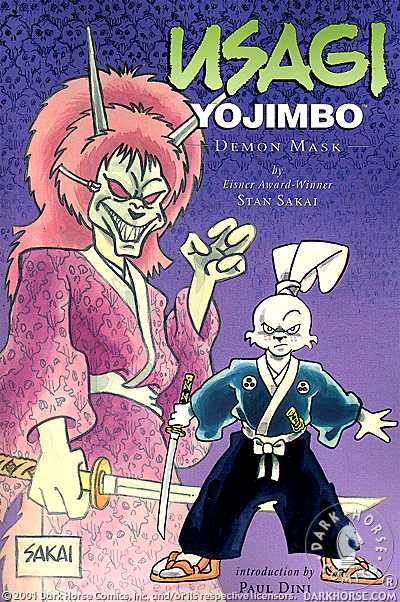
Usagi Yojimbo: Demon Mask comments Part 2

Stan Sakai brings new characters and scenarios up in the later part of Demon Mak by using some of the old favorite methods of getting Usagi involved by showing up unannounced at the action. While on the road seeing if it's safe to move the sword Grasscutter, Usagi comes across a duel where one of the swordsmen is wearing a demon mask.

He soon becomes involved with in the mystery of demon mask. This includes learning that his reputation, from his work with Inspector Ishida, has passed around, at least to those who work in the same field, such as Inspector Kojo.

Stan lays down several clues through the adventure until Usagi finds the identity of Demon Mask.

The real charm of the story though, is in how Stan brings to life the minor characters that fill the story. This ranges from Assistant Inspector Nitta, a son of a disgraced samurai who hates ronin and perfects his sword skill against his assistants and in continual training.

It comes in through Kuroda, a sickly, elderly samurai who has his own motivations for hunting down Demon Mask. We discover that he is Nitta's father.

It comes through the assistants of Nitta who are eager to help but who aren't up to the levels Usagi is. Usagi manages to use his native charm to win them over. Buying them liquor doesn't hurt either.

While doing so, he continues to bring to life different parts of Japanese culture. This includes their fire brigade system implemented to fight fires which could quickly burn down a town, as well as the enjoyement of the game go, to the value of a samurai's sword, as being his soul.


The next story, Kumo, starts innocent enough. Usagi decides to take a short cut through a pass over the mountains. While doing so, spiders begin to swarm about. Not enough to be that unusual, but enough to be noticible.

Then there's the large lizard stuck in spider's webbing. Poor guy, looking for a snack, and then caught in the webbing. Still, at least the lizard doesnt' do as bad as the guy Usagi comes across that's stuck in the webbing and already dead eh?

Upon getting to the town, Usagi relays the information about the spiders as well as the dead man who turns out to be Ichiro, a villager missing for days.  It is during this time of villager panic, that Usagi mets with Sasuke, a man who claims to be a ronin who introduces himself by what is part of his catch phrase, "You must have introduced yourself when you came over. Don't you remember?"

Instead of Usagi stumbling upon the adventure, this time it comes to him, While sleeping, giant spiders break into the tavern and steal the daughter of the innkeeper.  Usagi, Sasuke, and a group of villagers go to bring the daughter back. Here Stan brings us some more words from Usagi's time including Obakemono or haunts as well as Maho, or sorcerery, which Sasuke apparently knows.

As they move on, a single attack by a giant spider, a 'watchdog', shows the difference between Usagi and the farmers. Usagi stays and helps Sasuke fight off the monster. The villagers? They run. In many ways, this showcases some of the standards of fantasy role playing. The characters are often cast as the heroes. Giving them the spotlight helps enforce that.

Usagi learns that Sasuke is fighting Kumo-Onna, the Spider Woman, and this his comrade is a demon queller.  During the fight, Usagi learns that sword skill isn't necessarily as useful as magic when fighting the supernatural. After they complete their 'mission', Usagi notes that he hopes he never meets Sasuke again.

Usagi continues his travels and Stan continues to bring forth elements of a Japan populared by samurai, sorcerery, monsters, and the far more common, very human characters that populate it.

If looking for ideas on how to model NPC's like guards, one could do much worse then see how Stan does it in Demon Mask.

Thursday, March 17, 2011

Usagi Yojimbo Demon Mask: Book 14 by Stan Sakai


Stan Sakai continues to showcase his talents as a storyteller involved with the long term development of his main character, Usagi Yojimbo in volume 14.

Part of the methodology that he uses, is humor. Usagi gets into all sorts of situations, some of them quite dire, but Stan manages to often put a few smiles in there. His encounters at the Inn on Moon Shadow Hill involve deception, but not malice, and he turns a bet into an event for the other patrons of the Inn while pocketing some nice change. When the GM can encourage the characters to win without having to kill everything around them, it makes a nice change of pace. To do that though, the GM has to put characters IN such situations where they don't have to be bloodthirty barbarians.

Stan also doesn't shy away from the follies of youth nor the caste system that Usagi's world works in. When Usagi is assaulted by a teen claiming that he wants to become a samurai like Usagi, the samurai notes that peasants cannot become samurai warriors.

In another story, while taking shelter with a merchant family, the family notes that "To have one of the saurai class act on our behalf will ive our humble wars great prestige." The merchants aren't kissing up to Usagi, that's the way the world is, even as Usagi, whose now been on his warrior pilgrimage for a long time, does not necessarily see it so that way anymore.

The background of known characters continues to be expanded on even as events which are not directly tied into Usagi at the time, are fleshed out. For example, the Ninja leader Chizu and her first Kagemaru are involved with handling deserters and the two disagree, the latter taking action without the knowledge of the former.

In large organizations, especially those of the various nameless mooks that players may be struggling against, such as Zhent agents, Red Wizards, and good old bandit kingdoms, somewhere near the top, someone else wants what the person at the top has and with such individuals being of a generally less benign nature than the players, blood is often spilled to get it. If possible, let the players know of the various doings of different organizations as new blood comes and goes within it.

In other areas, Usagi's old teacher has another new student, this time it's Jotaro. Usagi's son follows in his birth father's footsteps without even realizing it and their eventual metting and adventurers have those seeds started long before the metting.

Note that some of this advice may be entirely useless depending on the length of the campaign. If you're running a convention one shot, you might be able to have the players take the roles of the outsiders to build some connections with them. You might be able to start at the very begining of the game with some background information. But usually, without longer term play, the depth of those relationships doesn't have time to grow.

Thursday, February 24, 2011

Usagi Yojimbo: Grey Shadows- The Courtesan


One of the things I didn't get around to, is the later part of the book where Usagi becomes involved with a courtesan. Now low wage bar wench, this is a high class professional who even lords see. There are some similarities in western European, but I cannot think of the name of the infamous madame now. Nontheless, it's still a profession today that can have its own 'clout' if you will, but only for the very best who service the highest paid as United States senators and other politicians can attest to.

1. Foreshadowing: Lady Maple, the courtesan in question, is mentioned prior to this in terms of her beauty. This is a good way to showcase an aspect of an upcoming event or character. If speaking of some monsters, have the character meet survivors of the last raid of those attacks. Let them learn second hand what they will be prepared to deal with.

2. Self-Character Involvement: Usagi, as always, is sticking his nose into other people's troubles. Because of his good nature, Usagi doesn't immediately go for the financial or the other rewards that might come from defending a high end courtesan. Know your players. If that angle won't work for them, perhaps those in the higher ends will still have use for such a character and can be paid out in the standard methods of adventurerers or as Skull from PvP would say, "Ales and Whores."

3. Character Motivations and Secrets: I was reading an old issue of Dragon during the 3.5 reign that featured Vecna in his new status of godhood. One of the things it mentions is his desire for secrets. The courtesan here has a hell of a secret. The players could be working for such a lady as body guards but not know her secret. Her motivation, keep the secret and keep what that secret is, proteced. Due to her kind nature and apperance, those around her have motivation to serve and protect her. Give a moment to thinking about the character's around the player's and what their motivations are.

This motivation goes in the opposite direction as well. Those seeking to end the life of Maple's son, aren't doing it because they are random baby killers. They are doing it for political motivation, for the right to be free from what they fear will happen should the child grow into his own ends and power. These motivations are at ends. Usagi in and of himself is just someone in the way, despite the fact they want him dead for interferring.

4. No World Wide Web Yet: Depending on the setting and access to magic use and the size of the location the players are at, they may become involved in huge events that have massive ramifications, such as the murder of a noble or a lord. Yet not everyone has a camera on their phone in these RPGs we favor. There are no eye in the sky close up shots. There may not even be a pony express! This can be vital for keeping the characters viable for player in a setting if things go wrong in one corner of the setting. Mind you Usagi has some help of his own through the inspector, but the point of non-instant identification should resonnate with those playing in lower magic, lower end sword and sorcery style settings.

Remember the limitations of the setting and run with them. The players will get theirs one way or another sooner or latter if that's the end goal.

Monday, February 21, 2011

Usagi Yojimbo: Grey Shadows


Usagi Yojimbo Grey Shadows is the thirteenth volume in the Stan Sakai collection of Usagi Yojimbo's adventurers. The book starts almost immediately after the previous one leaves off and does so with a bit of a twist.

You see, in the last volume, Usagi and the demon spear man Jei had another epic confrontation and although Usagi won, both he and his friend Gen, were injured. And that weapon of Jei's doesn't just pierce the flesh, it drains the soul.

This gets me to something that's hard to pull off in 'balanced' roleplaying games. The injuries that last. In my experience with GURPS, if I'm recalling correctly, you can get points for a handicapping injury when you first make the character, but anything after that is a GM freebie. Hero isn't quite like that depending on the GM. Previous editions of D&D weren't quite like that either in that if you lost a hand, very difficult to do outside of GM fiat or certain traps, it was a quest to restore it, until you hit X level and then it was pretty much asking the cleric to heal you.

You can bring the spirit of such elements to the game though with reinforcement of what the wound is supposed to represent. In Gen's case, it's almost a meloncoly mood of depression and despair. The seriousness isn't carried too far, but Gen's wound does have repurcussions down the line.

Another element Stan uses here is the friend of a friend when he introduces the readers to inspector Ishida. The law of Usagi's time have a distinctive weapon, the jitte, it's almost like a sai and serves as their symbol. Here though, Usagi is told of the inspector by his priest ally Shanshobo. This helps move Usagi along the way and proides him with a new encounter and one that is potentially an ally off the bat since this is coming from a friend.

While it can seem heavy handed if done too often, networking is something that happens every day. If you know someone who has skill with something you need done, and you have friends who know someone, you'd ask right? If your friends need someone that they trust, they might ask you if you know someone. Once the initial meeting is made though, then the characters have to move on their own and interact as their natures dictate.

In introducing the inspector, Stan pulls a little trick that's often seen in comics and anime. He showcases Ishida fighting two samurai and casually besting them to illustrate that the inspector is no soft politician or fool. In anime and comics, it's often done to showcase what a menace that the heroes are up against. If done in a game, you want to just make it a quick illustration of the NPC's abilities because you're not there to hog up the game with demonstrations of NPC power.

While Stan manages to hit some of the historical notes of his period piece, he also continues to sprinkle language through the series.

Copper Zeni: Small coin
Hour of the Ox: 2-4 Am
Obake: Haunts
Torihada: Goosebumbs
Hanya: Female Demon

This list goes on for quite a bit and there's numerous bits and pieces that make sense in the context of the story they're told in. It makes for some diversity that's often lacking in most standard fantasy unless it tries to go the way of the Planescape setting and make up a lot of its own dialect.

Usagi Yojimbo continues to showcase adventure seeds that don't necessarily have to take place in the dungeon.

Sunday, February 20, 2011

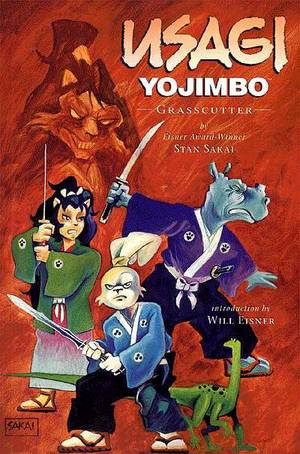
Usagi Yojimbo: Grasscutter

Usagi Yojimbo continues its trail of one rabbit samurai wandering the countryside as a ronin who keeps a circle of friends close while the world about him continues to come together in ways that are not always seen by the main character, but that the audience sees as ties that bind.

Below I'll be discussing some of the bits from Grasscutter, previewed here, the twelfth volume graphic novel collection of Usagi Yojimbo published by Dark Horse comics. Spoilers will follow so beware!

Mythology: Either Stan does a fantastic job of researching the history of Japan and presenting it to the reader or he does it in such a way that it's fun to read and doesn't negatively impact the story. In many cultures, there are magical weapons but too often the origin or founding point of these weapons are left to the readers imagination. There's nothing wrong with that. Was the infamous sword Blackrazor better before it gained excessive background or worse? Readers will be divided on that issue. Here, we are introduced to Grasscutter through both myth and historical events as to how it was lost to Usagi's Japan.

Nemesis: Ah, the dreaded tale of the nemesis. I've hit on this several times but well, here it hits again. Jei, the demonic warrior that Usagi has 'killed' several times prior to this returns in this novel. He showcases his powers against several entities that may have even been kin in their own way to him, but the path Jei walks is one that he walks unopposed. This can be an important thing to showcase with the villains in your setting.

In some setting such as the Forgotten Realms, there are so many high level villain and heroic organizations that it's often difficult to imagine the setting not resembling Gamma World more than a pseudo fantasy setting but those organizations dont' tend to ally with each other and even with 'good', may have their own ideas on how certain things, like artifacts and knowledge, should be shared, putting them at odds with one another. Have the party stumble upon a group of dead orcs and hobgoblins to showcase that just because they all hate the players, doesn't mean they love each other.

The Villain's Weakness: Most of the time when Jei and Usagi fight, Usagi doesn't do to well and generally is saved either by circumstance or luck. This volume is no different but it showcases a different side of Jei in that he leaves himselve open protecting 'his innocent'. This is essentially a follower of Jei who doesn't understand or care about what Jei is, only that he protected her at a dark period in her life and looks out for her. Usagi doesn't deliberately use her against him, but events conspire to put her in danger and Jei can choose to either end Usagi or save the 'innocent'. He saves the innocent.

Foreshadowing: Stan does this with a saint's patience. While probably not as noticeable in the individual issues that make up the series, the graphic novels allow the reader to see Stan setting up events so that they fall like domino's. Could you guess the events that will happen? Possibly. Do they make sense in the context of the story and keep the story moving forward?

Yes. In this instance, Inazuma, introduced only last volume, is hunted by Gen for the large bounty on her head. the two fight, Gen barely escapes with his life but ironically, due to an accident, it's Inazuma that's badly injured and passes out in front of Jei who at the bidding of his follower, leaves Inazuma, suffering from delusions and hallucinations, at a temple to heal. When Jei is 'killed', his spirit finds a new host in Inazuma, whose storyline will come back into play way down the line in volume 24.

Grasscutter: Grasscutter exhibits some interesting bits to it but doesn't shine through as something like Excalibur or Strombringer in terms of raw sword power. Rather, it's something that is a unique cultural artifact that could upset the political power of Japan and send the whole of it into further warfare. The thing is, Usagi is generally a 'good' individual and has no desire for political power. Don't put the gun in the room unless you're ready for the players to use it. I can easily envision a scenario where the players are supposed to pass an object to another individual but hey, when is this opportunity going to come along again? Always be ready for the players to take the path not offered and be ready for the consequences of it.

In my opinion, if you don't want to deal with the players potentially getting their hands on such an object and using it as players instead of as story element, it's better to not put it into the game rather than having some highly unlikely series of events conspire to steal the item from the players.

Friday, December 31, 2010

Usagi Yojimbo: Ghosts and other Supernatural

In Seasons, two of the stores, A Promise in the Snow and The Obakeneko of the Geishu Clan bring forth the supernatural elements to the forefront of the Usagi setting.

In A Promise in the Snow, Usagi is doing his standard wanderings and comes across a merchant that has been attacked and is near the point of dying. From out of nowhere the merchant's daughter comes and collects a promise from Usagi that the wandering ronin will not let her father die.

This is one of the first times I remember going, "She's a ghost."  the tip off is when Usagi tells the father, who is stumbling in and out of consciousness, that the merchant's daughter will lead the way and he replies, "F-fum-chant? But... " Right there, perhaps because I've read so much Usagi recently, I knew it was going to involve the supernatural.

But it makes an interesting turn of things for a role playing perspective. The ghost doesn't do any harm to Usagi. She leads him to safety. She doesn't really help him, but she does guard her father. Too often in fantasy RPGs, the focus on the ghost is fighting the ghost and somehow putting it to rest, ususally doing something that involves further adventure. But what if the ghost has a specific short set mission and doesn't even know it's a ghost? The more subtle elements of the supernatural can be played up on that don't involve direct conflict to give the players a greater appreciation of the beyond.

In the Obakeneko, Usagi, Gen, and Tomoe are invited out of the cold weather only to be attacked by a supernatural entity. The three are victorious of course and latter learn the tale of the owner of the house. the thing I thought interesting, was the illusions of the house as being new and stately. There were little insights that might make one suspect something was wrong, like a lack of servants, but the idea of a stately manor being whole and sound...

When the entity is defeated, the illusion is dropped. This allows the GM to prsent a magnificent encounter local that is actually shambles. This can be overused though and the GM should try and keep track of how many times he does it.

Usagi continues to provide both character elements and moments of 'cool' that can easily be swapped for most fantasy role playing based games.

Thursday, December 30, 2010

Usagi Yojimbo Seasons

Usagi Yojimbo Seasons is the last of the Usagi books that I did not own. I managed to snag it from Things From Another World, a web site vendor that actually sold it for less than the cover price at Amazon.com. Interestingly enough, all of the other sellers were selling it for massive amounts over the cover price. My order arrived in two days. Good deal all around.

Seasons has some points in it I'd consider weak. The use and reuse of certain elements, especially in fields of the supernatural, comes across a little too obvious. Good stuff for those who've never read the material before.

Before I ramble on too much, let's see what's inside eh?

The Withered Field: Stan does a fantastic job of introducing new characters. Here we are meet with Nakamura Koji. He is a master of the sword and a wanderer like Usagi himself. He was once a man who would teach the art of the sword but was soundly bested and went on the road to improve his skills. He's an important character for a few reasons.

One, he actually beats Usagi in a duel. While it's not cool to continuously shove the players face into the dirt, it doesn't hurt to remind them that there are still giants in the earth and that their power, as great as it is, may have equals or superiors out there.

Two, its a set up for a latter duel with Usagi's mentor. This doesn't happen until volume seventeen. Stan is able to build up different expectations in the in-between sequences and does a lot to promote things between Nakamura, Usagi, and Katsuichi.

Three, it gives the GM a chance to make Usagi look cool. You see, while Nakamura is out challenging schools, those schools don't like it necessarily and send out students to kill him. These are effectively minions and Usagi and Nakamura cut through them like butter. This allows the player to still showcase how powerful they are.

Four, it serves as a showcase of something beyond alignments. Nakamura accepted Usagi's help in a fight and then challenges him to a duel. What's up with that? It's Nakamura's motivation you see. He's not concerned necessarily with the good or evil of an action. He's concerned with being the best swordsman he can be. That motivation in and of itself is one that's used time and time again. Even with the manga character Guts from Berserk, before his battle against the supernatural, his main motivation was to become a great swordsman. Hell, it's the motivation of most players I know, to be the best in their field.

But are they really striving to be the best? Are they willing to give up creature comforts? To challenge friends? To issue challenges against anyone, regardless of their social status and ability? To take it on the road so to speak?

There are other bits of Seasons I'll get back to, but the idea of being the best, of having the motivation to throw away a past live, it strikes a powerful chord and is another useful thing to discuss with players. What is your motivation and what are you willing to do for it?

Tuesday, December 28, 2010

Usagi Yojimbo: The Brink of Life and Death

Let me hit some of the points here:

Kaiso: Usagi encounters a village of seaweed farmers but there is something odd going on with the other nearby village. Here Usagi is able, as an outside, to see where the true conflict lies. In addition, the author, Stan, is once again able to take something that seems small, seaweed farming, and make a story out of it. Not only that, but he does so in a way that's informative without being boring. If you can bring your setting to life in little ways like this, you're doing it right. Then again, it helps if the players are like Usagi and are willing to learn and explore the world about them.

A Meeting of Strangers: Usagi is always meeting 'the most interesting people' so to speak. In this case, he meets a woman swordmaster who showcases her skills by killing several bounty hunters. During that time though, a 'snitch' spots her and Usagi, who has made his own share of enemies. The stranger comes through and even saves Usagi's life. Intorducing NPCs into the game that the players want to learn more about can be tricky in that you don't want them to outshine the players in their fields but at the same time, if those NPCs don't stick around, they can make the players want to learn more about them.

Black Soul: Jei makes another apperance here. This would be considered an 'interlude' in some novels or comics in that it doesn't touch the main body of the story but at the same time, Jei has a huge role to play in upcoming events and by giving Jei his own 'sidekick', the author makes him more than just a mad killing machine. By giving the players a glimpse into what else is going on in the setting, the GM can set up anticipation for future encounters and events.

Noodles: This one has several factors going for it. A meeting with an old friend, a corrupt police officer who gets the wrong man for the wrong reason but that man is still a criminal. The use of irony in man-man karma and other bits. This is writing work at its strong points. Stan is able to weave continuity together with new elements and make the reader want to know what happens next. By having the problem be theft and having Usagi meet his old friend, the thief Kitsune, the reader automatically assumes that the rash of thef is caused by here.

Further reading however, shows that it's the corrupt official who winds up using Kitsune's accomplace, Noodles, as the fall guy. By doing this, the author switches the expectations around and sets up the officer for his own Karma based fall. Truly Stan must be a fan of such series as My Name is Earl.

Wrath of the Tangled Skein brings more of the supernatural to the forefront. Usagi fights a nue, a monster with the head of a monkey, a bager's body, tiger's legs, and a snake for a taile. Now mind you, the thing is about as big as a horse, not a badger. Usagi also battles a tanuki, a raccoon-like dog that is a shape changer trickster. These two monsters alone provide a suitible encounter with the nue acting as a 'brute' and the tanuki acting as a controler of sorts.

Usagi also meets Sanshobo, a priest that was a former warrior. Another character that will come to be more important as the series progresses. Despite being a former warrior however, Sanshobo doesn't cross over with Usagi's skill set in terms of swordskill or motivation. He's a priest that tends to specialize in fighting off possession.

Bats, The Cat, and the Rabbit brings more ninja warfare to Usagi. He meets another ally and fights against the bat ninja. It's another instance of trouble running into Usagi. It's important for me to keep these events in my mind because they are effectively random encounters that go beyond the single encounter. The chance meeting is the start of the actual adventure as opposed to just a onetime battle.

The Chrysanthemum Pass showcases Usagi as the do-gooder again. He happens to meet an older individual who is a disguised assassin. The use of disguise here is solid in that it allows the assassin to get in close to its target. The use of the mole ninjas however, allows the surprise to take a more dangerous form. These can make good encounter elements where the party is lead to an ambush point by what they take to be a friendly face only to find out that it is not.

Lightning Strikes Twice is the last story here and brings Usagi face to face with the female swordswoman who we learn calls herself Inazuma or lightning flash, for her speed with the blade. She is telling her tale almost as a warning to Usagi and her backstory, of being hunted for murdering a crime boss's son, comes into play as she continues to fight off disguised assassins and bounty hunters as well as where he travelling takes her.

Stan is able to use his visual style and storytelling skills to bring the setting to life. He is able to put Usagi against enemies that take a wide variety and prevent the sword scenes from being boring.  Stan brings forth new characters and uses older ones to keep the action moving forward. By expanding the setting, Stan keeps Usagi from becoming stale and keeps the setting fresh. When you think you're out of ideas, look at something mundane and ordinary and bring some opposition to it.

Monday, December 27, 2010

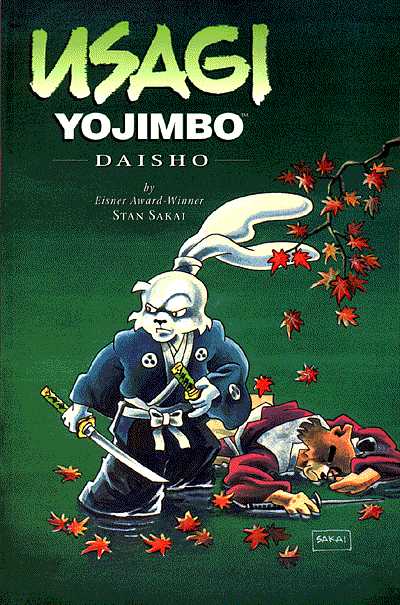
Usagi Yojimbo: Daisho

Usagi Yojimbo continues to make his presence known with this, the next reprint of the sold out volume nine.

For gaming purposes, let me consider the following:

1. Random Encounters that aren't hostile. While its always a good thing to keep the wandering random encounters packed to the gills with the dreaded and dangerous, sometimes you want to feed the players some of the setting and give them some more connection to the setting.

Here, Usagi meets a Komuso "monk of emptiness" that wears a tengai, a woven basket over his head and plays a shakuhachi, bamboo flute. The meeting between the two goes well and the reader is rewarded with a real feel for the character, caste, and style of the komuso.

2. If there is no body... I've mentioned it before, but Stan, the author of Usagi, is notorious in that if there is no body, the villain will be back. Here, one of the members of the 'Shi' group from the previous collection who was buried alive, makes his return. When the players overcome their foes, is there a way that would make it more entertaining for the game if that  villain's death wasn't so obvious and there was a chance of him coming back? If so, take it. If it'll feel like a cheap shortcut, ignore it.

3. Travel is tough. When the players are out and about, remind them of the simple pleasures of the towns. Things like being in an enclosed space, having people around, having water, heat, and a variety of food. Every time that Usagi comes to a town, even if its small and nameless, he's greatful because it means a chance to sleep inside on a bed.

4. Karma. Stan is a master of using karma to settle the score even when the Samurai rabbit isn't able to do so. These examples range from bully swordsmen making the mistake of challenging Usagi directly, to brothers backstabbing each other to make a gold claim. If you run a campaign and want the palyers to follow a certain style of gaming with a gentle hand, showcasing what happens to others in the setting can be a clear example of how the setting works moreso than just having a wandering paladin kill the drow assassin.

5. Slavery and Theft: I'll admit, that some things are easier to read about then to implement in a game. For example, making the players slaves. Usagi in his wanderings suffers the loss of his blades and his freedom from time to time but players, in my experience, generally don't take such loss well. Part of this might be the increasing complexity of game systems where everything from statistics and background abilities are designed to mesh into magic items and feats but part of it may just be the lack of freedom in a game about doing what you want. When using either slavery or outright theft, try to gauage how the players will handle it and if necessary use outside elements to end them if it goes against the grain of the group.

6. Not Everything Is As It Seems: Usagi gets to meet Stray Dog, another Ronin and another bounty hunter like his friend Gen. Stray Dog seems even more of an outlaw and rogue than Gen but when you look past that and see where he goes after the fighting is done, he doesnt' spend his winnings on himself, but rather on an orphanage. Something that may come along later to haunt the Stray Dog but in the meanwhile it acts as contrast to his stone cold killer bounty hunter persona.

7. Social Status: The society that Usagi comes from is very rigid in some of its aspects. Samurai are not peasants but that doesn't necessarily make them royalty. In today's politically correct world where everyone can be anything, the idea of social mobility is fairly ingrained despite the realities that most often people don't switch social classes. When allowing players to design their characters, see where their coming from, what they're trying to do.

There is no point in making a half-orc female paladin that strives against the social order and against stigma associated with half orcs, women, or half orc women being knights if none of those things are an issue. It doesn't mean mechanically the idea is unsound, but if the role playing reasons for selecting a certain combination don't apply, either have the character come from a reigion where they did apply or inform the player of the campaign's freedoms which ironically act as another type of character restriction.

Sunday, December 26, 2010

Usagi Yojimbo: Shades of Death

The samurai rabbit has gone through some interesting times not only in his series, but in his publishing history. These stories collected by Dark Horse, originally appeared by another publisher which is a different publisher than the first seven volumes.

Regardless though, I'm here to touch on some of the story telling techniques that I try to remind myself of here.

1. Bring the conflict to the characters. Usagi and Gen are walking down the road and bam! Attacked by dreaded ninajs and they have to figure out what's going on.

2. Don't be afraid to use the popular stuff. It's popular for a reason. During this time period, Usagi teams up with the Teenage Mutant Ninja Turtles. It's something that's happend a few times and I believe even happened on the carton. The point though for a game? If the players love to hate drow, use them. If they love to hate the undead, use them. Find out what the players want to see in the game and bring it out.

3. Throw the history or feel of the setting into the small things. One of the short stories is about Jizo, a road side statue that has its own history and feel to it. In the brief pages that the author gives it, you get the geist of what the purpose is for but the author also provides you with some notes at the end of the book in case you want more information. Bringing details to the players through third parties is an old stand by, but don't be afraid to give a specific player information and ask them to share it. This lessens the load on the GM and allows the other players to take part of the world building activity.

4. Make the Villains Cool. Usagi fights a group of four named Shi that spell their name with the death character. They come off as very bad ass with unique styles and attitudes but Usagi being the star here, kills them in variosu ways.  The more powerful, legendary, and overall awesome your monsters and villains are, the greater the heroes the players are when they overcome them.

Shades of Death has some flash back sequences and some other bits, such as the use of the language to illustrate the setting, but overall, the above four things are what I'll be thinking of when trying to crib notes from how and why Usagi Yojimbo has worked for decades.

Saturday, October 23, 2010

The Last Ino Story

When you're running a campaign, sometimes an NPC doesn't fit into the overall plot you had. Sometimes an NPC is poorly conceived. Sometimes you give the NPC a goal that, hey, he acheives.

On the other hand, sometimes you have a player who had a memorable character, but the player had to drop out of the campaign or wanted to play something else.

What happens to those old characters?

While on the road, Usagi and Gen are haunted by a premonition of death in the form of an owl. The owl almost seems to have a keen intellict and a mocking nature that upsets Gen. It haunts them through the whole story. In some ways, the owl is a character in and of itself. The idea of superstion is highly in use here and it's a common theme for Usagi, and indeed for 'primitive' socieities that want to provide their own structure and order to the unknown.

The owl's vision of death comes true when Usagi and Gen, on a narrow ledge, are set upon by bandits with bows. Clever shots, the duo are forced ohit directly under them and climb up hoping not to fall to their deaths. The use of the environment an enemy is clear here. A few skill checks or dramatic naration would do the job.

After Usagi and Gen make quick work of the bandits, they get drenched and seek shelter from an abandoned building. When they get to the building, a character familiar to readers, but not to Usagi and Gen is there trying to kill the duo ronin. They quickly disarm her and learn that their old comrade Ino is here, injured to the point of death by the bandits, a deep arrow wound that's infected.

The duo go through several stages in helping Ino, with Gen chasing and trying to fight off the owl and its vision of death.

While Ino lives, he doesn't know why the duo saved him and the owl? It meets a gruseome end of it's own completing it's vision of death.

Giving the players some closure on an old character or a character that they know of can provide some glimpses to how the rest of the setting works when not in use by the players. At the same time, at least in this case, by not simply killing off Ino, Stan is able to go back to the character if the need ever arises. This gives him the best of both worlds.

Try to give the NPCs a good send off, even in retirement. Make it something that the players talk about after the game session.

Friday, October 22, 2010

Return of Kitsune

One of the things Stan is able to do with his characters that brings me back to the reading, is not only to have Usagi meet a wide cast, but also how those Usagi meets also, usually at least, get to meet that cast and how different their reactions are to those individuals.

For example, when Gen meets Kitsune, he is taken with her beauty. Of course latter on he discovers that she's a thief and pick pocket and has suffered her skills he's a little annoyed at fellow Ronin Usagi who uses Gen's own words about being a busy body as to why Usagi didn't warn Gen.

But more than that, Kitsune, as a thief, has a habbit of stealing the 'wrong' thing which leads to many individuals coming after her, requiring her to need her own protection. In this case, Gen and Usagi provide ample protection.

This is easy to do in a RPG as well. If the players know some street urchins or if there is a thief in the group, having them rob the wrong person at the right time can lead the party into all sorts of trouble.

In this case, Kitsune steals a letter that promises war and oil shortages. An oil merchant is trying to corner the market and has no problem killing a thief and a few grubby ronin to do it.

That in and of itself might be enough to satisfy the needs of a game, but Stan goes one further. Seems the initial note is a fraud set up by the oil merchant's rival in order to trick that rival merchant into purchase his own oil supplies at a premium price. These little touches showcase how a 'living' campaign isn't necessarily about all of the exact things going on around the players at that very moment, but branch off and touch different 'departments' of the setting.

Other little touches Stan does, like Usagi polishing his sword, are part of the repetition of the things Samurai do that aren't straight out combat, even if it involves combat. Little touches go a long way in making the atmosphere of the campaign something that the players can not only follow along, but participate in. They may do this in degrees, for example, one warrior may not bother to clean his weapon, hoping that it infects others with disease, even as his fellows long down on him for the poor care he keeps it in. Another may always be forgetting about it and be embarrassed when he does remember to do so. Little character traits don't necessarily have to overwhelm the game but can easily add depth.

Thursday, October 21, 2010

Gen's Story

One of the things I've mentioned before, is that in the Usagi setting, everyone has a backstory. We might not always get to see it but that backstory helps expalin who the characters are and what their motivations originate from.

Here, Usagi meets an old woman and her single retainer asking for a meal. Usagi obligies, recognizing the noble spirit in Lady Asano. Turns out that the Lady's house was betrayed and they have spent all of their money and time looking for the traitor.

Gen's father? A famous general who also sought out the traitor, even though it meant his family had to live like destitute beggars and the mother had to perform acts that perhaps bordered on prostituion although full details are never given.

In this light, Gen's character and shape come into sharp contrast. Events of the past, such as his reluctance to help the poor children or his self serving attitude, those come into a more reasaonable being.

But Gen is not a one dimensional character. When Usagi is in trouble, Gen helps him. When the chips are down, Gen is there for him. In some ways, Gen is even fooling himself. "Well, he does have all the money." It's important that characters in a campaign, even if they are not all friends, even if they don't all have the same motivations and the same purpose in adventuring, are all loyal to one another. It just makes the game run smoother. If the players have to come up for reasons why they'd help each other, like Gen, they need to fake it.

I know there are some games that thrive on inter party conflict or at least the promise of it, but in most standard games, especially those not necessarily design for 'clan' politics, it's best to keep all the players loyalties above the surface unless one is deliberately running a deeper game of espionage where trust itself is a treasure well worth having.

Bringing in Gen's background is a sort of 'round robin' technique that GMs can incorporate into their own games. If the players provide some background elements at the start of the game, and the GM isn't necessarily running adventurers out of modules (nothing wrong with that in my own opinion), he can use a round robin method of having someone's background crop up every other game or so to keep the character's past in the now and to use different characters to move the characters against different elements.

In terms of GM tricks though, Stan pulls out a great one. When Gen and Usagi are captured by the tratior to the house, Gen rummages through the weapon storage and grabs some new weapons. He even notes that he was never as attached to his weapons as Usagi is to his own specialty blades. After the fighting is all said and done, Gen notices that the swords are those of his father, the famous general, and takes a moment to reflect how they must have come into the traitor's hands.

Providing characters in a game with legacy items, not necessarily those of power, but those that have a connection to them, is a way to establish a powerful bond between the campaign history and the player's place in it.